INTRODUCTION.—The events recorded in this lesson took place about thirty days after the giving of the law, as recorded in Lesson 11. In this brief space of time the Israelites had so far forgotten that no impression remained upon their minds either of the miracles wrought by him in their behalf or of the terrors of the voice of God from Mt. Sinai, and they were ready to undo all that God had done, by retracing their steps to Egypt. The lesson considers some of the initial steps which were taken toward carrying out this purpose.
Questions, with Scripture Texts, Notes, and Comments.
1. After the covenant between God and Israel had been ratified, what did the Lord say to Moses?
“And the Lord said unto Moses, Come up to me into the mount, and be there: and I will give thee tables of stone, and a law, and commandments which I have written; that thou mayest teach them.” Ex. 24:12.
2. What covered the mount, and what was its appearance?
“And Moses went up into the mount, and a cloud covered the mount. And the glory of the Lord abode upon mount Sinai, and the cloud covered it six days: and the seventh day he called unto Moses out of the midst of the cloud. And the sight of the glory of the Lord was like devouring fire on the top of the mount in the eyes of the children of Israel.” Verses 15–17.
3. How long was Moses in the mount?
“And Moses went into the midst of the cloud, and gat him up into the mount: and Moses was in the mount forty days and forty nights.” Verse 18.
While the full purpose of God in causing Moses to remain so long in Mt. Sinai can only be conjectured, it seems evident that he designed by this to test the Israelites on the point of their steadfastness in their allegiance to him when not especially impelled thereto by any outside influences.
4. Did he eat or drink during that time?
“When I was gone up into the mount to receive the tables of stone, even the tables of the covenant which the Lord made with you, then I abode in the mount forty days and forty nights; I neither did eat bread nor drink water.” Deut. 9:9.
5. When the Lord had finished talking with Moses, what did he give him?
“And he gave unto Moses, when he had made an end of communing with him upon mount Sinai, two tables of testimony, tables of stone, written with the finger of God.” Ex. 31:18.
6. What was on these tables of stone?
“And the Lord delivered unto me two tables of stone written with the finger of God; and on them was written according to all the words which the Lord spake with you in the mount, out of the midst of the fire, in the day of the assembly.” Deut. 9:10.
7. Whose workmanship were the tables? and how were they filled?
“And Moses turned, and went down from the mount, and the two tables of the testimony were in his hand: the tables were written on both their sides; on the one side and on the other were they written. And the tables were the work of God, and the writing was the writing of God, graven upon the tables.” Ex. 32:15, 16.
8. What did the people say and do when they saw how long Moses was gone?
“And when the people saw that Moses delayed to come down out of the mount, the people gathered themselves together unto Aaron, and said unto him, Up, make us gods, which shall go before us; for as for this Moses, the man that brought us up out of the land of Egypt, we wot not what is become of him. And Aaron said unto them, Break off the golden ear-rings, which are in the ears of your wives, of your sons, and of your daughters, and bring them unto me. And all the people brake off the golden ear-rings which were in their ears, and brought them unto Aaron.” Verses 1–3.
This could have been nothing more than affectation on the part of the Israelites, since they knew that Moses had gone up into Mt. Sinai to commune with God, and must therefore be safe beyond the possibility of any accident. The words, “We wot not what is become of him,” imply that they cared as little what had become of him as they affected to know.
9. What did Aaron do with the gold?
“And he received them at their hand, and fashioned it with a graving tool, after he had made it a molten calf.” Verse 4, first part.
10. What did they call this golden calf?
“And they said, These be thy gods, O Israel, which brought thee up out of the land of Egypt.” Verse 4, last part.
“We are not to suppose that a people who only six weeks before had witnessed such amazing demonstrations of the existence and glory of the true God, had suddenly sunk to such a pitch of mad infatuation and brutish stupidity as to imagine that human fabrication could ‘make a god that should go before them’! Their meaning was that an image, a visible sign, or symbol, of Jehovah should be made, something which should answer to them in place of the Shekinah which had hitherto conducted them in the pillar of cloud. This visible symbol, which they had hitherto enjoyed, and which had now become apparently immovable on the summit of the mount, is frequently denominated ‘glory,’ or ‘glory of the Lord,’ and as they proposed to form to themselves so vile a substitute for this as a brute animal, therefore it is that the psalmist calls it a changing of their glory into the likeness ‘of an ox that eateth grass.’”—Bush.
11. What does the psalmist say of this?
“They made a calf in Horeb, and worshiped the molten image. Thus they changed their glory into the similitude of an ox that eateth grass.” Ps. 106:19, 20.
12. Before they could do this, what did they forget?
“They forgat God their Saviour, which had done great things in Egypt; wondrous works in the land of Ham, and terrible things by the Red Sea.” Verses 21, 22.
13. How did they worship this image?
“And they rose up early on the morrow, and offered burnt-offerings, and brought peace-offerings; and the people sat down to eat and to drink, and rose up to play.” Ex. 32:6.
14. What must we conclude as to the nature of this “play”?
As to the nature of sun-worship, it will perhaps be sufficient to quote what the “Encyclopædia Britannica” says of Baal:—
“The Baal of the Syrians, Phœnicians, and heathen Hebrews is a much less elevated conception than the Babylonian Bel. He is properly the sun-god Baal-Shaem, Baal (lord) of the heavens, the highest of the heavenly bodies, but still a mere power of nature, born, like the other luminaries, from the primitive chaos. As the sun-god, he is conceived as the male principle of life and reproduction in nature, and thus in some forms of his worship is the patron of the grossest sensuality, and even of systematic prostitution. An example of this is found in the worship of Baal-Peor (Numbers 25), and in general in the Canaanitish high places, where Baal, the male principle, was worshiped in association with the unchaste goddess Ashera, the female principle of nature.”
This is a mild statement of the case; and so when we read of the Israelites that, “the people sat down to eat and to drink, and rose up to play” (Ex. 32:6), and learn that the word rendered “play” is the same as that rendered “mock” in Gen. 39:14, 17, we get a better idea of the heinousness of the sin of the Israelites.
15. How did the people happen to make a calf to worship instead of the image of a man? See note under question 17.
16. What was the Egyptian calf-worship? Ans.—Sun-worship. (See note below.)
17. How extensive was sun-worship anciently? and what was the nature of it?
In an article entitled, “Sun Images and the Sun of Righteousness,” in the Old Testament Student, January, 1886, Dr. Talbot W. Chambers calls sun-worship “the oldest, the most wide-spread, and the most enduring of all the forms of idolatry known to man.” And again: “The universality of this form of idolatry is something remarkable. It seems to have prevailed everywhere.” “In Egypt the sun was the kernel of the State religion. In various forms he stood at the head of each hierarchy. At Memphis he was worshiped as Ptah, at Heliopolis as Tum, at Thebes as Amun Ra. Personified by Osiris, he became the foundation of the Egyptian metempsychosis.”
In “Religions of the Ancient World,” p. 21, Prof. George Rawlinson says: “No part of the Egyptian religion was so much developed and so multiplex as their sun-worship. Besides Ra and Osiris, there were at least six other deities who had a distinctly solar character.”
Concerning Osiris, the “Encyclopædia Britannica” (art. Egypt) says:—
“Abydos was the great seat of the worship of Osiris, which spread all over Egypt, establishing itself in a remarkable manner at Memphis. All the mysteries of the Egyptians, and their whole doctrine of the future state, attach themselves to this worship. Osiris was identified with the sun. . . . Sun-worship was the primitive form of the Egyptian religion, perhaps even pre-Egyptian.”
But while Osiris was the Egyptian sun-god, or the chief representation of the sun, he was chiefly represented by a sacred bull, called Apis. On this the “Encyclopædia Britannica” (art. Apis) says:—
“According to the Greek writers, Apis was the image of Osiris, and worshiped because Osiris was supposed to have passed into a bull, and to have been soon after174manifested by a succession of these animals. The hieroglyphic inscriptions identify the Apis with Osiris, adorned with horns or the head of a bull, and unite the two names, as Hapi-Osor, or Apis Osiris. According to this view, the Apis was the incarnation of Osiris manifested in the shape of a bull.”
From these quotations it is easy to see why the Israelites made a golden calf, instead of an image of something else. They made the god and began the form of worship with which they had been most familiar in Egypt. And when they did this, they were simply engaging in sun-worship, the form of idolatry which in all ages has been the most universal rival of the worship of Jehovah.
18. What did God think to do to the Israelites for their abominable idolatry?
“And the Lord said unto Moses, I have seen this people, and, behold, it is a stiff-necked people: now therefore let me alone, that my wrath may wax hot against them, and that I may consume them: and I will make of thee a great nation.” Ex. 32:9, 10.
“And the Lord was very angry with Aaron to have destroyed him: and I prayed for Aaron also the same time.” Deut. 9:20.
19. With what words did Moses plead for them?
“And Moses besought the Lord his God, and said, Lord, why doth thy wrath wax hot against thy people, which thou hast brought forth out of the land of Egypt with great power, and with a mighty hand? Wherefore should the Egyptians speak, and say, For mischief did he bring them out, to slay them in the mountains, and to consume them from the face of the earth? Turn from thy fierce wrath, and repent of this evil against thy people. Remember Abraham, Isaac, and Israel, thy servants, to whom thou swarest by thine own self, and saidst unto them, I will multiply your seed as the stars of heaven, and all this land that I have spoken of will I give unto your seed, and they shall inherit it forever.” “And Moses returned unto the Lord, and said, Oh, this people have sinned a great sin, and have made them gods of gold. Yet now, if thou wilt forgive their sin—; and if not, blot me, I pray thee, out of thy book which thou hast written.” Ex. 32:11–13, 31, 32.
20. Did the Lord grant his request?
“And the Lord repented of the evil which he thought to do unto his people.” “And the Lord said unto Moses, Whosoever hath sinned against me, him will I blot out of my book. Therefore now go, lead the people unto the place of which I have spoken unto thee: behold, mine Angel shall go before thee: nevertheless in the day when I visit I will visit their sin upon them.” Verses 14, 33, 34.
21. What immediate punishment did the people receive?
“And it came to pass, as soon as he came nigh unto the camp, that he saw the calf, and the dancing: and Moses’ anger waxed hot, and he cast the tables out of his hands, and brake them beneath the mount. And he took the calf which they had made, and burnt it in the fire, and ground it to powder, and strowed it upon the water, and made the children of Israel drink of it.” “Then Moses stood in the gate of the camp, and said, Who is on the Lord’s side? let him come unto me. And all the sons of Levi gathered themselves together unto him. And he said unto them, Thus saith the Lord God of Israel, Put every man his sword by his side, and go in and out from gate to gate throughout the camp, and slay every man his brother, and every man his companion, and every man his neighbor. And the children of Levi did according to the word of Moses: and there fell of the people that day about three thousand men.” “And the Lord plagued the people, because they made the calf, which Aaron made.” Verses 19, 20, 26–28, 35.
When it is remembered that the Egyptian calf-worship was sun-worship, and that Sunday was “the wild solar holiday of all pagan times” (North British Review, vol. 18, p. 409), and has its name “because the day was anciently dedicated to the sun, or to its worship” (Webster), the Heaven-daring nature of the sin of the Israelites just after they had heard God’s holy law, and especially the first, second, fourth, and seventh commandments, is most strikingly set before us. A more perfect insult to the God who had delivered them from Egyptian bondage, that they might serve him, can hardly be imagined.
One more point should be noted to show how completely, in intent, the Israelites went back to Egyptian bondage, by their worship of the golden calf. A preceding quotation has shown that Ra and Osiris were intimately associated as leading representatives of the sun of Ra. Professor Rawlinson, in “Religions of the Ancient World,” p. 20, says:—
“Ra was the Egyptian sun-god, and was especially worshiped at Heliopolis [city of the sun]. Obelisks, according to some, represented his rays, and were always, or usually, erected in his honor. Heliopolis was certainly one of the places which were thus adorned, for one of the few which still stands erect in Egypt is on the site of that city. The kings for the most part considered Ra their special patron and protector; nay, they went so far as to identify themselves with him, to use his titles as their own, and to adopt his name as the ordinary prefix to their own names and titles. This is believed by many to have been the origin of the word ‘Pharaoh,’ which was, it is thought, the Hebrew rendering of Ph’ Ra—‘the sun.’”
Thus the Israelites not only deliberately sunk themselves in the bondage of sin, but also more fully showed their willingness to return to bondage under Pharaoh, than when they sighed for the leeks and the onions of Egypt. Their deliverance from physical bondage was in order that they might be delivered from spiritual bondage, and was a representation of it; and when they had plunged into sin, they placed themselves in a worse bondage than any physical oppression could ever have been. Being overcome by the idolatry of Egypt, they virtually returned to the bondage of Egypt, “for of whom a man is overcome, of the same is he brought in bondage.” 2 Peter 2:19.
CANVASSING IN KENTUCKY.
A LADY writes: “I have been quite successful since I began in the work. I have now been out about three weeks, and have already sold about $170 worth of “Bible Readings for the Home Circle.” I do not know that I am doing as well as other agents, but I am selling to those who know me, and know that I am an Adventist. I am surprised. In fact, I once thought there would be no use of my attempting to canvass this place. To the God of love be all the praise. I ask an interest in your prayers.”
CANVASSING IN LOUISIANA.
By A. F. Harrison
PERHAPS some would like to hear how the little company of canvassers sent to this State by the General Conference at its last meeting are succeeding.
We arrived at Shreveport Dec. 8, and began work promptly the following Monday. Since that time our company has steadily increased, until we now number eight workers. All are of good courage, and doing well. We have delivered 400 “Marvel of Nations” and 25 “Bible Readings for the Home Circle,” and have obtained 165 regular subscriptions for the Sentinel. We also have orders for 203 “Bible Readings,” and 262 for “Marvel of Nations.” The country, so far, seems to be a better field of labor than the city. One worker in three days in the country took orders for $137 worth of books; another last week in four days took orders for $144 worth.
We have the privilege of seeing some fruit of our labor. A colored brother who is a licentiate of the Baptist Church, has begun to keep the Sabbath. He is now working in the cotton-seed oil-press in this city. He will present his case to the foreman next Friday, and it remains to be seen what the result will be; but he expects to lose his position. One colored minister has preached a sermon against National Reform. Others are inquiring, “What shall we do?” O, may the Lord send us more laborers, for the harvest indeed is ripe, and the laborers few. A. F. HARRISON, Leader.
The Purpose of the Heart Accepted by God
By Joseph Parker
—Not the work of the hand, which may be imperfect, but the purpose of the heart, is recognized and accepted by the loving God.—Joseph Parker.
OHIO WORKERS, TAKE NOTICE!
By L. T. Dysert
The State depository of the Ohio T. and M. Society will be removed at once from 440 Floyd St., Toledo, to 1103 Case Ave., Cleveland, Ohio. This will be my address. L. T. DYSERT.
News of the Week.
FOR WEEK ENDING MARCH 9, 1889.
DOMESTIC.
—The Minnesota House Thursday, by a vote of fifty-nine to thirty-nine, refused to submit to the people a prohibitory amendment.
—A committee of the Rhode Island House of Representatives, on Tuesday, reported in favor of repealing the prohibitory amendment.
—Captain John Ericsson, the famous engineer who designed the iron-clad “Monitor,” died at New York early Friday morning, aged eighty-six years.
—It is reported from Livingston, Neb., that the remains of a prehistoric monster have been found fifty-four feet below the surface, by a well-digger.
—A new railroad is to be built from Beloit, Kan., to the Gulf of Mexico, running through the territory of Oklahoma. It will be known as the Hutchinson, Oklahoma, and Gulf Road.
—Settlers at Springfield, a small town in Colorado, who have been for a year troubled by the depredations of “rustlers,” on Friday night captured three of the gang, and hung them.
—The Metropolitan street-car stables at Kansas City, Mo., were destroyed by fire Wednesday. Sixty-eight mules were burned to death, and 120 tons of hay were consumed. The loss is estimated at $50,000.
—Nearly twenty dogs, showing symptoms of hydrophobia, at Terre Haute, Ind., have been shot in the last few days. The mayor has issued a proclamation to the effect that all unmuzzled dogs must be killed.
—While workmen were engaged in tearing down the building in which the cyclorama of the Battle of Gettysburg had been exhibited at Cincinnati, Ohio, Friday, the roof fell in, burying three men in the ruins.
—While shooting off an old cannon at Golconda, Ill., Monday night, in honor of President Harrison’s inauguration, William Hanna was blown to pieces, and James Johnson was fatally injured by the explosion of the cannon.
—A resolution was adopted in the Michigan House, Thursday, providing for a special committee of three to investigate the cause of the death of two inmates of the Pontiac Insane Asylum, and the charges of cruelty against the keepers.
—Although between 200 and 300 mad dogs have been killed in Wetzel County, West Virginia, during the past month, the interior of the county is still reported as being overrun with rabid canines. Farmers consider it dangerous to go unarmed.
—The Reading Iron Works, of Reading, Pa., which operated blast furnaces, forges, and machine-shops, and rolling, sheet, tube and pipe mills, suspended payments, Tuesday, with liabilities of about $1,000,000. The concern employed over 2,500 hands.
—Earthquake shocks were felt Friday evening in parts of Pennsylvania, Maryland, and Delaware. In some places a rumbling noise accompanied the disturbance, and women are reported to have rushed, shrieking, from their homes. Crockery and windows were rattled violently, but no damage was done.
—The Rev. Daniel Dorchester is authority for the assertion that a distillery firm within three miles of the Massachusetts State House has a contract to furnish 3,000 gallons of rum daily to the African trade for the next seven years. The amount of rum exported from Boston to Africa in the last six years has been 4,138,284 gallons.
—Great excitement prevails in California and other sections of the West over the report of gold-fields of fabulous richness in Lower California. The report appears to be true, and thousands of miners are flocking to the place from all sides, Mexican as well as American. It is said that ordinary miners at the new diggings make from five to twenty dollars per day.
—On Monday, at one o’clock, President-elect Harrison, standing in the usual place of inauguration in the rotunda of the Capitol, and in the midst of the usual inauguration-day rain, took the oath of office as President of the United States, and read to the vast multitudes assembled his inaugural address. The new presidential cabinet is as follows: Secretary of State, James G. Blaine, of Maine; Secretary of the Treasury, William Windom, of Minnesota; Secretary of War, Redfield Proctor, of Vermont; Secretary of the Navy, Benjamin F. Tracy, of New York; Secretary of the Interior, John W. Noble, of Missouri; Postmaster-General, John Wanamaker, of Pennsylvania; Secretary of Agriculture, Jeremiah Rusk, of Wisconsin; Attorney-General, W. H. H. Miller, of Indiana.
FOREIGN.
—Chili has prohibited Chinese immigration.
—The new French Cabinet is received with disfavor by the Paris press.
—A bill for the extradition of “boodlers” is to be introduced into the Dominion Parliament.
—It is stated that in the Dominion of Canada only 135 divorces have been granted during the past twenty-one years.
—Avalanches have destroyed the village of Nivollet, and killed four persons and injured many others in St. Michel, Savoy.
—It is announced that the discovery has been made in Peru that the juice, or sap, of peuca or maguey leaves will cure hydrophobia.
—The Haytien insurrection is ended. So at least says President Legitime, who has demanded recognition of his Government from the powers of Europe.
—The war in Central and Northern Africa still goes on. A dispatch from Suakim dated March 7, says, “It is reported that the Abyssinians are besieging Kassala, and that Senoussis’s army is marching on Khartoum.”
—Agitation for the overthrow of the Brazilian monarchy has become so threatening that the Government has been compelled to prohibit public discussion, and to suppress Republican newspapers. Riots have become frequent, and a number of people have been killed at Rio Janeiro.
—Two thousand five hundred men were discharged from the Panama Canal works at Tavernilla, on Feb. 16. The contractors continue to curtail the work on all the sections. There is a strong military force along the line of the canal to maintain order. The attempt to organize a new Panama Canal Company has failed.
—The Canadian Government will soon adopt a policy of hostility toward immigration. All alien laborers, except British, will be prohibited from coming to Canada, and the funds which the Dominion Government has hitherto granted in aid of immigration, amounting in the aggregate to a quarter of a million sterling, will be withdrawn.
—A sensational dispatch has been received from Breslau, Germany, to the effect that a naval engagement had taken place in Samoan waters between a German frigate, the “Olga,” and an American war-ship, the “Nipsic.” The dispatch states that the captain of the American vessel sent a protest to the German vessel, which was bombarding the helpless Samoans; that the protest being disregarded, the “Nipsic” opened fire, doing considerable damage, to which the “Olga” replied by projecting a torpedo at the American vessel, blowing her up, with all hands. Secretary Blaine and other prominent U. S. officials assert that the rumor is without foundation. The arrival of the next steamer from Samoa is anxiously awaited at San Francisco, where it is due on the 16th.
RELIGIOUS.
—Buddha’s birthday is now a government holiday in Ceylon.
—The German missionaries held captive by the Arabs, were liberated on the 27th ult.
—At Sydney, Australia, the ministers’ union is pressing the police to enforce the law against the sale of newspapers on Sunday.
—Protestant Episcopal churches in Europe are moving in favor of representation in American church councils and a voice in legislation, and desire a bishop.
—The sentiment against the so-called Sunday “sacred concerts” in Newark, N. J., has been so pronounced of late that they have been indefinitely postponed.
—The statutes of the Roman Catholic university to be erected in Washington have been printed in Rome. They are prefixed by a papal brief, in which a warm eulogy is paid to America.
—Rev. Gideon Draper, D. D., speaking of the religious outlook in Germany, says: “It is a significant fact that the young and warlike occupant of the German throne boldly sustains the church and its evangelical agency among the people.”
—Catholic hostility to evangelical work in Austria is growing more intense. The Roman Catholic archbishop has called a council to consider the question, “What means shall the priests employ in the hope of resisting successfully the further progress of the sects, the Free Reformed churches and the Baptists?”
—A great agitation is in progress in Canada between the Protestants and the Jesuits, concerning a grant of $400,000 made to the latter; and the editorials in the Canadian papers are said to be full of “fire and brimstone.”175Fuel has been added to the flames by a resolution introduced in the legislature, asking the queen to use her influence toward restoring to the pope his temporal power.
Obituary Notices.
“Blessed are the dead which die in the Lord from henceforth.”—Rev. 14:13.
“THE ANCHOR HOLDS.”
BY FANNIE BOLTON.
(Battle Creek, Mich.)
A hush had fallen on the house,
The shadows softly drawn,
And one beloved was lying low;
For death was drawing on.
They bent above her tenderly,
With hearts of love and woe,
To catch the last sweet utterance,
And hear her whisper low,
“The anchor holds.”
What anchor’s this? She dreams, perchance,
That she is on the wave,
The stormy voyage is almost o’er,
Alas! she nears the grave.
She sees the billows dashing round
In this last storm of life,
And now, she casts the anchor out,
Rejoicing mid the strife.
“The anchor holds.”
What confidence is in her tone!
What peace is in her face!
She does not meet the storm alone,
She finds a refuge place.
The waves of death, though cold and dread,
Cannot o’erwhelm her soul.
Her faith hath pierced the clouded sky;
She sees the heavenly goal.
“The anchor holds.”
What anchor’s this? ’Tis Christ, the life.
’Tis heaven’s Majesty,
Who passed through all the waves of woe,
And knows their mystery;
Who bore the sins of all the race,
And tasted death for all,
And rose a mighty Conqueror
To ransom from the fall.
“The anchor holds.”
Silent in Christ, the loved one lies,
Sleeping and hid in him;
Her eyes no more shall look on strife,
And tears no more shall dim.
After a moment of repose,
As one who wakes at dawn,
She’ll rise to find immortal joys,
In heaven’s eternal morn.
“The anchor holds.”
Here lay this pillow at her head,
Of flowers, an emblem sweet;
And in their white and purple bloom
Her words of faith repeat.
And all who come to weep may see
God’s signet in the clay;
For peace is written on her brow,
And still her calm lips say,
“The anchor holds.”
’Tis precious dust we lay away;
Angels will guard the spot,
And in the resurrection day
She will not be forgot.
When earth shall reel in fire and hail,
She’ll hear the Archangel’s voice,
And rise to immortality,
And evermore rejoice.
“The anchor holds.”
How blessed is the Christian’s hope!
In life and death to shine.
And e’en the tomb’s not desolate,
But lit with light divine.
No storm can break on any bark,
How wide soe’er the sea,
But faith may cast her anchor out,
And shout triumphantly,
“The anchor holds.”
COMINGS.—Died at Seneca, Wis., Jan. 22, 1889, Charles I. Comings, aged 38 years and 4 months. Bro. Comings embraced the truth in 1885. He was chosen elder of the Mt. Sterling church, which office he faithfully filled during the remainder of his life. His death is a severe blow to the church. Our brother was a great sufferer, having that fatal disease, cancer of the stomach; but in all his sufferings, he could say, “Thy will be done.” Sermon by the writer. ROBERT J. WHITE.
REMER.—Died of diphtheria, in St. Paul, Minn., Jan. 12, 1889, Archie Remer, aged 4 years and 2 months. Just three weeks before, these parents had laid away their youngest child, a babe. Thus the double loss falls upon them as a heavy blow indeed. They are cheered by the hope of meeting their little ones in the resurrection morn. Funeral sermon by Eld. Flaiz, from Jer. 15:16. C. M. SHEPARD.
MULNIX.—Died at Trinidad, Colo., Feb. 15, 1889, from the breaking of an internal abscess, Mrs. Hattie E. Mulnix, in the twenty-ninth year of her age. She was the daughter of brother and sister E. B. and S. Yant. She had not identified herself with the Seventh-day Adventist Church, but was convinced of the truth, and a few weeks before her last sickness, began the observance of the commandments of God, including the seventh-day Sabbath. During the last few days before her death, her sufferings were very great. The remains were brought for burial to Denver, where her parents live. She leaves a husband, father and mother, two brothers, and a large circle of friends to mourn their loss. We have hope that she sleeps in Jesus. Sermon by the writer, assisted by Eld. E. H. Gates. GEO. W. ANGLEBARGER.
LIVINGSTONE.—Died Jan. 27, 1889, at Lincoln, Neb., Bertha L. Livingstone, aged 37 years, 9 months, and 16 days. Sister Livingstone was born at Erie, Penn. She was converted at the age of twenty-two, and united with the Congregational Church, of which she remained a member until 1885. Previous to this date, she had moved to Lincoln, Neb., and during that year some reading-matter, distributed by one of our faithful brethren, fell into her hands, and she began to be interested in the truths of the third angel’s message. She soon after attended a tent-meeting, where she became fully convinced of the S. D. Adventist faith, and united with the church at Lincoln, when organized in 1886, and continued a consistent member until death. She leaves a husband and six children, who deeply feel their loss. Words of comfort were spoken by the writer, from 1 Thess. 5:9, 10. J. A. SKINNER.
RYAN.—Died at his residence near Exeter, Neb., Bro. Parker Ryan, in the forty-ninth year of his age. His illness lasted about ten days, and was of a very severe nature. Bro. Ryan was born in New York, but has lived in several different States and in Canada. He located in Nebraska a number of years ago. His death was one of Christian triumph. His faith in the One whom he had served and loved forsook him not in this trying hour. His last words were those of Paul, “I have fought a good fight.” Bro. Ryan first made a start in the Lord’s service in the U. B. Church, where he served as class leader six years. Ten years ago he accepted the truth. During this time he has led a consistent Christian life, serving, with good acceptance, as elder of the Blue Valley church. In his death his family lose a kind Christian parent and husband, the church a faithful leader, and the neighborhood a beloved and respected citizen. Words of comfort by the writer, from Rev. 22:3. THOS. H. GIBBS.
KEEL.—Died at her father’s residence, in Pueblo, Colo., Jan. 8, 1889, Mrs. Margaret A. Keel, aged thirty-two years. She was taken sick on their ranche twenty miles from Pueblo, and after two weeks was brought to her father’s home, where she died after three weeks of severe illness. She leaves a son four years old, and her husband, who deeply mourns his loss. Maggie Carpenter united with the Christian Church at twenty years of age, at Christian College, Mo., and lived a most exemplary life. In May, 1888, she and her husband attended a course of lectures given by Elds. Gates and Pegg in Pueblo, and accepted the truth. As fast as new light was presented, she received it without hesitancy. Sister Keel enjoyed living for Christ. She died at peace with her God; and all who saw her in her last illness testified she was truly a Christian. She had that blessed hope of immortality through Christ; and at the first resurrection she will come forth, with the saints of all ages. Funeral discourse by Eld. S. R. Bell (Methodist) from 2 Tim. 4:6–8. H. A. WHITTAKER.
Meeting Appointments for Watertown, Mannsville, and Roosevelt
Appointments.
“And he said unto them, Go ye into all the world, and preach the gospel to every creature.”—Mark 16:15.
WATERTOWN, N. Y. March 15–17
Mannsville, “ 19–24
Roosevelt, “ 27–31
The meetings at Mannsville will be held at the Gardner school-house each evening, and in the church at Mannsville Sabbath and Sunday, at 10:30 A. M. At Roosevelt the meetings will be held each day at 10:30, and in the evening, if thought advisable. The district quarterly meeting will be held at Roosevelt at the above date. Eld. S. H. Lane will be with me.
M. H. BROWN.
PROVIDENCE permitting, there will be a quarterly meeting at Milton Junction, Wis., beginning Sabbath, April 13, and holding over Sunday. We urgently invite all the Sabbath-keepers from Oakland, Monroe, Little Prairie, Bank Woods, and Darlington, and all the scattered ones who can possibly do so, to attend this meeting. It will be a very important meeting, in this momentous time of approaching trouble. We hope all who want a refreshing from the Lord will come. We expect Bro. O. A. and H. Johnson to help in this meeting.
I. SANBORN.
A SABBATH-SCHOOL institute is to be held at Ligonier, Ind., March 21–25. A special meeting will be held Thursday evening. All interested in the Sabbath-school and canvassing work should attend. Let all make a special effort to be present at the beginning of the meeting and remain to the close. We have good help promised Bro. J. E. White will be with us; also Eld. N. W. Kauble, from Battle Creek College, and Eld. J. S. Shrock, from Pennsylvania. Bro. Craig, the State agent, is also expected.
JOEL YEAGER, Pres. Ind. S. S. Ass’n.
Travelers' Guide.
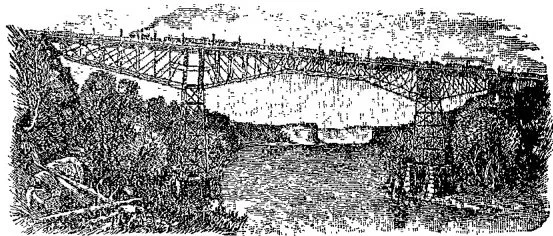
MICHIGAN CENTRAL NEW CANTILEVER BRIDGE, NIAGARA FALLS.
MICHIGAN CENTRAL
“The Niagara Falls Route.”
EAST. — STATIONS.
Mail.
Day Express.
N. Y. Express.
Atlantic Express.
Night Express.
Kal. Accom'n
Local Pass'gr.
Chicago
am 5.00
am 9.00
pm 3.10
pm 10.10
pm 9.10
pm 4.40
Michigan City
7.23
11.03
4.54
am 12.23
11.27
6.57
Niles
8.37
pm 12.10
5.49
1.30
am 12.55
8.20
Kalamazoo
10.20
1.40
6.56
3.35
2.27
pm 10.00
pm 5.30
Battle Creek
11.15
2.18
7.33
4.26
3.15
7.05
6.25
Jackson
pm 1.20
4.15
8.48
6.15
4.45
9.35
8.20
Ann Arbor
2.43
5.37
9.41
7.50
6.00
10.40
Detroit
4.10
6.55
10.45
9.20
7.30
11.50
Buffalo
am 3.35
am 6.15
pm 4.55
pm 8.05
Rochester
6.50
9.15
8.00
11.45
Syracuse
9.30
11.36
10.15
am 2.15
New York
pm 7.00
pm 8.50
am 7.20
11.15
Boston
10.00
10.50
9.15
pm 2.50
WEST. — STATIONS.
Mail.
Day Express.
Chicago Express.
Pacific Express.
Evening Express.
Kal. Accom'n
Local Pass'gr.
Boston
am 8.30
pm 3.00
pm 9.15
New York
10.30
6.00
11.30
Syracuse
pm 7.40
am 2.10
am 9.00
Rochester
9.55
4.20
11.10
Buffalo
7.45
6.15
pm 1.50
Detroit
am 7.30
9.10
pm 1.20
pm 3.00
pm 4.00
Ann Arbor
8.50
10.40
2.24
11.35
9.15
Jackson
10.13
11.45
3.27
12.54
10.55
am 6.25
Battle Creek
pm 12.05
pm 1.16
4.38
2.15
12.27
7.55
Kalamazoo
12.50
1.55
5.15
3.07
1.20
pm 9.45
Niles
2.27
3.20
6.27
4.32
3.07
am 4.45
Michigan City
3.48
4.35
7.32
5.43
4.32
6.40
Chicago
6.10
6.40
9.30
7.45
7.00
10.20
O. W. RUGGLES, General Pass. & Ticket Agent, Chicago. O. E. JONES, Ticket Agent, Battle Creek.
CHICAGO AND GRAND TRUNK R. R.
Time Table, in effect Dec. 2, 1888.
GOING WEST. — Thro' Passa.
Mail.
Day Exp.
Pacific Exp.
B. Crk Exp.
Passa.
STATIONS.
Mail.
Lim'd Exp.
Alto Exp.
Sun. Pass.
Pt H'n Pass. — GOING EAST.
Port Huron
Lapeer
Flint
Durand
Lansing
Charlotte
BATTLE CREEK
Vicksburg
Schoolcraft
Cassopolis
South Bend
Haskell's
Valparaiso
Chicago
*Stops only on signal. Where no time is given, train does not stop. Trains run by Central Standard Time. Valparaiso Accommodation, Battle Creek Passenger, Chicago Passenger, Pt. Huron Passenger, and Mail trains, daily except Sunday. Pacific Limited, Day, and Atlantic Expresses, daily. Sunday Passenger, Sunday only.
GEO B. REEVE, Traffic Manager. W. J. SPICER, General Manager.
NOTICE
By S. P. Spaulding
I AM not able to travel around and canvass, but I have a horse and buggy, and I should be pleased to assist in delivering for any company of canvassers this side of Grand Rapids. Any one wishing for such assistance, please address me at Hanover, Jackson Co., Mich. I love the truth, and want some humble part in its closing work. S. P. SPAULDING.