The Youth’s Instructor, Vol. 48, No. 49.

Knowing by Faith

The Youth’s Instructor

Dec 13, 1900

Review and Herald Publishing Company · Battle Creek, Mich. · Dec 13, 1900

Knowing by Faith

Under the snow in the dark and the cold, A pale little tendril was humming; Sweetly it sang ’neath the frozen mold, Of the beautiful days that were coming.
“How foolish your songs!” said a lump of clay; “What is there, I ask, to prove them? Just look at these walls between you and the day— How can you have power to remove them?”
But under the ice and under the snow The pale little sprout kept singing; “I can not tell him, but I know, I know— I know what the days are bringing:
“Birds and blossoms and buzzing bees, Blue, blue skies above me, Bloom on the meadow, and buds on the trees, And the great, glad sun to love me.”
Then a pebble spoke up. “You are quite absurd,” It said, “with your song’s insistence; For I never saw a tree or a bird, So, of course, there are none in existence.”
But, “I know, I know,” the tendril cried, In beautiful, sweet unreason, Till, lo! from its prison, glorified, It burst in the glad spring season. — Union Gospel News.

A PARABLE FROM THE LEAVES

It is not difficult to discover that in autumn the leaves fall. This is such a common thing, so plain and manifest, that even a child observes it. Neither is it difficult to go a step further, and moralize upon their fall; for the Scripture has set us an example, and in moralizing we have but to repeat the words, “We all do fade as a leaf.”
It is well for us to remember our frailties. To know our limitations is one secret of power, one of the foundation-stones of success. We are weak; without Him we can do nothing: “We all do fade as a leaf.”
“The voice said, Cry. And he said, What shall I cry? All flesh is grass, and all the goodliness thereof is as the flower of the field: the grass withereth, the flower fadeth: because the Spirit of the Lord bloweth upon it: surely the people is grass. The grass withereth, the flower fadeth: but the word of our God shall stand forever.”
The voice of God cries out to every person gifted with the power of speech: He that hath ears to hear, let him hear; and he that hath voice to cry, let him cry. “Cry,” says the voice of God to us; and when, in wonder and questioning, we ask, “What shall I cry?” there comes this answer to our questioning: “All flesh is grass, and all the goodliness thereof is as the flower of the field: the grass withereth, the flower fadeth: because the Spirit of the Lord bloweth upon it: surely the people is grass.”
And so if we cry at all as the Word bids us cry, we must declare the weakness and frailty of man. But this is not all the commission. We must not stop here; having said so much, we have only begun. So far there is no whisper of hope, no thought for courage. Obeying the Word that bids us cry, and having given so much of the message, we must proclaim the rest. “The grass withereth, the flower fadeth: but [oh, the glory of its truth!] the WORD OF OUR GOD SHALL STAND FOREVER.”
This is the whole message; it is twofold,—the weakness and frailty and failure of things earthly, and the power and permanency and steadfastness of the things of God.
It is a suggestion of this twofold message that is given us in the life and death of the leaves.
The leaves fade and fall away; and drawing the parallel, we say that we, too, must cease our labors and pass from our places. But this is but one side of the message; there is another, for the message is twofold.
The leaves fade and fall away, it is true, but they leave behind them mighty monuments of their labors. Not one leaf lives through the summer days, but, when it fades, leaves behind that which may stand for years, perhaps ages.
The leaves fade, but there abideth that which, through the leaves, God has built. While the leaves lived, they worked to build up the tree, which remains when the leaves are gone. Gray trunks and naked limbs are the mute testimony of the gigantic task wrought by the leaves.
The work of the leaf is not in vain; something is left behind that shall laugh at the fierceness of the storm, that shall brave the cold of winter, and that shall continue the growth of the tree until its circuit is accomplished.
While we remember that the leaves of autumn fade, let us not forget that the leaves of summer work. And it is the work that is of importance. By their labor they rear the beautiful maples, the stately elms, the giant oaks. By their fading they show us how weak was the instrument through which the Creator worked.
So it may be with us.
We, too, like the leaves, do fade. All the people are but grass; all flesh is like the fading, dying verdure of autumn, and all the goodliness thereof is as the flower of the field. One withers, the other fades; both are alike lost.
But our failure is not the only thing for us to consider. The great question with each of us should be: Have I, in life’s summer days, done with faithfulness the work that God gave me to do? It is the work that is of importance.
Our failure—our dying and passing from the work of life—shows how weak are the instruments that God uses for the accomplishing of his purposes. But what we leave behind, the memories of an unselfish life, the souls helped by us out into a better life,—these remain to show what God can do through humble instruments.
What the leaves leave behind must in turn perish and pass away, but not so that which human lives may leave behind. It is our privilege to leave behind us an immortal heritage.
What sort of monument are you building? What kind of memorial are you erecting? If you live as you may, there shall something abide; for “the word of our God shall stand forever.”
God will still carry on the work in which for a time he has given us a place. Without us, after our fall, as without the leaves after their fall, his work goes on. Of those who do his work it is said, when the fading time comes, “They rest from their labors; and their works do follow them.”
Faithfully let us work the works of Him that sent us, “while it is day: the night cometh, when no man can work.” L. A. REED.

THE BURNING BUSH

Nearly two thousand years ago a voice of strange and mysterious import was heard from the throne of God: “Sacrifice and offering thou wouldst not, but a body hast thou prepared me: . . . then said I, Lo, I come;” “in the volume of the book it is written of me, I delight to do thy will, O my God; yea, thy law is within my heart.” Here is made the announcement that Christ is to visit our world, and become incarnate.
God ordained that his chosen church should be educated in regard to the coming of the Redeemer. Ways were appointed whereby the infinite sacrifice to be made for the redemption of man might be gradually revealed. Impressive symbols were employed to unfold the plan of God. Those who desired to look into these things might understand them.
This system is not to be passed over in our study of the revelation of truth. From the time when the promise was made in Eden, Christ was shadowed forth in types and symbols. The light gradually increased,—becoming more and more distinct until the fullness of the time came. Then the great Antitype, the originator of all the Jewish economy, appeared in our world. In Christ, type met antitype. The gloomy shadows were lightened by the appearance of him who was the full signification of all the symbols.
The burning bush, in which God appeared to Moses, revealed Christ. There is living truth in this spectacle. In mercy God was about to deliver his people from Egyptian bondage; and he appeared to Moses, telling him that he had been selected as the visible leader of God’s people. Moses was chosen by the Lord as his representative to bear a message to Pharaoh. He must receive his commands directly from God: a most important responsibility had been placed upon him.
Moses had received a thorough education in the court of the king of Egypt. He was qualified to be the honored general of armies, and to engage in warfare with other nations. But although he was the king’s recognized grandson, with a prospective kingdom before him, and although he had enjoyed the highest educational advantages that Egypt could offer, he was not qualified to engage directly in the work to which the Lord saw fit to call him; he was not fitted to take his place as the visible leader of a vast multitude, receiving from God instruction in regard to framing their laws, and laying the foundation of their economy in a system of types and symbols; he could not then lead the people of God through the rocky, barren desert into the land of promise. He must first receive an education from heaven.
He who sees the end from the beginning, watched over and guarded his servant. God transferred Moses from the courts of luxury, where his every wish was gratified, to a more private school. Here the Lord could commune with Moses, and so educate him that he would obtain a knowledge of the hardships, trials, and perils of the wilderness. He gave him sheep to care for, that he might become qualified to be the shepherd of God’s people. God saw that the experience Moses would gain while minding sheep would qualify him to be the leader of his people; it would enable him to sympathize with those who had everything to learn. It was necessary to select for this position a man who was tender, patient, and sympathizing,—a man whose heart would ever be touched by human woe, as a shepherd is touched by the sufferings of the sheep and lambs of his flock.
God designed to make of Moses a channel through which he could communicate instruction to an undisciplined people, whose worship of God was mingled with idolatrous sentiments. From these sentiments this worship must be purified before they could be made the depositaries of truth, which was to be held in trust for future generations. During the forty years in which Moses was engaged in pastoral work, he was obtaining a knowledge of God. It was while he was following this lowly calling, that the Lord appeared to him in a flame of fire in the midst of a bush. Moses looked, “and behold, the bush burned with fire, and the bush was not consumed.” This arrested his attention, and he said: “I will now turn aside, and see this great sight, why the bush is not burnt. And when the Lord saw that he turned aside to see, God called unto him out of the midst of the bush, and said, Moses, Moses. And he said, Here am I. And he said, Draw not nigh hither: put off thy shoes from off thy feet, for the place whereon thou standest is holy ground. Moreover he said, I am the God of thy father, the God of Abraham, the God of Isaac, and the God of Jacob. And Moses hid his face; for he was afraid to look upon God.”
Let this lesson be carefully studied. Before God could talk with Moses, he educated him in the mountains, among the sheepfolds. Exiled from the courts of Egypt and from the temptations of city life, Moses held communion with God. For forty years God tested and disciplined him, preparing him for his important work. For forty years Moses dwelt in the wilderness, receiving from God an education that made him a wise, tender, humble man. When this time was ended, his self-confidence was gone; he was meek and lowly, so divested of self that God could communicate to him his will in regard to the people he had chosen, and whom he designed to educate and discipline in their wilderness life, while he was preparing for them a home in the land of Canaan. MRS. E. G. WHITE.

THE RED STAIRCASE

On the 27th of May, 1893, the city of Moscow was at once solemn and stirring with a great festivity, for the late czar, Alexander III, was celebrating with traditional pomp the tenth anniversary of his coronation. He had been autocrat of all the Russias for a longer term; indeed, for more than twelve years. But such was the activity of the Nihilists when he succeeded to the throne, and such was the horror excited in his soul by the assassination of his good father, that he could not make up his mind to be crowned in Moscow till more than two years of his reign had gone by.
During the festivities the czar visited the Cathedral of the Assumption in the Kremlin, accompanied by the empress, the grand dukes and duchesses, and a gorgeous array of great dignitaries of church and state.
This imperial procession to the cathedral left and re-entered the palace by the famous historical flight of steps commonly called the Red Staircase, and sometimes the Staircase Beautiful. Here, in accordance with the ancient custom of the czars, an interesting ceremony was observed.
At the top of the stairs, during each of his passages, the emperor paused to bow his salutations to masses of people assembled in the courtyard below. Then deafening cheers broke out, cannon thundered, church bells clanged from hundreds of steeples; every manifestation combined to indicate that the czar was popular with the multitude, however much his authority might be detested by the few.
The Red Staircase is very ancient and very memorable in the history of Russia. From the Church of the Assumption, where all the czars are crowned, it led to the old Palace of the Kremlin, as now it leads to the new. This noble marble structure was built on the site of the former by the emperor Nicholas, but he left the Beautiful Staircase undisturbed.
It was on the Red Staircase that Ivan IV, surnamed the Terrible, stood when he received the celebrated letter from Kurbski, his traitor general, who wrote from a safe place of refuge, sending a message of defiance by his servant. The haughty czar is said to have nailed the foot of this messenger to the Red Staircase with his famous iron staff while the letter was being read to him. This was a mild reception from that dreadful tyrant. The poor servant probably thought himself lucky to escape with his head on his shoulders.
This same iron staff in the hand of the angry czar afterward killed his son and heir. Great and fierce was the sorrow of Ivan over this horrible tragedy; and as he stood on the Red Staircase one night, mourning for his son, he saw the comet, which, he believed, foretold his own death.
Another scene on the Red Staircase began with the ringing of the bells of the four hundred churches of Moscow. Regiments of soldiers, numbering thousands, followed by a great crowd of people dragging cannon, were marching to the Kremlin. They had been roused into fury by a false report that a brother of Natalia, widow of Czar Alexis, had seized the crown, and that Ivan, the heir of the Russian throne, had been murdered.
Reaching the palace, they clamored for vengeance. Suddenly the tumult was quelled, as Natalia appeared on the platform of the Red Staircase with her two children beside her,—Ivan, her feeble, imbecile stepson, and Peter, her own bright, handsome boy.
Natalia trembled as she faced the angry crowd, who had placed ladders against the rails and climbed up to the platform; but the young prince Peter—afterward Peter the Great—stood still, and looked at them without a sign of fear.
Further disturbance might have been avoided if Mikhail Dolgorouki, chief of the army, had been wise enough to let well enough alone. But his aristocratic temper got the better of his prudence, and he began to rail at the rioters, ordering them to go home. His words roused to fury the mob, who, angry at having been deceived, were wishing for some one upon whom to vent their spite.
Some of them, rushing forward, seized Dolgorouki by his long gown, and threw him down the Red Staircase. There soldiers caught him on their spears, and brutally silenced his remonstrances forever.
Excited by the sight of blood, nothing could control the mob. They sacked the palace, and satisfied their desire for revenge by crimes so terrible that one's blood runs cold at the recital.
On the sixth of July, 1682, the same young boys, Ivan and Peter, appeared on the Red Staircase surrounded by boyars and nobles, but under very different circumstances. Peter looked on the crowd with the same calm gaze as when he stood holding the trembling hand of his mother, before a mob insane with rage. The people now greeted him with joy; and the great procession, which preceded and followed the two brothers, passed slowly down the Red Staircase on its way to the Cathedral of the Assumption, where, amid the pomp, magnificence, and ceremonial of the Russian Church, Ivan and Peter were crowned czars by the patriarch.
Nine days later the Red Staircase witnessed another scene important in history. A procession of priests, carrying the old parchments, manuscripts, and books which contain the creed and ritual of the Russian Orthodox Church, passed up the Red Staircase to attend a meeting in the banqueting hall of the palace, held to discuss the differences between the “Old Believers” and the State Church.
This meeting ended in a riotous dispute. At its close, the Dissenters, or Old Believers, ran excitedly in a crowd down the Red Staircase, lifting up their hands with two fingers extended, and crying out to the throngs of people who surrounded them, “This is the way to pray! This is the way to pray! Cross yourselves!” By extending two fingers instead of three, as their opponents were accustomed to do, they signified their abhorrence of a disputed opinion touching the nature of the Trinity.
A few days later some of these men were arrested, and condemned to be beheaded.
The steps of the Red Staircase have been ascended by conqueror and conquered. With what feelings of triumph did Napoleon stride up these steps when he took possession of Moscow,— with what forebodings of his destiny when he passed over them for the last time!
As a vision of the Red Staircase comes to memory, one seems to see a procession slowly passing down from step to step. Beautiful women are there, clad in queenly garments embroidered with gold and jewels; kings and emperors follow each other; priests and archbishops, nobles and foreign envoys, are in the train,— a brilliant and distinguished company. But one by one all these vanish, and pass out of memory, like the brilliant flowers of summer.—Selected.

Being True to Yourself

“ARE you disappointed in your friends? have they failed you? That is a matter of small importance so long as you are true to yourself. The only real failure is to fail yourself.”

BLESS THE LORD, O MY SOUL

BLESS the Lord, O my soul! And praise ye his name: Bless the Lord, O my soul! All his glories proclaim; For the Lord pities us As a father his child: He knoweth our frame; He is just, he is mild.
He ever remembers That we are but dust; Our days are as grass, And so wither we must. As a flower of the field, Man will flourish at dawn; The wind passes o'er, And behold! it is gone.
Then the place where it grew Shall behold it no more; But the mercy of God Is a never-closed door To the city of light, Where, to music's grand roll, We'll sing, "Bless the Lord! Bless the Lord, O my soul!"
Minnie Rosilla Stevens.

LESSON 6 — COMPOSITION

In sketching from nature everything depends on the choice of subject, or what artists call “motive.” The motive is whatever in the subject appeals to the sketcher by its beauty or picturesqueness.
Composition in art is the arrangement of the objects in a subject so they will appear artistic and natural. A landscape is well composed when the trees, distances, and foreground represent masses well weighted and pleasant to the eye.
FLOWERS NEED TO BE PLAINLY OUTLINED
It is said that selection is composition, and in nature drawing this is so; for the position of a tree or other principal object in a good picture, so drawn that its relations are correct with the proportions of the picture, is the result of the selection of a suitable point of view.
The student should endeavor to be personal in his selection. To be original in one’s technique is much less possible than individuality in choice of subject. for nature is inexhaustible. Do not select certain views because some favorite artist has done so, nor look for certain subjects because some one else has drawn them. Record your own impressions in your own way.
Select a point of view that will not place the main objects in the scene to one side, or in the corner of your drawing, unless there is some secondary object or group of objects which can be drawn at the opposite side or corner, and so balance the picture. If the composition of the picture is unequally balanced, there will be some part that will look bare, and the whole will have an unfinished appearance.
Draw only what impresses you. A good practice is to draw from memory, at the end of the day, some object or scene that has impressed you; or, after you have studied some object, to make a memory sketch, and then compare it with the original object, and see how faithfully you have represented it. This practice will greatly advance your power of observation. Much of the difficulty experienced by students in making a successful composition is easily avoidable. Let your picture have only a few objects,—those that your eye takes in at the first glance. Do not attempt bird’s-eye views.
These suggestions do not apply to pen-work alone, but should be followed when working with any other medium.
When working with ink, the composition should first be sketched in outline with pencil, as plainly yet lightly as possible, as it must be rubbed out after the drawing is finished, and much rubbing will spoil the surface, and gray the ink. The composition may be made on another piece of paper, and when you are satisfied with it, traced on your bristol-board, before you go to work with your pen. As correct an outline as possible should be drawn; for without a good outline, all character in the drawing is lost.
Outline and light and shade can be learned only by actual studies from nature.
One artist has said: “Whoever can make a good pen-drawing without a careful preliminary pencil sketch of more or less importance, may set himself up for a genius, and be congratulated on his ability to avoid much work. I know a study by Fortuny of a man draped, in which may be seen not only the nude figure, but the anatomy as well, drawn in pencil, which has never been erased.”
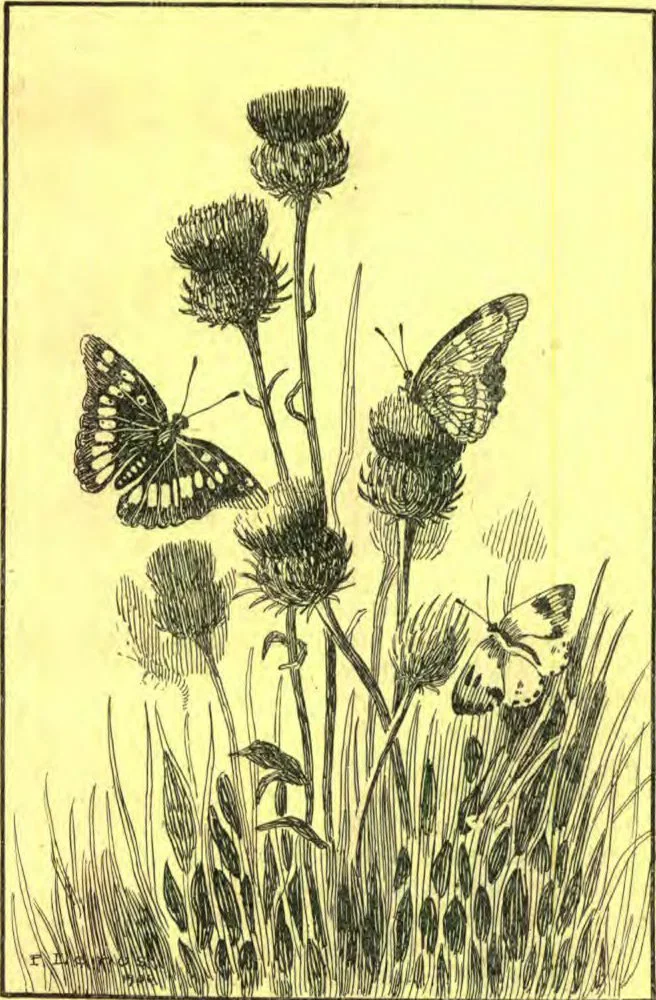
Flowers especially need to be plainly outlined; but care should be taken not to put all the detail into the drawing that is seen in the flower. When drawing flowers and plants, the student is tempted to indicate each vein and petal; but unless he is studying the construction of the flower or plant, and wishes to make an exact copy of the specimen, no more should be put in it than is necessary, although he will understand that more detail may be allowed in sketching flowers than in sketching a scene or a figure.
Students are sometimes at a loss to know how to make pen-drawings from a sunset, as the colors and shades are constantly varying. By making a rapid pencil sketch, indicating the lights and shadows roughly, and memorizing the scene as nearly as possible, the student can make a pen-drawing from his “notes,” and will secure much better results than by attempting to make a drawing first.
Many artists compose scenes, just as a musician composes songs. They make sketches of objects or subjects which they wish to introduce in their composition, and to these they refer for outline and character. The student will find this a good method, but he should be careful not to place by a stream or lake a tree that never grows near water, nor to commit other mistakes of like nature.
PEDRO LEMOS.

Friendship's Summer Beyond the Years

“WHAT a comfort it is to look back through the years, and think of what our earthly friendships have been, and then make a leap into the future, and know that there the real summer season of friendship comes! The best things we have on earth are but small beginnings, little eyes and buds on the tree of life, that look to the unfolding of all that life and love can mean in the land that knows neither sickness nor pain nor heartache.”

The Spendthrift and Wasted Time

“THE spendthrift uses in a month or a year of extravagance the money which, carefully invested, would have given him an income for the remainder of his life. And some other spendthrifts waste in foolish pleasures the moments which, properly invested, would have made them rich for all eternity.”

WHAT IS OURS

“But she is crowding you out; she is taking the place that really belongs to you,” said a warm-hearted but not very wise friend, condoling with another over what she regarded a wrong. But the brave heart repudiated that view of the case.
“No, if it were really mine, I should have it. No one can take from me what really belongs to me.”
How much of heart-burning and bitterness we might escape if we would but realize that truth! Is it not a truth? We resent the advancement of another to the position that we think should be ours, we are sore-hearted with a sense of personal wrong when another wins the success we have coveted; yet we can not miss our appointed place, our own guerdon, except by our own refusal of it. “While I am coming, another steppeth down before me,” said the disappointed man at the pool, lifting to the Master eyes weary with pain and waiting. But no place in the healing waters could have been to him like the touch that sent him on his way rejoicing. The rich, peculiar blessing, all his own, found him where he was.—Selected.

A ROSE PARABLE

“I WISH YOU WOULD look at this climbing rose of mine,” said the amateur gardener to his friend, the florist. “It is a fine Gloire de Dijon, grafted on a strong root of some ordinary variety of rose, which ought to give it a good growth. But it grows slowly, and will not bloom at all.”
“I can guess what is the matter,” said the florist, and he went down on his knees, and began to remove the earth from round the root. Sure enough, just below the surface, hidden safely from view, the root had sent out a long, straight shoot, which found its way to the sun several feet away, and was already opening a few leaves. The florist took out his knife, and cut it off close to the root. “Now your Gloire de Dijon will grow and bloom,” he said. “Or, if it doesn’t, just examine the root, and cut off the new suckers it is trying to send out. You see, the root remembers its old nature, and goes back to it. It will never give its full strength to the graft unless you watch it, and cut it back steadily. But if you will do that, you will have a glorious rose; for it is a strong stock.”
Was it not a parable of human nature that the rose taught? The spiritual life is not the natural life for any of us. The old nature still lies at the root. Only by cutting off the persistent growth of the natural root can we quicken the growth of the higher beauty of the soul. A secret sin beneath the surface—how many times it has ruined and killed the spiritual life of a man or a woman!
How many stunted, sickly, blossomless Christians need pruning at the roots! Is there not a lesson for us all in the florist’s knife, if we are willing to apply it? —Well Spring.

HOW TO PREPARE FOR EMERGENCIES

“And let our people learn also to perform good works on occasions of emergency.” Titus 3:14, Syriac translation. There are many who are able to deal reasonably well with the common, routine duties of life; but when an emergency arises, where soul or body is taxed to its uttermost, they utterly fail.
Saul had the promise that when the Spirit of God came upon him, he would be able to do as the occasion demanded. 1 Sam. 10:7. But the Spirit of God only brings things to our remembrance (John 14:26); that is, it brings to mind the things we have already learned. In other words, the Spirit of God reaches into our minds, and picks up the things that it has had an opportunity to stow away there. If a child has six blocks to play with, it may construct different objects with them; but the size of the construction will always be limited to six blocks. So God takes only the things that we have allowed him to put into our minds. He can make wonderful combinations with them, it is true; but he always works with the material at his disposal. Therefore we should continually secure more blocks of truth, because that will enable God to do a still greater work with us.
God has promised to prepare a table for us in the presence of our enemies when the occasion demands it (Ps. 23:5); but if we have neglected to acquire the necessary skill and knowledge to prepare a hygienic and healthful meal when we are in the presence of our friends, he will not make up for these neglected opportunities when we are brought into the presence of our enemies.
Every experience that God allows us to pass through will teach us something that will enable us to meet some trying emergency, if we will only extract from it the lesson there is stowed away in it for us. We must acquire the habit of picking berries from every bush that grows in our pathway. DAVID PAULSON, M. D.

MATCHES

The first really practical match was introduced in 1827 by John Walker, a druggist of England. Until the close of the eighteenth century, flint and steel, with the tinder-box, containing carbonized fragments of cotton and linen, were in use; also sulphur-tipped splints of wood called “spunks,” or matches. Not until 1805 was there any attempt to obtain fire through chemical action. Prof. M. Chancel presented an apparatus consisting of a bottle of strong sulphuric acid on asbestos, and splints of wood coated with sulphur and tipped with chlorate of potash and sugar. When the match was introduced into the bottle, it ignited. Attempts at friction matches were made in 1816 and in 1823, but found little favor. John Walker’s matches, invented in 1827, were known as “Congreves,” after Sir William Congreve, the inventor of the Congreve rocket. These matches were wooden splints, or pieces of cardboard, coated with sulphur and tipped with a mixture of sulphide of antimony, chlorate of potash, and gum. Each box contained eighty-four matches and a folded piece of glass paper, to be held firmly in the hand as the match was drawn quickly through it. The whole sold for a shilling. The modern phosphorous friction match appeared simultaneously in several places in 1833.
The manufacture of phosphorus matches is peculiarly dangerous, not only because of the risk of fire, but because the workers, if they have decaying teeth, are often attacked with a peculiar disease terminating in necrosis (mortification and death) of the jawbone. The most serious effects from the use of phosphorus have now been overcome by the discovery of red phosphorus, in the manufacture of what are now known as “safety matches.” The manufacture of matches is an interesting operation, but too lengthy a process to be described in this article.
W. S. CHAPMAN.

GUARDIAN ANGEL, WATCH TO-NIGHT

Guardian angel, watch to-night; A fair ship lies in danger, And o’er the waves no beacon shines To guide the wandering stranger.
No mariner hears her warning call; No watchman sees her signal-light; Alone on the deep, she heaves and rolls, Storm-tossed in the dead of night.
Her noble prow swings with the gale, On, on, to the water’s edge; Her crew sleep fast in her hold beneath, Nor dream of the fatal ledge.
So, many a fair and noble youth Alone on the seas of night, Drifts on and on to the fatal rock For want of a beacon-light.
WALTER CUMMINGS BUTTERWORTH.

THE BRAIN AND THE NERVES

III

There is a strange relation between the mind and the body. Diseases of each affect each. Involuntary actions of the heart, digestion, etc., are affected by the mind. Certain nerve-cells in the brain restrain other nerve-cells. One center causes contraction of the small blood-vessels. If this continued, the contraction would be too severe and prolonged. Another center therefore restrains the action of the first, thus balancing up the work of contraction, so that the proper supply of blood goes to all the body. This principle is called “inhibition.” Coughing and sneezing may be controlled by opposite nerve-cells. Cells that inhibit action of other cells lie in the front part of the large brain, or cerebrum. Here lies the power to exercise the will.
We can inhibit wrong desires, and curb evil inclinations. At first self-indulgence is a moral sin; then it becomes a physical disease. If we allow certain cells to act daily, always in certain ways,—that is, in our thoughts,—this action becomes easier the oftener done; in other words, habit is formed. When we do a wrong act once, it is easier the next time, and becomes easier with each repetition. So with right ways. If we conquer evil, and do right, it will become habitual. God gives us power, if the will is submitted to him, to overcome habit. While we can not understand the will wholly, we know it is that which makes character, and character is what we are. This will live forever if the individual believes in Jesus Christ, and lives with the will submitted to him.
As one accustoms himself to think along certain lines, so the brain-cells become set, and thought runs in a certain groove, or channel. Think pure, sweet, happy thoughts, in harmony with the love of God and Christ’s example, and the brain and mind are thus attuned to heaven’s music. Phil. 4:8 is a good mental exercise. Prov. 23:7 states a fact. A man once confessed to a Christian worker that it was impossible for him to think pure thoughts. Even scriptures read in his hearing were, in his evil mind, associated with impurity in some form. He said that he had allowed his mind so to develop that it was impossible for him to be saved, for he could not think of anything but sin. God hates sin, and he will pour out his wrath upon it; but he does not destroy men: this they do themselves. How?—By thinking on evil, and then acting it out. In this way it becomes ingrained in them, a part of them; in fact, it is they themselves, SIN! This God will consume in the last day, because it has already consumed the man. If we heed the invitation of mercy before this condition of mind becomes fixed, there is hope. God wrought miracles in the past, and healed the lesions of the brain-cells, so that it was possible for pure thoughts to travel their course, and thus affect the character; and where a heart is now truly desirous of such a change, God freely gives it.
MRS. M. D. Mc KEE.
Continue reading: LITTLE TEACHERS