The Youth’s Instructor, Vol. 28, No. 29.

SOMETHING TO CARRY HOME

The Youth’s Instructor

Jul 14, 1880

S. D. A. Publishing Association · Battle Creek, Mich. · Jul 14, 1880

SOMETHING TO CARRY HOME.

A STORY FOR TEACHERS.

Raising my parasol as I stepped out upon the front porch, I looked over the road which stretched out to the church, whose white spire rose above green trees in the distance, and wondered how I was to get over that hot hill, where not a shadow broke the glare. Such a sudden outpouring of the sun’s heat seemed quite overpowering.
When I entered the church I found my class of pupils nearly complete; I opened the closely-shut window near, and dropped into my straight-backed chair, feeling as though there was not an atom of reserve force left in me with which to tackle my duties. It was discouraging to have such feelings to contend with when I had striven so, but an hour ago, for a prayerful, tranquil mind; and I strove to overcome it. But the children, rubbing their feet on the bare floor, nearly set me wild, and I was glad when the opening bell called us to order. But I did not regain control of myself so but that when, after the lesson was well begun, Julia Simpson came in, dragging by the hand such a little mite of a brother as seemed too small to be anywhere but at home, I was annoyed. “Why can’t mothers be their own nurse girls?” I thought; and I’m afraid there was the least mite of sharpness in my voice as I said, “You shouldn’t bring such a baby to Sabbath-school, Julia.”
“Mother said I had got to stay and mind him, then,” was Julia’s reply.
I made room for them, and gave the little fellow a book of pictures to keep him from talking; but of course it wasn’t a minute before the book went, with a bang, on the floor. When this happened for the third time, and just as I was saying, “Now, children,” I took the book, and much to the child’s apparent wonderment, tossed it on to the table. After this for a while the child was determined to do the talking himself; and of course every time he gave utterance to anything, in his funny baby-fashion, a suppressed titter would break out from somewhere among the thirty-five children composing the class. But at last I seemed to get a little of the child’s attention. I think it came from my talking of the verse, “His flesh shall be fresher than a child’s,” and calling the children’s attention to how beautiful soft, rosy cheeks like Julia’s little brother’s were, and I took up one of his chubby little hands, to show them the difference between such flesh and mine. At any rate, the latter part of the exercise the child sat crouched down in a sort of listening way, as though giving his undivided attention.
When the school was closed and the children went out, “Eben,” as Julia called him, raised his great black eyes to mine, and said, in his slightly solemn, childish way, “I’ll tome again.”
“Yes,” I said; “and you must be a good little boy all the week.”
“I’ll be dood, and pray Dod,” he said, nodding his head like a wise judge, and marching away.
The last thing I had striven to impress upon the children’s minds had been the need of prayer,—for everything and at all times; and I was surprised that even so much, as seemed by the child’s words, had been grasped by him. And going home, thinking it over, the breeze seemed a great deal fresher than when I went over the road before, though it was an hour nearer noon, and the way was not half so long and tiresome.
The next Sabbath I looked for little Eben, but Julia came without him, and in time the incident of his ever having come slipped from my mind. A few weeks later I stood one morning out among my late roses, clipping and tying up, and smelling of this and that half-open rose, when a “hem” caused me to turn suddenly, and I found a woman standing beside me. How she had opened the gate and trodden the gravel walk without my knowing it was a mystery; but there she was, and as she did not say anything, I said, “Good morning.” She answered with a nod, and then stood awkwardly twisting the fringe of her shawl between her thumb and finger. Not knowing what else to say, I asked, “Can I do anything for you?”
“Well, no,—that is, I only thought I’d like you to know how we’d got on the right track again.”
“Ah,” I said, not having the remotest idea as to who “we” were, or what “track” they had generally been on.
“Yes, I felt as though I’d like you to know how much good you’d done us.”
“I!” I said in astonishment, as I pulled off my garden gloves, and walking to the porch, pushed one of the garden chairs toward my strange visitor, taking the remaining one myself. “I do not see how that can be, when I never saw you before.”
“But you’ve seen Bub,” and the woman laughed, and the laugh seemed to take ten years right off her age.
“Bub! who’s Bub?” I asked, struggling to get hold of what the woman was driving at.
“Why, my Bub, Ebenezer, that Julia took to Sabbath-school.”
“Oh,” I said, the Julia letting in a little light. “You’re Julia Simpson’s mother? I remember little Eben’s coming with her one day. Yes, yes.”
“Well, you see,”—and the woman settled back, as though surer of her ground now,—“I used to mind about religion, quite a sight, when we were first married. But after things got to going so hard with us, and it was work, work, and money always short, and so little time for anything, we kinder forgot about it; and when we didn’t, there did not seem much chance for such things; and I used to tell Rufus—he’s my husband—that there wasn’t much time for poor folks to be religious in, and he seemed to think it was about so. Well, as I started to tell, the next day after Bubby went to Sabbath-school was what some folks call ‘blue Monday’ with me. The baby’d been worrying all night.”
“Eben?” I added.
“Oh, no; you ha’n’t seen my baby yet. She’s most a year old; as I was saying, she’d kept me awake; and now there was the big washing, and the sun up so hot before I got at it; and taking it all around, it seemed as though I never could go through with it all; and after I’d rubbed a little, I dropped into a chair, saying, ‘It’s no sort o’ use; I never can do it.’ Bub was on the floor with baby’s playthings, and I didn’t suppose he was minding me one bit; but he looked up with those great eyes o’ his’n, and says he, ‘Why don’t you tell Dod so?’ I thought it must be I hadn’t heard him right, and so I asked, ‘What did you say, Eben?’ ‘I say,’ rising to his feet, ‘why don’t you tell Dod so?’ I got right up, and went about my work, but I was sort o’ numb like, as though I’d got a blow. You see it was so queer like for Eben to talk that, I tried to move about lively, and get myself free, but I couldn’t, and at last I went into the bedroom, where baby was in bed asleep, and, shutting the door, I did just tell the Lord all about it, just how tired I was, and how hard everything was going, and how little strength I had, and asked him to help me through the day; and when I went back to the kitchen my heart was as light as a feather, and I broke out singing, as though I was a girl. But I ha’n’t got to the best of it,” she continued, as I moved a little to get my handkerchief. “If you’ll believe me, as I was a-taking out the first boiling, who should come in but Rufus, and says he, ‘I didn’t have quite the right lumber I wanted for the job, so I thought ’t was so late I’d come home and help a bit, and not go after it till noon.’ Now, I don’t believe Rufus had done such a thing as that afore since the first year we was married, and what do you suppose could have put it into his head unless—”
Mrs. Simpson hesitated, as though I might not quite agree with her, I thought. So I hastened to say, “Unless the Lord put it into his heart. Of course you have a perfect right to think it in direct answer to prayer.”
“Well, so it seemed to me and Rufus,” said Mrs. Simpson, pulling her shawl up around her; “and you don’t know what a comfort it has been to us, and we have just taken a new start; and it’s wonderful how easy things do go now. And when I went by this morning, and saw you a-standing out in the garden, I felt as though I’d like you to know what a sight of good what Bubby brought home did for us.”
“Well, I’m sure, Mrs. Simpson,” shaking her hand warmly, “it does help me to go on with the little ones. Sometimes it seems as though I couldn’t get anything done up small enough for them to take.”
“Don’t you ever think that again, for it’s wonderful how these little folks do manage to get hold of things;” and with another shake of the hand, Mrs. Simpson walked away.
How do you think I felt after she was gone? I can’t tell you exactly how, but I know I felt a good deal as though I ought to ask somebody’s pardon, and I went down before God, in that little back parlor of mine, for a long time; and the next Sabbath, when Julia brought in Eben, gay in a new suit of blue waterproof, with brass buttons, I gave him the very best seat there was; and all that lesson time I tried to strip my talk free from big words, so that even the smallest should have something to carry home.—Christian Statesman.

THE ZEPHYRS.

“Did you hear the frolicsome zephyrs pass?” The clover said to the meadow grass, “They came along with the morning sun, And gathered our dew-drops,—every one. We had only time to nod good-day, E’er they were gone on their roving way— Gone on their airy, fairy wings. Ah! would they had told about the things, The beautiful, wonderful things they see In their gladsome life, so wild and free.
“We saw them kissing the golden sheaves, We heard them laughing among the leaves; They rocked the nests full of birdlings brown, And played at ball with the thistle-down. Then, merrily off to the streamlet’s way, Where willows weep and tall ferns sway Their graceful fronds to the subtle breath That ripples the dancing waves beneath, They swept away on its restless flow, And we wished we knew all the zephyrs know.”
—S. S. Advocate.

IS THERE A GOD?

To this inquiry, Chateaubriand replied in the following eloquent words:—
“There is a God! The herd of the valley and the cedars of the mountains bless him; the insects sport in his beams; the elephant salutes him with the rising orb of day; the birds sing to him in the foliage; the thunder proclaims him in the heavens; the ocean declares his immensity; man alone has said, ‘There is no God!’”
“Unite in thought at the same instant the most beautiful objects in nature; suppose that you see at once all the hours of the day and all the seasons of the year; a morning of spring and a morning of autumn; a night bespangled with stars and a night covered with clouds; meadows enameled with flowers, forests hoary with snow, and fields gilded by tints of autumn; then alone you will have a just conception of the universe.
“While you are gazing upon that sun which is plunging under the vault of the west, another observer admires him emerging from the gilded gates of the east. By what inconceivable magic does that aged star which is sinking, fatigued and burning, in the shade of evening, re-appear at the same instant, fresh and humid with the rosy dews of morning? At every instant of the day the glorious orb is at once rising, resplendent at noonday, and setting in the west; or, rather, our senses deceive us, and there is, properly speaking, no east, west, or south in the world. Everything reduces itself to a single point, from whence the king of the day sends forth at once a triple light. The bright splendor which nature presents, is most beautiful, and gives us an idea of the perpetual magnificence and resistless power of God.”

A Good Character Cannot Be Stolen

A GOOD character cannot be stolen by day or by night. If a person has a character that can be stolen, the thief will get badly cheated.

CHARACTER

Effects in character though concealed for a time, will appear. It cannot be otherwise. The characters of many persons present a dwarfed and deformed appearance, because the foundation was not laid right,—was not laid deep enough. The laying of the foundation is the most important part of the work of forming character, though the superstructure must be built with care. If a character is desired that will stand the storms of time and endure forever, it must be based upon a sure foundation, and that foundation must be Christ, the chief corner-stone. “Other foundation can no man lay than is laid, which is Jesus Christ.”
After the foundation is well laid, then the work of rearing up a character commences in earnest. Character must grow. And how do we make things grow? By cultivating them, do we not? The farmer or gardener would not raise much but weeds, if he did not cultivate. It is just so with other things besides wheat, corn, and vegetables. People would never become good scholars unless they cultivated their minds. Musicians cultivate their voices, and so it is,—anything that attains to perfection must grow.
Our lives are made up of thoughts and actions, and these are forming themselves into a wall of character, which, resting upon the foundation laid in childhood, forms a structure of symmetry and beauty, or one of deformity. This character must stand the test of the Judgment, must be a pure character, to associate with angels, and to enjoy the society of Heaven.
Character is of great importance to the worker for Jesus. If his conduct is not approved by those whom he is trying to benefit, his time is lost, for he will do them no good.
“I would give ten thousand dollars for your character,” said a dishonest dealer to one of sterling integrity, “because it would enable me to make double that amount of money.” Character, then, is powerful.
Oh, if boys only knew what golden capital this good character is, they would work hard to get it. Every business man sees and estimates the boys that pass before him at pretty nearly their worth. A good character is a stepping-stone to success in life, and a passport to Heaven.
V. A. M.

COLD WATER.

WATER, water—that’s the drink! Oh how foolish men should think Rum and whisky, which they sell, Good as water from the well. Water, water, fresh and free; That’s the drink for you and me. Water, water—children, heed! Water, water’s all you need. When you’re thirsty, drink it free; Water cold for you and me.

LESSONS FOR CHILDREN.

LESSON LXXXI.—AHAZ AND HEZEKIAH.

After the death of Jotham, his son Ahaz reigned in Jerusalem. He was more wicked than any king who had gone before him. He not only made images and worshiped them, but burnt incense in the valley of Hinnom, and made his children pass through the fire to Moloch.
Then the Lord caused his enemies to prevail against him; but instead of taking warning from this, Ahaz did worse than before. He cut in pieces the vessels of the temple, and set up altars of his own making in every part of Jerusalem. Instead of returning to the worship of the true God, he worshiped the gods of his enemies; saying, “Because the gods of the kings of Syria help them, therefore will I sacrifice to them, that they may help me. But they were the ruin of him and of all Israel.”
Ahaz died when he was only thirty-six years old, having reigned sixteen years. His son Hezekiah then reigned in his stead. The Bible says that this king “did that which was right in the sight of the Lord, according to all that David his father had done.” He is known as the good king Hezekiah. He called upon the priests and Levites to sanctify themselves, and to cleanse the temple; and when this had been done, gathered the people together, and offered sacrifices and praises to God.
After this, he sent messengers throughout all the land, Israel as well as Judah, inviting the people to come to Jerusalem to keep the passover. Now when they had assembled, and had kept the passover seven days with gladness, they counseled together, and decided to keep the feast seven days longer. Hezekiah prayed for the people, and spoke comforting words to them. Before they went to their homes, the people united with Hezekiah in destroying all the altars which Ahaz had set up to false gods in Jerusalem.
Hezekiah went on, doing all that he could to lead the people back to the worship of the true God. In the fourteenth year of his reign, Sennacherib, king of Assyria, came up with a great army to take Jerusalem. Hezekiah called the people into the city, built up the walls, and prepared weapons of war. He told the people not to be afraid, for their God was able to protect them. But Sennacherib sent messengers to tell the Jews not to believe Hezekiah; that the gods of other nations had not been able to defend them against the Assyrians, and that the God of the Jews could do no better. Then Hezekiah prayed very earnestly, and the Lord told the prophet Isaiah to tell him that the Assyrians should not harm him, but should return by the way they came.
The Assyrians were very haughty, and despised the God of the Jews, thinking that he was just like the false gods that heathen nations worshiped; but they soon had reason to think differently, for the angel of the Lord came into their camp by night and smote a hundred and eighty-five thousand of them, and in the morning their dead corpses were seen lying on the ground. They were then glad to return to their own country.
Note.—Turn to your Bible, and read how Hezekiah recovered from his sickness, what sign the Lord gave him, and how foolishly he acted in showing his treasures to the Babylonian messengers.

QUESTIONS.

  1. Who reigned in Jerusalem after the death of Jotham? 2 Chron. 27: 9.
  2. What kind of king was he? Chap. 28.
  3. What wicked things did he do?
  4. How did the Lord punish him?
  5. Did he take warning from this punishment?
  6. How did he act?
  7. What terribly wicked acts did he perform?
  8. What did he do instead of worshiping the true God?
  9. What reason did he give for worshiping these false gods? Verse 23.
  10. How old was Ahaz when he died?
  11. How long had he reigned?
  12. Who then reigned in his stead?
  13. What does the Bible say about this king? 2 Chron. 29: 2.
  14. What is he often called?
  15. What did he call upon the priests and Levites to do?
  16. What acts of worship were performed when the temple had been purified and everything made ready? Verse 20, etc.
  17. On what errand did he send messengers throughout the land? Chap. 30.
  18. How long did they continue this feast of the passover? Verses 22, 23.
  19. What did Hezekiah do for the people?
  20. What did they help him to do? Chap. 31: 1.
  21. Tell what the Bible says about this passover. 2 Chron. 30: 21–27.
  22. What did Hezekiah continually try to do? Chap. 31: 20, 21.
  23. Who finally came against Jerusalem with a great army? Chap. 32.
  24. What preparations did Hezekiah make?
  25. What did he say to the people? Verses 7, 8.
  26. What message did Sennacherib send to the Jews?
  27. What did Hezekiah then do? Verse 20.
  28. How did the Lord encourage him?
  29. What spirit did the Assyrians manifest?
  30. What did they think of the God of the Jews?
  31. What cause did they soon have for thinking differently?
  32. What were they obliged to do?
  33. Tell about Hezekiah’s sickness and recovery. 2 Kings 20.

BIBLE LESSONS FOR YOUTH.

LESSON CVII.—REVIEW OF LESSONS CIV-CVI.
1. How was the prophecy of Dan. 8:8 fulfilled after the death of Alexander?
2. In which of these divisions was Palestine included?
3. How long were the Jews under the control of the Ptolemies?
4. Describe the course and character of the Ptolemies.
5. What title was given to the first of the Ptolemies?
6. Describe his course toward the Jews.
7. How did he promote a knowledge of the true God among the nations of the earth?
8. How long did this monarch reign, and who succeeded him?
9. How did Ptolemy Philadelphus distinguish himself?
10. What was his course toward the Jews?
11. Describe the rise of the Syro-Macedonian kingdom.
12. What cities were made its capitals?
13. In what did Seleucus follow the example of Alexander and Ptolemy?
14. What period did the Syro-Macedonian kingdom cover?
15. With what kingdom did it have fierce contentions?
16. What decided advantage did the Egyptians finally gain?
17. Who ruled each kingdom at that time?
18. What caused Ptolemy Philopater to hate the Jews?
19. Tell how he treated them.
20. By whom was this cruel king succeeded?
21. How old was Ptolemy Epiphanes at this time?
22. How did Antiochus improve this opportunity?
23. How did the Egyptians protect themselves against the further encroachments of Antiochus the Great?
24. How did this Antiochus end his career?
25. Who were the next two kings in order, after Antiochus the Great?
26. Describe the contentions that arose for the high-priesthood in the time of Antiochus Epiphanes.
27. What provoked the anger of Antiochus against the Jews?
28. How did he give vent to his ill-humor?
29. Describe the expedition of Appollonius against the Jews.
30. How were the Jews oppressed in regard to their religion?
31. What cruelties were practiced upon those who would not conform to the heathen modes of worship?
32. Describe the family called the Maccabees.
33. What bold step did this family take?
34. Where did they and their followers take refuge from their enemies?
35. How did one company of them have to suffer for their conscientious observance of the Sabbath?
36. To what conclusion did they finally come in regard to defending themselves on the Sabbath day?
37. Relate some examples of the martyrdoms suffered at this time.
38. Describe the conflicts and the final success of the Maccabees.
39. What was the fate of the monster called Antiochus Epiphanes?
40. What steps did Judas Maccabeus take to restore the worship of the true God at Jerusalem?
41. From whom did he obtain protection against the Syro-Macedonians?
42. Who succeeded him?
43. Describe the subsequent changes by which Palestine was brought under the control of the Romans.

ARE YOU GROWING?

In body, mind, and spirit, Jesus grew. He was fitting to be the great teacher. He was a perfect and divine being, yet even he must needs grow. Surely, then, we need to grow. We have not reached the stature of a perfect man in Jesus Christ. He sought help from men and God. The teacher is to be a growing, fruitful plant. Soil and sun give growth. Some teachers take nothing from soil, but trust to sun alone. They pray, but do not study. Others would get all from the soil, but none from the sun. They study, but do not pray. Both are wrong. Christ is the example. He found the teachers’ meeting in the temple a necessity. Can we do without it? He wondered that his parents were surprised to find him there. Should we not wonder when the teacher is not there? The teacher who neglects either teachers’ meetings or his closet is a marvel. He proclaims that he need not grow, or else he declares that he can grow without the aids which his Divine Master needed. Now, are you growing?—Christian Union.

BREADTH AND HEIGHT.

A CERTAIN philosopher was always talking very much to his friends about the garden in which he was in the habit of walking, and where he carried on his studies. At length, one of them came to see him; and he found this extraordinary garden was a patch of ground about twice the size of the floor of his own room.
“What!” said he, “is this your garden? It’s not very broad.”
“No,” said the philosopher, “it’s not very broad; but it’s a wondrous height!”
And so I would say to you, Sabbath-school teachers,—your work in your classes is not a very large one, but “it’s a wondrous height.” It goes up to Heaven.

LETTER BUDGET.

FRANKFORT, IND. Dear Editors: I am a little boy seven years old. I am keeping the Sabbath with my father and mother. I go to Sabbath-school every week. I take the INSTRUCTOR. Pray for me that I may be saved when Jesus comes. LEWELLYN A. RILEY.
SOUTH STUKELY, P. Q. Dear Editors: We are two little girls, eight and eleven years old. We keep the Sabbath with our parents. We have no church yet, but we have meeting and Sabbath-school among the brethren. We live so far away that we cannot go to school every Sabbath, but learn our lessons at home. We want to meet the INSTRUCTOR family in Heaven. Pray for us. ROSEPHA CHAMBERLIN. SYLVIA CHAMBERLIN.
KINGSVILLE, MO. Dear Editors: I have taken the INSTRUCTOR for four years, and like it very much. I keep the Sabbath with my parents. I have one sister and two brothers. We all go to Sabbath-school, and are trying to do right. Pray for us that we may hold out faithful. JENNIE NOBLE.

A SCHOOL-GIRLS’ QUARREL.

I don’t like the title to this article. How bad it sounds! But as things of that sort do sometimes occur, perhaps it may not be amiss to tell you of this one, that you may see how they look on paper, and how little they really amount to.
Clara and Nellie were the best of friends; but for all that, standing upon the steps one day, I heard Nellie say,
“I’ll never—speak to—Clara—again, as long as I live! She’s real—hateful!” Her voice was all choked with sobs, and the words jerked themselves out with an effort.
Just then the school-bell rang, and I decided that it was not the time to interfere. Nellie’s tears were soon dried; but I noticed that the two girls avoided each other all day.
The next day, at noon, Clara came to me, complaining that Nellie would not speak to her, and she did not know what she had done. Then, calling Nellie, I set to work to get at the bottom of the trouble. This was the result:—
“Clara told Fanny not to let me take the jumping-rope. She said that neither Lucy nor I was to have it at all,” said Nellie.
“Well, Clara,” I said, “that does look bad. What is the explanation?”
“I asked Tom if we might take that rope, and he said we might, if we wouldn’t let any one else have it. I had been jumping, and got tired, when Alice wanted me to go and swing; so I left the rope with Fannie and Julia. Just then I saw Nellie and Lucy coming up the walk, and I said, ‘Remember that the girls can’t take the rope.’ I don’t know why Fannie didn’t tell the reason. I suppose Nellie thought that I didn’t want her to take it; but that was all the reason. I don’t see as I am to blame.”
“Not much, according to that story,” I said, “but just a little. You ought to have made it look all right by waiting until Nellie came, and explaining the matter to her.”
“But she ought to know that I like her, and wouldn’t be hateful to her on purpose,” said Clara; and I think she was right about that. Two girls that love each other ought surely to trust each other.
“Well, girls,” I said presently, “it seems to me that this trouble does not amount to much after all. Don’t you think that the better way is to let it all go, and just be friends again?”
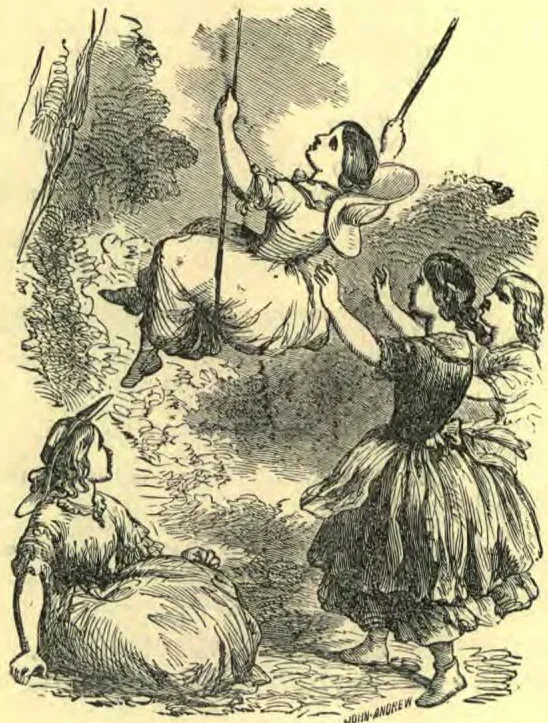
“Yes, yes;” answered both girls; so they “made up,” then and there; and locking arms, went out to join their playmates who were swinging under the trees.
As I heard their merry laugh ring out, I thought about these “school-girl quarrels,” that amount to nothing, though they are not all so easily “made up” as this one. Girls, I do not think that these quarrels are good for you. They do not help to form a beautiful character. Let the spirit of love prevail upon the play-ground and in the school-room, and then shall you one and all grow day by day into a perfect womanhood.—Home School.

GOLD-FISH

Some time during the seventeenth century, about two hundred years ago, Portuguese sailor saw, swimming in the lakes and rivers of China and Japan, a very beautiful variety of fish, which glistened like gold. They captured some specimens and brought them to Portugal. The little fish found the lakes of Europe as pleasant to live in as the lakes of China, and they at once domesticated themselves, and raised their little families, until the European streams became well stocked with these beautiful creatures. They are also found in many brooks and streams in the United States.
The glistening gold-color of these fish made them much sought for as household ornaments, and the demand for them became so general, that establishments were opened for raising them for the market. One of the largest and most celebrated of these places for gold-fish breeding is in Oldenburg, Germany, where more than a hundred small ponds contain the fish in all stages of growth, from the tiniest baby to the big stout fellow eight and even ten inches long. The little ones are carefully kept apart from larger ones, for the gold-fish is a wicked cannibal, and devours its little brothers and sisters, and even its own children, whenever it has an opportunity. At the same time it is a great coward, and will hide away from fish much smaller than itself that have the spirit to attack it.
The enormous demand for gold-fish is shown by the fact that from the establishment at Oldenburg alone, over three hundred thousand fish are sent to market every year. Their price varies according to their size and beauty, for there are grades of beauty in gold-fish as well as in all other things. They are very pretty household ornaments, and by caring for them, and carefully watching their habits, boys and girls may learn their first lesson in natural history. If kept in a glass globe or aquarium, nothing can be more interesting than to watch them moving about. In any case, fresh water should be given the fish every other day, and if the globe or aquarium be ornamented with rocks and water grasses, the fish should be carefully dipped out once a week and the rocks thoroughly cleansed from all impurities.
In changing the water, the fish should never be subjected to any sudden variations of temperature, as the shock produced by a violent change from water of medium temperature, which is always best, to ice cold, might ruin the whole stock of an aquarium in an instant.
Although the fish draw nourishment from animalcules supplied by the water, and will live a long time without other food, it is advisable to feed them by throwing bread-crumbs or flies and other small insects on the surface of the water. The eagerness with which they dart for them proves them to be welcome. Care should be taken not to scatter more bread-crumbs than will be immediately eaten, for bread sours very quickly, and renders the water impure.

You have reached the end of this edition.

The Youth’s Instructor · Jul 14, 1880