The Youth’s Instructor, Vol. 31, No. 24.

THE HORSE

The Youth’s Instructor

Jun 13, 1883

S. D. A. Publishing Association · Battle Creek, Mich. · Jun 13, 1883

THE HORSE.

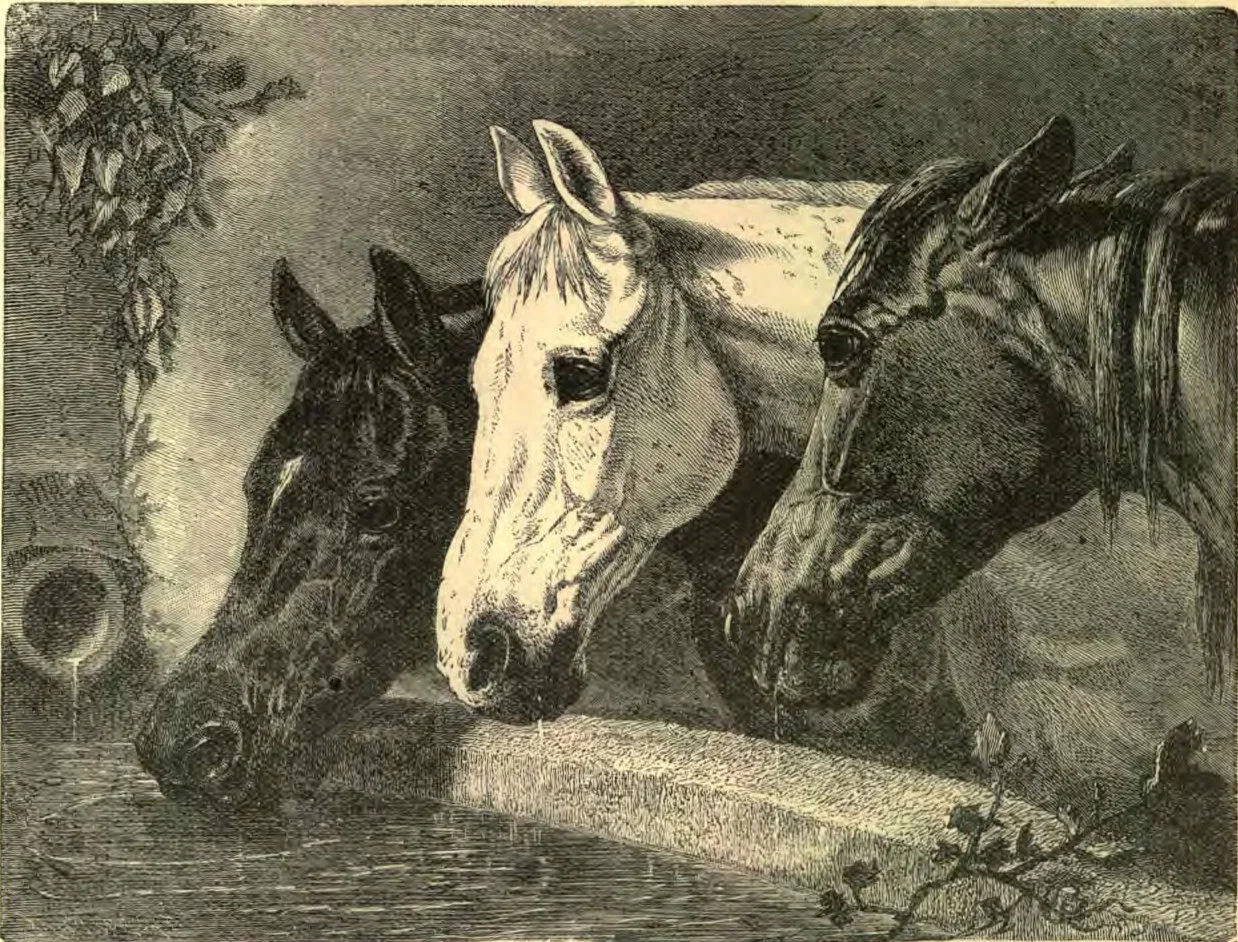
HORSES are found in every quarter of the globe, and in some countries vast herds of them run wild on the plains. These herds sometimes number many thousands, and are subdivided into several companies, each having a leader, while one acts as commander of the whole herd. This “commander-in-chief” is able in some unaccountable way to give orders to his followers; and when moving from one grazing ground to another, the herd presents the appearance of an army, each leader heading his proper line and keeping it in order. It is necessary for them to preserve this discipline for their protection. If they straggled off, each in a separate way, they would fall an easy prey to their enemies,—the wolves, pumas, and jaguars, which sometimes attack them even when in droves.
In Tartary, horse-hunting is a very common sport. The animals are captured by the aid of a falcon, which is trained to settle on a horse’s head, and flutter his wings about its face, until the hunter comes up to secure his prize. Not only do the Tartars ride their horses, but they drink their milk, and eat their flesh, so that a horse-hunt is often conducted as a food-procuring expedition.
The wild horses found on American prairies are called mustangs. They are used mostly for saddle horses, and are extremely tough and enduring. They are usually caught by the aid of the lasso. This is a long rope with a slipping noose at one end. A rider will throw a lasso quite a distance with such exactness that the noose will fall over the head of a mustang, and fasten around its neck. The more he plunges and pulls, the tighter the noose draws; he strangles, and after a time is thrown, when he is in the power of his captor.
There are as many different kinds of horses as there are uses to which they can be put. Most noted for swiftness is the Arabian horse. Its body is very light, its neck long and arched, its eye full and soft, and its limbs delicate and slender. This class is the one generally used in England for racers. Another horse highly prized in that country is the hunter. The body of the hunter should not be so long as that of the racer, and requires greater compactness, so as not to be tired out by long rides over ploughed grounds. A comparatively large foot is required, in order to prevent its being destroyed by the rapid alternation of hard and soft ground which the animal is required to traverse. The low shoulders of the racer would be injurious in a hunter, on account of the trying leaps which it is often called upon to perform.
But one rarely wishes to ride more than eight or ten miles an hour, and on a journey not more than six or seven. Fast horses are not even in their speed; and although they can perform extraordinary feats, they are not good travelers on long distances. For all common uses, then, the hackney, or road horse, is far more valuable. This horse, though not speedy, is generally a pleasant traveler, and is safe, good tempered, and enduring.
A very elephant among horses is the English dray-horse. Its great size is not needed so much for the amount of pulling which it performs as to withstand the jolting or battering of the tongue or shafts that takes place on the paved streets of large cities. The dray-horse is a very slow animal, and its pace cannot be quickened even if the load be light. Its breast is very broad and its shoulders thick and upright, the body large and round, the legs short, and the feet extremely large.
The Shetland pony is the smallest of horses. It is a native of the Shetland Islands, which lie north of Shetland. There the ponies run wild, and may be owned by any one who can catch them. For its size the Shetland pony is very strong, and has been known to trot forty miles in a day, with a man on its back.
The horse has from time immemorial been made the servant and companion of man. Besides being the most useful, it is also the most noble and beautiful of animals. By nature it is patient, kind, affectionate, and willing. It often shows an almost human attachment for the members of the family by whom it is owned, following them about the yard and the fields like a dog, placing its head on their shoulders as if to caress them, and allowing even the children to play around its feet, and mount its back two or three at a time. So attached does the Arabian horse become to its owner, that should he be thrown from its back, the animal will stand quietly until he gains strength to remount; and cases have been known in which, his master having been killed in battle or murdered in some wild place, the horse would stand guard over the body until, if not forcibly removed, he would himself pine away and die. The horse is also possessed of considerable intellectual power, having been trained to do very wonderful things, besides doing many clever things without being taught.
The Rev. J. G. Wood in a work on Natural History says: “The horse is mostly fierce because it is nervous, and bites and kicks, not because it is enraged, but because it is alarmed. Restore confidence, and the creature becomes quiet without any desire to use its hoofs and teeth in an aggressive manner.” There are few animals which are more affectionate than the horse, as will be acknowledged by any one who has possessed a favorite horse, and treated it with uniform kindness. The infliction of pain is a clumsy and barbarous manner of guiding a horse, and we shall never reap the full benefit of the animal until we have learned to respect its feelings, and to shun the infliction of torture as a brutal, a cowardly, and an unnecessary act. To maltreat a child is always held to be a cowardly and unmanly act; and it is equally cowardly and unworthy of the human character to maltreat a poor animal which has no possibility of revenge, no hope of redress, and no words to make its wrongs known. Pain is pain, whether inflicted on man or beast, and we are equally responsible in either case.”
In most of our large cities, societies for the prevention of cruelty to horses and other animals have been organized, and well named “Humane Societies.” Even little children have become enthusiastic members, and have done much in their way to help in bringing about kinder treatment for the poor, overworked horses who must daily, year in and year out, drag the street-cars, drays, and omnibuses up and down the streets, that men may ride and rest. Surely such kind servants should never receive cruelty or neglect at our hands.
C. H. G.

THE VOICE OF THE GRASS.

Here I come creeping, creeping everywhere; By the dusty roadside, On the sunny hillside, Close by the noisy brook, In every shady nook, I come creeping, creeping everywhere.
Here I come creeping, smiling everywhere; All around the open door, Where sit the aged poor; Here where the children play In the bright and merry May, I come creeping, creeping everywhere.
Here I come creeping, creeping everywhere; In the noisy city street My pleasant face you'll meet, Cheering the sick at heart Toiling his busy part,— Silently creeping, creeping everywhere.
Here I come creeping, creeping everywhere; You cannot see me coming, Nor hear my low sweet humming; For in the starry night, And the glad morning light, I come quietly creeping everywhere.
Here I come creeping, creeping everywhere; More welcome than the flowers In summer’s pleasant hours; The gentle cow is glad, And the merry bird not sad, To see me creeping, creeping everywhere.
Here I come creeping, creeping everywhere; When you’re numbered with the dead In your still and narrow bed, In the happy spring I’ll come And deck your silent home,— Creeping, silently creeping everywhere.
Here I come creeping, creeping everywhere; My humble song of praise Most joyfully I raise To Him at whose command I beautify the land, Creeping, silently creeping everywhere.
—Sarah Roberts.

The Brave Spirit.

American boys are familiar with the lives of those who, from humble birth, have risen to the highest positions in our republic. Let us go to Germany, nine years before America was discovered. Nov. 10, 1483, in a miner’s cottage in Eisleben, a little boy is born. His parents are very poor, but they are esteemed for their piety and industry.
In a few months, they removed to Mansfeld. Here we may see them on a winter evening, sitting by their hearth, the wood blazing under the huge iron pot; and hanging above, on the chimney, we see the pewter pans and various cooking utensils. The solid oak table is symbolical of the stability and worth of the parents. The little boy
For Martin, whom we have seen a baby, soon learned that parents and teachers in those days believed that to “spare the rod” was to “spoil the child.” One day Martin is punished by his mother till she brings blood on account of a trifling fault; and at school he is whipped fifteen times in one forenoon. Yet the mother begs his father to be less severe with the little boy, and his fond father carries him to school in his arms.
At fourteen, Martin has learned all that is taught in the school in Mansfeld. With an older boy, he walks fifty miles to the splendid city of Magdeburg. Here he stays a full year. He has no money, and the poor boy goes through the streets singing for his food. His parents see how their brave boy is suffering, and they send him to Eisenach, where he has relatives. His father has so many mouths to feed that he cannot help him any; and the friends he hoped to find in Eisenach fail him. Poor Martin still begs his food, and often falls asleep very hungry. The hard words and blows he has received are making him timid. He sings a Christmas carol at a peasant’s door. The peasant speaks, but the voice frightens him, and he runs, losing the sausage the peasant came to bring him. One day, with three other boys, he has sung at house after house, and no one has given them food. Fond as he is of study, he feels that he must give up, and go home to a life in the mines. They turn into St. George’s Square. Here they have often been kindly received by Ursula Cotta. They stop at her door; and, hearing their voices, she sends for them. She talks with Martin. She has admired his devotion in church, and been charmed with his sweet singing. She promises him a home in her house; and now he is a light-hearted, happy boy. He has a lute, and learns to play and compose music. His teacher, too, is Trebonius, whose character has been truthfully versified,—
“There was a school-master, Trebonius, Who followed a principle glorious, He made it a rule, When ent’ring his school, To his urchins to bow,— And well he knew how,— ‘For there may be some great man before us,’ Said respectful old master Trebonius, Who followed a principle glorious.”
Martin next became a student in the University of Erfurt, and now his father is able to pay his expenses in the best college in the land. He studies law; and, before he is twenty-two, he is teacher of philosophy in the University. Looking over the books in the library, he one day finds a Latin Bible. He has never heard that there is more of the Scriptures than the portions of Gospels and Epistles he has heard read in church. He opens to the story of Samuel. He is delighted, and reads till he must go to his lecture. On his way, he prays that some day he may own the book, little dreaming that he will yet give Germany the whole Bible in her own language. For two years he does not see a Bible again. He becomes anxious about his soul. His studies give him no help, and he enters a convent. Here he one day comes upon an old Bible. He studies it, and he sees that Jesus has died for him, and he must live by faith in him. His life in the convent and pilgrimage to Rome have disclosed the error and corruption of monks, cardinals, and even of his holiness, the Pope.
This is the early life of Martin Luther, who became the leader of the Reformation that freed Germany from the Pope of Rome. This year it is proposed to restore the doors of the church in Wittenberg, where he nailed his famous theses, as a fitting celebration of the four hundredth anniversary of his birth. How many of my readers when urged to do wrong, will dare to say as bravely as he did, when called to answer for his faith before a great council of his enemies, “Here I take my stand. I can do no otherwise. So help me, God. Amen.”—Well-Spring.

TWO CITIES ABOVE THE CLOUDS.

There is a city, children, Above the clouds, we're told, Where the rocky Andes wrap their heads In snows eternal and cold.
A mountain is its foundation; Its steeples, the lofty spires Of tall peaks, dressed in snowy robes, With veins of volcanic fire.
Its dwellings are built of “adobe,” With walls made firm and wide; And all unnoticed the storm may rage Below on the mountain-side.
But deep in the mountain's bosom Entombed in the rocky cell, Are struggling fires whose thunders loud Of ominous dangers tell;
As oft in their struggle for freedom They knock at their prison bars, Till the hard walls quiver beneath the strokes, And the mountain heaves and jars.
And the children of lofty Quito, Their faces pale with woe, In terror gaze on their trembling homes And the rocking earth below.
Far, far above earthly vision And the hills by mortals trod, Above the storms and above the clouds, Is builded the City of God;
Its foundation, the fair Mount Zion, Glittering with jewels bright; While above, the pure and jasper walls Reflect all their dazzling light.
Twelve are the pearly portals Which ope to a lovelier scene,— The golden walks, the Tree of Life, And the River that rolls between.
There are the “many mansions” Of workmanship divine, Over whose latticed porches wide Immortal flowers twine.
Shadows and darkness forever Are chased from that city away; For God's throne of glory that city crowns, And the Lamb is its lasting day.
Fullness of joys eternal Its children shall ever know, When they gather at last in those dwellings fair, While their songs of praise shall flow In one long chorus of rapture To Him who led the way Their feet have trod to the Mount of God And the city of endless day.
EMMA L. REA.

A BEAUTIFUL IDEA.

AWAY among the Alleghanies there is a spring, so small that a single ox could drain it dry on a summer day. It steals its unobtrusive way among the hills till it spreads out in the beautiful Ohio. Thence it stretches away a thousand miles, leaving on its banks more than a thousand villages and cities, and bearing on its bosom more than a half a thousand steamboats. Then joining the Mississippi, it stretches away some twelve hundred miles more, till it falls into the great emblem of eternity. It is one of the great tributaries of the ocean, which, obedient only to God, shall roll and roar until the angel, with one foot on the sea and the other on the land, shall lift up his hand to heaven, and swear that time shall be no longer. So with moral influence. It is the rill, the rivulet, the ocean, boundless and fathomless as eternity.

NEW-TESTAMENT HISTORY.

LESSON 139.—PAUL DRIVEN FROM DAMASCUS AND FROM JERUSALEM.

Not long after his conversion, Paul went to Arabia, where he no doubt preached the glorious gospel of salvation through Christ, and told the story of that wonderful vision in which he saw the person of Jesus, and had a commission from the very lips of the Son of God. How long Paul remained in Arabia, the Bible does not tell us, but it was probably not very long.
On returning to Damascus, he resumed his work there with his accustomed zeal. From the time of his conversion to his final departure from Damascus, must have been about three years, as may be seen from Gal. 1:17, 18.
As Paul was preaching in the synagogues at Damascus, the Jews who heard him were amazed, and said, “Is not this he that destroyed them who called on this name in Jerusalem, and came hither for that intent, that he might bring them bound unto the chief priests?” But the more Paul was opposed, the more he increased in strength, and the force of his argument was such as to thoroughly confound the Jews of Damascus, and prove that Jesus was indeed the Messiah.
But Paul’s arguments, instead of convincing the Jews, only enraged them; and after a time they began to lay plans for taking his life. Paul and his brethren knew their intentions, and how they watched the gates of the city both day and night, that they might lay hold on him if he should attempt to escape. Finally, the disciples became so alarmed for Paul’s safety that they let him down in the night from the wall of the city in a basket, and so he made his escape.
Paul, having a strong desire to see Peter, now went to Jerusalem, where he tried to join himself to the disciples of that place; but they, knowing what a cruel enemy he had been, were afraid of him, and would not believe that he was a true disciple of their Lord. Then Barnabas took him, and brought him before the apostles, and told them how the Lord had appeared in a vision to Paul as he was on his way to Damascus, and had spoken to him, and how Paul had been preaching boldly in the name of Jesus. After having this assurance, the disciples received him, and he immediately began to preach Christ with all boldness in Jerusalem, and to dispute with the Grecians, as Stephen had formerly done. But they met him with the same spirit that had been manifested toward the noble martyr whom Paul had helped to destroy three years before. The Lord, however, had a work for Paul to do; and so, when he went one day into the temple for prayer, he had a trance, and the Lord, appearing to him again, said, “Make haste, and get thee quickly out of Jerusalem; for they will not receive thy testimony concerning me.” Yet Paul was unwilling to go. He thought they would surely be convinced when they saw what Jesus had done for him; for, said he, “Lord, they know that I imprisoned and beat in every synagogue them that believed on thee; and when the blood of thy martyr Stephen was shed, I also was standing by, and consenting unto his death, and kept the raiment of them that slew him.” But Jesus said to him, “Depart; for I will send thee far hence unto the Gentiles.” The disciples at Jerusalem had become very anxious about Paul, fearing that he would share the fate of Stephen, and he was now willing to let them take him down to Cæsarea, whence he continued his journey to Tarsus, in the province of Cilicia, where he was born. This place was noted for its philosophers and men of learning, and it is highly probable that Paul disputed with them, as he did afterwards with the philosophers of Athens. It seems certain that he must have proclaimed to his relatives and neighbors the glad news of salvation through Christ, the long-expected Messiah, who had now really come in the person of Jesus the crucified.
Of a period supposed to have begun about this time, it is said, “Then had the churches rest throughout all Judea, and Galilee, and Samaria, and were edified; and walking in the fear of the Lord, and in the comfort of the Holy Ghost, were multiplied.” It is thought that this period of rest for the churches must have been occasioned by the troubles and persecutions which the Jews suffered under the Emperor Caligula; for at such a time they would scarcely have leisure to persecute others. Caligula, the successor of Tiberius, began his reign in the early part of A. D. 37, and was murdered in A. D. 41. Now if Paul was converted in A. D. 35, as marked in the margin of our Bibles, it must have been in A. D. 37 or 38 that he took his journey to Tarsus, for he remained in Jerusalem only fifteen days. Although it is not possible to fix definitely the chronology of many of the events of those times, it seems quite probable that it was after Paul had taken his northern journey, and during the period when the churches had rest, that Peter “passed through all quarters,” and came down to the saints that dwelt at Lydda. Here he found a man by the name of Æneas, who was sick of the palsy, and had kept his bed eight years. But Peter said to him, “Æneas, Jesus Christ maketh thee whole: arise, and make thy bed.” At this, the sick man immediately arose, and the people of Lydda and Saron, who saw him, were amazed, and turned to the Lord.

QUESTIONS.

  1. Where did Paul go, not long after his conversion? Gal. 1:17.
  2. What did he probably do there?
  3. What would he be likely to tell?
  4. How long is he supposed to have remained in Arabia?
  5. What did he do as soon as he returned to Damascus?
  6. How long was it from his conversion to his final departure from Damascus?
  7. How did the Jews of Damascus receive Paul’s preaching? Acts 9:21.
  8. What did they say among themselves?
  9. What effect did opposition seem to have upon Paul?
  10. What may be said of the force of his argument?
  11. What effect was produced upon those who were thus defeated?
  12. What did they propose to do?
  13. What did Paul and his brethren learn of the plans and movements of his enemies?
  14. How did Paul finally make his escape?
  15. What led Paul to visit Jerusalem? Gal. 1:18.
  16. What difficulty did he meet on arriving there? Acts 9:26.
  17. How were they at length convinced?
  18. What did Paul at once set about doing in Jerusalem?
  19. With what kind of spirit was he met?
  20. How was Paul warned of his danger? Acts 22:17, 18.
  21. Was Paul willing at first to give up trying to convince the Jews in Jerusalem?
  22. What did he say? Verses 19, 20.
  23. What reply did Jesus make to this argument?
  24. What promise did the Lord fulfill to Paul in rescuing him from his enemies? Acts 26:17.
  25. What did Paul now let the disciples do for him?
  26. To what place did Paul continue his journey?
  27. Where is the province of Cilicia?—On the northern coast of the Mediterranean Sea, and near the north-eastern angle.
  28. For what, among other things, was the city of Tarsus noted?
  29. What does it seem highly probable that Paul would do?
  30. What must he certainly have done?
  31. What is said of a period supposed to have begun about this time? Acts 9:31.
  32. What is thought to have been the cause of this period of rest?
  33. When did Caligula begin his reign?
  34. When and how did it terminate?
  35. Supposing Paul to have been converted in A. D. 35, when must his northern journey have been performed?
  36. When does it seem probable that Peter “passed through all quarters,” and came down to the saints that dwelt at Lydda?
  37. What miracle did he perform there?
  38. What was the effect of this miracle?

NOTES.

Gal. 1:17. Arabia. From the time when the word “Arabia” was first used by any of the writers of Greece or Rome, it has always been a term of vague and uncertain import. It is (1) Arabia Petra, toward Egypt, including the Sinai Mountains; (2) that wide desert toward the Euphrates where the Bedouins of all ages have lived in tents, joining Syria, and sometimes including Damascus itself, for the gardens of Damascus were on the verge of the desert, and Damascus was almost as much an Arabian as a Syrian town; (3) the peninsula between the Red Sea and the Persian Gulf, where Yemen, or “Araby the Blest,” is secluded on the south. Probably Paul went to either the first of these, following in the footsteps of Moses and Elijah upon the lonely Sinai Mountains, or to the second, in which case he may not have gone far from Damascus.—Peloubet.
Ver. 25. Let him down by (through) the wall. This entirely agrees with the account which Paul himself gives of his escape: “And through a window in a basket was I let down by the wall.” 2 Cor. 11:33. This may signify through a window of a house overhanging the wall; and, as Conybeare and Howson tells us, there are such houses in the wall of Damascus at the present day. Or, as Dr. Hackett supposes, it may have been through a window in the external face of the wall, opening to houses in the inside of the city. Such houses, he says, he saw to the left of the gate on the east side of Damascus.—Gloag. In a basket. Says a recent traveler, “As I stood with a friend who resided at Damascus, looking at the place referred to, a couple of men came to the top of the wall with a broad flat basket full of rubbish, which they emptied over the wall. Such a basket, said my friend, the people use here for almost every sort of thing. If they are digging a well, and wish to send a man down into it, they put him into such a basket; and that those who aided Paul’s escape should have used a basket for the purpose, was entirely natural according to the present customs of the country. Pilgrims are admitted into the monastery at Mount Sinai in a similar manner.”—Hackett.
Ver. 27. But Barnabas took him. Barnabas, one of the “seventy,” in the first days after the resurrection held a prominent place in the little church of Christ. We hear of him as one of the wealthy brethren who sold their land, and gave the price to the apostles for the use of the society. Acts 4:36, 37. His influence seems to have been very great in the first councils of the believers in Jesus.—Schaff. Barnabas was a native of Cyprus (chap. 4:36), itself only a few hours sail from Cilicia, and the schools for which Tarsus was famous may well have furnished Barnabas with part of his education. It is therefore not improbable that Barnabas and Saul may have known each other in youth.—Abbott. This would explain how it came to pass that while the other disciples were afraid of Paul, Barnabas listened to his statement, and repeated it to the rest of the church.—McCleer.
Ver. 32. Lydda. A city of considerable size, about a day’s journey from Jerusalem. It was, previous to the fall of Jerusalem, A. D. 70, the seat of a famous Jewish school. St. George, the patron saint of England, was a native of Lydda. In the Mohammedan tradition, the gate of this city will be the scene of the final combat between Christ and anti-Christ. It was ruined in the Jewish war, but was subsequently rebuilt by the Romans, when it received the name of Diospolis, “city of Zeus” (Jupiter). In the fourth century it became the seat of a well-known bishopric. The modern town, which with its tall minaret is seen on the plain between Joppa and Ramleh, is known by its ancient name Lydd or Ludda.—Rev. Com.
Ver. 33. A certain man named Æneas. From the name, which is Greek, the palsied man was probably a Grecian Jew.—Ibid.
Ver. 35. Saron, or Sharon, was the district in which Lydda stood. It was a beautiful plain extending about thirty miles along the coast from Joppa to Cæsarea. It has been conjectured that there was a village of that name, but no trace of it has been found. Luke’s meaning is that the inhabitants, not only of Lydda, but of the plain generally, heard and believed.—Abbott.

THE ORIOLE'S MESSAGE.

“FIDELIA! Fidelia!”
Miss French did not understand little girls very well, and found it hard to be patient sometimes, when Fidelia was thoughtless and forgetful. So the voice had a harsh sound as it rang out through the sweet June air, reaching Fidelia's ears while she bent over the rockery in the corner of the orchard.
“She might just let me see if my mountain violets are blossomed out yet, and not be so cross all the time,” thought Fidelia. Then looking down the lane where the graceful barberry-bushes hung their clusters over the stone wall, she thought,—
“I'm 'most a-mind to run down there, and not let her know I heard. I believe 't would serve her right.”
The next minute her feet were flying down the lane,—on, on, by the locust corner, through the gap in the wall, into the pine grove. The air was soft and cool here, but she did not lie down to rest upon the piney carpet as she had so often done. She passed through the grove to a breezy spot just beyond, where, under a waving willow, were a few gravestones. Among them was a new one of pure white marble, for it was not very long since Fidelie's mother had died. She threw herself upon the grass, close by the roses which bloomed above the graves, and burst into a flood of tears.
“O mamma, mamma!” she cried. “I want you back. I can't be good and happy without you. Oh, dear! dear! Won't she ever come again? I can't bear it.” And she buried her face in her hands, and sobbed as if her heart would break. She was far away from the sound of Miss French's voice, and there was no one near; but all at once she stopped crying to listen. Yes, there it was again,—
“Fiddie! Fiddie! Fiddie! Be true! Be true!”
She looked into the tree from which the sound came, and there, hopping up and down, and in and out, was a beautiful oriole.
“Fiddie! Fiddie! Fiddie! Be true! Be true!” he whistled again, while his black and golden feathers gleamed in the June sunlight.
A grieved and sorry look came over the little girl's features. She was thinking of one day in April, when her dear mamma's white face lay upon the pillow, and the thin hand smoothed her hair. “Fidelia,” she whispered, “your name means ‘faithful.’ I named you so because God had been so faithful to me, and I wished to be faithful to him. And now, my last words to you are, little daughter, be faithful and true to papa, and to your heavenly Father too. Take it for your motto, dear. Be faithful—be true.”
Poor mamma! She was tired then; and the next morning, when Fidelia went to her mother's room, she found that the dear Saviour had given her a rest from which she would never wake to be sick again.
“I wonder if it was God that made the golden robin sing that to me?” thought Fiddie, as over and over again the same whistling sounds rang out clear and sweet.
“I will be true!” she answered, half aloud. “Mamma said, ‘Be faithful—be true’; and I wasn't faithful in doing my chores this morning. Besides, I wasn't true. I cheated Miss French, and ran away, instead of going back to the house, when she called me. There, I should think she'd be cross at me. And papa'd be sorry too, I know.”
Fidelia lay for a little while upon the grass, looking up into the blue sky, with its soft, fleecy little clouds, repeating again and again to herself her mother's words. It seemed so long since she had felt the kindly touch of her mother's hand, and a great lump rose in her throat as she thought how her mother would have grieved to see her little girl behave so naughtily. Was it not the best thing she could do to go back and confess her fault to Miss French?
She was truly sorry now, and she knelt upon the grass under the willow, and asked the dear Saviour to help her not to forget again. Then she walked quickly back through the lane.
Miss French looked very sternly at her at first. But Fidelia told her all about it,—the running away, the message that God gave the birdie for her, and how very sorry she was.
“I will try to be faithful and please you all the time, Miss French,” she said; “and I don't believe I shall ever forget the birdie's words either.”
Miss French had a very kind heart; and putting her arm about the child's neck, she kissed her warmly, and said,—
“I'll try to help you all I can, dear.”
Is it any wonder that the golden robin was Fidelia's favorite among the summer songsters after that? She never heard his liquid whistle without feeling that her heavenly Father himself was speaking, to remind her of her mother's motto, “Little daughter, be faithful—be true”; for the birdie's song was always the same,—
“Fiddie, Fiddie, Fiddie! Be true! Be true!”
—Lillian Payson.

DID BOB THINK?

Bob was an old horse on my great-grandfather’s farm. He was a very clever horse; but it is not so much for his cleverness as for one thoughtful thing which he did, that his name has been handed down to us who live so long after him, and who never saw him.
He was very fond of children; the boys who lived near used to have many a pleasant game with Bob on sunny afternoons when he was grazing in the fields or by the roadside. Sometimes they chased Bob, and sometimes he chased them; and it was a funny sight to see the old horse running after a troop of boys, uttering a peculiar whinny, which said as plain as words could say it, “Isn’t this real fun, boys?”
One day Bob was coming slowly through the one long street of the village, dragging a loaded cart behind him. There, right in the middle of the street, a little child was sprawling in the dust. No one noticed it until Bob and the cart were close upon it. Was the child to be trodden beneath the horse’s feet, or crushed beneath the broad wheel of the cart? No; just as the mother rushed out of a doorway with a shriek, Bob stooped down, seized the child’s clothing with his teeth, and laid the little one on the foot-path out of harm’s way. It was done tenderly, quietly, and it was over in a moment. Then the wise horse went on as if he had done nothing surprising.
Do you wonder that we keep Bob’s memory green? And isn’t his thoughtfulness a lesson for the little boys and girls whose common excuse for carelessness which injures others is, “I didn’t think”? Bob thought; and his thinking saved a child’s life.—S. S. Times.

DO IT NOW.

THIS is for you, boys and girls. It is a bad habit—the habit of putting off. If you have something that you are to do, do it now. Then it will be done. That is one advantage. If you put it off, very likely you will forget it, and not do it at all. Or else—what for you is almost as bad—you will not forget, but keep thinking of it and dreading it, and so, as it were, be doing it all the time. “The valiant never taste death but once;” never but once do the alert and active have their work to do.

Letter Budget.

MINNIE E. WOODS writes from Locust Grove, Virginia. She says: “I am eleven years old. I go to Sabbath-school, and have not missed a Sabbath once this quarter. Our school has twenty-seven members. I like my teacher very much; she has been crippled in her ankle for four years, and cannot walk without crutches. I keep the Sabbath with my mamma and two sisters; papa does not keep the Sabbath, but we hope he will sometime. I send my love to the INSTRUCTOR family.”
HERE is a letter from LOUIE F. MIDDLEWORTH. He lives in Hill View, but has forgotten to tell the State. He says: “I am a little boy ten years old. I have just begun to learn about the Sabbath. I do not take the INSTRUCTOR, but I like to read it. I go to school, and am trying to learn all I can. We live in a hotel, and keep boarders during the summer months. I want to be a good boy, so I can be saved when Jesus comes.”
HERE is a letter from EMMA A. BOND, of Lemoore, Cal. She says: “I have never written for the INSTRUCTOR before, but we are always glad to get it at our house. I go to church every Sabbath. We have forty or fifty members in our Sabbath-school. I tried to get some subscribers for the INSTRUCTOR, but did not do very well at it. I am going to go to camp-meeting soon. It will be held three miles from our home.”
We have a letter from MERTIE B. MERRILL, who has had the INSTRUCTOR, with the Sunshine Series, sent to her by some friends. She hopes to get great good from studying the lessons. She wants to thank her friends through the INSTRUCTOR for their kindness to her.
We have letters from JENNIE and WILLIAM MYERS. Their home is in Weldon Creek, Mich. They have the paper sent to them by a friend, and like it very much. They live two miles from Sabbath-school. They want to meet the INSTRUCTOR family in the new earth.
Continue reading: WHAT THE WINDS BRING