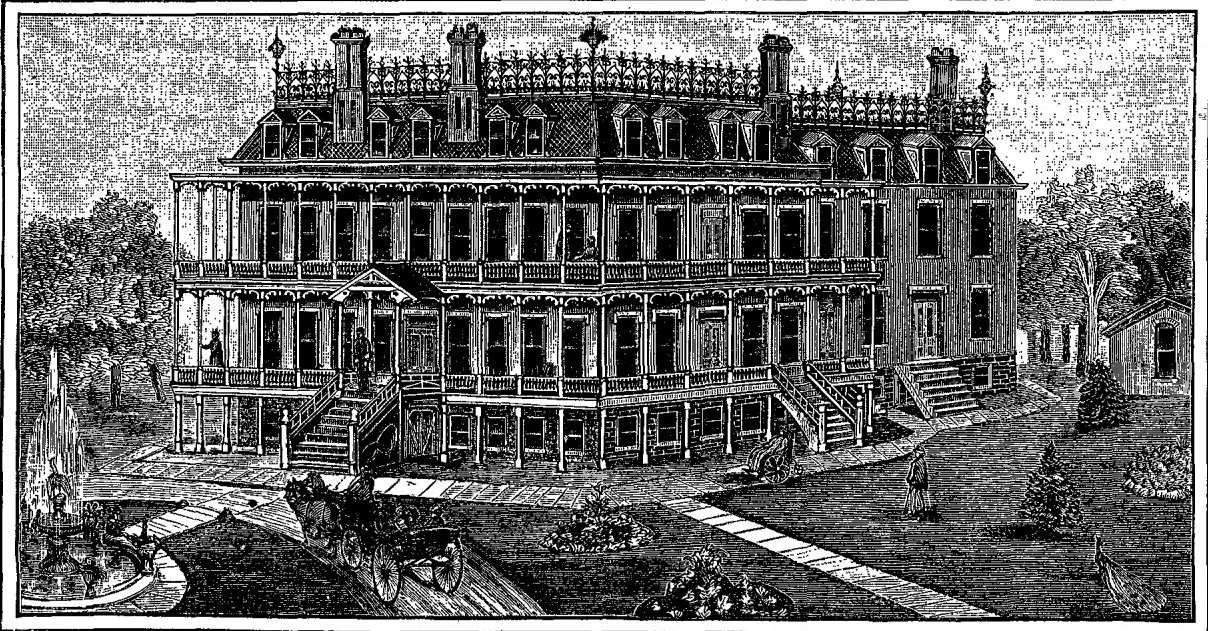
The Mount Vernon Sanitarium—formerly known as the Health Home—is pleasantly located on an elevated site near the beautiful city of Mount Vernon, Ohio. It was first started some two years since, as a private institution, by some of the leading brethren of the Ohio Conference. Appreciating the good work that our large Sanitarium at Battle Creek, Mich., is doing, and knowing that it is often unable to accommodate all who desire its benefits, many have felt the need of other institutions for carrying on this important branch of our reformatory work, and some such have taken an active interest in this branch of our work in Ohio, thus largely increasing the original number of stockholders.
A beautiful tract of forty-six acres of land was purchased, and a building erected, at a total cost of $35,000. The main building, shown in the above cut, is a commodious brick structure seventy-two feet long, forty-six feet wide, with a wing, thirty by forty-one feet. The whole building is three stories high, with a good basement. It is nicely furnished for the comfort and convenience of patients and guests, and together with several pleasant cottages in the beautiful grove adjoining, is capable of accommodating quite a large number. The building is warmed by the best system of heating known, and the warm currents of fresh, pure air give perfect ventilation to every room. The sewerage is excellent, and everything is in a thoroughly sanitary condition.
It is the design of the founders to make this a sanitarium in the truest sense of the term; and its work of lessening human suffering will be carried on in a thoroughly reformatory manner. While patients are treated on the most scientific principles, they are at the same time taught the necessity of obedience to the laws of health,—in diet and dress, labor and recreation, habits of life, and sanitary surroundings of home.
The medical faculty is composed of regularly graduated physicians, who are in good standing with the medical profession. They employ only such methods of treatment as are thoroughly scientific and rational; and no pains will be spared to bring to the aid of patients every remedial agent, and every means of treatment that has been proved to be of real value, and to place the patient under such conditions as will give Nature the best chance to exert in his behalf her wonderful powers of restoration.
The numerous methods of treatment employed enable the physicians to give every patient just such treatment as his individual case requires. In addition to surgical and medical treatment, are employed almost every variety of baths, carefully regulated diet, proper exercise and abundant rest, the scientific use of static, faradic, and galvanic electricity, in its various modes of application; massage, mechanical and manual Swedish movements, given by skillful operators, together with many lines of special treatment for special diseases, including those of the eye, ear, nose, throat, etc., etc. Physical culture taught in a systematic manner, will be given a prominent place as the true basis of all bodily health and mental vigor.
Three beautiful springs supply the entire Sanitarium with water of most extraordinary purity. These crystal springs pour out from a great depth their soft water, wholly free from the danger of surface contamination, which renders the use of well water so often disastrous to health and life. The medical faculty has recently been increased by the addition of two physicians—one gentleman and one lady—both of whom have been members of the medical faculty of the Medical and Surgical Sanitarium at Battle Creek, Mich., and have had several years’ experience in the modern and scientific methods employed in doing first-class sanitarium work. Under the medical direction of Dr. G. A. Hare, the Sanitarium is enabled to offer its patients such medical and surgical aid as their cases may require.
At the last annual meeting of the stockholders, which was held last January, the following officers were elected: W. H. Gilmore, President; R. A. Underwood, Vice-President; Geo. A. Irwin, Secretary; J. E. Scanlan, Treasurer. This institution is managed in the most unselfish manner. At a recent meeting it was voted by a majority of the stockholders to place it on the same philanthropic basis as other health institutions which are controlled by our people; and so it now stands, except that a tithe of its income is used for the support of the ministry in the third angel’s message. Those in charge will maintain a high moral and religious influence, because they believe, in the first place, that it is right, and because such a Christian influence is conducive to the best health and happiness of the entire household. Family worship is conducted in the parlors every morning, and also at the beginning and close of the Sabbath. Prayer-meetings are held every Monday evening, and regular Sabbath meeting and Sabbath-school are held every Sabbath in one of the adjoining Sanitarium cottages.
The patronage which this Sanitarium has received thus far has been all that could be expected, and the patients have been of an exceptionally intelligent and sensible class of people. The guiding providence which has seemed to be over this work is a source of gratitude and encouragement to all. The Mount Vernon Sanitarium needs the prayers and support of God’s people, and the hearty co-operation of all who desire the success of the good cause of health. MANAGERS.
GENERAL MEETINGS IN DAKOTA.
By W. B. White
The three general meetings appointed to be held in this Conference, at Vilas, Watertown, and Parker, are now in the past. We look back to these gatherings with feelings of both gladness and regret, realizing, on the one hand, that they were not all they should have been, but feeling very thankful that God, in his mercy and goodness, condescended to meet with his people. The general meetings last fall were almost entirely broken up by hard storms; but this season the weather was all that could be desired. The State meeting was held at Vilas, and continued four days, the time being fully occupied in considering the different branches of the work. Plans laid at the General Conference were considered, and will be carried into effect. The tract society report showed a marked increase in many respects, such as book sales, cash received, missionary visits, and pages of books and tracts sold and loaned, also in the amount of periodicals distributed. These items were very encouraging, but we were sorry to see a decrease in the number of missionary letters written and received. We are sure that when the printed page is not followed by carefully written missionary letters, much will be lost. In the temperance meetings the most of those present signed the teetotal pledge, and became members of the H. and T. Association. Quite a number of new canvassers started out from this meeting to engage in the work, and others will soon follow. Those who had canvassed through the summer have had excellent success. God has blessed them, and all seem to be of good courage. Bro. F. L. Mead, of Minnesota, attended the meeting, and rendered valuable assistance. The meetings were characterized by much of the good Spirit, and all seemed encouraged as they went to their homes.
The meeting at Watertown was hardly as large as the one at Vilas, but representatives were present from all the surrounding churches. A good spirit came into13this meeting at the first, and remained with us till the last. At this time one decided to give himself wholly to the canvassing work, and another from this meeting went to our College to prepare himself for usefulness. All present at this time, we believe, signed the teetotal pledge. Eld. Geo. Smith was present, and assisted much in this meeting.
The meeting at Parker was the largest of the three, and was held in the court-house. A large number of Germans were present, and Eld. W. B. Hill, of Winona, Minn., met with them, and also helped much in the English. We were sorry to see so few of our Scandinavian brethren present at this meeting. As the meeting was held so near them, we certainly expected to see more in attendance. We are sure they met a loss by not coming. These opportunities will not always be ours to enjoy, and should be improved as they are passing. From this meeting eight or ten of our German brethren started for the German school at Milwaukee, to obtain a preparation for the work. The prayers of the Conference will follow them. Sabbath afternoon an effort was made for the unconverted and backslidden. Thirty or forty responded, and pressed forward, expressing their desire to seek God anew. We trust the vows made at that time will not be forgotten. The presentation of the subject of National Reform awakened a deep interest, and confirmed the faith of some as to the truthfulness of the third angel's message. Plans were laid at this meeting to have most of the churches in the Conference visited during the week of prayer.
These meetings have strengthened our faith, and renewed our courage; and we trust that, as time closes up, our faith may grow brighter, and be of that kind which work by love, and purifies the heart. W. B. WHITE.
NOTICE
By M. B. Miller
PLEASE notice that the name and address of the secretary of Dist. No. 2, Mich. T. and M. Society, is Anna S. Miller, 35 College Ave., Battle Creek, Mich. Send all T. and M. business throughout the district to this address. M. B. MILLER, Director.
AUNT KATE’S NEW YEAR’S STORY.
By Mary
It was New Year’s Day, and a pleasant group was gathered in the double parlors of a sunny Southern home; but instead of romp and gaiety, all was quiet, and a holy solemnity rested over the entire company, even down to blue-eyed Daisy, who was only three years old. It was Sabbath day as well as New Year’s Day, and in this home all were taught veneration for that day which, after six days of labor, God called his own, and set apart from common use.
Father and mother occupied easy chairs by the grate in the back parlor. Aunt Kate, a stately matron whose dark eyes beamed with love and kindness, and whose raven hair was brushed smoothly back from a broad, full forehead, together with her four auditors, was seated where the warm rays of the afternoon sun shone full and bright through the large bay window. Since the coming of this dear auntie, a habit had some way become fixed of gathering thus on Sabbath afternoon; and then one of the children would repeat a Scripture verse from which she would draw a lesson, sometimes in one way and sometimes in another, upon which all were to try to act in the future. It was Harry’s turn this time, and in a clear full voice he recited, “When the wicked, even mine enemies and my foes, came upon me to eat up my flesh, they stumbled and fell,” closing with the reference, Ps. 27: 2.
Eager were the faces which looked into Aunt Kate’s, and even papa and mamma laid down book and paper, and leaned back, with closed eyes, to listen; for although Aunt Kate was wholly ignorant of the fact, her Sabbath afternoon lessons were often fully as beneficial to them as to the four eager listeners who took turns in choosing her text.
“Harry dear, what is the lesson you would draw from these words?” asked Aunt Kate.
Harry had learned to study the text as well as the words, and he quickly replied: “If I should try to wrong some one else, evil would in some way come upon me.”
“Very good, Harry. Then, Jessie, what should we do if some one tries to do us harm? Should we worry about it, and let it take our minds from our work?”
“No, ma’am. I think we should believe that the Lord will take care of us, if we trust in him.”
“Minnie, can you recall a text which would teach this part of our lesson more plainly?”
“Fret not thyself because of evil-doers, neither be thou envious against the workers of iniquity. For they shall soon be cut down like the grass, and wither as the green herb.” That is the only one I can think of now,” said Minnie.
“That is good. There is one also in the eighteenth psalm which has helped me greatly, the seventeenth verse: ‘He delivered me from my strong enemy, and from them which hated me: for they were too strong for me.’ There are many more which teach us the same lesson of trust in God. Do any of you think of another?”
“The Lord is my Shepherd; I shall not want,” lisped Daisy, who had not forgotten the assurance given, weeks before, that if she was the Lord’s little lamb, he would keep evil away from her, even as the shepherds keep wolves away from their flocks.
“Yes, Daisy, God will always take care of us, if we trust in him. And now I will tell you a true story which I think illustrates our text. It was at the opening of the New Year that the events which I will relate, occurred, and they come forcibly to my mind at this time.”
“While I was visiting Mrs. Baker, several years ago, in the town of Deering, one morning the startling announcement was made in the daily papers that a gentleman who had previously borne an unquestioned reputation for honesty, had been stealing from his employers.”
“It so happened that the morning this announcement was made to the public, Mrs. Baker and I went to spend the day with the family of Deacon Trifler, on the outskirts of the town. Our walk being a long one, we had taken baby and started early, so as to walk slowly; and in the hurry thus occasioned, we had not even glanced at the daily News which lay in a little roll in one corner of the front porch. We were, therefore, wholly unaware of the excitement which was stirring the usually quiet little town.
“We were scarcely seated, when the Deacon, with an air of as great satisfaction as might have marked his manner had he possessed some really good news with which to refresh us after our long walk, asked, ‘Have you heard the news?’ Our faces, raised to his in wonder, must have expressed ignorance of what the news could be, for he quickly proceeded to explain: ‘One Mr. Morse, who has been for several years in the employ of Hood Brothers, has been arrested for embezzlement. The papers are full of it! Great excitement in town!’”
“Turning from Deacon Trifler to Mrs. Baker, I saw a face which expressed so clearly the opposite of the Deacon’s, that I wish I could give you the lesson it gave me. There was not so much of astonishment depicted on Mrs. Baker’s face as there was of settled indignation and incredulity. It seemed to me to say as plainly as words: ‘How can you, a deacon in the church, so easily believe an accusation against a fellow-creature?’ It seemed also to say: ‘Taketh not up a reproach against his neighbor.’”
“But, Auntie,” Harry asked (for questions were allowable in this exercise), “you do not think that telling of anything that is printed in the papers is taking up a reproach, do you?”
“Not always, Harry. That depends upon how it is told. If it is repeated with satisfaction, you showing by your manner that you are rather pleased than otherwise that some one else has fallen, then it is most decidedly taking up a reproach.”
“Then, Aunt Kate,” asked twelve-year-old Minnie, “is it wrong to feel glad, if we don’t say anything, when something happens to some one else?”
“What does Paul say, Minnie, in his wonderful lesson on charity, in the thirteenth chapter of first Corinthians? Don’t you remember? ‘Rejoiceth not in iniquity?’”
“Yes; but, Auntie, I didn’t mean just that; but”—and Minnie paused and seemed embarrassed—“but—I wonder if it is wrong for me to feel glad when Susie Bird cannot come to school? Because, you know, she is a better scholar than I am.”
“Yes, my dear, that is decidedly wrong. ‘Charity envieth not; seeketh not her own.’ You envy Susie her scholarship, and hope by her absence to gain a standing equal to hers, if not ahead; but even though you get that showing, do you not see that it will not be truthful? Could Susie be present all the time, you know she would stand higher than you. Never, children, allow yourselves to rejoice over the misfortunes or downfall of others. Such a spirit is entirely unlike that of Him who gave his life to save sinners.”
“Well, hereafter I will go over and help Susie all I can with her lessons when she can’t go to school. That will be overcoming, won’t it?”
“Yes, my dear, that will be not seeking your own, but Susie’s advancement.”
Then, seeing by an eager look in little Daisy’s eyes that she was anxious to unburden her heart, and by a certain absent-mindedness about Harry and Jessie, that they too were making a little examination of self, she paused, and glanced over her auditors. A little choking was visible in Daisy’s voice as she said, “Then ’t was w’ong for me to be g’ad Eva White bwoke her dollie ’cause ’t was nicer ’an mine. I will be sorry next time.”
“And I,” said Jessie, “told Lottie Ray I was glad when Etta Bell tore her new dress. Next time I see Lottie I will tell her I am sorry I felt that way; and I will try not to envy others their nice things any more.”
Harry was silent, so Aunt Kate resumed her story.
“I was saying that Mrs. Baker’s face seemed to say, ‘Taketh not up a reproach against his neighbor;14but the rebuke her face expressed was not the only one she gave. Looking fixedly at the Deacon, she said quietly but firmly, ‘I don’t believe it.’”
“Oh, but the evidence is plain against him. They marked some half-dollar pieces, and placed them in the hands of a friend; and as Mr. Morse always opened the store in the morning, this gentleman came early and bought something, and paid the marked half-dollars; and when Mr. Morse was arrested, they found one of them in his possession.” And the Deacon closed his remarks with an air of triumph, as much as to say, “Now you must believe that he is guilty.”
“But Mrs. Baker’s now sorrowful face gave no sign of conviction. A deeper flash of indignation came into her eyes than at first, as she quickly said, ‘Deacon Trifler, you know, and every one else in our town knows, that Mr. Morse was head man in that establishment. He did nearly all the buying and collecting. Any one who knows anything about the store knows that often a load of produce has been kept waiting there an hour or more for Mr. Morse to come and tell them what to buy, and how much to buy. He had to go to the drawer and take money to make change. He often bought things from other stores for customers, which were charged to the customers, but paid for by him from the drawer, or from his own pocket, he to take his pay from the drawer. I know, and you know, that under these circumstances, there was all the chance in the world for Mr. Morse to get that marked money into his possession without any dishonesty on his part.’”
“Yes, but he has been building a new house this past summer, an elegant house, and his salary was not sufficient to enable him to do that. There is something wrong somewhere.”
“‘How do we know that he did not have money of his own, aside from his salary? Brother Trifler, we are too ready to condemn our fellow-creatures. I will not believe Mr. Morse is dishonest until it is clearly proved that he is. Then it will be time enough.’”
“So the matter was dropped; our conversation turned to other themes, and it was not again referred to. It was evident that the Deacon was not a little condemned for the position he had taken, and that, feeling the rebuke Mrs. Baker had given, he was glad to have no more said. And Mrs. Baker being naturally averse to discussion or controversy of any kind, it was a relief to her to have the conversation turn to other things.”
“But I do not see the illustration of my text, Auntie,” said Harry.
“Not yet, Harry, but you will soon. When the trial came off, it was clearly proved that Mr. Morse was not guilty. A nephew of the Hood Brothers, who was also a clerk in the store, slept in the chamber above the store; and he held a key to the store, passing in and out at pleasure. This young man was proved to be a gambler, and the natural question raised, and not satisfactorily answered, was, Why suspect a man of theft whose entire conduct is marked with honor, and pass by one who is known to have a questionable reputation, and who has the same access to the money?”
“The marked money being in the possession of Mr. Morse was easily accounted for, even as Mrs. Baker had shown that it might be. Mr. Morse also stated that he had many times requested that they would count out to him a certain amount of money each day, and keep a regular debit and credit account with him; but this they had not cared to do. This statement they did not deny, and further, one of the Hood Brothers acknowledged before the court that when Mr. Morse first came to Deering, he had consulted him in regard to the best investment of several thousand dollars belonging to his wife. The evidence was full and conclusive that Mr. Morse was innocent of the charge brought against him; and when he left the court-room, three business offers were made him by some of the first business men of the place. Thus the new year which had opened so darkly to Mr. Morse, was cleared of its shadows, and as its days sped by, they brought to him prosperity and happiness.
“Customers of Hood Brothers rapidly closed up their accounts with them, for they said, ‘There are so many mistakes made since Mr. Morse left the store that we do not know what to depend upon;’ or, ‘We were always having trouble with our accounts before Mr. Morse came, but the way he kept the books there was no chance for mistakes’; and, ‘We do not wish to trade where we know mistakes are continually occurring.’ Thus their business rapidly decreased until, in less than nine months from the arrest of Mr. Morse, the store of Hood Brothers was closed, and they moved from the place; while the business career of Mr. Morse was one of continued prosperity. ‘When the wicked, even mine enemies and my foes, came upon me to eat up my flesh, they stumbled and fell.’ Do you see my illustration of your text now, Harry?”
“Yes, Auntie, I do.”
“There is another link in my story which is yet untold. It is a sad one, and I do not take pleasure in telling it; but I wish you, my dear children, to learn from it another lesson. Deacon Trifler, who was so ready to believe Mr. Morse was dishonest, continued to take delight in talking of the wrongs of others, until he lost faith in God, and in less than three years came out an avowed infidel. Children, the lesson I would have you learn from this is, Be slow to believe others are not what they seem to be. By losing faith in others, you will come to talk about them; you will easily take up a reproach against them, and thus you will grieve the Spirit of God away from your hearts, and open them to Satan. You cannot be too careful in the matter of taking up a reproach.”
“And now, if this new year just opening shall bring shadows and sorrow to us, let us remember that a loving, compassionate Father is watching over us; and if we trust fully in him, the shadows and sorrows will only prove to be blessings. Let me illustrate: When Harry came to me with that problem over which he had vainly studied for hours, and in a moment I showed him where he had failed in his work, did not that trouble of his—for trouble it was to him then—did it not cause him to love Aunt Kate more than before? When Minnie helped poor lame Nancy across the muddy street that was so slippery, and so dangerous to her, did not the sweet smile on Nancy’s face, and her hearty, ‘Thank you, Minnie,’ say that Minnie was dearer to her than before?”
“Do you not see how sorrows may become blessings? If by them we learn to trust in God, then they are only cords by which we are bound more firmly to him, and thus they may be the greatest blessings we can have. They may also be the means of binding us more firmly to some faithful earthly friend, the memory of whose kind words spoken in our hours of sadness will live with us in after years, sending thrills of pleasure through our hearts which will be sweeter to us than anything else this earth affords, can possibly be.”
“Does little Daisy understand me?” asked Aunt Kate of the little one whose sunny head had nestled closer to her as she was speaking these words. Intelligence beamed from the innocent eyes, which seemed to say, “I think I do;” but as no reply was given, Aunt Kate said: “I think Daisy remembers how mamma’s words of sympathy comforted her when the little finger got pinched in the door last week. Mother’s voice never sounds so sweet as when we are suffering. A friend is never so dear as when we are in trouble. And who is the best friend we have?—It is God, because he gives us all our other friends and everything we have; and he gave the best and dearest he had, his only Son, to save us from sin and death, and make us truly happy. Children, I hope you will all learn to say from the heart, ‘The Lord is my light and my salvation; whom shall I fear? The Lord is the strength of my life; of whom shall I be afraid?’ There is nothing so precious to us as light, strength, and life; and God is our light, our strength, our life.” MARY.
NOTICE TO SOUTHWESTERN PENNSYLVANIA.
By L. A. Wing
It has been decided that I shall spend the winter in this part of the Conference. After attending the quarterly meetings, and looking after some of the general interests of the work, I expect to spend some time in working up new interests. In view of this, I would request all who know of favorable openings, to write me of them at once. Please address me at 41 Frankstown Ave., East End, Pittsburg, Pa. L. A. WING.
NOTICE TO THE HEALTH AND TEMPERANCE SOCIETY OF MINNESOTA.
By the death of our lamented brother, Wm. Schram, the position of president of the Minnesota H. and T. Society, to which he was elected at the camp-meeting last summer, is made vacant. The interest of the work in this State demands the active services of some competent person; and, at the suggestion of the president of the Conference, Allen Moon is hereby appointed to fill the vacancy until the next annual meeting of the said society.
GENERAL MEETING FOR NEW ENGLAND.
By A. T. Robinson; G. W. Caviness; E. P. Farnsworth
THERE will be a general meeting at South Lancaster, Mass., beginning Thursday evening, Jan. 10, and holding until Tuesday, Jan. 15. In connection with this meeting, will be held the annual meetings of the South Lancaster Academy, and of the New England Tract Society. Many things conspire to make this a meeting of great importance for all our brethren and sisters in this Conference, and we hope to see many of the friends of the Academy from surrounding Conferences. It is expected that Elds. Haskell, W. C. White, A. T. Jones, J. B. Goodrich, and Sister White will be present at this meeting. Elds. Haskell and Jones have recently attended the great Sabbath Convention at Washington, D. C., where they have seen the practical workings of the movement to make an “image to the beast;” and no doubt these brethren will have many startling facts to relate.
Sister White will not come a thousand miles during the cold winter weather to attend this meeting, without a special message which all our people need. Our brethren and sisters will have just passed through the week of prayer; and if there has been that taking hold on God that there should have been, why may we not come to this meeting expecting the out-pouring of God’s Spirit.
A. T. ROBINSON,
G. W. CAVINESS,
E. P. FARNSWORTH, } Conf. Com.
News of the Week.
NEWS FOR WEEK ENDING DEC. 29.
DOMESTIC.
—The holiday recess of Congress began Friday, the 21st, and will end Jan. 7.
—Fire Thursday morning almost obliterated the town of Auburn, D. T. The loss is not given.
—A saw-mill at Boulder, Colo., exploded on Saturday, instantly killing four men, and fatally scalding another.
—By the capsizing of a sail-boat in San Francisco Bay, Christmas afternoon, six of the seven persons on board were drowned.
—A basket picnic was held at Huron, D. T., on Christmas. The weather was so warm as to make heavy clothing uncomfortable.
—Mayor Hewitt, the defeated Democratic candidate for mayor of New York, says that his election expenses amounted to $40,000.
—The steamer “Lief Erickson” was burned at Alki Point, five miles west of Seattle, W. T., Monday afternoon. Seven lives were lost.
—Fire at Dongola, Ill., on Friday, consumed a business block of eleven houses. The town is without water, and the fire burned itself out.
—Four men were killed and two fatally wounded at Denver, Colo., Wednesday, by the dropping of the cable-car track, under which they were excavating.
—Vital statistics place beyond contradiction the fact that from one-third to one half of all persons born into the world die before reaching the age of five years.
—Friday morning, near Burnsville, Ala., a broken rail derailed an East Tennessee and Virginia train, two coaches being partly overturned. Sixteen persons were more or less hurt.
—M. M. Gray, the lawyer for John Arensdorf in the famous Haddock murder case, at Sioux City, Iowa, on Thursday sued Arensdorf for $1,000 for services rendered during the trial.
—A special session of the district court was begun in Clinton, Ia., Monday, to try liquor cases. It is believed that, despite the prohibitory law, there are about forty saloons in the city.
—It is estimated that in New York City there are 400,000 Germans, 30,000 Bohemians, 10,000 Hungarians, upward of 30,000 Italians, more than 30,000 colored people, and 100,000 Hebrews.
—On a curve near Bardstown Junction, Ky., Monday morning, passenger train No. 5, of the Louisville and Nashville Road, dashed into the rear of passenger train No. 3, telescoping two cars and wrecking the engine. Two persons were killed outright, and a dozen wounded, some of whom cannot recover.
—An old oak, in Woodbridge, Conn., said to be the largest tree in New England, was hewn down the other day, after five hours’ chopping by four men. The trunk was 27 feet 6 inches in diameter, and contained over 1,100 layers, or rings, showing the tree to be above a thousand years old.
—Seven acres in the business district of Marblehead, Mass., were burned over, Tuesday night, a number of stores, office buildings, factories, and dwellings being destroyed. The flames started in the basement of D. B. H. Powers’ furniture house, caused, as alleged, by the explosion of a can of benzine. The loss will probably exceed $500,000.
—A man and two women, all colored, were fatally injured near McGaysville, Va., Wednesday night, by the explosion of a dynamite cartridge which had been placed under a building in which a dance was in progress. The structure was totally wrecked, and great loss of life would have resulted, had not the other occupants been warned in time to escape.
—The river-boat “John H. Hanna” was burned to the water’s edge Monday at midnight, at Plaquemine, La., causing the death of twenty-one persons. Some perished on the boat, others were drowned, and many, in an attempt to reach the shore, stuck in the mud and were literally roasted alive. Scores sustained injuries by being burned, or scalded by escaping steam.
—The elegant passenger steamer “Kate Adams,” running as a semi-weekly packet between Memphis and Arkansas City, burned on the morning of the 23d, near Commerce, Miss., forty miles south of Memphis. She was en route to Memphis, and had about 200 people aboard, including her cabin crew of eighty, and twenty-five cabin and sixty deck passengers, and twenty-five colored cabin passengers. The lowest estimate places the number of lives lost at thirty-five.
FOREIGN.
—Several shocks of earthquake were felt Dec. 27, in the eastern and southeastern parts of Spain.
—The Italian senate has, by a very small minority, rejected a bill providing for woman’s suffrage.
—The Sultan has issued a decree proclaiming that murderers shall forfeit their lives, and that thieves shall lose their left hands.
—It is reported from Zanzibar that King Mwanga has been deposed by his brother in Uganda. There has been severe fighting at Bagamoyo.15
—The population of Japan, at the end of last year, according to the Official Gazette, was 39,069,007, of whom 19,731,354 were males, and 19,337,653 were females.
—A second inquiry into the recent accident to the Czar’s train at Borkier, results in attributing the disaster to a criminal conspiracy. All of the recently discharged railway employes will shortly be arrested.
—A prominent New York journal states that “if we may believe the dispatches from Rome (and there seems to be no good ground for doubting them), the Italian Government, so far from conciliating the papal authorities, is about to push still further than it has yet done, the policy of confiscating the possessions of the church in Italy.”
—A complaint against the Spanish Government has been filed with Secretary Bayard by the managing owner of the brigantine “Josefa,” which, while lately at Arrozo, Porto Rico, was seized and held until a fine of $4,000 was paid, simply because twenty-one packages of corn-starch, worth about twenty dollars, which were marked on the vessel’s manifest, were missing. The master and crew also suffered many indignities at the hands of the officials.
—The steamer “Zealandia” arrived at San Francisco Dec. 22, from Sydney and Auckland, via the Samoan Islands and Honolulu, bringing a written dispatch from the special correspondent of the Associated Press at Apia, Samoa, as follows, under date of Dec. 7: Since the last oceanic steamer left this place for San Francisco, a month ago, two battles of importance, and numerous skirmishes have taken place between forces of Malietoa Mataafa and Tamasese, rebel chief and pretended king. About 120 men have been killed and 150 wounded, many of the dead having been barbarously butchered. The state of affairs on the islands seems due to the continued action of the German consul, Dr. Knappe, supported by the men-of-war “Adler” and “Eber,” and the German Planting and Garden Company, who insist that Tamasese shall be king, although two-thirds of the Samoan people have elected Malietoa Mataafa as their choice, while the Germans oppose him, knowing he will not consent to their rule of the islands.
RELIGIOUS.
—In the chapel of the Ladies of the Sacred Heart, at New York, Tuesday, Mme. Gaston De Fontbillat, nee Smith, sister of Mrs. Wm. K. Vanderbilt, was received into the Roman Catholic Church.
—The “National Academy of Theology” was organized on Thursday at New York, its object being the prosecution of theology as a science. Prof. James Strang, D. D., of Drew Theological Seminary, was chosen president.
—The Methodist Preachers’ Association of Columbus, at a meeting Dec. 23, adopted the following: “We, the Methodist preachers of Columbus, in view of the election of a Christian man to the presidency, do feel that this is a fitting time for high official discountenance to the tendencies in certain quarters to imitate the follies, displays, pageantry, and extravagance of European courts. We therefore respectfully protest against the proposed expenditure of nearly $100,000 for the purpose of imitating these follies, corrupting the simplicity of Republican principles, encouraging the tendencies to extravagance, and perpetuating that relic of barbarism—the inauguration ball—on the occasion of his inauguration.”
Noticing the Clean Spots
—If your child has tried to please you by sweeping the floor, notice the clean spots rather than the dirty ones.