The Youth’s Instructor, Vol. 32, No. 38.

THE CORAL GROVE

The Youth’s Instructor

Sep 17, 1884

S. D. A. Publishing Association · Battle Creek, Mich. · Sep 17, 1884

THE CORAL GROVE.
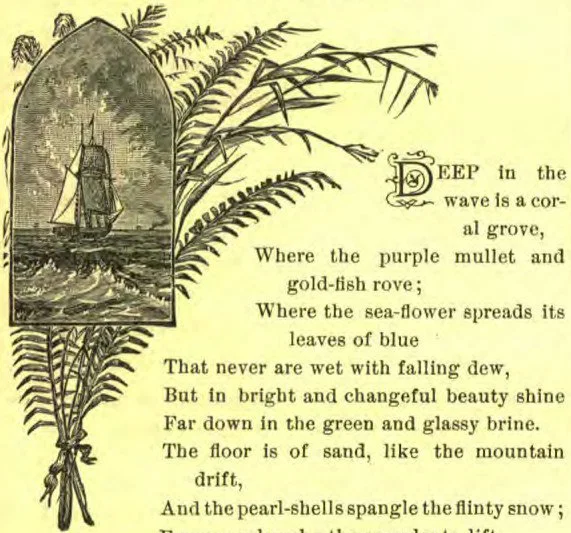
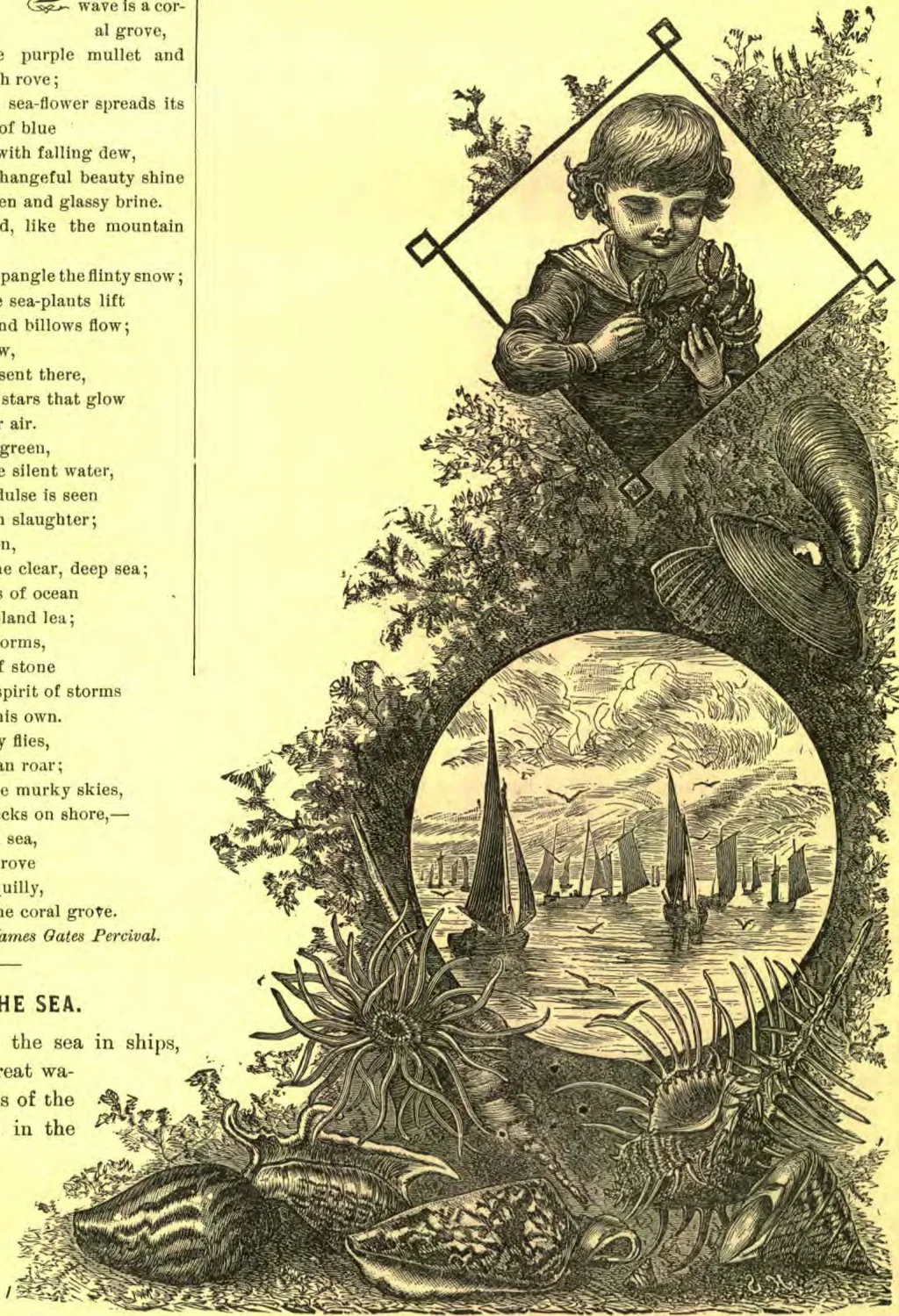
Deep in the wave is a coral grove, Where the purple mullet and gold-fish rove; Where the sea-flower spreads its leaves of blue That never are wet with falling dew, But in bright and changeful beauty shine Far down in the green and glassy brine. The floor is of sand, like the mountain drift, And the pearl-shells spangle the flinty snow; From coral rocks the sea-plants lift Their boughs, where the tides and billows flow; The water is calm and still below, For the winds and waves are absent there, And the sands are bright as the stars that glow In the motionless fields of upper air. There, with its waving blade of green, The sea-flag streams through the silent water, And the crimson stream of the dulse is seen To blush like a banner bathed in slaughter; There with light and easy motion, The fan coral sweeps through the clear, deep sea; And the yellow and scarlet tufts of ocean Are bending like corn on the upland lea; And life, in rare and beautiful forms, Is sporting amid those bowers of stone And is safe, when the wrathful spirit of storms Has made the top of the waves his own. And when the ship from his fury flies, Where the myriad voices of ocean roar; When the wind-god frowns in the murky skies, And demons are waiting the wrecks on shore,— Then, far below, in the peaceful sea, The purple mullet and gold-fish rove Where the waters murmur tranquilly, Through the bending twigs of the coral grove. —James Gates Percival.

THE WITNESS OF THE SEA.

THEY that go down to the sea in ships, that do business in great waters, these see the works of the Lord and his wonders in the deep.” But not these alone. All who go to the seashore in the vacation days of summer must also be impressed by the beauty and majesty of the sea.
From the golden hours of the morning, when the king of day comes forth above its gleaming surface in his chariot of flame, all along the swiftly passing day, through the radiancy of the noontide and the luster of the purple sunset, burnishing the waters and transfiguring the neighboring islands, until the more distant objects on the horizon gradually fade from view in the deepening twilight, the sea is an unfailing source of pleasure alike to young and old.
But the wonders in the deep, both in number and variety, far exceed those upon its surface or along its shores. At low tide we may walk out over the rocks covered with the sea-weed, brown, and purple, and green, and explore the nooks and crannies and little caverns for the treasures under the sea. Drawing aside the sea-weed here and there, we find that we are treading under our feet myriads of tiny shells filled with life. By-and-by we discern the star-fishes clinging with their “five fingers” to the rocks, all so soft and jaunty in their shining coats of red.
Peering into a crevice of the rocks, we espy far down beneath the shelving, dripping roof of their “castle of the sea” a group of beautiful sea-anemones. There they are firmly fastened in their lowly home, and yet with each recurring tide their every need is supplied abundantly. If we watch them carefully, we observe that they throw out their tentacles like fringes, and that by the aid of these they can draw their food to their mouths. They exist in considerable variety, and in some instances are very gorgeous in their coloring.
If we capture a few of them and put them into glass jars filled with sea water over night, we shall find them in the morning, to use the words of one of our noblest naturalists, “a bouquet of chrysanthemums. Each will have expanded into a hundred-petaled flower, crimson, pink, purple, or orange. Touch one, and it shrinks together like a sensitive plant, displaying at the root of the petals a ring of brilliant turquoise beads.” Some are blood-red, others of a delicate sea-blue, striped with pink, as we learn from that close and reverent observer of sea and field and air, Charles Kingsley; but specimens of such brilliant anemones are found chiefly on the English coast. How strange it seems to us that these beautiful evidences of the Creator’s wisdom and skill should be hidden among the rocks and under the sea, almost entirely unseen by man. But in this, as in so many other things, God’s thoughts are not as our thoughts. His eye can see them. His care extends to them. They give pleasure to him, in whose infinite mind they were planned before they were created!
If the rocks along the shore teem with so much of life and beauty and power, what inestimable treasures must lie infolded in the depths of the ocean! As we gaze upon its vast expanse, and try to penetrate a little way below the surface, the words of the Benedictine, so often used in the services of the Christian Church, come floating before the mind: “O ye seas and floods, O ye whales and all that move in the waters, bless ye the Lord; praise him, and magnify him forever!”
The reverent heart finds God in the infinitely little as easily as in the infinitely great. Witness to this truth is borne on every hand in earth and air and sky. But nowhere is that testimony more attractive in itself or more convincing in its character than on the sands and among the rocks of the wave-beaten shore.
“There is a Book, who runs may read, Which heavenly truth imparts, And all the lore its scholars need, Pure eyes and Christian hearts.”
—Christian Weekly.

SOME PORTIONS OF GERMANY AND HOLLAND

FOREIGN TRAVEL.—NO. 17.

SOME PORTIONS OF GERMANY AND HOLLAND.

After leaving Cologne, we traveled in Northwestern and Northern Germany, and made a very brief visit to Holland. Northern Germany is, on the whole, quite level, and resembles the northern States of America in many respects. The climate is not nearly so mild as in Southern Germany. Grapes, which are very plentiful in the southern part, are rarely seen in the north. Because of the cold climate, fires become a necessity, and the people have to give more attention to the matter of fuel. Forests are quite plentiful, and some of them are very fine.
We spent only a day or two in Holland, going there to see a friend. Though this is now quite a small country, and has but little political influence among the nations, yet the world owes much to Holland for its heroic position in the dark days after the great Reformation, when the Catholic nations tried their best to crush out the spirit of religious liberty in Europe. There was a time when Holland was able to cope with the strongest nations, as it did with England for the supremacy of the sea. Its mighty fleets, under the famous Van Tromp and De Ruyter, were as strong as any in the world. And Philip, king of Spain, at that time perhaps the strongest kingdom in Europe, tried his best, but failed, to conquer the stubborn Dutch who adhered to the Protestant cause. Many of them suffered death for their faith in the persecutions carried on by the Spaniards under the Duke of Alva.
But now all is changed. Holland is one of the most tranquil of kingdoms. The descendants of those warlike Dutch are now engaged in the peaceable pursuits of commerce, in raising fat cattle and fine stock, in lending money, and smoking their pipes. Nearly all the country of Holland is very level and low, and much land has been reclaimed from the sea. The mouth of the Rhine, with its different outlets, here opens to the sea. This river, which is so clear and rapid in its beginning, at this point moves with scarcely a perceptible current. The soil is very rich, and produces large crops of vegetation. We rarely see finer cattle and horses than we beheld grazing in the rich meadows of Holland. Canals and water courses are very numerous, and in all directions windmills may be seen extending their broad fans to catch the breeze. Much grain is ground in these windmills, though they would seem to us to be very slow and unreliable. But we judge that in the low country of Holland, bordering on the sea, the winds must be strong, thus affording much motive power where the use of water-mills is impossible. In our ride through the country, from ten to fifty of them were usually in sight.
Amsterdam is a very large, rich city, connected with the sea by its great canals. It is an important port. It lies very low and flat, but has many fine buildings. It has nearly as many canals running through it as Venice, and boats are constantly passing and repassing. But it has streets also for foot passengers and vehicles. Some of the canals were being filled up. As there is no foundation of rock to build upon, and the soil is very wet and soft, piles are driven into the ground thickly. These are cut off evenly, and the walls of the houses are built upon them. We saw them hoisting these long, huge poles, thirty-five or forty feet long, and driving them into the soft earth with their heavy pile-drivers, which were run by steam. They did it very rapidly.
Holland is encircled by a system of dikes, thrown up high to keep the sea from flooding the country. The energy of man can even dispute with nature, and gain the victory over it within certain limits. The Dutch have now a goodly heritage which they have recovered from old ocean.
The Dutch are a solid, sensible people. Their houses are kept clean and neat, and they are thrifty and intelligent. But they are great smokers. It is enough to stifle one to ride in a car where smoking is not prohibited.
In going from Holland through Northern Germany, we traveled very rapidly, and had no time to stop to view the country, or see interesting objects. In riding all day rapidly on the train, through Amsterdam, Utrecht, Oberhausen, Hamburg, and Kiel, we scarcely saw the surface of the earth sufficiently elevated to be called a hill, to say nothing of a mountain. There were some very fine groves of beech trees, as fine as we ever saw, and others of pitch pine of quite large extent. There are many villages and small towns on the route, and the people looked thrifty and quite prosperous.
The Germans are a fine, noble-looking race, on the whole superior to any we have seen, always, of course, excepting our own. It would not sound well to set any other people above the Anglo-Saxon race. But really the Anglo-Saxon race is a German one. The Angles and Saxons left Germany when they conquered England, more than a thousand years ago; so the Germans and our own race are a sort of forty-fifth cousins. Considering both of them as of German descent, it places this race a great way in advance of any other in the world in wealth, power, intelligence, push, and moral stamina, and one of the very first in numbers, supposing there are some 80,000,000 speaking the German tongue in Europe, and perhaps 1,000,000,000 in Great Britain, America, Australia, and other countries, speaking the Anglo-Saxon tongue, and it gives quite a large figure for the German kinship, in all parts of the world.
In Germany itself, one is surprised to see so great a number of large-framed, strongly built men, and healthy-looking women, who appear as if they could bear the burdens of families, and endure the wear and tear of life. The people look intelligent, and are such. All can read and write, education being compulsory. Every child must go to school. One is struck with their look of superiority as compared with the nations of Southern Europe. To me, it was no wonder that in the recent wars, Germany came out ahead. The nation is full of soldiers, well dressed and well armed. Every town has them. They have a proud, martial air, and they are the most thoroughly drilled of any soldiers in the world. The beer-drinking and tobacco-smoking, however, are great drawbacks; and one can but regret to see them waste their strength in such miserable, destructive habits. We will speak more of Hamburg and Germany on our return trip.
UNCLE IDE.

EDITOR'S CORNER.

All persons need at times to make promises, or engagements, and generally they are made with the intention of being kept. But if the one to whom the promise is made feels any doubt or uncertainty as to its fulfillment, he usually asks a pledge of faithfulness on the part of the one who has promised. Simply adding the word “certainly” or “surely” often serves to confirm the promise. The Saviour sometimes verified his word to his disciples by the use of “verily” and “truly.” The young most frequently strengthen their promises by the addition of “honor bright!” “upon honor!” and the like.
In thus making use of the term “honor bright,” dear readers, do you simply mean that your word respecting that one promise is true? or do you mean that your honor is always bright?
Honor is defined as “a nice sense, or a correct understanding, of what is right, just, and true, with a course of life to correspond.” You might have a nice sense of right in some matters, obeying your convictions of duty regarding them, and in other things be greatly lacking; would that make you truly honorable?—No, indeed! Your honor must be always bright to give you the character of an honorable person.
If you, young friends, would take advantage of wisdom gotten by the experience of your superiors, and build a character in which honor is always bright, those who are hard at work to get you in right relations with God and your fellows could devote much more time in trying to elevate other members of the human family; and should you be thrown upon your own resources, a place of usefulness would open before you. There is a desirable place for honorable boys and girls,—those who prove themselves such.
Although you are young, remember there are those interested in watching the growth of your characters. Do you yield to temptation, disgracing yourselves with mean, dishonorable acts, these defects will be thrown right in between you and success. On the other hand, do you regard your word so sacred as never to “lose your promise,” it will stand as a Gibraltar in your defense.
Dear young friends, let this be a golden motto, “Honor always bright!”
“Say, what is honor? ’Tis the finest sense Of justice which the human mind can frame, Intent each lurking frailty to disclaim, And guard the way of life from all offense Suffered or done.”
M. J. C.

TRIFLES

Are there any “little” things,— Those we deem so are so great! Poison fangs are hidden and small, But they kill the strongest man; Poisonous weeds can harm us all, More than leafy forests can; Little lies on little wings Are dread messengers of fate.
Little rifts make music cease, Little rocks sink vessels great, Little leaks in dam and dike Loose the floods to spoil and rend; Little whispered words can strike Cruel blows at heart of friend, Little signs be auguries Of great changes in the state.
Little habits grow to chains Which can fetter man’s strong will; Little kindnesses can heal, Little helps may save a soul; Little hands for woe or weal Can the sternest lives control; Fortunes start from petty gains; Every river was a rill.
“Small,” we say, “of little worth,” Heedless what the end shall be; But the angels sadly sigh Over what we so despise, And the small faults we decry Bring a cloud to heavenly eyes, And the petty deeds of earth Mold the long eternity.
—S. S. Times.

DOCTOR JOHN KITTO.

Near the beginning of the present century, in a home made wretched by the intemperate habits of the husband and father, a wailing baby opened its eyes only to rest them upon misery and want. In that home there was lack of nourishing food as well as of comfortable clothing for the puny infant. In wretchedness and neglect the baby boy struggled on, living in spite of neglect, until, when he was four or five years old, his grandmother came one day into the house, and seeing the misery there, asked the father and mother to let John go home with her to live. Their consent gained, John was only too glad of the peace and quiet of his grandmother’s humble home. It was while living with this old lady that he tasted something of the sweets of childhood, but it was only for a brief period. His grandmother soon became too infirm to live by herself, and as John was not old enough to care for her, they went to live with John’s parents, and again the boy entered upon a life of hardship. When he was old enough, he began to work with his father, who was a stone mason. One day, when he was eleven years old, he fell from the top of a high building where he was working, and was picked up from the ground, white and limp as if he were dead. Then there was confusion in the wretched home, made more wretched by the presence of sickness and the approach of what seemed like death. For many days the boy lay in a stupor from which it was impossible to rouse him. Anxiously the watchers stood around, expecting him soon to breathe his last. But to their surprise, he opened his eyes, and seemed to know them. Long before this, his friends had discovered his fondness for books, and I do not suppose they were surprised when he asked for a certain book which he had been reading before he fell. When he was refused, he was unable to understand what they meant, and grew impatient with what seemed to him like stupidity. He exclaimed, “Why don’t you answer me?” One of his friends wrote on a slate, “You are deaf!”
Imagine what that would be to an eleven-year-old boy! To be deaf, never to hear the voices you love, never to listen to the singing of birds or the babble of brooks, never to hear the wind sighing through the pines, not even to be startled by the roar of thunder—can you imagine it? And this was what befell John.
Things did not mend at home, and when John was fifteen, he was sent to the almshouse. Here he was set to work making shoes; and here he remained for several years. Once in the time he was bound out to a shoemaker, but he was treated so badly by his master that the authorities interfered, and he returned to the almshouse, where he had to work very steadily; but he contrived to find time for a great amount of reading and study.
After a time, some benevolent gentlemen found out how he was trying to gain knowledge, and planned a way to help him. He left the place where he had been so long, and went to live with a gentleman who gave him every opportunity for study. You may be sure he improved these opportunities, and soon became a fine scholar. Then he had a chance to travel. He wrote many books, and I have no doubt you may find in your father’s library some of them, as “Cyclopedia of Biblical Literature” or “History of the Bible.”
His writings are of great value, and the world could not well have done without him. Yet how many, laboring under his disadvantages, would have felt excused from doing anything to add to the literary wealth of the world. How many would have persevered in study under such difficulties? From his very babyhood, his life was one of struggle and privation; yet by steady, persevering industry, he rose above circumstances, and at length gained an honored name and position among men of letters, and for several years before his death, which occurred in 1854, he was known as Doctor John Kitto.—The Pansy.

IMPORTANT BIBLE SUBJECTS.

LESSON 12.—IMMORTALITY.

[NOTE TO THE STUDENT.—Do not consider the lesson learned until you can give at least the substance of every text, with the correct reference for each. The references in black letters indicate those texts that should be committed to memory. A little diligent application each day will enable you to do this.]
“Wherefore, as by one man sin entered into the world, and death by sin; and so death passed upon all men, for that all have sinned.” Rom. 5:12.
“Fight the good fight of faith, lay hold on eternal life, whereunto thou art also called, and hast professed a good profession before many witnesses.” 1 Tim. 6:12.
“For as the Father hath life in himself; so hath he given to the Son to have life in himself.” John 5:26.
“And changed the glory of the uncorruptible God into an image made like to corruptible man, and to birds, and fourfooted beasts, and creeping things.” Rom. 1:23.
“Shall mortal man be more just than God? shall a man be more pure than his Maker?” Job 4:17.
“For the wages of sin is death; but the gift of God is eternal life through Jesus Christ our Lord.” Rom. 6:23.
“But is now made manifest by the appearing of our Saviour Jesus Christ, who hath abolished death, and hath brought life and immortality to light through the gospel.” 2 Tim. 1:10.

QUESTIONS.

  1. What is the meaning of the word “immortal”?
  2. What is the appointed lot of mankind? Heb. 9:27.
  3. Are any exempt from death? Rom. 5:12.
  4. Then can it be that any of the human race are immortal?
  5. What exhortation did Paul give to Timothy? 1 Tim. 6:2.
  6. Until what time did he charge Timothy to keep this commandment? Verses 13, 14.
  7. What did he say that Christ in his times should show? Verse 15.
  8. What did he say further concerning this “blessed and only Potentate”? Verse 16.
  9. Who is this “blessed and only Potentate” here referred to?
  10. Then who alone is possessed of immortality?
  11. Does Christ share this attribute equally with the Father? John 5:26.
  12. What contrast does the apostle Paul institute between God and man? Rom. 1:23.
  13. What is the meaning of the words “corruptible” and “incorruptible”?
  14. Since God only hath immortality, what term must be applied to man? Job 4:7.
  1. Who has eternal life to bestow? Rom. 6:23.
  2. Through whom may it be obtained? Ib.
  3. To what class of persons will it be given? Rom. 2:7.
  4. If men have immortality, would they be exhorted to seek for it?
  5. How are we to seek for it? Rom. 2:7.
  6. Then if none get it but those who seek for it, what can you say of those who do evil?
  7. Who is it that has brought immortality to light? 2 Tim. 1:10.
  8. By what means is it presented to mankind? Ib.
  9. Then where are we to seek for immortality?
  10. What can you say of those who do not accept the gospel?

NOTES

Immortal.—Not mortal; exempt from liability to die; undying; imperishable; lasting forever; having unlimited existence.—Webster.
The blessed and only Potentate.—God, who is the ruler over all. The word used here means one who is mighty, then a prince or ruler. It is applied here to God as the mighty ruler of the universe.—Barnes.
Who only hath immortality.—The word here properly means exemption from death, and seems to mean that God, in his own nature, enjoys a perfect and certain exemption from death. Creatures have immortality only as they derive it from him, and of course are dependent on him for it.—Ib.
The question is not whether others besides God may come into the possession of immortality, but as to whether they have it by nature. Angels are immortal (Luke 20:35, 36), but they were once on probation, and their immortality was received as a gift from God. They cannot bestow it upon others. But God has “life in himself,” and can therefore bestow it upon whomsoever he will. Christ also has life in himself, because he is the Son of God; he has it by inheritance.
Corruptible.—Capable of being corrupted or tainted; subject to decay and destruction.—Webster.
Incorruptible.—Not corruptible; incapable of corruption, decay, or dissolution.—Ib.
In order to get the force of Rom. 2:7, we must bear in mind that the words “eternal life” are the direct object of “will render,” in verse 6. The meaning is, that God will render to every man according to his deeds; to those who, by patient continuance in well-doing, seek for glory and honor and immortality, he will render eternal life. To those who do not obey the truth, he will render indignation and wrath, as the following verse states.
“Immortality” means a state of unending existence; one in which the possessor cannot die. It must, therefore, be synonymous with “eternal life.” Rom. 2:7, then, teaches the simple fact that those who seek for immortality in the proper way, will have it bestowed upon them. But this is directly at variance with the idea that everybody possesses immortality.

Continuing Forward in the Christian Course

It is not enough merely to strike the right path. There must be progress in it to the end. One may follow it a little way, then stop, waver and swerve from it through the force of the various besetments. To advance in the right direction is the condition of success as well in building up an influential moral and religious character, as in completing a benign and symmetrical life-work. The world is strewn with the wrecks of those who ran well for a season, but then suffered the love of ease or pleasure to avert them, and turn them from their course. It is continuance in well doing, the going forward step by step in the right path, the strength increasing, and the hope brightening as the goal draws nearer, that secures success in the life-career that most benefits the world. It is in the Christian life that constant progress—as opposed to standing still from whatever cause—is most essential, and finds the supremest rewards. Paul understood this, and constantly enjoins it upon all who read his words; and it is his experience that should stimulate to renewed effort every one that grows listless or laggard, or ready to halt in the Christian course. “I count not myself to have apprehended; but this one thing I do, forgetting those things which are behind, and reaching forth to those things which are before, I press toward the mark for the prize of the high calling of God in Christ Jesus.”

THE BROKEN COMMANDMENT.

“She’s just as mean as she can be! I almost know she peeked when the teacher wasn’t looking, else how should she spell the word right, and get above me? That isn’t all either. You know that lovely plaque down to Jay’s that I pointed out to you girls as the one I meant to buy when I got money enough. Well, what did she do but go down there after school and buy it herself. I think she’s just hateful! So there! Of course she did it just to plague me.”
Mrs. Lane looked through the blinds in surprise. Could that be her Mollie talking in such a way, and about the very friend with whom she had walked arm in arm to school that morning?
“Come in, Mollie, I wish to speak with you.”
The voice was quiet, but Mollie started. She had meant her words for Mina Armstrong’s ear, and felt ashamed to know that mamma had overheard them. She entered the sitting-room half dreading a reproof.
“Can you recite the commandments, dear?”
The words reassured her. Perhaps mamma had not heard the talk.
“Certainly. Don’t you remember I learned every one those stormy Sabbaths?”
“Which one has a little girl I know just broken?”
“Oh, but mamma, you see I didn’t bear false witness. Every word I said was true, only I guessed about the peeking.”
“But I don’t mean the false witness one. You have heard of Shakespeare! Listen to what he says:—”
“He that filches from me my good name Robs me of that which not enriches him, And makes me poor indeed.”
“Why, mamma Lane, you surely do not—you cannot mean, ‘Thou shalt not steal.’ I never thought of such a thing!”
“That is just what I do mean. I know you would not take a penny, or even a pin, which was not your own; but a person’s good name is worth more to its owner than great wealth. Think of this, child, when tempted to speak ill of any one, and remember the commandment, ‘Thou shalt not steal.’”
Mollie walked away thoughtfully. Stealing had always seemed to her so mean and low! She had thought her friend almost a thief for finding the way to spell the word. Now, she could only think of herself, and the great poet’s words.
There was a ring at the bell. A boy handed her something wrapped in tissue paper, and a little note bearing her name. This was what the note said:—
“Dear Mollie, i am so sorry i spelt the word rite. i never knew before there was any i in business or i would not have put it in. Hear is the plak you wanted. i bought it with my own money for you. Less be friends just the same, and I wont get above you again. respectively yours, Jenny.”
As you may imagine, it did not take Mollie many minutes to put on her things, and run over to Jenny’s house. And you will not be surprised to hear that the next day they went to school arm in arm just as usual. I think afterwards that Mollie was always more careful how she formed judgments, and what she said about her friends.
—S. S. Advocate.

FRANK'S “NEIGHBOR.”

FRANK is a boy with a large heart. He gives away his balls and kites and tops, and says cheerfully, “Never mind; I don't care about it.”
His father gave him a handsome sled last winter, and told him that he must keep it. But Frank gives away rides to his heart's content. The poor boys who haven't sleds or skates know just where to go when they want to enjoy the delights that old Winter knows how to give.
Frank's grandma is well pleased to see her boy so generous, but she wants him to learn wise generosity. She gave Frank three dollars not long ago to spend as he pleased.
“He won't keep it three days,” said his mother, “probably not three hours. He will not be happy until he has given it all away.”
But nearly a week passed, and the three crisp bills were still in Frank's pocket. Meantime he was very busy and thoughtful. Then he came home one day, and, said,—
“Mother, I know a boy that's almost sick all the time, and I know a place where he can go at the seashore and stay two weeks for nothing if he can only get there; but his folks are awful poor, and can't get the money to send him. Hadn't I better give him my money?”
“I didn't know but you would like to take a little trip yourself,” said Mrs. Morris, smiling.
“Well, I don't care much about it; and then, you know, I'm well, and he isn't. I guess I'll give him my money if you are willing.”
Of course Mrs. Morris was willing; and so poor Tommy Smith had a fortnight at the seashore, and received a great deal of good, because a kind-hearted boy loved his neighbor as himself.—S. S. Advocate.

Letter Budget.

We here give the names of a few whose letters have been among the waiting ones so long. These dear children tell their love for the INSTRUCTOR, and that they are trying to do right. May the tender Shepherd gently lead them in his rich pastures. The names are, May Smith, Ramsey Co., Minn., Mertie Bennington, State not given, Carrie Trogen, Wright Co., Minn., Clifford S. Cole, Eaton Co., Mich., L. Nichols, York Co., Neb., and Florence I. Galer, Canada.
We have a letter written in June by WILLIE S. MITCHELL, of Polk Co., Neb. He says: “As I cannot go to school, I thought I would write a letter for the Budget, in hopes of seeing it printed. We have all been very sick with the scarlet fever. I have one sister five years old, one three years old, and a baby sister—she is sweet—four months old. We did not have a doctor when we were sick, nor take medicine; but mother treated us with water. I like to read the INSTRUCTOR very much. I want to be a good boy. I am trying to read the Bible through. Excuse all mistakes, as this is the first letter I have tried to write.”
We would like to see your sweet sister, Willie. If you would have her always sweet, you must be gentle and kind always with her. Willie’s mamma knows a better way to treat the sick than with medicine. Tell us the next time you write if she takes the Good Health, will you?
RUTH HASKELL, of Arapahoe Co., Colo., says: “I have taken the INSTRUCTOR six years, and like it much. I have been canvassing for it. We all go to Sabbath-school every Sabbath. Our class are reading the New Testament through. I want to be a good girl, and meet the INSTRUCTOR family in heaven.”
We like to know that you are canvassing for the INSTRUCTOR. We have had a great many new subscribers this summer, which you will be glad to learn.
LEAH VANDERMARK writes from Arapahoe Co., Colo. She says: “I have never written for the Budget before. I like the INSTRUCTOR very much. I have been canvassing for it. I go to Sabbath-school, and have begun to read the New Testament through. I am twelve years old. I want to be faithful, so I can be saved when Jesus comes.”
As you belong to the same Sabbath-school as Ruth Haskell, perhaps you went out canvassing together. We trust you are of good courage, and that you will persevere in the work until you are the means of getting many interested in the paper.
Continue reading: THE TWO FRIENDS