The Youth’s Instructor, Vol. 32, No. 50.

HONOR THY FATHER AND THY MOTHER

The Youth’s Instructor

Dec 10, 1884

S. D. A. Publishing Association · Battle Creek, Mich. · Dec 10, 1884

HONOR THY FATHER AND THY MOTHER.

THERE is a touching story of the famous Dr. Samuel Johnson, which has had influence on many a boy who has heard it. Samuel’s father, Michael Johnson, was a poor bookseller in Litchfield, England. On market days he used to carry a package of books to the village of Uttoxeter, and sell them from a stall in the market-place place. One day the bookseller was sick, and asked his son to go and sell the books in his place. Samuel, from a silly pride, refused to obey.
Fifty years afterward, Johnson became the celebrated author, the compiler of the “English Dictionary,” and one of the most distinguished scholars in England; but he never forgot his act of unkindness to his poor, hard-toiling father; so when he visited Uttoxeter, he determined to show his sorrow and repentance.
He went into the market-place at the time of business, uncovered his head, and stood there for an hour in a pouring rain, on the very spot where the bookseller used to stand. “This,” he says, “was an act of contrition for my disobedience to my kind father.”
The spectacle of the great Dr. Johnson standing bareheaded in the storm, to atone for the wrong done by him fifty years before, is a grand and touching one. There is a representation of it (in marble) on the Doctor’s monument.
Many a man in after life has felt something harder and heavier than a storm of rain beating upon his heart, when he remembered his acts of unkindness to a good father or mother now in their graves.
Dr. John Todd, of Pittsfield, the eminent writer, never could forget how, when his old father was very sick, and sent him away for medicine, he (a little lad) had been unwilling to go, and made up a lie that “the druggist had not got any such medicine.”
The old man was just dying when little Johnny came in; and he said to him, “My boy, your father suffers great pain for want of that medicine.”
Johnny started in great distress for the medicine, but it was too late. The father, on his return, was almost gone. He could only say to the weeping boy, “Love God, and always speak the truth; for the eye of God is always upon you. Now kiss me once more, and farewell.”
Through all his after life, Dr. Todd often had a heart-ache over that act of falsehood and disobedience to his dying father. It takes more than a shower to wash away the memory of such sins. Dr. Todd repented of that sin a thousand times.
When Washington was sixteen years old, he determined to leave home, and be a midshipman in the Colonial navy. After he had sent off his trunk, he went to bid his mother good-by. She wept so bitterly because he was going away, that he said to his negro servant, “Bring back my trunk; I am not going to make my mother suffer so by my leaving her.”
He remained at home to please his mother. This decision led to his becoming a surveyor, and afterwards a soldier. His whole glorious career in life turned on this one simple act of trying to make his mother happy. And happy, too, will be the child who never has occasion to shed bitter tears over any act of unkindness to his parents. Let us not forget that God has said: “Honor thy father and thy mother.”—Dr. T. L. Cuyler, in Youth’s Companion.

SOME COMMON THINGS WE SAW IN EUROPE

FOREIGN TRAVEL.—NO. 23.

SOME COMMON THINGS WE SAW IN EUROPE.

Our travels in foreign lands being now ended, we will close this series of articles by noticing yet a few things which we think may interest the readers of the INSTRUCTOR. European customs seem very strange to one who has been reared on the American continent; and it was quite novel to us to see the women working in the fields, as they do in that country, as regularly as the men. We saw them plowing, digging with the spade and hoe, sometimes chopping, and carrying mortar and other burdens; in some cases they were even yoked up to carts, which are much used in the cities. Most of the people are too poor to own horses, so the burdens are drawn in hand-carts. They work in the open air, spending but little time in the duties of housekeeping. No doubt this custom was an effect of the great wars of the past. At such times the men were drafted into the army, and none but the old men and the youth were left at home, so the women had to do the work. When the soldiers came home, they were accustomed to army life, and unused to labor; but the women having learned how, continued to do the out-door work. Very likely the habit originated as above, though in many of these countries, wages are so low that it requires the united efforts of all the members of the family, working at their utmost, to earn even the necessaries of life.
The struggle for life is terrible in the older countries of the world. Our American ladies know but little of life's realities in some parts of Europe.
In Germany, the hand-carts were drawn, partially, by large dogs. These were harnessed under the cart; while a person took hold of the handle of the cart, the dogs would put forth every effort, apparently, in their power to force the cart along. They seemed to know their duty, and felt determined to discharge it in the most effective manner possible. Our sympathies were somewhat excited in behalf of the dogs, as we saw how vigorously they exerted themselves. We wondered whether they had ever felt the force of the rod.
In some fields we saw cows and oxen yoked together, working with the plow or cart; and in others, a horse and an ox or cow hitched together.
In Germany, Switzerland, and Italy, grape culture is carried on very extensively, and the fruit is manufactured into wine. In the northern countries the vines are kept small and low, and trained to small poles four or five feet in height, and very close together. The vines not being permitted to run but a short distance, keep bunching out, which turns most of its strength into the grape cluster. In many places in Italy, trellises are formed six or seven feet from the ground, over which the vine runs, forming a covering over the whole ground. In other places, they are trained to run on the mulberry trees, which are planted in rows fifteen or twenty feet apart.
In Italy, Switzerland, France, and Southern Germany, wines are as commonly drunk at every meal, as are water, tea, and coffee in this country. Being good teetotal temperance people, we did not even taste the wine, but were told it was not very pleasant.
Beer is the principal beverage with most Germans. The amount drunk at the beer gardens is perfectly enormous, and would astonish some of our temperance workers. Yet we did not see any more drunkenness in these countries than in our own,—perhaps, hardly as much. Being accustomed to drink these beverages from their childhood, they do not usually get fully intoxicated; but the injurious effects upon them we think are striking. Constant imbibing of strong drinks destroys and benumbs the finer faculties of the mind, and is an injurious practice.
There are many things in Europe which we could profitably imitate in this country. Their roads are most excellent. They are hard as a floor, and about as smooth. They are stoned up nicely with masonry on the sides, and paved over the surface of the ground. There are no mudholes and unseemly places; we scarcely noticed an exception in any place in Europe. Of course it requires many years of preparation and much labor and expense to put them in this fine condition. The people receive so small wages it is necessary that they have constant employment in order to sustain life; hence many are employed on the public works, which are always kept in order.
To an American, it seems almost impossible to live on the wages of a common laborer in many of the old countries. Wages vary somewhat in different places, from twenty-five to fifty cents per day being about the usual rate for common labor. The cost of living is usually as high as here. Much of the grain is imported from this country. Cloth is somewhat cheaper. Rent is fully as high.
In passing through the cities and towns of Europe, one sees many soldiers and officers in uniform. Policemen carry swords, either long or short, by their sides, and we met one at every turn. If a person offered to walk on the railroad track, he would be arrested very quickly. People are not usually allowed to walk even across the track, but high bridges are erected so that the cars can pass under them, and the people can go over and not cross the track, so careful are they of human life.
The houses in Europe are built very strong and durable, wholly of stone or brick. They are expected to stand for centuries. The public markets are usually in the open squares, on the streets, and are usually kept by women. They have their little stands of fruit or vegetables, and sell butter, flowers, etc.; and during their leisure moments they sit visiting with one another, busily engaged in knitting or sewing, and having a nice, quiet time. They have little cloth booths or tents, which shelter them from the sun or rain. They come in the early morning; at three or four o'clock P. M., they pick up their goods and depart, leaving the public squares forsaken and bare. Some of these market women carry their burdens on their heads, and their dexterity in doing so is surprising. I saw women carrying tubs of water in this way, that would hold as much as two large pailfuls, and filled within an inch of the top. They would lift them upon their heads and walk off as calmly as an American lady could carry her portmonie in her hand. They have a sort of cushion which they place upon the top of the head to ease the burden as much as possible.
In many towns they took special pains to have pleasant gardens, laid out in every kind of shape, filled with every variety of flowers, with borders of various kinds of plants, which makes them very attractive. Many of them are adorned with pleasant fountains, some of them of remarkable beauty.
There are many pleasant and beautiful things to be obtained in Europe if one has money which he can afford for them. During the many centuries of the past, the people have had a chance to make improvements, and things look far more finished and tasty than in our new country. But on the whole, America is the land of our choice. There is no place like home. UNCLE IDE.

W. S

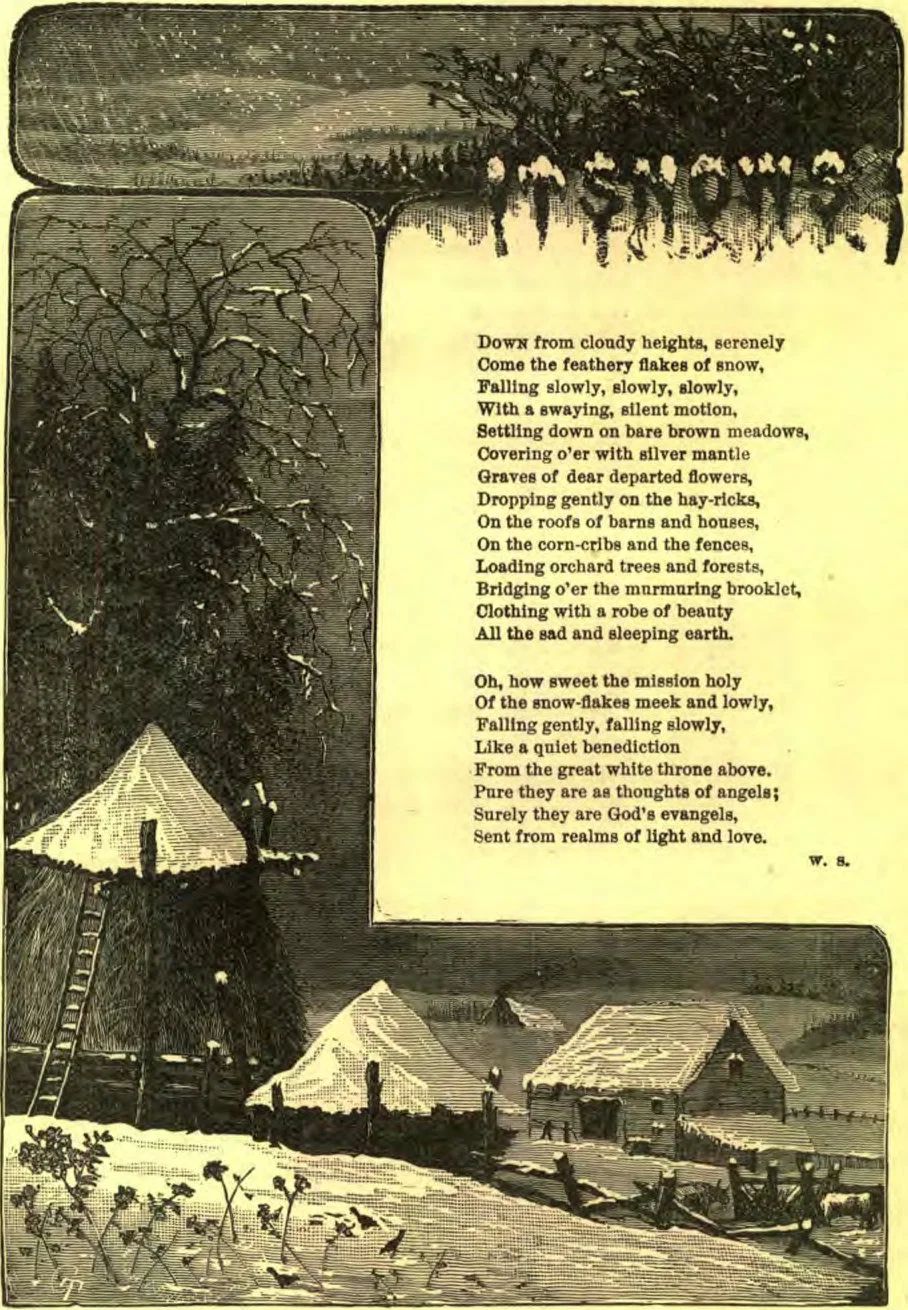
Down from cloudy heights, serenely Come the feathery flakes of snow, Falling slowly, slowly, slowly, With a swaying, silent motion, Settling down on bare brown meadows, Covering o'er with silver mantle Graves of dear departed flowers, Dropping gently on the hay-ricks, On the roofs of barns and houses, On the corn-cribs and the fences, Loading orchard trees and forests, Bridging o'er the murmuring brooklet, Clothing with a robe of beauty All the sad and sleeping earth.
Oh, how sweet the mission holy Of the snow-flakes meek and lowly, Falling gently, falling slowly, Like a quiet benediction From the great white throne above. Pure they are as thoughts of angels; Surely they are God's evangels, Sent from realms of light and love.

W. S

LITTLE STRAWS.

“George, will you go out to the stable and bring me a few small straws in your hand?” said Mrs. Jones, one evening after they had talked about the next Sabbath’s lesson a little while.
“Yes, ma’am,” said George, pleasantly, as he ran down the garden-walk; for he knew that his mother wanted to show them something about the lesson.
“Will these do, mamma?” said George, as he came back in about a minute.
“Yes, my dear. Can any of you tell me which way the wind is blowing this evening?”
“Why, mamma,” said Lucy, “the wind is not blowing at all. There is hardly a leaf in the garden moving. It is all as quiet as a church-yard.”
“Now, we shall see what use we can make of George’s straws. Go out into the garden, George, and throw them up in the air.” He did as he was told.
“Now,” continued his mamma, “which way does the wind blow?”
“Northeast!” shouted several voices at once.
“Now you see the meaning of that old sentence you have heard so often, ‘Little straws tell which way the wind blows.’”
“But what has that to do with our lesson, mamma?” said George.
“I do not think I said it had anything to do with it; but we will make it have something to do with it. Can you tell me again what men Gideon was told to pick out of his army in the second division?”
“It was those who raised the water to their mouths with their hands, and lapped it like a dog.”
“Well, that seems a very little thing to pick out men by; and yet that little thing may have told a great deal about the men. Some tell us that those who knelt down to drink had to lay aside a part of their armor; but the others did not lay off any of theirs—they stood ready to battle all the time. And so a very little thing may show now what kind of people we are. I think I can tell a good deal about a boy from the way he walks. If he goes moping along, dragging his feet on the ground as if he was not able to lift them, I set him down as a lazy boy. If I peep into a girl’s room, and find everything upside down, topsy-turvy, shoes under the bed, and dresses on the floor, towels on the writing-desk, and books on the washstand, I set the owner of the room down for a lazy girl. So you see, my children, you should always watch the little things.”—Selected.

TIM'S PLAN AND HOW IT WORKED.

“Want your coal brought up, sir?”
Dr. Bell, turning about, eyed the new-comer from head to foot; and, to tell the truth, it was not a very great distance from Tim’s head to his feet.
“Well, now!” exclaimed the doctor at last, “how many days do you think it would take you to bring that ton of coal up the stairs?”
Tim flushed angrily.
“Not any more days, sir, than it would take your big boys that stop every few moments for a smoke or a drink;” and Tim turned about, and in a moment was down on the street again. “Mean old thing!” he exclaimed under his breath; “he might ha’ known I can’t help being small.”
People were hurrying to and fro, and no one noticed the disappointed little fellow standing there with his hands in his pockets.
“Hello, Dake! Was that your errand boy that skipped off the other day with so much money? It was? Why how did you happen to get so taken in?”
“Why, he brought good letters; and he carried such an honest face that I never thought of watching him.”
“Oh, that was it? Well, you don’t catch me that way. A boy may make me ever so good promises, I try him every time. If he is dishonest or careless with even a penny’s worth, I don’t trust him with more.”
“Wish I was an errand boy or a something, so I could help mother,” muttered Tim, as he started homeward.
A little later, he was talking over the day’s disappointment to sister Bess. Bess was a mere baby, only four years old; but she had such great solemn eyes, and such a wise way of carrying her little head, that it seemed to Tim she knew all about it.
“I say, Bess,” said Tim, “I should think the Father up there, that keeps watch of us all, would make them let me have something to do, so I could help mother. He knows I want it all for mother, for I’ve told him so.” And little Bess viewed the matter very soberly, as she patted Tim’s cheeks.
“I believe,” began Tim again, “it’s as those men said, out on the street, this afternoon. I’ve told him I’d give it all to mother; but maybe he’s waiting for me to show that I would. If I do all the little things I can do for her now, maybe he will send me some bigger things to do.”
After that, when the tired mother came home from her day’s work, she found the fire lighted, the tea-kettle singing, and the supper-table ready. She also found that now there was always a pair of willing feet to run on errands and a pair of willing hands to help about lifting the little home burdens. Bob, her fretful, crippled boy, was waited on so pleasantly that he sometimes forgot to fret. Under the influence of this new order of things, Tim’s mother grew young, and the careworn look disappeared from her face.
The weeks went slowly by.
“Well, Bess,” said Tim one night, as they were waiting for mother, “I don’t see as He is going to send me anything bigger to do; but, then, this is bigger’n I thought it was.”
But that night Tim’s mother had something to tell him.
“Tim, Mr. Dake wants to try you for an errand boy.”
“Why! what made him think of it, mother?”
“Well, to-night, after washing for Mrs. Dake, I was putting on my shawl to come home, when Mrs. Dake invited me to take tea there, as she thought I was too tired to come home and get my own supper. Then I told her about my house-keeper, and how I should not need to do a bit of housework to-night.
“Mr. Dake overheard me, and asked me more about you. Finally he said: ‘I believe he’s the very one I want at my store. Send him around in the morning, and I’ll try him, anyway.’
“Mrs. Dake told me, afterward, that since an errand boy of his ran away, he’s been very particular about whom he employed. He had often said that, if he only could know of one that was trusty and handy at home, he knew he would be good in the store.”
In the morning, Tim began upon his new work. Mr. Dake, finding him careful in even the smallest duties, was pleased with him, and gladly kept him in his employ. So, now, little Tim’s earnings will save his mother from many a hard day’s work.
“Oh, dear!” sighed his fretful brother, “if I’d only staid at home, doing the things I could do, instead of running out on the street looking for the things I couldn’t do, I wouldn’t have been run over and had my back hurt. Now, I can’t do anything, not even the little things, for mother.”
“But I say, Bess,” said Tim afterward, commenting upon this speech of Bob’s, “I think if Bob would do now the things he can do, such as being cheerful and pleasant, it would help lots; and, perhaps, by and by other work would be sent him to do. Don’t you think so, Bess?”
And Bess very emphatically nodded her wise, little head.—The Well-Spring.

Thanksgiving

Each mountain gives an altar birth, And has a shrine to worship given; Each breeze that rises from the earth Is loaded with a song of heaven.
Aye! from each flower that lifts its eye In modest silence in the shade, To the strong woods that kiss the sky, A thankful song of praise is made. —Anon.

IMPORTANT BIBLE SUBJECTS.

LESSON 24.—SPIRITUALISM.

[NOTE TO THE STUDENT.—Do not consider the lesson learned until you can give at least the substance of every text, with the correct reference for each. The references in black letters indicate those texts that should be committed to memory. A little diligent application each day will enable you to do this.]
1. When on a certain occasion the Philistine host came against Israel, how was king Saul affected? 1 Sam. 28: 4, 5.
2. To whom did he seek for guidance? Verses 7, 8.
3. How had Saul previously treated such people? Verses 3, 9.
4. By what authority had he done so? Ex. 22: 18; Lev. 20: 27.
5. Why had the Lord given such instruction concerning diviners, consulters of familiar spirits, etc.? Deut. 18: 10–12.
6. With what people were such abominations common? Verses 9, 12.
7. What had the Lord said would be the result to those who should seek after such persons? Lev. 19: 31.
8. Since Saul had obeyed the Lord in putting away those who had familiar spirits, why did he now consult one? 1 Sam. 28: 6.
9. When he went, for whom did he ask? Verse 11.
10. Why did he not go directly to Samuel? Verse 3.
11. What can you say concerning the part which the dead are able to act in earthly affairs? Eccl. 9: 5, 6.
12. Give other Scripture testimony concerning the state of the dead.
13. Then could it indeed have been Samuel himself who carried on the subsequent conversation with Saul?
14. Was Saul at this time in favor with the Lord? 1 Sam. 28: 6.
15. Why had the Lord rejected Saul? 1 Sam. 15: 22, 23.
16. When people reject the word of the Lord, what are they left to believe? 2 Thess. 2: 11, 12.
17. Then since Saul had rejected the word of the Lord, what must his supposed interview with Samuel have been?
18. Who is the author of delusions and lies? John 8: 44.
19. Whom did the heathen worship? 1 Cor. 10: 20.
20. When the Israelites turned from the Lord, whom did they worship? Deut. 32: 16, 17.
21. Then what sort of a spirit was it which Saul consulted?
22. How is the devil able to make himself appear? 2 Cor. 11: 14.
23. If he can appear as an angel of light, would it not be easy for him to assume the appearance of persons who have died?
24. How could Saul have kept from being deceived? (To be continued.)

NOTE.

In studying this lesson, it is necessary to remember (1) That it was for disregarding the plain word of the Lord that Saul was rejected; (2) That when the Spirit of the Lord is withdrawn from one as the result of rejecting truth, Satan must necessarily take control of the mind, since a man must be subject either to God or the adversary; (3) That this is why and how it happens that “strong delusion” is sent upon those who believe not the truth, but have “pleasure in unrighteousness;” being left to fall under the influence of Satan, the father of lies, they must inevitably accept a delusion; and (4) That “an evil heart of unbelief” is the cause of departure from God. The only surety any one has against being deluded by Satan, is to implicitly believe the word of God, and to promptly obey it as fast as it is made known.

ALWAYS AT SCHOOL.

MICHAEL ANGELO was one of the great artists of Italy. One day, when old and feeble, he was found walking among the ruins of Rome. “Where are you going?” he was asked. “To school,” said the old artist, “to try to learn something.”
This brief reply showed the nature of the man and the secret of his great success. Though he lived to old age, yet he was never too old to learn. His great genius was linked to industry, and therefore he was able to enrich the world with so many works of art. His mind was active, and his hand busy, until death closed his long and glorious career.
Many boys and girls are anxious to get through their school-days, and do something in the world. They say their lessons are hard and dry, and they chafe under the restraints of the school-room. Nor must we censure them too harshly. The life of the student is not all sweetness, but there are some bitter drops in the cup, and it is a pleasant moment when school-days are numbered. It is sad to part with loved schoolmates; it is pleasant to be out in the world, and to feel that you are to some degree your own master.
But what we want to say is this—do not cease to learn. Use your eyes and ears, and do not let any rust gather on your mind to dull the bright polish which school has given it. The world is a school, and he must be either a prodigy or a dunce who cannot be taught by it. Contact with others, in business and in social life, may teach us; and if we know how, we may extract some information from all kinds of people, as bees get honey from all kinds of flowers. To the real student the world is a school, and increasing years bring increasing wisdom.
Keep up your habit of reading; and if you read many books, be sure to study a few. Above all, let the Bible be your daily guide, and let its lessons be the lesson of your daily life.—Selected.

IN THE RAIN.

What a bit of sunshine Glinting through the green: While the raindrops patter On his leafy screen, Hidden in the maple Just beyond my pane, Merry, merry robin, Singing in the rain!
When some trouble gathers O’er me like a pall, And about my pathway Storms of sorrow fall, Let the song that charmed me Cheer me in my pain, Till some friend shall hear me Singing in the rain!

USE GOOD LANGUAGE.

“More forcible than polite” is an expression descriptive of something a person very much in earnest has said; but it need not imply that one cannot be in his language both forcible and polite at the same time. We knew a man for years who always used correct language, and talked “like a gentleman” even under excitement. More than once or twice we saw him angry, and heard him talk loudly, but he never used slang or said anything coarse; and we shall always remember his flashes of vocal emphasis as examples of the tremendous vigor of good plain English. It was simply the result of habit with that man; in his youth he had learned to speak well, and the culture made it “second nature” with him to do so. The slang of the street is sometimes very forcible; but those who think a spice of “Bowery boy” vocabulary necessary to sharpen an expression or drive home a meaning, should learn better by reading the speeches of such men as Demosthenes, Cicero, Gladstone, and even Wendell Phillips. No one can charge their language with lack of force and vigor, and yet it never parts with its elegance.
Young people should acquire the habit of correct speaking and writing, and abandon, as early as possible, any use of slang words and phrases. The longer you put this off, the more difficult the acquirement of correct language will be; and if the golden age of youth, the proper season for the acquisition of language, be passed in its use, the unfortunate victim will most probably be doomed to talk slang for life. You have merely to use the language which you read, instead of the slang which you hear, to form a taste in agreement with the best speakers and poets in the country.—Good Cheer.

Books as Patient Masters of Instruction

A LEARNED writer says of books: “They are masters who instruct us without rods or ferules, without words or anger, without bread or money. If you approach them, they are not asleep; if you seek them, they do not hide; if you blunder, they do not scold; if you are ignorant, they do not laugh at you.”

Letter Budget

HATTIE D. KNOWLTON writes from Martin Co., Minn. She says: “My sister takes the INSTRUCTOR, and we are always glad when it comes. I think it is well worth its name. When we get through reading them, we sometimes give them to our friends. I am eleven years old, and my sister is seven. We keep the Sabbath with our parents. We have no Sabbath-school to attend, but we get our lessons at home. I learn my lessons in Book No. 3. I am reading the New Testament through; have read Matthew and Mark. We went to camp-meeting this year. I never have been baptized, but would like to be. I want to be a good girl, so I may be saved when the Lord comes. I send love to all the INSTRUCTOR family.”
Hattie, when you read the first four books in the New Testament, keep in mind that they are the words of our Saviour; and if you read them very carefully, they will teach you how you may be saved.

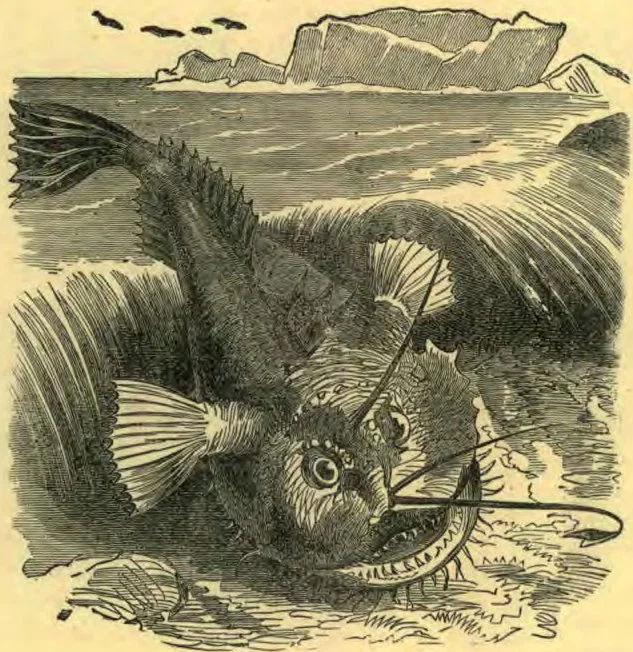
THE ANGLER-FISH.

In our picture we have a view of a very strange fish. He does not look much like the fishes we catch in the ponds and brooks. His head, as you see, is large and flat, and he has a wide, gaping mouth, with rows of sharp-pointed teeth. His eyes, instead of being on each side of his head, are placed on the top.
You will notice that the two side fins are different from those of a common fish. They seem to be large and strong, and stand out a little, like very short arms. By means of these fins, some of the fishes in this family can walk over wet ground nearly as well as four-footed animals. It would look strange, would it not, to see a fish walking on the land? Yet some kinds of fishes are so made that they can go on quite long journeys over hot and dusty roads, to get from one pond of water to another.
The angler is a very hungry fish, never seeming to have all it wants to eat; and the worst part of it is, it eats other fishes. It is not a swift swimmer, and so it would often go hungry, if it depended on its swiftness for catching the fish. The way it does get its food is truly wonderful.
Many fishes have two fins on the back. But the angler has three spines in the place of the first fin. The first one of these spines has at its tip a loose, shining piece of skin. At its base, the bone that forms the spine grows in the shape of a ring. Through this ring a short bone passes, fastening the spine to the rest of the bones of the head in such a way that the fish can freely move the spine in any direction. You can see just how this is done if you should drive a staple through the ring of an iron skewer into a board. You could move the skewer any way you pleased. Just in this way the spine is fastened to the angler’s head. The other spines are fastened on in a very similar manner. You can see them in the picture, between the eyes of the fish.
What does he do with them? They are his bait. As was said before, he cannot swim fast enough to catch the fishes; so he buries himself in the mud, leaving the spines on his head above the mire, and he waves them back and forth. Fishes are very curious creatures, and are always anxious to find out about anything shining in the water, as the boys who have fished with tackle having a spoon-shaped piece of polished metal fastened to it know very well. As the fishes see this shining bit of skin, flirting round, they rush up to find out what it is. Then the angler opens his wide, gaping mouth, and swallows the fish down.
He is such a greedy fellow that he sometimes swallows the cork floats on nets and lines. When he is caught in a net himself, he does not seem to be disturbed by it; but turns round and eats his fellow-prisoners.
He grows from three to five feet long. He is good for nothing, so far as his use to man is concerned. His flesh is not good for food, and his body contains very little oil.
W. E. L.

WRINKLES

“WHERE do the wrinkles come from?” And the joyous little Grace Looked gravely into the mirror At her rose-tinted face.
“Where do the wrinkles come from?— Why, first, dear, I suppose, The heart lets in a sorrow, And then the wrinkle grows.
“Then anger comes a-tapping, And the heart’s door opens wide; Then hasten naughty envy, And discontent, and pride.
“And the wrinkles follow slowly, For the face has for its part To tell just what is doing Down in the secret heart.
“And the red lips lose their sweetness, And draw down so,” said Grace; “And the lovely, youthful angel Goes slowly from the face.”
“Watch the gates of the heart, my darling, For the heart is the dwelling-place Of the magical angel of beauty, Whose smiles are seen in thy face.”
—Selected.

A WORD TO OUR READERS.

THE publishers of the INSTRUCTOR, in planning for its canvass the coming year, offer a new premium, and have thoroughly revised the old prize list, making it up almost entirely of new and desirable books for children and youth; and what they now want is to enlist the sympathies and services of all our wide-awake boys and girls in canvassing their respective districts for it.
They hoped to be able to publish the revised list in the present number of the INSTRUCTOR, but failed to complete it in time; however, it will appear in the following number. In the meantime we want you each to carefully consider what good thing you can do at canvassing, and decide to enter into the work with a mind never to say “fail.”
The publishers are satisfied that if you will co-operate with them in their new plans, you may not only be of great service to them, but you can thus procure some very valuable books upon comparatively easy terms. They are preparing a new circular, which, with the new prize list, will be sent to all who wish to act as their agents. Let such send their names, with P. O. address, to this Office at once; the circular will be ready by the time your orders arrive.
M. J. C.

MAN WITH THE KITE.

A MAN with a kite? Yes, that is what it is. He is flying the kite over a river,—the Niagara Falls. This kite is not a toy; it is for a very useful purpose, just as was the kite with which Franklin caught the lightning from the heavens. Men sometimes make toys serve science, just as they may turn many matters of little consequence into benefits to themselves and others. So it was with this kite. It was desired to hang a suspension bridge over the Niagara River. Since its banks are very high and steep, and the current so strong as to be dangerous, it was a question how this could be done. How was the bridge to be got from one bank to the other?
After a while, a man suggested flying a kite across. So they waited till a day when the wind was blowing right across the river; and the kite was sent up. When enough cord had been drawn out, the kite was allowed to run down, and fall upon the other shore; then the end of the string was taken, and a thicker cord was tied fast to it, and drawn across the river; then a heavy cord was tied to this, and drawn across; then, by this, a light rope was drawn over, then a heavier, and a heavier, until strong, firm cables were attached, and the bridge was made.
So a little thing like a kite was the first step to the building of this bridge. Little things are generally the first steps to great things. Little sins lead to great sins, unless checked; and little good deeds lead to lives of kindness and love to God, if they are followed up.
Our lives ought to be like the building of this bridge. First we send across the gulf which separates sin from holiness a look to Christ our Saviour; then a little resolution, and this draws after it a good deed; then others should go out, and still others, and so on, until our whole lives are blended in thoughts and words, and acts of love to God, and kindness to our fellow-men. Such lives may also, like the bridge, help others to get to heaven too. The young should begin while they are young; for later in life it will be harder to start.
Let us begin, at once, and, with God's blessing, go on all our lives in pleasing him, and helping others.—Sabbath-School Visitor.

Love Brings Rainbows Through Every Dark Cloud
WHEN there is love in the heart, there are rainbows in the eyes, which cover every black cloud with gorgeous hues.

You have reached the end of this edition.

The Youth’s Instructor · Dec 10, 1884