The Youth’s Instructor, Vol. 34, No. 46.

AUTUMN SIGHS

The Youth’s Instructor

Nov 17, 1886

S. D. A. Publishing Association · Battle Creek, Mich. · Nov 17, 1886

AUTUMN SIGHS.

Come, Nature's sleep, silvery snow, Life's solace in the North, And a shower of downy blossoms throw O'er the poor, hard-frozen earth.
O'er all the fallen, frost-nipped leaves, And the withered flowerets small, O'er the herbs of the field thy finger weaves A cold and solemn pall.
It seemeth sad, that snow-white pall, Yet peace beneath it dwells, And 't is ever in peace God worketh all His wondrous miracles.
The snow shall melt at the breath of spring, And moisten the lap of earth, And the germs in her bosom slumbering Shall wake to sunshine and mirth.
In tears the snow-drift melts away, The brook makes a tender moan, And earth grows green as the soft winds play, Nor thinks of the days that are gone.
The tree that braved the winter's storm, With branches bare and brown, As the brooklets sing in the sunbeam warm, Puts on its leafy crown.
And we who have buried hopes and joys On dark Oblivion's shore, Oh, may not we, e'en we, arise To live and praise once more?
Then fall, O snow, tired Nature's sleep, We'll rest and forget while 't is night; But in winter's slumber, calm and deep, We'll dream of the spring-tide bright.
—From the Swedish of Fredrika Bremer.

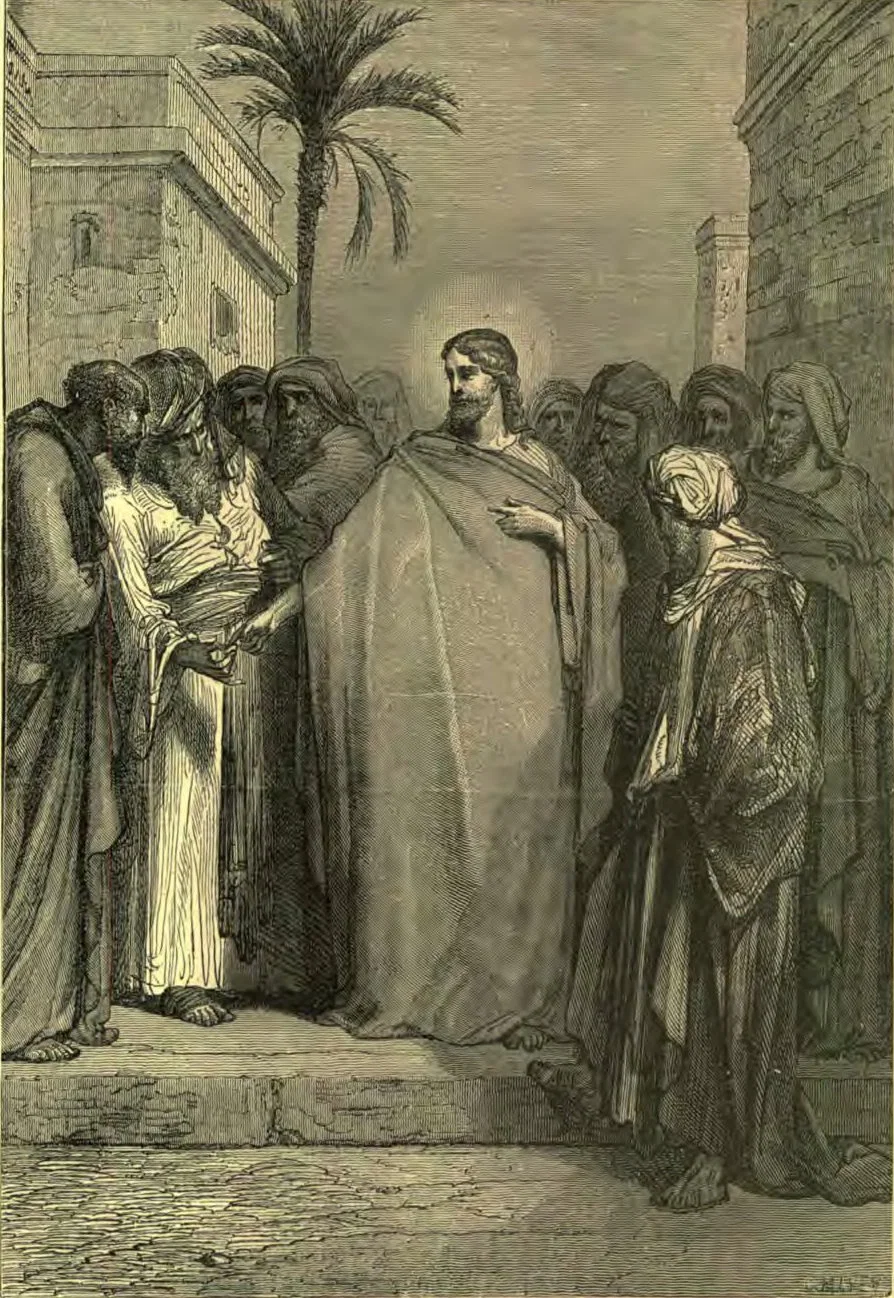
CHRIST AND THE PHARISEES.

It was over eighteen hundred years ago that Jesus walked this earth, and taught as never yet man taught, healing the sick, comforting the broken hearted, and giving to the perplexed people the simple teachings of the gospel for the traditions and burdensome ceremonies imposed on them by hypocritical priests. With gladness the common people listened to his words and received him into their hearts. But the bigoted priests could not endure his doctrines, for they were directly opposed to their teachings, which tended to exalt man instead of God.
With apt and cutting parables Jesus exposed their hypocrisy, and won their bitterest hate. Gladly would they have killed him but that they “feared the people.” So with cunning malice they “sought to entangle him in his talk.” Selecting, one day, some of the Herodians, who professed great friendship for the Roman governor, and some of the Pharisees, who were the strictest of the Jews, they approached the place where Jesus was teaching and healing the people. With a great show of sincerity they addressed him: “Master, we know that thou art true, and teachest the way of God in truth, neither carest thou for any man; for thou regardest not the person of men. Tell us therefore, what thinkest thou? Is it lawful to give tribute unto Cæsar, or not?” A simple and direct question surely, yet how deep a plot it concealed; for if Christ should say it was unlawful, the Herodians were ready to report the matter to the Roman governor; and if he should say it was lawful, the Pharisees were equally ready to summon him before their council for speaking things contrary to the religious teachings of the Jews. “But he perceived their craftiness, and said unto them, Why tempt ye me?” “Show me the tribute money. And they brought unto him a penny. And he said unto them, Whose is this image and superscription? They say unto him, Cæsar’s. Then said he unto them, Render therefore unto Cæsar the things which are Cæsar’s; and unto God the things which are God’s. And when they heard these words, they marveled, and left him, and went their way.”
We fancy the common people who stood near must have been glad to have this much-disputed question settled, and so easily—render to your temporal rulers the things which they demand, provided what they ask does not conflict with the requirements of God. And the angry Pharisees, covered with confusion that their plot was revealed—what a rebuke was given to them!
I wonder if we might not learn a lesson from Christ’s talk with the Pharisees that day, for these things “were written for our learning.” Are we not as forgetful sometimes, as these proud Jews, to “render unto God the things that are God’s”? W. E. L.

DOUBLE BOYS.

I do not mean twin boys, two little brothers so nearly alike that friends can hardly tell them apart, but two very different boys in one little body. You never heard of such a thing and do not see how that can be?
Let us see. If I were to take a handful of almond nuts and sit down to crack them, with you all standing about me, by-and-by you would see two little kernels lying in one nutshell.
Well, just as these two little kernels lie snugly together in one nut, which looks exactly the same as other nuts on the outside, so do two spirits lie inside of your little bodies, making you double boys.
Now if you look at some of the nuts you will see that the two kernels are pressed and crowded out of shape; one will often be much larger than the other, but neither will be of the smooth, oval shape that belongs to almond nuts. This is because they are crowded two in one shell that was meant to be the house for but one nut. The shell is only just large enough for one, and if there are two, you see they must push and press and crowd each other.
So each little body was meant for one dear little boy, and if two boys try to live in it, don't you see they crowd and press each other so that neither is of a right and perfect shape?
Shall I tell you of some of these double boys among you? Here is Harry. He has a very sunny, happy boy living in him with such a cross, fretful double. Some days the happy boy looks out through his eyes, talks in his voice, and sings in his laugh; then whatever mamma asks him to do, or says he may not do, there rings out the pleasantest “All right.” I think that is the happy boy's name. Other days nothing is all right; but lessons, work, brothers, playmates, play, even dear mamma herself, are all wrong. That is because Master Fret is the biggest and strongest boy on those days, and happy All Right is crowded close against the wall, and the sunshine is all squeezed out of him.
Frank has two boys also. One is a loud boy, that stamps and shouts, bangs and slams, in the house as well as out-of-doors. His mate is a quiet little gentleman, who remembers that too much noise disturbs the busy or sick or nervous people in the house.
One of Bobbie's boys is deaf and doesn't hear well when he is called to lessons or bidden to some work or when papa says, No. The other of that double boy answers so quickly, pleasantly, and politely when he is spoken to that everybody likes to have him around.
In Ned's body lives the laziest fellow, who growls out, “I can't,” “Too much trouble,” “I don't feel like it;” then he yawns and stretches and says, “I'm so tired.” Along with him lives an active, cheerful fellow who plays with all his might and main, and sometimes when it is study-time, sets at lessons with a will and is such a nice scholar.
Now is it not a pity to have two such different boys in one little body? Would it not be ever so much nicer to have only one, and that the better one, growing into the fairest and most perfect shape? I am sure you think it would, so I am going to tell you that each of you can help the boy you like best to grow so fast as to crowd the bad, ugly fellow into such close quarters that he will shrink up and grow smaller and smaller till there is almost nothing left of him.
Don't you know sometimes you'll find in an almond shell a good, fair, whole nut and one tiny, little shriveled up speck that hasn't had any chance to grow? Now the nut-shell hasn't any power to control what is inside of it. God makes to grow in it what he likes, one or two kernels; but God has made you different, and leaves it to you to help the inside boy to grow. By thinking and taking a little care, you can hush that loud boy's voice and step so they will not annoy others and make you seem rude; you can cure that boy's deafness so he will hear every time he's spoken to; the lazy boy will wake up and stir himself if he is only managed right; and the merry, happy boy can just swallow Master Fret if he is only given half a chance.
It is hard? Well, yes, of course! But hard things are what make men of boys, and you all want to be men, you know, just as soon as ever you can.
Besides, there is a Helper who is always ready to make the wish and the will strong for the right. His name is Jesus, and whenever you say, “Lord, help me,” even if you whisper it ever so softly in your heart, so that no one else but yourself can hear it, he is quick and strong to hear and help and save.—The Child's Paper.

Lighthouses Shine Quietly Without Bells or Cannons

LIGHTHOUSES do not ring bells and fire cannons to call attention to their shining; they simply shine.

A VISIT TO THE INDIANS.

'It may be some of you would be interested to hear about a visit we made to the Indians a short time ago. Down on the Missouri River, forty-five miles south of Bismarck, Dakota, is the “Standing Rock” Indian reservation, a tract of land about fifty miles long and forty wide, reserved by the Government for the Indians. No white man is allowed to settle there, and the Indians have it all to themselves. As we were stopping a few days across the river, we thought we would see how they lived; so getting a little half-breed boy to carry us across in a row boat, we made our way to the mission school, established there by the Government.
The school-house is made of cotton-wood logs, and is light and airy. We here met the teacher and his wife, and also a Jesuit Catholic missionary, who made us very welcome. As we went into the school-room, where the little Indian boys and girls are taught to read and write English, about the first thing that attracted our notice was the whiteness of the floor, vastly different from many school-house floors we had seen; the teacher told us that it was kept clean and white by the moccasins of the little Indian boys and girls. On the blackboard we saw some of their writing, which was neatly done.
Every morning, before going into the school-room, they are required to wash their hands and faces and to comb their hair. This they very much dislike to do, as the Indians believe that soap is poisonous, and they will trade off to the white man, as far as possible, all the Government gives them.
The teacher showed us the school register, containing some very queer names. One little boy had the name of “Painted Log,” another “Flying Arrow,” another “Big Bear,” and so on through the list. The Indian children do not love study, preferring to play their games, spin their tops, and ramble over the prairies; but the teacher said they took to writing and drawing very naturally.
The scholars all take dinner at the mission school, and the little boys and girls have to prepare it, Mrs. White, the teacher, seeing that they do it right. I suspect she hurries them sometimes, and perhaps punishes them too, for they have given her two names, “Hurry up,” and “Devil woman.” Mr. Wells, the teacher, they call “Fox.” They have given the Catholic missionary three names, “Black Robe,” “The eagle hovers over its young,” and “The tall lean man.” The Indians are very apt in giving nicknames.
The day we visited the school happened to be “ration day,” that is, the day when the Government issues their regular rations, and most of the children had gone to Standing Rock, with their parents, after provisions. We were sorry this was so, as we much desired to see them in school, and hear them read and spell. They go to the agency every two weeks, where the Indians gather from all quarters, and spend a day or two in their games and dances.
After we had visited the school, we went, in company with the teacher, through the village. The Indians live in wigwams and sod and log houses. Some of them cultivate small patches of ground. There are no streets in their village, houses and wigwams being placed anywhere, regardless of order. We saw numbers of lean, gaunt dogs running around, and were told by Mr. Wells that at their large feasts and dances these were eaten, and considered a great delicacy. Out of one hut came a squaw, with her face all painted red, and she looked fierce enough. We went into one wigwam where there was a sick Indian. A small fire was burning in the center of the wigwam, and the smoke was curling out of the top. He lay before the fire, and said he was very sick; but when Mr. Wells began to talk about their battles and the brave deeds of others, he sprang up, and removing his clothing, showed us the wounds he had received in fights with the Crow Indians. Receiving wounds is thought to be the greatest honor, and they show them with pride.
Just out of the village we saw two high, forked posts standing and a cotton-wood trough laid across. In this was the corpse of a squaw, wrapped in blanket and deerskin. The Government does not allow them to care for their dead in this way now, but sometimes they do it if the Indian agents do not interfere. Mr. Crafts, the missionary, told us the Indians said that when he died they were going to put him up very high, thinking that the higher a corpse is placed, the more honor is shown to the person.
These Indians are Sioux, and are very treacherous. When they were placed here, they were dismounted and disarmed, so they were not dangerous to the settlers. The boys and girls of the INSTRUCTOR family may be very thankful that God has given them pleasant homes, and that they do not have to spend their lives in such degradation. God has given to us many blessings, for which we should be thankful to him.
W. B. WHITE.

INCIDENTS CONCERNING THE EARTHQUAKE.

Notwithstanding the terribleness of the earthquake, these were some of the natives who appeared as much unconcerned as though nothing had happened. An old Maori chief, supposed to be one hundred and ten years old, and who was greatly feared by the natives as a wizard and one who had caused the death of many by witchcraft, was dug out of his whare, or house, after having been buried five feet under ground for one hundred and four hours, or over four days. He seemed perfectly contented with his condition, sitting with his elbows on his knees, and manifested little concern about his deliverance. His nephews and grandchildren made no effort to search for their aged relative, partly attributing this dreadful calamity to him, since he was thought to have caused the death of a child just before this by witchcraft. When the ashes had been dug away, he arose, shook off the dust, and without giving a look of recognition to any one, went straight away in search of food. One of his relatives wondered why they dug him out, saying, “He is no good.”
A minister who frequently visited that locality among the natives went in search of some in whom he was especially interested. Here he found a man who told him his sad story. Mohi, the man, and his wife Mary, were in the chief’s house when the eruption first began, but they were afraid to stay there on account of the falling boards, so they went to their own whare, taking their two little boys with them. Mohi, said, “Fair brother taught us to pray. Let us pray to God.” The roof was crushed with lava, stones, and mud. To save the life of the boy, he wrapped him in a shawl, and knelt over him so that he should not receive any hurt from the falling lava and stones; but the drift rose so quickly that the little one was soon covered, and he had to keep throwing the mud with one arm from the little fellow. All this time the mother was trying to protect the other little boy. Mohi, finding it getting dark, and the lava very heavy on his back, made a desperate effort and threw it off; then taking up his little boy, he called to his wife to be quick and follow, when, to his horror, he found that both his loved ones had died in silence by his side. She was sitting with her arms extended over her babe, to protect it. This is but one of the many sad incidents which which might be mentioned of Maori devotion to their loved ones in danger.
There were nine Maoris that traveled six miles from Tapahora over hills of ashes waist deep, having no conception of the state of affairs in their own settlements. They would have been buried, as were their friends, beneath forty or fifty feet of mud had they not been seen by a relief party in a boat. They cried with joy at sight of them. The boat was rowed the last part of the distance through hot mud.
It is feared that one entire settlement of natives, although it has not yet been visited, is entirely buried, since not a single person from that place has been seen. One old horse, frightfully cut and battered, was seen wandering about; but this was the only sign of animal life. Everything else was totally destroyed by the terrible storm of stones and mud. Many of the whares were completely buried under four or five feet of mud.
One item worth mentioning is that of fifty persons who assembled in a large house, and spent the entire time in praying to God to spare them from this awful death; and not one of them was hurt. The place of the eruption is about two hundred miles from Auckland, where some of our friends lived, yet they felt the earthquake and heard the explosion.
This earth contains elements of destruction under the control of Him who is mightier than man. Our only safety lies in faithfully serving the God that made the heavens and the earth, and before whom “the pillars of heaven tremble.” He will save those who serve him and constantly trust in him. S. N. HASKELL.

NOVEMBER

Oh how withered and dead the face of the bare earth lies Under the leafless trees, and the frown of the drooping skies! Oh, how silent and sad she sleeps in her gloomy rest, With never the song of a bird, and never a flower on her breast! And yet from the gloom and the silence the far-off spring shall arise!
Nay! in the hidden life of the pretty things sleeping below, Waiting the moment of waking, ready to burgeon and grow, Who shall say but the touch of this cool, dark quiet to-day Is full of a saving grace as the strong, warm kisses of May! —And which is the dearest and kindest, no soul upon earth may know! —Wide-Awake.

TRUE BEAUTY.

A WOMAN, famous as one of the most kindly and lovable among leaders of the best American society, once said: “If I have been able to accomplish anything in life, it is due to a word spoken to me in the right season when I was a child, by my old teacher. I was the only homely, awkward girl in the class of exceptionally pretty ones, and being also dull at my books, became the butt of the school. I fell into a morose, despairing state, gave up study, withdrew into myself, and grew daily more bitter and vindictive.
One day the French teacher, a gray-haired old woman, with keen eyes and a kind smile, found me crying.
“What is the matter, my dear?” she asked.
“O madame, I am so ugly!” I sobbed out. She soothed me, but did not contradict me.
Presently she took me to her room, and after amusing me for some time, said: “I have a present for you,” handing me a scaly, coarse lump covered with earth. “It is coarse and brown as you. ‘Ugly,’ did you say? Very well. We will call it by your name, then. It is you! Now you shall plant it and water it and give it sun for a week or two.”
I planted it and watched it carefully; the green leaves came first, and at last the golden Japanese lily, the first I had ever seen. Madame came to share my delight.
“Ah,” she said, significantly, “who would believe so much beauty and fragrance were shut up in that little, rough, ugly thing? But it took heart and came up into the sun.”
It was the first time that it ever occurred to me that, in spite of my ugly face, I too might be able to win friends and to make myself beloved in the world. —Youth’s Companion.

WHAT CAN WE LEARN FROM A SPIDER?

A YOUNG girl was running a sweeper over the floor, when she swept up a little spider. She thought, “I've crushed the poor little thing,” and then forgot it.
After dusting the room, she opened the sweeper to empty it, and to her surprise she found that the spider had not been hurt, but had already begun to spin a web on the brush. Suddenly snatched up from light and liberty and shut in the dark, it had cheerfully gone to work to make the best of matters, by making a new home. If God should change our bright, happy homes, or take us from them, or shut us in with sickness, should we sit down and cry, and say there is nothing left for us? or should we get all the good we can out of our darkened lives, and try to find something that would make them more happy and useful?

Acknowledge and Repair Wrongs Rather Than Defend Them

If thou hast done a wrong or an injury to another, rather acknowledge and endeavor to repair, than to defend it. One way thou gainest forgiveness, the other thou doubtest the wrong and the reckoning.— Wm. Penn.

PARABLES OF CHRIST.

LESSON 10.—THE IMPORTUNATE WIDOW AND THE PENITENT PUBLICAN.

1. To what end, or for what purpose, did Jesus give the parable of the importunate widow? Luke 18:1.
2. Who were the leading characters in the parable? Verses 2, 3.
3. Describe the judge. Verse 2.
4. What request did the widow make? Verse 3.
5. How did the judge at first regard her petition? Verse 4.
6. What good motives ought to have influenced him? Same verse.
7. Did these things have any power to move him? Same verse.
8. Why did he finally conclude to take up her cause? Verse 5.
9. What admonition does Jesus give? Verse 6.
10. Did the admonition apply alone to those who were present when it was spoken, or does it apply to us as well?
11. By what question did Jesus try to set home the meaning of the parable? Verse 7.
12. Is there any promise here for those who do not cry to God?
13. What seems to be the teaching of the parable?—That if a wicked man, who cared not to please God, and who had no sympathy for human suffering, would yield to the persistent supplications of a poor woman, it is certain that God, who tenderly loves all his creatures, will heed the prayers of his saints.
14. What question seems to imply that in the last days there will be but few who will still have faith that the Lord Jesus is coming, according to his promise, to deliver his people? Verse 8.
15. For whose special benefit did the Lord give the parable of the Pharisee and the publican? Verse 9.
16. How are these two characters introduced? Verse 10.
17. For what did the Pharisee thank God? Verse 11.
18. Of what did he boast? Verse 12.
19. How did the publican show by his behavior that he was both penitent and humble? Verse 13.
20. Repeat the words of his prayer. Same verse.
21. What did Jesus say about the way in which God looked upon the worship of these two men? First part of verse 14.
22. What general principle did our Lord then lay down? Last part of verse 14.
23. Whom did the disciples rebuke? Verse 15.
24. What did Jesus do to show the disciples how they had erred in judgment? Verse 16.
25. How did he still further exalt the grace of humility? Verse 17.
26. What is the first part of this lesson meant to inspire?—Faith in prayer.
27. What is the last part of the lesson meant to teach?—That God loves a humble, penitent heart.

NOTE.

Shall not God avenge his own elect?—A question used in this way is called a figure of interrogation. It is not asked for the purpose of obtaining an answer, but to make a stronger impression of a truth than could be made by a direct statement. It is put under such circumstances as to admit of but one answer, and that answer must declare the truth which the speaker wishes to impress. In this way, the hearer, in answering the question, is compelled to testify to the fact which he is called upon to admit. If this unfeeling judge, who feared not God, nor regarded man, could in any way be induced to administer justice in favor of the widow, certainly God, a being of infinite love, will without unnecessary delay, give help and protection to his own elect, whom he regards with such tender compassion. Nevertheless, to remove all doubt, and perhaps for the purpose of adding another thought, our Lord proceeds to answer the question himself.

THE SHEPHERD BIRD.

How many of the readers of the INSTRUCTOR ever saw the shepherd bird? If any of our young friends have been in certain sections of South America, or if any of them reside there, they may have seen the feathered shepherd that we have in mind. But if they have not, as we are sure is the case with many, they may read the following description of this wonderful bird with interest. Seeing it in the youth’s column of a county paper, some time since, I preserved it for the readers of the INSTRUCTOR, if the editors shall deem it worthy of a place in their excellent paper. Here it is:—
“In South America there is a very beautiful bird called the agami, or golden-breasted trumpeter. It is about as large in the body as one of our common barn-yard fowls, but as it has longer legs and a longer neck, it seems much larger. Its general color is black, but the plumage on the breast is beautiful beyond description, being what might be called iridescent, changing, as it continually does, from steel-blue to a red-gold, and glittering with a metallic luster.
“In its wild state the agami is not peculiar for anything but its beauty, its extraordinary cry, which has given it the name of trumpeter, and for an odd habit of leaping with comical antics into the air, apparently for its own amusement. When tamed, however,—and it soon learns to abandon its wild ways,—it usually conceives a violent attachment for its master, and, though very jealous of his affection, endeavors to please him by a solicitude for the well being of all that belongs to him, which may fairly be termed benevolence.
“It is never shut up at night as the other fowls are, but with well-deserved liberty, is permitted to take up its quarters where it pleases. In the morning it drives the ducks to the water and the chickens to the feeding-ground; and if any should presume to wander, they are quickly brought to a sense of duty by a sharp reminder from the strong beak of the vigilant agami. At night the faithful guardian drives its charge home again.
“Sometimes it is given the care of a flock of sheep; and though it may seem too puny for such a task, it is in fact quite equal to it. The misguided sheep that tries to trifle with the agami soon has cause to repent the experiment; for, with a swiftness unrivaled by any dog, the feathered shepherd darts after the runaway, and with wings and beak drives it back to its place, not forgetting to impress upon the offender a sense of its errors by pecks with its beak.
“Should a dog think to take advantage of the seemingly unguarded condition of the sheep and approach them with evil design, the agami makes no hesitation about rushing at him and giving combat. And it must be a good dog that will overcome the brave bird. Indeed, most dogs are so awed by the fierce onset of the agami, accompanied by its strange cries, that they incontinently turn about and run, fortunate if they escape unwounded from the indignant creature.
At meal-times it walks into the house and takes its position near its master, seeming to ask for his caresses. It will not permit the presence of any other pet in the room, and even resents the intrusion of any servants not belonging there, driving out all others before it will be contented. Like a well-bred dog, it does not clamor for food, but waits with dignity until its wants have been satisfied.”
A. S. HUTCHINS.

CARRYING WEIGHT.

It has often been proved that the carrying of weights or burdens develops latent strength and goodness in the heart, although, seemingly, these are hindrances to the perfection of character. If the readers of the Instructor will learn that what appear like obstructions to their mental and moral growth are really the tools God is using to bring to the front the better man within, the burdens will be shorn of much of their oppressiveness. A late Companion furnishes some forcible thoughts upon the subject, the perusal of which we think will be of benefit to you. The paragraphs read as follows:—
“There is a tradition that the famous Count Oxenstierna (who, in fact, ruled Sweden during the reigns of Gustavus Adolphus and Queen Christina) was the younger of twin brothers, and so missed by only a few minutes the heritage of an elder son. As a boy, almost as much as in after life, he was noted for his indomitable energy and zeal.
“‘I came half an hour too late into the world, and I must try all my life to make that half-hour up!’ he was wont to say. It was this statesman who sent out the Swedish colonists ‘to found a city in the New World, where every man could be free to worship God as he chose.’
“‘It was from Oxenstierna, also, that William Penn first got the idea of establishing such a refuge for the oppressed of Europe. Penn followed the course of the Swedes up the Delaware, and bought from them the land on which Philadelphia, the City of Brotherly Love, was built. This country owes much to the ‘half-hour’ lost to the twin infant.
“‘It is stated that Pope was so hard a student when a boy that his tutor feared he would injure his health; ‘I have a weight to carry, different from other men,’ the boy said, glancing at his deformed back, ‘and I must stiffen my muscles for it.’
“‘The training of the athletes for the Olympian games began in their boyhood, by making them lift weights which were increased every day.
“‘A jockey on a race-course, explaining lately to a by-stander why some of the riders were handicapped with weights, said,—
“‘It is fair to the other riders, and besides, it is of use to the horses. A horse will not put forth his whole strength unless he feels a difficulty on his back.’
“‘There are few persons who are not handicapped in the race of life which they have just begun by some disadvantage: obscure birth, lack of fortune, a homely face, an irritable temper, or a dull brain. Let them recognize it only as ‘a difficulty on their backs,’ which is intended to call forth their full strength. God has permitted it for that purpose, and designs that they put forth energy to conquer it. Let them remember, too, that the race of life has its goal elsewhere, and that the prize is not his who wins the plaudits of the crowd, but his who struggles most faithfully and patiently with the burden which he has to carry.”

LIFE IN NEW GUINEA.

The Rev. James Chalmers has written a new book on New Guinea, in which he represents the manners and customs of the natives as somewhat startling. He describes some as wearing immense “nose-jewels, daubing their faces in stripes of black, white, red, and yellow, and who, when in mourning, paint themselves all over black and wear net collars. When in very deep mourning, they get inside a very tight kind of wicker-work dress, extending from the neck to the knees in such a way that they are not able to walk well.”
He also represents certain ones as wearing “head-dresses seven feet high, built up on a wooden frame; while at Kabadi and Naara they have frames about two feet and a half in height and three feet broad, and from the center a stick ten or twelve feet long. On the frame and center they fasten plumes until all the wood is hidden.”
These people show but little skill or ingenuity, as represented by Mr. C., save in the manufacture of weapons and in the management of their canoes. They practice tattooing to such an extent that some of the chiefs are “almost covered with these savage medals of honor, each mark meaning a life violently taken.”
Of their strange houses, he says:—
“Some of the houses are in the tops of trees, with ladders of long vines on each side to assist the ascent. Some of the houses are in shape like animals, the largest being built to represent an alligator with open mouth. The platform in front is the lower jaw, and the long shade over the platform is the upper, so that standing on the platform you stand in the alligator’s mouth, the house sloping to appear as a body.
“In some districts the houses have a regular burglar alarm. On the door hangs a bunch of nutshells, so that when the door is shut or opened they make a noise, thus wakening the occupants of the house, should they be asleep. Spears and clubs are all ready for self-defense.
“Bones are much used for decorative purposes, and inside the houses are hung large collections of human bones, bones of animals and of fish. In those houses temporarily occupied by the teachers, skulls, shells, and cocoanuts are hung all about; the skulls are those of the enemies he and his people have eaten. One of our guides to the village wore as an armlet the jawbone of a man from the mainland that he had killed and eaten: others strutted about with human bones dangling from their hair and about their necks.
Of the animal life, among other interesting things, he says: “We saw three nests of the mound-building jungle fowl of megapode; one of them was fifty-one feet in diameter. It is said that larger nests exist at East Cape. It seems incredible that so small a bird should build such immense hillocks as nests. In point of fact, however, no such mound was ever built by a single bird or in one season. The jungle-fowl never sits upon its eggs, but buries them deep in the mound to be hatched by the heat of the sun.”

A RACE AROUND THE WORLD.

The Boston Herald describes a curious experiment by way of sending mail in opposite directions on a race around the earth, giving also the result of the journey. It says:—
“The Rev. James L. Hill, of Lynn, sent from that city in the same mail two postal cards so stamped as to go in opposite directions on a race around the world. One was sent via San Francisco to Japan, and back by Brindisi and Liverpool, and the other crossed first to England and so around home by Japan and San Francisco. Both travelers returned from their long journey well worn and well stamped. As the post-office authorities have prohibited the old-time method of getting these curiosities, it was necessary to arrange to have the cards restamped and redirected by a friend interested in the project in Kobe, Japan. The card that went around the earth from west to east made the circuit eight days quicker than the other, and was eighty-five days on the way. If the authorities had bought elephants and hired special trains, like the hero of Jules Verne’s story, the postal card might have saved five days and gone ‘around the world in eighty days.’”

Memorizing Bible Verses Without Understanding Truth

It is certainly true that the memorizing of Bible verses has many times stood in the way of acquiring a knowledge of Bible truth. Children have been set at parrot-like memorizing of Bible words—to which at the time they attach no meaning—when they ought to have been taught Bible truths which might have tended to their spiritual profit. And any child who can memorize Bible words can understand the saving truths of the Bible. It is therefore a wrong to that child's soul to set him at memorizing the words without also helping him to a knowledge of the truths which he needs to know.—S. S. Times.

LITTLE CLARA BELLE.

LITTLE Clara Belle is as busy as a bee; No one in the house is busier than she; Many thoughts must fill that head, so sunny haired and curly. For no matter what's the weather, she's busy late and early. 'Cept fastening the buttons, she dresses all herself. And when her hair is brushed, looks dainty as an elf. She eats her bread and milk, and sits back from the table, And plans her morning's work as well as she is able: There's the chickens to be fed, the sweeping to be done, Miss Dolly's clothes to wash and rinse and hang out in the sun: Black Topsey must have a bath, for who's so black as she? And Sally Rose be put to bed and fed some catnip tea: The dishes must be put away, they were left in such a clutter. For yesterday she fed the dolls a piece of bread and butter: And when her house is set to rights, and ended all her labors, She dresses all her children, and calls upon her neighbors. And so you see from morn till night she's busy as a bee, No little girl in all the world is happier than she. S. ISADORE MINER.
Continue reading: SOME USEFUL DOGS