I WOULD join heartily with the psalmist in the following words: “Bless the Lord, O my soul: and all that is within me, bless his holy name. Bless the Lord, O my soul, and forget not all his benefits: who forgiveth all thine iniquities; who healeth all thy diseases; who redeemeth thy life from destruction; who crowneth thee with loving-kindness and tender mercies; who satisfieth thy mouth with good things; so that thy youth is renewed like the eagle’s.”
BROTHER AND SISTER PILQUIST AND FAMILY
Since I left Sin Iang Cheo in October last year, the Lord has permitted much sickness to come into our family. While on the journey here, I was taken sick with malarial fever, a disease which is very prevalent among the Chinese during this part of the year. The last day of my journey I was not able to sit up in the chair in which I was being carried, but was obliged to lie down on a bed, which was carried on bamboo poles by two men. During my sickness our younger daughter, Ellen, was also taken sick, and I spent many a long, dark night; for her sickness made it necessary for me to give her frequent attention. After a time she became convalescent, without the aid of any medicine or other human assistance.
My fever, however, continued persistently in spite of the fact that several times I took medicine to counteract the malarial poison. At last, however, I recovered my strength. But before this, my older daughter took sick with typhoid fever. Now, however, the Lord had sent us help in the sisters who had lately arrived, Mrs. Dr. Selmon, and the nurse, Miss Erickson, and they took care of my little girl, and God blessed the water treatment which they in love administered during a month’s time, so that she became well again. We were now all of us recovered.
I still, however, felt sick at heart, and there was considerable cause for this, but I did not then see my nakedness and blindness as described in Rev. 3:14-19, so that the Lord must again allow me to be prostrated not only on the sick bed, but on the death bed. The first part of January I was seized with a pain in my right side, which also caused distress in breathing, especially when I arose in the morning. The cause for this pain we traced to one night in Sin Iang Cheo in the fall of the previous year, when I got up to protect something from the rain that was beating into our room. It rained very hard almost incessantly all that summer, and the cottage in which we lived, with its wide, sheltering eaves, became very damp, even the brick floors in our private rooms, although these rooms were provided with large glass windows. The wind was so sharp from the many openings in this dark, queer Chinese house, that the draft affected me as I went about my daily duties in the home.
On Sabbath, January 9, I did not rise as usual, and the Lord gave me rest to both body and soul. The next day, however, I was up again, but was so sick that everything became black before my eyes, when I tried to perform my household duties; and I was taken with a chill which continued for a long time. The twelfth I was unable to rise, and Mrs. Dr. Miller came and examined me, and the result of this examination showed, as she believed, that I was suffering from a severe attack of pneumonia, but further examination revealed fully that I had quick consumption.
Sisters Miller and Erickson did all that human love can do for the sick, but their energetic water treatment seemed to do no good. From my childhood my constitution had not been strong, and my lungs were weak, and now I also suffered from insomnia and night sweats, which weakened me very much. On Sabbath, the sixteenth, I again enjoyed a good sleep, better than I had had for many days previously. I became emaciated rapidly, and the end seemed to be very near.
One day I drew my dear children to my bleeding mother heart, and wept bitterly at the thought of leaving them motherless in a strange land.
The nurse, Sister Simpson, stayed with me nights; for my husband was troubled with a very sore eye, so he could not watch by my bedside.
At the last moment, as it were, the Spirit of God enlightened me regarding my condition before God, and I saw that what I needed was a new heart. On the night preceding the twenty-second I had a glimpse of my sinful and uncharitable heart, and I felt the godly sorrow that leads to repentance. In the morning when Sister Erickson came in as usual, I asked her forgiveness, and requested her to ask the brethren and sisters to forgive me. I also called my husband to my side, and confessed to him, and asked his forgiveness. I asked my Chinese servant to forgive my impatience and coldness, and requested my husband to present my greetings of peace to all our Chinese brethren and sisters, and ask them to forgive me. All this took considerable of my strength, and the cold sweat stood on my brow.
I received forgiveness from God and man, and was very thankful for this, and by faith in the blood of Christ I experienced, as never before, the power of the gospel to create within me a new heart. The change was so real, and everything became so new and bright to me! The eternal truth of God became as a gold-mine of great blessing, and the Spirit reminded me of the promises of God, which are yea and amen in Christ Jesus. Hallelujah.
To the brethren and sisters I expressed a desire that on Sabbath, January 23, they should pray for and anoint me according to the instruction in James 5: 14-16. Sabbath afternoon they came into my room for prayers, and in our prayers and testimonies we expressed a desire that we might come into full and harmonious relationship with God, so that we might be clothed with the Holy Spirit in rich measure. My husband reminded us of the first year in China, when I became deathly sick, but was restored through the healing power of God. The brethren and sisters prayed for my restoration, and we felt the presence of Jesus and his angels, and experienced a rich measure of the Holy Spirit.
The previous night I had perspired more than usual, and my voice became so weak that the sister who was taking care of me, told the other missionaries in the house the following morning, “It is impossible that she can be healed.” The night, however, had been a pleasant one for me; for I had experienced the presence of Jesus. The Great Physician had been with me, with his life-giving, divine power, and had healed me, yes, he redeemed my life from the grave.
Sabbath morning, the twenty-third, dawned with salvation to the glory of the Creator, the day on which Jehovah, through Jesus Christ, finished his work of creation; and “God blessed the seventh day [not the first], and sanctified it: because that in it he had rested from all his work which God created and15made.” It was the same day on which our beloved Saviour rested, and on which he healed the sick, and saved sinners through the power of his preaching,—a day which above the six working days is especially blessed for those who keep it holy, and are willing to live up to all the light that God in Christ lets shine upon their pathway, so that he alone may be glorified and exalted in everything. This day began in paradise, and in Hebrews 4 the Lord says that a Sabbath of rest remains for the people of God to enjoy in the restored paradise on the new earth.
My little daughter came to my bed, and together we sang two stanzas of a Sabbath hymn. At the close, Sister Erickson came in as usual to ascertain how my fever was. When she took the thermometer from my mouth, I remarked, “Normal. It can not be otherwise, because Jesus has been with me. Praise his holy name, he is here.” Rejoicing, she ran out of the room, and told the news to the others. In the name of Jesus I arose from my bed and stood on my feet, and dressed myself. I then went out into the adjoining room, and was heartily welcomed by my husband and by two bright children’s faces.
Although I already was healed, the Spirit did not forbid us from following the instruction in James 5, and so the brethren and sisters anointed me, and together we continued in prayer, thanksgiving, testimony, song, and music to the glory of God, and we were all filled with the Holy Spirit.
My dear reader, are you experiencing the same wonderful power of love? Jesus loves all, and he is no respecter of persons. His mission to save sinners and to heal disease is more comprehensive now than when he was here on earth; for he “will have all men to be saved, and to come unto the knowledge of the truth.” The reason we see so little of this wonderful manifestation is that so few go to the Saviour for divine help, which he is always willing and anxious to give. When you feel yourself deprived of everything, and when you go to him who has all power in heaven and earth, you may be assured that he “shall supply all your need according to his riches in glory by Christ Jesus.” Join with me in praising the Lord, and let us extol his holy name.
Sin Tsai Hsien, China.
The Bible in India
By Rev. George H. Rouse
FOUR short words, but how much is in them! India—a “country” we call it, and think, perhaps, that it is simply a country like France or Germany, with one people and one language; but really it is as much a continent as Europe is, with many peoples and many languages. A card has been prepared which gives an outline of India on a map of Europe. In this card Kashmir is on the arctic circle, and Ceylon on Greece; Karachi is in Ireland, Calcutta near Moscow, and Rangoon near the Caspian Sea. An outline of India on the map of America would show Kashmir at Winnipeg, and Ceylon at Mexico; Karachi is in the west of Dakota, Calcutta at Washington, and the coast-line of Burma running many hundreds of miles south of Nantucket. India is as large as all Europe outside of Russia; its population is about as dense, and it has as many languages as are spoken in Europe. If we include the languages of the various hill tribes in India, the number is far larger than those spoken in Europe.
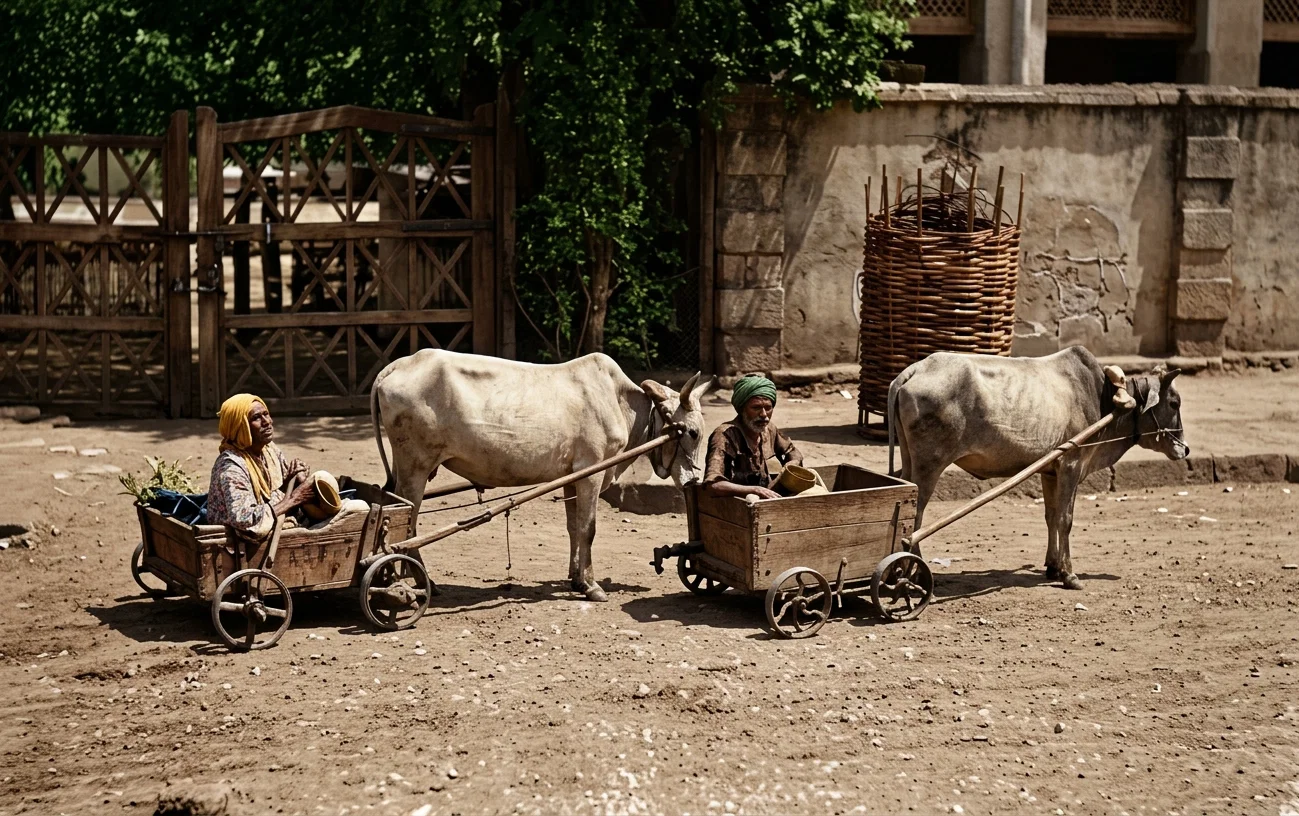
STREET SCENE IN INDIA: BEGGARS WHO RIDE
The population of India by the last census was about 300,000,000 (three hundred millions!). Leaving out of consideration for the present the languages of the hill tribes, those spoken on the plains of India may be divided into two main classes: the Sanskritic languages of the north, and the Dravidian languages of the south of India. Sanskrit, as is well known, is a language somewhat akin to Greek in its inflections and in its phraseology. It has long ceased to be a spoken language, and is important only as being the sacred language of the Hindus and the basis of the north Indian languages. The most important of the spoken languages of India is Hindi. This is spoken throughout the Gangetic Valley, except in Lower Bengal, and also in Rajputana and the central provinces. When the Mohammedans invaded India, this was the center of their authority. They therefore had to learn the language of the people; but while adopting its grammatical structure, they introduced a large number of their own Persian words, including many Arabic words which had been adopted in Persian. This mongrel dialect was called “Urdu,” and as it was the language spoken by the conquerors, it gradually developed into one of the most polished of Indian languages, and its literature is probably more extensive than that of any other tongue in India.
In some respects it has become a sort of lingua franca of northern India. It is specially the language of the towns in Northwest India, while Hindi, in one or other of its dialects, is spoken in the country districts; it is also the special language of educated Mohammedans. As Hindi and Urdu have practically the same grammatical structure, and differ only in phraseology, the two merge into one another, and the common people speak something which is neither pure Hindi nor pure Urdu, and is sometimes called Hindustani, though by some the term “Hindustani” is regarded as a synonym for Urdu. It is difficult, for this reason, to say how many people speak one language as compared with the other; but we may safely say that Hindi, in one or other of its dialects, and Urdu are, between them, spoken by fully ninety million people. In its composite character and its general hardiness, Urdu reminds one of English.
The next most important language of India is Bengali, spoken in the fertile and thickly populated country of Lower Bengal, the delta of the Ganges and the country to the north and east of it, of which Calcutta is the chief city. Bengali is, in its phraseology, as near the mother tongue (Sanskrit) as any other language, if not more so. A large number of pure Sanskrit words are in constant use in Bengali—even many compound words. Forty million persons speak Bengali, of whom about half are Hindus and half Mohammedans.
In the east of Bengal the Assamese language is spoken by between one and two millions, and to the south Oriya is spoken by nine millions. These languages are so akin to Bengali that sermons delivered in one language will be understood by people speaking one of the others, yet so different that separate versions of the Bible are needed in each. On the slopes of the Himalayas to the north of Bengal lies the country of Nepal, an independent State, but so friendly that it furnishes some of the best troops in the British Indian army—the Goorkhas. For fear of annexation, no Europeans are allowed to cross the boundary of Nepal, but the Bible can go there. The language of the people is akin to Hindi and Bengali, and active work is carried on by the Church of Scotland Mission among the numerous Nepalis who live in British territory.
On the northwest, beyond the Hindi-speaking population, lies the Punjab, and the Punjabi language, akin to Hindi, is spoken by seventeen million people. South of it is the small country of Sindh, where two and a half million people speak the Sindhi language. To the southeast of Sindh, on the shores of the Arabian Sea, lies Guzrat, and the Guzrati language is spoken by ten million. South of this comes Marathi, the chief language of the Bombay Presidency, which is spoken by eighteen million.16
All the languages thus far enumerated are more or less Sanskritic. Coming now to south India, we have as the most northerly language Telegu—sometimes called the Italian of India. This is spoken by twenty million people on the coast of the Bay of Bengal, south of the Oriya district, and inland in the native State called the Nizam’s Dominions. South of the Telegu district comes that in which Tamil is spoken by fifteen million, reaching down to Cape Comorin, the southernmost point of India. On the western coast, below the Mahrati-speaking district of Bombay, two other languages are spoken—Canarese by ten and Malayalam by five million. All these south-Indian languages are called Dravidian; they belong to the same family of languages, with altogether distinct characteristics from the languages of northern India.
To the east of the Bay of Bengal lies Burma. The chief language spoken there is Burmese, the vernacular of five million; but various dialects of Karen and Shan languages are also spoken in Burma, so distinct as to require a separate religious literature, including, of course, separate Bibles.
Ceylon is not part of British India, but a separate colony; it is, however, naturally so connected with India that we may include it in our present survey. The Cingalese language is Sanskritic, and is spoken by about one or two million. As we have already said, besides these important languages of the plains, there are a great many hill languages, into all of which the Bible, or portions of it, need to be translated, if these tribes are to be evangelized.
So much for the country “India.” It will be seen how large the country is in its area and the vastness of its population, and what a babel of languages it contains.—Rev. George H. Rouse, D. D., in Missionary Review of the World.
Learning to Pray Without Repetition
A SUGGESTION for Christians at home comes from a Japanese woman at Susaki, who came to a missionary to ask to be taught how to pray without falling into a habit of repeating the same words. “It is such earnest people as this,” says the missionary, “that make us realize it is worth much to be here to help them as they grope upward.”
Mission Notes
THE first college for women in Japan is only two years old, yet it already has more than eight hundred pupils. It is an undenominational school: all religions are tolerated, but none are taught.
THE Protestant Episcopal mission at Kiu-kiang, China, finding the work hampered by the lack of women workers, has decided to insist that before men are admitted to baptism, they must show interest in the conversion of their wives, and make some real effort to bring them also under instruction.
THE Missionary for April mentions a case where four heathen women in China called a meeting to take action in unbinding the feet. Fifty women present promised to unbind their own feet, and have to refrain from binding the feet of their daughters. The fact that the meeting was called and conducted by heathen women shows the extent to which ideas are at last entering the most conservative of nations.
JAPAN has 4,302,623 children in her elementary schools, while Russia has only 4,193,594. This means that in Japan ninety-two children in every thousand study, and in Russia thirty-two in every thousand. Secondary schools and universities show equally striking figures. The Mission Field draws from this comparison the suggestion that missionaries sent to Japan must receive the highest possible education.
MR. A. B. LLOYD, of the C. M. S. Uganda Mission, writes joyously that the tide of evangelical teaching has spread from tribe to tribe, until now the way is open for an advance into the Sudan from the south. “Nearly all the big chiefs,” he says, “have sent messages begging me to send them teachers, and to come myself and live with them.” I hope in July to take up my abode in Acholiland in the Nile province of Uganda.
IN taking account of the forces at work in the universal foreign mission field, one may not overlook the Y. M. C. A. There are now three hundred associations in the mission fields, about one half of them in colleges and universities. In the Imperial University of Japan the association has a building for its own use. The Japan Y. M. C. A. is undertaking work among the soldiers at the front. Two prominent men in Seoul, Korea, are earnest supporters of the Y. M. C. A., but both are graduates of American universities, where the association blessed their student life.
IT is announced that slave raiding and slave dealing will be abolished in Hausa Land. Charles H. Robinson, one of the very few European travelers who have penetrated into Kano, the capital of this land, gives some facts that show the necessity of such a movement. In his most interesting and instructive book, “Hausa Land,” published in 1896, Mr. Robinson states that it is generally admitted that there are at least 15,000,000 Hausa-speaking people, and that of these 5,000,000 are slaves, or, as he forcibly puts it, “one out of every three hundred persons in the world is a Hausa-speaking slave”! There being scarcely any currency in this great country except cowries, which are too bulky for large transactions, it has become the custom to pay in slaves; so that when a merchant goes on a trading expedition, he takes with him a number of slaves, with whom to buy goods and to pay for the expenses of his journey. These slaves are not brought from distant, outlying countries, but by raiding neighboring villages and people of their own tribes. Thus there is always civil war in the land, especially as all the smaller kings have to pay a yearly tribute of slaves to the sultan of Sokoto.—Selected.
The Work in Iceland
By Guy Dail
GUY DAIL
BROTHER D. OSTLUND has recently moved to Reykjavik, the capital of the island. When he was in this city before, the interest to hear God's Word was not so great, as many who have read reports of the work there may remember. Then he lived in Seydisfjord for about two years. All this time the circulation of the Icelandic paper bearing the message of truth has been increasing, until now the paper is read almost everywhere in the whole island. This paper seems to have made openings for the truth, and now, in the capital itself, there is a desire to hear. Brother Ostlund writes:—
“I have for some time been thinking of the necessity of securing a house for half our work here in Iceland, and I feel sure that had we a good hall, we could hasten the work much more. We can find no hall in the city, as often as we would like to use it; the only one we have the use of at all, is a dancing-hall, and often this is occupied just when we would like to have our meetings. The prospects for securing a permanent place are rather hopeful. Some friends here would give toward the enterprise, and I hope that the brethren in the lands which I may visit this summer will also assist us some. We really need a center here, and I think Reykjavik will be the best place for that center.”
“The interest to hear the word since I arrived in this city has been specially good. From three to four hundred men have been attending the meetings. There seems to be an awakening just now. Souls are hungry for the word. Previously, it has been very hard to reach their hearts, as they did not believe in the Word of God, and had no understanding of regeneration and conversion, thinking that this took place through infant baptism. I am so glad that this is now changing. The Lord is drawing near the people, and when men are converted to God, his truth will be received into their hearts. Our paper is now read nearly everywhere, and we have a splendid opportunity to publish the gospel through its pages.”
It is expected that Brother Ostlund will visit Europe the coming summer, and attend the meeting of the European General Conference, as well as some of the local meetings in various countries. For years he has been working hard in Iceland, and we certainly hope that God may soon crown his efforts with an abundant harvest. He is having a good experience in connection with work for the children in the city of Reykjavik, where he has opened a Sunday-school. The fact that there is now a desire to hear is in itself a hopeful sign; for formerly the people were quite indifferent and unbelieving. May God be with the work in this far-away land, and give success to the message for this time.
Rev. Hamburg, Germany.
Arkansas
By V. B. Watts
GENTRY.—About four miles from this place meetings were begun March 4, and as a result eleven were added to the church, and several others have begun to keep the Sabbath of the Lord. This makes twenty-five who have been added to the Gentry church since last fall. Pray for the work here, that the waste places may become fruitful fields.
V. B. WATTS.
East Michigan
By E. K. Slade
The work in the East Michigan Conference is onward. Encouraging reports are coming in from the laborers in the field. Following our good State meeting held at Ithaca in March, Brethren C. N. Sanders and P. C. Hayward carried on a series of meetings, resulting in several taking a stand for the truth. Elder Wm. Ostrander, assisted by two Bible workers, is just taking up the work in Saginaw. This is an important field, and let us pray for the success of the work there. The work in Detroit is advancing encouragingly. From time to time souls are deciding for the truth in that large city. Brother O. F. Butcher is in charge of the work in Detroit, having the assistance of one Bible worker.
Meetings were held at Mt. Forest by Delmer P. Wood and E. R. Lauda the latter part of the winter. The Lord blessed their labor, and sixteen souls are waiting at that place for baptism. A good work is being done in Jackson and Flint. Good reports are coming in from the churches.
The Sabbath-school and church-school work throughout the entire conference is well organized, and most effective work is being done. Efforts to organize the young people of the conference have met with some success, and a good work is started. An army of young people is waiting to be trained for the work in this conference. Plans are being made to provide for this need.
E. K. SLADE.
Our Work in Washington
By Ellen G. White
TAKOMA PARK, D. C., May 13, 1904.
I AM grateful to my Heavenly Father for the blessings that he has bestowed upon me since we left St. Helena.
I have several times gone over the land which has been purchased for school and sanitarium purposes, and all that I have seen is most satisfactory. The land resembles representations that have been shown me by the Lord. It is well adapted for the purpose for which it is to be used. There is on it ample room for a school and a sanitarium, without crowding either institution. The fine stream running through the land is a treasure more valuable than gold or silver.
Our Sanitarium is to have an abundance of water free for five years. The school will pay seven cents for each one thousand gallons used.
To-day our contract with the Takoma Park Town Council for the removal of the sewer-farm was signed, and we can now go forward in carrying out the plans that have been laid. The sewer-farm is to be moved one mile down the creek. We are to have most excellent sewer facilities.
No pains or money should be spared to secure perfect sewer arrangements in connection with our schools and sanitariums. Message after message in regard to this matter has been given to those bearing responsibilities in our institutions. I have been plainly instructed that carelessness or neglect in regard to sanitary conditions, in home or in public buildings, means a withdrawal of the blessing of God. Special directions in reference to sanitary arrangements were given to the children of Israel. Every one was charged to keep his premises clean, within and without, lest the Lord, passing by, should see uncleanness, and should remove his presence from those who were careless and indifferent in this respect.
A week ago we took a drive through various portions of Takoma Park, and Sister Daniells showed me the quiet and beautiful settlements near our land, half hidden by the natural forest. These settlements reminded me of Oakland, as it was thirty years ago. We feel thankful that our work can be located in such a place. It seems as if this place has been waiting to be occupied by our working forces.
The situation here fills me with hope and courage. We know that the Lord desires us to go forward as speedily as possible with the work before us. This work is to be a representation of the work that can be done in other parts of the South. It is to give a clear representation of the principles held by Seventh-day Adventists.
There will be much to do in various branches of the work, and young men and women of solid worth will be needed, who can enter the school as students when the buildings are ready. Wise, experienced teachers will be needed,—men and women who can give the youth lessons in business lines, and who can teach them, also, how to do true missionary work. Nothing is to be neglected that will give a thorough training in right principles.
The Bible is to be made the foundation of all study, the basis of the education given. Thus the students will be taught to build upon the Rock. Many in our world do not understand the truth for this time. Our young men and women should be wise unto salvation. They should know what is required of them.
The true motive of service is to be kept before old and young. The students are to be taught in such a way that they will develop into useful men and women. Every means that will elevate and ennoble them is to be employed. They are to be taught to put their powers to the best use. Physical and mental powers are to be equally taxed. No part of the living machinery is to be overworked, or left to become useless.
Our school here is to follow the plan of the schools of the prophets. It is to be the earnest endeavor of every one to use the powers that God has given him in harmony with God's laws. Habits of order and discipline are to be cultivated. All that is done is to brace nerve and muscle and will to more resolute effort for the harmonious development of the whole being. The power that is exerted by a true, pure life is to be kept before the students. This will aid them in their preparation for useful service. Daily they will grow purer and stronger, better prepared, through his grace and a study of his Word, to put forth aggressive efforts against evil.
ELLEN G. WHITE.
Canadian Union Conference
By W. H. Thurston
SINCE my last report to the REVIEW we have had a very interesting religious liberty campaign. An association known as the Lord’s Day Alliance of Canada has been making a strong effort to get a Dominion Sunday law enacted.
This being an opportune time to set before Parliament, as well as before all the people of Canada, the true principles of religious liberty, we had literature prepared for the occasion. Four-page tracts taking up different phases of the question were sent to members of Parliament, judges, lawyers, ministers, editors, and to the people in general, and the subject has been freely presented from the desk by our ministers.
Elder H. E. Rickard, of the Quebec Conference, and Mr. T. H. Robinson, of the Ontario Conference, went to Ottawa soon after Parliament convened, and while Mr. Robinson stayed only a few days, Elder Rickard remained nearly three weeks, and the Lord blessed the efforts.
As soon as the right of Parliament to legislate upon religious questions was contested, the Sabbath question began to be discussed through the daily papers. Mr. Robinson wrote a short article for the Ottawa Evening Journal in which he stated that he was willing to give one thousand dollars to the one who could frame a Sunday bill that would become18law and not lead to religious persecution. In a day or two the same paper came out with a bold heading: “SATURDAY OR SUNDAY, THOUSAND DOLLAR OFFER; What City Clergymen Say About Challenge. Position of the Seventh-day Adventists Stated.”
Following this heading were short articles from five ministers, favoring the first day of the week, and urging its observance. Rev. Dr. Hunter in his article asked the question: “Is it possible that Protestants and Catholics the world over who observe the first day as a day of rest would be wrong, and a few Seventh-day Adventists right?” Rev. Dr. Armstrong said: “There may be no distinct injunction in the Bible that the first day of the week is the day to observe, but we are following the example and observance of Christ and the early Christians.” Rev. McIntosh declared: “There must be in this world uniformity in all things, and it will not do to have part of the people keeping one day, and another part some other day.” Rev. A. A. Cameron insisted that “man was made for the Sabbath, and not the Sabbath for man, showing that man was greater than the Sabbath.” Archdeacon Bogart, after calling attention to the fact that God rested on the seventh day, and thus set the example that one day in seven belonged to God, said: “It is not necessary that this day should be a multiple of seven in order to be the only day. Starting on the first day of the week and observing each seventh day thereafter means that Christ expects his people to keep that day, which is the first day of the week.”
Rev. William Caven, D. D., LL. D., principal of Knox College, delivered a lecture in Toronto, entitled “The Divine Foundation of the Lord’s Day,” and in his lecture he made the following statement: “The Lord’s day [Sunday] is a good and valuable institution, helpful to the cultivation of spiritual life, but it can not plead the direct sanction, either of the Lord or of his apostles. The church, however, has power to decree such a day, and it should be observed.”
It is not hard for thinking people to see the absurdity of such arguments as the foregoing, and some people are beginning to see the true light through this very line of reasoning.
Following these articles in the Journal, in the same issue, appeared an article from Elder Rickard in which he stated our position respecting the Sabbath, defined the Saviour’s custom according to the Scriptures, showed the evils of religious legislation, and that a Dominion Sunday law compelling the observance of the first day of the week would be a violation of the gospel, as well as a violation of the principles of religious liberty contained in the proclamation of Her Majesty, late Queen Victoria, in 1858, which reads as follows: “Firmly relying on the truth of Christianity, and acknowledging with gratitude the solace of religion, we disclaim alike the right and the desire to impose our convictions on any of our subjects. We declare it to be our royal will and pleasure that none be in any wise favored, none molested or disquieted, by reason of their religious faith or observance, but that they shall alike enjoy the equal and impartial protection of the law, and we do strictly charge and enjoin all those who may be in authority under us that they abstain from all interference with the religious belief or worship of any of our subjects, on pain of our highest displeasure.”
As a result of the efforts made during this campaign the Sabbath question has been brought prominently before the people, and the effect that a Sunday law would have upon the rights and privileges of the people of the Dominion, and it is evident that many who observe the first day of the week are opposed to religious legislation.
The present outlook is that the “bill” will not pass at this session of Parliament, but it is only a question of a few years at the most when a Dominion Sunday law will be enacted.
This agitation has caused our people to realize more fully the times in which we are living, and it will inspire them with new zeal and activity in the Master’s work.
There have been some additions to the “little flock” in our conference during the last quarter, and greater results are expected later on from the seed sown. We are planning now for our camp-meetings and tent work, and are hoping for good results this summer.
The work is great, and the laborers are few. We are praying the Lord of the harvest to raise up and send forth laborers into the harvest.
The Ontario and Maritime Conferences will hold their annual meetings in June, and the annual meeting of the Quebec Conference will be in September. The biennial meeting of the Canadian Union Conference will be held in September, and we are planning for a large meeting. W. H. THURSTON.
Mississippi
By E. P. Auger
CORINTH.— Since the first of March, 1904, we have given away several periodicals, made forty-one missionary visits, had as many Bible and health conversations, prayed with the sick and dying, conducted one funeral service, and given fifty-two treatments. Many patients who had despaired of recovering under the doctors’ care are now well.
We have been the only family of Seventh-day Adventists in this town for about four years. Two sisters are now canvassing in this place, and are meeting with success in taking orders for “Coming King,” and “Bible Readings for the Home Circle.” We are praying that they will deliver all the books ordered, and many more. We feel it a great privilege to have these workers with us. The truth is more and more precious to us. We are busy beyond our strength, but thankful for these opportunities to labor for the Master. We have gained the confidence of the general public, and do all we can to enlighten the people. Pray for us and the work here.