"And Isaiah crieth concerning Israel, If the number of the children of Israel be as the sand of the sea, it is the remnant that shall be saved: for the Lord will execute His word upon the earth, finishing it and cutting it short. And, as Isaiah hath said before,
"Except the Lord of Sabaoth had left us a seed,
We had become as Sodom, and had been made like unto Gomorrah.
"What shall we say then? That the Gentiles, who followed not after righteousness, attained to righteousness, even the righteousness which is of faith: but Israel, following after a law of righteousness, did not arrive at that law. Wherefore? Because they sought it not by faith, but as it were by works. They stumbled at the Stone of stumbling; even as it is written,
"Behold, I lay in Zion a Stone of stumbling and a rock of offense:
And he that believeth on Him shall not be put to shame." Rom. 9:27–33.
THE Israel of Paul's time, so far as outward appearance and profession went, was the Jewish church. But "they are not all Israel, that are of Israel: neither, because they are Abraham's seed, are they all children." Rom. 9:6, 7. Out of that great mass of professors of the religion of the true God there was only a remnant to be saved. The professors of the truth for that time were as "the sand of the sea," but they did not possess the thing that they professed. The very Lord of glory Himself came to that people, and instead of receiving Him they crucified Him. The Messiah that their prophets and priests had been pointing to for centuries as the One that was to come, actually appeared among them, but they did not recognize Him.
The Messiah had preached in person to the very generation of men to which the apostle Paul belonged. But out of all that vast multitude there was only a little handful of disciples comparatively that actually took the time to become acquainted with the teachings and the message of Christ. There were thousands who heard it, and like Felix they were made to tremble, but they put off the acceptance of the Gospel message of salvation. It was only the remnant that was saved in that time, and the remnant, which is a very small part as compared to the whole, is all that has been willing to accept Christ and truly devote themselves to Him in any of the generations that have come and gone.
Except the Lord had left a seed, unless He had nourished and specially cared for the few that would stand true to Him, the whole world would have gone into sin as did Sodom and Gomorrah of old. There has never been any lack of the forms and the ceremonies of religion. Even in times and places where there have been the grossest darkness and superstition, there have been forms of religion on every hand, and these forms were adhered to closely and most rigidly. In many instances, when individuals refused to pay homage to these dead forms and ceremonies, they had to suffer the cruelest kind of persecution.
These things should be a lesson to us as individuals in this time. There is an eternity of happy existence at the right hand of God to be secured by every one who will seek for it after the Lord's own order. But we may cheat ourselves out of this valuable prize by following some dead form. Forms and ceremonies do not constitute the life and power of Christianity. The Christianity of the Christ is a life of right-doing—it is a life of right-thinking. For the thoughts must be made right so that the life may be made right. Right-thinking must be at the foundation of all right-doing. "Let the words of my mouth and the meditation of my heart be acceptable in Thy sight, O Jehovah, my Rock, and my Redeemer." Ps. 19:14. Our meditations are the basis of our actions, and hence the necessity of heeding that other injunction—"Wherefore girding up the loins of your mind, be sober and set your hope perfectly on the grace that is to be brought unto you at the revelation of Jesus Christ." 1 Peter 1:13.
The "girding up" of the mind is one of the great essentials of the Christian warfare. And this girding is not done by forming resolutions and bracing ourselves by certain mental efforts of human device and design. The bracing and the girding must be done by filling the mind with the words of Jehovah. The divine word will gird us and keep us if we cherish it in our minds continually. "Thy word have I hid in mine heart, that I might not sin against Thee." Ps. 119:11.
"The Gentiles, who followed not after righteousness, attained to righteousness, even the righteousness which is of faith." Thus are we again reminded in this Roman letter that the righteousness that is acceptable with God is the righteousness that comes of faith. This is the only righteousness that the sinner can hope to receive. For we read that the professed Israel did not attain to that righteousness "because they sought it not by faith, but as it were by works."
All the man-made religions have one great round of ceremonies and works. They make salvation depend upon pilgrimages, and upon afflictions of the body in various ways, and upon an endless round of things that have to be done. This is all summed up under the head of "works," as opposed to "faith." The individual who gets his righteousness on God's plan accepts it as a free gift by faith. And having accepted this righteousness by faith he does righteousness because God has made him right, and not because he is trying to drive himself to do right. God's plan is simple and powerful and effective to accomplish the work of giving the individual a righteous character. Which plan are you following? Are you with the many who are seeking righteousness by works, or are you with the remnant that the Lord tells us are getting righteousness by faith, and seeking to live righteousness by faith, the only way that it can in reality be obtained, or lived? T.
Environment and Character
"E—EN—ENVIRONMENT may determine character, but it depends on you to determine environment."
Japan and the United States
By Kosmios
BURKE'S observation on the difficulty of framing an indictment against a nation applies with peculiar force when the nation judged differs from its critic in language, manners and customs, religious and ethical ideals, and historical traditions, as is the case with Japan and the United States. In any case the obvious difficulty is that of proving the charge against the nation as a whole, or even against a majority of its citizens. Is Japan a menace to the United States? Some Americans are answering this question in the affirmative, while others are returning as emphatic a denial, the reply depending upon the point of view. The Congressman, anxious to advance the naval expansion policy of his party, naturally views things in a different light from that of the sympathetic missionary who has spent his life laboring for the spiritual uplift of the people. It is possible that the view of each is more or less partial. But in all fairness it must be allowed that the man who has lived among the people the best part of his life is in far the better position to judge.
The present position of Japan before the world is certainly unique. For a generation past the Japanese have been engaged in a struggle to appropriate Western civilization, and to win the recognition of the Western nations as one of the world's leading powers. With the close of the war with Russia this recognition came, not in a mere sentimental way, but in a very substantial manner, from all the leading nations. This result has had its effect, both upon the Japanese and upon their critics. It is very human that some among the white race should still be unwilling to admit a nation of yellow people into the charmed circle of the world's great powers. And the industrial problem arising from Japanese immigration has helped to strengthen the feeling against the self-assertive Orientals. It is also quite human that the Japanese should feel elated over their successes in peace and war. The results are suspicion and adverse criticism on the one hand, and conceit and over-confidence on the other.
Thoughtful Japanese in the home country, men in responsible positions, are fully conscious of these conditions, and are doing what they can to improve the situation. The Japan Times, of Tokyo, a daily paper owned and edited by Japanese, tho printed in English, recently contained an editorial discussing the question of Japan's foreign critics. In trying to account for the feeling on the part of foreigners that “Japan is trying to make too much of her newly gained position,” and to explain why foreigners “see an upstart in Japan and resent her self-assertion,” the paper observes:
“And the vexatious part of it is that the Japanese, or at least some of them, are responsible for this mistake almost as much as the foreigners. For such of Japanese as are familiar with the material and intellectual civilization of Europe and America, it is impossible to have an extravagant idea of the greatness of their own country. But it is not always the writers of this class who take up pens for popular magazines and newspapers that reach the masses and the young. It happens that those who have the ears, or rather the eyes, of the untaught and raw minds are themselves men who can measure their country only by what it was, and to them Japan of to-day is the marvel of the world. . . . In turn, the effects thus produced are wrought into weapons of attack by their foreign detractors. Thus we have often to blame our own nationals for many of the weaknesses we are charged with unfairly as a nation. To our bitter experience we have had enough of sensational American journalism, and seen what mischief it can be capable of in international relations; and it seems high time that the publishers of our newspapers and periodical literature awaken to the importance of correctly selecting matter entering their columns, especially in connection with the international position of this country.”
Such an utterance fairly represents the attitude of the large class of Japanese who have either traveled abroad, or have breadth of mind to see beyond their own coasts. Of the great mass of the people who have never been outside their own country, their lack of perspective in world affairs is not so much to be wondered at. Time and the experiences it brings will gradually enable them to properly estimate themselves. The great Exhibition to be held at Tokyo in 1912 will be an educational factor of rare value in this direction.
Then there is the charge that Japan is secretly plotting against the United States in a struggle for the supremacy of the Pacific. The only basis for such a charge is unconfirmed suspicions. It is true that Japan is taxing herself to the utmost to build up her army and navy; but in this she is simply following the lead of her instructors, the great powers of the West. She is but paying the price of being reckoned among the great powers. Commercial competition among the maritime nations of the world is very keen; and no doubt some have felt annoyed at the rapid progress of Japan in the markets of the Orient. But these same foreigners stand ready to take any advantage of the Japanese that occasion offers. This is shown by the alacrity with which certain foreign firms in China seized the trade that the Japanese lost as the result of the boycott on account of the “Tatsu Maru” affair. It is simply the way of a selfish world, where even those who live in glass houses often throw stones.
While prominent Americans are indulging in violent criticisms of Japan, it is not to be wondered at that the Japanese are inclined to question the friendliness of Americans. The Nichi Nichi, a leading Tokyo daily, recently gave expression to this feeling. A translated summary of the editorial runs as follows:
“The ‘Nichi Nichi’ can not understand the persistent survival of anti-Japanese sentiment among certain sections of the American public. The violent speech attributed to an Alabama Congressman [Hobson] must be dismissed only as an attempt for advancing the naval expansion policy of his own party; but nevertheless, public expression of an opinion signifying hostile feeling toward the nation most friendly to his own should be denounced as extremely imprudent. Worse than this case, words put into the mouth of no less a person than Admiral Evans, declaring the necessity of advancing American trade interests even by force of arms, betray disregard of the possibility of rousing in the peacefully minded Far-Easterners the suspicion of ambitious intentions of America on the Pacific.”
Thus does suspicion breed suspicion. And it is not difficult to predict the result if such suspicions are persisted in. This may all be looked upon as shrewd foresight and skilful politics; but should the predicted clash come, who can tell how much it might be due to the ill feelings and lack of confidence thus engendered?
Congressman Hobson charges the Japanese with being addicted to the war habit, as an inheritance from eight centuries of ancestors. And Dr. De-Forest replies that for the two hundred fifty years prior to the recent awakening of Japan the nation enjoyed a period of profound peace. Very true; but that was the period of the supremacy of the Tokugawa line of Shoguns, and the peace enjoyed was due to the consummate skill of the early rulers of this line, by which the whole country was brought under one of the most absolute military despotisms known in history. The samurai class were the ruling class, and enjoyed privileges and were accorded honors denied the farmer, the craftsman, and the merchant; and the elaborate feudal code of honor applying to this class also helped to keep alive the military spirit even in time of peace.
And altho these class distinctions were abolished at the beginning of the Restoration Era, the military spirit of the nation was well preserved, and still survives. The accomplishments of the Japanese in their most recent wars is proof of this. And while it seems to me unfair to charge them with having the war habit any more than some other nations that might be mentioned, I think it would not be unfair to say that when war does come, the Japanese can be depended upon to act their part. The student of prophecy knows that the final clash of arms can not long be delayed, and sincerely prays that the war spirit may be held in check a little longer, till the Gospel of peace has done its work in the earth.
Tokyo, May 12. KOSMIOS.
The Spirit of Confederating.
IN the one hundred and twentieth General Assembly of the Presbyterian Church, recently held in Kansas City, Mo., Rev. M. A. Matthews, a Seattle pastor, gave a talk on federation. The reporters say that his talk created a deep impression on the delegates, and that it was discussed favorably with a good deal of interest.
Mr. Matthews said that the church must agree on some kind of organization thru which it can speak as one man. He would not favor a Protestant pope, but would confine the actions of the church to questions of divorce, educational problems, the drink evil, civic righteousness, and such other questions as involve the whole people. The Protestant churches need a head, says Mr. Matthews, so that they can speak with authority and become a political power. He says that the federation of churches which has already been organized is not effective in its work, because it does not have a central body that can speak with authority when matters come up where the church might make itself felt in civic affairs. He recommends that the evangelical Protestant bodies should agree on a system by which delegates could be elected from all the various churches to form a central electoral college. This college should elect a permanent president, and the college itself should be the executive committee. The president and the executive committee should be vested with authority to voice the sentiment of the combined Christian world; to speak authoritively on questions of civic righteousness, etc.
Mr. Matthews thinks that faith in Christ should be maintained; he believes that we are just as much in need of visions and miracles now as at any time in the world's history. This combination of the churches should be confined to political morality, and not be allowed to invade the realm of religion.
In 1829 a number of religious people combined to petition Congress not to allow the mails to be carried on Sunday. With the men living at that time the question of religious liberty was a very live issue. They had tasted of the real experiences of religious intolerance, and had fought the hard battle and won out against it. They were determined to put freedom, both civil and religious, on its proper foundation. A paragraph from the action of the Senate in response to those petitions is very much to the point here:
"Extensive religious combinations to effect a political object are, in the opinion of the committee, always dangerous. This first effort of the kind calls for the establishment of a principle, which, in the opinion of the committee, would lay the foundation for dangerous innovations upon the spirit of the Constitution, and upon the religious rights of the citizens. If admitted, it may be justly apprehended that the future measures of the government will be strongly marked, if not eventually controlled, by the same influence. All religious despotism commences by combination and influence, and when that influence begins to operate upon the political institutions of a country, the civil power soon bends under it; and the catastrophe of other nations furnishes an awful warning of the consequences."11That is the manner in which the men of a generation ago looked at "extensive religious combinations" that are formed to "effect a political object."
When the church as such goes into politics, the church and not the state is the dominating factor. The politician who is always on the lookout for votes is ever ready to yield to the influences of the church in order that he may carry his elections and remain in power. The question of what ought to be done is swallowed up by the desire to please the church. This causes the church to feel its power, and then the downward course into religious despotism is natural and rapid.
God does not call for federations in His work. He calls for union. When Christ was about to make the great sacrifice of giving up His life for the sins of the world, He was surrounded by His disciples and praying earnestly to His Father. In that wonderful prayer is this petition:
"Neither for these only do I pray, but for them also that believe on Me thru their word; that they may all be one; even as Thou, Father, art in Me, and I in Thee, that they also may be in us: that the world may believe that Thou didst send Me. And the glory which Thou hast given Me I have given unto them; that they may be one, even as We are one; I in them, and Thou in Me, that they may be perfected into one; that the world may know that Thou didst send Me, and lovedest them, even as Thou lovedest Me." John 17:20-23.
Unity with Christ brings unity between the individuals who are thus brought into harmony with the Master. This is the only real Christian unity. This is the unity that Christ desires in each of us; this is the unity for which He prayed so earnestly to His Father. Instead of Christian people seeking for a plan on which they can combine or federate, Christ's method, as is clearly shown by His prayer, is for us to become one in Him. This can be done only by an earnest seeking of Him by faithful prayer and by an unprejudiced study of His word.
The trouble with the Christian world is that the majority of the people have settled down to the belief that all the various sects of Christians are necessary; that we could not believe alike, and, therefore, all the various religions of the Christian world are a necessity. But the prayer of Christ from which the foregoing paragraph is quoted shows this to be a fallacy of the worst kind. He prayed that they all might be one, and He desired this unity "that the world may believe" that the Father had sent Him. If we seek for this unity with Christ as He prayed that we should, we will have perfect unity with one another, and this will so clothe us with power that we will not need federations or anything of the kind in order to influence the state in political matters.
Christ not only prayed earnestly for our unity, but thru His prophet He has warned us against confederating:
"For the Lord spake thus to me with a strong hand, and instructed me that I should not walk in the way of this people, saying, Say ye not, A confederacy, to all them to whom this people shall say, A confederacy; neither fear ye their fear, nor be afraid. Sanctify the Lord of Hosts Himself; and let Him be your fear, and let Him be your dread." Isa. 8:11-13.
The prayer of Christ for perfect unity between Him and His followers, and this warning thru the prophet against a confederacy make a very striking contrast with conditions in the state and church to-day. The warnings of Isaiah apply in the main to the Gospel dispensation, and certainly this one against forming a confederacy is most applicable in this our day.
It is always safe and desirable to seek the things for which Christ prayed, and it is also desirable and safe to shun the things against which His prophets utter such pronounced warnings.
T.
Coming Together.
It is frequently stated in liberal journals that Roman Catholicism and Protestantism are coming together; and there is no question but what it is true. Protestants comfort themselves in the dream that the change is in Roman Catholicism; Roman Catholics know that the change is in Protestantism. As stated by that doughty editor and consistent Catholic, Father Phelan of the "Western Watchman," "Protestantism is dead." As to the changed attitude of some of our Protestant journals, at least aforetime Protestant journals, we take the following from "The Independent" of April 30, 1908, on the Catholic Centennial. Says that journal editorially:
"We can not afford to do without the Catholic Church; it is Christian; it teaches positively the great Christian duties and doctrines. If it teaches some other things, true or untrue, that is what other churches have done, with the result that the good overbears the evil. Compare the lowest Christian land in the world, Protestant, Catholic, Greek, or Abyssinian, with pagan countries, and the supremacy of Christianity is evident.
"The Roman Catholic Church in this country has had an extraordinary history. The Western Continent was discovered and then settled by Catholics. Catholics have the full precedence, for there was at first no Protestantism. . . . It is thus true that more than three fourths of our territory was preempted by Catholics; but that it was the greater virility of the English people which gave Protestantism the victory we may not claim, but we believe that religion is the greatest factor in the development of national character, and that the independent self-assertion of Protestantism implied in its name, its resistance to authority, has much to do with its past success, which now gives us forty-six states, from French Canada to Spanish Mexico, and from the Atlantic to the Pacific, and not one of them predominantly Catholic. But the days of Catholic decadence are ended."
Admitting this to be true that Catholics first settled in this country, and the logic of the present claim made by Protestants that whatever Christian sect may enter a heathen land should be left undisturbed in its position, the conclusion would be that Protestants should yield the country to Roman Catholic domination and let it indeed be what it is fast becoming, a Roman Catholic country. That is the logic of the theory upon which Protestants are now working.
As to the strength of the Roman Catholic Church, "The Independent" says that Catholicism proudly claims nearly fifteen million adherents. There are 250,000 children in the parochial schools of New York. "The old New England States, long strictly Protestant, are rapidly becoming Catholic, and Boston is a Catholic city, and Massachusetts and Rhode Island are very nearly Catholic. Archbishop Farley may well feel a holy pride in the growth of his church." "The Independent" closes its editorial in this way:
"What we do expect is a closer approach of Protestants and Catholics, due chiefly to the silent change in the Catholic Church thru the gradual sloughing off of those non-essentials but hitherto destructive superstitions among the illiterate, too often cultivated for financial advantage. In both branches of the church the essential Christian faith will be more and more emphasized, and the non-essentials will be minimized, with full liberty of more than tolerance. A chief bishop in the Vatican can still be accepted as well as one in Canterbury Cathedral, each leading and neither enslaving his followers. The Catholic Church in this country has a worthy history, and we hope for it its full part in holding our country to the Christian faith."
It is a simple fact that the Protestant churches have left the essentials of Protestantism—an open Bible, as the authority in religion, the absolute non-interference of the civil magistrate; no other head save Jesus Christ. They stand now, uncertain, vacillating, drifting; one class tending toward German Rationalism, which is practical infidelity; the other, toward a strong, centralized human church in which traditionalism is dominant. Roman Catholics stand just as clearly and strongly and steadily to the tradition and the Bible, or THE BIBLE INTERPRETED BY TRADITION, with the pope as the infallible head of the church. They have no idea of ever changing their position. To yield to Protestant principles in any way is to relinquish the claim to infallibility. It is true that of late there has been a drawing together of the two bodies, but the one which has yielded the ground has not been the Roman Catholic, but the Protestant.
And yet, there is a Protestantism which still holds to God's word. Some of its adherents are in error, but all are facing the right way. And just as surely as God led a church out of the formalism and traditionalism of Judaism, just as surely as He led His church out of the traditionalism of the Medieval Ages, just so surely God will lead His church out of the formalism and ritualism and traditionalism of the last days, a church which He describes in these words: "Here are they that keep the commandments of God and the faith of Jesus." Rev. 14: 12.
Persia in Revolution
Persia is in the throes of revolution. Despatches under date of June 23 tell of horrible butchery with sword, bomb and fire, in Teheran, the capital, in which scores and probably hundreds of men, women, and children were killed by Cossacks and soldiers, some of whom were also killed. The Shah reluctantly proclaimed a constitution two years ago, but sympathizes with the reactionists who oppose the constitution. It is stated that during the few years of warfare between thirty and forty thousand lives have been sacrificed.
Twelve deaths and a score of prostrations from heat is the record of June 23 in Chicago. The advice of Dr. Harvey W. Wiley, chief chemist of the Department of Agriculture at Washington, D. C., for keeping well in summer, is good: "Moderate eating, moderate drinking, moderate exercise in the open air, and cheerful friends, will keep any good man alive thru the summer."
Iola, Kan., is experiencing the results of Sunday closing as religious zealots demand. Our correspondent says "the citizens in general are raving mad to think a few councilmen governed by religious zealots are thus able to tie up the city and make life miserable on Sunday." Mass meetings have been held to remonstrate.
A bomb thrown into the midst of the congregation at the cathedral of Turin at Rome, June 24, caused a panic among the worshipers, and many were injured in their attempt to reach the doors. It is thought to be an attempt on the life of Cardinal Richelmy, who was celebrating mass at the time.
Many lives were lost in the wrecking of the Spanish steamer "Larache" off the coast of Spain, near Muros, June 24. In a dense fog the steamer ran on an unchartered rock, sinking in eight minutes. Of nearly one hundred passengers and nearly as many of the crew, not more than about seventy were rescued.
Floods in Kansas were reported from a number of cities along the Kaw River, Topeka and Kansas City suffering especially. June 6 and onward the river rose rapidly, destroying considerable property and endangering the lives of those living in the lower lands. Bridges were washed out and crops damaged by high waters.
Forest fires in northern Michigan are reported to have wiped out three villages, Presque Isle, Cheboygan, and Case. Hundreds were made homeless and the property loss reached $200,000. June 20 the smoke was so dense that lamps were used in the day-time.
An explosion and fire in a coal mine in Monongahela City, Pa., June 19, killed six miners and imprisoned thirty others, all of whom, it is feared, will perish in the burning mine. The cause of the explosion is not known.
Oliver H. P. Belmont, well-known capitalist and former member of Congress from New York, died at his home in Hempstead, L. I., June 19, of appendicitis.
A son was born to Queen Victoria of Spain June 23. Salutes from a battery of artillery welcomed the little prince into the world.
Chinese Respect for Literature
By H. W. Miller, M.D.
By H. W. Miller, M.D.
Dating back to the days when the kingdom of Babylon was in the height of her power, the Chinese have been characterized as a cultured and literary people. The doctrines of Confucius and Mencius continually keep before them the importance of preserving the records of the past. These records are preserved from generation to generation, and details are written with great verbosity. It is a Chinese proverb that "he who would know things ancient and modern must peruse five cartloads of books." Wealthy families have records extending back fifty generations. Even to this day the descendants of Confucius are carefully traced, and are allowed special privileges, and have for them a place set apart by the government in the province of Shantung.
Destruction and Replacing of Literature.
While it is true that all the literature has been confiscated at intervals in China's career by rulers who wanted to blot out the illustrious name of some previous sovereign, still these records have at least partially been replaced. Chinese learning is characterized by memorizing entire books. So if the book should be destroyed they still would be able to duplicate it. So intent have the rulers been to preserve the classics that there is standing in Peking today what is known as the Stone Library. On mounted slabs of stone are carved the entire volumes of the classics. Students from all parts of the empire go to Peking to read the classics from this celebrated library. Books, altho greatly appreciated, are owned by few, since to possess a small library would often require the salary of a Chinese teacher for a whole year. Many of them do not so much as possess a copy of their own standard dictionary. It is not uncommon for a teacher to sit down and copy an entire book, or parts of a book, that he most desires to keep. No piece of paper with a few Chinese characters on it should ever be trampled underfoot if one would conform to customs of the Chinese. In every city at the gates, and in large cities at various street corners, will be found small boxes in which the public may deposit small bits of paper they may find flying about in the streets, and these are either carefully buried in the earth or burned.
An Encouraging Trait of Character.
The past history of China in regard to their respect for literature is one of the encouraging features to those interested in the disseminating of literature, for they can safely feel that what goes out from their hands, especially if sold at a price within proper limits, will be read by some one and perhaps passed thru many hands until worn out. School-books are handed down from one child to another until they are often almost black and the ink so rubbed off that it is hard to tell where the character begins. One of the worst offenses a schoolboy could commit would be that of mutilating his school-books. If a Chinese teacher wishes access to books, even the books he has himself studied, as a rule he must go and borrow from some one who is at the time studying from those books.
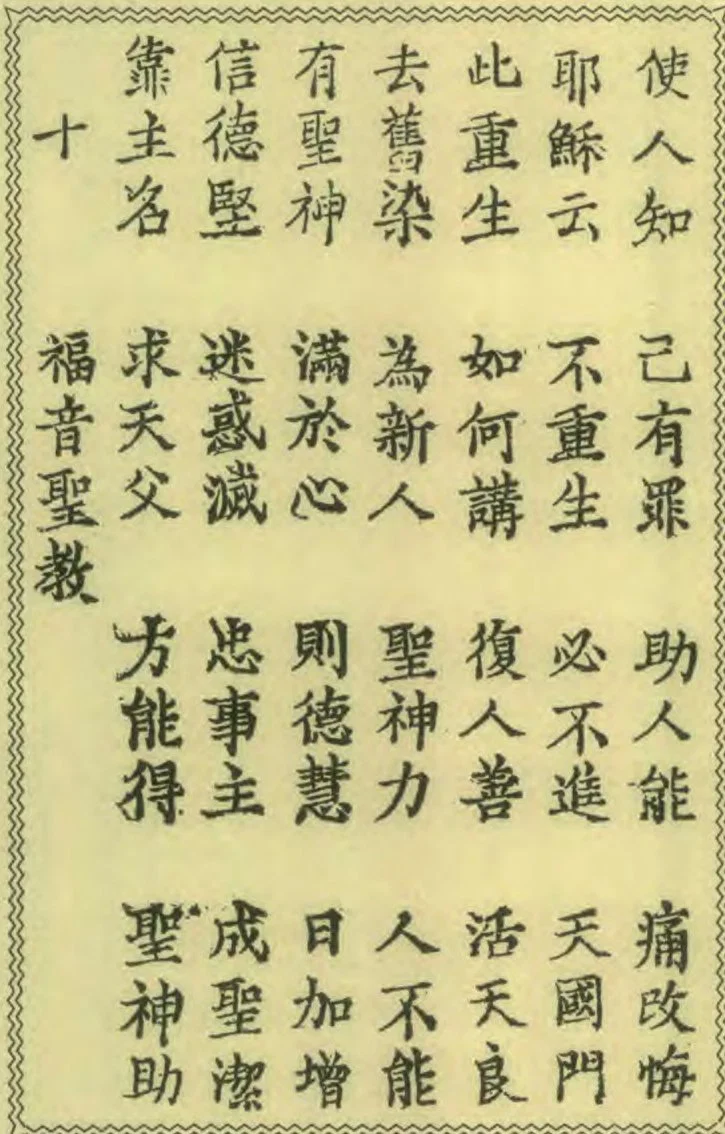
A Page from a Chinese School-Book, Printed from Black Letters, Reduced About One Third.
Printing in China.
While the art of printing was invented by the Chinese, it is not until the last few years that they have begun duplicating their literature by modern methods of printing. For many centuries the method has been that of writing the copy on very thin paper, into which the ink readily soaks, then pasting this on a smooth block of wood with the face of the copy to the surface of the block. Then they carefully carve the characters. The method of printing is also a simple one: First brushing ink over the surface of the carved block, then laying a sheet of paper on the top of this, with another brush they press down, somewhat as we in America do when hanging wall-paper. But this method of duplicating their books has answered in preserving the writings of the sages, and every year of past centuries has witnessed hundreds of thousands of students presenting themselves for the examination leading to degrees in every provincial capital and prefectural city.
Medical Book Illustrated.
The illustrations in books, when there are such, are indeed very crude. Medical books with illustrations of men simply outline their principal parts by lines; the first line bounding the periphery of the body and extremities, then another line half way between the apex of the chest and the thighs divides the body into two parts, the upper containing the heart, and the lower, the stomach. The latter is supposed to be the seat of the mind. If the abdomen is prominent or less conspicuous, the range of thought is respectively profuse or slight. Another illustration often found in these books is that of a man outlined as above, with small crosses marked in various places where it is supposed to be safe to thrust in a long needle for the cure of disease in the various parts of the body, in order to rid the parts of an evil spirit which is supposed to reside there. A few of these places are the eye, just above the elbow, thru the cheeks, the lower end of the sternum, over the stomach, in the thigh, etc. With no method but the wooden blocks with which to produce their illustrations and their superstitions relative to the dead, this has been the best they could do to indicate their ideas.
The Old and the New.
The ordinary Chinese seem to have no ability whatever along the line of illustrating anything by a drawing. This they readily learn when taught by Americans or Europeans. Their drawing is limited to their characters. I have been surprised after sending a man to see a plot of land that he could not make any kind of a drawing to show the location of same. He could write a good description of it and give the boundaries and the directions of the boundaries, also remember the length of each side, but would have no idea how to represent these by a small diagram. Their ideas of illustrating are well shown by some of the maps they have of their own empire. The outline of the empire is a large rectangle, and the13location of the provinces and prefectures of the empire are indicated by ovals in juxtaposition containing within them the Chinese characters. From these they have studied their geography. Their knowledge of locations is therefore very indefinite. They will say this city is on the south side, that on the north, the other on the west, and still another on the east side, but to give the boundary and actual distances from one to the other would be quite impossible even to some teachers who have secured their degree. Their education consists in memorizing large numbers of characters, and that man who has the best education is the one who can explain the meaning of the largest number of characters and repeat line after line of the classics.
This old system of education has been replaced by the modern, and China is largely indebted, if not entirely so, for its modern literature to the efforts of missionaries who have been active in translating and circulating the more modern books. These conditions—the Chinese being a people who have a love for literature—add respect for all printed matter, and with such an inadequate method of reproducing their literature and illustrating it, speak in loud terms of the opportunities before us with modern methods to place before the millions of this empire the Gospel in clearness and in a respectable form. Certainly this cause is worthy of the assistance of every one desiring to see this people rise from their heathen superstitions and walk in the light to which God has seen fit to call us.
Shanghai, China.
A Double Portion.
THE "double portion" is often the only remedy for our losses. Nearly forty years ago a girl just stepping into womanhood, bade good-by to parents, friends, and home, and set off across the American continent to China, on the way to meet her missionary lover, who had gone out some years before to make ready for her. Several months went by, and the friends waiting in the old home received her first letter. She wrote: "I have traveled for seven months thru strange continents and over tempestuous seas to meet my beloved, and I have found the grass seven months green upon his grave." The missionary friends wished to take her to their own house, but she refused. "Let me go to the home he made for me," she said, and there she took up her abode. Thirty years after, visiting her native land for the first time, with a record of missionary work behind her such as few women have ever achieved, she said: "From some people I believe God takes away the pain of loss for the asking. With others of us He leaves it all unlighted, and only gives the strength to bear it. So it has been with me, that I might the better realize the desolation and the darkness of the lives of those Christless Chinese women." So she won her "double portion."—Selected.