Such wondrous music fell from tuneful strings
When the young shepherd played before the king—
Such holy, thrilling music, that anear
The shining angels drew, on hovering wing;
The evil angels, full of deadly blight,
Fell backward to their dread abodes of night.
Such holy spell came o'er the royal heart—
Such gentle impulse, and such kindly mood—
His spirit grew like to a little child's,
The evil spirits could no more intrude.
Within the court was life and love and joy,
Wrought by the music of a shepherd boy.
And as to-day we hear the wondrous strains
Wrought in the strings of that same tuneful lyre,
We seem again to feel their presence near,
To hear the music of that heavenly choir.
O'er our warm hearts there throbs the selfsame joy
Saul felt while listening to the shepherd boy.
The rich, deep chords have never lost their spell;
And wondrous love has kept the lyre, still,
That, while the shepherd watched his father's sheep,
Rang out its music over plain and hill.
To saddened hearts it still can gladness bring,
And still we hear the gentle shepherd sing.
Still has it power to quell the mighty tides
Of sin and evil in our human hearts.
Still at its music loud, or soft and low,
All kindly impulse into being starts.
A harp of widest range, thou tuneful lyre,
What thoughts, what hopes, what joys, thy notes inspire!
And listening to thy voice, thou shepherd-king,
Our hearts leap forward with a wondrous joy.
We think upon the time when thou shalt sing,
Thy skilful fingers on the strings employ,
And we shall hear that harp forevermore,
Join in the music of the eternal shore.
Just for a Photograph
By B. M. Grandy
Merely to Get a Picture — Expensive Buildings Erected for the Purpose — "Wildcat" Speculations and "Wildcat" Religions
By B. M. GRANDY
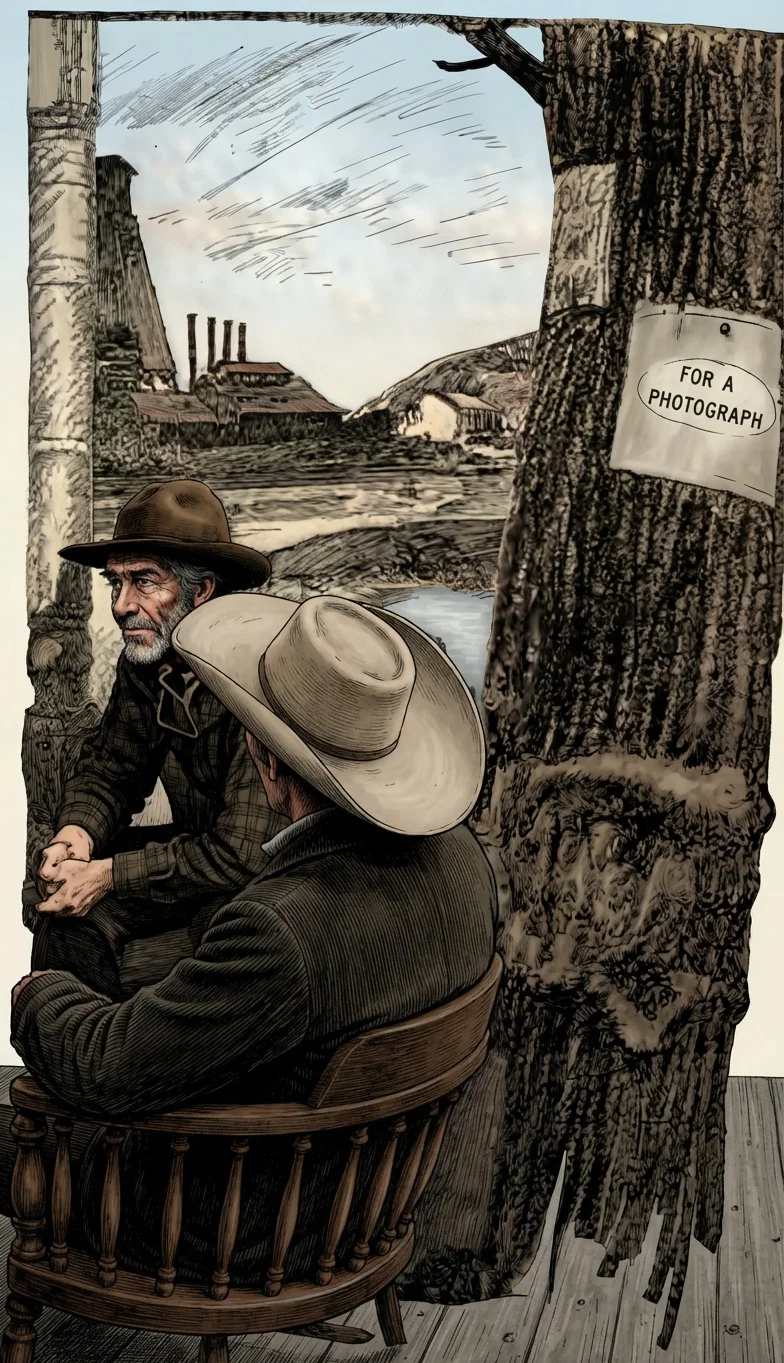
TWO mining men were sitting on the veranda of a hotel in a decaying mining camp situated on the banks of the sinuous Snake River. Pointing to a large, dilapidated mill a short distance up the mountainside, one questioned the other thus: "Why was that built? Was it for a photograph?"
The men passed out of hearing, and the remainder of the conversation was lost. But what a strange question! Why should any one build such an expensive mill just to photograph?
JUST TO BE PHOTOGRAPHED
In order to induce people to invest money in mining stock, promoters sometimes go to great expense in constructing buildings and installing machinery, that these may be photographed, and the pictures used to embellish attractive and alluring circulars that are sent to prospective investors.
Why was that built? Was it for a photograph?
Sometimes promising ore is in sight, but more than likely only a worthless ledge; but be that as it may, the real purpose of the promoter is to extract money from the public. No investors are barred; and the hoarded pennies of the widow, the hard-earned savings of the artisan, as well as the surplus wealth of the more well-to-do, all go to swell the bank-account of the successful (?) promoter.
"WILDCAT" MINES
In mining parlance, this is known as "wildcatting"; and while not practised so much as formerly, it is still, in some places, carried on successfully.
These dishonest methods practised by mining promoters have caused many investors to shun mines and mining, and look with suspicion upon all mining operations.
Still there are legitimate mining investments; and every year, the rock-seamed earth yields a harvest of precious metals. The wealth of commerce witnesses to the fact that stored in the depths of the earth, the virgin gold lies, waiting for the pick of the miner to bring it to the light of day, to take its place in the marts of the world.
By those who delve beneath the rugged surface of the earth, who seek earnestly and intelligently, the precious treasure is brought forth, and the world's wealth increased.
WILDCAT RELIGIONS
In describing last-day conditions, Jesus said, "For there shall arise false christs, and false prophets, and shall show great signs and wonders; insomuch that, if it were possible, they shall deceive the very elect." Matt. 24: 24.
And so to-day we find ourselves living in the days of "wildcat" religions. Promoters are springing up almost daily in all parts of the earth, and the cry goes out, "Lo, here is Christ, or there." Books and circulars flood the mails, and enthusiastic agents are peddling stock in every city, village, and country. One after another of these "wildcat" ventures is exploded, but still they come forth. Many persons are led to invest their time, means, and talents in these movements. Disappointed in one, they turn to another; and while each promises great returns, the dividends consist only in blasted hopes. They "shall show great signs and wonders." And for what? — To deceive many — just to photograph.
THE COUNTERFEIT IMPLIES THE GENUINE
Again, many who have talents, means, and a life to save, are led to look upon all religion with distrust, and stifling their craving for the spiritual, they let other fields engage their attention.
But as we behold the wonderful work that true Christianity has done and is doing, we have abundant evidence that, apart from the many delusions, there are still legitimate investments that bring forth rich returns from the mine of truth.
The "wildcat" mining schemes would be impossible but for the well-paying mines. The counterfeit religions are themselves evidence of the existence of the true. And to those who seek earnestly, with a whole heart, "if thou seekest her as silver, and searchest for her as for hid treasure," there remains the sure reward. Again, "the kingdom of heaven is like unto treasure hid in a field; the which when a man hath found, he hideth, and for joy thereof goeth and selleth all that he hath, and buyeth that field." Matt. 13: 44.
"I counsel thee to buy of Me gold tried in the fire, that thou mayest be rich; and470(Continued on page 13)
Just for a Photograph
(Continued from page 5)
white raiment, that thou mayest be clothed, and that the shame of thy nakedness do not appear; and anoint thine eyes with eye-salve, that thou mayest see." Rev. 3: 18.
Our eyes enlightened by the Spirit and the word of God, the wonderful array of man-promoted doctrines that confront us will have no attraction for us, but unerringly will we be led to the mine of truth. It has never failed to pay rich returns in joy, happiness, and peace. Besides, in the bank of heaven our investments are growing, and when the final dividends are declared, our share will be life eternal.
"If any man will do His will, he shall know of the doctrine." John 7: 17.
The Influence of a Holy Life
"The unstudied, unconscious influence of a holy life is the most convincing sermon that can be given in favor of Christianity. Argument, even when unanswerable, may provoke only opposition; but a godly example has a power that it is impossible wholly to resist."
The Personal Friendship of Jesus
By F. A. Allum
Influence of Contact with His Life — A Mere Idea Not Sufficient — We Need to Sense His Personal Power — The Effect of Individual on Individual
By F. A. ALLUM
Superintendent West China Mission
“HENCEFORTH I call you not servants, . . . but I have called you friends.” John 15: 15.
In these words, Christ uses human friendship to represent to us the close relation that exists between the believer and his Lord, and He expresses this relationship as the supreme friendship that is possible to mankind.
MORE THAN A FRIENDSHIP
Of course the religion of Jesus is more than a friendship, and His relation to us can never be fully stated in the terms of any friendship, however exalted, or, indeed, in the terms of any human relationship. It far transcends them all, and yet human friendship may serve to illustrate the sacred tie that binds us to our Lord.
It is stated that “ideas rule the world”; but in reality those things that have been most powerful in influencing our lives have not been abstract ideas, general principles, but rather somebody. That is, the great master forces of our lives are personal rather than impersonal. Speaking of the gospel, Bishop Lightfoot says, “It is neither a dogmatic system nor an ethic code, but a person and a life.”
THEY HAVE BEEN WITH JESUS
This is well illustrated in the way Christ dealt with His first disciples. When they first came to Him, He did not say: “These are My doctrines; believe them. These are My precepts; obey them.” But He said: “Follow Me,” “Come and see.” Thus He bound them to Himself. He “ordained twelve,” we read, “that they should be with Him.” Mark 3: 14. That was all, and then the wondrous power of divine love did the rest. They, “beholding as in a glass the glory of the Lord,” were changed “from glory to glory,” even “into the same image.” And this was so noticeable that after the ascension of their Master, the people of Jerusalem whispered to one another, as they saw these fishermen, “They have been with Jesus.” There was that in them which only thus could be explained.
The thought, in the words of another, is this: “If there is any good, if there be any spiritual enrichment, that can come into your life through human friendships, then that multiplied a hundredfold may come to you through the friendship of Jesus.”
OUR HUMAN FRIENDSHIPS
Let us inquire: What is it that our human friendships do for us? What are the fruits they yield to us? Let Bacon answer: “A principal fruit of friendship is the ease and discharge of the fulness and swellings of the heart, which passions of all kinds do cause and induce; . . . but no receipt openeth the heart but a true friend to whom you may impart griefs, joys, fears, hopes, suspicions, counsels, and whatsoever lieth upon the heart to oppress it in a kind of civil shrift or confession.”
And this communicating of man’s thought to his friend, he says, works two utterly different effects, “for it redoubles joys, and cuteth griefs in half; for there is no man that imparteth his joys to his friend but he joyeth the more, and no man that imparteth his griefs to his friend but he grieveth the less.”
POSSIBILITIES OF THIS SUPREME FRIENDSHIP
That the above is true, human experience has again and again attested. And the important question is: Can the friendship of Jesus do all that for us? Can Christ prove Himself to be a friend after this fashion? This is not a question for argument. Let us appeal to the facts of Christian experience.
In that wonderful story of John G. Paton, missionary to the New Hebrides, is a chapter that reveals the possibilities of this supreme friendship. He tells of the death of his young wife and his infant child, and how with his own hands, when his heart was well-nigh breaking, he dug their grave just at the end of the house, and then he walled it up with blocks of coral, and covered the top of it with beautiful white coral, broken small. That place became to him, he says, as a sacred shrine, where during the months and years that followed, with ceaseless prayers and tears he claimed the land for God where he had buried his dead in faith and in hope.
He finishes the story thus — and I want you to listen, and then tell me whether the friendship of Christ may not be a real thing: “But for Jesus and the fellowship He vouchsafed me there, I must have gone mad and died by that lonely grave; and all that is possible of sympathy through human friendship can come to a man through the friendship of Christ.”
SYMPATHY AND COUNSEL
Bacon further tells us: “The first fruit of friendship is sympathy, and the second is counsel. The best preservative to keep the mind in health is the faithful admonitions of a friend.” “The best receipt — best, I say, to work, and best to take — is the admonition of a friend. It is a strange thing to behold what gross errors and extreme absurdities many, especially of the greater sort, do commit for want of a friend to tell them of them, to the great damage of both their fame and fortune.”
Again I ask, Can Christ be a friend after this sort? Let us appeal to the facts of human experience.
Below is an extract from one whom Henry Drummond has called one of the highest intellects that this age has known. He says:
“I say frankly that more than any recognized influence of my father or of my mother upon me; more than the social influence of all the members of my father’s household; more, so far as I can trace it, than all social influences of every kind, Christ has had the formation of my mind and my disposition. My hidden ideals of what was beautiful I have drawn from Christ. My thoughts of what is manly and noble and pure have almost all of them arisen from the Lord Jesus Christ.
“Many men have educated themselves by reading Plutarch’s lives of the ancient worthies, and setting before themselves one and another of these that in different ages have achieved celebrity, and they have recognized the great power of these men upon themselves. Now I do not perceive that any poet or philosopher or reformer or general or any other great man ever has dwelt in my imagination and my thought as the simple Jesus has. For more than twenty-five years I have gone instinctively to Christ to draw a measure and rule for everything wherever there has been a necessity for it. I have sought, and at last almost spontaneously, to throw myself on the companionship of Christ; and early, in my imagination, I could see Him standing and looking quietly and lovingly upon me.
“There seemed almost to drop from His face an influence upon me that suggested what was the right thing in the controlling of passion, in the subduing of pride, in the overcoming of selfishness; and it is from Christ manifested to my inward eye that I have consciously derived more ideals, more models, more influence, than from any human character whatsoever.”
CAN NOT GO ALONE
After enumerating the above-mentioned fruit of friendship, Bacon finally gives the following remarks that are well worthy of our attention. “I mean,” he says, “aid and bearing a part on all actions and occasions. Here the best way to represent to life the manifold use of friendship is to cast and see how many things there are which a man can not do for himself, and then it will appear that it was a sparing speech of the ancients, to say that a friend is another himself, for that a friend is far more than himself.”
That thought applied to the friendship of Christ suggests the power to become like Christ; for we become, in disposition at least, like our friends.
This is clearly shown in a touching incident related in the biography of the famous Brighton preacher, Frederick William Robertson. The biographer was collecting material for his biography; and he went into one of the shops of Brighton where Robertson used to do his business, and asked the man about Robertson’s whole personal influence over him. The shopkeeper said, “Come”; and he took him into a small room behind the shop, and there upon the wall he pointed him to a portrait of the great preacher, and said, “If ever there in the shop I am tempted to meanness or baseness or trickery, I come back here and look in that man’s face, and, sir, I can not do it.” With those pure, searching eyes upon him, he could not “do this great wickedness, and sin against God.”
HIS INSPIRING PRESENCE BROUGHT SUCCESS
All this is but the faintest image and the poorest parable of what Jesus Christ can be to them that put their trust in Him and make Him their real friend. Here are the words of another living man who speaks of the truthfulness of the above statement. He says: “I can only speak my own experience. I am not talking theology or philosophy. I know what I am saying; and I can point to the places where I should have fallen if I had not been able to rely for guidance upon something better than a commandment or deduction, but the pure, calm, heroic image of Jesus confronted me, and I succeeded. I have no doubt as to what He would have done. Through Him I did not doubt what I ought to do.”471
The friendship of Christ will never fail us. As for human friends, the following lines tell us how unstable they sometimes are:
“Go search for friends.
You’re sure to find some
Who charm by being new;
But years must pass,
And troubles come,
Ere you can prove them true.”
We remember the wail of the psalmist, “Yea, mine own familiar friend, in whom I trusted, which did eat of my bread, hath lifted up his heel against me.” And again: “It was not an enemy that reproached me; then I could have borne it: . . . but it was thou, a man mine equal, my guide, and mine acquaintance. We took sweet counsel together, and walked unto the house of God in company.” Ps. 41:9; 55:12-14.
Such broken friendships strew many lives. But the friendship of Jesus will never fail us. “Love Him,” says Thomas a Kempis, “love Him, and keep Him for thy friend who, when all go away, will not reproach thee, nor suffer thee to perish at the last.”
HOW MAKE IT OUR OWN?
How can we make the friendship of Christ our own? How can it be truly realized?
The answer to this question is found in the text at the beginning of this article. “Henceforth,” says Christ, “I call you not servants.” You see we take Him first as our Master, and then He takes us as His friends; and so, as some one has said, “through the door of discipleship, we enter into friendship.”
Thus we can not realize the full, real friendship of Christ until we are willing to yield all to Him. “Ye are My friends, if ye do whatsoever I command you.” John 15:14. It was thus that Abraham became the “friend of God.” See James 2:20-23.
And Jesus, this Friend of all friends, has given His life for His friends. Then let us yield all to Him. O that from our hearts the cry might go up:
“Nay, but I yield, I yield.
I can hold out no more.
I sink, by dying loved compelled,
And own Thee conqueror.”
Sonship Evidence
By T. E. Bowen
THE testimony of Jesus' enemies was, "This man doeth many miracles." Jesus looked like other men. He was a man. He was also more. He was the Son of God.
He gave unimpeachable evidence that He had power such as had never before been seen among men. He spoke with authority. Every act and word was an expression of truth. Demoniacs heard His authoritative command to evil spirits possessing them, and were healed. Lepers were cleansed. Whole cities were left without one sick person as the Son of God passed through. The blind saw, the deaf heard, and those silent in death answered His call by coming back to life. Even the elements obeyed. The officers who were sent to arrest Him returned saying, "Never man spake like this man."
It was the Father speaking through His Son. It was the Son revealing the Father.
Evidence of the genuineness of His mission among men was piled high. Every word, every act, was surcharged with the wonder-working miracle power of the Infinite One whose Son He was and is.
And best of all, He still lives. He still belongs to us, though now in heaven. He is still "this same Jesus," full of love for every tempted, struggling soul looking to Him for deliverance. Only believe, and you shall know also that this miracle-working One can change your vile heart, making it His home, and transforming it into the image of His own—the most wonderful of all miracles. T. E. BOWEN.
Satan Powerless to Create
By A. S. Booth
Shut Up in a World All His Own—Has Every Opportunity to Make His Boast Good—Despairingly Ends in Destruction
By A. S. BOOTH
"And I saw an angel come down from heaven, having the key of the bottomless pit and a great chain in his hand. And he laid hold on the dragon, that old serpent, which is the devil, and Satan, and bound him a thousand years, and cast him into the bottomless pit, and shut him up, and set a seal upon him, that he should deceive the nations no more, till the thousand years should be fulfilled." Rev. 20:1-3.
Satan is to be confined to this world in its desolate condition. The voice that he has despised and caused cruel men to hush, out on Golgotha, is then proved to be the voice of the Life-giver, who descends "from heaven with a shout," and in "a moment, in the twinkling of an eye," the righteous are changed, and "caught up to meet the Lord in the air," and live and reign with Him a thousand years.
NO WICKED IN THAT TIME
During the period of time in which the righteous reign with Christ and Satan is bound, the wicked will be in death. The hand that the adversary has moved men to nail to the cross, will be made bare, and strike despair and death to the wicked, and they live not again until the thousand years are finished. Verse 5.
The condition of the earth during the time of Satan's binding is expressed in the following texts:
REDUCED TO CHAOS
"The day of the Lord cometh, . . . a day of darkness and of gloominess, a day of clouds and of thick darkness." Joel 2:1, 2.
"I beheld the earth, and, lo, it was without form, and void; and the heavens, and they had no light. I beheld the mountains, and, lo, they trembled, and all the hills moved lightly. I beheld, and, lo, there was no man, and all the birds of the heavens were fled. I beheld, and, lo, the fruitful place was a wilderness, and all the cities thereof were broken down at the presence of the Lord, and by His fierce anger. For thus hath the Lord said, The whole land shall be desolate; yet will I not make a full end. For this shall the earth mourn, and the heavens above be black: because I have spoken it, I have purposed it, and will not repent, neither will I turn back from it." Jer. 4:23-28.
BOASTS A BETTER KINGDOM THAN GOD'S
It has been the boast of Satan that he could conduct a kingdom better than God. So once, in the end of time, God will reduce the earth to the same condition it was in immediately after He created it, and grant Lucifer opportunity to demonstrate his power.
When the Lord began the work of creation, He said: "Let there be light: and there was light." "Let the earth bring forth the living creature after his kind." "Let Us make man." And so it was; and "God saw that it was good." Genesis 1.
CAN HE CREATE?
Can Satan create light?—He may say, "Let there be light," a thousand years, but the heavens will remain black. Can he say, "Let the heavens bring forth birds, and the fields beasts"?—He may say it, and repeat it a thousand years, but the birds and the beasts are perished. Will it be worth while for him to say, "Let us make man"?—He can not give life to a blade of grass.
He is utterly bound, and wanders up and down the earth, beholding what the working out of his plans has wrought, and trembles for the final end when he himself will be utterly destroyed. Eze. 28:12-19.
"Resist the devil, and he will flee from you. Draw nigh to God, and He will draw nigh to you." James 4:7, 8.
The Risk and the Gain
By Adelaide D. Wellman
Freedom Eternally the Object Sought
By ADELAIDE D. WELLMAN
"Nothing ventured, nothing gained," says an old saw. And it contains more truth than do most saws. The principle it expresses was involved in the purpose of the Creator when He gave to angels and to mankind the power of choice.
Mere Machines Not Desired
Had the Infinite thought best not to "venture" so much, He must needs have made His creatures mere machines. Certainly He would thus have guarded effectually against the danger of sin, with all its consequent misery. There would then never have been a Satan or a demon to wield superhuman power for malignant purposes, nor would there have been on earth a depraved human being to cast discredit, by his very existence, on the God who formed him.
But while there would have been this security against loss, what of the gain? Alack, all possibility of gain would have been foregone. Instead of responsible intelligences, there would have been only puppets.
One Advanced and the Other Fell
Though the possession of the power of choice on the part of Lucifer and those who became his followers, made possible their transformation from angels of glory to fiends, yet that same power was so exercised by twice as many other inhabitants of heaven, that they advanced to infinite attainment, past all liability to fall.
Likewise, while the inhabitants of earth, by misuse of the free will granted them, seem almost to have stamped as a failure the work of their Maker, yet in untold worlds472are innumerable hosts who, having chosen good instead of evil, have reached heights of happiness that would have been utterly impossible without the exercise of free personal volition.
Eventually
And eventually, all the disastrous effects of the "venture" will be erased. The experiment of sin will have demonstrated, to the conviction of the entire universe, the rightness of right and the folly of sin; and in the eternity of the future, an unmarred creation will be grateful that God "ventured" more than mortals can ever know, in order that they might be in the fullest sense free.
Blasting at the Rock of Ages
By Le Roy E. Froom
Open Infidelity Has Sought to Break Down the Word—
A Disguised Infidelity Is Trying It To-Day
By LE ROY E. FROOM
BIBLE study and Bible preaching are fast dying out of the world. Art, literature, oratory, ethics, politics, "social service," "civic reform,"—anything, everything,—has taken the place of the old-fashioned Bible. Such is the condition in the home, and congregations demand that kind of sermons.
Against all this the apostle Paul utters his warning to the ministry, "Preach the Word." And the Master urges all men everywhere to "search the Scriptures." There is life and power in that Word. It is the eternal Rock of Ages.
Down through the centuries, men have been blasting away at it, but it seems to have thrived under the hard treatment. That is a wonderful story of how the Bible has come to us through those years. Like a great anvil, it stands unworn and unmoved, while the hammers of hatred are battered and worn. Destroy the Bible! One might as well talk of blotting the sun out of the sky. Yet men will try it.
The infidel Voltaire said, "In one hundred years there will not be a copy of the Bible on earth." Voltaire is dead—but the Book lives on. A hundred years have passed, and the Bible is going to the world at the rate of over six million copies a year, printed in more than five hundred and fifty distinct forms of human speech. And the very printing-press that scattered Voltaire's false prophecy was later used by the Geneva Bible Society to print God's holy word.
In those years that are past, rank and open infidelity sought to bring God's book into contempt. To-day infidelity has taken on a more insidious and refined form. In the church it is called higher criticism, and in the university it is called science. With the air of advanced learning, a campaign of doubt is fast encircling the globe.
The leaders in this movement are entrenched in the pulpit, the press, the university, and even the theological seminary. They demand a revision of belief regarding the Sacred Writings, rejecting this, cutting off that, ridiculing another passage, until among them all there is nothing left of it.
Are we to accept the Bible as you would a fish, picking out the bones before swallowing it? Is it the word of God, or is it not? The prevailing movements of the day are subtle infidelity. Truly the time has come, predicted by Paul, "when they will not endure sound doctrine," but will "heap to themselves teachers, having itching ears." 2 Tim. 4: 3, 4. Do we not know the baneful results of forsaking the Bible during the Dark Ages? Do we not see the forward strides made during the Reformation? They were made because men turned again to the word of God.
I plead with you to study God's living word. Study it as His message to you; not to prove a pre-adopted creed; not for ammunition to argue with; not with father's spectacles, to see it just as father saw; but as the message of the living God.
Its precepts are binding. Its histories are true. Each time the pick and shovel of the explorer unearth a new record, the evidence increases. From the dust of the dead and buried past march forth mute witnesses to the truth of the Word. May it accomplish its divine mission in each one of us!
The Sabbath and the Law
Pertinent Questions with Answers in Scripture Texts
1. Does Christ give assurance of the perpetuity of all the law?
"Jesus said unto him, Thou shalt love the Lord thy God with all thy heart, and with all thy soul, and with all thy mind. This is the first and great commandment. And the second is like unto it, Thou shalt love thy neighbor as thyself. On these two commandments hang all the law and the prophets." Matt. 22:37-40.
2. Is there Sabbath law in the New Testament?
"Wherefore it is lawful [in harmony with law] to do well on the Sabbath days." Matt. 12:12.
3. Did Christ observe the law, and thus magnify it?
"I have kept My Father's commandments, and abide in His love." John 15:10.
"He will magnify the law, and make it honorable." Isa. 42:21.
"Whosoever therefore shall break one of these least commandments, and shall teach men so, he shall be called the least in the kingdom of heaven: but whosoever shall do and teach them, the same shall be called great in the kingdom of heaven." Matt. 5:19.
4. In whose name and through whose counsel must men obtain eternal life?
Jesus Christ's.
"Neither is there salvation in any other: for there is none other name under heaven given among men, whereby we must be saved." Acts 4:12.
"And a certain ruler asked Him, saying, Good Master, what shall I do to inherit eternal life? And Jesus said unto him, . . . Thou knowest the commandments." Luke 18:18-20.
"And He said unto him, . . . If thou wilt enter into life, keep the commandments." Matt. 19:17.
5. Should the life be in harmony with the whole law?
"If ye fulfil the royal law according to the Scripture, Thou shalt love thy neighbor as thyself, ye do well. . . . For whosoever shall keep the whole law, and yet offend in one point, he is guilty of all. For He that said, Do not commit adultery, said also, Do not kill. Now if thou commit no adultery, yet if thou kill, thou art become a transgressor of the law. So speak ye, and so do, as they that shall be judged by the law of liberty." James 2:8, 10-12.
Becometh Thine House
By M. E. Olsen
"HOLINESS becometh Thine house, O Lord." This beautiful scripture is usually taken as referring chiefly to conduct in the house of God — a reverent attitude of mind, carefulness in refraining from all that would be unseemly or contrary to the spirit of a place where God is worshiped. But it surely includes the further thought that the people who come together thus to worship should themselves be holy. To be a Christian means to live a holy life — a life separate from the world, wholly devoted to the Lord Jesus. M. E. OLSEN.
S. N. H
By Stephen N. Haskell
In crises, decisions are made quickly. Many fail at such times, because they do not have independent Christian characters. They are in the habit of following the leadings of those in whom they have confidence, and they have no strength in themselves. He who would always prove true in the crises of life, must have a clear connection with the God of heaven, and must fear God more than man.