Pacific Press Publishing Company · New York · Sep 26, 1895
RELIGIOUS TOLERATION IN MARYLAND.
THERE are two facts that conspire to make the history of religious toleration in Maryland of surpassing interest to the student of American history. One is that the lord proprietary was a Roman Catholic; the other is that Maryland, it is claimed, was the first of the original thirteen colonies to establish religious toleration by statute.
Confronted by the history of centuries of intolerance in other countries, Roman Catholics turn with satisfaction to the history of Maryland, and point to it with pride, as an evidence of the tolerant character of “the church.”
After exhausting the very meager materials found in the Old World with which to support the papal claim that “the church” is tolerant, Cardinal Gibbons says:—
Turning to our own country, it is with no small degree of satisfaction that I point to the State of Maryland as the cradle of civil and religious liberty, and the “land of the sanctuary.” Of the thirteen original American colonies, Maryland was the only one that was settled by Catholics. She was also the only one that spread aloft over her fair lands the banner of liberty of conscience, and that invited the oppressed of other colonies to seek an asylum beneath its shadow.
There are, at least, two fatal errors in this paragraph: first, Maryland was not settled exclusively, nor even principally, by Roman Catholics; and second, religious libertywas never established in that colony, either by Catholics or by Protestants. The act of April 21, 1649, was an act of toleration merely, providing that “no person within this province, professing to believe in Jesus Christ, shall be in any ways troubled, molested, or discountenanced, for his or her religion, or in the free exercise thereof.”
The same act provided that “whatsoever person shall . . . deny the Holy Trinity, or any of the persons thereof, shall be punished with death.” And that “whatsoever person or persons shall from henceforth use or utter any reproachful words or speeches concerning the blessed Virgin Mary, the mother of our Saviour, or the holy apostles or evangelists, or any of them, shall in such case for the first offense forfeit to the lord proprietary the sum of five pounds sterling or the value thereof. . . . And every such offender or offenders, for every second offense shall forfeit ten pounds sterling or the value thereof. . . . And every person or persons before mentioned offending herein the third time, shall for such third offense forfeit all his lands and goods, and be forever banished and expelled out of this province.”
It will be readily conceded that this was very far short of religious liberty; it was simply toleration for believers in the Christian religion. It is true it was far in advance of any other colony at that time except Rhode Island, but it was not religious liberty. In practice it did not secure even toleration to all believers in Jesus Christ. “The Quakers were persecuted in Maryland as badly as in Virginia and Massachusetts.” For example: “In 1658, Joseph Coale and Thomas Thurston, preachers belonging to that body, were treated with great severity by the authorities and compelled to flee the country.”
But let us consider briefly the question as to whom the credit belongs for a measure of religious toleration in Maryland.
As before stated, Maryland was not settled by Roman Catholics but very largely by Protestants. The charter was issued on the twentieth day of June, 1632, to Cecil Calvert, the second Lord Baltimore. The following November, Leonard Calvert, brother of the proprietary, sailed from the Isle of Wight with two hundred colonists to effect a settlement in Maryland.
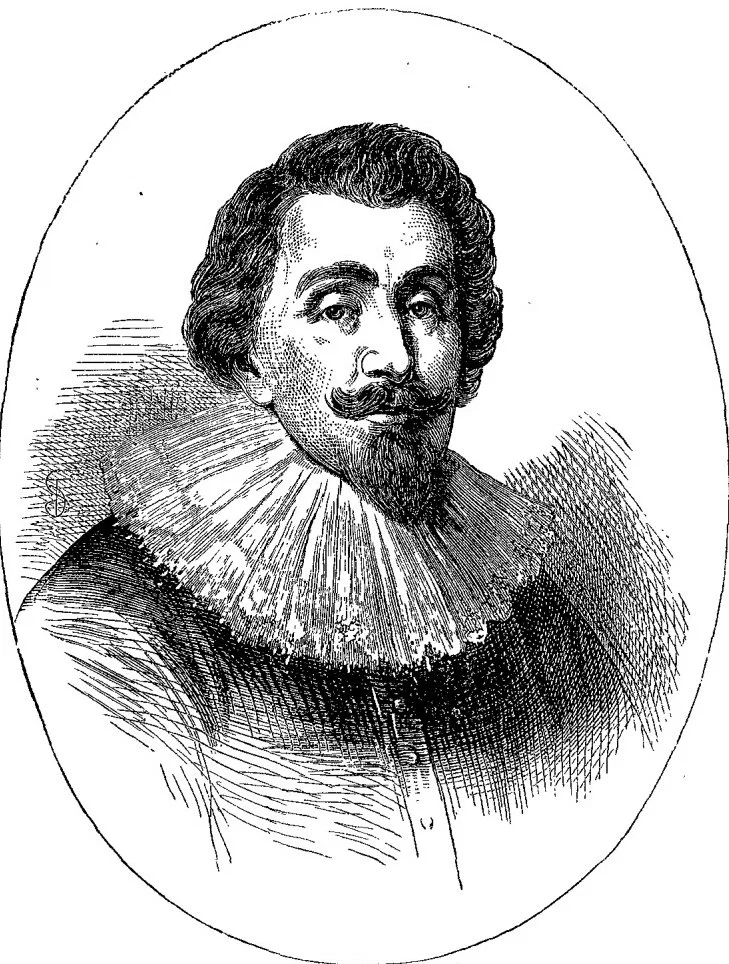
CECIL CALVERT, SECOND LORD BALTIMORE.
The vessels, the Ark and the Dove, sailed by way of Fortune Island, Barbados, and St. Christopher’s, and did not reach Maryland until March, 1634. After cruising about in298the Chesapeake Bay and the Potomac River, they dropped anchor in St. Mary’s River.
Leonard Calvert gained the good-will of the natives who were preparing to abandon that particular locality, and purchased from them for some cloth and a few axes, their right to the soil. Bancroft says:—
Upon the 27th [of March, 1634], the emigrants, of whom at least three parts of four were Protestants, took quiet possession of the land which the governor had bought.
It is probable that the relative proportion of Catholics and Protestants in Maryland remained about the same, and though the government was in the hands of the lord proprietary, who was a Catholic, it would have been quite impossible for him, even had he desired to do so, to have denied toleration to so large a majority of his subjects. Bancroft says:—
In the mixed population of Maryland, where the administration was in the hands of Catholics, and the great majority of the people were Protestants, there was no unanimity of sentiment out of which a domestic constitution could have harmoniously risen.
This was about the time of the conflict in England between the Parliament and Charles I., and Lord Baltimore had to look well to his rights in order to retain any authority at all. Leonard Calvert, the proprietary’s deputy, went to England in 1643 to consult with his brother, Lord Baltimore, about affairs of the colony. Claybourne was still claiming Kent Island, and the Presbyterians, Episcopalians and Puritans, who formed a large proportion of Lord Baltimore’s subjects, were restless under the authority of a Catholic, and were desirous of establishing Protestantism, so-called, as the religion of the colony.
In 1645, a petition was presented to the House of Lords, asking that the government of Maryland might be settled in the hands of Protestants. For some reason this petition was not acted upon, and “the politic Lord Baltimore,” says Bancroft, “had ample time to prepare his own remedies. To appease the Parliament, he removed Greene [the Roman Catholic Governor], and in August, 1648, appointed in his place Wm. Stone, a Protestant of the Church of England.” A very significant fact in this connection is that Lord Baltimore required Governor Stone to take and subscribe the following oath:—
I do further swear I will not by myself, nor any other person, directly trouble, molest, or discountenance any person whatsoever in the said province, professing to believe in Jesus Christ; and, in particular, no Roman Catholic, for or in respect of his or her religion, nor his or her free exercise thereof within said province, so as they be not unfaithful to his said lordship, or molest or conspire against the civil government established under him.
This shows very clearly that instead of being in a position to dictate to others in matters of faith, had he been so disposed, Lord Baltimore was apprehensive lest religious toleration might be denied to his co-religionists; as, indeed, there was a manifest disposition in the colony to do, and as the charter would have warranted, for at that time popery was outlawed in England.
It was in April of the following year that the act, already referred to, establishing religious toleration, was passed. Bancroft says: “To quiet and unite the colony, all the offenses of the late rebellion were effaced by a general amnesty; and, at the instance of the Catholic proprietary, the Protestant governor, Stone, and his council of six, composed equally of Catholics and Protestants, and the representatives of the people of Maryland, of whom [only] five were Catholics, at a general session of the assembly held in April, 1649, placed upon their statute books” this act of toleration.
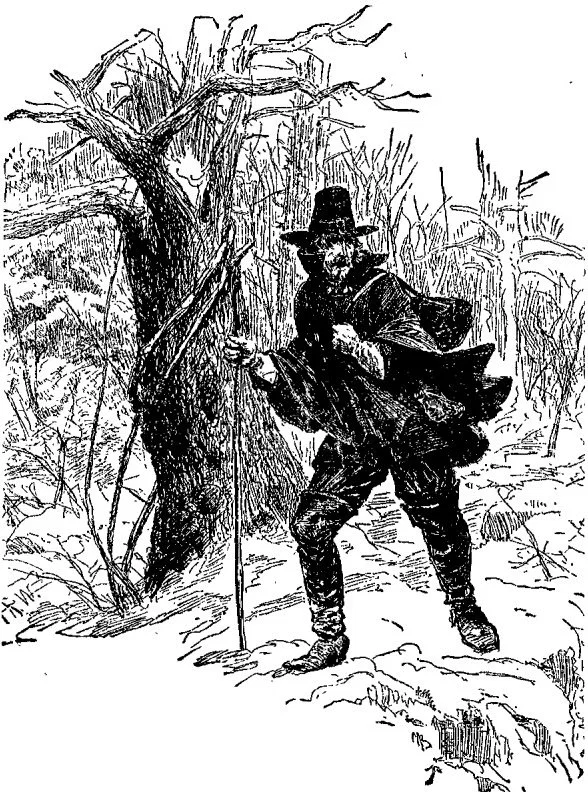
Roger Williams Fleeing from Massachusetts.
It is not our purpose to deny that Lord Baltimore himself was a liberal-minded man; and it is very probable that he entertained charitable feelings toward Protestants. But even had this not been the case, his environment and the circumstances under which he received and held his charter were such that he could not well have taken any other course than that which he did take in securing for his subjects religious toleration. England was at that time Protestant, so-called, and the charter granted Lord Baltimore by Charles I., established in effect the Anglican Church as the church of Maryland. It gave the lord proprietary authority to found “churches and chapels, and places of worship in convenient and suitable places within the premises; and of causing the same to be dedicated and consecrated, according to the ecclesiastical laws of our kingdom of England.”
Speaking of this phase of the charter, Bancroft says: “Christianity, as professed by the Church of England, was established [by the charter]; but the patronage and advowsons of churches were vested in the proprietary; and, as there was not an English statute on religion in which America was specially named, silence left room for the settlement of religious affairs by the colony.” But it would have been in flagrant violation of the charter to have established Roman Catholicism, for an express provision of that instrument was that all acts concerning religious establishments were to be “according to the ecclesiastical laws of our kingdom of England.”
It will be seen at once that it was quite out of the question for Lord Baltimore to establish the Catholic religion in Maryland; he did the only thing that was possible for him to do under the circumstances to secure even toleration for those of his own faith: he established religious toleration for all who professed faith in Christ; and the fact that representative Catholics appeal to the history of Maryland, in proof of the tolerant spirit of Catholicism, demonstrates the paucity of such evidence.
But even if all that is claimed for Maryland were true, it would by no means establish the claim that is made in behalf of Rome. Cardinal Gibbons himself states the principle which dominates Rome everywhere. He says:—
Many Protestants seem to be very much disturbed by some such argument as this: Catholics are very ready now to proclaim freedom of conscience, because they are in the minority. When they once succeed in getting the upper hand in numbers and power, they will destroy this freedom, because their faith teaches them to tolerate no doctrine other than the Catholic. It is, then, a matter of absolute necessity for us that they should never be allowed to get this advantage.
Now, in all this, there is a great mistake, which comes from not knowing the Catholic doctrine in its fullness. I shall not lay it down myself, lest it seem to have been gotten up for the occasion. I shall quote the great theologian Becanns, who taught the doctrine of the schools of Catholic theology at the time when the struggle was hottest between Catholicity and Protestantism. He says that religious liberty may be tolerated by a ruler when it would do more harm to the State or to the community to repress it.
This is true Catholic teaching on this point, according to Becanns and all Catholic theologians.
This is indeed, as the cardinal states, “the true Catholic teaching upon this point,” and it ought to be universally recognized as such by Protestants. When Rome grants toleration she does not do it as a matter of principle, but as a matter of policy; and as a matter of policy, partial religious toleration was established in Maryland.
THE “CHRISTIAN STATESMAN’S” UNCHRISTIAN INTOLERANCE.
The Christian Statesman, as might be expected, is out with a defense of the prosecution of Seventh-day Adventists. It has been moved to this by the stinging criticisms of intolerance made by such papers as the New York Tribune and the Christian Intelligencer.
The Statesman asserts that “not a single individual in any State of the Union has been prosecuted for keeping the seventh day as the Sabbath.” We would like the Statesman to reconcile this assertion with the fact that in the neighborhoods where Adventists have299been prosecuted, only Adventists have been interfered with. We have repeatedly published this statement and given the facts, stating what kinds of work were done, and just where done; and so far from being denied, these facts have been recognized by others, and have been published to the world by others; not from what we have said, but from their own personal knowledge. The Republican, of Dayton, Tenn., has published such facts. Ex-Senator Slaughter, of Tennessee, has published to the world in the Nashville American, over his own signature, the statement that “steamboats, railroads, street-car lines, hotels, livery-stables, hackmen, and other money-making concerns can continue their various vocations without the least fear of molestation by officers of the law, whilst another class of true and good citizens must be persecuted for doing what others are promiscuously allowed to do.”
The Statesman also asserts that “no man’s conscience requires him to work on Sunday.” It would be difficult to make a more erroneous statement. The Statesman ought to know, for it has had opportunity to know, the position of Seventh-day Adventists upon this question. Seventh-day Adventists regard the Sunday institution as a rival of the true Sabbath; it is the badge or mark of pagan and papal apostasy, and rebellion against the Creator of the heavens and the earth. For this reason they cannot pay even outward regard to it. They look upon the demand that they shall keep Sunday as exactly parallel to the decree of King Nebuchadnezzar requiring the three Hebrews, Shadrach, Meshach and Abednego, to bow down with the multitude before the great image set up in the plain of Dura.
It is argued, however, that “the Adventists are left free to observe the seventh day,” and that “they are not required to keep Sunday religiously.” Neither were the three Hebrews forbidden to worship the true God; nor were they required to pay more than outward and formal respect to the great image. They might have bowed before the image at the sound of the music and then prayed to the God of heaven; but to all beholders they would have appeared to worship the image, and God vindicated them in their refusal to even seem to countenance idolatry.
It is true that Adventists are not forbidden to rest upon the seventh day, neither are they required to perform upon the first day any act which is of itself religious; but rest is itself a religious act in such a case, just as bowing before the image, under the circumstances, would have been a religious act on the part of Shadrach, Meshach, and Abednego. Actions speak louder than words, and by working upon the seventh day, and resting upon Sunday, the Sunday-keeper testifies more loudly than he could by words that the seventh day is not the Sabbath, and that Sunday is the sabbath. In like manner by resting upon the seventh day and working upon the first day, the Sabbatarian testifies that the seventh day is the Sabbath, and that the first day is not. This the Christian Statesman would prohibit by statute, thus curtailing the liberty of the Sabbath-keeper to teach by his example that which he believes is the truth; so that not only do Sunday “laws” require of the Sabbatarian a service which he cannot conscientiously render, but they forbid him to render a service, in the way of testifying to the truth, which he feels in conscience bound to render.
It does not follow from this that the Sabbatarian should be unnecessarily offensive in his Sunday work; but he should treat the day as a secular day, doing quietly and in an orderly manner his accustomed work, just as Daniel, being accustomed to pray three times a day with his window open toward Jerusalem, continued that practice when he knew that the writing had been signed forbidding any man to ask any petition of any God or man for thirty days, save of the king only. His act was not uncivil, nor was it anything that could possibly be styled a disturbance of the peace before the king’s decree was issued; neither was it anything that ought to have disturbed anyone after the decree was issued; and yet, as a matter of fact, it did very seriously disturb Daniel’s enemies; not because it was uncivil or because it injured them in any way, but because their intolerant feelings could not brook such violation of the king’s decree, when in conflict with their ideas of propriety. And it is for the same reason that Sunday work by Sabbatarians so powerfully disturbs Sunday-keepers; it is because it is obnoxious to their intolerant feelings. They cannot brook it because they feel that it is improper, and because fortified by the knowledge that there is a statute against it, they cultivate that feeling until it becomes a passion with them.
SCRIPTURAL PRECEDENT FOR IT.
THE Outlook gives an account of a communion service in Japan at which neither bread nor wine were used; sponge cake taking the place of the bread, and tea being substituted for wine; but those who partook felt that “they obeyed the command of our Lord.” The Outlook remarks:—
This is parallel to the question which might arise in an arctic region. For ourselves, we have no doubt that Jesus baptized by immersion, but that would be manifestly impossible in a frigid zone. Do not these facts indicate that the virtue is not in the thing used, or in the form in which a rite is administered, but in the fact that it brings to mind the person and teaching of the Saviour himself? We think few would presume to say that the cake and tea were not as holy and acceptable as the bread and the wine, and a no larger number would require baptism by immersion in the frigid zone. Not on the rite, but on the truth symbolized, the Master would have the emphasis placed.
The Examiner (Baptist) takes exception to this view of the case, and shows very conclusively that there is nothing to prevent immersion even in the coldest countries inhabited by man. It also goes further and shows that both bread and wine are easily obtainable in Japan, and that hence there was no occasion for substituting sponge cake and tea, as was done in the instance referred to by the Outlook.
But is there any greater impropriety in substituting sponge cake and tea for bread and wine in the celebration of the Lord’s supper, or in substituting sprinkling for immersion in baptism, than there is in substituting the first day of the week for the seventh in the matter of Sabbath observance? The fact is that the practice of substituting something that the Lord has not commanded for that which he has commanded, is altogether wrong. However, the practice is very ancient, and is regarded by some as even venerable.
The first one so far as we know to offer a substitute, was Cain, who, instead of bringing a lamb as an offering, as required by the Lord, substituted the fruits of the ground. Another case of substitution is recorded in the 10th chapter of Leviticus, where we read that “Nadab and Abihu, the sons of Aaron, took either of them his censer, and put fire therein, and put incense thereon, and offered strange fire before the Lord, which he commanded them not.”
Thus it is seen that there is precedent even in the Scriptures for offering to the Lord something that he has not commanded instead of that which he has commanded. These cases are not likely to be appealed to, however, in support of the practice, as it is very evident that such substitution was not pleasing to the Lord then; and there is no reason to believe that it is any more pleasing to him now.
ARE METHODISTS CONSISTENT?
By Editor
The Methodist missionaries, expelled from the Caroline Islands some years ago by the Spanish authorities, are demanding, through the State Department at Washington, the privilege of returning to the Islands. It is stated that the Secretary of State will shortly demand that the missionaries be permitted to return. Whether this will be granted or not remains to be seen; but if they are not permitted to return, it is stated definitely that Secretary Olney will take “most vigorous measures to bring about obedience.”
Our sympathies in this matter are wholly with the Methodist missionaries. There ought to be no part of the world where any man who conducts himself civilly, could not go and teach whatever religious views he might wish to teach, in a quiet and civil manner, to as many as would listen to him, without molestation; neither ought there to be any portion of the world in which every man could not practice freely in accordance with his faith, as long as in so doing he did not interfere with the equal rights of his fellow-men.
But we fail to see how Methodists can consistently demand that they shall be permitted to teach and to practice contrary to the law of the Caroline Islands. We believe that the Methodists in this country advocate the idea that Seventh-day Adventists “should obey the civil law until it is repealed, whether right or wrong;” and that they should not array themselves against the “laws” which require the observance of Sunday as the Sabbath. This being their position here, what right have they to demand that they shall be300permitted to teach and practice contrary to the statute-intrenched religion of the Caroline Islands?
The fact is, however, that neither Methodists nor any other denomination obey the civil statutes which are contrary to their religious faith and practice. Methodists are right in insisting upon their right to return to the Caroline Islands, but they are wrong in insisting that Adventists ought to obey Sunday laws until they are repealed. The enforcement of Sunday laws in this country is exactly the same in principle as the enforcement of the laws of the Caroline Islands against the teaching and practice of the Methodists. It is just as legitimate and just as much the province of government to require Methodists to take off their hats to the host (a piece of bread), as it is borne through the streets, as it is to require all men to render homage to the Sunday institution by refraining from work upon that day.
JAILED FOR “OBSTRUCTING THE STREETS.”
The Sabbath Recorder, of the 19th inst., has the following relative to the imprisonment of members of the Salvation Army:—
While the persecutions for conscience’ sake are going on in Georgia and Tennessee against Seventh-day Adventists, Pontiac, Mich., has thrown eleven Salvationists into jail on a charge of “obstructing the streets.”
These prisoners say they also are persecuted for conscience’ sake. But there is a wide difference between their alleged offense and that of the Seventh-day Adventists. The latter consider it a sin to work on the day which Jehovah has set apart, blessed and sanctified and commanded all men to observe as his Sabbath; while no Scriptural law would be violated by refraining from obstructing the streets which the city ordinance forbids. There may be and probably is a spirit of persecution exhibited in the former case, but the victims stand on very different grounds from those who are persecuted for Sabbath-observance. To obey the law of the land, in one case is a sin against God; in the other case it is right and honorable. In one case it “renders unto Caesar the things that are Caesar’s;” and in the other case “unto God the things that are God’s.”
Being ignorant of the facts in this Michigan case, we cannot of course say that the authorities acted arbitrarily in the matter; but we are convinced that in most instances the offense of the Salvationists is only technical. We have seen a good many Salvation Army street meetings, and never yet saw a street seriously obstructed. There certainly is the difference pointed out by the Recorder, and yet it is safe to say that if the “obstruction” were occasioned by some political club no arrests would be made.
HE WROTE THE SUNDAY MAIL REPORTS.
The Mail and Express recently printed the following concerning Hon. Richard M. Johnson:—
He Killed Chief Tecumseh.
The Senate Chamber in Washington is about to be decorated with the bust of one of the most able and popular men who have presided over that body, Richard M. Johnson, of Kentucky, who was vice-president of the United States, during the presidency of Martin Van Buren.
Richard M. Johnson was one of those early statesmen who fought their way to popularity in the forests of the New World. Like Jackson, Harrison, Sam Houston, Davy Crockett and others who were familiar figures in public life during that era, Colonel Johnson had smelt gunpowder on the frontier, and knew well the ring of the savages’ war whoops.
Johnson’s most famous exploit was during the war of 1812. As Garfield did many years later, the bold Kentuckian resigned a seat in Congress in order to take the field. He was in command of a regiment under William Henry Harrison, and in the battle of the Thames, Oct. 5, 1813, it is believed that Johnson slew with his own hand the famous and hitherto unconquered chief, Tecumseh.
In this battle the British and the Indians were combined. The English forces were posted between the river and the marsh, while the Indians were on a high ground in the swampy land. Colonel Johnson ordered his men forward, and the English let them get within a few yards before the command to fire was given. A desperate battle took place, the Americans being victorious. Tecumseh was found on the field dead, and it was asserted that Johnson was the one who shot him, as he was killed by a man on horseback, and Johnson was the only one mounted, his command being infantry. It was also known that Johnson had been engaged in a hand-to-hand fight with one of the most desperate of the chiefs, who answered to the description of Tecumseh. Johnson himself was badly wounded.
When Colonel Johnson returned to Congress he was still too sick to walk, and was received with a triumphal procession, and a joint resolution of thanks was passed by both houses of Congress.
The Mail and Express has failed to mention the service which most of all endeared Mr. Johnson to the hearts of the people of his generation, namely, the writing of the Sunday mail reports of January, 19, 1829, and March 4 and 5, 1830. Of all Mr. Johnson’s public services, the writing of these reports was singled out by his fellow-citizens in Kentucky for mention upon the tombstone which they erected in his memory.
WORSHIPED THE IMAGE.
By W. S. Chapman
BY W. S. CHAPMAN.
In ancient times King Nebuchadnezzar, of Babylon, erected a golden image in the plains of Dura, and issued the following command to the people:—
O people, nations and languages, That at what time ye hear the sound of the cornet, flute, harp, sackbut, psaltery, dulcimer, and all kinds of music, ye fall down and worship the golden image that Nebuchadnezzar the king hath set up. Dan. 3:4, 5.
In the exercises, “Children’s Day,” at Cheswold, Md., in the Methodist Episcopal churches of that place, occurred a most remarkable and startling reproduction of the enforced worship of an image, which we find recorded by Daniel the prophet. In these churches the pulpits were removed out of the way, and in place of a pulpit a representation of a golden gate arranged—typifying the entrance to the city of God in heaven. Beside the gate stood a female (Virgin Mary) having a key which unlocked the gate (key of Peter). From among the audience young girls were selected to personate the Christian graces. These, in turn, approached the gate, each being met at its entrance by the female guard (Mary), who presented the key by which alone entrance through the gate could be obtained. The pastor of the church (as high priest) superintended the whole performance, issuing directions and offering explanations. As each of the young women went forward and received the key, strains of music issued from the organ, and the command came from the pastor—“At the sound of music let everyone in the audience bow down before the image of the ‘Heavenly Gate,’” and all the audience did so bow down.
Of the organization from which such exhibitions emanate, and are promulgated, and which is striving for unity of action between Catholics and Protestants, Rev. W. H. McMillan, in his speech at the convention in Boston, said, speaking of the Catholic views of the body he represented:—
They suggested that the spirit of love and brotherhood was in harmony with that through which Pope Leo hoped to operate in bringing about the Christian unity for which his recent encyclical letter prays.
There was but one hopeful thing connected with these exhibitions, and that was that afterwards, upon reflection, many of the more sober-minded realized the enormity of the offense which had been committed.
THE DIVINE RIGHT OF COURTS.
[San Francisco Examiner, July 28.]
The criticisms that have been made on the decision of Judge Ross that overthrew the Irrigation Act have brought to the front the same dear old defenders of the courts, who protest against the dissent as a piece of sacrilege against the divine institution of the bench. A suggestion that a judge’s decision is against public policy, a danger to the commonwealth, a reversal of settled principles of law, or in opposition to the intentions of the law-making body, can be depended on to bring out the solemn asses who ground their faith on the infallibility of courts, and insist that a judgment from the bench should be taken as the final settlement of any question.
It would be unfortunate for the public rights if the press took this view of the matter. No question of public policy is settled in this country until it is settled right. No declaration of a court that “this is the law” can be regarded as final unless it is a law for the benefit of the public. Courts are not omnipotent or infallible. They have not succeeded to the divine rights that went down with the Stuarts and the Bourbons. The courts are a part of the machinery of government established to secure certain public purposes. When they fail in serving these purposes; when they lay down principles that place the people in the power of corporations or confer upon wealth privileges that do not belong to it, or deny to government the powers demanded for the public welfare, it is not the public, but the courts, that must yield.
The final appeal is not to the Supreme Court. The last word has not been said when four justices in California or five gentlemen on the supreme bench at Washington have given their opinion. Their opinions are entitled301to due consideration and respect, and their statement of the law must for the time be obeyed.
But there is another appeal, and that is to the power that makes courts and constitutions and molds governments and forms of society. The final appeal is to the great tribunal of the people, and on the decision of the people finally must all principles of law and government rest.
It is thus proper that the press should criticise or approve the acts and opinions of judges, so long as it does so in honesty and fairness of purpose to secure the right. The press may err, and when discussing the technical rules of securing justice and the precedents of courts is more likely to be mistaken than is a judge who has given his life to examining these rules. But when it comes to discussing the fundamental principles of government, to pronouncing on questions of public policy; to declaring that this law is good because it operates for the public interest, and that a decision is bad because it injures the people, the press is at least on even ground with the courts. Clearness of vision in regard to matters of public policy is probably more frequent in the press than among the judges on the bench.
It is thus not sacrilege, but in the public interest, that the press should protest against a decision which it believes to be wrong, and appeal from the court to the people, from the agent to the principal. If the court is right it will be sustained. If it is wrong it will be reversed in the long, slow process through which the popular will makes itself known and felt.
SIGNIFICANT!
We have often remarked that the demand for the Sunday-closing of saloons was less in the interests of temperance than of Sunday sacredness. The following from the September 19 issue of the Examiner (Baptist), of this city, shows clearly that this is so:—
Do the liquor-dealers and their friends fully understand what they are doing in their efforts to keep saloon doors open on the Lord's day? Do they not see that they are forcing the issue—a clean sabbath or entire prohibition? There are thousands of men who do not profess to be prohibitionists, but who, when that issue is made, will take their stand. If it is the sabbath or the saloon, they will demand the suppression of the saloon. It may be that God is allowing the liquor traffic to trample on the sabbath day that the Christian heart may be fired with holy indignation against a trade that is willing to sacrifice everything sacred for its own benefit. Open doors on the Lord's day will do more to consolidate Christian sentiment against the saloon, unify the decent elements of society, and array everything that is good against the dram-shop, than anything else. The cupidity and madness of the liquor traffic are forcing the issue—a clean sabbath or entire prohibition. Open doors on Sunday will help to bring over to us thousands of men who are now halting.
This is, in effect, saying to the liquor dealers, “Close your saloons on Sunday, or else we will close them on all days.” In other words it is saying, “We have power to prohibit the liquor traffic on all days, but we will not do it if the saloons will assist in giving us a ‘clean sabbath.’”
We expect to see the saloons accept the compromise.
VERY TRUE!
[The Examiner (Baptist).]
GREAT zeal in religious matters does not always indicate religious principles or religious motives. Demetrius was very zealous for the worship of “Diana of the Ephesians.” He was very clearly influenced by the business profit resulting from the making of “silver shrines of the goddess.” His appeal to the workmen was, “By this means we have our wealth.” “There is danger that this our trade come into disrepute.” He cunningly appealed also to the feelings of the populace who did care for the worship of Diana, and admired her “magnificence.” He was an astute manager in this matter, and as unprincipled as have been many other managers since his day, where money making is concerned. Many a bad business is advocated for the same reasons which influenced Demetrius. It is not unusual for men in many occupations to consider alone the profit of them. Liquor men are not pursuing their business from benevolent, or moral, or philanthropic motives. It is solely for the money which is in it, even though the money be stained with tears and blood, that they follow the business. The interests of architects and builders in the erection of temples of worship, is not a guarantee of their devotion or piety. Real estate men have been known to offer liberally for churches because of their influence in promoting the value or ready sale of lands. Noah’s carpenters possibly were interested in the ark, but perished in the flood in spite of ark and interest.