The Youth’s Instructor, Vol. 28, No. 30.

GOLD AND SILVER MINING

The Youth’s Instructor

Jul 21, 1880

S. D. A. Publishing Association · Battle Creek, Mich. · Jul 21, 1880

GOLD AND SILVER MINING.

From various expressions in the Bible, we learn that gold and silver have ever been regarded as of great value, and their possession seems to have given influence and power to those who have obtained them.
The search for these precious metals has, evidently, engaged man's attention from the earliest gathering of the human race into nations; yet it remained for the present generation to develop the work of mining into one of the great industries of the world.
There are different ways of mining. Silver is produced only by “lode” mining, while gold is obtained by both “lode” and “placer” mining. “Placer” mining is more simple, being usually done in gulches where the gold is washed out of the dirt, and lasts but a short time in any one place. But “lode” mining is of much more importance, since the quantity of metal contained in quartz and ore is much greater than the gold of alluvial deposits.
A “lode” is a mineral vein, or, in other words, a longitudinal fissure in the solid rock, filled with ore-bearing matter. These veins vary in width from two or three inches to the same number of feet, and are worked either by “drifting” or “sinking.”
The usual way to open a mine is to commence at the top and dig, or “sink,” down, the same as one would to dig a well, until the “pay streak” is reached; then a horizontal course is taken, and the miner “drifts” in whichever direction the vein leads. As the work of drifting progresses, a track is laid, and the ore is drawn over it on a car to the perpendicular opening, or shaft, and hoisted to the surface, from which point it is taken by teams to the mill, where the precious metal is separated from the ore, and fitted for the mint.
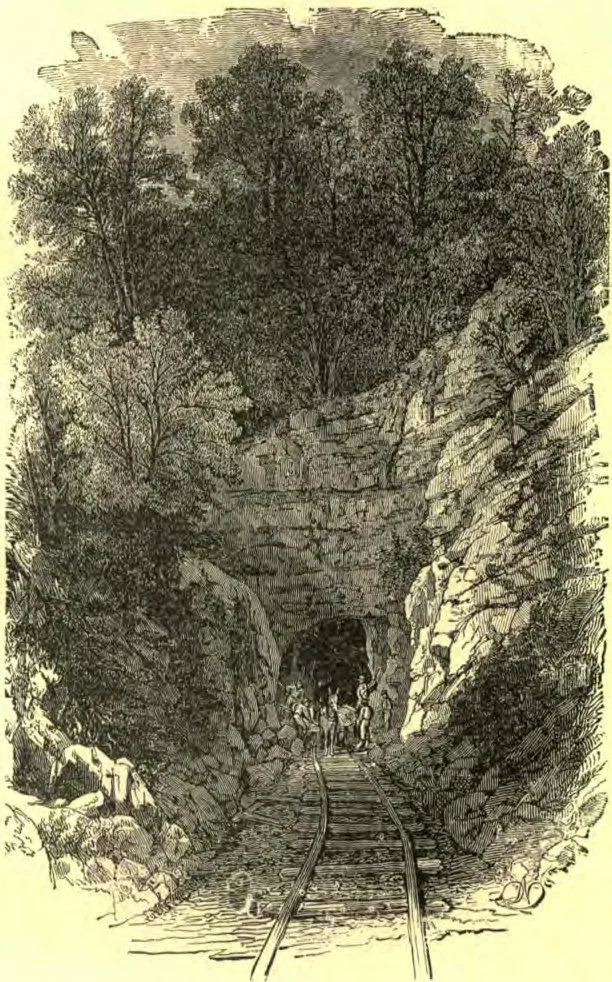
The accompanying cut is designed to represent tunnel mining, which is done by making an opening in the side of a mountain large enough to admit a car drawn by a mule as seen in the engraving. In some cases these tunnels extend a long distance into the mountain, and the cars for removing the ore are drawn by steam. This is a great improvement over some methods employed in the early days of mining in the Rocky Mountains, before so much time and labor saving machinery had been invented.
A very novel way of transporting ore, before the “tramway” came into general use, was with the “drag,” which is described by a certain writer as follows: “It was made of a fresh ox-hide sewn together at the ends; an aperture was left in the middle for the reception of the ore, the opening being looped up with ropes when the ‘vehicle’ was loaded. An iron brake, with long, sharp teeth like those of a rake, was fastened to the tail, while the mule’s traces were connected at the other end. Fifteen hundred pounds of ore could be hauled in one of these, over the snow and ice covered trails of the steepest mountains. If from the steepness of the trail the ‘drag’ threatened to slide upon kicking heels, the ‘engineer’ straightway jumped upon the brake and sank its teeth into the snow.”
There has ever been a fascination attending the search for gold and silver, which time rather intensifies than diminishes. Under its magic influence, men have flocked to the mountains of the far West, willing to endure toil and privation, for the sake of gaining a little of that which perishes with the using. How much better the “gold tried in the fire,” the “true riches,” the “enduring substance” to be obtained through our Lord Jesus Christ.
J. O. CORLISS.

“MOTHER'S WAY.”

OFT within our little cottage, As the shadows gently fall, While the sunlight touches softly One sweet face upon the wall, Do we gather close together, And in hushed and tender tone Ask each other's full forgiveness For the wrong that each has done. Should you wonder why this custom At the ending of the day, Eye and voice would quickly answer, “It was once our Mother's way.”
If our home be bright and cheery, If it hold a welcome true, Opening wide its door of greeting To the many,—not the few; If we share our Father's bounty With the needy day by day, 'Tis because our hearts remember This was ever Mother's way.
Sometimes, when our hearts grow weary, Or our tasks seem very long, When our burdens look too heavy, And we deem the right all wrong, Then we gain a new, fresh courage, As we rise and brightly say, “Let us do our duty bravely, This was our dear Mother's way.”
Thus we keep her memory precious, While we never cease to pray That at last, when lengthening shadows Mark the evening of life's day, They may find us waiting calmly To go home our Mother's way.

PREPARING TO CROSS THE ATLANTIC.

A VOYAGE of three thousand miles by sea is quite different from a journey of the same distance on land. There are risks to run in passing over the “bounding billows;” and although it is said that “there are no more accidents by sea than on land,” one feels there is constant danger, and often is this scripture brought vividly to mind: “They that go down to the sea in ships, that do business in great waters; these see the works of the Lord, and his wonders in the deep. For he commandeth, and raiseth the stormy wind, which lifteth up the waves thereof. They mount up to the heaven, they go down again to the depths; their soul is melted because of trouble. They reel to and fro, and stagger like a drunken man, and are at their wits’ end.” Ps. 107:23–27. Some cry to the Lord, and are brought safe to their desired haven; but many, alas! are engulfed by the waves.
Knowing the perils of the deep, we deem it advisable to select a strong ship, and ask Divine guidance, that we may take the right one, and at the right time. Having been taught by past experience in sea voyages that it is not best to wait until the bustle and confusion of sailing day before buying our tickets, we purchase ours several days previous to sailing, thus giving time to select our state-room near the center of the boat, so that in case of storm, we shall be more quiet, and feel less of the pitching of the ship.
Having looked over the list of steamers sailing from Boston to Liverpool, we decide upon the Minnesota, of the Warren Line. This is a fine steamer, and one that has carried several of our missionaries safely over the mighty deep. We make all necessary arrangements, and return to South Lancaster to spend a week with friends there.
We are somewhat surprised on Saturday night to receive a telegram from Mr. O’Hara, the agent of the steamship company, saying, “The company have decided not to carry any passengers on the Minnesota this trip, but they dispatch the Homer with good accommodations two days earlier, will you go on that? If so, we will make a rebate of $10 on your tickets.” A feeling of gloom comes over us as though all is not right; still, as we are anxious to go, and feel satisfied the time has come for us to go, we reply to the dispatch, “Yes.”
On Monday, the day appointed for sailing, we go to East Boston, to the Grand Junction Wharf. Here we meet several of our friends who have come to bid us “good-by.” Instead of “boarding the steamer,” as we expected, Mr. O’Hara meets us and says, “Mr. Loughborough, all’s up now. I do not know what to make of it. The captain positively agreed to take you, but now he as positively refuses to take a passenger; but I am bound to see you out of this strait. There is a steamer of the William and Guion Line, the Nevada, that sails from New York to-morrow at 11:30 A. M. If you will go by that, I will transfer you, and all your baggage, to that boat with no extra expense to yourself. Will you go?” After a moment of silent prayer to God, the gloom that had hung over us since deciding to go by the Homer, left us and we again said, “Yes.” This active agent telegraphed at once to New York City, and secured our tickets, transferred our trunks, boxes, and ourselves to Providence Depot, and paid our passage to New York, at a cost to the company of $25.
At ten o’clock P. M., having parted with our friends, we take a sleeping-car, and at dawn of day reach 42d St. Depot, New York. Here we take the street-car, and ride three miles to the pier of the William and Guion Line. Showing our tickets we are admitted on board our steamer. It is a grand ship, four hundred and fifty feet in length, and its sides are covered with massive plates of iron. The steam is hissing from two powerful engines. The vessel is all loaded, ready for sailing, except a few pieces of baggage. The pilot is at his post, and soon the signal for our departure will be given. J. N. L.

PERFECT FAITH.

A STREET boy in London had had both legs broken by a dray passing over them. He was laid in one of the beds of the hospital to die; and another little creature of the same class was laid near by, picked up sick with famine fever. The latter was allowed to lie down by the side of the little crushed boy. He crept up to him and said,
“Bobby, did you ever hear about Jesus?”
“No, I never heard of him.”
“Bobby, I went to mission-school once, and they told us that Jesus would take you to Heaven when you died, and you’d never have hunger any more, and no more pain, if you axed him.”
“I couldn’t ax such a great big gentleman as he is to do anything for me. He wouldn’t stop to speak to a boy like me.”
“But he’ll do all that, if you ax him.”
“How can I ax him, if I don’t know where he lives? and how could I get there with both legs broke?”
“Bobby, they told me at the mission-school as how Jesus passed by. The teacher said that he goes around. How do you know but what he might come to this hospital this very night? You’d know him if you was to see him.”
“But I can’t keep my eyes open. My legs feel so awful bad! Doctor says I’ll die.”
“Bobby, hold up your hand, and he’ll know what you want when he passes by.”
They got the hand up; it dropped. They tried again; it slowly fell back. Three times he got up the little hand, only to let it fall. Bursting into tears, he said, “I give it up.”
“Bobby, lend me yer hand. Put yer elbow on my pillar; I can do without it.”
So his hand was propped up. When they came in the morning the boy lay dead, his hand still held up for Jesus.
You may search the world, and you cannot find a grander illustration of simple trust than that of the little boy who had been to mission-school but once.—John B. Gough.

The Beauty and Glory of God's Truth

How beautiful is God’s truth! How rich are the treasures of his thoughts! How straight the ways of his law! How glorious the end of those who delight in his precepts!

SMILES

Oh, smiles have power, a world of good To fling around us ever; Then let us wear their golden beams, And quench their ardor never.
For while a smile illumines the eye, And wreathes the lip of beauty, The task of life must ever be A pure and pleasant duty.

IN THE SUNSHINE.

SUNSHINE is good for health. The flowers are all the brighter for it, and fruits ripen because of it. It brings warmth and light and life. How gloomy it must be to live in the distant northern regions where there is no sun to be seen for six months! But, on the other hand, how bright and beautiful it must be there when the sun shines for the next six months! So if there is a long night, there is sure to be a long day to follow.
It is well to get all the sunshine you can. Even in the hottest days of summer, the sunshine is good because it makes the grain grow, and ripens vegetables and fruits. What a blessing it is, giving light, and color, and brightness to everything. The sun is a wonderful painter. In the dark night every object looks black; but when the sun rises he touches the earth with his bright beams, as a painter touches the canvas with his brush, and see how quickly and how beautifully the colors come.
Sunshine in the face is also very beautiful. This can come only from a sunshiny heart. We like to see boys and girls with bright, sunny faces, looking as if they felt happy. It is not pleasant to see a child with a dark frown like a cloud on its face. We have seen such children, who would make a warm room seem chilly. Ugh! how everybody shivers when they come near. They are so cross, ill-natured, selfish, and gloomy that nobody is pleased with them. On the other hand, there are children whose faces are always smiling and bright, and they make every one happy who sees them.
Remember, then, to have the heart full of light, and joy, and peace, and the face will be sure to show it. If the blessed Saviour dwells in the heart, he will surely bring the sunshine, and not only our faces, but our daily lives, will show it. It will be seen in our treatment of parents, and brothers and sisters, and friends. Keep in the sunshine!
—S. S. Advocate.

LESSONS FOR CHILDREN.

LESSON LXXXII.—MANASSEH AND JOSIAH.

When Hezekiah died, he left a son twelve years old. This son’s name was Manasseh, and he reigned fifty-five years in Jerusalem. He did all the wicked things that Ahaz had done, and besides, he carved an image and set it up in the house of God to be worshiped. “So Manasseh made Judah and the inhabitants of Jerusalem to err, and to do worse than the heathen, whom the Lord had destroyed before the children of Israel.”
“And the Lord spake to Manasseh, and to his people; but they would not hearken. Wherefore the Lord brought upon them the captains of the host of the king of Assyria, which took Manasseh among the thorns, and bound him with fetters, and carried him to Babylon. And when he was in affliction, he besought the Lord his God, and humbled himself greatly before the God of his fathers, and prayed unto him; and he was intreated of him, and heard his supplication, and brought him again to Jerusalem into his kingdom. Then Manasseh knew that the Lord he was God.”
After this, Manasseh seems to have been a good king. He broke down the altars, and destroyed the images which he had set up, and spent the remainder of his life in good works. After his death his son Amon reigned in his stead; but did very wickedly, following the example of the early part of his father’s reign. So after he had reigned two years, his servants conspired against him and slew him in his own house.
Then the people took his son Josiah, who was then only eight years old, and made him king. Josiah “did that which was right in the sight of the Lord, and walked in the ways of David his father, and declined neither to the right hand nor to the left.”
When he was sixteen years old, he began to seek the Lord; and when he was twenty, he began to purge the land from idolatry. “And they brake down the altars of Baalim in his presence; and the images that were on high above them, he cut down; and the groves, and the carved images, and the molten images, he brake in pieces, and made dust of them, and strewed it upon the graves of them that had sacrificed unto them. And he burnt the bones of the priests upon their altars, and cleansed Judah and Jerusalem. And so did he in the cities of Manasseh, and Ephraim, and Simeon, even unto Naphtali.”
When he had finished all this work, he set about repairing the temple. Now as the workmen were engaged upon the temple, there was found a book of the law, written by Moses. When this book was read before Josiah, he was greatly distressed; for it told just what evils would come upon the people if they should ever do just as they had been doing before he began to reign. He then inquired of the Lord by Huldah the prophetess, and was told that all the curses written in the law would surely come upon the Jewish nation, but not in his day.
Josiah reigned thirty-one years, and then his son Jehoahaz reigned in his stead.

QUESTIONS.

  1. Who reigned in Jerusalem next after Hezekiah? 2 Chron. 32:33.
  2. How old was he when he began to reign? Chap. 33:1.
  3. How long did he reign?
  4. What course did he pursue?
  5. How did he go beyond Ahaz in wicked deeds?
  6. How did his conduct affect the people? Verse 9.
  7. How did Manasseh and his people treat the warnings which the Lord gave them?
  8. What way did the Lord then take to put a stop to Manasseh’s wicked actions?
  9. What did his enemies do with him?
  10. What did he do when he was thus brought into affliction?
  11. Did the Lord regard his prayer?
  12. What did the Lord do for him?
  13. What did Manasseh then know?
  14. What kind of life does Manasseh seem to have led after this?
  15. How did he try to undo the wicked actions of former years?
  16. Who reigned after the death of Manasseh?
  17. What example did he follow?
  18. How long did he reign?
  19. How was he destroyed?
  20. What did the people then do? Verse 25.
  21. How old was Josiah when he was made king? Chap. 34:1.
  22. What does the Bible say of his actions? Verse 2.
  23. What did he begin to do at the age of sixteen?
  24. What work did he commence when he was twenty?
  25. Tell how he carried on this work.
  26. What did he do with the dust of the images which he destroyed?
  27. What did he do with the bones of the priests?
  28. By whom had this been foretold?
  29. In what work did he next engage?
  30. What was found as the workmen were repairing the temple? Verse 14.
  31. How did Josiah feel when the book was read to him?
  32. Why was he so distressed?
  33. By whom did he inquire of the Lord?
  34. What answer did he receive?
  35. How long did Josiah reign?
  36. Who then reigned in his stead? Chap. 36:1.

BIBLE LESSONS FOR YOUTH.

LESSON CVIII.—A SKETCH OF ROMAN HISTORY.

The Romans were now the real masters of Judea; and since they are so intimately connected with the history of Christ and the apostles, it seems important to notice the condition of the Roman empire at this time. We have already noticed that the second Carthaginian war ended about the time when Palestine came under the rule of the Syro-Macedonians, B. C. 202. The third Carthaginian war ended about fifty years after, in the total destruction of Carthage. The Romans had now no formidable rival, and the conquest of the world lay before them.
For the next hundred years, Roman history presents a scene of continuous war. There was war with Greece, war with Macedonia, with Egypt, and with Syria.
About one hundred and six years before Christ, Rome was again threatened by a vast invasion of northern nations, but was saved by the skillful management of Marius, one of the most wonderful military geniuses known to history. Soon after, a civil war broke out, headed by Marius and Cinna on the one side, and Sulla on the other. This war was one of the fiercest ever known. First one party and then the other gained possession of Rome, “butchering its opponents in massacres that almost surpass belief,—one hundred thousand Roman citizens, ninety senators, and two thousand six hundred Roman knights lying in blood under the butchery of Sulla alone.”
About 81 B. C. Marcus Tullius Cicero comes upon the stage in defense of one of Sulla’s victims, whose cause none of the older advocates dared to espouse. In this defense he gave promise of that wonderful eloquence which afterward astonished the world.
Then there was war for years with Mithridates, king of Pontus. This war was finally brought to a successful termination by Pompey, who, on his return, visited Jerusalem, settled the affairs of Palestine, restored Hyrcanus, and desecrated the holy of holies.
About this time occurred the frightful conspiracy of Catiline, whom Cicero, with all his eloquence, arraigned before his fellow-citizens.
Julius Cæsar, a son-in-law of Cinna, now begins to act a prominent part on the stage of public life. “By-and-by we find this Julius Cæsar, along with Pompey and Crassus, sharing among them, as the first triumvirate, the wide dominions of Rome.
“Then the triumvirate is broken up, first by the death of Crassus in battle with the Parthians, and then by the rupture between Cæsar and Pompey. Their forces join issue at Pharsalia in Thessaly. Pompey is defeated, and Julius Cæsar is left sole ruler of the great empire of Rome, B. C. 45.”
When Pompey returned from Jerusalem to Rome, he carried Aristobulus with him as a prisoner; but after a time, Aristobulus escaped, and returned to Judea, where he renewed the civil war with Hyrcanus. The contest was continued by his son Alexander, who was at last defeated, with immense slaughter, at Mount Tabor.
In the division of the Roman empire among the triumvirs, Syria had been assigned to Crassus. After his death, Cassius, an eminent Roman general, administered the affairs of Syria for a time; but upon the death of Pompey, it fell under the control of Cæsar. Cæsar determined that Hyrcanus should rule as king at Jerusalem, and his family after him, and appointed Antipater, an Idumæan by birth, procurator of Judea under Hyrcanus. The two sons of Antipater, Phasael and Herod (afterward Herod the Great) were made governors of Judea and Galilee.

QUESTIONS.

1. After Pompey’s visit to Jerusalem, who were the real masters of Judea?
2. Why does it become necessary to notice some of the leading events of the Roman history of this period?
3. What important fact was mentioned in a former lesson?
4. When did this event take place?
5. When and how did the third Carthaginian war terminate?
6. Why may we say that the conquest of the world then lay before them?
7. What does the next hundred years of Roman history present?
8. Mention some of the nations that were subdued by the Roman arms.
9. By what was Rome threatened about one hundred and six years before Christ?
10. How was it saved?
11. From what great calamity did Rome suffer soon after this?
12. By whom were the contending parties led?
13. Describe the character of this war.
14. Give an illustration of the blood-thirsty spirit that prevailed.
15. What noted man came upon the stage of action about eighty-one years before Christ?
16. How did he first distinguish himself?
17. Of what did he give promise in this defense?
18. In what important war did the Romans next engage?
19. By whom was this war finally brought to a successful termination?
20. What place did Pompey visit on his return from this war?
21. What did he do there?
22. What occurred in Rome about this time to call forth the eloquence of Cicero?
23. Who now begins to act a prominent part on the stage of public life?
24. What position do we by-and-by find him occupying?
25. How was this first triumvirate broken up?
26. Describe the issue of the contest between Cæsar and Pompey.
27. What did Cæsar thus become?
28. When Pompey returned to Rome, what did he do with Aristobulus, the brother of Hyrcanus?
29. What further trouble did Aristobulus make?
30. Who continued the contest after his death?
31. How did the contest terminate?
32. In the division of the Roman empire among the triumvirs, to whom was Syria assigned?
33. Who administered the affairs of Syria after the death of Crassus?
34. Under whose control did it fall after the death of Pompey?
35. What did Cæsar determine in regard to Hyrcanus?
36. What rulers did he appoint under him?
37. By what epithet was this Herod afterward distinguished?

LETTER BUDGET.

FLINT, MICH.
DEAR INSTRUCTOR: I thought I would write you a letter as I am six years old to-day. I go to Sabbath-school and get the lessons for little ones. We have an infant class. I get the INSTRUCTOR at Sabbath-school. I wish there were more stories in it for the children. I have a little sister Laura. I am not as good as she is, for she never did anything naughty; but I pray to God every day to make me a good little girl so that I can go to Heaven when Jesus comes. This is on my slate, but mamma will copy it.
ALLIE McKEE.
WEST RIDGE, N. H.
DEAR EDITORS: I like to read the letters in the INSTRUCTOR, and thought I would write one for the first time. We came here in March. My birthday was in April. I was eight years old. We are on a farm, and enjoy living here very much. We have a great many kinds of wild flowers, and some tame ones. Brother Freddie and I get our Sabbath-school lesson every week and recite to Aunt Mary. There is one little boy who comes to recite with us. I am learning the names of the books in the New Testament. I want to be a good girl, and am trying to be one. Freddie sends a kiss to Sr. Chapman, and says, “Tell her that I am trying to be a good boy.”
Your little friend, GENEVIEVE CANRIGHT.

BLESSED ARE THE PEACE-MAKERS.

BLESSED are the peace-makers; for they shall be called the children of God,” repeated little May. “What is a peace-maker, Paul?”
“A peace-maker?” replied Paul, with the wisdom of ten years. “Why, a peace-maker is one who makes peace,—who tries to keep people from fighting, and when they’re at it tries to get them to stop.”
“If I saw two boys fighting, and got them to stop, would I be a peace-maker?”
“I suppose so; but you would better not try it, for most likely they’d pitch into you;” with which sage advice Paul went off to play ball, and wholly forgot the conversation.
Not so little May. All day long she watched for fighting boys, but saw none. In her anxiety to prove herself a child of God, she was quite willing to have some one naughty enough to fight.
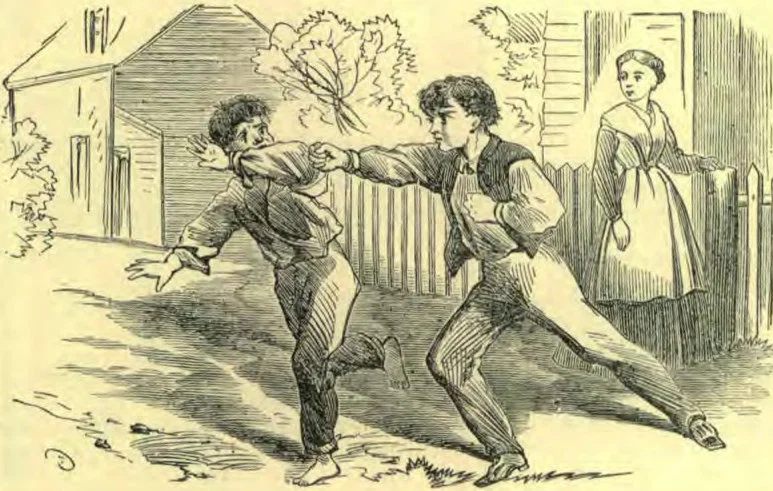
When nurse dressed her for her afternoon walk she went with unusual alacrity. The walk was nearly over, when, as they were crossing a narrow street, she saw at the other end two boys fighting. May rushed down the street; but before she could reach them, a woman came out of a house near by, and parted them, sending one boy down the street, and taking the other into the house with her.
When the woman sent the boy away, he turned so suddenly that he did not see little May who had just come up, but rushed against her, knocking her against the fence. When the terrified nurse reached her, the blood was dropping from a cut in her head.
The boy stopped. “I’m so sorry, ma’am,” said he. “I didn’t see her, she came so sudden-like. Let me help you get her home.”
At first the nurse indignantly refused the proffered aid; but finding that it was no easy matter to carry May and draw the baby, she gave the latter into the boy’s care.
Morning found May quite well, but greatly disappointed at the result of her attempt to become a child of God. A little talk with mamma, however, made this matter clearer.
During the morning, the boy who had knocked May down was seen hanging around the house, intently watching the windows. Mrs. Morgan called him in.
“I came to see how the little ’un is,” he said, bashfully.
“He cannot be wholly bad,” thought Mrs. Morgan. So she talked kindly to the boy, and soon became so interested in him that before he left he had promised to enter an industrial school.
Little May’s ill-advised attempt to win a blessing was not without good results; for under the helpful influences which Mrs. Morgan brought around him, this boy-fighter grew into an honest, useful man.—Christine Earle.

THE OLD MONK AND HIS WORK.

NEARLY twelve hundred years ago, there lived in England a learned monk of saintly character, who spent his life in trying to do good to others. He wrote very many books on religious subjects, and toward the close of his life translated into the Saxon language the Gospel according to St. John. Over sixty years of age, he was desirous of completing this work before he should die. As the work proceeded he found that disease was rapidly bringing him to the grave, so that, as he neared the closing chapter of the Gospel, he felt the need of haste. He dictated the translation to a young man named Wilberch, who faithfully wrote all that the old monk told him.
The day before his death he suffered very much from pain and difficulty of breathing, but continued cheerfully at his work, saying to Wilberch, “Go on quickly. I know not how long I shall hold out.” The next day the young man told him that there was but one chapter left, and asked him if he thought he could get through with that. The monk replied, “Yes; take your pen, mend it, and write fast.”
Thus they worked together until evening, when Wilberch said, “Dear master, there is yet one sentence not written.”
“Write quickly, then,” he replied, as he gave him the translation of the last sentence. When it was done the young man said, “Now it is finished.”
“It is well,” said the old man. “You have said the truth. It is finished. Receive my head into your hands. I wish to sit facing the place where I have been accustomed to pray, that I may again call upon the Father.”
Thus, seated on the pavement of his little cell, he sung, “Glory be to the Father, and to the Son, and to the Holy Ghost.” As he uttered the last word, he fell asleep in Jesus.
Was not that a beautiful way to die, working to the very last, and praising God with the expiring breath?
The name of this good man was Bede, one of the most eminent fathers of the English Church. He is commonly known in history as the Venerable Bede. He was born in the county of Durham, England, in the year 672 or 673, and died in 735. This is many years ago, yet his name and his piety are still cherished by Christian people.—Sel.

ONLY ONE DOOR.

It is said that the ancient city of Troy had but one entrance, and all who would enter the city must enter by this gate. A man might go round the walls as much as he pleased, but he would find no other entrance. It is just so with that glorious and beautiful city, the heavenly Jerusalem. Only one way leads to it, and it can be entered only by one door; and that way, that door, is the Lord Jesus. He alone is the way. No one can enter there, unless he goes by this way and enters by this door. Reader, would you be a citizen of the New Jerusalem? Then you must enter by this way.

You have reached the end of this edition.

The Youth’s Instructor · Jul 21, 1880