Pacific Press Publishing Company · New York · Mar 19, 1896
RELIGION AND REVOLUTION.
A LITTLE more than a hundred years ago, the civilized world stood within the shadow of the greatest tragedy of modern times. It was the eve of the French Revolution. Thrones which stood in fancied security were to be rudely shaken, and institutions and doctrines which had grown venerable under the sanction of time and tradition, were to be overturned and lost in the great upheaval.
To-day, we are still in the era of revolution. The causes from which political and social mutations take their rise, having their seat in the selfishness of human nature, are not eradicated by the changes which they produce. Neither the lapse of time nor the civilization of the nineteenth century, afford us immunity from their operation.
There are ominous signs upon the horizon of our own national future. In a manner more or less perceptible to all, the air is darkened by the shadows of coming events. It is fitting at such a time that we should note the real causes which culminated in the convulsion of a century ago, and the extent to which, as concerns them, history may be repeating itself to-day.
The French Revolution is commonly spoken of as an outburst of atheism. That this was a prominent feature of the Revolution no one denies; but it is proper to inquire, What produced the atheism? Man is not naturally an atheist. And if we look into the condition of society and the church, as it was in France just prior to the Revolution, we shall find abundant cause for the irreligion which at that time burst forth like a devastating flood upon the realm.
“There were twenty-three thousand monks in France,” says Ridpath; “there were sixty thousand curates and vicars; there were thirty-seven thousand nuns; there were two thousand five hundred monasteries; one thousand five hundred convents, and sixty thousand churches and chapels. In all there were a hundred and thirty thousand persons who enjoyed themselves in the work of saving France from her sins. But they did not begin with themselves.”
“There were a hundred and forty thousand nobles in France. . . The noble families numbered thirty thousand. On each square league of territory, and for each one thousand of the inhabitants there was one castle, one noble family. France was not only saved but she was ennobled. It required a great deal of land to support properly the dignity and office of one of her saviours. The abbey of St. Germain des Pres owned about nine hundred thousand acres. One fifth of all the lands of France belonged to the clergy, one fifth to the nobility, one fifth to the communes and the king. This made three fifths.”
This three fifths of the land was the richest and most valuable land in France. Of the value of that part belonging to the clergy we are told: “Its possessions, capitalized, amount to nearly four billion francs; the income from this amounts to eighty or a hundred millions, to which must be added the dime or tithes,—a hundred and twenty-three millions per annum; in all two hundred millions, a sum which must be doubled to show its equivalent at the present day; and to this must be added the chance contributions and the usual church collections.”
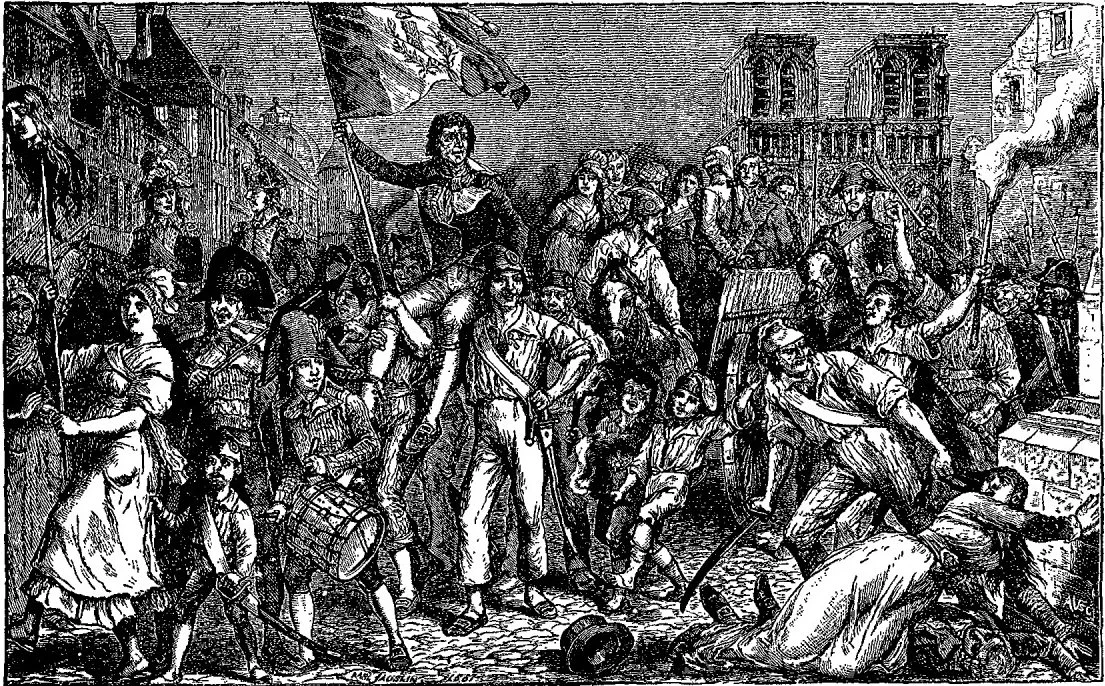
Street Scene in the French Revolution.
Coming to particulars, it is stated that four hundred monks at Premontro possessed a capital of forty-five million livres, from which they derived a revenue of more than one million livres. The Benedictines of Cluny, two hundred and thirty-eight in number, enjoyed an income of one million eight hundred thousand livres. The abbot of Clairvaux had a yearly income of more than three hundred thousand livres; the archbishop of Strasburg had an income of more than a million, etc.
In Mexico, when the French monarchy under Maximilian was overthrown, the value of the church property was $300,000,000, and its income was more than that of the Mexican Government. In the United States, the amount of untaxed church property, as shown by the census of 1890, is $679,630,139. Of this the Roman Catholic Church,—the church of France and Mexico, holds $118,069,746; but even she is second to the Methodist Church, which holds in the aggregate of her various bodies property valued at $132,140,179.
In France, at the time of the Revolution,90there were twenty-six millions of people of the laboring classes, and upon them rested the burden of supporting themselves, the privileged classes, and the government. They were taxed without mercy, while the nobles and clergy were exempt.
As a straw showing which way the wind is blowing, it is worthy of note that a bill has been recently introduced into the New York legislature, which provides for exempting from taxation “the personal property of every minister of the gospel, or priest of any denomination, or every such minister or priest who is permanently disabled by impaired health from performing the active duties of the ministry, and every such minister or priest who has reached the age of seventy-five years; and the real estate of such minister or priest or such disabled or aged minister or priest, provided such real or personal estate do not exceed the value of one thousand five hundred dollars.”
The parallel is being even more rapidly drawn with respect to the theory of government. Of the epoch which ushered in the Revolution, the historian says: “At this epoch nearly the whole activity of France was displayed in the government. The government was everything. It was meant to be so. The doctrines of paternalism in the State were completely triumphant. The theory reduced to a formula ran thus: It is the duty—the business—of the State to teach men what things to do, and of the Church to teach them what things to believe. As for man, it is his business to be governed. That is—and was—the object of his creation. He must receive with unquestioning simplicity and obedience whatever is doled out to him by the noble and the priest to whom his management, his interests, his destiny, in this world are entrusted.”
There was in such a system no development of manhood, no formation of stable character, no quickening of the conscience. The moral nature was dwarfed; all the better impulses of human nature were palsied; hate and malignity were engendered; and the scenes depicted in our illustration were only the inevitable result when once restraint was thrown off.
To-day, in our own land, the doctrine of paternalism is fast displacing the theory of government espoused by the founders of the Republic. The sphere of individualism has been contracted to very narrow limits. Men are taught that their first duty to the State is obedience to the law, whether the law be good or bad; they are taught to set “law” above justice, thus virtually ignoring their prerogative of self-government, which asserts that they are free from obligation to any form of legalized wrong.
The Church, with all her religious allies, has entered the arena of politics, and assumes the right to dictate the law for nation, State, and city. The Church and the aristocracy of wealth, control the government; and the people—the mere toilers and producers—exist to be governed and to pay the taxes. The doctrine of individual inalienable rights is relegated to the background; the scheme of government has been transferred from the basis of individual rights, recognized by the Declaration of Independence, to the undefinable one of the “best good of the majority.” And the clergy and the “nobles,” the “better classes,” speak for the majority.
The French Revolution was a struggle for the mastery between the privileged classes and the people. “It was,” says Ridpath, “simply a revolt, an insurrection of the emancipated mind of France against the tyranny of her social, civil and religious institutions—a rebellion of man against his masters—a struggle of the human spirit to break an intolerable thralldom which had been imposed upon it by the past.” The spirit of self-exaltation, making unscrupulous use of the power pertaining to wealth and station, had made the multitudes slaves both in soul and body, to human taskmasters. It had bound them in the chains of both a civil and a spiritual tyranny. And when the spirit of liberty in the breasts of the downtrodden asserted itself and burst those chains, the popular demonstrations against the Church and religion were as natural as were those against the nobles and royalty.
The atheism of the French Revolution was the legitimate fruit of the spiritual despotism imposed upon the people by the Papacy. In the papal system, the spirit of self-exaltation finds its fullest and most conspicuous embodiment. By it a mortal man, under the name of pope, is exalted to the place of God, while other fallible mortals, such as cardinals, bishops, and priests, are held up to their fellow-mortals as invested with the authority and prerogatives of God. And when man is put in the place of God, the result is always a spiritual tyranny. It cannot possibly be otherwise; for the power and wisdom of man cannot rise to the level of divinity. “Where the Spirit of the Lord is, there is liberty;” but the spirit of man cannot give liberty in the religious life. The despotism breeds revolt; and revolt, when directed against religion, naturally manifests itself in atheism. The papal religion is full of the seeds of this baleful fruit.
“The religion of the French Revolution,” says Prof. Goldwin Smith, “was a State church which, deserted by the convictions of the people, but retaining their outward allegiance, reduced them to hypocrisy and to atheism.”
There is nothing in Christianity that tends to the violence of revolution. The revolution accomplished by Christianity is the revolution of the individual. Christianity means freedom through the Spirit and power of God; and having this soul freedom, men are more desirous of imparting the same blessing to others than of laying violent hands upon the fabric of government. They seek to promote the welfare of themselves and of mankind through the uplifting power of the gospel of Christ, rather than by the violence of carnal warfare; and while conducting themselves at all times as the champions of the cause of humanity and the rights of the people, will if possible, follow after the things which make for peace.
Had the people of France known the freedom of the gospel instead of the despotism of the Papacy, the terrible scenes of the French Revolution would never have been. But the seeds of atheism, and of resistance to the restraints of both God and man, had been sown by a religion which put man in the place of God, tradition and dogma in the place of God’s word, and the law of man in the place of conscience. The prevailing conditions gave opportunity for its perfect development, and the world shuddered at the harvest. But the lesson was not sufficiently understood and appropriated by mankind. And now, in these United States, as well as elsewhere in the civilized world, the same influences are at work to bring man into a position where they will be ready to make a like mad and blind effort to reform government and society, and realize the good to which they feel they have a birthright claim. But the hope of mankind lies in the divinely-revealed assurance that the Author of liberty and of every blessing is about to take the affairs of earth into his own hands, to root out of it all things that are evil, and to usher his righteous people into the eternal era of happiness and peace.
THE HARMONY(?) OF ERROR.
The following extracts from “Our Mail Bag,” in the Christian Herald and Signs of Our Times, the first under date of Aug. 1, 1894, the other under date of June 5, 1895, afford an excellent illustration of the harmony(?) of error:—
Victoria. Dodd, Denison, Iowa. How should Sunday be spent by those who profess to be Christian people?
They should obey the divine command to refrain from all labor and secular things, and devote the day to the service of the Almighty and to physical rest and recuperation. To spend the whole or even part of the day in the reading of newspapers or secular literature is a violation of the spirit of the injunction. Attendance at the house of worship and a hearty compliance with the religious ordinances instituted by the Church, are among the privileges that should never be neglected. These are among the “means of grace.”
Fannie E. Crewe, Mass. Is there any command given after the resurrection of Christ to keep Sunday or any day holy?
The New Testament does not mention any explicit command being given after the resurrection. From the early Christian writers we learn that the observance of the Lord’s day was universal in the Church. It was not observed, however, as the Jewish Sabbath, with restrictions and penalties, and with minute regulations as to what should, and should not be done on that day. Some Jewish converts wanted to compel the Gentiles to keep Saturday holy, according to the Jewish law, as some people are trying to do still; but the Apostle Paul wrote that they need give no heed to such teachers, and to let no man judge them as to the Sabbath. Col. 2:16.
This is the sort of blowing hot and cold that becomes necessary in attempting to sustain the false sabbath while rejecting the true.
If there is no divine command for Sunday, and there certainly is none, by what right does the Herald say of Sunday: “They should obey the divine command to refrain from all labor,” etc., on that day?
Self-justification could scarcely be more complete than it is in these two answers. The first assumes a divine command for Sunday observance; the second admits that there is no such command, and that Sunday does not take the place of the Sabbath.
The lugging in of Col. 2:16 in this connection is in perfect keeping with the consistency shown in these two answers. The 17th verse states plainly that the days concerning which the apostle was writing were the festivals belonging to the typical system: shadows of things to come.
THE ONLY REMEDY.
“Is it not perfectly manifest,” says the Christian Statesman, of February 22, “after all our comparatively fruitless efforts to cure our festering political corruption by other means, that the only adequate remedy is to bring our nation into acknowledged subjection to the perfect and purifying law of Christ?” This it says in behalf of the so-called Christian Amendment which it is trying to have fastened upon the national Constitution.
The “purifying law of Christ” does not91consist in the written words of an acknowledgment, but is “the law of the Spirit of life in Christ Jesus,” which makes the believer free from the “law of sin and death.” It is the very life of Christ, which he lives in the believer’s heart. It is therefore altogether above and beyond the reach of the United States Constitution. Only a very low and altogether earthy view of the purifying law of Christ could ever have conceived it as being applicable to the nation through the Constitution.
It is an easy thing to make an acknowledgment or profession of Christianity; but mere profession accomplishes nothing. So long as the hearts of legislators and of the people are filled with the natural depravity of human nature, so long will “our festering political corruption” remain uncured, whatever profession may be inserted into the Constitution.
KEEPING SUNDAY RELIGIOUSLY.
As an argument in behalf of Sunday “laws,” it is said that such legislation as is called for does not infringe upon any person’s rights of conscience, since it does not require that Sunday should be kept religiously.
Just what would constitute a religious observance of Sunday, in the minds of those who make use of this “argument,” we are not told. But it is not their nor any person’s ideas upon this point that determine the propriety of Sunday legislation from the standpoint of interference with conscience. That must be determined by the truth, as defined by Him whose word is truth. And the truth is that refraining from work upon the first or any other day of the week, so as to acknowledge that day as a weekly rest day, is a religious act. It must of necessity have this significance.
A weekly rest day is wholly a religious institution. It was given to man as such by the Creator. Gen. 2:2, 3; Ex. 20:8–11; Eze. 20:12, 20. Rest from secular work is an essential part of the keeping of the Sabbath commandment. And from the very fact that the Sabbath is wholly a religious institution—since it is “the Sabbath of the Lord”—and that rest from secular labor is an essential part of its observance, such weekly rest upon Sunday must have a religious significance. Being exactly similar to the Sabbath rest which God commanded, so far as regards the performance of secular work, it is either that rest itself or a counterfeit of it; in either of which cases its significance is religious.
A counterfeit dollar bill has the significance of money, and is intended by its maker to serve the purpose of money. So it is with the Sunday sabbath. It must of necessity have the significance of the institution which it professes to be, or of which it claims to be a pattern; and that significance is wholly religious.
Hence the weekly Sunday rest which is demanded by Sunday “laws” is a religious act, and the plea that such “laws” do not require any person to keep Sunday religiously, is of no force. By the very fact of requiring Sunday rest, they require a religious observance, and hence go entirely beyond the legitimate sphere of civil legislation.
Let the truth be kept in mind that the Sabbath is wholly a religious institution. This is shown by the fact, already pointed out, that it is “the Sabbath of the Lord.” God has stated expressly that the Sabbath is his and not man’s. “The seventh day is the Sabbath of the Lord thy God.” See Ex. 20: 8–11; Isa. 58:13; Eze. 20:12, 20. In the light of this fact, the impropriety of human sabbath “laws” may be seen in full. The Sabbath is God’s sign between himself and his people. It is the mark of his Godhead, pointing out him who has creative power, and who is therefore the true God. Hence man has no business to meddle with it. Even a trade-mark is recognized in human law as the property of its originator. No other party is allowed to appropriate it. How much more, then, is God’s Sabbath sacred to him—to the high and holy purpose specified in his law, as the memorial of him who has power to create and redeem! Yet men speak of the Sabbath as though it were their common property, to be put to their own uses and legislated upon as they see fit!
The American Government is very jealous—and properly so—of its currency. It punishes counterfeiting with severe penalties. It will not allow any imitation of that which constitutes its currency, whether of coin or paper, and whether it be intended to serve the purpose of money or not. Its secret service officials promptly seize and confiscate all such imitations, no matter if obviously intended to serve only as medals or as advertisements. And why will not men recognize the principle in its application to that which is infinitely more sacred and important,—the memorial or “sign” (Eze. 20:12, 20) of God between himself and his people? Why will they not treat God’s sacred things with at least as much respect as is made obligatory with regard to man’s things? Oh that all men would recognize the iniquitous folly of enacting sabbath “laws,” and cease to intrude with their human legislation upon that which is holy unto the Lord.
THE ORIGIN AND NATURE OF SUNDAY “LAWS.”
The various bills relating more or less directly to Sunday now before Congress and several of the State legislatures, render timely an examination of the origin and nature of Sunday “laws.”
The first “law” of this character, a copy of which has been preserved to us, is Constantine’s edict of A. D. 321. Sozomen says that it was “that the day might be devoted with less interruption to the purposes of devotion.” And this statement of Sozomen’s is indorsed by Neander. This reason given by Sozomen reveals the secret of the legislation; it shows that it was in behalf of the church, and to please the church.
By reading Constantine’s edict, it is seen that they started out quite moderately. They did not stop all work; only judges, townspeople, and mechanics were required to rest, while people in the country might freely and lawfully work. The emperor paraded his soldiers on Sunday, and required them to repeat in concert the following prayer:—
Thee alone we acknowledge as the true God; thee we acknowledge as ruler; thee we invoke for help; from thee have we received the victory; through thee have we conquered our enemies; to thee are we indebted for our present blessings; from thee also we hope for future favors; to thee we will direct our prayer. We beseech thee that thou wouldst preserve our Emperor Constantine and his pious sons in health and prosperity through the longest life.
This Sunday “law” of A. D. 321 continued until 386, when “those older changes effected by the Emperor Constantine were more rigorously enforced, and, in general, civil transaction of every kind on Sunday were strictly forbidden. Whoever transgressed was to be considered, in fact, as guilty of sacrilege.”
Then as the people were not allowed to do any manner of work, they would play, and, as the natural consequence, the circuses and the theaters throughout the empire were crowded every Sunday. But the object of the “law,” from the first one that was issued, was that the day might be used for the purposes of “devotion” and the people might go to church. Consequently, that this object might be met, there was another step to take, and it was taken. At a church convention held at Carthage in 401, the bishops passed a resolution to send up a petition to the Emperor, praying “that the public shows might be transferred from the Christian Sunday, and from feast days, to some other days of the week.”
And the reason given in support of the petition was, “The people congregate more to the circus than to the church.”
In the circuses and theaters large numbers of men were employed, among whom many were church members. But, rather than to give up their jobs, they would work on Sunday. The bishops complained that these were compelled to work; they pronounced it persecution, and asked for a law to protect those persons from such “persecution.” The church had become filled with a mass of people, unconverted, who cared vastly more for worldly interests and pleasures than they did for religion. And as the government was now a government of God, it was considered proper that the civil power should be used to cause all to show respect for God, whether they had any respect for him or not.
But as long as the people could make something by working on Sunday, they would work rather than go to church. A law was secured forbidding all manner of Sunday work. Then they would crowd the circuses and the theaters, instead of going to church. But this was not what the bishops wanted; this was not that for which all work had been forbidden. All work was forbidden in order that the people might go to church; but instead of that, they crowded to the circus and the theaters, and the audiences of the bishops were rather slim. This was not at all satisfying to their pride; therefore the next step, and a logical one, too, was, as the petition prayed, to have the exhibitions of the circuses and the theaters transferred to some other days of the week, so that the churches and the theaters should not be open at the same time. For if both were open, the Christians(?), as well as others, not being able to go to both places at once, would go to the circus or theater instead of to the church. Neander says:—
Owing to the prevailing passion at that time, especially in the large cities, to run after the various public shows, it so happened that when these spectacles fell on the same days which had been consecrated by the Church to some religious festival, they proved a great hindrance to the devotion of Christians, though chiefly, it must be allowed, to those whose Christianity was the least an affair of the life and of the heart.
Assuredly! An open circus or theater will always prove a great hindrance to the devotion of those “Christians” whose Christianity is the least an affair of the life and of the heart. In other words, an open circus or theater will always be a great hindrance to the devotion of those who have not religion enough to keep them from going to it, but who only want to use the profession of religion to maintain their popularity and to promote their selfish interests. On the other hand, to the devotion92of those whose Christianity is really an affair of the life and of the heart, an open circus or theater will never be a particle of hindrance, whether open at church time or all the time. But those people had not enough religion or love of right to do what they thought to be right; therefore they wanted the State to take away from them all opportunity to do wrong, so that they all could be Christians. Satan himself could be made that kind of Christian in that way; but he would be Satan still.
Says Neander again:—
Church teachers . . . were in truth often forced to complain that in such competitions the theater was vastly more frequented than the church.
And the church could not stand competition; she wanted a monopoly. And she got it. And the “church” wants a monopoly to-day.
This petition of the Carthage convention could not be granted at once, but in 425 the desired law was secured; and to this also there was attached the reason that was given for the first Sunday “law” that ever was made, namely: “In order that the devotion of the faithful might be free from all disturbance.”
It must constantly be borne in mind, however, that the only way in which “the devotion of the faithful” was “disturbed” by these things was that, when the circus or theater was open at the same time that the church was open, the “faithful” would go to the circus or theater instead of to church, and, therefore, their “devotion” was “disturbed.” And of course the only way in which the “devotion” of such “faithful” ones could be freed from all disturbance, was to close the circuses and the theaters at church time.
In the logic of this theocratical scheme, there was one more step to be taken. It came about in this way: First, the church had all work on Sunday forbidden, in order that the people might attend to things divine. But the people went to the circus and the theater instead of to church. Then the church had laws enacted closing the circuses and the theaters, in order that the people might attend to things divine. But even then the people would not be devoted, nor attend to things divine, for they had no real religion. The next step to be taken, therefore, in the logic of the situation, was to compel them to be devoted—to compel them to attend to things divine. This was the next step logically to be taken, and it was taken. The theocratical bishops were equal to the occasion. They were ready with a theory that exactly met the demands of the case, and the great Catholic Church father and Catholic saint, Augustine, was the father of this Catholic saintly theory. He wrote:—
It is indeed better that men should be brought to serve God by instruction than by fear of punishment, or by pain. But because the former means are better, the latter must not, therefore, be neglected. Many must often be brought back to their Lord, like wicked servants, by the rod of temporal suffering, before they attain to the highest grade of religious development.
Of this theory Neander remarks:—
It was by Augustine, then that a theory was proposed and founded which . . . contained the germ of that whole system of spiritual despotism, of intolerance and persecution, which ended in the tribunals of the Inquisition.
The history of the Inquisition is only the history of the carrying out of this infamous theory of Augustine’s. But this theory is only the logical sequence of the theory upon which the whole series of Sunday “laws” was founded.
Then says Neander: “In this way the church received help from the State for the furtherance of her ends.”
This statement is correct. Constantine did many things to favor the bishops. He gave them money and political preference. He made their decisions in disputed cases final, as the decision of Jesus Christ. But in nothing that he did for them did he give them power over those who did not belong to the church, to compel them to act as though they did, except in that one thing of the Sunday law. Their decisions, which he decreed to be final, were binding only on those who voluntarily chose that tribunal, and affected none others.
Before this time if any who had repaired to the tribunal of the bishops were dissatisfied with the decision, they could appeal to the civil magistrate. This edict cut off that source of appeal, yet affected none but those who voluntarily chose the arbitration of the bishops. But in the Sunday “law” power was given to the church to compel those who did not belong to the church, and who were not subject to the jurisdiction of the church, to obey the commands of the church. In the Sunday “law” there was given to the church control of the civil power, that by it she could compel those who did not belong to the church to act as if they did.
The history of Constantine’s time may be searched through and through, and in it will be found that in nothing did he give to the church any such power, except in this one thing—the Sunday “law”. Neander’s statement is literally correct, that it was “in this way the church received help from the State for the furtherance of her ends.” And it is “in this way” that the “church” is still demanding and receiving help from the State, and getting it only too often.
JOINING HANDS WITH THE PAPACY.
It is a sorry spectacle to lovers of civil and religious freedom when Protestantism, in the persons of its leading representatives, stretches out the hand to the Papacy for an alliance with that religious despotism in the “battle for righteousness” against “atheism” and “lawlessness.” Such spectacles are becoming more and more frequent. One of the latest was presented in Columbus, Ohio, on Sunday evening, February 23, when a leading “Protestant” minister of the city, Rev. J. C. Jackson, delivered a eulogy upon the Catholic Church, closing with these words, as reported in the Ohio State Journal, of February 24:—
Then there is the noble stand the pope and the church has taken in the encyclical upon the labor question. There is much, also, that might be said in praise of the Catholic attitude on the social purity question, and in the divorce reform. She is one of the main anchors of the family in our American life. In the temperance reform the trumpet of the Baltimore Council gave a clear sound; and in Ohio and other States her bishops are rendering hearty and valuable service. On the Sabbath question, what a noble utterance was that of Mgr. Seton, of Jersey City, when we were having our struggle in the “Greater New York.”
I wish now, as a Protestant minister, to say to my fellow-churchmen, that in the struggles for morality and reform which are ahead of us in this country, we will need all the help from Catholics we can get. If they are treated as they ought to be, treated as fellow-Christians and members of the same household of faith, we will find their 10,000,000 of people coming into line with us; and in all probability furnishing the decisive force that shall win the battle for righteousness. We are now facing foreignism, atheism, and lawlessness of all sorts. None but fools will slight those sincere and godly Catholics who are naturally our best allies.
It is one thing to join hands with Roman Catholics upon the plane of their own individuality, and quite another thing to unite with them when acting under the direction of “the church.” In the latter case it is simply a union with the Papacy,—with a religious system which is altogether unrighteous.
While we should have only words of welcome for the Catholic people of our land, as individuals, in every good purpose and work, no support whatever can properly be given the unchristian system under which they have the misfortune to be in bondage. But when support is sought from the Catholic bodies in our land, it is the support of the Papacy that is asked, and it will be given in that way which will best serve the interests of the Papacy in this country.
ON THE WRONG TRACK.
The would-be reformers who are trying to Christianize this nation through the agency of civil law, are on the wrong track. They should be devoting their energies to the spiritual welfare of the Church, instead of trying to force religion upon the masses. The spiritual interests of the Church are in great need of attention. But our self-appointed and self-heralded “reformers” care nothing that the lamp of piety burns dimly in the sanctuary, while they with carnal weapons seek to gain control of worldly governments. Says the Christian Instructor:—
We cannot but feel that the sappers and miners are busy at work under the foundation of our Christian system. They do not proclaim their object, and perhaps many of them are not aware of what will be the result of their present operations. . . . They belong to orthodox churches, and are supposed to be feeding the sheep of Christ with pure doctrine. And yet by their learned criticisms upon the Scriptures they are doing more than open infidels to shake the foundation of faith and bring the Lord Jesus into contempt.
The New York Observer takes note of this utterance with the remark: “This may seem severe language; but that there is some warrant for it is patent to multitudes of intelligent and reverent souls.” This is certainly so. It is painfully patent to lovers of piety and the pure doctrine of God’s word, and it is also patent to multitudes of others who find in it an opportunity to point the finger of scorn at the Church and make light of sacred things.
The spiritual condition of the Church—in its confusion of multiplying sects and diversities of doctrine—is alarming, and aptly expressed by the prophetic utterance, “Babylon is fallen.” God’s word is criticized in the pulpit; sermons upon political and municipal reform topics are dealt out to the multitudes93perishing for the bread of life; fairs and festivals, parties and ridiculous shows, desecrate the house set apart to the worship of God, and furnish revenue for his treasury in lieu of the offerings prompted by love. Upon every point of truth there is division; upon error alone is there unity. And yet we see this divided and fallen Church entering the domain of civil government to dictate reforms to “the powers that be” in the affairs of municipal, State and national legislation. “Physician, heal thyself”!
MORE SUNDAY SELFISHNESS.
[New York World, March 9.]
ALBANY, March 9.—The proprietors of a small theater in Brooklyn have found it necessary to give Sunday concerts because a rival establishment does so.
The venture is not profitable, and in order to be rid of annoying competition they persuaded Senator McNulty to introduce a bill putting an end to all Sunday entertainments of any description anywhere in the State, and to all public singing, except in churches. This bill is still in the Codes Committee.