The Youth’s Instructor, Vol. 28, No. 36.

THE BEAVER

The Youth’s Instructor

Sep 1, 1880

S. D. A. Publishing Association · Battle Creek, Mich. · Sep 1, 1880

THE BEAVER.

The beaver is about two feet in length, and is short in stature. Its body is thick and heavy. Its eyes are small, oblique, and wide apart. Its ears are also small. Its fur is remarkably close and soft, but is interspersed with longer bristly hair, which gets more abundant as the animal grows older. The tail, however, is the most peculiar part of the beaver. It is very large, nearly half as long as the body, oval in shape, and flattened on the upper and under sides. It is, also, with the exception of a small portion of the base, not covered with fur like the rest of the animal, but with a sort of horny scales which are produced by a thick, dusky skin.
Beavers are common to the north temperate latitudes, both of Europe and America; but are very rare in the middle latitudes, and are unknown in the south, even in Europe. Within a very recent period, beavers were abundant in all that country which constitutes the northern, middle, and western States of the United States. The gradual clearing up and cultivation of the country has, however, banished them, mile after mile, and day after day, from the haunts of intrusive and encroaching man, until they will, it is probable, erelong become extinct.
Beavers generally choose the site of their settlements on running streams which do not afford a sufficient depth of water to be secure against freezing in winter. They begin to build, generally, in the latter part of August, although they sometimes fell their timber earlier in the summer. The trees that they fell are often five or six inches in diameter. Perhaps you wonder how they do this. It is done by means of their sharp fore-teeth. While gnawing, they sit much like a dog. They eat much of the bark and wood which they gnaw off. In fact, the food of the beaver consists of the bark of the aspen, willow, birch, poplar, and alder.
While the more able-bodied beavers are cutting down trees, and arranging them to form their dwellings, others bring earth in their mouths with which they fill the openings between the timbers. When a portion is placed as they wish it, they turn about and give it a slap with their tails, similar to that given on the surface of the water preparatory to diving.
Beavers are easily domesticated, and become very tame. We have heard it said that they are very fond of play. We give a little incident which we read not long since, but cannot vouch for its truthfulness: Two boys who live in the State of Iowa once concluded to see what beavers did on moonlight nights. Therefore they crept through the snow just about midnight, and went to the home of the beavers. At the dam, which the beavers had built, the moon was reflected from the ice with a great glare. To their surprise the boys saw the beavers coasting down a long slide from the top of the dam to the ice below. It was fine sport; but just then one of the boys sneezed, when the beavers disappeared like a flash.
How wonderful is this world, and the creatures it contains! J. C. NICHOLS.

HOME

How dreary would all earth's inhabitants roam, If God had not given the instinct for home To every creature, of every grade, His wisdom has fashioned, his goodness has made.
Man buildeth a palace, or buildeth a cot, Where others may share with him life's varied lot. Wild beasts of the forest have lairs for their rest, While birds of the wild-wood, each buildeth a nest.
So, sheltered, the young learn some lessons of life, So, guarded, the aged may rest from the strife, The helpless be aided, the famishing fed, The mourning be pitied, the wandering led.
Thus the instinct appears in each shelterless thing, To creep close to its fellow, to hover, and cling, To live out the impulse the Father hath given, Of making the earth-home a foretaste of Heaven.
—The Myrtle.

THE TRUE RICHES.

A LITTLE girl stood at the window watching the purple twilight as it settled on the distant hills, and was softly saying to herself, “It is easier for a camel to go through the eye of a needle, than for a rich man to enter the kingdom of God.” “Where did you learn that verse, Bertha?” said her mother. “Why, don’t you know? Papa read it in the Bible this morning.”
It was observed that the child had been unusually thoughtful during the day, and now she asked if a certain Mr. Brown was a rich man. Being answered in the affirmative, she said, “Then Mr. Brown cannot go to Heaven, can he, mamma? I am glad that we are not rich, so we can go to Heaven.”
Then mamma took Bertha in her arms, and told her of the true riches, which are the fruits of good works, deeds of love and kindness, obedience to God and to parents, etc. These duties well performed would secure her a rich treasure in the kingdom of Heaven, even a shining crown and a harp of gold. MRS. M. B. POWELL.

A WONDERFUL CITY.

DOUBTLESS many of the children who read the INSTRUCTOR have never lived in a large city, and some, perhaps, have never even seen one. They may have read of them, or heard older ones talk about them until they have a great desire to see one for themselves.
Well, there are many interesting and beautiful things to be seen in our large cities; it would take a great many days to see them all. There are lovely parks and fountains, walks and drives, elegant buildings both public and private, and very many other things to attract the eye.
There are also many things not so pleasant,—things of a very different nature. There are dens of vice and iniquity, almost without number; there are also many places of amusement which draw the mind away from all that is good. In some cities, on almost every corner, poor, half clad, and half-starved children constantly remind one of the poverty and wretchedness everywhere existing.
Sometimes great fires ruin whole cities, or earthquakes swallow them up; and often in a tornado the wind will destroy what has required years of patient labor to build up. In these cities thieves and all kinds of wicked men gather, and so watchmen are stationed in every part of the city to guard it by day and by night. Notwithstanding their watchfulness, many terrible crimes are committed every day.
But the city that we want to tell you about is not like any of these. Only one man has ever seen it, and that was the apostle John when exiled on the island of Patmos. (Ask your parents to show you where that is on the map.) He there saw the new heavens and the new earth, and this city coming down from Heaven. He describes it as being of pure gold. Only think of it! A golden city many hundred miles around, surrounded by a great and high wall of jasper, its foundations adorned with all manner of precious stones, its streets of gold, and its gates made each of pearl.
This beautiful city is the one which Jesus promised to prepare for those who love him. And when he comes to earth again to dwell with his people, this heavenly city, the New Jerusalem, will be the capital of the entire earth.
There will be no lack there of food and clothing, for all will be clothed in new and beautiful garments, and will be permitted to eat freely of the fruit of the tree of life. There will be no need there of watchmen to guard the city, for although the gates will not be shut by night, there will be nothing to molest or make afraid. Neither will there be any need of the sun, for the light of the glory of the Lord will be so much greater than the light of the sun that it will pale into insignificance. No fires will ever rage there, no storms destroy it, for it is the great eternal city that is never to be destroyed.
Who of us can afford to miss having a home in this beautiful city, and joining our voices in that “song of the redeemed which will echo and re-echo through the length and breadth of the whole earth”? Our Saviour is soon to come. Who will be prepared to enter through those pearly gates into the city? M. K. W.

THE HALF-WAY PLACE.

“John,” said the teacher, “have you found the beloved disciple’s place in Jesus’ bosom? Are you with him to-day?”
John’s eyes and glad smile said even more than his “I hope so.”
“And Fred, how is it with you?”
“I guess if there’s any half-way place I’m there,” said Fred, who had been halting some time between Christ and the world.
“And how long do you mean to stay there?”
“I don’t know. I can’t get any farther.”
“Ah, you mistake: Where is the half-way place? Where would it have been to the prodigal had he stopped there? Still a long way from home. No father in sight; no home near; no food; no clothes; no fatted calf; no golden ring; the feast not made. He never would have heard those precious words, ‘My son was lost and is found.’ He would still have been lost. Half-way home would have been no better than the far country. But there is no half-way place. Half a Christian is still a sinner. Half-way to Heaven is nowhere near the pearly gates. Half-way to Christ is still on Satan’s ground; for ‘he that is not with me, is against me.’ Christ wants your whole heart or none. Do you like half-way friends?”
“No; I despise them.”
“Do you suppose Christ wishes such friends? Do not stop any longer where you are. ‘If the Lord be God, follow him; but if Baal, follow him.’”
The half-way place, if such there be, is Satan’s favorite ground.—S. S. Times.

A Convert's Bible and the Clock

A HINDOO who had become a Christian, first had a Bible given him and afterward a clock. “The clock will tell me how time goes, and the Bible will teach me how to spend it,” said the old man.

JESUS AND THE CHILDREN.

A CIRCLE of children were sitting In the shade of the olives one day, Their heads crowned with roses and lilies, At rest from their innocent play.
“And so you saw Jesus?” said Ezra, Who leaned on a sheaf of ripe corn, For he had been out with the gleaners, Since the first breaking of morn.
“Oh, yes;” cried the children, and Ruth said, “He stopped at the wayside to rest, And called us, and little Nathaniel He lifted up into his breast.
“And that's why he wears those white lilies; We crowned him for love of the Lord, Whose lips kissed his dear little forehead, And, Ezra, you ought to have heard
“All the sweet words he said to us children! We could not go on with our play, But have sat here and talked it all over And wished that he always would stay.”
“I wish he would stay,” sighed Nathaniel, “I love him a thousand and one; I wish I could lie on his bosom Till mother the gleaning had done.”
And Ezra arose with his corn sheaf, And thoughtfully went on his way; “Oh, if I could see him!” he whispered; I wish I had been here to-day.
“But maybe again he’ll be coming This way,—I'll watch as I glean; I should know him, the chief of a thousand, The kingliest form ever seen.
“But they say he is gentle and tender As ever a woman could be; I long to behold him, this Jesus, And yet,—would he look upon me?”
“I only would speak of my mother, If just for a moment he’d hear, For they say that he healeth the palsy; O Jesus, the blessed, draw near!”
And Ezra went on to the cottage Where all through the long, weary day, His mother, alone, sick of palsy, In sorrow and helplessness lay.
And lo! as he entered, a stranger Passed out of the cottage door, And laid his hand on him and blessed him, And his heart thrilled as never before.
And his mother sprang forward to meet him, With footsteps as light as the air; “Oh, Ezra,” she cried, “it was Jesus. My heart was so heavy with care,
“And he came in; he said thou hadst asked him, And bade me arise to my feet, And I stood, and I walked, and behold me In strength and in vigor complete.”
And Ezra was silent with wonder, And beat out the sheaf he had gleaned, And his mother thought he was like Jesus, For his face with a strange beauty beamed.
—Sel.

BIBLE LESSONS FOR YOUTH.

LESSON CXIV.—THE BIRTH OF CHRIST.

“AND it came to pass in those days, that there went out a decree from Cesar Augustus that all the world should be taxed. . . . And all went to be taxed, every one into his own city. And Joseph also went up from Galilee, out of the city of Nazareth, into Judea, unto the city of David, which is called Bethlehem (because he was of the house and lineage of David); to be taxed, with Mary, his espoused wife.”
On arriving at Bethlehem, Joseph and Mary found the inn so crowded that they were obliged to turn aside, and lodge in a place where cattle were sometimes kept. It was in this place that the infant Jesus was born,—the one who was to be the Saviour of the world. But He who rules all things took care that the advent of our divine Lord should not be wholly unhonored. Although men might be indifferent, all Heaven looked on with the deepest interest; and a part of the heavenly host were sent to earth to proclaim the birth of Jesus. Their visit is described by the pen of inspiration in these beautiful words:—
“And there were in the same country shepherds abiding in the field, keeping watch over their flock by night. And, lo, the angel of the Lord came upon them, and the glory of the Lord shone round about them; and they were sore afraid. And the angel said unto them, Fear not; for, behold, I bring you good tidings of great joy, which shall be to all people. For unto you is born this day in the city of David a Saviour, which is Christ the Lord. And this shall be a sign unto you, Ye shall find the babe wrapped in swaddling clothes, lying in a manger. And suddenly there was with the angel a multitude of the heavenly host, praising God, and saying, Glory to God in the highest, and on earth peace, good will toward men.”
When the heavenly messengers had departed, the shepherds went to Bethlehem, and found all things just as the angel had told them. And they made known abroad what they had seen, and what the angel had said to them concerning Jesus. When the infant was eight days old, he was circumcised, according to the instruction which the Lord had given Abraham.
“And when the days of her purification according to the law of Moses were accomplished, they brought him to Jerusalem, to present him to the Lord, . . . and to offer a sacrifice according to that which is said in the law of the Lord, A pair of turtle-doves, or two young pigeons. And, behold, there was a man in Jerusalem, whose name was Simeon; and the same man was just and devout, waiting for the consolation of Israel; and the Holy Ghost was upon him. And it was revealed unto him by the Holy Ghost, that he should not see death, before he had seen the Lord’s Christ. And he came by the Spirit into the temple; and when the parents brought in the child Jesus, to do for him after the custom of the law, then took he him up in his arms, and blessed God, and said, Lord, now lettest thou thy servant depart in peace, according to thy word; for mine eyes have seen thy salvation, which thou hast prepared before the face of all people; a light to lighten the Gentiles, and the glory of thy people Israel.” Simeon’s testimony was confirmed by Anna, an aged prophetess, who, coming into the temple while Simeon was speaking, gave thanks likewise, and spake of Jesus to all them that looked for redemption in Jerusalem.
NOTE.—It is generally understood that their going to Bethlehem to be taxed means that they went there to have their names enrolled preparatory to being taxed.

QUESTIONS.

  1. What decree did Cesar Augustus issue in those days? Luke 2:1.
  2. What did all the people have to do in order that the tax might be properly levied?—They had to go to the city of their nativity to have their names enrolled.
  3. Who among others went up to Bethlehem for this purpose?
  4. Where were Joseph and Mary obliged to lodge when they arrived at Bethlehem? Why?
  5. What took place there to make Bethlehem one of the most sacred and most noted of places?
  6. Who took care that the advent of Jesus should not be wholly unhonored?
  7. Who were sent to proclaim his birth?
  8. To whom was the proclamation made?
  9. How were the shepherds employed?
  10. What first astonished them?
  11. How did the angel quiet their fears?
  12. What wonderful announcement did he make?
  13. What did he say should be a sign unto them?
  14. What was then suddenly revealed to their sight?
  15. What words of praise did they utter?
  16. What glorious proclamation did they make?
  17. How did the shepherds prove the truth of the angel’s word?
  18. What did they then make known abroad?
  19. What ceremony was performed upon the infant Jesus when he was eight days old?
  20. How old was he when he was presented to the Lord at Jerusalem?—About six weeks. Lev. 12: 2-4.
  21. What offering did they make on this occasion?
  22. Why did they not offer a lamb? Lev. 12: 8.
  23. Who at this time gave testimony that Jesus was to be the promised Messiah?
  24. How is Simeon described?
  25. How did he know that the child of Mary was Christ?
  26. What did Simeon say of Jesus? Luke 2: 30-32.
  27. By whom was Simeon’s testimony confirmed?
  28. In what way?

LESSONS FOR CHILDREN.

LESSON LXXXVIII.—REVIEW OF LESSONS LXXXV—LXXXVII.

1. WHERE do we find an account of the carrying away of the first company of captives from Jerusalem?
2. When, and by whom, were they carried away?
3. Describe the kind of persons that were taken.
4. What did Nebuchadnezzar purpose to do with these young men?
5. What noted persons were among them?
6. What trouble did Daniel and his three companions have in regard to their food?
7. How was the matter finally settled?
8. How long were these young Hebrew captives taught in the learning and wisdom of the Chaldeans?
9. How did they stand the trial of examination at the end of this time?
10. How useful did they prove to be as counselors of the king?
11. What special gifts were conferred upon Daniel?
12. How was Nebuchadnezzar troubled soon after this?
13. Why could he not tell his dream?
14. How did he try to find out the dream and its meaning?
15. What difficulty did he have with the astrologers, soothsayers, Chaldeans, and magicians?
16. What punishment did he finally decree?
17. How were they all saved from destruction?
18. When Daniel was called before the king, what did he say about the power of men to tell dreams and their meaning?
19. Why had the Lord given this dream to Nebuchadnezzar?
20. Relate the dream as Daniel told it to the king.
21. How did Daniel interpret the dream?
22. Which of the kingdoms is named or pointed out?
23. Of which one is most said?
24. What is said of the strength and cruelty of the fourth kingdom?
25. What is shown in regard to its division?
26. What is to break in pieces and consume all these kingdoms?
27. How is this kingdom described in Dan. 2:44?
28. What did Nebuchadnezzar set up in the plain of Dura?
29. How did he make preparation for the dedication of the image?
30. What proclamation did he have made before all the people when they had come together?
31. How did Shadrach, Meshach, and Abednego get into trouble?
32. What choice did the king set before them?
33. What answer did they give him?
34. How did the king try to punish them?
35. How were they kept from harm?
36. Who were the witnesses of this wonderful miracle?
37. How far would the news of it be sure to spread?
38. What good would thus be accomplished?

BETHLEHEM

A two hours’ ride over the hills which stretch away to the south of Jerusalem brings one to Bethlehem, that place around which, perhaps of all places in the holy land, cluster the most tender and sacred associations. The distance from Jerusalem to Bethlehem is variously estimated by different travelers, perhaps because of the winding way. It is usually given, however, as about six miles. The traveler going from Jerusalem over the long intervening hill hardly loses sight of the city where Christ was crucified, ere he comes in sight of the one where he was born. On a ridge of considerable height, descending abruptly on the north and east, he sees a small town of a single street half a mile long. Its houses of white limestone, crowned with neat domes, contrast beautifully with the deep green of the olive-groves that embosom them.
The present population of Bethlehem is said to consist of some three thousand souls, all nominal Christians. In the most easterly part of the village stands the celebrated Church of the Nativity, built in the fourth century by the Empress Helena, the mother of Constantine; and which, as tradition will have it, covers the birthplace of our Saviour. This may or may not be true; we cannot know, nor is there any necessity that we should. Our salvation comes from knowing Christ himself, not the place where Christ was born.
“The district around Bethlehem is exceedingly rocky, more so than is usual in that rocky country; but green spots of quiet beauty are always to be found in the nooks and hollows. Many a fig-grove and vineyard, protected by their little watch-towers, adorn the terraces close to the town; and if the wild Bedouins would suffer those fine, wide-stretching plains to be cultivated, the place would be again true to its ancient name,—Bethlehem, ‘the house of bread.’ Never was place so rich in sacred associations. There is the spot where Jacob had his first great grief, when his beloved Rachel was taken from him. There are the fields where Ruth came to reap when she won the heart of Boaz, and on which she and her husband afterward made so many reapers happy. There are the plains where David kept his father’s sheep, and learned to sing those songs that to the end of time are to supply the worship of all nations, alike in the coral islands of the south, in the churches and cathedrals of Europe, and among the forests of the distant west. It was in these plains the shepherds were keeping their flocks by night, when the announcement that has gladdened so many millions of hearts was made by the angel,—‘Fear not; for, behold, I bring you good tidings of great joy, which shall be to all people. For unto you is born this day in the city of David, a Saviour, which is Christ the Lord.’ It was here, too, that the great gospel anthem fell upon their ears in all its divine beauty and thrilling force,—‘Glory to God in the highest, and on earth peace, good will toward men!’ Never, to the end of time, can Bethlehem cease to be surrounded with a halo of glory, or to awaken a thrilling interest in every Christian bosom.” EVA BELL.

QUEER TOM.

TOM FLOSSOFER is the queerest boy I ever knew. I do not think he ever cries. I never heard him cry. When anything goes wrong, instead of crying he whistles.
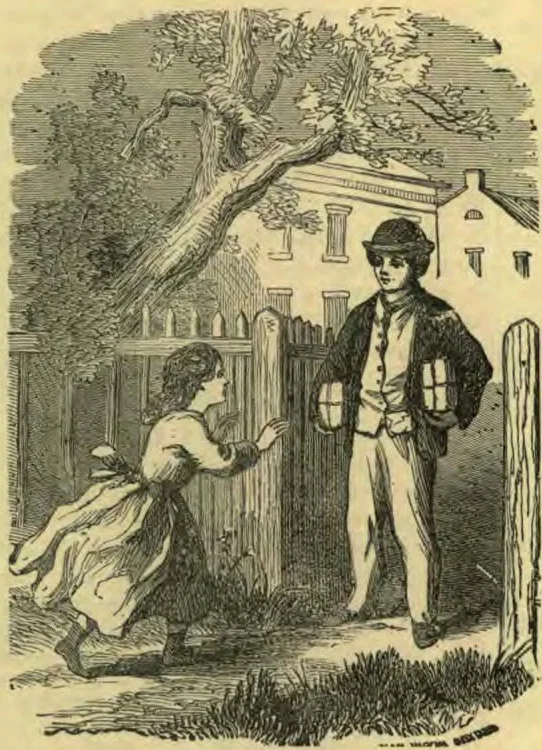
One day when Tom came home from the express office, where he had been to get some packages for his father, his sister Fleda came running to meet him, crying as if her heart would break.
“O Tom,” said she, “Fido has rooted up all my tulips;” and then she cried and cried, as little girls will.
Tom felt sorry for her, but he only said, “What makes you cry? Can you cry tulips? Do you think that every sob makes a root or a blossom? Here! I’ll give these packages to father, and then we’ll try to right them.”
So Tom picked up the poor flowers, put their roots into the ground again, whistling all the time, made the bed look smooth and fresh, and then took Fleda off to hunt hens’ nests in the barn.
Neither did Tom do any differently in his own troubles. One day his great kite snapped the string and flew away far out of sight. He stood still a moment, and then turned around to come home, whistling a merry tune.
“Why, Tom,” said I, “are you not sorry to lose that kite?”
“Yes, but what’s the use? I can’t take more than a minute to feel bad. ‘Sorry’ will not bring the kite back, and I want to make another.”
It was just so when he broke his leg.
“Poor Tom!” cried Fleda; “you can’t play any m-o-o-re!”
“I’m not poor, either. You cry for me; I don’t have to do it for myself, and I have a splendid time to whistle. Besides, when I get well, I shall beat every boy in school on the multiplication-table, for I say it over and over till it makes me sleepy every time my leg aches.”
Tom Flossofer is queer, certainly, but I wish a great many more people were queer in that way, don’t you?—Treasury.

LETTER BUDGET.

Almost every mail brings letters for the “Budget.” We are very glad to get these letters, because they show that you have an interest in our little paper; but let us see what the mails have brought this week:—
Alta Olmstead, a little girl seven years old, sends us a nicely printed letter, and ends it with these words, “Yours in love.” This did us good. We want the love of all our little readers.
George L. Whitmarsh, of Brownsdale, Michigan, says that this is his first letter to the INSTRUCTOR family. He has taken the INSTRUCTOR only two months, but likes it very much. He says that his papa takes the Review and Herald.
Clara E. Allen writes us from Allentown, Dakota. She has been keeping the Sabbath since last winter, and is trying to live a Christian life. They have no Sabbath-school yet, but hope to have one soon.
Deisy Shook, in a letter for the Budget, tells about their new church, also about the Sabbath-school, and closes by saying, “Pray for me.” We know that the Editors pray for Deisy, and we hope that the INSTRUCTOR family pray for one another.
Joseph L. Gardner writes that his father and mother are dead. He lives with people who are very kind to him. He attends Sabbath-school and day-school. He is trying to live so as to meet the INSTRUCTOR family in the new earth.
Chloe Blake, of Portis, Kansas, writes: “I am eleven years old. I like to read all the pieces in the INSTRUCTOR, but I like to read the ‘Budget’ best. I am trying to be a good girl.”
Mary Noland, of Fair View, California, writes us a nice letter for a little girl only seven years old. She says that she goes to Sabbath-school, and loves it dearly. She is trying to live so as to have a home in the new earth.
Gracie C. Hurley says that her papa is away preaching, and that she misses him very much. Although she is but six years old, she helps mamma take care of “baby brother.” She can read the letters in the “Budget” herself.

STRANGE FOOD.

PEOPLE in some parts of the world eat very curious things; they think them nice, and in all probability they would not enjoy our food at all. The best way, the right way, is to be satisfied with what we have. The Esquimaux thinks that there is nothing so delightful as a fat whale blubber. Some of the subjects of Russia enjoy train-oil, and in one region a tallow candle would be preferred to the choicest confectionery.
A tribe of Indians in South America actually eat dirt, but this is only when they cannot get anything else to eat. They much prefer fish and turtle, but these are only to be had when the river is low; and to keep from starving, they swallow balls of clay, which look like huge pills. A stock of these clay pills is always kept on hand; pyramids of them, four or five feet high, may be seen in their huts.
Another strange thing to eat is a mineral called “fossil-flour.” It is mixed with the food of the poor in some Chinese provinces in the time of scarcity or famine. This is also a kind of earth, which is found only where no vegetation will grow. After bruising it to a fine powder, it is mixed with ground rice and a little salt or sugar and made into small cakes. By this means the supply of food is made to hold out twice as long as it otherwise would, but unless the scarcity is very great the mineral flour is not used. Those who eat this mixture always complain of feeling ill, and unless the earth is mixed with some vegetable matter it is almost sure to cause death.
This food would seem easier, to those not accustomed to such fare, than to eat ants. The people of Eastern India, however, make flour of these insects, which are of the large white kind, by parching them on hot stones or metal plates, and then grinding them to powder. But this flour does not agree with the eaters much better than the fossil-flour, as those who eat largely of it generally die of cholera. Ants are also eaten in Africa and South America, where they do not appear to be injurious.
In other places spiders are considered a delicacy, and in New Caledonia the natives roast a fine large species about an inch long, and devour it with great zest; they are said to taste like hazel-nuts. Grubs and larvæ also are eaten, and in one of the South Pacific islands butterflies are caught in large quantities and roasted. These do not agree, either, with the eaters, but the sickness they produce does not last long.
Locusts and grasshoppers and caterpillars also are used as food, and in Southern France the peasants eat largely of snail-soup. It is habit that makes these things palatable or disgusting, and it gives us fresh cause for thankfulness to the God of harvests that our favored land is so bountifully supplied with the fruits of the earth.
— Well-Spring.

The First Almanac Printed by George Von Purbach

THE first almanac was printed by George Von Purbach in 1640.

You have reached the end of this edition.

The Youth’s Instructor · Sep 1, 1880