The Youth’s Instructor, Vol. 32, No. 5.

—Alice Cary

The Youth’s Instructor

Jan 30, 1884

S. D. A. Publishing Association · Battle Creek, Mich. · Jan 30, 1884

—Alice Cary

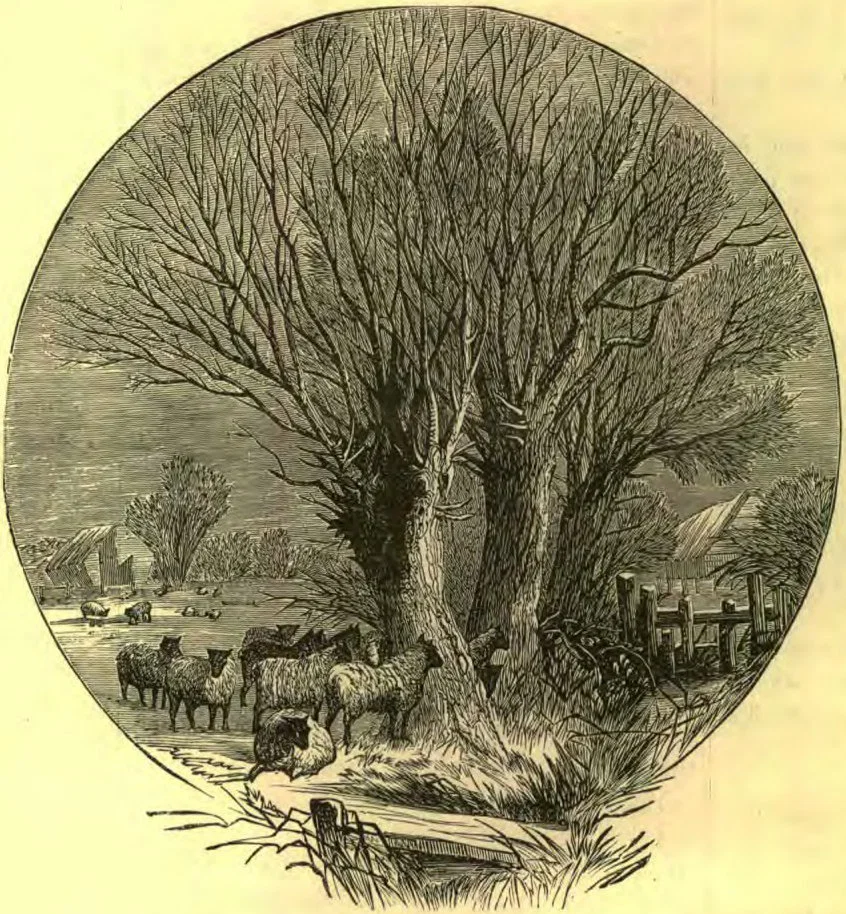
The winter goes, and the summer comes, And the swallow he swingeth no more aloft, And the bluebird’s breast swells out of her nest, And the horniest bill of them all grows soft.
The summer goes, and the winter comes, And the daisy dies, and the daffodil dies; And the softest bill grows horny and still, And the days set dimly, and dimly rise.
The summer goes, and the winter comes, And the red fire fades from the heart o’ th’ rose; And the snow lies white where the grass was bright, And the wild wind bitterly blows and blows.
The winter comes, and the winter stays, Aye, cold and long, and long and cold, And the pulses beat to the weary feet, And the head feels sick, and the heart grows cold.
The winter comes, and the winter stays, And all the glory behind us lies, The cheery light drops into the night, And the snow drifts over our sightless eyes.

—Alice Cary

HOME DUTIES.

DEAR YOUNG FRIENDS, Let me point you to the life of Christ, to his compassion, his humility and love, his inexpressible tenderness. You are to copy his example. God has given you life and all the rich blessings that make it enjoyable, and in return he has claims upon you for service, for gratitude, for love, for obedience to his law. These claims are of the first importance, and cannot be lightly disregarded; but he requires nothing of you that will not make you happier, even in this life. He requires you to control passion, to restrain selfish thoughts and actions, and to leave fretful words unspoken. Would Jesus require this self-control, if it were not for your real happiness to practice it? No; he wishes you to cultivate such traits of character as will bring peace to your own hearts, and enable you to brighten other hearts and lives with the sunshine of love, joy, and cheerful contentment. If you are truly converted, if you are children of Jesus, you will not only do what they tell you, but will watch for opportunities to help them. In doing this you are working for Jesus. He considers all these care-taking, thoughtful deeds as done to himself. This is the most important kind of missionary work; and those who are faithful in these little every-day duties are gaining a valuable experience.
Would it not be well to talk these matters over when you are together, and see what plans you can devise to become home missionaries? By cheerful obedience and manifesting a loving, helpful disposition in the home circle, you lighten the cares and burdens of your parents, and thus show true love for them, while exemplifying the grace of Christ. Take your older friends into your counsel, and see what you can do in this direction.
Many children go about their home duties as though they were disagreeable tasks, and their faces plainly show the disagreeable. They find fault and murmur, and nothing is done willingly. This is not Christ-like; it is the spirit of Satan, and if you cherish it, you will be like him. You will be miserable yourselves, and will make all about you miserable. Do not complain of how much you have to do, and how little time you have for amusement, but be thoughtful and care-taking. By employing your time in some useful work, you will be closing a door against Satan's temptations. Remember that Jesus lived not to please himself, and you must be like him. Make this matter one of religious principle, and ask Jesus to help you. By exercising your mind in this direction, you will be preparing to become burden-bearers in the cause of God, as you have been care-takers in the home circle. You will have a good influence upon others, and may win them to the service of Christ.
Some young persons who have the privilege of attending school, do not improve their advantages. They would like to read and write accurately, but the price of excellence is hard work, and they will not pay it. They remind me of the youth whose father sent him to school, and gave him every advantage for gaining a good education; but he neglected to study, saying that his father was able to give him a liberal education, and he was not going to bother his brains about it. You will all say at once that he would remain ignorant, for there is no royal road to learning. But wishing for a healthy religious experience without making earnest, self-denying effort, will be equally useless. Sighing over your ignorance of divine things will never make you wise unto salvation. There are ten thousand sluggish tears and sighs toward heaven that will never win one smile of approval from Jesus. Do not think that a Christian experience will come to you of itself. When you make up your mind to do something on which your heart is set, you do not give up for difficulties, but try again and again. Put the same energy and determination to succeed into the service of Christ, and you will not fail of a reward.
I point you, dear young friends, to Jesus. I commend you to his grace. He invites your confidence; and if you trust him in the simplicity of faith, he will come into your heart, and take up his abode with you, and will be to you an ever-present help in every time of need. Will you comply with the conditions laid down in his word? Will you come to Jesus? Many of you profess to be his followers; will you not begin now to imitate him in your lives? MRS. E. G. WHITE.

Character Written Upon the Face

Every hidden propensity or vice, every noble trait or feeling, leaves its mark on the features, the expression, the eyes. Day by day and hour by hour, line after line, here a little and there a little, it is recorded on the face, as on a tablet, and when we reach middle age, there is the story of our lives plainly written, so that he who runs may read.

WINTER AND SUMMER.

The winter goes, and the summer comes, And the clouds descend in warm, wet showers; The grass grows green where the frost has been, And waste and wayside are fringed with flowers.
The winter goes, and the summer comes, And the merry bluebirds twitter and trill, And the swallow swings on his steel-blue wings, This way and that way, at wildest will.

THE BOY AND THE BRICKS.

A boy, hearing his father say ’t was “a poor rule that would n't work both ways,” said:— “If father applies this rule to his work, I will test it in my play.”
So setting up a row of bricks three or four inches apart, he tipped over the first, which, striking the second, caused it to fall on the third, and so on, through the whole course, until all the bricks lay prostrate.
“Well,” said the boy, “each brick has knocked down his neighbor which stood next to him; I only tipped one. Now I will raise one, and see if he will raise his neighbor. I will see if raising one, will raise all the rest.” But he looked in vain to see them rise.
“There, father,” said the boy, “is a poor rule; ’t will not work both ways. They knock each other down, but will not raise each other up.”
“My son,” said the father, “bricks and mankind are alike made of clay, active in knocking each other down, but not disposed to help each other up. When men fall, they love company; but when they rise, they love to stand alone, and see others prostrate below them.”

MINDING

“CHARLIE, come in, I want you,” said a sweet, womanly voice to a little boy who was playing marbles on the sidewalk in front of a nice brick house.
Now Charlie was very busy, and in the midst of a delightful game. He was as happy as could be. To quit his play then was like quitting the table when half through dinner. Would he obey? We looked with interest to see what he would do. What would you have done?
Charlie replied, “Yes, mother,” and picking up his marbles, started off with a smiling face and a bounding step up the side yard and in at the end door of the house. A fine boy that, I thought, as I looked after him. I wonder who he is? What a beautiful thing it must be to have a little boy or girl that will mind at once, and with a happy, loving heart! I wondered what would become of that boy, and wished to see more of him, and learn his history.
I used to walk past that house every week, and always thought of that blue-eyed, light-haired boy. The thought of him made me happy. I saw a great many naughty children. Once I spent two or three days in trying to find a naughty boy who ran away from his home, and overwhelmed his parents with grief; and when I found him, some one had stolen his coat and hat, and bundle of clothes, and all the money he had. A boy that minds is a jewel.
I had been in business a year or two, and in that time had had several boys; but it was next to impossible to find one that would mind. At last I was quite out of patience, and I determined that I would have no one who could not bring the best recommendation, and stand the closest test. Several applied for the place, but no one suited us. At last came a blue-eyed, flaxen-haired youth of twelve years, with a bright, honest face. There was something engaging in his looks. Had I seen him before? “What is your name?”
“Charlie Warren, sir. I live in Franklin street. My father is a carpenter, but is lame now, and cannot work; and I have got mother’s consent to go into a store, if I can find a place.”
It was the very Charlie whom I had seen playing at marbles. I remembered the circumstance, and knew that he would mind. I did not need a recommendation for him, but gave him the place.
Charlie came to work on Monday morning. It seemed hard for him, the first week of work, but he behaved like a man. The boys in the next store came in, and made his acquaintance. One morning I heard two of them trying to coax Charlie to go off with them down on the wharves in the forenoon, and see a boat race that was to come off. “No,” said Charlie, “mother told me to mind my business, and I am paid for staying here, and don’t think it right to go off without my employer’s knowing it.”
That was a brave word, and I thought more of Charlie than ever. That was ten years ago. He has been with me ever since, and proved to be the best clerk I ever had. Yesterday we put up a new sign, and on it, in large gilt letters, was Charlie’s full name. The store is his own. He is now a prosperous, promising young man, and if he lives, will be a rich and honored man. And all this because one bright morning he minded his mother when she called him. From such little things do great results come. Always mind, and it will be well with you.—Selected.

Trusting God's Providence in Great Enterprises

WE shall find difficulties in all great enterprises; but if we are sure we have begun them from God, we may securely cast all events upon his providence, which knows how to dispose and how to end them.

SONGS OF PRAISES.

In a dried old mow, that was once, alas! A living glory of waving grass, A cricket made merry one winter’s day, And answered me this, in a wondrous way, When I cried, half sharply, “Thou poor old thing! How canst thou sit in the dark and sing, While for all thy pleasure of youth thou starvest?” —“I’m the voice of praise that came in with the harvest!”
I went away to the silent wood, And down in the deep, brown solitude, Where nothing blossomed, and nothing stirred, Up rose the note of a little bird. “Why carollest thou in the death of the year, Where nobody traveleth by to hear?” —“I sing to God, though there be no comer, Praise for the past, and the promise of summer!”
I stopped by the brook that, overglassed With icy sheathing, seemed prisoned fast; Yet there whispered up a continual song From the life underneath that urged along. “O blind little brook, that canst not know Whither thou runnest, why chantest so?” —“I don’t know what I may find or be; But I’m praising for this: I am going to see!”
—Wide Awake.

RULING CIRCUMSTANCES.

It is a false philosophy which teaches that circumstances make or mar men. A failure may ruin one man, and cause another man to succeed. The men, not the failure, determine the difference in the results. Cyrus W. Field, through whose enterprise the Old World was cabled to the New, was overthrown by a disastrous failure a few years after he began business as the junior partner of a paper firm. Young Field fell to rise again. Compromising with his creditors, he opened a paper commission house in the city of New York. He began with a small capital and little credit, but with industry, promptness, and the determination to sell paper. He was up early and late. The doors and windows of his store were the first opened in the morning and the last closed at night. His salesman, book-keeper, cashier, and porter were always at their post of duty, for he was all four. Customers were impressed with his precise habits and the methodical way in which he managed his business. He had a place for everything and a time for every duty. At noon, no matter who was present, out came the tin pail in which he had brought his dinner, a napkin was spread on the desk, and a “cold bite” eaten.
Within ten years, the industrious young man had built up a large business, and paid off his creditors, principal and interest. Then he became possessed by the grand idea of connecting Europe and America by an Atlantic telegraph. Men laughed at him as visionary; obstacle upon obstacle interposed; failure followed upon failure. Yet he held to his great thought, and made the two worlds neighbors. Did circumstances make him, or did he make circumstances do his bidding?—Selected.

EDITOR'S CORNER.

Boys and girls, did you ever hear of a person having four ears? A minister once made the statement to a congregation of little hearers, whose attention he was anxious to secure, that “children have four ears.” Said he, “Their eyes are their ears; they hear with their eyes; and if I see a child looking at the speaker, I know that he hears him.”
You will do well always to remember this when a person is speaking to you. It is pleasanter for the speaker to have the attention of his hearers; and you, if you look straight at him while he is talking, will be sure to get the best he has to say. All talkers like good listeners, and if their hearers are attentive, ready to catch every word that is said, the speaker will do his best to say something worth hearing and remembering.
Did you ever try to relate a story, or some bit of news, to a person who, although he pretended to be listening, was looking in every direction save at you? If so, you know a little of the experience of a speaker under like circumstances, and how hard it is for him to be interesting without listening eyes to help him.
An eloquent minister once said that two or three good listeners, who always looked straight at him, helped him much in preaching; that he preached better sermons for his whole congregation for just two or three who heard all he said, and seemed to care for what he preached. If a few interested hearers can be of such help to a minister by “looking straight at him,” what might we not expect of him should the whole congregation be equally attentive? Try it, dear children, in the house of God, and in the Sabbath-school, and see how your attentive habits will encourage the minister, the superintendent, and the teachers. We believe you will report the most interesting seasons you have ever enjoyed.
Two thoughts cannot occupy the mind at the same moment; and if your eyes are wandering about at the time you are trying to hear, your attention will be more or less taken up with the things upon which your eyes rest, and you will lose much that is said. We wish we could impress your minds with the importance of forming habits of close attention. If you engage in conversation, or listen to the words of another, fix your eyes attentively upon the speaker; and whether you have opportunity to gain knowledge by the ear, or by the eye, notice as closely every particular point of what is said or done, as you would were you obliged afterward to relate all you saw or heard. Such habits formed will be the best investment you ever made.
This habit of observation will also help you in talking; for those who hear well, usually lay up a good store of useful knowledge, and command choice words to express their ideas to others. So begin early the habit of close attention, and you will acquire a mine of knowledge. Try it, young friends, will you not?
M. J. C.

TRUE SOVEREIGNTY.

Alexander, the king of Macedonia, is known in history as a great robber. Before he went to Asia in order to subdue it, he sat one day lost in deep thought. Aristotle, a wise man of his time, came to him, and said:—
“Why dost thou delay, O King? Thy treasury is full; thy armies are ready; everything smiles on thee.”
“I was thinking,” answered Alexander, “whether the bit of glory I shall gain, and all Asia which I shall conquer, be worth the trouble of taking a single step before the house here.”
“Thou art, indeed, right,” replied Aristotle; “but the matter is easily set right. Since the sovereignty of the world does not seem worth thy taking pains for it, then set before thyself a higher aim,—the sovereignty over thyself, and the happiness of the other life.”
Alexander heard the good advice, but history shows that he did not heed it. Although he almost conquered the then known world, although he heaped up treasures and riches, and was reverenced by his soldiers as a god, yet he was not happy, because he could not rule himself. His pride and avarice were never satisfied. At a banquet, he once fell into such a passion that he killed his most faithful and trusty servant. How true it is, that “he who ruleth his own spirit, is greater than he that taketh a city”!

HE KNEW ALL ABOUT IT.

“Rex, have you studied your Sabbath-school lesson?”
“Not to-night. There isn’t need this time.”
“No need! Why not?” queried Rex’s mother.
“Because,” replied Rex, promptly, “the lesson is the story of David and Goliath. I’ve heard it over and over—it’s the one I always liked, you know—till I know all about it. I don’t need to look it up. I almost believe I can tell it now better than the teacher can.”
“You are sure you know all about it? Very well; then I will ask you a question on the subject.”
“All right. I can answer any number of questions on that story,” replied Rex cheerfully.
“What became of Goliath’s sword?”
Rex whistled. Somehow the promised answer was not so quick and ready as he had expected to have it.
“You remember,” explained his mother, “that David cut off the giant’s head—not with his own sword, for he had none, but with Goliath’s, which he drew out of its sheath for the purpose. And after that, what was done with the sword?”
“Why, I never heard. That isn’t in the story, is it?” cried Rex.
“A boy who knows all about it ought to be able to tell,” replied his mother.
And again Rex took refuge in whistling.
“Well, mother, I expect I’ll have to own you’ve caught me this time,” he confessed, at last; “and now are you going to tell me about it?”
“Any time when you are ready for the lesson,” was the answer.
So, at the hint, Rex left his shavings, packed his tools, and joined his mother at the library table among her books and papers.
“Now then, please, mother! What really became of the giant’s sword?”
“When we hear of the sword again,” said the mother with a smile, “the shepherd boy, David, who was, at first, soothing and dear to King Saul in those strange, dark moods that tormented him, had become a presence the fickle king could not bear. David had had to flee for his life, and we find him, as he flies, coming to Abimelech, the priest, asking for food and help. And he asks for another thing,—a spear or sword. Read me what the priest answered; here it is.”
Rex looked at the place pointed out and read thus:—
“And the priest said, The sword of Goliath the Philistine, whom thou slewest in the valley of Elah, behold it is here wrapped in a cloth behind the ephod; if thou wilt take that, take it, for there is no other save that here. And David said, There is none like that; give it me.”
“Now that is worth knowing; I’m glad you’ve showed me that, mother,” said Rex heartily. “I won’t say anything more against studying my lesson every week.”—The Young Churchman.

NEW-TESTAMENT HISTORY.

LESSON 172.—REVIEW ON ACTS 7 AND 8:1-24.

1. WHEN the number of the disciples had much increased, what complaint did the Grecians make? Acts 6:1.
2. How were the apostles relieved from the care of such things?
3. How did the church prosper at this time? Verse 7.
4. Which of the seven deacons was noted for his great faith, and for the miracles he performed? Verse 8.
5. When the wisdom which the Lord gave to Stephen proved too great for the enemies of Christ, what did they do? Verses 10-12.
6. Of what did they accuse Stephen? Verses 13, 14.
7. By what miracle did the Lord show that Stephen was approved of him? Verse 15.
8. Of what did Stephen then give an outline? Chap. 7.
9. When under the yoke of Egyptian bondage, how did the Israelites treat the man whom God had raised up to deliver them? Verses 35, 39.
10. What did this illustrate?
11. How did the Lord finally exalt Moses? Verses 35, 38.
12. How did Moses prophecy of Christ? Verse 37.
13. How far did Stephen trace the history of the Jews?
14. How did he then set forth the stubborn, willful disposition of the Jews? Verse 51.
15. What question did he ask? Verse 52.
16. What fearful crime did he lay to their charge?
17. What effect had Peter’s words when he brought forward a similar accusation? Acts 2:23, 37, 41.
18. What different effect had Stephen’s words? Acts 7:54.
19. How do you account for this difference?—Perhaps those who were enraged at Stephen had hardened their hearts by rejecting the preaching of Peter.
20. What assurance had Stephen that the Lord had not forsaken him? Verse 55.
21. What did he say? Verse 56.
22. What effect had his words? Verses 57, 58.
23. How did Stephen receive this cruel treatment? Verses 59, 60.
24. Who took care of the clothing of those who stoned Stephen?
25. What seeming calamity caused the rapid spread of the gospel about this time? Acts 8:1, 4.
26. Where did Philip preach?
27. How was he encouraged in his labors? Verses 6-8.
28. Who came down from Jerusalem to visit Philip? Verse 14.
29. What blessing was received in answer to their prayers? Verses 15-17.
30. Who was anxious to buy with money the power to confer this blessing? Verses 18, 19.
31. How did Peter reprove him? Verses 20, 21.
32. How had this man heretofore imposed upon the people?
33. What counsel did Peter give him? Verse 22.
34. How did the man still show the selfishness of his heart? Verse 24.

WHAT CAN BE DONE?

Written for the Instructor.

WHAT CAN BE DONE?

THE interest in your Sabbath-school is decreasing, the pupils are not regular in their attendance, imperfect lessons are on the increase, the teachers’ meetings are not well attended, the finances of the school are running behind; in short, the prospect is in every way discouraging. What can be done?
When the physician is called to prescribe for a sick person, he at first seeks to find out the cause of the disease, and he cannot proceed to treat his patient intelligently until he has discovered how the malady originated. After this is found out, he very naturally begins his course of treatment by attempting to remove the exciting causes, and he does not look for substantial improvement until he succeeds in this.
The same principle may be followed out in the Sabbath-school. If your school is not in the condition you would like to see it in, begin to look around and find out what the trouble is. It will do no particular good for the superintendent to bewail the condition of the school, and to tell them what a deplorable state they are in, and at the same time not really understand where the evil lies, nor do anything to remedy it.
The superintendent and officers should devote time and thought to the matter, and should earnestly seek for heavenly wisdom and guidance to discover the cause of the inefficiency of the school. They should closely examine and understand every detail of its workings, questioning every point as it comes up, to find out whether it contributes to the welfare of the school or not. Proceeding in this manner, with the fear of God before them, it will not be long before the seat of the trouble is found.
Perhaps the superintendent himself is at fault. He may not manifest that devotion, energy, and faithfulness in his work that it is his duty and privilege to do. It is nearly always true that as the superintendent is, so is the school. No one person can exert such an influence over the Sabbath-school as the superintendent can. If he devotes time and thought to his work, makes himself conversant with all its parts, keeps well posted on the lessons, is prompt and punctual in his work and attendance, he will exert a similar influence upon his school. They will receive impressions from him which will be of lasting benefit to them. On the other hand, if he manifests the opposite qualities, shows no particular interest in the work of the school, and allows matters to go as they may, he will soon discover a disposition on the part of the officers, teachers, and scholars to follow his example.
Or, the officers and teachers may not be working as hard as they ought, to second the efforts of the superintendent. Laxity among them may sometimes entirely hinder the work of the school, and be the cause of its decline and inefficiency. Or, the fault may be among the scholars.
But whatever may be the hindering cause to its prosperity, steps should be carefully taken to remedy the evil as soon as practicable. Are imperfect lessons frequent? Let officers and teachers themselves spend more time and thought on the word of God, and thus by the influence of example, as well as by personal effort, try to raise the standard of scholarship. Are tardiness and irregularity of attendance growing upon your school? Let the teachers themselves make it a point always to be punctual and never to be absent, unless unavoidably detained; and this example, with a word spoken in season, will soon have the desired effect. Are your teachers’ meetings thinly attended? Let those having these meetings in charge, make them so profitable and interesting that the teachers cannot be persuaded to remain away from them. Are changes in the policy or management of the school desirable? Let them be made cautiously and carefully, avoiding all unnecessary talk about the matter, that may cause ill-feeling or party spirit.
But if the blessing of God is lacking, then all other efforts in behalf of the school are in vain. “Seek ye first the kingdom of God,” is the privilege and duty of all connected with the Sabbath-school; and earnest effort in this direction, preceding all other work for its welfare, will bring about such a change in the school as will gladden the hearts of all interested in its prosperity.
A. B. OYEN.

Effect Without Labor, Labor Without Effect

THEY who begin by effect without labor, will end by labor without effect.

BE THOROUGH.

WHATSOE'ER you find to do, Do it, boys, with all your might! Never be a little true, Or a little in the right. Trifles even Lead to heaven, Trifles make the life of man; So in all things, Great or small things, Be as thorough as you can.
If you think a word will please, Say it, if it is but true; Words may give delight with ease, When no act is asked from you. Words may often Soothe and soften, Gild a joy or heal a pain; They are treasures It is wicked to retain.
Whatsoe'er you find to do, Do it always with your might; Let your prayer be strong and true— Prayer, my lads, will keep you right. Pray in all things, Great and small things, Like a Christian and a man; And forever, Now or never, Be as thorough as you can. — Selected.

AN OLD STORY.

A LONG time ago the Lord's people were slaves in the land of Egypt. They had left their home and come to this strange country, because for several years nothing grew in their own land, and they could not get enough to eat. When they first came down to Egypt, the king was very kind to them, and gave them the best of the land for their cattle to pasture in.
By and by this king died, and there came a new king, who didn't know anything about the Lord's people, and how they happened to be living in his country. He didn't like them very well, and for this reason made slaves of them. But the people trusted in the Lord, and prayed to him, and he blessed them; and they grew to be mightier than the king's people.
When the king found out that the Hebrews, as they were called, were more and stronger than the Egyptians, he became alarmed, and called his wise men together.
“Now,” said the king, “I am much troubled; for these Hebrew people are getting to be mightier than we. By and by, when we have war, I am afraid they will join our enemies, and fight against us, and so get away from us.”
“True,” said one of the wise men, “that would indeed be bad; for they are very useful people, and do much hard work for the kingdom.”
And the wise men thought and thought what they could do so that the Hebrews wouldn't increase so fast. At last they set over them task-masters, that treated the Hebrews cruelly, and made them work very hard indeed. But this plan didn't prove successful, as the people only grew to be more and stronger for their hard work.
Then the king was angry, and ordered all the male children to be drowned as soon as they were born. The Hebrew mothers were very sad, and tried in every way they could think of to hide their little ones. But just as soon as one of the king's people found out that there was a baby still alive, they would take it away, and throw it into the river.
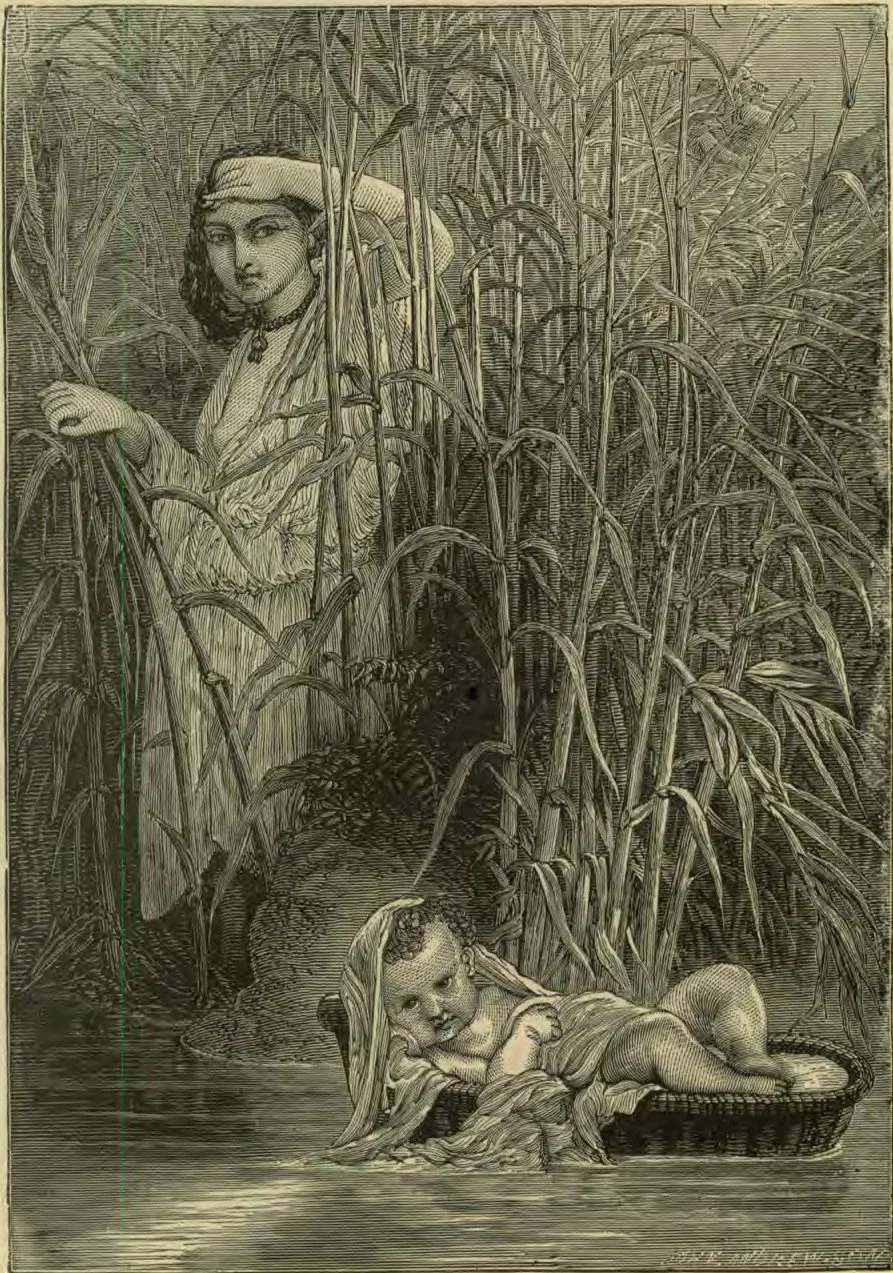
One woman made out to keep her little boy hid till he was three months old. But he grew so large she couldn't hide him in the house any longer; so she made a basket of bulrushes, and daubing it with pitch inside and out, put the baby into it, and laid the basket among the flags growing by the river's brink.
By and by Miriam saw somebody coming down toward the river; and it was—yes, she could see plainly as they came nearer—it was the king's daughter, coming down with her maids to bathe, and they were going right where the baby lay hidden. How Miriam's heart beat! Hark! What was that she heard the princess saying to her servant? She stood near enough so that she could hear. “Go and find out what that strange object is that's floating by the flags, and bring it to me.”
The servant came back with the basket that held the baby; and when the king's daughter opened it, the baby looked up and cried.
“Poor little thing!” she said; “some Hebrew woman has put him here to save him. I don't care if the king should be angry, I shall take him home and bring him up.”
How glad Miriam was when she heard that! She ran right up to the lady, and said, “Wouldn't you like to have a nurse for the baby?”
And the princess replied, “Yes, indeed; if you know of any woman that would take care of him, you may go and get her.”
Then Miriam ran as fast as she could to tell the good news to her mother, who came hurrying up to where the king's daughter was, and offered to take care of the baby.
The princess said, “Take good care of him, and I will pay you well for it.”
The mother kept the baby, Moses, as the king's daughter called him, till he grew to be quite a large lad; then he had to leave his mother, and go to the palace, where he was taught all the things that the wisest men could teach him, and he became a learned man.
One day he made the king very angry, and he had to flee away into a far country, where he stayed many years, taking care of sheep. Here the Lord appeared to him, and told him to go back to Egypt, and lead the people out of bondage up into their own land again.
Without doubt you all know the story well, and have told it again and again. Yet we never get tired of thinking of the wonderful way the Lord saved Moses, so that by and by he might lead his people into the promised land.
W. E. L.
Continue reading: Letter Budget