The Youth’s Instructor, Vol. 31, No. 48.

A TALK ABOUT THE SEA

The Youth’s Instructor

Nov 28, 1883

S. D. A. Publishing Association · Battle Creek, Mich. · Nov 28, 1883

A TALK ABOUT THE SEA.

How I love to look at the sea! It is grander than anything I ever saw or thought of!" exclaimed Edward Stanton, as he stood with his uncle, gazing out upon the broad Atlantic.
Edward was a Chicago boy; he had been born and brought up in the West. He had sailed over the blue waters of Lake Michigan, and had driven over the rolling prairies, but he had never seen the ocean. He was a good scholar, and day after day, as he studied in his geography about the great wide waters that separated America from Europe on the east and from Asia on the west, he longed to see them. So his father had promised him that he should spend a part of his vacation with his Uncle Edward in Boston, and have a sight of the Atlantic Ocean; “and a touch and taste of it too,” said his father, “for you can bathe in it.”
And here he was at the very sea-shore, with the gray, solid rocks beside him and the salt marsh grass in tufts at his feet, while his eyes feasted on the broad blue waters of the ocean, over which so many ships were continually coming and going to and from his native land.
“There is a stiff breeze to-day, as the sailors say,” remarked his uncle, “and the sea is dotted with white caps.”
“What makes them?” asked Edward.
“It is the foam-crest caused by the breaking of the top of the wave by the wind.”
“How beautiful they look!” exclaimed Edward.
“Sometimes the waves are much higher than to-day, and at others the sea is so tranquil that no white caps are to be seen. Your Aunt Mary, when she sees them, is always reminded of the words of David’s joyful psalm: ‘Oh, sing unto the Lord a new song; . . . let the floods clap their hands;’ and she says it seems to her as if every wave was glad, so that they clap their hands and laugh for joy. She calls such a sea as this ‘the laughing sea.’”
“That is nice, I think; it is like poetry. I shall remember it when I read those verses in my Bible; and I shall never forget how the laughing waves look.”
“But you must see the ocean in other moods. This great and wide sea presents many aspects, my boy.”
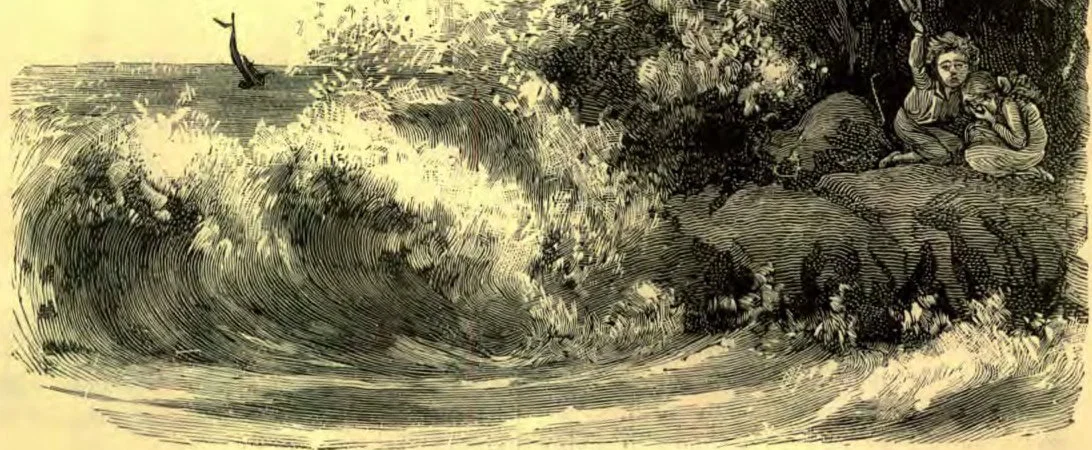
Not long after this they came again to the sea-side, and this time it was with a party of friends. There were grandpa and grandma, Aunt Mary and little Genie, Aunt Louisa and Cousin Helen. It was a very warm day in August, and when they started from home, the sun was as scorching as a great fire; but clouds arose as they rode along, and when they arrived at the seaside, the wind blew a gale. The water looked dark—almost black—and the billows tossed fiercely as they rose and fell, and with a heavy roar broke upon the sand.
Dear little Genie, not two years old and just beginning to talk, seemed timid and afraid. The sight and sound of the angry waters quieted her natural merriment, and she sat in her mother’s lap, and gazed as if fascinated by the scene. Presently an immense wave, higher than any that had preceded it, rolled in and dashed upon the sand. She raised her tiny hands, and, bending forward, shook them at the sea, crying, “Don’t! don’t!” as if her little voice and strength and will could calm the power, and silence the voice, of the mighty waters.
“Dear child!” said mamma soothingly. “Genie needn’t be afraid. God holds the waters in his hands.”
The baby looked up into her mamma’s face and smiled. “God,” she repeated, “holds—waters;” and she leaned back, contented and fearless. She was safe as long as God, the dear heavenly Father, held the waters. They all smiled at the little incident.
“No,” said Uncle Edward, standing near, “Genie need not fear the waves;” and then he repeated those grand words of Jeremiah:—
“Fear ye not me? saith the Lord. Will ye not tremble at my presence, which have placed the sand for the bound of the sea by a perpetual decree, that it cannot pass it? and though the waves toss themselves, yet can they not prevail; though they roar, yet can they not pass over it.”
“They toss themselves and roar to-day,” said Edward, as another tremendous wave, with deafening noise, dashed upon the beach.
“Yet these are nothing,” said his uncle. “And think of ships being tossed about on these billows! The wonder is that any vessel can outride a storm at sea.”
“But,” asked Aunt Louisa, “do not the waves sometimes exceed their appointed bounds? We read of floods and tidal waves that cause great desolation.”
“No; the sea never forgets the command of Jehovah: ‘Hitherto shalt thou come and no further, and here shall thy proud waves be stayed.’ We can have no better illustration of the restraining power of God than by looking at the sea. It heaves and tosses, and now and then, as if by a spasmodic effort, throws its water in upon the shore beyond its usual bounds, but it quickly subsides, and holds its place obedient to the Almighty will. We are told, ‘He weigheth the waters by measure;’ ‘He gathereth the waters of the sea together as an heap.’”
“I wonder of what use the sea is?” said Edward. “We are afraid of it, we can’t manage it, and what do you suppose, uncle, it was made for? It separates us from other countries, and—”
“Where would the fishes live?” asked Cousin Helen.
“We could live without fishes,” said Edward.
“The ocean has a more important use than simply as a home for fishes,” replied Uncle Edward. “God has a wonderful system of equalizing the temperature—as it were of ventilating our earth—by means of it, and it is the chief source of all the vapors or clouds that are wafted around the globe and fall in rains and snow.”
“And these feed the rivers,” suggested Aunt Louisa.
“And then return and fall back into the ocean. So the water is going round and round all the time—up in the clouds, down upon the earth, back to the sea. It is perpetual. Who could have devised such a system but God? All is done without any trouble on the part of man, and no machinery is needed.”
“God needs no machinery,” said Aunt Louisa. “His agencies are simple. Everything he does is done easily.”
“I can’t help thinking how little I am, as I stand here by the seaside,” said Edward. “I am so glad I came here and have seen this great Atlantic Ocean! I shall never forget it. The very word ‘sea’ will seem different to me after this.”—S. S. Visitor.

The Sea.

There is a pleasure in the pathless woods, There is a rapture on the lonely shore, There is society where none intrudes, By the deep sea, and music in its roar: I love not man the less, but nature more, From these our interviews, in which I steal From all I may be, or have been before, To mingle with the universe, and feel What I can ne'er express, yet cannot all conceal.
Roll on, thou deep and dark blue Ocean,—roll! Ten thousand fleets sweep over thee in vain; Man marks the earth with ruin,—his control Stops with the shore;—upon the watery plain The wrecks are all thy deed, nor doth remain A shadow of man's ravage, save his own, When for a moment, like a drop of rain, He sinks into thy depths with bubbling groan, Without a grave, unknelled, uncoffined, and unknown.
  • *
And I have loved thee, Ocean! and my joy Of youthful sports was on thy breast to be Borne, like thy bubbles, onward; from a boy I wantoned with thy breakers,—they to me Were a delight; and if the freshening sea Made them a terror, ’twas a pleasing fear; For I was as it were a child of thee; And trusted to thy billows far and near, And laid my hand upon thy mane, —as I do here.
—Lord Byron.

A SACRED TALISMAN.

THREE little German girls, whose friends were in America, wanted to go thither. They were from eight to twelve years old, and the question was how to get them across the great ocean, and away into the interior of America. There was no one to go with them, they must go alone; and no one could tell what troubles might assail them, or what dangers might surround them. But their friends had faith in God, and before they sent them out, they got a book, and on the fly-leaf they wrote a sentence in German, in French, and in English, and they told the little children when they started,—
“If you get into trouble, or need any help, you just stand still and open this book, and hold it right up before you.”
Then they started off on their long journey by railway and by steamship, from place to place and from port to port; and wherever they went, if any trouble occurred or any difficulty arose, the children would stop and open the book and hold it before them, and they always found some one who could read German, or English, or French, and who was ready to help them on their way.
And what were those words which proved such a talisman and protection to these children among strangers in a strange land? What were the words that made the careless and thoughtless, the rough and reckless, kind? that gave them protection and help in every hour of need, and opened doors before them? They were the words of One who lived on the earth long years ago, and who, though he has passed away from human vision, yet holds his grasp upon the minds of men. These were the words: “And the King shall answer and say unto them, Verily I say unto you, inasmuch as ye have done it unto one of the least of these my brethren, ye have done it unto me.”—Selected.

JOHN HUSS.

In Hussinecz, a market-town of Bohemia, was born in 1369, or according to some accounts, 1373, a boy named John Huss. His parents were peasants, yet they seem to have been in comfortable circumstances, for John was allowed to go to school in his native town; afterward he was sent to Praschalitz, and from there he went to the university of Prague, where in 1393 he graduated. He did not learn as readily as some, but his conduct was exemplary; he was modest and kind, and an earnest Christian. He was a tall young man, with a sad, pale face.
After graduating, he became president of the theological department of the university. He was also chosen preacher in the Bethlehem chapel, a church built several years before this by some good people, who wanted to have the Scriptures preached in the Bohemian tongue for the benefit of the common people, since they could not understand the preachers when they talked in Latin. Great multitudes came to the Bethlehem chapel to hear the earnest words of John Huss. Among them was the queen, who was very friendly to him, and chose him for her confessor. He was also adviser to the archbishop.
He had read the writings of Wycliffe, and believed his doctrines. The more he studied the Bible, the more he became convinced of the truthfulness of Wycliffe’s teachings. Shortly after he became preacher in the chapel, the archbishop sent him, with two others, to Wilsnack, near Wittenburg, to find out the genuineness of certain miracles and relics of the Roman Catholic church there. Huss became so indignant at the avarice and greed of the priests, who forged these miracles and relics, that on his return he with all boldness exposed the wickedness of the priests, saying in a sermon before the archbishop, that the churches ought to sell their useless ornaments to help support the poor, and that the people ought not to trust to relics and images, but should look to Christ and the Bible.
Huss was very popular among the people, and especially among the students of the university. As he kept on preaching these doctrines, the church of Rome became alarmed, and the pope issued a bull, ordering all Wycliffe’s books to be burned and his doctrines to be renounced. Huss boldly protested against this, and continued to defend these so-called heresies.
After a time the pope issued a bull, or document, excommunicating Huss from the Roman church, and forbidding the priests to hold services in any of the towns where he might be. This was at first disregarded by the people, and the Reformer continued to teach the people that in matters of conscience, God ought to be obeyed rather than man, and that men had no power to forgive sins.
The next year, the pope declared a civil war against the king of Naples, who had been excommunicated, and offered indulgences to all who should take part in it. Huss openly condemned this manner of offering indulgences, and held a public discussion upon it in the university hall. Here a friend of his delivered such an eloquent address upon the same subject, that the students gathered together as many of the documents as they could find, and forming a procession, carried them to the outskirts of the town and burned them. The king, who had been friendly, now became alarmed, and decreed that any further contempt shown toward the pope or the papal bulls, should be punished with death. Three young men were put to death in a few days, and Huss buried them, and extolled them as martyrs. When tidings of these things reached the ears of the pope, he placed a new ban upon Huss, which was this time regarded, and he was obliged to leave the place. He retired to a friendly castle, and spent his time in writing books in the Latin and Bohemian languages. He carried on a large correspondence with those disciples whom he had left behind. This tended more and more to increase the difficulties.
Meanwhile, a council had been called at Constance for the purpose of settling the difficulties between the Bohemians and the pope. To do this, it was necessary that Huss should be present. He was promised a safe conduct, and he gladly accepted the opportunity of clearing himself from wrong charges, and of confessing Christ.
Fearing that he might be going to his death, he arranged his private affairs, and set out October 14, 1414, preaching on his way in all the towns where he stopped over night. Before he had been in Constance a month, he was put in prison without any charges being brought against him. When the council was in the midst of its deliberations, the pope fled, and Huss was removed, and put in a more secure place in a miserable cell where he could scarcely stand upright. When again brought before the council, he attempted to defend himself, but was assailed by such violent outcries that he was obliged to close, for he could not make himself heard. At the next session, the emperor was present, and Huss was then able to continue his defense. He steadfastly refused to recant his doctrines, or to cease preaching and teaching them, should he be released. During the next few weeks every effort was made to shake him from his resolution but he remained firm to the end. In a letter to a friend he said, “I write this in prison and in chains, expecting to-morrow to receive sentence of death, full of hope in God that I shall not swerve from the truth, nor abjure errors imputed to me by false witnesses.”
According to his expectations, he was condemned to die. After he was tied to the stake, and the faggots were piled around him, he was urged to recant; but he replied, “God is my witness that I have never taught or preached that which false witnesses have testified against me. He knows that the great object of all my preaching and writing has been to convert men from sin. In the truth of that gospel which hitherto I have written, taught, and preached, I now joyfully die.”
After the last flame had flickered and died, his ashes, together with the soil whereon he had stood, were taken up and scattered on the waters of the Rhine. Papal bigotry and fanaticism had done all it could to destroy the work of a noble man; but as his scattered remains floated down the Rhine and out over the broad ocean, so his doctrines rapidly spread among his countrymen, and kept alive the torch of the Reformation that was soon to light the world. W. E. L.

THANKSGIVING HYMN.

For summer's bloom and autumn's blight, For bending wheat and blasted maize, For health and sickness, Lord of light, And Lord of darkness, hear our praise!
We trace to thee our joys and woes,— To thee of causes still the cause,— We thank thee that thy hand bestows; We bless thee that thy love withdraws.
We bring no sorrows to thy throne; We come to thee with no complaint; In providence thy will is done, And that is sacred to the saint.
Here on this blest Thanksgiving night, We raise to thee our grateful voice; For what thou doest, Lord, is right; And thus believing, we rejoice.
—J. G. Holland.

NEW-TESTAMENT HISTORY.

LESSON 163.—PAUL'S SECOND LETTER TO THE CHURCH AT CORINTH.

In concluding his first letter to the Corinthians, Paul encourages them to liberality, promises them a visit, exhorts them to be kind to Timothy, enjoins respect and honor toward those who are active and faithful in the work of the Lord, and closes with a most affectionate salutation and blessing. In speaking of brotherly kindness, he says, “Let all that ye do be done in love.”
In opening his second letter to them, he speaks of a great trouble that had come upon him. He says, “We were pressed out of measure, above strength, insomuch that we despaired even of life.” Yet, trusting not in themselves, but in God, they were delivered. In the hour of trial they had the consolations of a good conscience, knowing that they had behaved themselves with simplicity, and with sincerity toward God. Paul finds a blessing also in this tribulation; for it had taught him how to comfort others.
It seems that the apostle had not yet carried out his purpose of visiting them. He assures them, however, that this delay is not caused by fickleness on his part, but by a desire to spare them; “For,” says he, “if I make you sorry, who is he then that maketh me glad, but the same who is made sorry by me?”
In speaking of his former letter, he says, “Out of much affliction and anguish of heart I wrote unto you, with many tears; not that ye should be grieved, but that ye might know the love which I have more abundantly toward you.” He admonishes them to be kind and lenient to those who have been in error, but have now forsaken their wrong ways. In referring to such a one, he says, “Wherefore I beseech you that ye would confirm your love toward him.” He recommends a tender, forgiving spirit, “Lest Satan should get an advantage of us; for we are not ignorant of his devices.”
Paul tells them that he needs no letter of commendation to them; for they are his epistles, written in his heart,—an epistle known and read of all men; for they are manifestly an epistle of Christ ministered by the apostles, not written with ink, but by the Spirit of the living God; not engraven on tables of stone, but upon living hearts. They had been brought to more than a mere outward obedience to law; the Spirit of God had touched their hearts, and a new life had begun in them. The apostles claim no sufficiency in themselves, but give all the honor to God, who had made them able ministers of the new covenant; yet, as the ministration under the former dispensation was glorious, Paul thinks the ministration under the new must certainly be more glorious, especially since the first dispensation was passing away.
Therefore, since they have such a glorious ministry, they, by the mercy of God, faint not; but renouncing the hidden things of dishonesty, they walk not craftily, neither do they handle the word of God deceitfully; but by manifestation of the truth, they commend themselves to every man's conscience, in the sight of God.
Paul declares that the glorious light of the gospel of Christ is hidden to none but those who have hardened their hearts by unbelief, and have been blinded by the god of this world. He says, “We preach not ourselves, but Christ Jesus the Lord; and ourselves your servants for Jesus' sake.”
God had given them wonderful light for the benefit of the world: “But,” says Paul, “we have this treasure in earthen vessels, that the excellency of the power may be of God, and not of us. We are troubled on every side, yet not distressed; we are perplexed, but not in despair; persecuted, but not forsaken; cast down, but not destroyed; always bearing about in the body the dying of the Lord Jesus, that the life also of Jesus might be made manifest in our body.”

QUESTIONS.

1. In concluding his first letter to the Corinthians, what does Paul encourage them to practice?
2. What does he promise them?
3. To what does he exhort them?
4. What does he enjoin?
5. How does he close?
6. What does he say while speaking of brotherly kindness?
7. In opening his second letter, of what does he speak?
8. What words does he use in speaking of this trouble? 2 Cor. 1: 8.
9. How did they obtain deliverance?
10. What consolation did the apostles have in the hour of trial?
11. How does Paul find a blessing in the tribulations he suffered?
12. What purpose had he not yet carried out?
13. Of what does he assure them?
14. Why was he unwilling to make them sorry by coming to them in heaviness? Chapter 2: 1, 2.
15. What does he say of his feelings while writing his former letter to them? Verse 4.
16. What was his purpose in writing that letter?
17. What admonition does he give with reference to those who have been in error?
18. What words does he use in speaking of such a one?
19. What does he give as one reason why a tender, forgiving spirit should be exercised?
20. Why does Paul need no letter of commendation to the Corinthian church?
21. What had the apostles' preaching done for these brethren?
22. How had their preaching been made so effectual?
23. What does Paul think about this ministration of the Spirit?
24. Since they have such a glorious ministry, what course are the apostles prompted to take? Chapter 4: 1, 2.
25. To whom alone is the gospel light hidden?
26. What does Paul say about his preaching? Verse 5.
27. What great gift had God bestowed upon the apostles? Verse 6.
28. How does Paul say they carry this treasure? Verse 7.
29. Why is this necessary?
30. How does Paul describe their experience? Verses 8, 9.
31. What do they continually bear about in the body?
32. What does this help them to do?
33. How do they bear about in the body the death of the Lord Jesus?

ONE BRICK LAID WRONG.

SOME workmen were once building a large brick tower, which was to be carried up very high. In laying a corner, one brick, either by accident or carelessness, was set a very little out of line. The work went on without its being noticed, but as each course of bricks was kept in line with those already laid, the tower was not put up exactly straight, and the higher they built, the more insecure it became.
One day, when the tower had been carried up about fifty feet, there was a tremendous crash. The building had fallen, burying the men in the ruins. Do you ever think what ruin may come of one bad habit, one brick laid wrong, while you are now building a character for life? Remember that in youth the foundation is laid.—Selected.

E. B. G

Written for the Instructor.

FROM CORINTH TO ANTIOCH.

Paul’s stay at Corinth extended over a year and six months. The situation of this city and its importance as a commercial center, made it a fitting place from which to send forth the rays of gospel light. The apostle had some hard experiences at Corinth. At one time he was about ready to leave because of the persecutions he received; but the Lord bade him tarry on, for he had a great work yet to do there. From Corinth were written the most important of the epistles of Paul.
But the time came when it seemed the mind of the Lord that his servant should seek another field of labor. After descending from the low table-land on which Corinth was situated, the road which connected the city with its eastern harbor extended a distance of some eight or nine miles across the plain before reaching the sea-shore. Cenchrea was in the days of the apostle an important port, and had a large trade with Alexandria and Antioch, with Ephesus and Thessalonica, and other cities of the Ægean Sea. But the daughter has fallen with the mother, Corinth, and little more than the name remains to mark her site. From this port Paul began his journey to Syria, whither he was bound. His fellow-laborers, Aquila and Priscilla, accompanied him on his voyage. No journey across the Ægean Sea was more frequently made than that between Corinth and Ephesus. They were the capitals of the peaceful and flourishing provinces of Achaia and Asia Minor, and the two great mercantile towns on opposite sides of the sea. A fair wind would, in the sailing-vessels of those days, have taken the travelers across from one city to the other in about twelve or fourteen days. It seems, however, that their vessel was bound for Syria, and only stopped a few days in the harbor at Ephesus. Here the apostle and his companions went ashore; but Paul only tarried to speak to the brethren once, and leaving Aquila and Priscilla in their care, he went on with the ship to Syria, promising to come to Ephesus again on his return from Jerusalem.
The voyage to Syria led first by the coast and islands of Asia to the islands of Cos and Cnidos, and then across the open sea by Rhodes and Cyprus to Cesarea, which was the military capital of Syria, and the harbor by which it was approached by all travelers from the west. This city was, at that time, as beautiful as the money and skill of the Romans could make it. But all its splendor,—its buildings and its ships, its marble temple crowned with a statue of the Roman emperor, which the sailors saw far out at sea,—all has long since vanished. The magnificent city is a wreck on the shore; a few ruins are all that remain of the harbor.
From this city were paved Roman roads leading north to Tyre, Sidon, and Antioch; south to Egypt; and east to Jerusalem and the Jordan. The apostle would take the latter road, as he was going directly to Jerusalem. No particulars are given of his visit to the Holy City, only that he went there and saluted the brethren. We do not even know if he arrived in time for the feast, which he was so anxious to attend. From Jerusalem he went immediately to Antioch. To make this journey, he would no doubt return to Cesarea,—and take advantage of the paved road leading northward. This was not a new road to the apostle. Many times he had passed over it in going to and from Jerusalem and Antioch. Over this very way he and Barnabas had come, many years before, to bring relief to the brethren at Jerusalem in the time of famine; over this road they had also come after their first missionary journey to attend the council at Jerusalem concerning circumcision. Yes; we may well believe the apostle’s mind was full of thoughts and memories of the past as he journeyed from Jerusalem to Antioch.

E. B. G

Faithful Stewardship Measured by Our Best

From him to whom little has been given, his little is accepted as the greatest if only it is his best; and the seemingly small achievement of one who wrought it through years of pain, and fairly in defiance of himself and of his own nature, may outweigh in the balance of God all the high and brilliant deeds of another to whom God had made their doing comparatively easy, and who has proved but a careless steward of the great treasure committed to his charge. What you are belongs to God, and neither praise nor blame is due to you for what has been given you; what you may do, is, in God's plan, in your own hands; and final praise or blame will come to you for your stewardship of that.—Sunday School Times.

THE SAND-PIPER.

HAVE you ever read about or seen a nice little bird called the sand-piper, or the summer snipe? This bird does not make its home in the grove, or build its nest upon the branches of high trees. Near the shore of some lonely lake, upon the bank of some large river, or on the mud flats, marshes, or sandy beach of the ocean, the sand-piper may be seen thrusting its long bill into the mud or the sand in search of the worms or insects upon which it feeds, or wading along the edge of the water after the insects there to be found.
Celia Thaxter has written a pretty little poem about this bird, and I will give you some of the verses:—
“Across the narrow beach we flit, One little sand-piper and I; And fast I gather, bit by bit, The scattered driftwood bleached and dry The wild waves reach their hand for it, The wild wind raves, the tide runs high, As up and down the beach we flit, One little sand-piper and I.
“I watch him as he skims along, Uttering his sweet and mournful cry; He starts not at my fitful song Or flash of fluttering drapery. He has no thought of any wrong, He scans me with a fearless eye, Staunch friends are we, well-tried and strong, The little sand-piper and I.
“Comrade, where wilt thou be to-night When the loosed storm breaks furiously? My driftwood fire will burn so bright, To what warm shelter wilt thou fly? I do not fear for thee, though wroth The tempest rushes through the sky, For are we not God's children both, The little sand-piper and I?”
“Weet-weet” is the “sweet, mournful cry,” as the sand-piper rises from the level sand, in a rapid graceful flight; but near the shore the bird ever stays, for there is its food to be found; and near by is its little nest, by the side of some sheltering rock, or under the shade of some low shrub, or down among the coarse sea grasses,—a small round hole lined with a bit of grass or heather, with four pretty eggs, the small ends turned toward the center, and so placed that if one is taken out, it can scarcely be fixed in the same position again.
The eggs are so nearly the color of the sand, and the little nest is so securely hidden, it would take a sharp-eyed boy or girl to find them. If the mother bird should see that her nest had been found, she would try by all the means in her power to turn the attention of the intruder upon herself, fluttering along the ground as if a wing were broken and she might become an easy prey, until far away from her precious treasures, then she would rise upon the wing and fly joyfully away.
When the young birds are hatched, like young chickens, they follow their mother here and there in search of food, down into the water, over the sands, across the marshes and the mud-flats, becoming every day larger and better able to fly, until, as the cold of autumn deepens, nature teaches them to fly away across the sea, down to the summer-land.
You will hear the bustle and the noise of their getting ready, but you will not see them go; for they fly away in the night. All along the old places where they used to flit you will miss them; no more “sweet, mournful cry,” no more little foot-prints along the water side, until April shall come with her sunshine and her tears, and the cold winter is surely past.—Mrs. Mary Brainard.

“FOR FUN.”

Four boys were full of fun; they wanted to see the people get a tumble as they came out of church, so they stretched a rope across the sidewalk, and hid behind the hedge to “have a good laugh.” Little Alice came running down the street; she had been carrying a basket of fruit and flowers to Aunt Comstock, who was ill; and the cheery words spoken by the invalid made the little girl very happy; so she came hopping and singing along, gay as any bird. The night was dark, the street lamps dim and far apart. The little girl fell. The boys ran away. After service the people found the rope; they found something else lying near, lying quite still, and bore it to the light—poor little Alice! It was long before she opened her eyes again; and then it was only to know she could not skip about any more, could never even sit in her cosey chair, but must lie on her couch all the years of her life. Just for fun! Johnnie and Charlie wanted a laugh. “Girls are such sillies, you know!”
Johnnie made a dough-face and put it on Charlie, wrapped him in a sheet, and hid him behind the tall old clock on the stairs. Dear little Mamie came down the long corridor hushing Dollie in her arms. An awful groan and flourish of white from the shadows!—a shriek, a flying figure, a fall! The boys had their fun, but Johnnie has no sister now.
Some young men in college “must have some fun, you know,” so they held a companion and poured brandy down his throat. A few hours later this telegram went flashing over the wires into a peaceful home: “Come at once, your son is dead.” To-day those boys are wanderers over the face of the earth; behind them is a desolate home and an early grave—“all for fun!”
Five or six idle boys wanted a “jolly time,” so they caught a little homeless dog, saturated its matted and tangled hair with kerosene, then applied a lighted match. In a moment the poor creature was in a blaze. With cries of agony it ran hither and thither—oh, how the boys laughed!—then rushed into the open barn and hid beneath the closely packed hay. In a moment all was ablaze, and before assistance could arrive, barn, house, and the entire contents were destroyed. The boys had their fun; mamma and the little ones were left homeless.—Selected.

LITTLE BOY BLUE.

YOU have heard the story that I shall tell, Of Little Boy Blue and what befell. That famous lad on a summer day, When the farmers were busy making hay. They left him to watch the cows and sheep, And Little Boy Blue fell fast asleep!
And his sleep was as sweet as the fragrant hay, Where with his head on his arm he lay; By his side was lying his silent horn, While the crows held revel amid the corn, And into the meadows soon followed the sheep, While Little Blue Boy lies fast asleep.
The rustling leaves of the orchard trees, The drowsy hum of the droning bees, The rippling song of a rivulet near, Like a lullaby softly falls on his ear; But housemaids and farm-hands are calling for you, So wake from your slumber, my Little Boy Blue.
My story, though brief, has a moral that's clear: Watch well at your post when temptation is near; If voices of pleasure allure you to sleep, You may waken to evils far worse than the sheep. Beware of the herds of intemperance and sin; While you carelessly sleep, they creep silently in. —Mrs. M. P. Chick.

Letter Budget.

Clifford Lamson writes from Hermon, New York. He says: “I have written before for the Budget, but did not see my letter printed, so I thought I would write again. I am ten years old. We have taken this paper for nearly six years, and like it. We do not have any Sabbath-school, but I learn a lesson each week in Bible Lessons No. 2. I went to camp-meeting this fall with my mother, and enjoyed it very much. I am trying to be a good boy.”
Edna Burgess, of Blue Earth county, Minn., says: “I am five years old. I have not learned to write yet, so my mamma is helping me. I go to Sabbath-school most every Sabbath, and learn lessons in Book No. 1. I like to have mamma read in the Instructor to me. I have two brothers, Paul and Clinty. We all keep the Sabbath but papa, and we hope he will some time. I want to be a good girl.”
Arthur McKenzie sends a letter from Smithland, Iowa. He says: “I am eight years old. I like the Instructor very much, especially the nice pictures that are in it. I go to Sabbath-school, and have a perfect lesson almost every Sabbath. We have a large Sabbath-school. I want to have a home in heaven.”
Hattie J. Scofield writes from Raymond, Dakota. She says: “I am fifteen years old. I have two brothers and two sisters. I am the oldest. We keep the Sabbath, but do not have any Sabbath-school to go to. I have taken the Instructor a year. I hope to see my letter in the paper.”
Here is a letter from Mabel McFarland, of Duncan, Nebraska. She says: “I am five years old. I have four brothers, two older and two younger than I. We all keep the Sabbath. I love to go to Sabbath-school. I am in the small class, and my grandma is our teacher. I want to live with Jesus by and by.”
Hattie and De Silver Bissell send letters from Steamburg, New York. They go to Sabbath-school every Sabbath, and recite in their mamma’s class. They want to be good children, so that they can live with Jesus.
Ida May Burdie, who lives in Millport, Pa., says that she keeps the Sabbath with her parents. They have the Sabbath-school at their house. She is trying to be a good girl.
Maud Wyant sends a letter from Parsons, Kansas. They all keep the Sabbath. She takes the Instructor, and likes to read it. She is at Bro. Santee’s, going to school. She is trying to be a good girl.
Continue reading: SABBATH-SCHOOL MAPS