By order of the Emperor Nicholas, the czar of Russia, his foreign minister, Count Muravieff, placed in the hands of foreign diplomats at St. Petersburg, August 24, a startling proposal for disarmament of the nations. This note, which has awakened extraordinary interest, is as follows:—
“The maintenance of general peace, and the possible reduction of the excessive armaments which weigh upon all nations, present themselves in existing conditions to the whole world as an ideal toward which the endeavors of all governments should be directed. The humanitarian and magnanimous ideas of his majesty the emperor, my august master, have been won over to this view in the conviction that this lofty aim is in conformity with the most essential interests and legitimate views of all the Powers, and the Imperial Government thinks the present moment would be very favorable to seeking the means.
“International discussion is the most effectual means of insuring all people’s benefit—a real, durable peace; above all, putting an end to the progressive development of the present armaments.
“In the course of the last twenty years the longing for general appeasement has grown especially pronounced in the consciences of civilized nations, and the preservation of peace has been put forward as an object of international policy. It is in its name that great States have concluded between themselves powerful alliances.
“It is to guarantee peace that they have developed in proportions hitherto unprecedented their military forces, and still continue to increase them, without shrinking from any sacrifice.
“Nevertheless, all these efforts have not yet been able to bring about the beneficent result desired,—pacification.
“The financial charges following the upward march strike at the very root of public prosperity. The intellectual and physical strength of the nation’s labor and capital are mostly diverted from their natural application, and are unproductively consumed. Hundreds of millions are devoted to acquiring terrible engines of destruction, which, tho to-day regarded as the last word of science, are destined to-morrow to lose all their value in consequence of some fresh discovery in the same field. National culture, economic progress, and the production of wealth, are either paralyzed or checked in development. Moreover, in proportion as the armaments of each Power increase, they less and less fulfil the object the governments have set before themselves.
“The economic crisis, due in great part to the system of armaments à l’outrance, and the continual danger which lies in this massing of war material, are transforming the armed peace of our days into a crushing burden, which the peoples have more and more difficulty in bearing.
“It appears evident that if this state of things were to be prolonged, it would inevitably lead to the very cataclysm it is desired to avert, and the horrors whereof make every thinking being shudder in advance.
“To put an end to these incessant armaments, and to seek the means of warding off the calamities which are threatening the whole world—such is the supreme duty to-day imposed upon all States.
“Filled with this idea, his majesty has been pleased to command me to propose to all the governments whose representatives are accredited to the Imperial Court, the assembling of a conference which shall occupy itself with this grave problem.
“This conference will be, by the help of God, a happy presage for the century which is about to open. It would converge into one powerful focus the efforts of all States sincerely seeking to make the great conception of universal peace triumph over elements of trouble and discord, and it would, at the same time, cement their agreement by a corporate consecration of the principles of equity and right, whereon rest the security of States and the welfare of peoples.”
INDORSING “CHRISTIAN SCIENCE.”
Among the delusions by which Satan has deceived mankind none is more potent than that which in a multitude of forms induces man to believe that his salvation is in himself, and that faith is but the recognition that this is a fact. Among these delusions Evolution, Spiritualism, Theosophy, Buddhism, and Christian Science are playing prominent parts; but the basis and result of each are the same. The foundation is self, and the result is the hiding of Christ from the soul. The only Saviour is Jesus Christ; Bible faith is faith in the Word. But men leaving the Word, and feeding upon the dry, dead husks of tradition, are easily led away by these latter-day counterfeits to the Gospel. “Christian Science” has its devotees and defenders among ministers, of which the following is an example, from an Episcopal clergyman:—
“By taking the apostle’s creed sentence at a time and comparing the teachings of their text-book, ‘Science and Health,’ with it, I find nothing in Christian Science which the Protestant Episcopal Church can not assimilate; that there is nothing in this church which condemns them or their teachings in so far as they antagonize this creed, which is all an Episcopalian has to subscribe to. To my brethren of the clergy I simply say that this is a roomy church of ours.
‘This church was once foolish enough to make it so warm for the Methodists that they took their little prayer-meetings outside the Episcopal Church and set up the greatest denominational sect the world has ever seen. Are we now getting ready to do this same thing with Christian Scientists?’
“ ‘Away in the centuries gone by this historic church of ours was full of healing by the power of faith alone. And shall I, a minister of this church, or you, a member of it, look askance at any organized effort to restore to it its ancient heritage?’”
But restoration to the apostolic privileges of the church will not come through “Christian Science,” but by simple faith in the Word of God.
State-Paid Chaplains
A writer in Living Issues most reasonably remarks: “Tracing the subject of government-paid chaplains to its source, we find it springs from the same corrupt fountain as Sunday legislation. Constantine, that wisest of politicians, and combiner of Paganism and Christianity, in the year A.D. 321 made Sunday a sacred holiday, and in 324 he appointed chaplains in the army. Says ‘Chambers’ Encyclopedia,’ vol. 2, page 375:—
“‘Chaplain was originally the title of the ecclesiastic who accompanied an army and carried the relics of the patron saint. An army chaplain is a clergyman whose services are retained especially by the government for the soldiers of the government, and the office was at one time regarded as a salable perquisite.’
“‘It is not to chaplains that I object, nor even to paid chaplains. But to chaplains paid by the government I object with all my might and main, and shall do all in my power to induce every true American to also object.’”
Madness and Crime
The Philadelphia Evening Bulletin of August 20 records the suicide of two girls simply and solely because they could not get work on the stage. After repeated attempts to obtain employment in theaters their narrowed vision saw nothing more in life, and they drowned themselves. The same paper of August 23 records that the first twenty-two days of August were marked in that “City of Brotherly Love” by twenty-two murders and suicides, or attempts at suicide. There were twenty similar cases in July, and between June 10 and July 1 fifteen more. The record is a horrible one, but it is characteristic of these last days, as foretold by the prophets. See Isaiah 59; 2 Tim. 3:1–5.
THE ISLAND OF CUBA AND ITS PEOPLE.
Cuba is about 760 miles in length, and the breadth at the narrowest part, near Havana, is from 30 to 36 miles; at the widest part, in the east, 125 miles. If Cuba was translated to the latitude of New York, and Cape Maisi, the eastern extremity, were laid down at Sandy Hook, Cape San Antonio, at the west, would be in the vicinity of Chicago. The distance from the northwest coast of Cuba to the Florida mainland is about that from New York to Albany, while our fleet at Key West is as near Havana as Poughkeepsie is to New York. The area of Cuba is 45,000 square miles, or about equal to that of Pennsylvania.
The eastern end of the island is the source of the mustering and march of the insurgents. From hence the raiders have proceeded with their long processions of cavalry through all the provinces, and Havana has seen the light of the flames that consume the substance of the island, in spite of the large Spanish army and the trench lines with detached forts at short intervals, known as “trochas,” drawn at various points across the island.
Cuba, in form a thin, irregular crescent, has a coast line of 2,200 miles, or of nearly 7,000 miles if all indentations are included. About half of the north coast is open, and an equal portion of the south, affording many fine harbors capable of easy defense. The country is in general mountainous, and this physical feature has enabled the insurgents to maintain their struggle against overwhelming odds in the way of numbers and military resources. The Cubitas Range, in Puerto Principe province, is the seat of whatever there is of the insurgent government. The mountains give the varieties of climate and products which make portions of Cuba remarkable.
The rivers are many rather than large. The lakes are few and mostly near the coast in proximity to the great marshes or everglades. The lowlands and rolling slopes worn from the mountain chains compose four-fifths of the area of Cuba, and the rich soil makes the productive capacity of incalculable value. Two crops of cereals are often obtained in the same year.
Considering its tropical position, the climate is mild. The seasons are divided into the dry and the rainy, the latter extending from May to November. Humidity averages over 80° at all seasons. The mean annual temperature at Havana is 78°; for the hottest month, 81°; coldest, 70°. January is the coldest month; August, the warmest. The dry season is delightful, and the hottest period is redeemed by refreshing ocean breezes. North winds prevail; the annual rainfall is forty inches, and hurricanes are not infrequent. The foliage is green at all seasons.
Rich ore deposits are known to exist. Copper occurs in the extreme eastern and western departments. Bituminous coal of fine quality is found in large quantities in many parts. Marble is abundant. Gold has been found. Iron ore making a super quality of steel is mined in the province of Santiago de Cuba.
The great wealth is in the agricultural products, the chief of which are sugar, tobacco, and coffee. The first sugar plantation was established in 1595, but the industry did not assume importance until the present century. In addition to heavy taxation, the trade has of late years suffered severely from beet-sugar competition. The war has practically ruined the crops for three years past. Tobacco is indigenous and its quality famous. Coffee does not hold an important place commercially. Maize, peppers, yams, and sweet potatoes are raised for home use. Almost all the tropical and sub-tropical fruits grow freely, as the pineapple, orange, plantain, banana, fig, and pomegranate. Coco, cassava, honey, and wax are produced for domestic consumption and export. The dense, uncleared forests—13,000,000 acres—abound in tropical and other valuable woods, including mahogany, ebony, cedar, and granadillo. There are over thirty species of palms, and the botanical catalog gives 3,350 indigenous flowering plants besides those introduced by Europeans.
CUBA.
The communications are poor, whether by road, rail, or boat. The roads, as a rule, are mere trails, almost impassable in the wet season. The government has built perhaps 175 miles of paved highway, the chief stretch being the sixty miles from Havana to Pinar del Rio. Outside the cities the universal passenger vehicle is the “volante,” a two-seated carriage, swung low by leather straps from the axle of two large wheels, with shafts fifteen feet long. The shaft horse is led by a postilion, whose horse is also harnessed to the carriage with traces. The conveyance is comfortable and safe. Merchandise, when not sent by rail, is usually transported in heavy carts drawn by oxen or mules.
The railway lines comprise about 1,000 miles of track, controlled by ten companies. In addition, sugar planters have built numerous narrow-gauge branches to connect their estates with the main lines. The land facilities for travel and transportation are far from satisfactory. There are frequent coastwise and foreign steamers connecting the coast towns. The telegraph system is under government control, and wires connect all the principal towns and villages. Telephonic communication is, as yet, confined to Havana and suburbs, and controlled by the government.
Each of the 6 provinces bears the same name as its chief city, and is divided into judicial districts. There are 112 cities and towns on the island. Havana, the capital and only city of any considerable size, has a fluctuating population commonly put at 200,000. Matanzas has 50,000; Puerto Principe, 40,000; Cienfuegos, 26,000; Cardenas, 20,505; Sagun la Grande, 14,000; Manzanillo, 9,036; Guantanamo, 9,000; while only one or two of the others reach 6,000.
[The religious condition of Cuba and the various forms of Protestant missionary effort among the Cubans are thus described by Rev. George Lester, in The Review of Missions.]
In Cuba flagrant desecration of the Sunday, gambling, brutal and degrading sports, and the exposure of indecent prints, are only the outward and visible signs of moral degeneracy, which is deep and widespread. A writer who is by no means unfavorable to the Roman Church has said, “Whether it be from want of rivals or merely from force of time, the Catholic Church in Cuba has fallen from its high estate.” It wants the wholesomeness which is essential to vigorous combat with worldliness and lust, and the “love” which endureth all things. It is the tool of the State, and its priesthood is a butt for the ribaldry of every scoffing wit. Its altars are served chiefly by foreigners; it is a rare thing for an educated Cuban to enter its ministry.
It is only a few years ago that liberty of worship was granted by the revised Spanish constitution.
Now, altho sympathy with evangelism is not yet forthcoming, toleration is the word of the written law. In a hundred ways which priestly ingenuity can devise, religious liberty may be interfered with, but the law professes to afford protection. Protestant teachers have only to toil on in the patience of hope and the labor of love, and the Cuban, who is indifferent to religion rather than averse to it, will come to know who are his true friends. Beginnings have already been made, of which the most successful was the work of Pastor A. J. Diaz, in Havana.
The Methodist Episcopal Church South has a station in Havana. The premises consist of a small hall and dwelling-house in Concordia, in the northwest quarter of the city, where the population is chiefly of the artisan class. The work has suffered many vicissitudes, and but for the grace and mercy of God, and the loyal devotion of a faithful few, would ere now have come to naught. In spite of many discouragements this mission church shows signs of life and hope, and is worthy of the support and sympathy of all who pray for the evangelization of Cuba.
The Jamaica Baptist Missionary Society has had a mission in Cienfuegos for several years. The results have not been encouraging, and it is not improbable that the station will have to10be abandoned.
The Presbyterians of Mexico have had one or two small missions in Cuba; and there is also an Episcopal mission in Matanzas.
A good work has been done by the distribution of the Scriptures and Gospel tracts. There is now but little that can be called persecution, altho considerable prejudice exists, and insult and petty annoyances have frequently to be endured. The priests are keenly sensitive, “doubting whereunto this thing may grow.” The well-known tactics to which the zealots of Rome resort in order to harass and hinder the evangelist are plied without mercy; but for all that, “a great door and effectual is opened” in Cuba for the preaching of a present, free, and full salvation.
What is done in the way of Protestant missions in Cuba should be done on a large and generous scale. Small hired halls in out-of-the-way places neither attract the Cuban, who is a lover of the spectacular, nor do they suggest to him the idea that these evangelists mean to stay. With every mission set up there should be arrangements for a cemetery—a strange suggestion to those who do not know Cuba, but to such as do, an adjunct regarded as important to success in this island as are schools in India and dispensaries in China. As far as possible, Cubans should be employed as missionaries to their countrymen. There is a strong sentiment of fellowship in the Cuban mind; there are patriotic ambitions in which no foreigner can fully share. And in all labor and underlying all plans of service there must needs be a strong, fervent, and triumphant expectation of success. Protestantism, not as a mere theological negation, but as a spiritual energy, is, under God, equal to the splendid task of saving Cuba.—Missionary Review.
“NOT ALL.”
By Jessie Rogers
“Not all that I'd like to do”—the day
That began full of vigor and high intent,
Has passed, and darkness and night have come,
And I have not done one-half I meant.
“Not all whom I'd like to cheer,” ah, no!—
I think of the paths intersecting mine,
Where many a dark-winged shadow falls,
And grace and love do not often shine.
If for me some radiant joy has blown,
How blessed to share its dear delight
With another whose somber pathway lies
All overcast by the shade of night!
“Not all that I'd like to do”—if ever
The day shall dawn when we truly say,
“No plan has failed, no purpose thwarted,”
'Twill be in the everlasting day.
JESSIE ROGERS.
South Africa.
A HOT NIGHT IN THE SLUMS.
By T.
A Kansas City paper has the following to say in regard to hot nights in the slums:—
A hot night in a city is a time of torture, and Kansas City has had several of them lately. The air has been heavy and moist, sticky and slimy, settling down over the town like a huge blanket of oppressiveness. The cable-cars and parks have been crowded, folks have lived on their porches and lawns, and have fought for sleep, leaving doors and windows open for the few faint, stray breaths of breeze that have filtered through the soggy atmosphere. Fans have been a necessity; cold baths have been a requisite; iced drinks have become the only thirst quenchers partaken of. The city—the parts of the city that the average man or woman reader knows—has suffered and whined and cursed through almost sleepless nights, till every one is cross and fretful and nervous with the strain.
But how about those who live in the other parts of town that one seldom sees—the slums, the vague “North End,” the indefinable “Little Italy,” the almost impenetrable “Hell’s Half Acre”? Does one think the nights are hot on the boulevards, in the cable-cars, on the south and northeast hills? Go to these other places and learn what a hot, sultry night means.
Down through the Slums.
The city last night was oppressed and heavy with moist, hot vapors and stagnant air. In its freer, roomier quarters it slept with difficulty, but its crowded districts through all the long hours were wakeful and suffering. The narrow streets in the North End districts, the alleys and paths and bare open places in the West bottoms and Hell’s Half Acre, were restless all night, and the saloons alive to doubtful purpose. Lights flared in the streets and flickered in the houses; earlier, the moon cast faint shadows, and under the lights the varied population walked up and down the streets, seeking for coolness and relief from the nightmares of their sleep. Men were disposed in various attitudes of rest. Some lay slumbering on their doorsteps; some were sprawled out on the pavement; others were asleep in chairs, tipped back against the house walls; but the most of them walked the streets until midnight.
The streets indeed were full of noises, of the slight, faint, inarticulate sounds of human voices, conversing in low tones.
The walk led past a crowded brick tenement where only Italians live, a whole family in a room. The doors and many of the windows even were shut and locked. Out of the stifling rooms came the thin wails of many children and the cooing, drowsy voices of the mothers. One window near the street was open, and a light, turned low, showed inside a kitchen of dirty pots and tin pans. On the floor, in the shadow, lay the husband, and across the room was his wife, the mother, with the children arranged in a circle about her.
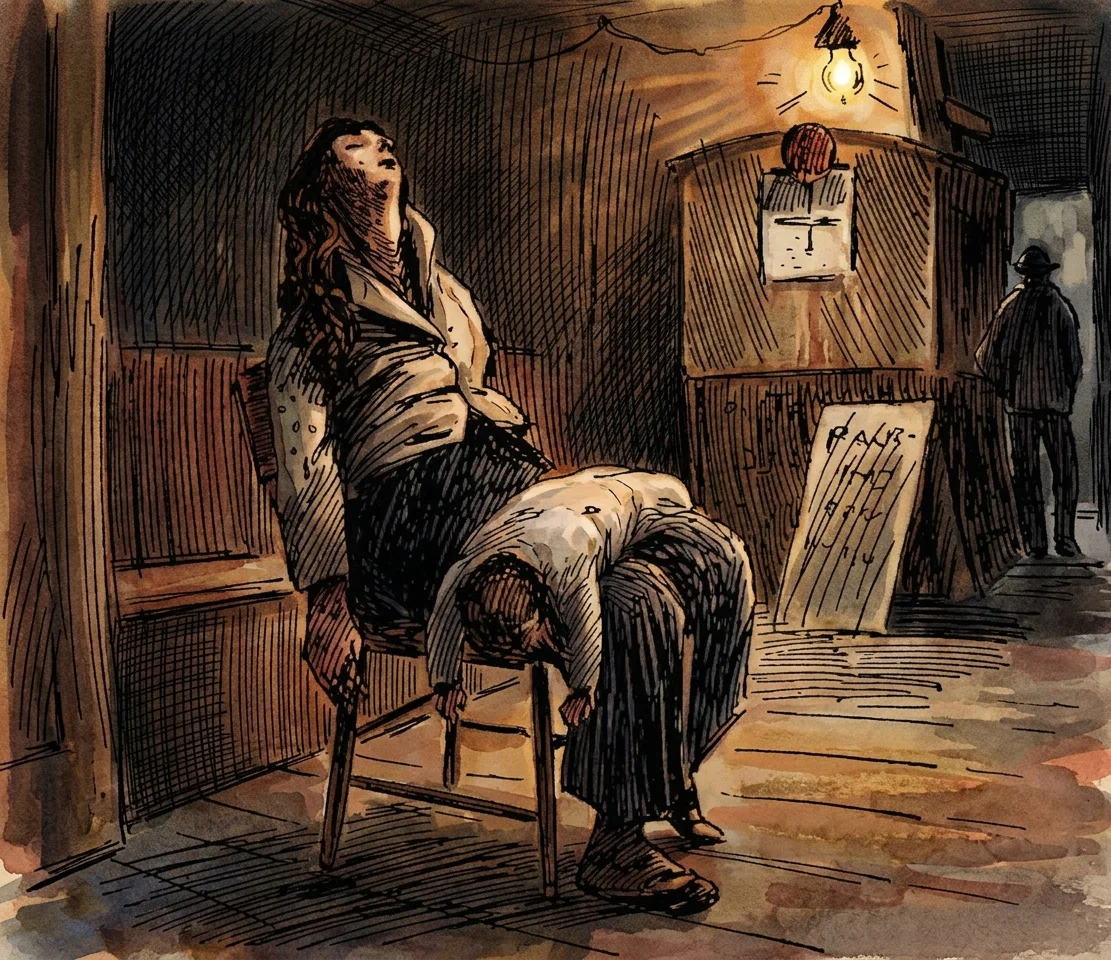
In the darkness of Third Street a tamale wagon, drawn up before a second-hand store, cast a circle of light, and in the circle sat a woman with her child. They made a strange and moving picture. Both were in the abandon of utter weariness. The woman lay back in her chair with the child across her knees.
Her collar was partly open in front, and her breast rose and fell with gasping breaths like a person in a fever. Her head had fallen back; her throat glistened, and the damp, loosened hair lay along her shoulders. The arms of the child, like those of the woman, were drooping till they almost touched the walk beside her.
The West bottoms and Hell’s Half Acre, too, lay under the spell of the heat last night. An arc light at each end of “The Patch,” made the alleys and narrow streets look like bars of shining steel. Out of some of the shanties a single pair of feet stretched into the lighter space, with the trunk concealed in the shadows, and across the sidewalk, his form blocking the way sometimes, was to be seen the body of a big negro, his head and shoulders in the street and the rest of the body extended on the walk.
There are very few of those in comfortable circumstances who know much about the misery and suffering that exist in the alleys and lanes of the great cities. Christian workers should hasten to relieve this distress so far as it lies in their power. And wealthy men and women, who have so much means that it is an incessant burden and worry to them, could find rest, peace, and relief by going to the rescue of these poor, unfortunate fellow-mortals. There is a great work that the Master is urging to have done for those who seem to be too far down and too insensible to moral worth to be reached. But just go among them and see how they will appreciate every attention and effort in their behalf.
To be sure, some of them will deceive you, and show themselves unworthy of your labors. But we must needs bear with this part of it in order to reach those who will respond to the helping hand extended to them. How much better it is to use our abilities and means in helping our helpless and poor fellow-men than to exhaust all our resources on our own selfish pleasures, and then find that after all we have secured no real enjoyment!
When we are enjoying all the comforts and blessings of life, it is hard for us to realize that others in the very town or city where we live may be suffering indescribable miseries. But if we go out among these poor, unfortunate ones, our hearts will be touched and we will be cheered and gladdened by the happiness that we see coming into their lives through our ministrations in the Master’s name.
Look about you. There is some one just near you who needs your help. If you would not do this work on your own account, do it for the sake of the Friend of sinners and the suffering humanity that He would have us relieve from their wo and distress. T.
OUR WORK AND WORKERS.
THE Visitor reports the baptism of eleven candidates at Springfield, and six at Dayton, Ohio.
A RECENT report from Brother F. W. Spies, missionary in Brazil, notes the baptism of seven candidates.
DURING the recent camp-meeting at Appleton, Wis., twenty-seven persons were baptized in the Fox River.
AT the camp-meeting recently held at Clinton, Mo., forty-eight persons were baptized in a lake near the camp.
DR. ALBERT CAREY has been assigned to the medical dispensary of the Helping Hand Mission, Cleveland, Ohio.
THE baptism of two persons at Hickory Grove, Ky., and three at Sedalia is reported by Brethren W. R. Burrow and C. G. Lowry.
AT the recent Ohio camp-meeting forty-eight persons were baptized; a number of others deferred the ordinance until they should return to their homes.
BROTHER T. B. SCOTT notes the baptism of four persons in connection with meetings held at Pine Valley, Wis., also the organization of a tract society.
THE depository of the Wisconsin Tract Society has been removed from Milton Junction to Fond du Lac, 14 East Johnson Street. S. D. Hartwell is the secretary.
A LOCAL camp-meeting has been appointed for Creston, Iowa, September 20 to October 2. A like meeting is now being held at Waverly, to close the 18th.
NINETEEN members added to the church at Cripple Creek, Colo., is one feature of the results of meetings held there under direction of Brother F. W. Trubey.
THE Bulletin, of Des Moines, Iowa, notes the departure of two missionaries from that conference. Miss Winnifred Peebles goes to Bermuda Islands to engage in educational work, and Miss Anna King goes to South Africa.
THE Nebraska Reporter says: “The College View Sanitarium has recently established a branch office in the city of Lincoln. Rooms have been secured in the Y. M. C. A. Building, which have been fitted up for the treatment of patients.”
An encouraging tent effort is in progress at Rosenthal, Texas, conducted by Brethren J. B. Beckner and W. L. McNeely. They would like a number of copies of THE SIGNS to use in their work, and we trust their need will be supplied.
PROF. P. T. MAGAN, of Battle Creek, Mich., has been spending some time in Wisconsin in the interest of church school work. At Green Bay the brethren are building a schoolhouse, and at Milton Junction a like enterprise is being pushed forward.
AT the recent camp-meeting held in San Diego, Cal., forty-three persons were baptized. Notwithstanding the severe drought through which Southern California has passed, about $800 were raised for educational and camp-meeting purposes. The meeting was excellent.
PROF. B. O. WADE and wife, late of Union College, College View, Neb., sailed from San Francisco for Japan on the 3d inst., where they go to labor as missionary teachers. They were accompanied by Bro. Hasegawa, who has been connected with the Japanese mission in San Francisco.
BROTHER J. H. WHEELER reports fourteen converts at Custer, Neb., and a Sabbath-school of twenty-eight members, as a result of nine weeks’ labor. He also notes the organization of a Sabbath-school of thirteen members, at Deadwood, and a prospective church organization at Boyd.
MEETINGS being held at Vienna, N. Y., are making encouraging progress. A report in the Indicator states that nine had taken a decided stand, and a Sabbath-school had been partially organized, with thirty-two persons present. The meetings are conducted by Brethren F. Peabody and S. B. Whitney.
“THE DESIRE OF AGES” is the title of a forthcoming volume by Mrs. E. G. White, published at this office. It is intensely interesting and beautifully illustrated, and is devoted to the consideration of the great truth that in Christ the love of the Father is revealed,—that “God was in Christ reconciling the world unto Himself.”11
ON the 7th inst. Brother B. L. Howe and family sailed from San Francisco for Honolulu, to engage in church and missionary work. On the same steamer Brother F. J. Brainerd, for some years an employee of this office, with his family, sailed for Melbourne, Australia, where he will connect with the Bible Echo Office.
AT the recent annual session of the Missouri Conference the following officers were elected: President, W. A. Hennig; vice-president, W. B. Tovey; secretary and treasurer, James Cochran. Two brethren, L. W. Terry and Jacob Riffel, were ordained to the ministry. A report of the meeting says that “fully 2,000 people witnessed the solemn scene.”
BROTHER G. W. REASER, president of Upper Columbia Conference, reporting to the Reaper, says that at Union and Baker City, Oregon, and Boise, Idaho, steps are being taken toward the establishment of church schools. At Boise a teacher had been secured at the time the report was written. A camp-meeting is now in progress at Chewelah, Wash., to continue until the 15th.
ONE of our workers in Marsovan, Asia Minor, has been exiled in chains for violation of a command sent out some months ago from Constantinople, forbidding the promulgation of any new religion. The pretext for the command was that some might work rebellion under the name of religion. Satan never does anything to hinder the work of the Lord without a plausible excuse. He is always fearful that some harm be done, lest the people be aroused from their slumber.
IT is a quite common idea in the world that anything is too good for a tramp. A great many, however, who pose as philanthropists will modify this idea to the extent that anything is good enough for a tramp. But the real Christian idea is suggested in an item in The Bivouac regarding the mission in Butte, Mont. The report says: “The last few days have brought considerable bedding from different parts of the State, and as we open it we can but notice in this labor of love the pains that has been taken in selecting good material and doing the work well—knowing, too, that it would be used largely for covering tramps. In this we are made to praise the Lord.” This ought to be the rule in everything that is done for the poor. In no other way can our works show that we love them as we do ourselves.