If we turn our attention to the historical course of the Christian peoples on the continent of Europe, and more especially those in German-speaking regions, we notice that, in regard to their exterior religious forms and fellowship, at least, there have come up changes and innovations among them which have resulted in the establishment of various free churches, in the very midst of the territories of the State churches. These free churches derive neither their creed, nor forms of worship, nor their support, from the latter as little as from the State itself; for they are in these respects wholly independent of either. That this order of things is of the greatest significance, no one will dispute for a moment, who is at all conversant with the situation of things in the countries in question. These free sectarian churches, looming up as they do, alongside of the State churches, are indeed one of the most important phenomena of the times. In order to appreciate why this is, we need only to look at the history and the condition of the so-called Christian State churches, to become at once satisfied, that they and their gospel missionary labor, independent of all State organizations or support, are of most urgent necessity, if life and vitality is not utterly to die out among the millions of the various peoples in professedly Christian Europe.
The most fatal characteristic of any and all State churches, is that their origin is not, and from the very nature of things cannot be, based on any command or institution of Christ or his apostles—but that is the only genuine foundation on which a church can stand, and prosper. So-called Christian State churches are solely the outcome of the self-appointed decretals of a worldly ruler—a Roman emperor.
The religious systems of paganism had proved themselves in time more and more197untenable in themselves, and could never satisfy the deep yearnings of the human soul for truth and liberty; neither could the schools of the world's wise men and philosophers bequeath to the people anything better than doubts and distrust for what they had, i. e., their priests and their rites—thus simply confirming the consciousness of their own helpless condition. In spite of their ingenious and pleasing mythology, and notwithstanding their profound philosophy, their devotees have escaped neither social, nor moral and political decay, so that already in the second century (A. D.) Pausanias could most truthfully pay to the Romans, notwithstanding their intellectual and political greatness, the anything but flattering testimony, that in their midst evil had reached to the very highest summits, and no man could any more be ranked among the gods, as they had been in former years, for moral or intellectual greatness, or heroic achievements, because they had sunk too low in the scale of human worth. The decayed supports of the pagan systems of religion were to such a degree shaken by the vastly superior moral power and the indomitable life and force of Christianity, that they threatened to collapse entirely, and so doing to bury beneath their own ruins the State that was so closely connected with them. The Roman emperors, endeavoring to restore the old splendor of their realm, labored ardently to preserve their pagan worship from the rapid decay toward which with irresistible power it seemed to drift more and more, and to that end they spared neither the life nor the property of those who were active in the extension of Christianity; for these wicked rulers felt that they must uproot this new religion as imminently endangering their own personal authority and power, as well as that of the State at large. Hence arose the ten times repeated and fierce persecutions against the early Christians.
But the blood of the martyrs was the fructifying seed which multiplied the witnesses of Christ a hundred, yes, a thousand fold; and the storms which seemed to threaten the Christian Church with destruction, only caused her to take root more deeply, and to give unmistakable evidences of her divine origin and inalienable right to exist. To such an extent did these eventually come to be recognized in the Roman Empire, that in the year 311 an edict was issued making it incumbent upon Christians, as their sacred duty, to pray for the welfare of the Roman Government and the entire realm.
After evincing this degree of reverence for people professing the religion of Christ, it required but one step farther on the part of the emperor (Constantine), favorably influenced to Christianity as he had been by his parents, to suppose (upon his accession to the throne) that the religion of Christ could be made the very best support of his throne, and that the morally pure and upright walk of its adherents, as well as their great readiness to suffer martyrdom, could only confirm him in the opinion that such men, who clung so scrupulously and tenaciously to their convictions, and who were so fearless of death, must be the very best of citizens, too; and that their religion which imparted to them such moral strength and heroism, as well as very uncommon powers of endurance in every way, must be a good and acceptable religion for all.
Tolerant by nature and education—as long as the safety of his throne and power were not endangered thereby—and by virtue of his eclectic views of things inclined to form unbiased opinions, he issued edicts of toleration, gave to Christians everywhere in his wide domains the preference for offices of State; and he furthermore encouraged the Christian modes of worship; at the same time, however, he suffered many pagans in office, some of whom had only outwardly made a profession of Christianity, in order to be chosen for this or that position under the government.
At the ecclesiastical councils of the Church the emperor thereupon took part in the disputes and strifes about doctrines that arose, and reserved for himself, as Pontifex Maximus, the chief authority over the Christian Church, which church he, in turn, protected and fostered so zealously, that it is a matter of fact—let the hidden motives, which lead him to it, have been what they may; whether political or purely religious, no matter—that Constantine gave to Christianity the preference before all heathen systems of religion, and by this very means left the Church unmolested from without; and she might internally have become sound and strong as well, if there had been among her adherents minds sufficiently endowed with force of faith and will, to bring the emperor fully under the convincing and converting power of the doctrines of the gospel of Christ, instead of allowing him to interpret them according to whatever crude conception of their meaning he himself might have had at the time. But proud and worldly as they had already become through the flattering attentions shown them by the ruling powers, they now recklessly fell into that fatal snare of looking to things external and visible, for light, strength and courage to be and to do, thus making flesh their arm, rather than looking to God and by faith obtaining help from him alone, by whatever instrumentality he might choose to send it—for thus only could they become preëminently strong, in the power of his might.
To the bishops and leaders of the Church this became forthwith a temptation which they could resist less and less, the more they allowed themselves to be attracted by the splendor of the court, or looked upon the favor of royalty as the highest and most desirable thing. Soon they went so far as to vie with each other in lavishing fawning adulations upon the Roman emperors, in order to gain their favor, instead of contending manfully for right and truth, independent of them, or their support, and thus of their own accord remaining loyal and true to their holy calling.
The foundation for the union of Church and State thus being laid, the work was fully completed and cemented by the edict of Constantius, who peremptorily forbade henceforth the observance of any pagan religion—a thing which his predecessor, tolerant as he had been, did not even think of doing—imposing the most severe penalties upon all the disobedient. The Christian Church had now at her side the sword of the mighty State to direct as well as to protect her; the State, on the other hand, had as its strong ally, the Church, an organization which had heretofore given the most indubitable proofs of inherent power, life and activity. By virtue of her position, thus so highly and exalted and protected by the State, the Church assumed more and more external power, exerting the same far and wide, so that already in the fifth century Christianity stands there as ruling over the people; and during the Middle Ages she had become so satanic that every one who did not bow in deference to her mandates, was not permitted to live, so that millions upon millions fell as victims of her tyranny.
But these victories for evil, if they can be so called, the Church could purchase only at the cost of her God-given purity and freedom—a most terrible price to pay for such advantages, that were so entirely at variance with the very spirit and teachings of Him that founded the Church—Christ. For in this once seemingly so harmonious and desirable union lay concealed the elements of the most vehement, bloody, and disastrous atrocities, persecutions and inhumanities ever witnessed since the world stood. The outward harmony and union that was presented to the world for a little while, was only the cloak that concealed the divided interests underneath. Now the Church, then the State, allowed themselves to become over-reaching, resulting ever and anon in mighty struggles for the preëminence all over the realm, and finally brought about the undisputed sway of the Papacy over the whole earth, as then known. Like Herod’s magnificent temple of old, so now stood the Church—outwardly a mighty and resplendent structure of the State, but within, like that costly edifice, too, utterly destitute of the highest adornment of the house of God, without sanctity in its inner life, and void of divine guidance and blessing in its outward manifestations. Thus stood the so-called Christian Church as fostered by the State, in the countries of Europe, until the time of the great Reformation.
AUGUST KUNZ.
Battle Creek, Mich.
(Concluded next number.)
Sunday the Touchstone.
INSTEAD of issuing a proclamation ordering the Columbian Exposition to be closed on Sunday, May 28, and ordering troops to keep it closed, the President went yachting down the Potomac on that day. Concerning this fact the Mail and Express’ Washington correspondent says:
“No wonder the minor officials of the Government tarry in their work of carrying out the Sabbath-closing law, when the heads of the Government themselves openly violate the express will of the people and desecrate the Lord’s own day by yachting excursions down the river.
All the pulpits of the churches at the Capital yesterday were filled with eminent divines of the Presbyterian Church, and had the President so desired he could have listened to words of wisdom as well as arguments why the law of the Nation should be upheld and the World’s Fair be closed on Sunday. But instead Mr. Cleveland preferred a Sunday excursion down the river on a steam yacht, while the Sabbath bells were still ringing out their welcome to churchgoers. Mr. Cleveland, accompanied by his Secretary of the Treasury and his Ambassador to England, boarded the pleasure yacht of W. R. Hearst, of California, and steamed off for a day’s excursion down the Potomac.
The boat was well stocked with provisions, and “dry and wet” lunch was served before the party reached home.
This action of the President on the day when the law was being violated in Chicago by the inaction of his Attorney-General has caused no small amount of criticism here.
The day was far from being a yachting one. It was cold, damp, and disagreeable for a water excursion, but this did not matter, for Cleveland198wanted to show to the public that he favored Sunday desecration, and if he could not go to the World’s Fair, he did the next best thing, and went yachting.
In this regard, it may be mentioned that it is stated here that Secretary of State Gresham used all his influence with Attorney-General Olney to let the World’s Fair be open. It is said that heavy Chicago influence was brought to bear on Gresham, and he in turn informed Olney that to close the Fair by injunction meant its utter failure. The result is too well known to need further remark.
Some time ago Mr. Cleveland forbade the holding of a Sunday concert; it was at once proclaimed to the world by the Sunday people that the President was a Christian. Now he has displeased them by disregarding their ideas of Sunday sacredness, and he is a desecrator of the Lord’s day, and a wine bibber! And thus it appears that loyalty to Sunday is the great touchstone by which every man’s Christianity is to be tried.
A Strange Thing.
By Alfred Mallett
It is strange that professed Christians cannot see that Sunday laws and all other religious laws are wicked, and that they tend to drive men from the Lord instead of drawing them to him. Or do they see that they are wrong, and have not enough moral stamina to protest against them? Or again, is it because their ministers tell them that Sunday laws are needful, and whatever the preachers say the people think must be right? If they think thus, let them study their Bibles and not their ministers, and they will find that Christ used no force in spreading the gospel. He only entreated, and that is the minister’s, and every Christian’s duty, and not to be seeking cruel laws from the civil power to make men-obey God.
There are those in the churches who know that the outcome of Sunday laws is persecution of those who keep the seventh day of the week, and yet they still petition for them. But the strangest thing is that they still claim the name of Christian. Can they be Christians and persecute? I fail to see how they can, for a persecutor is just the opposite to being like Christ. Persecution is of Satan, and so they who persecute must inevitably be the servants of Satan. As Christ said to the Jews, so must it be said to those who seek to persecute their fellow-men: “Ye are of your father the devil, and the works of your father ye will do.”
Then again, there are those who say that Sunday laws will not bring persecution. Let such go to Springville, Tenn., and find out for themselves what Sunday laws have brought upon a quiet, orderly little church of Seventh-day keepers. If they are honest they will soon change their minds. Only just recently several honest, God-fearing men have been arrested and fined in Maryland, because they worked on Sunday as God commanded them; and the arrests were made by members of the same church to which they belonged only a few months ago, and from which they came out because they were convinced that the seventh day was the Sabbath instead of the first, according to the fourth commandment of the Decalogue. And not only were they persecuted by former brethren in the church, but by their own brothers, and yet this is not persecution. Oh, no. It is just simply enforcing the law. I say it is just simply making men do as I do whether that which I do be right or wrong. “By their fruits ye shall know them.”
Sunday laws are certainly evil, and the persecution is their inevitable result.
To those who are in these persecuting churches, the Lord, who they profess to love, gives the invitation: “Come out from among them, and be ye separate.” “Come out of her, my people, that ye be not partakers of her sins, and that ye receive not of her plagues.” Who will heed the warning, and come out and serve the Lord with a true heart?
I am a Seventh-day observer, and that because in the Word of God, I read that “the seventh day is the Sabbath of the Lord,” and because I learn from history that the Roman Catholic Church changed the law of God, and made the first day of the week the Sabbath in the place of the seventh day. And being a Protestant, I cannot serve that church from which I protest, and I certainly would be serving it if I observed its “holy days.” Persecution may come, but I am determined that as long as I serve God I will keep his Sabbath as he has commanded me; and no man can of right compel me to do otherwise. Nothing, not even persecution, can separate us from him. “Who shall separate us from the love of God? Shall tribulation, or distress, or persecution, or famine, or nakedness, or peril, or sword? As it is written, For thy sake we are killed all the day long; we are accounted as sheep for the slaughter. Nay, in all these things we are more than conquerors through him that loved us. For I am persuaded, that neither death, nor life, nor angels, nor principalities, nor powers, nor things present, nor things to come, nor height, nor depth, nor any other creature, shall be able to separate us from the love of God, which is in Christ Jesus our Lord.” Rom. 8:35-39. ALFRED MALLETT.
Religious Persecution in Maryland.
By Charles O. Ford
Ford's Store, Md., June 7, 1893.
EDITOR SENTINEL: On Sunday June 4, 1893, Bro. Alexander Dodd and myself, of this place, hauled from the Chester River Steam Boat Company's wharf at Jackson Creek, some goods, and were arrested on Tuesday, June 6.
The agent, T. F. Ford (my brother), had three other men to see the work done so as to be witnesses against us. They were Samuel H. Ford (my brother), Samuel W. Morvel and John. T. Collier. The latter is a professor of religion in the M. E. Church.
We were tried June 7 before the Magistrate, J. M. Aker, convicted, fined $5, and cost $3.90; total, $8.90 in each case. I acted as counsel in these cases. Under the law (which is the law made while this country was under English rule) the magistrate did all he could for us.
When the cases were over the magistrate said that we would have to pay $2 for the bond (as we took an appeal). I told him that we could not do so. He then said, pay the $2 or go to jail. I told him to send us to jail. The magistrate (who is a friend of mine) says, “I can’t do that.” I told him to add all costs together, and if Queen Anne’s County Court convicted us, we would go to jail and the county could pay all costs.
Also, Sister Hettie Mansfield was arrested at the same time for sewing on Sunday, April 30th. She was also informed on by her brother; but the State’s witnesses did not appear, so the case was postponed until June 14. I am positive if and the State’s witnesses can be made to appear, that our sister will be convicted. We are building a church, and the devil is getting angry.
In my cross-examination to-day I caused three of the witnesses to say upon their oath that they would not break the law knowingly, so the justice read the law to them. Now if they even ride out to church or ride out for pleasure (which they always have done), they will perjure themselves. But Seventh-day Adventists will not seek revenge even within the law as it is not their religion.
The justice said that he was sorry that these people were becoming so strict about Sunday, it will cause the old Blue Laws to be brought into legislation again. He said, “If the law is strictly enforced here I would sooner be magistrate than Chief Justice of the United States of America, because there are none that keep the law.”
You can readily see that this is fulfilling the Bible when my own brothers had me arrested. But thank God, that his grace is sufficient for us here, and we are glad to suffer for Christ, as he suffered so much for us. Pray for us, that we may continue faithful until the end.
The goods hauled were goods that were easily broken, and because of the prejudice that exists here, they were unsafe out on the wharf. The agent notified me on Saturday night, June 3, at 8 o’clock, too late to haul them. I requested them to be put in the warehouse built upon the wharf for that purpose, but the agent refused to do so.
CHARLES O. FORD.
National Reform Described by a National Reformer.
[THE last session of the Reformed Presbyterian Synod was held at New Castle, Pa., early in June. On the afternoon of the 4th, a twenty-minute address was delivered in the Opera house, by Rev. J. M. Foster, a typical National Reformer. The following is a part of what he said, as published in the Christian Cynosure, of June 8.]
The State must receive and apply both tables of the Decalogue. This Nation should make a constitutional recognition of the authority and law of Christ and give its pledge to serve him, and that will bring down his Spirit and unite us one composite Christian nationality.
It should stipulate, in the compact, that the enemies of Christ be excluded from office and only his friends be made eligible. And the application of Christ’s law to incoming foreigners would result in the requirement of these conditions: 1. All who are in sworn allegiance to the Pope, the Endowment House, or the secret oath-bound lodge, could not become citizens without renouncing this extra-American authority. 2. All idolaters, whether in papal cathedrals, Chinese Joss houses, Mormon Endowment House, or Masonic temple, are to renounce their idolatry or be prosecuted as criminals. 3. All who prostitute the divine ordinance of the oath by administering or receiving it without divine authority, and all guilty of blasphemy and profanity are to be judicially punished. 4. All must work six days in the week and rest the seventh. Vagrancy, loafing, idleness, are crimes. All must work that all may eat. And all must rest on Sabbath; Sunday trains, Sunday mails, Sunday newspapers, and Sunday excursions must cease, that the Nation may have her Sabbath rest. 5. Authority in the divine institutions of199the family, the Church, and the State, must be respected. Obedience to the just and legal authority is obedience to God. Rebellion against just and legal authority is resisting God. “And they that resist shall receive judgment.” 6. Every saloon must be outlawed, and the manufacture and sale of intoxicating liquor as a beverage made a capital offense. 7. Houses of ill-fame and the “social evil” must be prohibited, and speedy and easy divorce made impossible by a uniform national divorce law. Mormon polygamy must be wiped out. 8. Stock-gambling must be stopped; money-kings and grasping corporations and heartless trusts and syndicates must be subjected to the restrictions involved in the Golden Rule. 9. Falsehood and perjury must be punished with rigor. 10. Discontent, anarchy and lawlessness must be made afraid of the arm of the law which is held over them.
Bible Object Lessons: Songs for Little Ones for the Home and School
By Lillie E. Affolter; F. E. Belden
With Illustrations and Special Instruction for Mothers and Teachers.
By Lillie E. Affolter and F. E. Belden.
Book 1. The Life and Words of Christ.
The first of a Series of Three Books covering a Three Years’ Course of Graded Scriptural Instruction for Children.
30 Original Hymns and Songs, written for the Lessons.
36 Beautiful Full-page Illustrations, with Colored Plates.
52 Original Pen Drawings, showing how to use the Kindergarten Material when Teaching the Lessons.
Sold by Subscription
In the following styles of binding. Orders by mail will be filled postpaid at prices given below. Twenty-five cents less per copy if delivered by canvasser.
ROYAL EDITION, 9 x 11½ inches, with Colored Plate. Plain Edition, 7½ x 10 inches, without Colored Plate, $2.00.
EXTRA CLOTH, panel sides, Gilt Edges, $3.75. SONG BOOKS, paper covers, large size, $1.50.
COMMON CLOTH, Aluminum and Green Cover, [unclear] Paper, Linen Edges, $2.75.
DISCOUNTS TO SCHOOLS.—Six copies, 10 per cent; twelve copies, 15 per cent; twenty-four copies, 25 per cent from agents’ retail prices.
When the Kindergarten Material (set of three boxes) is ordered with the book in either style of binding, purchaser will receive a beautiful premium “Portfolio of Blackboard Sketches on the Life of Christ,” to aid mothers, teachers, and children in drawing.
HEALTH, PLEASURE, and BUSINESS
Travel via the famous Trunk Line and Picturesque
West Shore Railroad.
Magnificent new Parlor Car Service from Washington, Baltimore, Philadelphia, and New York, to and from the Catskills, Saratoga, Lake George, and the Adirondacks.
Wagner Buffet Sleeping Cars on fast express trains between New York, Kingston, Albany, Utica, Syracuse, Rochester, Buffalo, Niagara Falls, Toronto, Detroit, Cleveland, and Chicago.
Excellent Service to the World's Fair.
N. B.—Send six cent stamp for copy of Summer Excursion Book, containing list of summer hotels and boarding houses in the Catskills and along the line of our connections.
For tickets, time tables and information, apply to any West Shore ticket agent, or to
H. B. JAGOE, G. F. P. A. A. A. SMITH, N.E.P.A.
362 BROADWAY, N. Y. 300 WASHINGTON ST. BOSTON, MASS.
E. J. WEEKS, G. A. F. J. WOLFE, G. A.
BUFFALO, NEW YORK. ALBANY, NEW YORK.
C. E. LAMBERT, Gen’l Passenger Agent.
5 Vanderbilt Ave. New York City.
SAFETY PENCIL POCKET.
NEAT, CHEAP, SERVICEABLE.
It perfectly secures pen or pencil in the pocket, so that it can not fall out when stooping. Can be easily and safely attached to any part of the clothing. A small investment will prevent the loss of a valuable pen or pencil.
Sent by mail on receipt of price. We guarantee these pockets superior in every particular to similar styles formerly sold and still offered at much higher prices.
Address all Orders to
PACIFIC PRESS PUBLISHING COMPANY,
12TH & CASTRO STS.,
OAKLAND, CAL.
43 BOND ST.,
NEW YORK.
THE BATTLE CREEK SANITARIUM HEALTH FOODS.
For more than sixteen years the Battle Creek Sanitarium has maintained a Health Food Department, at first for the benefit of its patients and patrons, later, and for more than a dozen years, with increased facilities, to supply the general public. Within the last year More than 150 Tons of the following named foods have been manufactured and sold:—
Our Granola, which has now been manufactured by us for nearly seventeen years, is unquestionably the finest health food ever devised, and is greatly superior to any of the numerous imitations to which its success has given rise.
TO THE PUBLIC:
This certifies that the Battle Creek Sanitarium Health Foods, manufactured by the Sanitarium under the name of the Sanitarium Food Company, are made under my direction and supervision, and that Granola and the other special foods manufactured by this company, are not made or sold by any other firm or person except their duly authorized agents. J. H. KELLOG, M. D.
Our goods are shipped to every part of the world—to Australia, New Zealand, India, Persia, and other foreign countries, as well as to all parts of the United States; and in every instance they have demonstrated their wonderful keeping properties. The following are a few of the hundreds of testimonials received from persons who have for years made use of our foods.
MICHIGAN.
I have for three years used the “Health Foods” in my family, and can heartily recommend them, both for purity and health-giving properties. C. F. PORTER, D. D. S.
INDIANA.
Your “Health Foods” are the wonder of the nineteenth century. I have used Granola but a short time, but have already experienced relief from indigestion and acid, or flatulent dyspepsia. I also find the Zwieback nourishing and toothsome. D. M. KAUFFMAN.
I have personally tested your excellent food known as Granola. It is highly pleasing to the taste, easy of digestion, and the most nutritive cereal production with which I am acquainted. DR. R. W. BULA.
NEW YORK.
Your Granola is the best selling invalid food I have ever handled. I have already sold nearly two thousand pounds. A. J. BROUGHTON.
CONNECTICUT.
We have used your “Health Foods” in our family for three years, and can not get along without them. Having been troubled with dyspepsia and chronic inflammation of the stomach, I find that your Granola, Avenola, Wheatena, and Gluten are the only foods that I can eat with safety. WM. M. MERWIN.
OHIO.
Our baby is a testimonial to Sanitarium food. She is ten months old, weighs twenty-eight pounds, and is as ruddy and healthy a specimen as can be seen. She has actually gained flesh while cutting her last two teeth. Her flesh is firm and sound, and she is very strong. FRED. L. ROSEMOND.
MINNESOTA.
We have twins, and the little fellows are thriving nicely. The food agrees with them perfectly, and I have recommended it to many who are bringing up babies “by hand.” D. W. McCOURT.
We are constantly improving our foods, and adding to our list as the result of experimental researches conducted in the Sanitarium Laboratory of Hygiene and our Experimental Kitchen. For the latest descriptive circular and price list, address,
SANITARIUM HEALTH FOOD CO., Battle Creek, Mich.
TO ACCOMPANY
Special Kindergarten Material
TO ACCOMPANY
Bible Object Lessons and Songs for Little Ones,
Book 1.—The Life and Words of Christ.
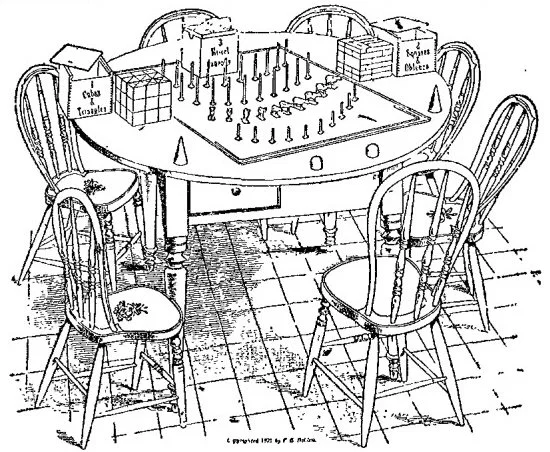
The material for this book consists of three boxes. (1) Cubes and Triangles. (2) Squares and Oblongs. (3) Miscellaneous Supplies. (a) Two Coins and Two Domes, ten 1-inch and twenty 2-inch Mounted Orange Sticks, to represent people, thirty-six 2-inch and twenty-four 1-inch Unmounted Green Sticks for Outline and Tree Building, ten Miniature Sheep, and Crumpled Green French Tissue Paper, to represent water.
Boxes 1 and 2 are made of finished cherry, 3 x 3 x 3 in., with locked corners and sliding top. The blocks are of hard maple. Box 3 is of pasteboard, with double sides.
Price of the Three Boxes, by mail. $1.75 Delivered by canvasser, 1.50 In lots of 6 sets or more for Sabbath-Schools, 10 per cent discount. Freight or express, extra.
ROUND TABLES, 20 inches high, leaf top, 30 inches in diameter (the section for 5 to 8), lock drawer large enough to hold all the material needed for the entire series of books, $3.75. Drayage and freight or express, extra. In lots of 6 or more for Sabbath-Schools, 10 per ct. discount.
SMALL CHAIRS, ornamental, strong, bent rim, R.D. 12 inches high, for children, each, 50 cts. B.L. 14 inches high, for teachers, each, 60 cts. Drayage and freight or express, extra. In lots of twelve 12-inch and two 14-inch, for the Sabbath-Schools, 10 per ct. discount. Noiseless Rubber Tips for chairs, 2 cts. per chair additional.
Waterman's Ideal Fountain Pen
“I find the most satisfactory pen of its kind,” says Chauncey M. Depew, President of the New York Central R.R., and thousands of others are ready to bear a similar testimony. This pen is simple and yet highly philosophical in its construction. It rarely gets out of order and seldom needs repairs.
The pen-points are fine, medium or coarse, and of all grades of flexibility from soft to very stiff. Any hand can be suited. A full guarantee goes with each and every pen. The cut shows a No. 4 pen (gentleman’s size) reduced about one half in size.
No. 1, $2.50
No. 4, $4.00
“ 2, 3.00
“ 5, 5.00
“ 3, 3.50
“ 6, 6.00
PACIFIC PRESS PUBLISHING COMPANY.
12th & Castro Streets, Oakland, Cal. 43 Bond Street, New York.