Pacific Press Publishing Company · New York · Jun 22, 1893
Sunday Law Persecution of Adventists in Maryland
By B.
As in Tennessee, religious persecution is being carried on in Maryland, by means of the Sunday law. One Seventh-day Adventist has already served a term in jail for husking corn on Sunday; and five others are awaiting trial on similar charges, one being a woman arrested for sewing on Sunday in her own house, “against the peace and dignity of the State”!
As is related elsewhere in this paper by one of the victims of this persecution, two of these arrests were at the instigation of relatives of the persons arrested; and in one instance the brother who made the complaint conspired to have the work done, and took pains to have witnesses on hand to prove it, in order that he might swear out the warrant.
ANOTHER prominent feature in these Maryland cases, is that while very few really obey the law, and many violate it openly and repeatedly, only Adventists are arrested, and that, avowedly, not because they work on Sunday, but because they do not work on Saturday. Said one Sunday champion not long since, to an Adventist, when reminded that he himself worked on Sunday when it suited his convenience to do so: “Yes, and we would not notice your work so much if you did not keep Saturday.” The real offense of the Adventists is keeping another day.
BUT it has been said, why do not the Adventists retaliate by having the law enforced against their persecutors? Simply because their religion teaches them not to seek revenge. It is written in their law: “Dearly beloved, avenge not yourselves, but rather give place unto wrath; for it is written, Vengeance is mine; I will repay, saith the Lord. Therefore, if thine enemy hunger, feed him; if he thirst, give him drink.” “Be not overcome of evil, but overcome evil with good.” This course is in accordance with the gospel of the Lord Jesus Christ, “who when reviled, reviled not again; when he suffered, he threatened not; but committed himself to him that judgeth righteously.”
CHRIST’S example is the Christian’s rule of life. “He that saith he abideth in Him ought himself also so to walk, even as He walked.” The Christian must obey this rule, or else cease to be a Christian. He can suffer wrong, but he must not do wrong. Nor is this hard to do when the grace of God reigns in the heart. The apostles when beaten for their fidelity to Christ, “departed from the presence of the council, rejoicing that they were counted worthy to suffer shame for his name. And daily in the temple, and in every house, they ceased not to preach Jesus Christ,” though expressly forbidden by the magistrates to speak in his name. The same power is in the gospel to-day, and it is still the privilege of the humble follower of Christ to rejoice in tribulations also.
THE Saviour warned his followers that they would be called upon to suffer persecution, and said: “Blessed are they which are persecuted for righteousness’ sake: for theirs is the kingdom of heaven. Blessed are ye, when men shall revile you, and persecute you, and shall say all manner of evil against you falsely, for my sake. Rejoice, and be exceeding glad: for great is your reward in heaven: for so persecuted they the prophets which were before you.” And the apostle declared: “Yea, and all that will live godly in Christ Jesus shall suffer persecution;” and why? Because “evil men and seducers shall wax worse and worse, deceiving and being deceived.”
BUT have we not a right to expect that in this, the nineteenth century, men will be so enlightened that persecution will cease? Let the Scriptures answer: “This know also, that in the last days perilous times shall come. For men shall be lovers of their own selves, covetous, boasters, proud, blasphemers, disobedient to parents, unthankful, unholy, without natural affection, truce-breakers, false accusers, incontinent, fierce, despisers of those that are good, traitors, heady, highminded, lovers of pleasures more than lovers of God; having a form of godliness, but denying the power thereof; from such turn away.” 2 Tim. 3:1–5.
ENLIGHTENMENT is no guarantee against persecution. Often the most enlightened are the most wicked and the most cruel. It is the grace of God alone that softens the human heart and takes out all desire to coerce others. It is impossible for the true Christian to be a persecutor; but he who has the form of godliness but denies the power of the gospel, must in the very nature of things seek elsewhere for that power he feels he must have but which he cannot find because he denies the source from whence it alone comes.
THE Lord promises to be with his people and give them power, but this he does only when they rely solely upon his divine power. Christ can have no concord with Belial. His kingdom is not of this world, neither is the power by which his work is to be carried forward to be derived from this world. The power is in the divine Word itself and in the Spirit that is in that Word and which makes it effective. It is only as men lose sight of this truth that they seek civil power to maintain their doctrines and vindicate their practices.
BUT how can the friends of Sunday trust in the Lord to maintain the honor of that institution when his Word says nothing about it as a sacred day? The very name by which the day is known is not once found in the Scriptures; and the twenty-four hours which, according to Bible reckoning (from sunset to sunset), most nearly correspond to Sunday, are known in the Word of God by no other designation than “first day of the week.” Is it not the most natural thing in the world that in departing from the truth, men should also depart from the Spirit of truth, and seek by human agencies and human inventions to compensate themselves for the loss of power which they necessarily suffer in departing from the true source of spiritual power—the Lord Jesus Christ? It certainly is. It follows that persecution is the logical result of the substitution of Sunday keeping for the observance of the Sabbath of the Lord.194
The divine Word gives no hint of first-day sacredness, but it tells us explicitly that “the seventh day is the Sabbath of the Lord thy God.” B.
The Basis of Sunday Laws.
By Ellet Joseph Waggoner
THOSE who have read the papers to any extent cannot have failed to notice that the enforcement of Sunday observance is increasing. In Birmingham, in Southampton, in Belfast, and at various other places in the Kingdom, crusades have been carried on against those who have ventured to take Sunday as a business day, instead of a day of rest and worship. These things are becoming so common, and are done so much as a matter of course, that it is necessary again and again to call the attention of the people to the basis upon which Sunday laws rest.
First, however, let us recall a statement concerning the action taken in the Isle of Man. A correspondent of the Christian Commonwealth said:—
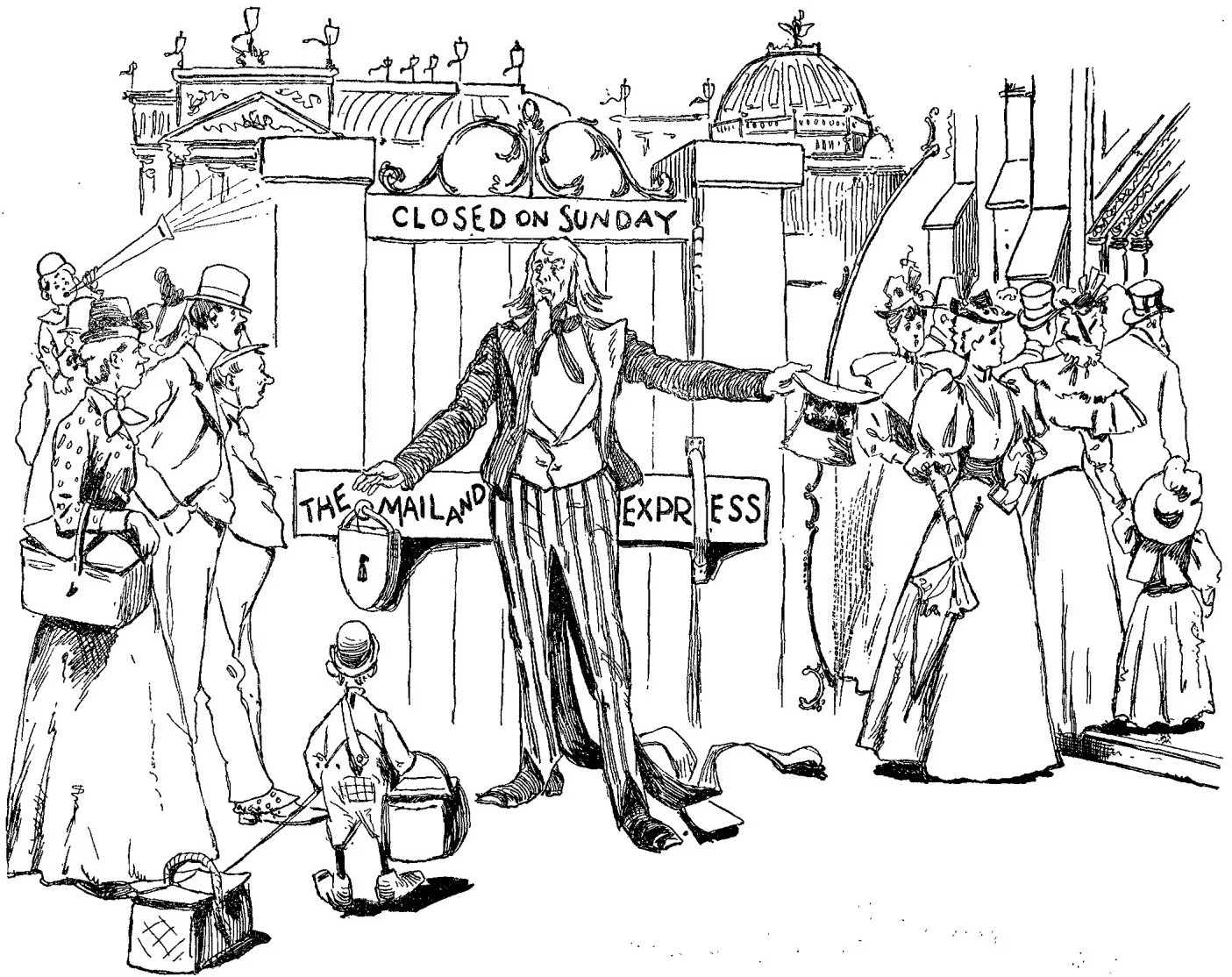
WHAT THE DECISION OF THE U. S. DISTRICT COURT MEANT. From the Mail and Express (the great champion of Sunday laws), of June 10, 1893.
The Sunday trading question is becoming a vexed one in the Isle of Man. For some time past the sale of newspapers in the streets, and Sunday trading generally, have become distasteful and intolerable to the majority of the Manx people; and on the introduction of the Local Government Act into the House of Keys, Mr. John Thomas Cowell, the member for North Douglas, moved the insertion of a new clause, to the effect that any person publicly crying, showing forth, or exposing for sale any wares, merchandise, fruit, newspapers, or any chattels whatever, on the Lord’s day, shall, at the instance of a constable, be liable to a fine of 40s. for each offense.
The clause was carried by a vote of fifteen to five, but was thrown out on being sent back to the Legislative Council. One member declared that he would rather lose the whole bill than consent to such a piece of legislation. The writer above referred to says: “This will undoubtedly be the case, as the Manx ire is now fully aroused, against the wholesale Sunday desecrations of recent years, and things are gradually growing worse. The Council may play the part of obstructionists for a time, but the voice of the people must ultimately be heard, and a strong measure be passed prohibiting Sunday trading.”
NO CONNECTION WITH TEMPERANCE.
In this connection it may be well to note the fact that the Bishop of Sodor and Man said that during his twelve months’ residence on the island, he has been favorably impressed with respect to the temperance question. “So far as he could recollect, he had observed only one case of drunkenness in a Manxman.” So it will be seen that it cannot be claimed that Sunday legislation is necessary on the ground of temperance.
We have already repeatedly shown that the Sunday observance question cannot in any sense be considered a temperance question. The same number of the Christian Commonwealth which contained the item in regard to the Isle of Man, had an editorial on the drink question. From that editorial we quote the following:—
Most temperance advocates believe that Sunday closing ought to be national, and not local. But why do they think so? Simply for the reason that the country is ripe for a national Sunday-closing bill, and that such a bill is right in itself. Undoubtedly these are weighty considerations. But we fail to see why Sunday closing should be made national and total closing local. The evil influence of the drink traffic for six days in the week must be more than for one day; and yet some who are comparatively indifferent to the former, are sticklers for the latter.
This should be sufficient to settle the question as to the connection of Sunday closing with temperance. There is none whatever. “The whole country is ripe for a national Sunday-closing bill,” but not by any means for national prohibition seven days in the week. Sunday closing would make but little appreciable difference in the amount of liquor consumed, for the workingmen are as idle on Saturday nights as they are on Sundays, and there is ample time then for them to get rid of their wages, even if they did not lay in a supply of drink for the next day.
NOT A PHYSICAL NECESSITY.
We may therefore leave the question of temperance entirely out of our study of the basis of Sunday laws. There are only two other possible grounds on which compulsory Sunday observance may be based, and they are (1) the physical benefit to be derived, and (2) the religious character of the day. We will consider them. But first, again, let us see how much importance is attached to this matter of Sunday observance. The Christian Commonwealth of March 20, said:—
If shopkeepers persist in needless Sunday trading, they must be stopped by the strong arm of the law. In Birmingham the nuisance has become so intolerable, that a Watch Committee has been formed, and is making a crusade against Sunday trading. . . . We should prefer Sunday closing to be voluntary, but if this cannot be realized, the only alternative is to make it compulsory.
Take now the idea that Sunday observance is necessary for the physical well-being of people, especially of the workingmen. At the most that can be claimed for a weekly physical rest it is of far less importance than many other things. For instance, it is far more necessary that a man should have a regular amount of sleep in every twenty-four hours. A man may work every day in the week for an indefinite time, if he has sufficient regular daily rest; whereas if he is broken of his rest at night for a few nights, he will be totally unfitted for work. But we never hear of a proposition that laboring men should be compelled by law to sleep seven hours every night, and nobody will ever be foolish enough to advocate such a195thing. Laws are not needed to compel people to rest when they are tired; nature will attend to that.
Again, if enforced Sunday rest is only for the physical well-being, then it is most absurd, not to say tyrannical, because all persons do not become weary and in need of rest at the same time. Different kinds of labor induce different degrees of weariness; and to say that all men shall take exactly the same amount of rest, and at the same time, is as absurd as to say that they shall all eat the same amount of the same kind of food, and at precisely the same time. One man’s work cannot make another man tired, neither can the fact that a hundred men are working hinder one from resting, and therefore there is no reason why all men should rest at a given time, simply because a few wish to do so.
But it is often urged that the Government has the right to set apart certain days as holidays. Very true, but that is not what Sunday is desired to be. A holiday is a day on which people are permitted to cease labor if they wish; on Sunday it is desired to force people to cease work whether they want to or not. If a man wishes to dig in his garden on a Bank Holiday, instead of going to the parks, he is at liberty to do so. If there were an attempt to force everybody to stop all kinds of work on a Bank Holiday, there would be such a protest as would put an end to the attempt. Pleasure can not be forced, and neither can rest.
E. J. Waggoner.
London, England.
Chicago Correspondence.
By W. H. M.
The United States vs. The World's Fair.
On June 8, a decision was rendered in the United States Circuit Court granting an injunction against the World's Fair Directory and requiring the closing of the World's Fair on Sundays henceforth during its continuance. Of the three Judges sitting in the case, Judges Woods and Jenkins gave opinions in favor of Sunday closing, though reaching the conclusion from somewhat different premises, while Judge Grosscup dissented. Judge Woods held that Congress had acquired a similar jurisdiction over the grounds upon which the World's Fair is situated and the buildings and exhibits placed there to that which it has over the District of Columbia or a Government reservation, and therefore Congress had the right to make regulations, and the Directors of the Illinois corporation, being the agents and servants of the Government, were bound to obey. Nevertheless he says of the Local Directory:—
That company was the only financially responsible body connected with this enterprise. The government fixed an express limit to the liability which might be incurred on its account. It necessarily follows that the local corporation is legally liable for all obligations created, whether by the government—whether by the government agencies or by the local corporation itself—within the scope of the general scheme. In fact, the local corporation, as was stated by one of the counsel for the defense, is only another agent of the government. All acts of the government in the way of providing for the erection of buildings, making exhibits—all appropriations made by Congress are in the nature of gifts to this enterprise, one just as much as another. The government agrees or proposes to build certain structures, to make certain exhibits, and to make certain appropriations. They are all gifts to the enterprise.
Judge Woods considers the appropriation of the souvenir coins as a gift with a condition attached, and says:—
I do not think it at all permissible to speak of the transaction as a matter of contract. It would be discreditable to the government, and discreditable to the Exposition to be bargaining on any such subject. The fact is that by reason of the enlarged plans and scope of the Exposition, greater expenditures of money were necessary than was in the first instance apprehended. Congress was appealed to to give further help, but in the meantime we know that the question of Sunday opening had begun to be agitated. The agitation began early, and yielding to that sentiment, or indorsing it, Congress made a further gift, but coupled with it this condition. The government, without giving a dollar, as I think, had the power at any time to enact this rule, but it had never chosen to do it. It did not choose to do it now, absolutely, but, simply, the occasion calling for further help, it makes it a condition of giving that help that the gates shall be closed. If the government had intended simply a bargain it would have stopped short of using the language that it did. The expression is: “It is hereby declared that all appropriations herein made for or pertaining to the World's Columbian Exposition are made upon the condition that the said Exposition shall not be open to the public on the first day of the week, commonly called Sunday.”
If the government had simply meant a condition, whether you call it a contract or a gift, and to have had the rights that might result from a breach of that condition, it would have stopped with the language that I have read. A gift being made upon a condition, of course any breach of the condition would have its legal consequences; but the Act of Congress goes further and says: “If said appropriation be accepted by the corporation of the State of Illinois, known as the World's Columbian Exposition, upon that condition it shall be and is hereby made the duty of the World's Columbian Commission, created by Act of Congress of April 25, 1890, to make such rules or modifications of the rules of said corporation as shall require the closing of the Exposition on said first day of the week, commonly called Sunday.”
Congress went further than merely to declare a condition; it declared an obligation; enacted an obligation upon the commission to adopt this rule. The rule was adopted. Independently of the proposition that the rule had not been repealed, in fact it is quite clear that the rule adopted under such a requirement could not be repealed. No matter if the commission had been present, and they had all voted to ratify the act of the Directory, it would have been a void act, because it was not for them to revoke the action which they had been required to take by superior authority.
The portion of the souvenir coins not yet paid over to the World's Fair authorities, Judge Woods declared to be improperly withheld, but says:—
It follows that there has been no legal withholding of this money, and the acts of administrative officers cannot be allowed to put the government in the attitude of an unjust withholding of that which it had promised to give. A construction should not be adopted which puts the government in the wrong. I therefore am quite clear that there has been no breach of obligation on the part of the government of which these parties have any right to complain. I should not deem it within their authority, even if there had been a breach to repeal the rule. Congress had the right to make this regulation, and chose, in making this gift, to require the adoption of the regulation, and it is effective in my judgment, notwithstanding the grounds urged for disregarding it.
The next question is the right of the government to seek relief in a court of equity. There is no want of equity in the government's position. The government has an interest in this matter because it has possession of the grounds and for other reasons. The only question is the question of the jurisdiction of the court. If the government has possession then it has a right to protect its possession. It is now an enforcement of a criminal provision. The government has the same right to protect its possession and its right to regulate the occupation of those grounds that it has of this building; (the post office building in the city of Chicago) its title is temporary; its possession is temporary, but for the time being it has the same right there that it has here.
Of the jurisdiction of the State Court which had granted a temporary injunction restraining the World's Fair Directory from excluding the people from the public park on Sunday or any other day of the week, the Judge said:—
If I am right in respect to possession, then the State Court has no more right to pass judgment concerning the opening and closing or any other act of management of the Fair or Fair grounds than it would have with regard to the doors of this building. It is not a question of the United States exercising authority over local corporations; it is a question of its exercising authority over ground which a local corporation has delivered into its possession, and of which the local corporation itself had possession, only for the purpose of making that delivery. It is provided in the act of the legislature of the State, as well as in the ordinance of the Park Commissioners, that the ground was licensed, or leased, whatever you call it, to the local corporation for the purposes of this Exposition, and that alone. It took possession only for the purpose of devoting it to this use, and therefore the possession and control are completely within the government. On that theory I would have no doubt with regard to the duty of this court, to aid and protect the government in its possession, regardless of any effort in the State courts to interfere. Of course it is undesirable that conflicts of jurisdiction shall arise, and I have no serious fear any such conflict will arise in this case. My opinion is that the relief prayed ought to be granted.
Judge Jenkins did not agree with Judge Woods in regard to the possession of the World's Fair and grounds by the United States Government; he looked upon the souvenir coin appropriation as a gift, but the amount required for awards, diplomas, etc., was a loan on security and the souvenir coins which were retained were that security. This in his opinion did not invalidate the condition attached to the souvenir appropriation, and it was his conclusion that “a court of chancery is authorized to see to it that the condition is enforced and observed.”
As to the possible conflict of authority between the State and United States Courts, Judge Jenkins said:—
I need only add with reference to the action of the State Court, which is pressed upon our attention, and as to which we are sought through motives of comity not to interfere with, that the Government of the United States was not before that court, and while for one I always recognize the right and jurisdiction of a State Court over a subject properly before it, when it has jurisdiction of the parties and the subject matter, there can exist at this day no sort of question that the United States of America has the right to use the courts of its own jurisdiction for the determination of its rights, and that a State Court cannot by any proceeding between private parties undertake to adjudicate upon those rights of the government, or by its injunction nullify the rights of the government of the United States. I am therefore of the opinion upon the grounds which I have stated, that this injunction prayed for should issue.
Judge Jenkins, in the course of his opinion, touched upon the question of constitutionality in these words:—
It is said that this legislation by Congress is without the power of Congress; that it is unconstitutional; that it seeks to establish religious tests. I cannot concur in that objection. The legislation with respect to the observance of the first day of the week has nothing to do with the matter of religious tests, or the compulsion of a particular religious belief or service. It is founded upon the necessities of the human race as taught us by experience; the needed rest which human beings require from the avocations of six days' labor, and it is justified by that experience outside of and irrespective of any question of creed or any question of religion; and all that the laws seek to do, the laws of the several States which have existed almost from the existence of the States, is to provide for that needed rest and to provide for non-interruption in that rest, and in such religious services as any citizen chooses to indulge in. It is not an imposition upon any one of compulsion in respect to religious belief or in respect to attendance at church. It provides simply for the protection and for the peace of those who may choose to attend church; that they shall not be interrupted by labor that day.
This point of constitutionality was alluded to by Judge Grosscup, incidentally, in the course of presenting his dissenting opinion, in language which showed that in his mind the legislation upon the part of Congress to close the World's Fair on Sundays was the assumption of an unconstitutional196power. A portion of the opinion of Judge Grosscup is as follows:—
It is in the nature of American thought and purposes that a commemorative national enterprise should be undertaken and carried on directly by the people with the aid and sanction of the government, but not as a governmental work. Such was the exhibition at Philadelphia, as viewed by the Supreme Court, an exhibition commemorative of the beginning of national history, and therefore a peculiarly national enterprise. The Act of Congress of April 25, 1890, adopted the Illinois corporation as an embodiment of the popular movement, and in connection therewith made provision on the part of the government for the holding of the Exposition. In that act the respective parts of the government and the Illinois corporation, in the creation and the control of the exhibition, were plainly marked. The government, through its commission, was to determine the plan and scope of the Exposition; allot space for, and classify the exhibits, appoint judges, award premiums, and generally have charge of all intercourse with exhibitors and the representatives of foreign nations. To the Illinois corporation was left the duty of procuring and preparing a site and the erection of such buildings as were necessary to suitably house the exhibits. Did Congress thereby intend to include the Illinois corporation as one of its own agencies, and thus create and control the exhibition as a governmental work under exclusive governmental dominion? Plainly not. There is no express term or reasonable implication to that effect. A national commission is created with prescribed powers and duties and put under a mandate to report from time to time to the Government of the United States. If the corporation created by Illinois were a like agency why should not like provisions extend to it? Why should there be no requirement for periodical or final reports? Why should there be no supervision over its agents or finances? Why should there be an express disclaimer of any liability for its debts or doings? Could any other principal repudiate, in advance, the doings and liabilities of an agent within the express scope of his powers? Could the government do so and yet remain honorable and just? The proposition contended for involves the assumption of a relation between the government and the corporation, no element of which is found in the language of the statute, and every element of which is contrary to the principles and safeguards of the law commonly controlling such relations. If this corporation is an agent, it is the first known instance in which an agent is bound to pay all the debts of his principal; the first instance in which the principal assumes all the moral responsibility and repudiates all financial responsibility. In my opinion the Illinois corporation and the government entered upon the work of this Exposition, not as principal and agent, but as co-workers, each independent of the other, within the scope of the part respectively undertaken by each, except as the defendant corporation was expressly made subject to the right of control or modification of the government. Within the scope of these respective powers and duties each had dominion, and the dominion of neither was as agent for the other. It therefore follows that the government had no right, derived from dominion or possession, to control the closing of the gates.
Judge Grosscup then recites the terms of the souvenir coin act and the failure of Congress to deliver the full amount of the souvenir half dollars in time to enable the corporation to profit by their use or sale for the completion of the buildings before the opening of the Exposition; and says as to the appropriation and proviso:—
The corporation accepted the proposal; it issued and sold its bonds on the pledge of the gate receipts and passed a rule opening the gates only on six days of the week. I cannot bring my mind to see that the mere acceptance of this proposal released the government from its obligation to completely fulfill its terms. Certainly no such law or logic would be applied to the contract or donation of an individual. The formal act of acceptance may have had the effect of preventing the corporation from rightfully retiring from the arrangement as long as the government was engaged in fulfilling its promise; but what court was ever told, until this case was argued, that an acceptance by a donee, not of the actual funds of the donation, but only the promise of the donor, foreclosed an inquiry as to whether those promises were redeemed. The acceptance of the condition of a contract or gift implies that the terms of the contract or gift will be fully performed, and is, therefore, not beyond recall or equitable terms, when it is found that the contract or donation will not be fully performed by the party who is charged with its performance.
Judge Grosscup held therefore that, as there had been a breach of contract on the part of the Government by withholding a portion of its appropriation, the corporation was thereby relieved from all legal or equitable compulsion as to the carrying out of the condition imposed. To hold otherwise would be to “sacrifice the substance of justice to the mere shadow of form.”
Immediately upon the rendering of the decision of the court, Attorney Edwin Walker, for the Columbian Exposition, took an appeal and asked that the appeal should have the effect of a supersedeas and the gates be thus permitted to remain open until the final decision of the matter upon appeal. This request was denied and the injunction was ordered to issue. Mr. Walker then immediately applied to Chief Justice Fuller, of the United States Supreme Court, who is in the city, and obtained a restraining order, permitting the Fair to remain open Sunday, June 11, and secured also a hearing of the question before the Appellate Court on Thursday, June 15. Chief Justice Fuller will sit on the bench with Judges Allen of Illinois, and Bunn of Wisconsin. The final outcome, as far as Sunday opening or closing of the Fair is concerned, is just as indefinite as at any previous time, but whichever it may be, the matter of real moment, the agitation of the question of constitutional and inherent rights, both civil and religious, is likely to be equally subserved.
W. H. M.
Chicago, June 11, '93.
Opposed to the Boycott.
THE Christian Union has this to say about Sunday and the Columbian Exposition:—
There is a wide and honest difference of opinion in this country respecting the legitimate uses of Sunday. A Catholic and Christian spirit would have endeavored, in arranging a World's Fair, to have secured such a settlement of the Sunday question as would recognize that difference and respect all honest and honorable opinions. Some attempt of this kind was made, such as the notable contribution by Bishop Potter in the Forum. But neither side made much response to this attempt at mediation. The Sunday openers and the Sunday closers arrayed themselves in line for battle, which grew more bitter as it progressed. In our judgment, in this conflict the Sabbatarians made a serious mistake. We said so at the time; and events have confirmed the opinion then expressed. If they had united their forces to secure no running of Sunday excursion trains; to compel the closing of liquor saloons and variety shows in Chicago, and to provide religious services in the park; and had consented to an afternoon and evening opening of the educational aspects of the Fair and the closing of all else, they might not have succeeded, but they certainly would not, as now, have aroused in the foreign portion of the population the hostility to Sunday which has been aroused, and which a quarter of a century will hardly suffice to overcome. They preferred to pursue other methods. They appealed to Congress, and Congress made its appropriation conditional on Sunday closing. When that appropriation was made on that condition, it was the plain duty of the directors to determine whether they would accept the money on that condition. Having accepted the money, the transaction was closed; the mere attempt to reopen it, except by mutual consent, was a dishonest attempt. It is not made less dishonest by a promise to return the money, if there is any money left after all other debts are paid. The directors should have said, officially and emphatically, the honor of the Fair is at stake; our word has been given and it cannot be broken. Men who do not believe in keeping Sunday believe in keeping faith, and they would have responded with acquiescence to such an appeal, or raised the money to release the directors from the bond. Instead, the directors closed the gates, and at the same time allowed the public to understand that they were trying to find a way to open them. The Sabbatarians have been angered by the proposal to open; the anti-Sabbatarians have been angered by the attempt to close; and all men of honor, whatever their Sunday views, if they have given the matter close attention, have been made indignant by seeing their Nation's Fair stained by an act of national dishonor. From Mount Desert to the mouth of the Mississippi, and from Sandy Hook to the Golden Gate, the popular enthusiasm for the Fair has been checked and chilled, and the energies which should have been united in an endeavor to make the Fair a success have been expended in angry battles over the question whether it should be opened or closed on Sunday.
It is not our place to enter into any defense of the managers of the Fair. But one feature of the question seems to have been very generally lost sight of, namely, the fact that the money appropriated did not belong to Congress but to the people; and that while it is safe to say that the people were willing that it should be given in aid of the Fair, it is just as certain that they were not willing that it should be used to bribe the managers of the Fair to observe a religious institution. Even if Sunday were all that is claimed for it, instead of being itself a fraud, so far as its sacred character is concerned, Congress would have no right to use public funds to purchase its observance any more than it would have to bribe other churches to use the prayer book of the Church of England, or to baptize entirely by immersion. It is scarcely reasonable to expect good faith between the briber and the bribed.