The Youth’s Instructor, Vol. 36, No. 48.

THANKSGIVING HYMN

The Youth’s Instructor

Nov 28, 1888

S. D. A. Publishing Association · Battle Creek, Mich. · Nov 28, 1888

THANKSGIVING HYMN.

We thank thee, O Father, for all that is bright,— The gleam of the day and the stars of the night; The flowers of our youth, and the fruits of our prime, And blessings that sweeten the pathway of time.
We thank thee, O Father, for all that is drear,— The sob of the tempest, the flow of the tear; For never in blindness, and never in vain, Thy mercy permitted a sorrow or pain.
We thank thee, O Father, for song and for feast,— The harvest that glowed, and the wealth that increased; For never a blessing encompassed earth's child, But thou in thy mercy looked downward and smiled.
We thank thee, O Father of all, for the power Of aiding each other in life's darkest hour; The generous heart, and the bountiful hand, And all the soul-help that sad souls understand.
We thank thee, O Father, for days yet to be,— For hopes that our future will call us to thee; That all our eternity form, through thy love, One Thanksgiving Day in the mansions above.
—Will Carleton.

COAL FORMATIONS.

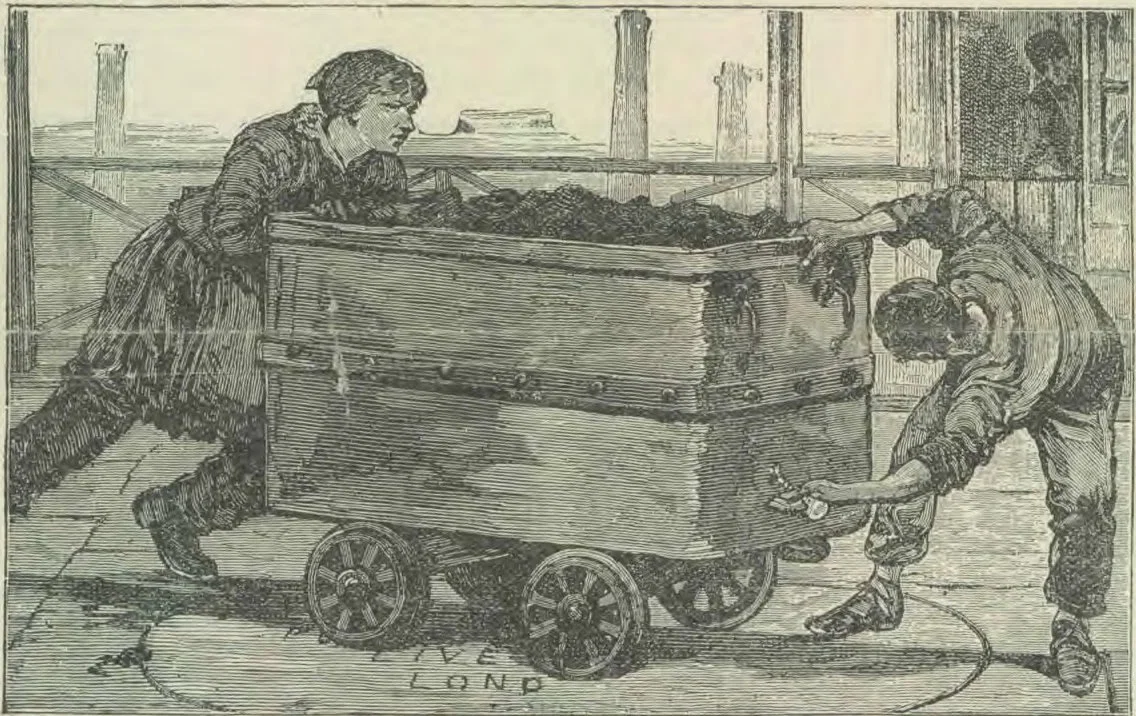
In previous articles we have learned something of the process of mining coal. The query naturally arises, What is coal? We are told, by those who have studied the matter most, that it is the mineralized remains of a strange vegetation which must have grown and flourished in the earliest periods of the world's history. It must have existed, too, at a time when there was one settled climate all the world over; for wherever coal deposits are found—from Spitzbergen to the center of Africa, or from Greenland to Guinea—everywhere the vegetable matter of which they were formed, has been found to be precisely the same, and this could not have been, had the climate then been as variable as it now is.
WEIGHING COAL AT THE MOUTH OF A PIT.
The vegetation of those days was different from that which now grows in a temperate climate like our own. In the limitless coal seams, are now traced the outlines of monster trees pressed close together, filling the solitary forests with the rankest foliage. Ferns, shrubs, mosses, water-plants, and slender little weeds are all traceable in the huge coal beds of the different countries.
A traveler in the tropical forests of the East, or in South America may be able to get some idea of the ancient flora that now forms the coal beds of the world. In those countries, with their moist, hot climates, may still be seen the same kinds of giant palms, immense water-rushes, strange looking shrubs, and tangled undergrowth of weeds, that once flourished in the long, long ago throughout the world.
In some cases the shrubs and trees have been found standing upright, and so complete that their limbs and leaves were traceable. Sir Charles Lyell tells of a bed of coal in a quarter of England, where, within a quarter of an acre, there were found no less than seventy-three stumps of trees, all their roots still attached to, and forming a part of, a seam of coal ten inches in thickness; and this resting on a layer of clay two inches thick, under which were two other forests separated in the same way, and forming beds of coal.
Strange as it may seem, by some process, vegetation has been transformed into beds of coal. But how was it done? The scientific answer of the chemist would perhaps be, that wood will become lignite, or wood-coal, by parting with its oxygen in the shape of carbonic acid gas, and then it can pass into ordinary bituminous coal. This explanation, however, may not be satisfactory to all our readers, without an illustration to show how such changes take place.
An apparatus was once used by which a mass of sawdust was compressed and enveloped in moist clay, and exposed to a long-continued warm temperature. By this means the gases and vapors arising from the vegetation were allowed to escape in such a way that the decomposition of the organic matter took place while the mass was warm and saturated with moisture, and at the same time under so much pressure as to prevent the separation of the elements of which it was composed. In due time the sawdust of different kinds of wood produced substances resembling various kinds of coal. This may explain why there are so many kinds of coal, hard and soft, now found in our markets.
The fact that layers of clay are found between beds of coal, shows that at some time deposits of earth have, by some action of the water, been spread over the primitive forests. These deposits of earth brought about the same process as related in the experiment quoted, producing the present coal deposits. There was opportunity for this breaking up of the forests, and their being covered with layers of earth, when the flood swept the world from one end to the other, and the “fountains of the great deep were broken up.” In fact, it seems quite probable that this was the time when such deposits were made.
When we stop to consider another thing, it seems doubly sure that this is the proper conclusion. We have already referred to the fact that everywhere the traces in the coal deposits show the same kind of vegetation. We have also seen that these are the same kinds of vegetation that thrive only in a warm, moist climate. Then when we think that the climate before the flood was of just this kind, it is easy to determine that this was the period when the deposits were made. Again, we learn from the Bible that before the flood no rain had fallen, but the ground was watered by a mist which ascended from the earth. This would show that the climate was in just that moist condition which would produce the kinds of vegetation of which all the coal deposits are formed.
The probable reason why these beds of coal are now found at such various depths, some being almost on the surface of the earth itself, is that they have been disturbed by volcanic movements, which have shaken and changed their places and positions, sending some lower, and raising others to all sorts of angles. Had it not been for this, man might not have discovered these valuable commodities.
J. O. C.

GEORGE III. IN THE PRIVATE CHAPEL AT WINDSOR.

A GENTLEMAN who was present in the private chapel about a year before his majesty’s last illness, has given a touching description of the scene as witnessed by him. He says: “As the clock struck 8 A. M., the gates of the castle were opened, and the king was conducted to the private chapel by an attendant, who left him there alone. The chaplain soon after came, and while he was looking over the prayer-book after his private devotion, the king was led to his chair, having entered the chapel, followed by two of the princesses and a lady in waiting. When the service began, his Majesty acted as clerk through every prayer in audible voice. At the petition, ‘Give peace in our time, O Lord,’ his Majesty, with hands uplifted, responded, ‘Because there is none other that fighteth for us,’ adding, with the strongest emphasis, ‘but only thou, O God!’”
“The king followed the chaplain through the Psalms, apparently very seldom at a loss, but saying the words as correctly as if he possessed his eyesight and had a book before him. The words of the Creed were repeated after the minister with specially distinct and audible voice.
“I afterward saw his Majesty’s prayer-book, and was shown that where we implore the Almighty to bless and preserve ‘Thy servant George, our most gracious king and governor,’ these words had been crossed through with a pen, and the words substituted in the king’s own writing, ‘An unworthy sinner.’”
“That the devoutness of the king in public worship did not consist in outward form we know from the whole tenor of his life, and notably from what is recorded of the deeply-affecting interviews with his favorite daughter, the Princess Amelia, during her last illness.
“‘My dear child,’ he said on one of these occasions, ‘you have always been a good child to your parents; we have nothing to reproach you with; but I need not tell you that it is not of yourself that you can be saved, and that your acceptance with God must depend on your faith and trust in the merits of the Redeemer.’”
“‘I know it,’ said the princess, gently, yet decidedly; ‘I know it, and I could wish for no better trust.’”
“‘It was truly a striking scene, the old and almost blind father bending over the couch, and thus speaking to his loved child.’”—S. S. Classmate.

Glimpses of Switzerland: Carriage Drive to Tramelan

GLIMPSES OF SWITZERLAND.—NO. 5.

Two years ago I had the pleasure of a carriage drive from Basle, about forty miles out into the northern part of the canton of Bern, to Tramelan, a snug little town on a mountain slope, well up in the Jura range.
Bicyclists find the route we took a delightful one, and they make the trip in less time than we did. Almost anywhere in Suisse they can easily whirl off sixty to seventy miles per day, and a great deal of traveling is done in this way; for the highways generally follow the valleys, and, centuries ago, these roads were thoroughly macadamized. Since then, they have been kept in good repair, as hard and smooth as a new concrete pavement, by means of crushed stones, which are filled in whenever a slight depression occurs by wear. These are soon powdered and packed hard; and as much scraping and even sweeping is done, muddy, dusty roads are discomforts not encountered by Swiss travelers. In bright weather, however, the reflection from their white surface is very trying to the eyes.
We followed up a pretty stream, the Birs, winding its way down among the mountains and rocks; but the ascent was so gradual that one of our party declared we must be going down stream, hardly willing to credit her own eyes, when she saw that it was persistently flowing in a direction opposite to ours.
At dinner time, we drew up at a little hotel, with a big name, La Croix bleu, which was backed up close to the rocks of one side of the valley. In front was the railroad, then just room for the river and highway before the mountain abruptly rose at the opposite side. We had previously bought a bottle of nice, rich milk at a peasant's house by the wayside, and here on wooden benches, which serve for chairs in such restaurants, seated ourselves at a bare table, and spread out our lunch, only asking for a pitcher of hot water to use with our milk. Had we ordered a loaf of bread with cheese, and mugs of beer or wine, our foreign accent and dress would have attracted only a few glances of curiosity; but as it was, even the proprietor, in an amazement which would have been purely amusing to us had he not mercilessly smoked into our faces until invited to desist,—even he could not refrain from a thorough inventory of our dinner, taking up a graham roll and gem to feel and smell them.
Nightfall found us at the entrance of one of the most interesting passes of Suisse, la gorge de Moutier, one we wished to see by daylight; hence we put up at the hotel In cheval blanc (of the white horse), at Roches. Here very comfortable accommodations, with good breakfast for three and care of our horse, cost but four francs, not quite eighty cents.
A description, however well given, of the many curious and wonderful sights of this route, the numerous villages and larger towns, also peasant's homes nestling here and there in little nooks, or perched upon apparently inaccessible heights, ruined castles and lookout towers with rocky steeps for foundation walls, the endless variety and combinations of rocks, in strata, in boulders, in solid palisades, falls altogether short of bringing to the mind's eye a correct picture of the reality, especially of the remarkable scenery at Moutier and Court.
Of one spot, however, so wildly beautiful, I will try to give some idea. Going southward up the valley, a turn around a certain curve reveals a perpendicular wall of bare rocks, which rises abruptly from the route, and stretches away in an irregular line of a hundred feet or more, half a mile to the left, till it loses its identity in the mountain beyond. All along on its jagged summit is a beautiful fringe of evergreens, standing up clear-cut against the azure, and half hiding, by its delicate tracery, a little chapel of fantastic build, with accompanying buildings close by on the same ridge. On looking back after passing this wall, we saw an immense pile of rocks in horizontal strata, their layers running up and up in shelving form to near the top of the wall. Thus it appears as if, while all were moving upward, one or two layers of the strata had suddenly been set upon end to form the perpendicular wall, or palisades, which firmly held the oncoming layers behind until all became immovably settled.
This romantic spot is only one of a large number to be found in Western Switzerland, where strata of rocks look as though with some gigantic force the immense layers had been sent from the southwest to the northeast, up among rocky heights, that now form the Juras, which resisted their progress; and there they lie, doubtless with the same slant, and many of them as bare as when the waters of the deluge subsided.
Just after beginning to climb the steeps which lay at the end of our journey, we turned aside to a grassy slope, and after the manner of Napoleon when on his long marches, made a temporary kitchen and dining-room of the carriage by setting up our alcohol lamp stove, going to our lunch basket again for supplies, and drawing Heaven's purest nectar from a clear spring close by, for our beverage. Thus we had an excellent dinner and a comfortable time eating it, here in the open air on the 24th day of November. Meanwhile our driver took the pony to a blacksmith near by to get its shoe-calks sharpened before attempting to scale the icy places we expected to find; for before leaving Basle, friends at Tramelan had warned us that it would be impossible for the horse to bring the heavy carriage up their mountain, slippery as it then was. But we encountered no ice, and a light snow on their smooth road-bed was no obstacle at all, and soon reached Tramelan, where we were cordially welcomed by Bro. Roth's people, one of the first families to accept the third angel's message in Switzerland.
Next day, while driving up among the fir-trees to the summit, we noticed a row of sticks about five feet high, with their tops singed black, and these were set a few feet apart along the route. Being interested to know the object of this arrangement, we were told it was to mark the way as the heavy snow-falls of this altitude come on, when frequently only the black heads are visible.
At the top of this mountain the forest had long been cleared away and given place to many excellent farms. Finding good sleighing with the two or three inches of snow, we stopped at a farm-house to get a sleigh, and meantime the ladies of the party were invited into the kitchen, that being the only room where they had a fire. Entering, we stepped down upon a floor of flat quarried stone, which, although rather uneven, was clean. I have seen them of only the bare earth pounded smooth. This room seemed to us rather cheerless, with its one window, low ceiling, benches and stools for seats, its long, bare dining-table and dish cupboard, and nothing more except the stove; yet it was a much better one than many country people have. The stove, somewhat more convenient to use, but of about the same value for heating as an old-fashioned fire-place, was built into the wall, and like those commonly seen in the peasants' kitchen, had its fire-place low down at the side in front, and much care is required to keep the projecting faggots pushed in as they burn, else too much smoke as well as coals and ashes would escape. The salon, or parlor, opened out of the kitchen at one end of the building; while at the other end were the comfortable stables—which, by the way, are better kept than the average in America,—for the goats, cows, and possibly a horse, though few of these peasants are able to own horses.
The sleigh we sought not being ready, we drove on, finding good wheeling for some miles across the plateau to Bellelay, where, in an isolated spot, the Catholics several centuries ago built up a little town, consisting of an immense convent, with other buildings necessary to carrying on a large farm and trades, in order to be independent of all the world around. Many years they had things to their own liking, but long ago its monks and nuns went forth, most of them to a freer existence; and the last blow which put an end to their scheme, came at the time of the Franco-Prussian war, when its walls and towers were shattered. The large church at one end of the large rectangular court, has for years been used as a barn. Fragments of the paintings and frescoings on the walls still remain to testify of the adornments the interior once presented; but with the falling plaster these are fast disappearing. The long stretch of prison-like buildings, once the convent proper, which, running out from the church, incloses the other three sides of the central open court, we found used as work-shops, by private families, as telegraph, telephone, and business offices; but it is principally devoted to butter and cheese making. The cheese made here called tête de moines, has a wide and excellent reputation. I never tasted better cheese; it is soft, and has a rich and peculiar, but not the least strong, flavor.
Had time allowed, we should have stepped into one of the offices to look over the history of the institution. But we could only go through the long, stone-paved corridors, up and down flights of stone stairs, calling at some rooms, peeping into others, and wondering what the locked doors of many, many more concealed, and into what horrible subterranean passages others led.
In one room men were making tow ropes, in another an intelligent Frenchman worked at a carpenter's bench, meanwhile enjoying a visit from his wife. They kindly invited us in to get warm by their fire; and before leaving, we found them ready to accept papers we had with us, and to give their address for the purpose of receiving other journals. As one result, they subscribed for Les Signes de Temps, and later the lady, then a widow, wrote me that her husband became much interested in the paper, also his family. May we not hope that the truths thus received led him to full salvation? To me this incident has been an encouragement to “sow beside all waters.” ADDIE S. BOWEN.

NOVEMBER

PURPLE dawns will flood no more Starry asters bending low; Reign of golden-rod is o'er, Lit with sunshine's overflow; Fields, where armied corn has stood, Gold fires flashed from spear to spear, Now are left in solitude— It's November, dear.
Bees no longer wander through Flowers of autumn growing wild; Where the meadow grasses grew, Faded aftermath is piled; Torrent-hearted birds have flown; And the winds o'er forests drear Sweep with wailing monotone— It's November, dear.
Now and then the gray sky lets Glimmers of the sunshine through, And, outreaching pale regrets, Shows its azure self anew. Now and then the crow's late call Through the woods breaks sharp and clear, And the dead leaves rustling fall— It's November, dear.
It's November, dear,—what then? You and I can surely wait Till the rose-time comes again, Though these days are desolate; And how beautiful to know, Set in music of God's year, In the symphony's full flow, Comes November, dear.
—November Wide-Awake.

“COULDN'T, ’COS HE SUNG SO!”

LEANING over a fence, a few days since, we noticed a little four-year-old “lord of creation,” amusing himself in the grass, by watching the frolicsome flight of birds which were playing around him. At length a beautiful bobolink perched himself upon a drooping bough of an apple-tree, which extended within a few yards of the place where the urchin sat, and maintained his position, apparently unconscious of the close proximity of one whom birds usually consider a dangerous neighbor. The boy seemed astonished at his impudence, and after regarding him steadily for a minute or two, obeying the instinct of his baser part, he picked up a stone lying at his feet, and was preparing to throw it, steadying himself for a good aim. The little arm was reached backward without alarming the bird, and Bob was within an ace of damage; when lo! his throat swelled, and forth came nature’s plea: “A link—a link—a link, Bob-o-link—Bob-o-link!—a—no—weet—a—no—weet! I know it—I know it!—a link—a link—a link—don’t throw it!—throw it!—throw it!” etc.;—and he didn’t. Slowly the little arm subsided to its natural position, and the despised stone dropped. The minstrel had charmed the murderer!
We heard the songster through, and watched his unharmed flight, as did the boy, with a sorrowful countenance. Anxious to hear an expression of the little fellow’s feelings, we approached him, and inquired,—
“Why didn’t you stone him, my boy? You might have killed him and carried him home.”
The poor little fellow looked up doubtingly, as though he suspected our meaning, and with an expression, half shame and half sorrow, he replied,—
“Couldn’t, ’cos he sung so!”
Who will say that music hath no charms to sooth the savage breast? Melody awakened humanity, and humanity, mercy; the angels who sang at the creation whispered to the child’s heart. Dear little boys, don’t kill the birds.—Clinton Courant.

Absent-Mindedness in a Little Girl's Words

A LITTLE girl who wanted to describe the absent-mindedness of her uncle, said: “His remember is so tired that he has to use his forget all the time.—Kind Words.”

SECOND EPISTLE OF PETER.

LESSON 8.—2 PETER 3:1–7.

[Commit to memory the verses in Peter which form the basis of this lesson.]
1. To whom was the second epistle of Peter addressed? 2 Peter 1:1.
2. Why was it written? 2 Peter 3:1.
3. Of what does the apostle wish us to be mindful? Verse 2.
4. What purpose does prophecy serve? 2 Peter 1:19.
5. Upon what is special light given by the prophecy? 1 Peter 1:11, last part; Dan. 2:28.
6. Give reference to some prophecies which foretell the final glory of Christ, and give the substance of each. Ps. 50:1–3; Hab. 3:3–6; Isa. 63:1–6, etc.
7. What must we look for just before the end? 2 Peter 3:3; Jude 17, 18.
8. Mention some other places in the writings of the apostles where this is foretold. 1 Tim. 4:1, 2; 2 Tim. 3:1–5, 13; 4:1–4; 2 Thess. 2:8–10.
9. Of what do these scoffers profess to be ignorant? 2 Peter 3:4.
10. Is there any excuse for such ignorance? Verse 5.
11. What notable event recorded in Scripture shows that all things have not continued as they were from the beginning of the creation? Verses 5, 6.
12. How did the earth come into existence? Ps. 33:6, 8, 9.
13. In what condition was the earth at first? Gen. 1:2.
14. What division was first made in this watery mass? Verses 6, 7.
15. What was done with the waters that were beneath the firmament? Verse 9; Ps. 33:7.
16. When, by the word of the Lord, the flood destroyed the earth, how did the waters that were stored up in the earth contribute to that result? Gen. 7:11.
17. What fate, by the same authority, now awaits the earth? 2 Peter 3:7.
18. Where has the word of the Lord declared this? Nahum 1:5; Isa. 34:8–10; Deut. 32:22.
19. What positive assurance have we that this will be done? Ans.—We have the word of Him who spoke the earth into existence, and who caused the water that constituted a portion of the earth to contribute to its destruction. See 2 Peter 3:5–7.
20. Show the analogy between the destruction of the earth by water, and its destruction by fire. See note on verses 5–7.

NOTES.

THE phrase, “the earth standing out of the water and in the water,” does not at all express the idea of the original. The Greek word which in the Authorized Version is rendered “standing,” should, as the margin indicates, be rendered “consisting.” Robinson’s “Lexicon of the New Testament” says of the word: “To place together parts into a whole, i. e., to constitute, to create, to bring into existence. Hence, in N. T., intransitive, to be constituted, created; to exist,” as in Col. 1:17, “by him all things consist.” Wakefield translates the passage thus: “A heaven and earth formed out of water and by means of water.” Bloomfield says: “The earth . . . being formed out of water, and consisting by means of water.” Murdock’s translation of the Syriac has it: “The earth rose up from the waters, and by means of water, by the word of God.” The meaning is that the earth in its chaotic state was simply a watery mass, as indicated by Gen. 1:2: “And the earth was without form, and void; and darkness was upon the face of the deep. And the Spirit of God moved upon the face of the waters.”
“Whereby the world that then was, being overflowed with water, perished.” When God gathered the waters together into one place, and made the dry land appear, he evidently stored large quantities of water in the interior of the earth. This is indicated in the second commandment, by the phrase, “the waters which are under the earth,” and by Ps. 136:6: “To him that stretched out the earth above the waters,” and also by Ps. 33:7; 24:1, 2. In the flood which destroyed the earth in the days of Noah, the waters in the interior of the earth united with the rain from heaven, as the record says: “The same day were all the fountains of the great deep broken up, and the windows of heaven were opened.” Gen. 7:11. The idea of the passage in Peter’s epistle is that one of the very elements from which the earth was formed, was made to contribute to its destruction. Having disproved the assertion that all things continue as they were from the beginning of the creation, the apostle draws a parallel, thus:—
“But the heavens and the earth, which are now, by the same word [the word of God, see verse 5] are kept in store, reserved unto fire against the day of judgment and perdition of ungodly men.” 2 Peter 3:7. Instead of, “are kept in store, reserved unto fire against the day of judgment,” a better translation would be, “stored with fire, reserved unto the day of judgment.” Now the comparison is at once apparent. By the word of God, the earth, in the beginning was formed from the watery mass which God had spoken into existence. Part of this water was stored up in the earth, and by the word of God was afterward caused to overflow the earth, and contribute to its destruction. And the same word of God, which performed this, has stored the interior of this present earth with fire, and is keeping it till the day of judgment, when, as in the case of the waters of the flood, the fire within the earth, uniting with that which comes down from God out of heaven (Rev. 20:9) will destroy it.
Particular attention should be given to the word “kept.” Instead of all things continuing as they were from the beginning of the creation, the earth has within it the elements of its destruction, and it is only the power of God that stays the catastrophe.
Some have fancied that this chapter teaches that the earth will be annihilated at the judgment day. This is a mistake. This earth will be destroyed in the same sense that the original earth “perished” by the waters of the earth. It was all broken up, and the face of it was changed, so that the earth after the flood had no resemblance to the earth before the flood. This was the last and greatest curse caused by sin, and completed the desolation of the earth. But the matter which composed the earth was not destroyed. So by the fires of the last day “the elements shall melt with fervent heat,” but they will not be annihilated. From those melted elements, “new heavens and a new earth” will be formed, which will have no more resemblance to this sin-cursed earth than this earth does to Eden, the garden of God. The people that shall dwell in it will all be righteous (Isa. 60:21); and “the wilderness and the solitary place shall be glad for them; and the desert shall rejoice, and blossom as the rose. It shall blossom abundantly, and rejoice even with joy and singing; the glory of Lebanon shall be given unto it, the excellency of Carmel and Sharon, they shall see the glory of the Lord, and the excellency of our God.” Isa. 35:1, 2.

LEE CIRCLE.

The city of New Orleans is especially noted for its statues and monuments. Its cemeteries are said to contain some of the finest marble work of any in the United States, if not in the world. Its large commercial interests and easy access to ocean traffic have brought to the city nearly every nationality and all classes of goods and wares. Each nationality has here its peculiar statues and monuments in commemoration of their noted men and great events. This makes New Orleans an interesting place to visit.
One of the most imposing monuments of the city was erected by the Southern Confederacy, and stands in Lee Circle on St. Charles St. The circle is some fifty rods in circumference, and the street-cars and vehicles have to make a semicircle to pass the monument. It is a most beautiful place. A smooth stone pavement, several feet in width, surrounds the circle, and between this and an inner walk is a strip of green turf. A few feet from this inner walk is still another wide gravel walk that passes around close to the base of the monument, making three walks that extend around the circle.
A few feet from the outer walk, the earth has been gradually elevated until the mound reaches a height of twelve feet above the level of the street. It is covered with a carpet of green, and the grass is kept so evenly mown, summer and winter, that it gives it a very fine appearance indeed. Four nice, wide shell-walks lead from four points of the compass to the top of the mound.
Upon the top of this large circular mound stands a monument to the memory of the confederate general, Robert E. Lee, who was the commander-in-chief of the southern armies. He was naturally a kind, generous-hearted man, and also said to be a Christian, and thereby won a very warm place in the hearts of the southern people.
His monument is 95 feet high from its base to its top. The bottom of the base is 40 feet square, and is built of heavy slab stone that have been neatly dressed. It is composed of four risers which are each three feet high, making twelve feet from the bottom to the top of the base. Upon the stone table top stands a round pillar about twelve feet in circumference and sixty-three feet high. Upon the top of the pillar is the bronze iron statue of the General. It is 16 feet in height, and is represented in a standing posture, facing northward with folded arms, as if complacently viewing the approaching foe. His sword is sheathed, and hangs by his side. The attitude of the statue represents the familiar position the General was wont to take when viewing the battle-field just before or during an attack.
A row of gas lamps surrounds the circle, giving a brilliant light, and making a very pretty view in the night. The monument stands in the central part of the city, making it conspicuous from all quarters.
E. HILLARD.

AN ANCIENT BRIDGE.

It is said that the first London bridge over the Thames was built by the nuns of St. Mary, who lived at Southwark. This was very early in British history; for in 1008 there was a battle fought on the bridge with the Danes, who had taken possession of it. The Danes could be driven off; but there was a mightier foe to this structure. The bridge was a wooden one, and it was dashed to pieces by a violent flood. This wooden bridge was succeeded by another of the same material, and as the first succumbed to flood, so did the second to fire.
The third bridge was made of stone, as wisdom had been learned from the fate of the other two. It was built by an ecclesiastic, Peter of Colechurch, in the reign of Henry II. To raise the necessary money, the king put a tax on wool, and so the people used to say that old London Bridge was built on wool-packs. Peter of Colechurch, who is supposed to have belonged to the Brethren of the Bridge, began his work in 1176, and it was completed in 1209 during the reign of King John. There was no question about the strength of this structure. It was remarkable for its massiveness and the enormous surplus of material used in it. It had twenty arches in a span of 940 feet. The piers were from 25 to 34 feet thick, so that the piers themselves occupied two-thirds of the stream, even at high water, while at low water less than one fourth of the whole span was left for waterway, and a dangerous fall was caused. There was a small town built upon the bridge, markets, bakeries, manufactories, dwelling-houses, and even a church. In the crypt of this church were buried the remains of Peter, its architect, who died while the work was in progress.
It is said that some of the people who lived on the bridge thought of it as quite a world in itself, and spent their whole lives there, never leaving it. The great fire of London, in 1666, did much damage to the bridge, so far as the structures upon it were concerned, but it stood nearly two hundred years more.
The New London Bridge was designed by the architect Rennie, and work was begun upon it in 1824. It is an imposing structure of granite, 928 feet in length, with five elliptical arches, in the place of the twenty of the old bridge. The center arch has a span of 152 feet. An immense traffic surges over this structure.—Illustrated Christian Weekly.

PORTRAITS IN PROFILE.

In 1759, the French king had for his finance minister a certain Etienne de Silhouette, whose chief recommendation was that he did his best to reduce the expenditure of what was at all times an extravagant court and administration. Such great things were expected of this very ordinary man that even the fashions were designed to fit in with his humor. Coats were worn without pleats, hats without feathers, shoes without buckles, and instead of portrait-painting, there sprang up a custom of merely sketching a profile, and filling in the outline with a flat wash of Indian ink. Such portraits were the plainest and least ornamental that could be imagined. They were easy to make, and there was nothing in them, after all. They were silhouettes. Before photography came into vogue, these silhouettes were the ordinary portraits of ordinary people; and many a mantel-piece is still decorated with the little patch of black which represented the best attempt at a correct likeness that our grandfathers could manage. With the advent of photography, light took the place of shadow, and the profile-drawers found their occupation gone.—Sel.

A HAPPY MAN.

PHILOSOPHERS tell us that contentment is better than wealth, and we know that the only true happiness comes from contentment. Therefore the governor of the Danish colony of Greenland may be called the richest and happiest man in the world. That functionary receives his supplies by a ship which comes from Copenhagen once a year, and the same ship brings him all the daily papers for the year preceding. The governor arranges these papers in the order of their dates, and then quietly and calmly reads a paper each day, just as though it were fresh from the press. He is sometimes tempted to peer into futurity by reading some papers ahead when he comes across interesting news; but he resists the temptation, no matter how anxious he is to know the fate of some measure. One day's paper for each day is his rule; and so at the end of the year he is thoroughly familiar with the news of the preceding year, and says he is just as happy as though he pulled each day's paper off the press.—Sel.

AN OLD BANK-NOTE.

The museum of St. Petersburg possesses a bank-note which is probably the oldest in existence. It is of the Imperial Bank of China, issued by the Chinese Government, and dates from the year 1399 B. C.

Cost of Cannon Fire Versus Missionary Support

HERE is a fact, but there is no fun in it. The cost of firing one shot from a cannon of the largest size now made is sufficient to maintain a missionary and his whole family in China for more than two years.
Continue reading: Letter Budget