The Youth’s Instructor, Vol. 28, No. 9.

THE MIDNIGHT SUN

The Youth’s Instructor

Feb 25, 1880

S. D. A. Publishing Association · Battle Creek, Mich. · Feb 25, 1880

THE MIDNIGHT SUN.

DOUBTLESS few of the readers of the INSTRUCTOR ever saw the sun at midnight, and yet these lines may possibly be read by some dweller in the North with the rays of the midnight sun shining on his page. In our latitude, the sun is never seen later than 7:41 P. M., nor earlier than 4:22 in the morning. He never reserves less than 8 hours and 41 minutes each day for other purposes than shining on us, and we never see him within 4 hours and 19 minutes of midnight. But away off in the regions of the North, in Iceland, Greenland, and the northern coasts of British America, Europe, and Asia, during a part of the year, the sun does not go out of sight at all.
The picture represents a beautiful ship at rest upon a calm sea, among the northern icebergs, while the sun at midnight is seen swinging low in the north. In the dark lines that rest upon the smooth face of the water, and in the dark form of the ship with its tall masts outlined against the sun-streaked sky, the artist has conveyed to us the idea of night as well as he could do, perhaps, with the sun shining right in his face.
Hammerfest is the most northern town in Europe. Were you there next June, you might enjoy continual sunshine for several weeks. At noon the sun would be seen in the south, at an altitude of about 42 degrees. From that point it would appear to swing downward toward the north-west, where it would appear to be about 20 degrees high at 7:41 P. M., when it would be setting in Michigan. Then it would appear to move in an even curve downward and northward until at 12 o’clock P. M. it would be seen almost down, directly in the north. Then it would seem to rise gently, passing southward around to its place at noon. But you must remember that it is not a motion of the sun that has caused this appearance, The earth has been turning around, and you have been riding on it.
It must be very pleasant to have the sun shine all the time; and sunshine is much cheaper than kerosene or gas. But there is another side to this picture, which the artist has left out. For every day the people of the North enjoy a constant sun, next winter will deal out to them a frozen day without any sun at all. Thus the people are obliged to take a rather unpleasant average.
Would n’t you like to live in a country where you might enjoy all the good things you can think of, without having to suffer any disadvantages? Yes. Well, God has promised just such a country to all that love him. Christ has gone to prepare mansions for them to live in, and he is soon coming back to bring his people together and take them to their home. Read John 14. And when at last the earth shall have been made new, and that great city of God shall have been placed upon it, then there will be a day that never shall end. “And the city had no need of the sun, neither of the moon, to shine in it; for the glory of God did lighten it, and the Lamb is the light thereof. And the nations of them which are saved shall walk in the light of it. . . And the gates of it shall not be shut at all by day; for there shall be no night there.” Rev. 21. Some who read these lines will be there.
C. W. STONE.

BIDDING THE SUN “GOOD-NIGHT.”

When the short, bright summer of Lapland is ended, and the sun is about to set, to rise no more for seven or eight months, the people of the hamlets and villages ascend the neighboring hills to see the last of the Day God, and chant a requiem, or farewell psalm, for the parting day.
Come, little daughters, hasten, Ye should be bravely dight! Make ready, boys! for we go forth To bid the sun good-night.
“Four months with steady shining He's made the whole earth fair, And myriad blossoms greeted him, And bird-songs filled the air.
“But now October waneth; His setting draweth near; We shall not see his face again For more than half a year.”
So forth they go, together, Parents and children, all, The aged, and the little ones, Young men, and maidens tall.
The sun hangs low in heaven; He throws his slanting rays Across their loving faces, turned To meet his parting gaze.
And now he's gone! The darkness Is settling like a pall; A long, low dirge of sad farewell Breaks from the lips of all;
In mournful cadence chanting The requiem of the sun, The dear, bright day departed now, The long, long night begun.
—St. Nicholas.

HAPPINESS

It is nothing short of an art to be happy—and an art worthy of being cultivated in the highest degree. That perfect happiness is attainable in this world, no one will admit; but that comparative happiness is within the reach of all is, without doubt, true.
The most real and enduring happiness is that which we find within our own hearts.
We should therefore gather into them all the sunshine that we can; and there is enough of it in the world to brighten any spot, provided we will throw open the doors and windows and let the light enter.
It is a fact that this world is to us what we make it. Life’s happiness is composed of small joys; then let us not trample under foot the little pleasures which are scattered in the daily path, and which, in our eager search after some great joy, we are apt to overlook; but, gathering the roses at our feet, make our pathway to bud and blossom forth into happiness to ourselves and those around us.
He who seeks for sorrow and misery can find them to his heart’s content; but he who looks on the bright side will find his heart filled with gladness. To be looking into the future for either light or darkness is not well; but we should live a day at a time, remembering that every day rightly lived makes us stronger for the next.
One source of happiness is to be always busy. Weave into the warp of life all the happiness possible; let the pattern be made up of that which is good, true, and beautiful. And though some days are darker, as necessarily they must be, for, “Into each life some rain must fall,” still keep to the same pattern though the colors are more somber—even gray.
We should study not only to be happy ourselves, but to make others happy; and in doing this the result is two-fold—happiness to ourselves and to those around us; for God has thus ordered it, that if we seek to do good to others, it will reflect upon ourselves.
The most simple rule of happiness of which we know is this: Love God, and believe that he loves you. V. A. M.

“I AM THE GOOD SHEPHERD.”

SEVEN thousand miles away, on the eastern shore of the Mediterranean Sea, lies the land where the Saviour lived when he was on the earth; and we call it Syria, or Palestine, or the Holy Land. It is a rough, hilly country, with no roads such as we have in America, but rocky paths, and long, sandy beaches.
Over these stony roads, and through the heavy sand, toil the shepherds, caring for their sheep. Sometimes one man will have a hundred sheep, with only his dog to help him; and you would think it would be hard to keep them in order; but they have grown up together, and these sheep have followed their shepherd ever since they were little lambs, and know his voice so well that they will come at his call. He has names for them all, and some of them have such a love for him that they keep close beside him all the time.
Several years ago, while riding over a long beach not far from the old Bible city of Sidon, I saw two flocks of sheep coming from opposite directions. They met, and all stopped to rest, lying down on the sand, while the two flocks were mingled together, so that they seemed but one. The shepherds talked together for a while, and then one of them arose and began to call his sheep, apparently by name; for one after another jumped up as he called them, and soon they were ready to start. The shepherd went before, and his sheep followed; but not one of the other flock had stirred. Do you remember the verse, “And the sheep follow him, for they know his voice; and a stranger will they not follow, but will flee from him; for they know not the voice of strangers”?
When they come to a river that must be forded, the shepherd goes into the water, and they follow even there, never doubting their safety when he leads the way. If any of them are sick or wounded, he lays them over his shoulder, and carries them across one by one. Every shepherd wears a loose jacket, open in front and belted tightly at the waist. It is like a bag, and in that he places his lambs, sometimes two or three, and takes them over the rough places and through the deep waters.
Once, in a dark, windy night, high up on Mount Lebanon, I heard a strange sound. I listened, and heard it again, till it grew fainter and fainter in the distance; and some one said, “That is a shepherd hunting for a lost sheep. He will not go home till he has found it, and brought it safely to the fold.”
Then these words came to my mind: “How think ye? If a man have a hundred sheep, and one of them be gone astray, doth he not leave the ninety and nine, and goeth into the mountains, and seeketh that which is gone astray? And if so be that he find it, verily I say unto you, he rejoiceth more of that sheep, than of the ninety and nine which went not astray. Even so it is not the will of your Father which is in Heaven, that one of these little ones should perish.”—Well-Spring.

HALVING THE PEACH.

I ASKED Nellie the question often asked, What happiness is, in idle vein, Scarce looking for answer; and it tasked And puzzled her childish brain.
She stood with her hands close clasped behind, As though she was gravely turning o’er Her budget of baby-thoughts to find An answer among their store.
Her brow was knit with a thoughtful frown, And her crimson lips had a pretty pout, While her eyes looked up and her eyes looked down, Determined to find it out,
When suddenly over her radiant face There flowered a flashing smile, whose glow Like a rosebud burst to a rose’s grace, And she eagerly cried, “I know!
“It’s halving the peach. You gave me one, As yesterday at the table we sat; And I shared it with Bess, for Bess had none; And I’m certain it must be that.”
“Dear child! you have taught as I could not teach What happiness is; and, darling, so, If you always are ready to halve your peach; You always can say, ‘I know!’”
—Margaret J. Preston.

MAKE HOME PLEASANT.

The home should be ever full of cheerfulness. Many a child goes astray, not because there is a want of prayer or virtue at home, but because home lacks sunshine. We all need smiles as much as flowers need sunbeams. Children, especially, look little beyond the present moment. If a thing displeases, they are prone to avoid it. If home is a place where faces are sour and words harsh, and fault-finding is ever in the ascendant, they will spend as many hours as possible elsewhere. Every father and mother, therefore, should seek to make home a bright and happy place.
And for the children there is something to do; they should study to make home a pleasant place. There is a right way to open and shut the door; a right way to move from one part of the room to another; a right way to sit down, to rise, to hold a book,—a right way to do everything that is worth doing at all. And yet we have known children to give their parents sad hearts by the neglect of these little home duties. It is more easy to do these things right than to do them wrong. One very bad habit some young people have is that of calling aloud the name of a brother or sister, or even of a father or mother, who may be in another room, or up-stairs, or in the yard. A polite person will always go to the one whose attention is required, and speak in a low and modest tone of voice. Home might be made far more pleasant by a strict observance of many of these little matters.

WITHIN AND WITHOUT.

WHEN we see individuals arrayed in costly garments, and decked in all the fashionable paraphernalia of the times, we are very likely to speculate as to what kind of jewels these caskets may contain. Not unfrequently we find all fair without, while within dwells a raging tempest; all the evil of their nature is left unchecked, while the outer man is made perfect, and so they have become as whited sepulchers.
Many a corrupt thought is veiled beneath a smile, many a heart rankling with evil passions throbs beneath a costly robe. Ah! this outward life is but an empty show. It matters little how beautiful the face and form may be if the inner life does not correspond. Have you ever taken an apple in your hand and admired its beautiful color, and then cut it open only to find it decayed? or plucked a lovely flower, hoping to be refreshed by its breath, and found it odorless?
The imperfect fruit and the odorless blossom are but types of the life within.

LESSONS FOR CHILDREN.

LESSON LXI.—ELIJAH RAISES THE WIDOW'S SON.

When Elijah came near the gate of the city, the woman was there gathering sticks, and he asked her to give him some water, and some bread. Then she told him that she had nothing but a handful of meal, and a little oil in a cruse, just enough to make one more cake, and was now gathering sticks to bake that; and that when it was eaten, she and her son must die. Elijah told her to go, and bake a cake for him first, and afterward some for herself and her son, saying that the Lord had said, “The barrel of meal shall not waste, neither shall the cruse of oil fail, until the day that the Lord sendeth rain upon the earth. And she went and did according to the saying of Elijah; and she, and he, and her house, did eat many days. And the barrel of meal wasted not, neither did the cruse of oil fail, according to the word of the Lord, which he spake by Elijah.”
Finally the woman's son was taken sick and died, and she said unto Elijah, “Art thou come unto me to call my sin to remembrance, and to slay my son?” Then Elijah took the child to his own chamber, and laid him upon his own bed, where he stretched himself upon the child three times, and prayed that the Lord would bring him to life. And the Lord heard the voice of Elijah, and the child's breath came into him, and he lived again. Then Elijah took the child to his mother, and said, “See, thy son liveth.” And she said, “By this I know that thou art a man of God.”
After many days the word of the Lord came unto Elijah, saying, “Go, show thyself unto Ahab, and I will send rain upon the earth.” When Ahab saw Elijah, he said unto him, “Art thou he that troubleth Israel?” But Elijah answered, “I have not troubled Israel; but thou and thy father's house, in that ye have forsaken the commandments of the Lord, and thou hast followed Baalim. Now therefore send, and gather to me all Israel unto Mount Carmel, and the prophets of Baal four hundred and fifty, and the prophets of the grove four hundred, which eat at Jezebel's table.”
When all the people and false prophets were gathered together, Elijah said to the people, “How long halt ye between two opinions? if the Lord be God, follow him; but if Baal, then follow him. And the people answered him not a word. Then said Elijah unto the people, I, even I only, remain a prophet of the Lord; but Baal's prophets are four hundred and fifty men. Let them therefore give us two bullocks, and let them choose one bullock for themselves, and cut it in pieces, and lay it on wood, and put no fire under; and I will dress the other bullock, and lay it on wood, and put no fire under; and call ye on the name of your gods, and I will call on the name of the Lord; and the God that answereth by fire, let him be God. And all the people answered and said, It is well spoken.”

QUESTIONS.

  1. When Elijah came near the city of Zarephath, where did he find the woman that was to give him a home in her house? 1 Kings 17:10.
  2. What was she doing?
  3. What did he ask of her?
  4. What did she tell him?
  5. Why was she gathering sticks?
  6. What did she think must become of her and her son when that cake was eaten?
  7. What did Elijah tell her to do?
  8. What promise did he say the Lord had made?
  9. Was she willing to trust this promise?
  10. What did she do?
  11. What was the result?
  12. What did the woman say to Elijah when her son was taken sick?
  13. What did Elijah do with the child?
  14. How was his prayer answered?
  15. What did he say to the woman when he brought her child back alive?
  16. What reply did she make?
  17. What did the Lord after many days tell Elijah to do? 1 Kings 18:1.
  18. What did he promise?
  19. What did Ahab say when he saw Elijah?
  20. What did Elijah answer him?
  21. How had Ahab and his father's house troubled Israel?
  22. What did Elijah tell Ahab to do?
  23. What did he say to the people when they and the false prophets were gathered at Mount Carmel?
  24. How did they answer him?
  25. What did he then say to them?
  26. How did he propose to show which was the true God?
  27. What did the people say to this plan?

BIBLE LESSONS FOR YOUTH.

LESSON LXXXVII.—MANASSEH AND AMON.

  1. How old was Manasseh when he began to reign? 2 Kings 21:1.
  2. How long did he reign?
  3. Whose conduct did the conduct of Manasseh resemble? Verse 2.
  4. How did he pollute the temple? Verses 4, 5, 7.
  5. Of what other abominations was he guilty? Verse 6.
  6. What effect did his wicked example have upon the people? 2 Chron. 33:9.
  7. How did he and his people treat the admonitions of the Lord? Verse 10.
  8. What evil did the Lord then bring upon Manasseh? Verse 11.
  9. What effect did this affliction produce?
  10. How did the Lord show mercy upon him?
  11. How did Manasseh show gratitude for this mercy?
  12. Where was he buried? Verse 20.
  13. Who then reigned in his stead?
  14. How long was he king?
  15. Describe his reign.
  16. What was his fate?
  17. How did the people avenge him?
  18. Whom did they make king in his stead?
  19. Enumerate the kings of Israel, beginning with Saul.
  20. Enumerate the kings of Judah, from Solomon to Josiah.
  21. How long did each reign?

SYNOPSIS.

Manasseh, the son of Hezekiah, began to reign when he was only twelve years old, and reigned fifty-five years. “And he did that which was evil in the sight of the Lord, after the abominations of the heathen, whom the Lord cast out before the children of Israel; for he built up again the high places which Hezekiah his father had destroyed, and he reared up altars for Baal, and made a grove, as did Ahab king of Israel; and worshiped all the host of heaven, and served them. And he built altars in the house of the Lord, of which the Lord said, In Jerusalem will I put my name. And he built altars for all the host of heaven in the two courts of the house of the Lord. And he made his son pass through the fire, and observed times, and used enchantments, and dealt with familiar spirits and wizards; he wrought much wickedness in the sight of the Lord, to provoke him to anger. And he set a graven image of the grove that he had made in the house, of which the Lord said to David, and to Solomon his son, In this house, and in Jerusalem, which I have chosen out of all the tribes of Israel, will I put my name forever.”
“So Manasseh made Judah and the inhabitants of Jerusalem to err, and to do worse than the heathen, whom the Lord had destroyed before the children of Israel. And the Lord spake to Manasseh, and to his people; but they would not hearken. Wherefore the Lord brought upon them the captains of the host of the king of Assyria, which took Manasseh among the thorns, and bound him with fetters, and carried him to Babylon.”
“And when he was in affliction, he besought the Lord his God, and humbled himself greatly before the God of his fathers. And prayed unto him, and he was entreated of him, and heard his supplication, and brought him again to Jerusalem into his kingdom. Then Manasseh knew that the Lord he was God.”
After this, Manasseh seems to have been a good man. He rebuilt the temple, and restored the worship of the Lord, as did his father Hezekiah.
“So Manasseh slept with his fathers, and they buried him in his own house; and Amon his son reigned in his stead.”
“Amon was two and twenty years old when he began to reign, and reigned two years in Jerusalem. But he did that which was evil in the sight of the Lord, as did Manasseh his father; for Amon sacrificed unto all the carved images which Manasseh his father had made, and served them; and humbled not himself before the Lord, as Manasseh his father had humbled himself; but Amon trespassed more and more. And his servants conspired against him, and slew him in his own house.”
“But the people of the land slew all them that had conspired against king Amon; and the people of the land made Josiah his son king in his stead.”

CARMEL

MOUNT CARMEL is not, as one might suppose, an isolated mountain but a continuous range of hills, probably about eighteen miles long, with an average height of 1,500 feet. These mountains run inland from the Mediterranean in a south-easterly direction. At the western end, or more properly, the north-western, the range terminates in a bold promontory, which forms the southern headland of the Bay of Acre.
The mountains are of compact lime-stone, and on the north-eastern side, steep and precipitous, deeply furrowed with rocky ravines, which are filled with dense jungle, and tenanted by jackals, hyenas, and wolves. In the sides toward the sea are numerous caves and grottoes, formed partly by nature and partly by art. These were anciently used as hiding-places by refugees; and at one time Carmel is said to have swarmed with monks and hermits, who made these caves their home. The entrances are so narrow that only one person can creep in at a time, and the caverns so crooked that he is immediately lost sight of, unless closely followed. Thus we see the fitness of the reference of the prophet Amos, when, speaking the words of Jehovah, he says, “Though they hide themselves in the top of Carmel, I will search and take them out thence.” This mountain was frequently visited by the prophet Elijah, and to this day is shown a cavern called the “cave of Elijah.” It has been thought—and it is not unlikely—that it was in Carmel that the prophet called down fire upon the two fifties sent by Ahaziah to take him.
The south-western side of the ridge is not so steep and rugged as the north-eastern, but sinks down gradually into wooded hills, with well-watered valleys, presenting to the eye a district of great fertility, and declining gently into the beautiful plain of Sharon, lying along the Mediterranean. Carmel, in the Hebrew language, signifies park or garden-like tract; a name which the mountain may well claim from its beauty and fruitfulness. It is sprinkled with fine oaks and other forest trees in its upper parts, and olive and fruit trees farther down. Says a writer who has visited the place: “Long, deep ravines of singular wildness wind down the mountain sides, filled with tangled copse, fragrant hawthorn, myrtle, and jessamine, and alive with the murmur of tiny brooks and the songs of birds. At intervals along the slopes are open glades, carpeted with green grass, and spangled with myriads of wild-flowers of every hue.” Another says that he is sure a botanist might spend a year in this locality, and every day add new specimens to his collection.
The north-western extremity of the range is, however, more bleak and barren; and here, overlooking the blue waters of the Mediterranean, stands the convent of the Carmelites, said to be one of the finest in the world. It is a modern building, erected on the site of a more ancient structure. At this end of the range is also situated the town of Haifa, a seaport on the Mediterranean. A late traveler speaks of finding here a colony of about one thousand foreigners, chiefly Germans, who are quite transforming the squalid little town. They believe in the speedy coming of Christ to establish his kingdom, making Palestine his gathering place; and they are here to prepare the way by spreading Christian civilization, through means of modern agriculture, manufactories and the like. They are both zealous and industrious, and their neat gardens, streets, and houses make the place look quite inviting.
The scene of Elijah’s sacrifice in the days of Ahab, seems to have been near the south-eastern extremity of Carmel. Modern travelers have thought that they could identify the very spot; namely, a terrace of natural rock, which bears the Arabic name El Mukrakah, meaning “the sacrifice” or “place of burning.” From this place there is a narrow pass leading down to the river Kishon, which flows at the base of the mountain; and it is supposed that down this track the idolatrous priests were hurried to meet their death beside the stream; for, part way down, is a point known as Tell Kussis, which means “hill of the priests.” From the terrace where it is supposed the altars were built, a few minutes climbing would have brought the servant of Elijah to the top of a projecting peak, whence he could command a full view of the sea, which is not far from ten miles distant. The fountain from which the water was probably drawn to deluge the sacrifice of Elijah, still sends forth its crystal stream; and near it are massive stones, which may have been used in the construction of the altars.
Travelers wax eloquent in their descriptions of this remarkable mountain, and in the thought that their feet have rested and their eyes gazed, on the very spots where such wonderful events have transpired. Carmel has always been venerated, and to this day it is held sacred by Jews, Christians, and Moslems alike. EVA BELL.

A LONG TONGUE.

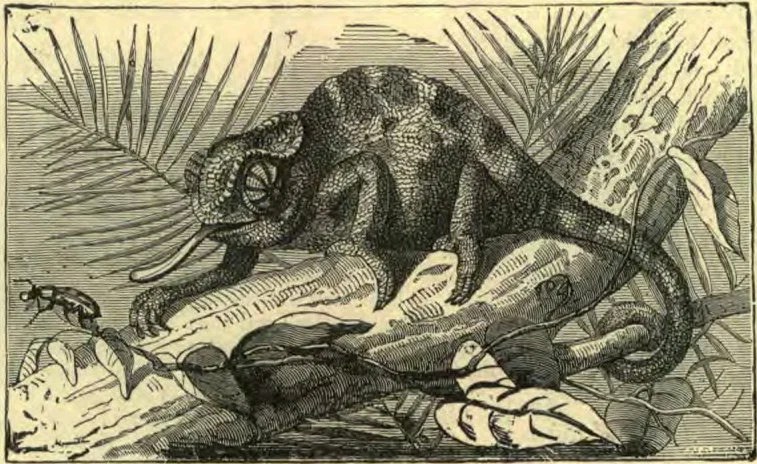
If your tongue were as long as your body, wouldn’t you think it a long one? Well, odd as it is, there is a little fellow, who lives in Africa, with just such a tongue, and you can’t imagine how useful it is to him.
You see he is a dignified, slow-moving little fellow, and he lives on insects and such lively game. He could never catch them, and might starve to death, only that he can dart out his tongue, as quick as a flash, and as long as his body. The end of this droll weapon is sticky, and holds fast any unfortunate bug or fly it touches.
The little animal I speak of is a chameleon, and his tongue is not the only droll thing about him. His eyes are very curious. They are large and round, and stick out like big beads on the side of his head. And the funniest thing is that he can turn them different ways, so as to see all around him. He can turn one up and the other down, or he can turn one forward and the other back, and thus see everywhere. It must be a very small bug which can escape these sharp eyes.
These eyes are covered with eyelids all the time. To be sure, there is a hole in the middle, where the bright eye looks out, and he can contract or expand it as he likes, but he can’t uncover his eyes as we can.
But his tongue and his eyes are not the only odd things about him—his feet are as strange as the rest. He has five toes, just as you have, though they are more like a bird’s claws than like your toes. They are all long and have claws on the ends, and then they are fastened together by skin in a curious way. Three of them are fastened into one sort of bundle, and the other two into another.
You can see how nicely this arrangement enables him to hold on to the branches of trees, where he lives. All four of his feet are fixed in the same way. And, as if four such hands and feet were not enough, his long, slim tail is as good as another foot. He can curl it around a branch, as a monkey can his, and hold on with it.
Even when he walks on the ground—which he doesn’t much like to do—he steadies himself with this useful tail.
Everything about this fellow is odd. His skin is not fastened tight to him, as it is to most animals. It is more like a loose bag, and he can swell it out into queer shapes, or rather into a shapeless mass, by filling it with air. And another oddity about the skin is that, by a peculiar arrangement of the coloring matter, he sometimes looks one color and sometimes another, according to the way the light strikes him. It is something like what you have seen in changeable silks.
Strange stories were told about this curious little fellow in old times. It was really believed that he had no regular color of his own, but that he took the color of the thing he was near, being green among the leaves and brown on the ground. That error was caused, of course, by the changes of color I spoke of.
Another error was the effect of his curious habit of blowing himself up like a bladder. It was said that he had no particular shape. In fact, he had no character of his own any way—neither color nor shape!
The wisest men of old times believed these stories, and it seems droll enough to read of it in serious, wise books. Even the name of the honest little fellow got to mean one who changes his opinions to suit everybody and has no fixed ideas of his own.—Olive Thorne.

HINTS TO TEACHERS.

1. STUDY the lesson to present it as a whole, and not merely with the idea of hunting something to say on each verse.
2. Study it thoroughly, and let it stand out in your mind as a picture with the main teachings in the foreground, and the rest as appropriate costume. Then you will have unity, simplicity, vividness.
3. Have a clear analysis of every lesson, one of your own making, if possible.
4. Have a distinct and direct aim in studying and teaching each lesson, and then hit the mark.
5. Let your class see that you are on fire with the lesson subject, and you will easily kindle them to enthusiasm.
6. Give pains to the art of questioning, and stir up your scholars with bright, thoughtful questions that are full of meaning. But remember that no surface study will enable you to do this.—E. G. Taylor.

Letter Budget

Sagetown, Ill.
Dear Editors: I saw the rest of the letters and liked them so much that I thought I would write to you. I have taken the monthly INSTRUCTOR, but this year I am taking the weekly because it has the Sabbath-school lessons in it. I have tried to get some subscribers, but could not. I will try again. We are the only family here who keep the Sabbath, and we believe it is the right day. I took the Bible to school to prove it was the Sabbath.
Alice Densmore.
Alice has the right spirit—try again. Keep trying to get subscribers, and by and by you will succeed.

You have reached the end of this edition.

The Youth’s Instructor · Feb 25, 1880