The Youth’s Instructor, Vol. 48, No. 46.

THE HARVEST TIME

The Youth’s Instructor

Nov 22, 1900

Review and Herald Publishing Company · Battle Creek, Mich. · Nov 22, 1900

THE HARVEST TIME
The readers of the Instructor are aware that the Saviour was always illustrating his teachings by parables, comparing the kingdom of heaven to the various occupations in which his hearers were engaged.
Many of them were fishermen; and as they were familiar with the fishing business, Jesus told them that the kingdom of heaven was like a man casting a net into the sea.
Many were engaged in fruit-raising; so the Lord told them that the kingdom was like the business of a husbandman, or vineyard-owner.
IN DANTE'S INFERNO
IN DANTE'S INFERNO
Others were shepherds; and for them the Lord used the parable of the shepherd and the lost sheep.
Some were engaged in buying and selling merchandise; therefore the illustration of a merchantman seeking goodly pearls was used.
Even the women in their housework had constant reminders of the kingdom of God; for the Saviour likened it to leaven, which they put in the meal when making bread. When sweeping the floor, the housekeeper would think of the parable about the lost piece of silver.
Then, as now, many of those who listened to Jesus were farmers; and one of the Saviour’s favorite illustrations was that of the sower who went forth to sow seed for a crop of wheat.
Farming is an occupation that is familiar to many persons. Raising a crop of wheat requires quite a variety of work. In the first place the ground must be cleared of stumps, stones, thorns, etc.; afterward it must be fenced, the fallow ground must be broken up, and the soil must be plowed, harrowed, and brought into a good state of cultivation. Then the seed is sown; but the work is not yet finished, for the growing crop must be watched, cultivated, perhaps watered. Then comes the harvest, when the crop is reaped and gathered in.
This beautiful and forcible illustration the Saviour used to teach the people about the kingdom of God. The cause of Christ—the work of salvation in this world—has various steps in the progress of its development. Jesus came into this world as a helpless babe in Bethlehem; he lived an obedient, benevolent life as an example to men; then he suffered and died on the cross as our Sacrifice, was buried, and rose again from the dead. After this he ascended to heaven; and as he came once in humility, so he will come the second time in glory to reap the harvest of the earth.
Next week we will speak of this harvest.
F. D. Starr.

NATURE A MIRROR OF THE DIVINE

The poet Bryant expresses a beautiful thought in these words:—
“To him who in the love of nature holds Communion with her visible forms, she speaks A various language.”
THE NARROWS
THE NARROWS
Those whose ears are so attuned that they can hear the voice of God in nature whenever they come in contact with it, and whose eyes have been so anointed that they can trace the handwriting of God wherever their eyes fall upon the material world, have certainly received a great blessing. To such a soul, nature is continually whispering sweet things. To him the growing seed is a definite promise of the resurrection. The grass rising again where it was trodden down impresses on his mind the comforting words of the prophet, “When I fall, I shall arise.” The beautiful plant growing in the unsightly earthen vessel reminds him that we have the divine treasure in earthen vessels. The fragrant flowers, which are so fully surrendered to the divine will, are a constant reminder of the beauty of character that results from complete personal consecration. Every raindrop that falls is a promissory note that God’s word, hidden away in the human heart, shall not return unto him void.
But thousands of human beings pass through this world so deaf and dumb that they neither see nor appreciate not only these lessons, but a thousand others that they might daily receive. For such it seems almost necessary that they should be transported for a time to the more rugged, grand, sublime, and almost awe-inspiring scenery that God has here and there still left upon this sin-cursed earth, apparently to awake by its very grandeur the calloused hearts and souls of men.
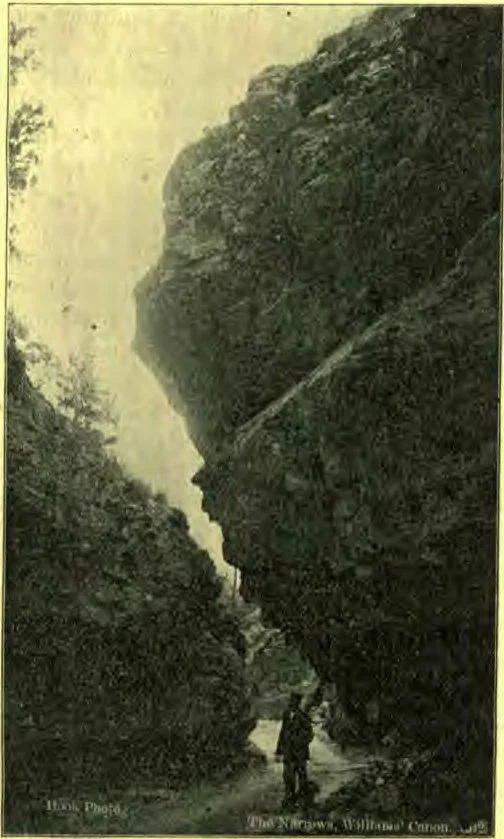
If such a bit of scenery as is suggested by the accompanying illustration, when seen in its natural beauty, does not arouse some thought of the great Master Architect, it is doubtful whether such a heart can be reached by any earthly means.
“The Narrows” are found a short distance up the Williams Canon, not far from the “Garden of the Gods.” Climbing slowly up this steep canon, where in places the road is so narrow that it would be utterly impossible for wagons to pass each other, upon gradually nearing the head of the canon we reach a place where the rocks entirely overhang the road; this, together with the abrupt curve that occurs at the same place, makes it appear, to one who is a few feet away, as if the road came to a sudden end. These massive rocks are laid side by side and layer upon layer with much more accuracy than is ordinarily displayed in the construction of a great stone wall. What a wonderful exhibition of the handiwork of that great Master Builder who formed the city to which Abraham looked, and which has been an incentive and inspiration in dark hours to God’s children throughout all generations!
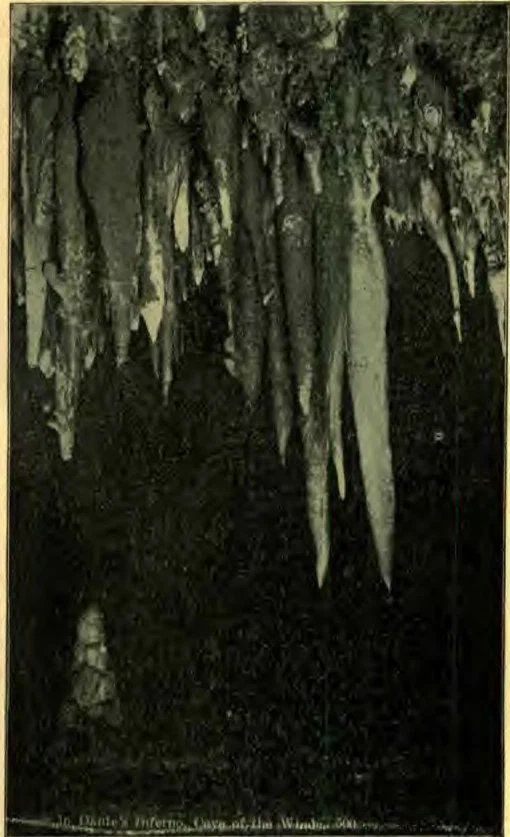
A little beyond this spot is a famous cave, known as the “Cave of the Winds.” Here the visitor may wander for hours hundreds of feet underground, seeing at every turn the most surprising and striking sights. One moment he will see, as the result of the slow changes of ages, work which is more marvelous than the most artistic fresco-work ever designed by human minds. Perhaps in another chamber will be built up by this same crystallizing process a series of reeds, side by side, which resemble those in some great church organ, and which, when struck, give forth distinctly musical sounds.
In other places the saline fluids have crystallized in such a way as to resemble, with a very little stretch of the imagination, the forms of human beings. The accompanying illustration only poorly represents the wonderful view of what has been named “Dante’s Inferno.” As the torch carried by the visitor lights up the ceiling and sides of this natural chamber, it seems as if it is fairly alive with various grotesque figures, which would make one shudder if he were at all superstitious.
It may yet be that before the end of time God will allow human beings to discover many such vast underground caverns; and it is possible that some of these may become the hiding-places of the children of God when they are compelled to flee before their enemies, leaving the populous cities and even quiet country homes.
DAVID PAULSON, M. D.

Solemnity of Living Versus Dying

“It is a more solemn thing to live than to die: for death but seals, and is born vanquished.”

II

FROM PERSECUTOR TO DISCIPLE

II

On one occasion Paul said: “Ye know, from the first day that I came into Asia, after what manner I have been with you at all seasons, serving the Lord with all humility of mind, and with many tears, and temptations, which befell me by the lying in wait of the Jews: and how I kept back nothing that was profitable unto you, but have showed you, and have taught you publicly, and from house to house, testifying both to the Jews, and also to the Greeks, repentance toward God, and faith toward our Lord Jesus Christ. And now, behold, I go bound in the spirit unto Jerusalem, not knowing the things that shall befall me there: save that the Holy Ghost witnesseth in every city, saying that bonds and afflictions abide me. But none of these things move me, neither count I my life dear unto myself, so that I might finish my course with joy, and the ministry, which I have received of the Lord Jesus, to testify the gospel of the grace of God.”
These words explain the secret of Paul’s power and success. He kept back nothing that was profitable for the people. He preached Christ publicly, in the market-places and the synagogues. He taught from house to house, availing himself of the familiar intercourse of the home circle. He visited the sick and sorrowing, comforting the afflicted, and lifting up the oppressed. And in all that he said and did, he preached a crucified and risen Saviour.
Paul’s great desire was to preach the gospel at Rome. In his letter to the church at that place he wrote: “For God is my witness, whom I serve with my spirit in the gospel of his Son, that without ceasing I make mention of you always in my prayers; making request, if by any means now at length I might have a prosperous journey by the will of God to come unto you. For I long to see you, that I may impart unto you some spiritual gift, to the end ye may be established; that is, that I may be comforted together with you by the mutual faith both of you and me.”
It was not curiosity that made Paul desire to see the capital of the world. He had been assured in a vision that he would be permitted to bear witness for the Lord in Rome.
Paul went to Rome as a prisoner. As he approached the city, his brethren came out to meet him. In the eyes of the world he was a criminal worthy of death, but in the eyes of his fellow Christians he was worthy of special honor. He tells us what effect his bonds had upon them. “Many of the brethren in the Lord,” he declares, “waxing confident by my bonds, are much more bold to speak the word without fear.”
After Paul had been in Rome three days, he called the chief men of the Jews together, and explained why he had been brought to Rome as a prisoner. He stated that he had done nothing against the people or the customs of the fathers; and that after being examined before the Roman authorities, he would have been set at liberty, had it not been for the opposition of his countrymen.
Paul manifested true Christian forbearance. He had been falsely accused by his countrymen in Judea, and had been subjected by them to an unjust trial. He had endured the hardships and perils of the journey to Rome, and was now awaiting his trial before the emperor. Yet when he told his brethren in Rome about his imprisonment, he made no complaint. Not that I had aught to accuse my nation of, he said; I did not come to accuse any one. I have called you together to speak of the hope of Israel, for which I am held in bonds. Acts 28:30.
“And Paul dwelt two whole years in his own hired house, and received all that came in unto him, preaching the kingdom of God, and teaching those things which concern the Lord Jesus Christ, with all confidence, no man forbidding him.”
Though kept a prisoner at Rome, Paul exerted a powerful influence. He was near the palace of the emperor, and he wrote to the Philippians: “I would ye should understand, brethren, that the things which happened unto me have fallen out rather unto the furtherance of the gospel; so that my bonds in Christ are manifest in all the palace, and in all other places.” We know that converts were made in the court of the emperor; for in concluding his letter to the Philippians, Paul said, “All the saints salute you, chiefly they that are of Cæsar’s household.”
For hundreds of years after Paul had laid off his armor, the papacy bore sway. Then Luther, an Augustine monk, brought up under the straitest rules of the papacy, went on a pilgrimage to Rome. He sought for salvation in the rites and ceremonies of a corrupt church. As he was performing an act of penance, slowly climbing on his knees up Pilate’s staircase, the words of Paul to the Romans came with peculiar force to his darkened mind, arousing his senses and touching his heart. “The just shall live by faith,” a voice seemed to say to him. That one sentence changed Luther’s whole life, and brought about one of the greatest reformations the world has ever witnessed.
MRS. E. G. WHITE.

A MODERN MIRACLE

The readers of this paper are very familiar with the story of the conversion to Christianity of a young Hebrew named Saul. It happened nearly two thousand years ago, and we have become accustomed to think of it as a wonderful event, belonging to an age of miracles and wonders long since past. But not long ago I heard a story of a similar wonderful change that took place in the heart of a young Japanese, whose life bears a strange resemblance in its progress to Paul's.
He told me the story himself. We were walking over one of the hills back of a great university town; and my Japanese friend, who was studying in the place for a year, was recounting to me the story of his life, and how he became a Christian. He spoke somewhat in this wise:—
“I was highly educated in the Japanese schools. I was always of a thoughtful and religious temperament, and loved to read our sacred books. I loved also to walk under the stars at night, and think and pray. My father was an honored government official, and held the chief offices in the empire. I had everything that money and position could procure. Of course our people were Buddhists, and I was brought up in the Buddhist faith. Not only did I read their books, and talk with their learned men, but I read Confucianism and Shintoism, trying to get down into the heart of their mysteries, trying to find what they taught about God.
“But as I grew to manhood, and my life expanded, there began to arise in my mind questions that these books could not answer; there began to stir in my heart yearnings which the god they revealed could not satisfy; mysteries surrounded me which the priests of Buddha could not solve; from the sacred writings there shone no light sufficient to light my way. For many weeks I was greatly troubled, and went about as one in dreams, praying and hoping that the light might break.
“No light came; but one day I saw for sale on an old bookstand a book in English, which purported to be the sacred book of Christianity. I had heard of the Christian missionaries, but despised them, just as you would despise a Buddhist preacher here; but my curiosity was aroused, and I bought this copy of the life of Jesus. Concealing it under my coat, I hurried home, ran up to my room, pulled my private screen, and somewhat listlessly began to read the opening pages. It was the first Gospel. I had not read through ten verses of the sermon on the mount before I became all lost in the great words; and as I read on through the wonderful truths, my heart beat faster and faster with eager expectation of some new light that soon might break. How the great truths thrilled me I can not tell. As I read on, I felt the darkness falling away, as a shroud might drop from a corpse as it awoke to new life. All I can say is that I read the Gospel through without a pause, and arose and fell on my knees, and prayed to the new God. Every question had been answered, every yearning satisfied, the meaning of life made plain, the darkness dissipated. I felt just as Saul felt when the scales fell from his eyes. The new light had dawned. I read all the Gospels and Letters, and then sought out a Christian missionary and talked with him. Everything grew clear, and for the first time I felt peace in my soul.
“But great trouble was to come. I knew that if I should confess myself a Christian, I would be disgraced in the eyes of the people, and it would break my mother's heart. My father had died, and my mother and I lived alone. She was a devout Buddhist, and hated the Christian missionaries. But I felt it my duty to tell her of the great change that had come over me.
“So one day, in fear and trembling, I told her all—told her the struggle, the darkness, the yearnings, I had passed through; how now my soul had found its satisfaction; how the meaning of life had been made clear, and the truth I needed had dawned upon me. She turned white as I listened, called me ‘traitor,’ and taking down my father's sword, said, ‘Unless you renounce all this foreign belief, I fall thus on the sword.’ Then she put the hilt against the wall, the point at her breast, and stood ready to fall against it.
“Oh, how my heart was torn between parental love and fidelity to Him! After much reasoning, I persuaded my mother to let me have a week to think it over, promising her I would review all the truths of her religion, and see if I could find rest there. I spent the whole week in my room. I hardly ate or slept. I grew thin and pale. How I remember the last night! I knelt by the open window all night long, and looked out over the moonlit sea, and prayed to my new God to show me the way.
“In the morning I went downstairs, and met my mother. I could not speak. She pitied me, and put her arms around me. Then I said, ‘Mother, before I answer, won't you let me read the new book to you?’ She hesitated, and then out of pity said, ‘Yes.’ So I read it to her day after day.”
Here my friend stopped a moment, but I eagerly asked, “Well?”
“Well,” he answered, smiling at me, “what could happen? The new light and the dear peace came into her heart; and three months later, she and I were baptized together into the Christian church.”
My friend is now a loved and devoted worker for his fellow men in Japan, and has caused the new light to shine in many a heart in that country. — Young People's Weekly.

THANKSGIVING

THANKSGIVING, O Thanksgiving! The heart can never tell The wealth of cheer That filled the year, But whispers, “All is well.”
For health we bring thanksgiving. That precious boon was ours, With lowing herds, And singing birds, And gardens bright with flowers.
For friends we bring thanksgiving. Beneath the tender blue, In love are sent, With kind intent, Our friendships warm and true.
For love we bring thanksgiving. Affection’s tightened grasp, A kindly thong Both true and strong, Binds hearts within its clasp.
But how can tongue of mortals The gifts of Him requite, Whose countless spheres Through ceaseless years Are rolling, bathed in light?
Our loving Heavenly Father, Accept our hearts, we pray, That life may be All praise to thee Each day Thanksgiving day.
B. F. M. SOURS.

LESSON 4 — PHOTOGRAPHS

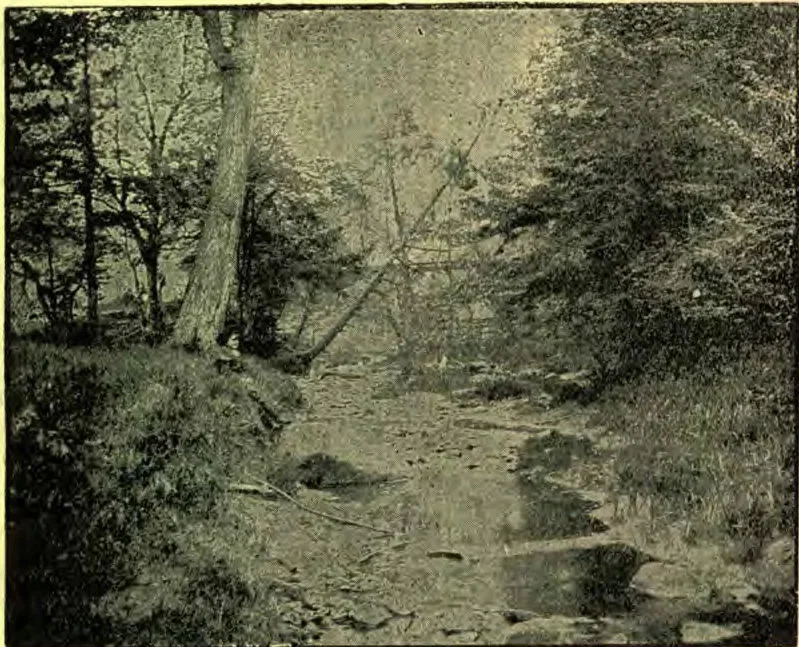
Much help may be received from photographs in the study of pen-work, as one often has access to excellent photographs of walls, trees, etc., water ruffled by the wind and many other effects, which might be difficult to obtain outdoors at the desired time. Careful pen-studies of these will be of great value to the student.
When photographs are used in illustrating, they are reproduced by what is known as the “half-tone” process. Unless the photograph is clear and distinct, the reproduction is not a success. A pen-drawing is generally made if this is the case.
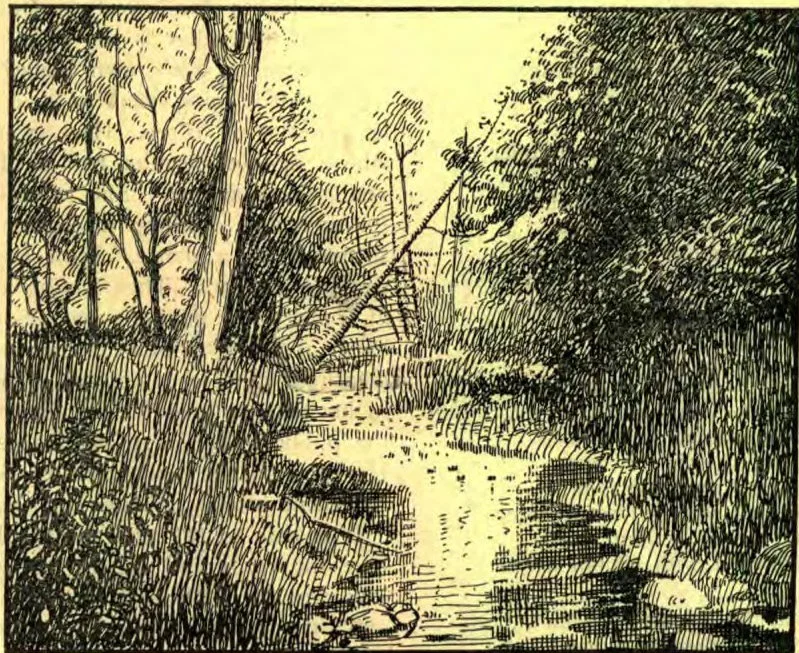
The student will be tempted, in drawing from a photograph, to put in his drawing all that he sees in the photograph; but he should endeavor to omit all the many small, uninteresting details, which detract from the principal objects of interest.
One of the main things to keep in mind when working from a photograph is that you must look at it, and study it, rather than copy it. Artists claim, and rightly too, that a photograph is not a true representation of nature as seen by the human eye. In it the relative values of color are not preserved. Blue is non-photographical; and as this color enters into nearly all colors of nature, the reader can readily understand how the relative values are not preserved. A dark-blue can be photographed; but it is the black, red, or whatever color is used in making the blue darker, which is photographed: pure blue can not be photographed. Thus while half-tones printed in black ink may be again reproduced, those printed in blue are useless for this purpose.
Just as a flower seen under a microscope is not the image of a flower as seen by the naked eye, so a photograph, of a street scene for instance, brings out hundreds of details, such as bricks, arches, the grain in wood, etc., which the usual pedestrian never notices; while a clever sketch, in which these details are absent, and the essential characteristics, which the eye takes in, are preserved, is a truer representation of what is seen by the human eye. The great charm of a sketch, if successful, is that it gives only what is desired.
When drawing from a photograph, forget that it is a photograph; endeavor to place yourself in the camera’s place, and think how such a scene would have impressed you, and how you would have rendered it with only pen or pencil to record your impressions.
Have you ever come by chance upon a scene that you have never looked upon before, which at first appears charming, but which seems to lose its beauty the more you look at it, or when viewed a second time? It is the detail which is seen after the first glance, that tires the eye, and causes the scene to lose its charm.
It is this first glance, preserved on canvas or paper, that makes a good picture, often more charming than the original. Thus we learn that all unessential details should be omitted when drawing from a photograph, and the main motive preserved.
Accompanying this lesson is a reproduction from a photograph, and a pen-drawing made from the reproduction. By comparing the two, the student will see what detail has been omitted.
PEDRO LEMOS.

BE KING IN YOUR LINE

Be king in your line. The world does not demand that you be a physician, a lawyer, a farmer, or a merchant; but it does demand that, whatever you do undertake, you will do it with all your might, and with all the ability you possess. The world does protest against a good shoemaker doing bad cobbling in a legislature; it does protest that a farmer shall not still do farming while in the pulpit; that a dry-goods clerk who would make a good engineer shall not continue to handle the yard-stick.—Success.

“GARLAND” STOVES AND RANGES

were awarded highest prize at Paris Exposition, 1900.

A WORD FOR STUDENT DAYS

Every year thousands of boys and girls, young men and young women, are entering high schools and universities all over the country. One watching the procession, and feeling the power of possibilities which these young lives hold, wonders what it means to them—what ideals they are following.
A man whose face was beaming with delight met a friend the other day.
“Tom’s going to get through!” he cried; “he’s really going to get through!”
Had that been the goal of Tom’s ambition through four years of splendid opportunities—that at the end he might somehow manage to “get through” without disgrace? What could his diploma mean to him but reproach?
There are other students, many others, whose hearts are fixed upon some prize, who bend every effort, sacrifice every pleasure, to the winning of that one thing. It may be wise, often it is; but perhaps quite as often it is not. All the teaching of schools and colleges can not be found in books or lecture halls. The real reward, always and everywhere, lies in one’s self. So it is even possible to purchase honors in philosophy or mathematics at too high a cost, if in exchange for them one pays the strength which God has given him for a life of useful work, the tenderness that sees a brother in every needy soul, the power of making friends and of finding joy all along the common ways.
Upon the arch at the entrance to the campus of one of our largest universities is an inscription which might well furnish an ideal to every student:—
SO ENTER THAT DAILY THOU MAYEST BECOME MORE LEARNED AND THOUGHTFUL SO DEPART THAT DAILY THOU MAYEST BECOME MORE USEFUL TO THY COUNTRY AND TO MANKIND
— Selected.

HUMAN INFLUENCE

In a late number of the Review, I found the following words in an article written by Elder W. P. Pearce: “Every word we utter, every look we give, every attitude we take, every act we commit, is photographed on others, molding to some extent their character, and shaping the destiny of their souls.”
Again: “Remember that upon a single word, or even a passing glance, some person may be influenced rightly or wrongly. One word spoken is said to set the pulsations of the atmosphere in motion until within twenty-four hours every part of the planet takes up the altered movement.”
A quotation from Elihu Burritt is also given: “No human being can come into this world without increasing or diminishing the sum total of human happiness, not only for the present, but during every subsequent age of humanity.”
After meditating upon these thoughts, there arose in my heart a feeling of solemnity mingled with gladness,—solemnity because of the awful reality of these facts, and gladness because of the grand and holy privileges before us. When we realize that a single word, or even a glance, may lead a soul to eternal ruin, how careful we should be that our looks, words, and actions bear the heavenly mold, that lives may be cheered and brightened through our influence.
While thinking of these things, there came to my mind this beautiful text, “Arise, shine; for thy light is come, and the glory of the Lord is risen upon thee.” These words impressed me with a depth of meaning that I have never before realized; and the thought came that if we, individually and as a body of young people, should heed this command, what a vast amount of good we might do, and what an important part we might take in warning the world of the soon coming of Christ. Shall we not, dear young friends, improve every opportunity of shining for him? Shall we not be always ready to give bright smiles, speak kind, hopeful words, offer needed assistance, and so make this sin-cursed earth brighter and better because we live in it?
K. Blossom Wilcox.

SHOULD CHRISTIANS PLAY CARDS OR DANCE?

We do not raise this question because there are many professed Christians who do these things, but to help the minds of some who may be in a quandary over the matter. To answer the question directly, I will say, No. Then arises the query, Why not? This can not be told in a word.
The Christian must learn to discriminate between right and wrong in every action, no matter how small. Every word we speak is either right or wrong, every deed and influence is either good or evil, and therefore is either acceptable or objectionable to God. Card-playing and dancing both come under God’s great measuring-rod of right and wrong. Let us apply a test: “The friendship of the world is enmity with God. Whosoever therefore will be a friend of the world is the enemy of God.” Now are these of the world?—Oh, yes, wholly so. Another test: Jesus says, “He that is not with me is against me; and he that gathereth not with me scattereth abroad.” What effect would card-playing and dancing have upon our power to draw people to Christ? If one were sick unto death, would he send for a dancer or champion card-player to pray for him?—Ah, no!
It may be that there is no intrinsic harm in certain things when they are considered apart by themselves, but that by their associations they become evil. That which produces evil fruit is wrong; for a good tree can not bear evil fruit. The home of card-playing is the gambling-den. Because it strays into respectable places, it does not therefore become transformed. A boy who is taught to play cards in the home of a professed Christian can not with consistency be reproved for playing them in a saloon. In many cases he will do it. He soon learns to play for money, for drink. He becomes crazy with drink and passion, and shoots a man over a game of cards. Is there anything wrong about his career? When did the wrong originate? Ah! it was wrong from the start; and the one who taught him to play, the man in whose home he was permitted to play, will have to bear his part of the responsibility for the awful results.
The dance is low in its native haunts. It is associated with sensual pleasures. Was ever any one led to God by a ball? How many have been led to ruin by the dance! The best people do not dance; the lowest do dance.
“Well, but what is the harm of a little private dance in one’s own home? Where’s the wrong of keeping step to nice music?” Let us follow it up to see. Here is an innocent girl, whose mother permits her to dance with her young companions. She conceives a passion for dancing. Nothing in the world pleases her so much as a dance. Soon boys become her dancing partners. Then having learned to dance at home, under mother’s eye, she can not see the harm of going to other homes for an evening’s pleasure. She loses control of her better sense in her intense love for the dance. She goes to the public ball. Here she learns to love wine. Her downfall is now marked. Soon she is lost to decent people. Where did the wrong begin?
It is safe to say that the youth who forms a love for cards and dancing is sure to lose his love for the Bible and for God. The effect is evil; the things themselves must therefore be wrong. G. C. TENNEY.

LOVE MAKES PERFECT

I was sitting alone in the twilight, With spirit troubled and vexed, With thoughts that were morbid and gloomy, And faith that was sadly perplexed. Some homely work I was doing For the child of my love and care,— Some stitches half wearily setting In the endless need of repair.
But my thoughts were about the building, The work some day to be tried, And that only the gold and the silver And the precious stones should abide, And remembering my own poor efforts, The wretched work I had done, And, even when trying most truly, The meager success I had won—
“It is nothing but wood, hay, and stubble,” I said; “it will all be burned,— This useless fruit of the talents One day to be returned: And I have so longed to serve Him, And sometimes I know I have tried; But I'm sure when he sees such building, He never will let it abide.”
Just then, as I turned the garment, That no rent should be left behind, My eye caught an odd little bungle Of mending and patchwork combined. Then my heart grew suddenly tender, And something blinded my eyes With one of those sweet inspirations That sometimes make us so wise.
Dear child! she wanted to help me, I knew ’twas the best she could do; But oh! what a botch she had made of it, The gray mismatching the blue! And yet, can you understand it? With a tender smile and a tear, And a half-compassionate yearning, I felt her grow more dear.
Then a sweet voice broke the silence, And the dear Lord said to me, “Art thou tenderer for thy little child Than I am tender for thee?” Then straightway I knew his meaning, So full of compassion and love; And my faith came back to its refuge, Like the glad returning dove.
So, I thought, when the Master Builder Comes down this temple to view, To see what rents must be mended, And what must be builded anew, Perhaps as he looks o’er the building, He will bring my work to the light; And seeing the marring and bungling, And how far it is all from right,
He will feel as I felt for my darling, And will say, as I said for her, “Dear child! she wanted to help me, And love for me was the spur; And for the great love that is in it The work shall seem perfect as mine;” And because it was willing service, He will crown it with plaudit divine.
And there, in the deepening twilight, I seemed to be clasping a hand, And to feel a great love constraining, Far stronger than any command. Then I knew by the thrill of sweetness, ’Twas the hand of the Blessed One, Which should tenderly guide and hold me, Till all the labor is done.
So my thoughts are nevermore gloomy, My faith is no longer dim, But my heart is strong and restful, And mine eyes are unto him.
—Selected.
Continue reading: WYOTA — THE STORY OF INDIAN BREAD