The Youth’s Instructor, Vol. 48, No. 46.

THE HARVEST TIME
Earlier text: THE HARVEST TIME

WYOTA — THE STORY OF INDIAN BREAD

“Manaho!” (hallo!) my friend said, cheerfully, as we neared the little group on the mountain-side.
“Manaho! manaho!” was echoed by a dozen tongues. A group of Indians, some brightly, some soberly dressed, were sitting on and around a great flat rock, over which bent springy boughs. Here were the Indian “mills,” and we had come to witness the interesting process of making the famous Indian bread known as wy-o-ta.
The mills themselves are simple affairs. Long, cylindrical rocks, tied sometimes to springing boughs, are pounded up and down in little hollows in the rock. In these hollows shelled and blanched acorns are placed, and quickly pounded to a fine meal. Some of this meal was handed me on a leaf. I tasted it, and to my surprise found it intensely bitter. I must have made a grimace; for the Indians who were watching me burst into laughter, and broad grins showed pearly teeth in almost every mouth. And here I may say that nowhere can a people be found whose teeth are better than those of the Sierra Indians. Aged men and women will display grinders still sound, though worn almost to the gums.
In speaking of the Indians I must not forget the children. While their mothers are making flour,—pound, pound, pound, half a day at a time,—the little ones are by no means idle. An old hatchet or knife in hand, they go out to make war on the sturdy pine saplings. Around every Indian mill these trees will be seen scarred and barked through the destructive instincts of the young warriors. These children like blindman’s buff, also, and their shout and hurrah often make the forest ring. They have many other games and pastimes, some of which I may speak of another time.
For making meal the white oak yields the most valued acorns. To gather these, the Indians beat the boughs, and pick up the nuts that fall. Years ago, before reservation laws were passed, the men climbed the trees, and cut off the branches, while women and children picked the acorns. It is maintained that the trees were kept young and vigorous by this pruning process.
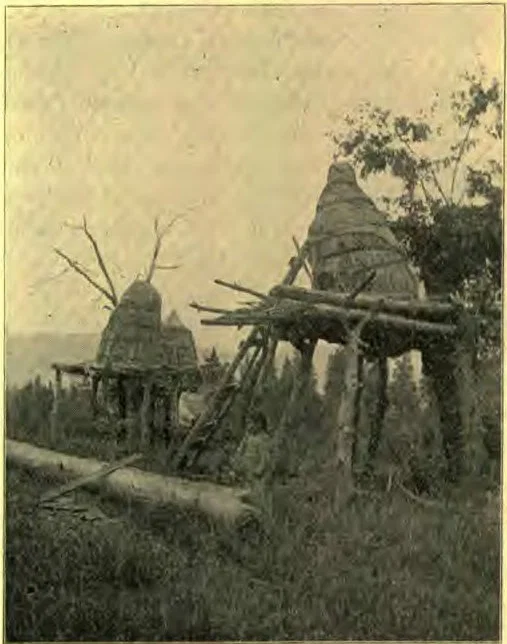
When the Indians go far from home to gather their crop, often they do not carry all the harvest home, but build cone-shaped storehouses of grass, bark, and twigs. These are always on some rock, stump, or platform open to wind and sun, that the nuts stored in them may cure nicely, without danger of molding. No matter how far from home they may be, the surplus harvest is always stored in these acorn houses. And all Indians respect them. No matter how strong their thieving propensities, some strange sense of honor keeps them from molesting another’s bread.
Often during the late harvest the weather is cold and damp; and the Indians, with scanty covering, must sleep on the bare ground. First they dig a hollow in some sheltered place, and build a great fire in it. When the earth is very hot, they rake away the embers, and sleep on the warm ground.
Now for the process of making bread. When the meal has been made, it is placed on a closely woven sieve made of fern roots. Scalding water is then prepared by throwing hot stones into baskets of water. This water is poured over the meal, gradually washing away the bitter tannin. When the meal has been made thoroughly sweet, it is mixed with water, and cooked in the same manner as the water is heated,—with hot stones. The mass quickly thickens, and when done, resembles heavy jelly in consistency. It is ashy gray in color, and in flavor is not unlike a raw chestnut, though not so sweet. The Indians eat it with fruit, milk, other nuts, and meat; for it combines well with all flavors. In their bills of fare it is as necessary as is bread in ours.
INDIAN ACORN HOUSES
INDIAN ACORN HOUSES
EDISON J. DRIVER.

MRS. HOLMAN'S SNAPSHOTS

“It’s a real pleasure to call at the Mason’s,” declared Ethel Holman, enthusiastically. “It’s so different there from—from—well, I might as well confess it—from the way we live here;” and Ethel laid on the table a late magazine that she had just borrowed from her friend.
“In what way, dear?” asked Mrs. Holman, quietly, as she turned Tom’s stocking, which she had been darning. “We haven’t the wealth—”
“It isn’t that, mother,” interrupted Ethel. “It’s hard to express; but they have a fondness for one another there that we don’t have at all. They’re so considerate of one another, too. Emma was making frosting for a cake when I got there, and Alice told her to leave it, and hurry right in, so as not to keep me waiting, and that she’d finish it. Beth wouldn’t have done it for me. I’d have been obliged to leave it—to spoil! It’s always just so there; I’ve noticed it scores of times. They’re always ready to assist one another. They do it in such a hearty way, too—not in a grudging spirit at all. When I was coming away, Emma started down to the gate with me; and Ralph, noticing that she had nothing on her shoulders, ran in for her cape. Tom wouldn’t have done a thing like that for me. Probably he never would have noticed that I hadn’t a wrap. I don’t see why my brothers and sisters aren’t as considerate—why we can’t get along as the Masons do.”
“I think, dear, I can show you;” and Mrs. Holman set her basket of stockings on the table, and went quietly into the hall. “It’s just the chance I’ve been longing for,” she said to herself, as she hurried up to her room.
When the door opened again, Ethel looked up inquiringly.
Mrs. Holman sat down by her daughter, and began to untie the little box that she carried in her hand.
“I think, dear, that this contains the secret of the want of love which you feel exists among us.”
“Why, those are only snapshots!” exclaimed Ethel, disappointedly. “They—they can’t reveal any secret! Then, too, haven’t I seen all the pictures you’ve ever taken?”
“Not all,” replied Mrs. Holman, soberly, passing one to Ethel as she spoke. “That, dear, I think tells a part of the secret.”
Ethel took the photograph, which Mrs. Holman had recently mounted. Her face flushed, and her eyes dropped. “Did—did I look like that, mother?” asked Ethel, handing back the picture.
“Yes, dear; ’twas only last Monday. You remember you were getting ready to take Miss Hall out driving, when Tom came in, and asked you to mend his catcher’s glove. You didn’t refuse; but it gave Tom no pleasure to have you do it—you frowned constantly till it was finished.”
“I—I—didn’t realize it.”
“No, dear; I’m sure you didn’t.”
Mrs. Holman handed Ethel another card. “This was taken while you were reading to Beth one afternoon when she was suffering from her sprain. I recollect that when Beth asked you to read aloud, you said you ‘s’posed you could do it, but you didn’t see why you should be shut in just because she was obliged to be.’ I took the snapshot from the doorway, when neither of you were looking.”
“Do hide it, mother,” and a tear trickled slowly down Ethel’s grieved face.
“This one shows when you were so provoked because Mary was invited to the Fuller’s instead of you; and this—”
“O mother! please don’t show me another!” begged Ethel, brokenly. “I—I—know now why we aren’t like the Masons, and—and it’s all my fault! It’s hard, mother, but the snapshots have revealed the secret that I might never otherwise have known; and—and before it’s too late to correct the fault. Hereafter we’ll be different, for I—”
“Know now what’s been the obstacle,” interrupted Mrs. Holman, gladly, taking a pledge kiss as she spoke.—Selected.

What Toodles Knew

A Scotch terrier, Toodles, knew perfectly well the words “mama;” “Chica,” the pet name of his little mistress; “Brun,” the name of a Newfoundland dog belonging to a neighbor; and “Rags,” the name of his mother. He was sent to stay with relatives of his mistress while the family were away for the summer holiday. When any of the familiar names were mentioned, he manifested the greatest eagerness and delight, whining and barking and turning his head first on one side and then on the other, until he was told that they were gone. Collett, another terrier, had still more pronounced intelligence in this direction. He was fiercely and uncontrollably jealous, and his heart was broken if his mistress so much as looked at another dog. He soon learned the word “dog,” and it roused him to fury. The family were fond of taking advantage of his infirmity, at the same time testing his keenness of hearing. Frequently, when he lay sleeping on the rug before the fire, some one would say, without altering the tone or raising the voice, as if the remark were a part of the conversation being carried on, “I see a much handsomer dog than you.”
This never failed to send him to the window like a whirlwind, where he would stand on his hind legs, his paws on the sill, bristling and barking outrageously. If a dog really happened to pass, he choked and swallowed, nearly strangling in his jealous rage, and it would be some time before he could be quieted or consoled.—Selected.

WHITESOCKS

Once I had a puppy dog,— A “shepherd” dog, they said,— A fuzzy, woolly ball of fur, With cunning tail and head.
He was the very prettiest pet, With long, soft ears like silk: And how he wagged his cunning tail, To see a dish of milk!
Whitesocks was the name we gave, For all his feet were white; I thought he’d grow a useful dog, And drive the cattle right.
But when he’d grown to be a dog, He chased them just for fun, And barked and barked till he was hoarse To see them plunge and run.
Some stranger cows he saw one day, And after them he tore, And ran and ran so far away We never saw him more.
Our dear Whitesocks was homeless then, And supperless each night; Far better had he stayed at home, And learned to do things right.
MINNIE ROSILLA STEVENS.

Going Back into Bondage

(December 1, 1900)
Lesson Text.—Gal. 4:6-11.
Memory Verse.—Ps. 85:8.
Begin your study by carefully reading the verses in last week’s lesson, as they are very closely connected with our present lesson. A few review questions are given on the first part of the chapter. Truth is like a chain of many links. If you study each lesson faithfully, you will enjoy tracing the connection between the different lessons, thus uniting the links of truth.

Questions

1. What is the condition of an heir before he becomes of age? What is he under? Till what time? Gal. 4:1, 2.
2. In what similar condition were we? To what time in our experience does this refer? Under what were we in bondage? V. 3.
3. In due time whom did God send? Under what conditions? For what purpose? Being redeemed, what do we receive? Vs. 4, 5.
4. Since we are sons, what has God sent us? What does the Spirit cry in our hearts? V. 6; note 1. What has the giving of the Spirit to do with the inheritance? Eph. 1:13, 14; note 2.
5. When we receive the Spirit, what change has taken place? What are we because we are sons? Through whom are we heirs? Gal. 4:7.
6. What had been the former condition of the Galatians? Whom did they not know? What gods did they serve? V. 8; note 3.
7. Whom had they come to know? or better, who had known them? To what were they returning? What did they desire? V. 9. What were these “weak and beggarly elements”? Col. 2:8; Eph. 2:11, 12; note 4.
8. What shows that they were turning back to heathenism? Gal. 4:10. What scripture shows that the heathen were observers of times? Deut. 18:10-12; note 4.
9. Because of their backsliding, what fear does Paul express? Gal. 4:11; note 5.

Notes

1. That God is our Father is a most precious truth. How sad it is that so many deny him, and daily curse his name. How it must grieve him to be thus treated by those for whom he has done so much. And how heaven must rejoice when the prodigal sons return to their Father!
2. When an heir becomes of age, he is no longer in bondage. He may not at this time come into full possession of all his father’s estate; but it is customary for a man of means to give his sons a start in life when they reach manhood. As sons of God, we receive the promise of the Spirit, which we have found is the promise of the inheritance. Gal. 3:14-18. But do we receive only a promise when we become sons of God?—No; we receive the gift of the Spirit. And this is the earnest, the pledge, that we shall receive the full inheritance when the purchased possession is finally redeemed. Acts 2:38, 39.
3. The Galatians had been 'converted from heathenism. At that time they “were in bondage to them which by nature are no gods.” This is the reading of the Revised Version. The service of false gods is always bondage; for it is prompted by fear, never by love. Furthermore, all false gods simply reflect the sinful characters of those who worship them. It is evident that such service could bring the worshipers into nothing but bondage.
4. Many of the services of the heathen consisted in observing festivals on both regular and special occasions. Examples are found in the celebration of the mysteries among the Greeks and Romans. Days were dedicated to the various gods and heroes of their mythology, and observed in various ways. Births, weddings, and deaths were also celebrated with religious rites. In the marginal reading of Isa. 47:12, 13, there is a reference to the observance of months.
5. Paul was not solicitous for himself, but for them. He feared that they would eventually give up their hope in Christ, and so his labor for them be lost. He had an earnest desire and longing to reclaim them from their errors, and bring them again to a knowledge of the truth.

BEREAN LIBRARY STUDY

Revelation 6; “Thoughts on the Revelation,” pages 402–434

NOTES ON LESSON 6

  • (November 25 to December 1, 1900)*
The Lamb.— The wonderful love of God for us is shown by Christ’s being recognized as a Lamb in the midst of the throne. This is a constant reminder to the heavenly host that he is the sacrifice for fallen humanity. In heaven as well as on earth it can be said, “Behold the Lamb of God, which taketh away the sin of the world.”
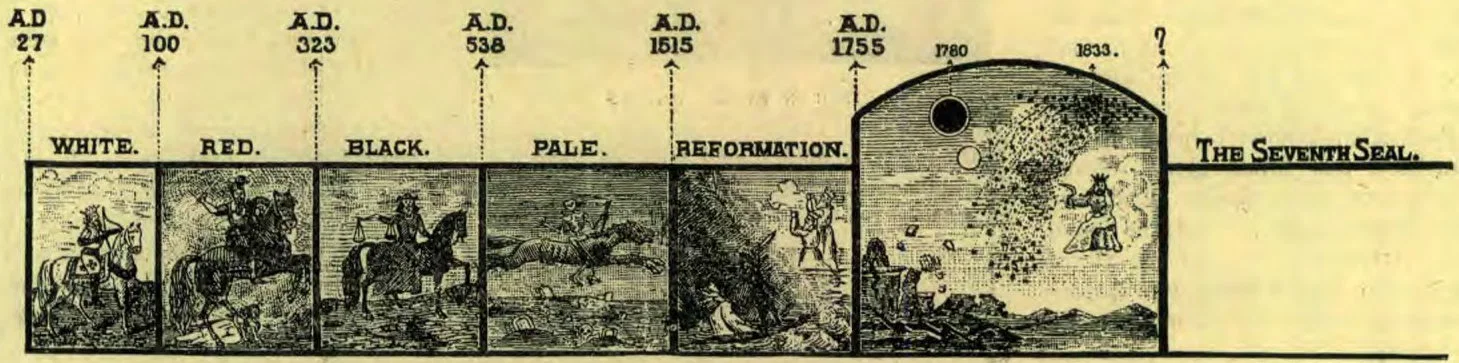
The White Horse.— White denotes purity. The church went forth as an aggressive power, and in a few years the good news of salvation had spread over all the then known world. This condition of prosperity continued until the close of the first century.
THE SEVENTH SEAL.
THE SEVENTH SEAL.
The Red Horse.— The purity indicated by the white horse had now departed from the church. Persecution came in; and a great sword, not a very peaceful weapon for a church to wield, was given the rider. When Constantine nominally accepted Christianity, and the church began to compromise principle in order to gain worldly favor, it placed a great power in the hands of the church. This was not an omen of good, but a sword that inflicted a severe wound upon the church.
A Black Horse.— This is one of the saddest periods in the history of the church. Persecution from without was not to be compared with the calamity that befell the church when it was wounded by its friends. Heathen customs found their way into the church almost imperceptibly. When the persecution ceased, it became popular to be a Christian. In the courts and palaces of kings, persons accepted the form of Christianity, but rejected the simplicity and meekness of the true followers of the lowly Nazarene. They took, instead, the pomp and ceremonies of the pagan religion. “The nominal conversion of Constantine in the early part of the fourth century caused great rejoicing; and the world, cloaked with a form of righteousness, walked into the church. Then the work of corruption progressed rapidly. Paganism, while appearing to be vanquished, became the conqueror. Her spirit controlled the church.” But God’s care is over all, and from the midst of the four beasts of heaven comes a voice limiting their power, and warning them not to hurt “the oil and the wine,” the true Christian graces. He who has set bounds for the sea, and said, “Hitherto shalt thou come, but no further: and here shall thy proud waves be stayed,” also places a limit on the power of darkness. He will not let the waves of worldly policy completely overwhelm his people.
The Pale Horse.— The mystery of iniquity was now established, and began to show forth the satanic spirit of its master. The Bible was taken from the people, and heathen superstitions were taught in its place. The Sabbath of the Lord was dethroned, and a spurious rest-day was given to the people. “In the early part of the fourth century the emperor Constantine issued a decree making Sunday a public festival throughout the Roman Empire. . . . Vast councils were held from time to time, in which dignitaries of the church were convened from all the world. In nearly every council the Sabbath, which God had instituted, was pressed down a little lower, while the Sunday was correspondingly exalted.” Thus the pagan festival came finally to be recognized by the mass of the people as the Sabbath; but there were always a faithful few who honored the Sabbath of the Lord.
The Fifth Seal.— During this period God raised up men to stand in defense of the gospel, and one by one the coverings of falsehood that the papacy had spread over the pure gospel were removed by these resolute reformers. The Bible was brought out from its hiding-place. It was no longer chained either by literal chains or by being kept in a dead language. It was translated into the language of the common people, and placed in their hands. The martyrs who had given their lives for the gospel under the fourth seal were now given white robes of character; and they, with all other martyrs, will also be honored on the new earth. From “Early Writings,” page 14, we read as follows: “As we were traveling along, we met a company who were also gazing at the glories of the place. I noticed red as a border on their garments; their crowns were brilliant; their robes were pure white. As we greeted them, I asked Jesus who they were. He said they were martyrs that had been slain for him. With them was an innumerable company of little ones; they had a hem of red on their garments also.”
The Sixth Seal.— The scene of action changes; no longer is it confined to the people upon the earth; but the old earth itself is mightily convulsed, telling in unmistakable language that the end of all things is near. Then the heavens take up the refrain; and the sun, that faithful witness in heaven, testifies to the fact that the end of all things is at hand. The moon, which for six thousand years has transmitted to man what it has received from the sun, now re-echoes the faithful testimony, and hangs as a great ball of blood in the sky in fulfillment of the words, “The moon became as blood.” A few years later the stars fell as untimely figs. We are living between the thirteenth and fourteenth verses of Revelation 6. There are three heavens,—the first, or atmospheric, heaven (Jer. 4:25; Zeph. 1:3), where the birds fly; the second, or starry heaven (Rev. 6:13); and the third heaven, where God dwells. 2 Cor. 12:1–4. The first heaven is tainted with the effects of sin, and will be rolled together. Peter says, “The heavens shall pass away with a great noise.” The air is composed of various gases; and when the Great Master sees fit to roll it together, there will be an explosion that will echo through the universe of God. Every island and mountain will be moved out of its place.
Read the chapter on the Deliverance of the Saints, in “Early Writings,” or Chapter XL in “Great Controversy,” Vol. IV.

Who Talks of Evil: On Everlasting Hope

“Who talks of evil conjures into shape That formless thing, and gives it life and scope. This is the law; then let no word escape That does not breathe of everlasting hope.”

CHICAGO & GRAND TRUNK R'Y

E. W. Meddaugh and Henry B. Joy, Receivers.

CHICAGO & GRAND TRUNK R'Y.

Trains leave Battle Creek.

WEST-BOUND FROM BATTLE CREEK.

No. 9, Mail and Express, to Chicago......................... 12.15 P. M.
No. 1, Chicago Express, to Chicago........................ 8.30 A. M.
No. 3, Lehigh Valley Express, to Chicago.................. 3.50 P. M.
No. 5, International Express.............................. 2.15 A. M.
No. 75, Mixed, to South Bend.............................. 8.30 A. M.
Nos. 9 and 75, daily, except Sunday.
Nos. 1, 3, and 5, daily.

EAST-BOUND FROM BATTLE CREEK.

No. 8, Mail and Express, East and Detroit.................. 3.45 P. M.
No. 4, Lehigh Express, East and Canada..................... 8.27 P. M.
No. 6, Atlantic Express, East and Detroit................. 2.25 A. M.
No. 2, Express, East and Detroit.......................... 6.50 A. M.
No. 74, Mixed (starts from Nichols)....................... 7.15 A. M.
Nos. 8 and 74, daily, except Sunday.
Nos. 4, 6, and 2, daily.
G. W. VAUX,
G. P. A., CHICAGO.
W. C. CUNLIFFE, Agent,
BATTLE CREEK.

PROSPECTUS NOW READY

BEST STORIES FROM THE BEST BOOK

By J. E. WHITE.
In Four Languages: English, German, Danish, Swedish.
Begins with over fifty pages of charming “easy lessons,” including model nature studies for children, with fifteen beautiful colored plates, and many pen-drawings. Concludes with about 150 pages of entertaining “Bible stories” from the Old and the New Testament Scriptures, with numerous full-page engravings and other artistic illustrations.

AN EVERYDAY BIBLE COMPANION FOR THE HOME,

DEVOTIONAL AND PRACTICAL,

COMPRISING TWO HUNDRED LARGE OCTAVO PAGES.

STYLES AND PRICES IN EACH OF THE FOUR LANGUAGES: Heavy paper edition, cloth back and corners........75 cents Thin paper edition, board cover........50 cents Thin paper edition, limp paper cover........25 cents
“Best Stories from the Best Book” has been designed with special reference to the needs of the children. For this reason it has been profusely illustrated. The experience of years has fully demonstrated that immature minds need good illustrations to impress the truths presented in either oral or written lessons.
We have been instructed that for people of childlike minds “we should have issued books in so simple a style that a child might have understood them, for many of them are only children in understanding. Pictures and object lessons should have been used to present to the mind valuable ideas. Children and youth should have been educated in such a way that they could have been instructors and missionaries to their parents.”
The Bible stories have been prepared with special reference to teaching the truth. Many vital points of present truth are considered in a manner to cause a deeper investigation of these subjects from the Bible.

IN FOUR LANGUAGES.

“BEST STORIES” is being carefully translated from the English into the German, Danish, and Swedish languages. The Author’s profits from the sale of this book will be used in behalf of the southern missionary work.
1,000 CANVASSERS Can earn $200,000 from the sale of 1,000,000 copies of “Best Stories from the Best Book.” The easiest seller ever prepared for little people. 750,000 copies of “Gospel Primer” have been sold. “Best Stories” will sell more readily. The prospectus shows all four languages and the three styles of binding. It, with printed description for agents, will be mailed, postpaid, to any address, for 35 cents. With this you can immediately begin work, taking orders in all these languages by only once passing over the ground.
This is an easy-selling canvasser’s “HELP.” Subscription book profits to agents. The English book will be ready for canvassers to deliver for the holidays. The foreign editions will immediately follow.
Address your tract society, or the—
REVIEW AND HERALD PUB. CO., Battle Creek, Mich.,
or the—
PACIFIC PRESS PUB. CO., Oakland, Cal.

A BEAUTIFUL HOLIDAY BOOK

JUST FROM THE PRESS.
— ENTITLED —

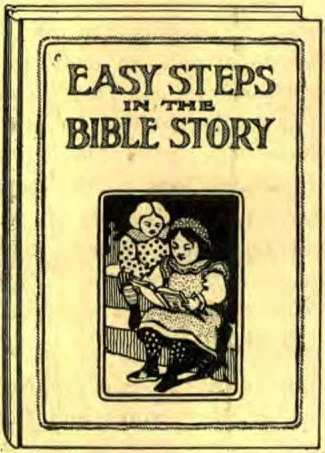
Easy Steps in the Bible Story

By ADELAIDE BEE COOPER
Introduction by ELDER STEPHEN N. HASKELL.
SOLD BY SUBSCRIPTION ONLY.
AGENTS WANTED IN EVERY CHURCH.
Profits go to General Conference Association.
The beautiful stories of the early Bible times never lose their charm. In Easy Steps in the Bible Story the author takes up the early Bible narratives in their natural order, drawing a lesson from each and showing their relation and bearing to present truth.
This book will be read with interest and profit by all.
This book contains 160 pages, table of contents, and list of illustrations. Our artist has prepared 150 beautiful pen drawings, illustrating the text of the book. It also contains many full-page illustrations. Beautiful cover design. Two styles of binding.
PRICE, IN CLOTH, 50 CENTS.
PRICE, IN PAPER, 25 CENTS.
The price brings the book within the reach of all. Ready for delivery. Order at once.
For particulars address your tract society, or—
REVIEW AND HERALD PUB. CO., BATTLE CREEK, MICH.,
Or PACIFIC PRESS PUB. CO., Oakland, Cal.

AN EVIL PLANT

One of the tares that the enemy loves to plant in the soil of the heart is suspicion. And if it receives ever so little encouragement, immediately it springs up, and begins to grow, filling the heart, warping the mind, and making its poisonous influence felt far and wide. But however far its work may spread, however cruelly and unjustly it may sit in judgment on the motives and acts of others, its worst effect is upon the heart of the one who cherishes it. For it is impossible to look at people with anything like a spirit of love, and at the same time be suspicious of their acts, their motives, whatever they do and say; and where the love-spirit is not, there is a “legion” of Satan’s angels ready to bring bitterness and envy and jealousy into the mind—company with which there can be nothing but unhappiness. If you find the plant of suspicion growing in your own heart,—if it is easy for you to look with distrust upon others, to impute unworthy motives to them,—then beware. Get rid of this plant by cherishing only the kindest of thoughts about all; look for the best motives, and ascribe them to those whom you were inclined to view with distrust—and you will find yourself in a far happier, as well as far safer, frame of mind.

SABBATH-SCHOOL OFFICERS, ATTENTION!

WATCH the figures on the printed address-label on the wrapper, and be sure to renew your club of INSTRUCTORS before the subscription expires. It has been our custom to send out notices to schools whose clubs were soon to expire, that renewals might reach us in time to prevent our dropping the club from the list; but in spite of this precaution, we are obliged to do this in many cases, and it is usually several weeks before the clubs are again entered. To have the paper dropped out for a time, especially where it is depended on for the Sabbath-school lesson, must certainly have a depressing effect on the school. The thought has occurred to us that the trouble is sometimes occasioned by changing officers at the end of a quarter. In all cases, retiring officers should call the attention of their successors to the time when the subscription to the club expires, and advise them to renew promptly, that there may be no misunderstanding nor delay. A little thought and care at the right time will, we are sure, do much to conduce to the best interests of the school. We shall greatly appreciate your co-operation in this matter.

TWO BEAUTIFUL BOOKS FREE

By sending five new subscriptions to the YOUTH'S INSTRUCTOR, at 75 cents each, you will receive, free of charge, the beautiful new book by Vesta J. Farnsworth, entitled “The House We Live In.” We will also send our Premium Bible for six new subscriptions at 75 cents each. Both these books are fully described in another column. We hope scores of our young people will take advantage of this opportunity to obtain these books. With a little effort, you can easily secure a sufficient number of subscriptions to entitle you to one or both these books free. One worker has sent in twelve subscriptions to the paper, and expects to forward more. Now is the time to work. Who will respond? Sample copies will be sent on application. Address the YOUTH'S INSTRUCTOR, Battle Creek, Mich.

Correction to Malay Kite Dimensions in Instructor

In giving the dimensions of that improved Malay kite described in the “Notes and Comments” column of the INSTRUCTOR for October 25, a mistake was made in giving the length of the long frame-stick. The length is only seventy-one inches—not seventy-seven inches, as there stated. The other dimensions are correct as given.

Our Premium Testament

As an aid to daily Bible study, and to memorizing the Scriptures, there is nothing better than a pocket-edition. We have secured a beautiful Vest-pocket New Testament, size 4 x 2¾ in., that we offer, postpaid, with the INSTRUCTOR one year, for only $1.00. Well printed, in ruby type, as shown; Flexible Covers, Round Corners, Red under Gold Edges,—a splendid little book.
This offer is made to both renewals and new subscribers. Address—
THE YOUTH'S INSTRUCTOR, BATTLE CREEK, MICH.
Continue reading: SELF-PRONOUNCING S.S. Teachers’ Reference Bible