The Scottish Covenanters’ Contest for the Rights of Conscience
Page 1
The American Sentinel
Jun 18, 1896
Pacific Press Publishing Company · New York · Jun 18, 1896
The Scottish Covenanters’ Contest for the Rights of Conscience.
By S.
The long struggle between freedom and despotism which has centered around the rights of conscience, affords perhaps no picture more pathetic and sublime than that presented by the lowland Christians of Scotland, in their heroic maintenance of their faith under bitter persecution, in the latter half of the seventeenth century.
It is at a critical epoch of the Reformation that the “Covenanters,” as these Christians were called, came prominently upon the stage of action. “The Reformation was ebbing in Germany, in France, in Holland, in all the countries of Christendom; everywhere a double-headed tyranny was advancing on men, trampling down the liberties of nations and the rights of churches.” But God had left not himself without witnesses, and in that as in every other crisis of his work he had chosen ones who would not bow the knee to Baal,—men and women who held not their lives dearer than their Master’s cause, which was the cause of humanity, and whose zeal waned not either in the face of general spiritual declension, or of the dragon of prosecution. These held aloft the standard of liberty which elsewhere was trailing in the dust, and the value of their service to humanity cannot be measured. In the persons of these noblest of her representatives, Scotland “had so illustrated the fundamental principles of the struggle and the momentous issues at stake, and she had so exalted the contest in the eyes of the world, investing it with a moral grandeur that stimulated England, that she mainly contributed to the turning of the tide and the triumph of the Protestant cause all over Christendom.”
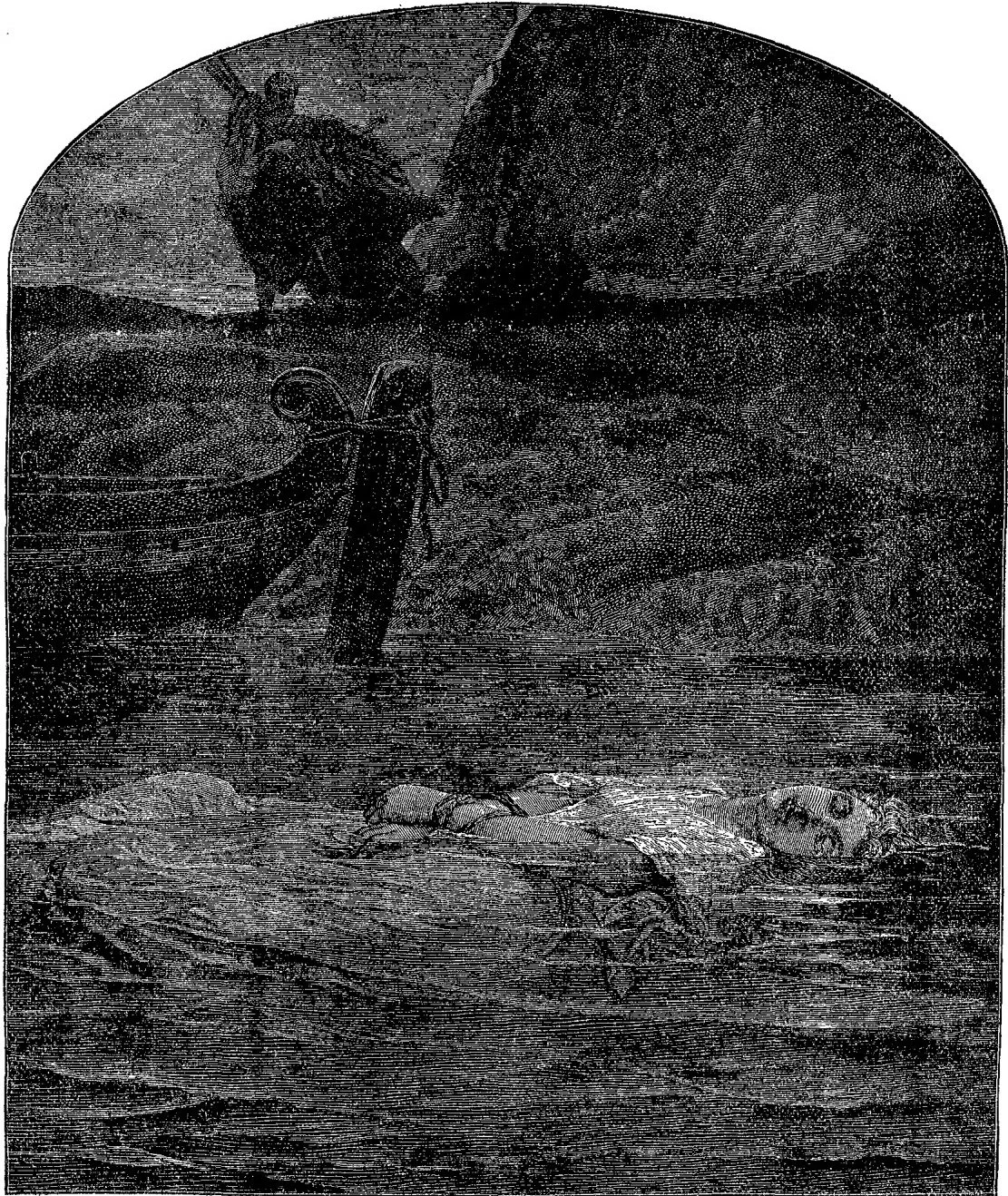
THE MAIDEN MARTYR.
Theirs Was a Contest With the Government.
The contest of the Covenanters was a contest with the government. Charles II. was then seated upon the throne of Great Britain. Though professedly a Protestant, he was a Romanist at heart, and a ready tool in the hands of the Jesuits. As a civil ruler he was ambitious, unscrupulous, despotic. He determined that no authority other than his own should be acknowledged in his kingdom in any matter, either civil or religious. Accordingly, one of his first acts as king was the securing from the Scottish parliament of the “Act of Supremacy, which transferred the whole power of the Church to the king, by making him absolute judge in both civil and ecclesiastical matters.” “This act was immediately followed by another,194which was meant to carry into effect the former. This second act imposed an oath of allegiance. . . . The new oath bound the swearer to uphold the supremacy of the king in all religious as well as all civil matters; and to refuse the oath, or deny the principle it contained, was declared to be high treason.” But the Scottish Christians felt themselves bound by the “Solemn League and Covenant,” to which they had sworn only a short time before, and which stood in direct opposition to the oath demanded by the king. It was an oath which allegiance to Christ would not permit them to take.
The obligations imposed by the “Solemn League and Covenant,” as summarized by the historian, were: “1. Defense of Reformed Presbyterian religion in Scotland. 2. Promotion of uniformity among the churches of the three kingdoms. 3. Extirpation of popery, prelacy, and all unsound forms of religion. 4. Preservation of parliaments, and of the liberties of the people. 5. Defense of the sovereign in his maintaining the reformed religion, the parliaments, and the liberties of the people. 6. Discovery and punishment of malignants, and disturbers of the peace and welfare of the nations. 7. Mutual protection and defense of each individually, and of all jointly, who were within the bonds of the Covenant. 8. Sincere and earnest endeavor to set an example before the world of public, personal, and domestic virtue and godliness.”
The Purpose of the King.
The king—the government—was determined to establish prelacy in Scotland. It was to this end that these acts had been passed aiming to make him the acknowledged authority in both the civil and spiritual realms. Accordingly, “the bishops held diocesan courts, and summoned the ministers to receive collation at their hands. If the ministers would obey the summons, the bishops would regard it as an admission of their office. . . . To their great mortification very few ministers presented themselves. In only a few solitary instances were the episcopal mandates obeyed.”
Middleton, the king’s prime minister in Scotland, was very wroth at this contumacious disregard of authority. “To the irascibility and imperiousness with which nature had endowed him, Middleton added the training of the camp, and he resolved to deal with this matter of conscience as he would with any ordinary breach of military discipline. He did not understand this opposition. The law was clear. The king had commanded the ministers to receive collation at the hands of the bishop, and the king must be obeyed, and if not, the recusant must take the consequences.”
Yes, “the law was clear,” and, by the “logic” which persecution invokes, there was nothing left for the king’s officer but to enforce it; and enforce it he did. It was quite in harmony with his nature to inflict cruelties upon such as dared stand for liberty of conscience against his own command and the “law” of the realm; and had his nature been otherwise, he would doubtless still have been able to foresee, after the manner of some eminent men of our times, that “the best way to get rid of a bad law is to enforce it;” so that the result to the unfortunate Scots would have been the same. It is bad enough to become the victim of the passions of men by nature base and unprincipled; but no cruelty of human passion ever exceeded the cruelty of “logic,” in the grasp of short-sighted finite intellects fired by religious zeal. No weapon has ever proved more dangerous to the rights and liberties of mankind.
Banished for Their Faith.
At a meeting of the King’s Privy Council, held in the College Hall of Glasgow, Oct. 1, 1662, for the purpose of devising decisive measures for crushing the opposition to prelacy, it was resolved “to extrude from their livings and banish from their parishes all the ministers who had been ordained since 1649, and had not received presentation and collation as the king’s act required. In pursuance of this summary and violent decision, a proclamation was drawn up, to be published on the 4th of October, commanding all such ministers to withdraw themselves and their families out of their parishes before the 1st of November next, and forbidding them to reside within the bounds of their respective presbyteries.”
“Hardly four weeks had he given the ministers to determine the grave question whether they should renounce their Presbyterianism or surrender their livings. They did not need even that short space to make up their minds. Four hours—four minutes—were enough when the question was so manifestly whether they should obey God or King Charles. When the 1st of November came, four hundred ministers—more than a third of the Scottish clergy—rose up, and quitting their manses, their churches, and their parishes, went forth with their families into banishment.”
“It was the beginning of winter, and the sight of the bare earth and the bleak skies would add to the gloom around them. They went forth not knowing whither they went. . . . The sacrifice they were now making had only added to their guilt in the eyes of their monarch, and they knew that, distressing as was their present condition, their future lot was sure to be more wretched; but rather than take their hands from the plough they would part with even dearer possessions than those of which they had been stripped. They had counted the cost, and would go forward in the path on which they had set out, although they plainly descried a scaffold at the end of it.”
They Met in the Fields.
“It was now that the field-meetings termed ‘conventicles’ arose. The greater part of the pious ministers cast out, and their places filled by incapable men, the people left the new preachers to hold forth within empty walls. It was in vain that the church doors were thrown open on Sunday morning; few entered save the curates’ dependants, or the reprobates of the place; the bulk of the population were elsewhere; . . . they had gathered by hundreds or by thousands, devout and reverend, on some moorland, or in some sequestered glen, or on some mountain side, there to listen to one of the ejected ministers, who taking his stand on some rock or knoll, preached the word of life.”
All this, of course, was exceedingly mortifying to the bishops, and only added to their rage and determination to crush out the spirit of religious liberty. The common people now became the victims of their tyranny. “The conventicle was denounced as a rendezvous of rebellion, and a rain of edicts was directed against it. All persons attending field preachings were to be punished with fine and confiscation of their property. Those informing against them were to share the fines and the property confiscated, save when it chanced to be the estate of a landlord that fell under the Act. These good things the Privy Council kept for themselves. . . . Magistrates were enjoined to see that no conventicle was held within their burgh; landlords were taken bound for their tenants, masters for their servants; and if any should transgress in this respect, by stealing away to hear one of the outed ministers, his superior, whether magistrate, landlord, or master, was to denounce or punish the culprit; and failing to do so was himself to incur the penalties he ought to have inflicted upon his dependants. These unrighteous edicts received rigorous execution, and sums were extorted thereby which amazed one when he reflected to what extent the country had suffered from previous pillagings. It was not enough, in order to escape this legal robbery, that one eschewed the conventicle; he must be in his place in the parish church on Sunday; for every day’s absence he was liable to a fine.”
Made a Capital Crime.
Finally an edict was issued which made it a capital crime to attend a field-preaching bearing arms. That the Covenanters did bear arms at these gatherings, and that they offered armed resistance to the king’s forces, was a source of great weakness to their cause. They were engaged in a contest which, while conducted simply through faith in God, could know no defeat, for God himself has made victory sure to faith. But when they essayed to fight the battle with worldly weapons of warfare, the event by no means justified their position. The battle for God’s authority against the king’s was God’s battle; but the Lord’s battles are not fought by the losing side. They took the battle out of God’s hands, and the result was disaster. God’s battles are fought not with carnal weapons, but with “the sword of the Spirit, which is the word of God.” Nothing can stand before that sword, and all who hold to that word by faith will triumph with it.
Their Military Power Broken.
A disastrous engagement with the king’s forces on June 22, 1679, left the military power of the Covenanters completely broken, and 1,200 of the latter prisoners in the hands of their enemies. These unfortunates were made the victims of every species of barbarity. At the end of five months their number was reduced by nearly 1,000, the most of these having succumbed to inhuman treatment. The remainder were transported to Barbadoes, and the ship being wrecked in a storm, many were drowned, and others who reached the land were sold into slavery.
“The years that followed are known as ‘the killing times;’ and truly Scotland during them became not unlike that from which the term is borrowed—the shambles. The Presbyterians were hunted on the mountains and tracked by the bloodhounds of the Privy Council to the caves and dens where they had hid themselves. Claverhouse and his dragoons were continually on the pursuit, shooting down men and women in the fields and on the highways. As fast as the prisons could be emptied they were filled with fresh victims brought in by the spies with whom the country swarmed. . . . Aged matrons and pious maidens were executed on the scaffold, or tied to stakes within sea-mark and drowned. The persecution fell with equal severity on all who appeared for the cause of their country’s religion and liberty. No eminence of birth, no fame of talent, no luster of virtue, could shield their possessor from the most horrible fate if he opposed the designs of the court. Some of lofty intellect and famed statesmanship were hanged and quartered on the gallows, and the ghastly195spectacle of their heads and limbs met the gazer in the chief cities of the kingdom, as if the land were still inhabited with cannibals, and had never known either civilization or Christianity. It is calculated that during the twenty-eight years of persecution in Scotland, 18,000 persons suffered death, or hardships approaching to it.”
Thus heroically did the Scottish Covenanters maintain upon their native heath the contest for the supremacy of that principle long before enunciated by the apostles Peter and John to the Sanhedrim,—“We ought to obey God rather than men.” That they grasped the principle in its full breadth, as separating the sphere of religion from that of the civil power, cannot be said. The views expressed and attitude maintained by them during this period clearly show that they did not. They battled with error in its grosser forms, as was necessary while the world was just emerging from the shadows of the Dark Ages. It was left for a later generation to proclaim to the world the rightful freedom of the conscience from all human coercion, and of man’s natural right under it to believe and practice whatever he will, so long as he does not invade the rights of his fellows. All this was involved in and justified by the resistance of the Covenanters to the government and the “law;” and it is a pity that their descendants of this day, instead of upholding the doctrine of the inviolability of conscience against coercion by the civil power, are striving to erect in this country the same religio-civic despotism which brought such a bitter experience to their ancestors two centuries ago. S.
CIVIL GROUNDS OF RELIGIOUS INTOLERANCE.
In No. 18 of the current volume of this paper was published an article under this title in which it was shown that “in all ages and in every country religious intolerance has been defended on the ground of public policy,” and that “dissenters have ever been stigmatized as enemies of the State, subverters of social order, and disturbers of the public peace.” The proof of these propositions was conclusive, but by no means as full as it might have been. Indeed, to exhaust the subject would be to review the entire history of the world, for substantially the same arguments have been urged in justification of restrictions of freedom of conscience in every country and in every period.
Speaking of the causes of pagan persecutions, Lecky says that “they were partly political and partly religious.” The same writer explains this statement in this way:—
In the earlier days of Rome religion was looked upon as a function of the State; its chief object was to make the gods auspicious to the national policy, and its principal ceremonies were performed at the direct command of the Senate.
Of certain repressive measures directed by the Romans against other religions than their own, Lecky says:—
They grew out of that intense national spirit which sacrificed every other interest to the State, and resisted every form of innovation, whether secular or religious, that could impair the unity of the national type, and dissolve the discipline which the predominance of the military spirit and the stern government of the Republic had formed.
It thus appears that the real motive that led the pagans to persecute the Christians was a desire to preserve intact their civil institutions; the very motive which to-day actuates the Czar in the persecution of Jews and Stundists, and that is urged in our own country in justification of certain measures of religious legislation. In justification of Sunday laws, Mr. Crafts says, as quoted in our former article:—
It is the conviction of the majority that the nation cannot be preserved without religion, nor religion without the Sabbath, nor the Sabbath without laws, therefore Sabbath laws are enacted by the right of self-preservation, not in violation of liberty, but for its protection.
This is but a revamping of the old pagan theory firmly believed by the multitude. Lecky says, “that the prosperity and adversity of the empire depended chiefly upon the zeal or indifference that was shown in conciliating the national divinities.” That the Christian religion is true while the religion of the Romans was false does not affect the principle; civil government was as much a divine ordinance in Rome as it is in the United States, and if the preservation of social order justifies religious laws now, it justified them as fully then. Nor is this all; if the preservation of either this or any other nation justifies religious restrictions at all, it justifies such restriction to any extent which in the judgment of those in authority may be necessary for the preservation of that nation. But to maintain such a position would be to justify all the persecution that has ever cursed any land, or disgraced any system of religion.
Another point of semblance between ancient and modern intolerance, between pagan and so-called Christian bigotry, is found in the fact that when Rome reached the point of tolerating professors of all religions in Rome, this liberty did not free the Roman “from the obligation of performing also the sacrifices or other religious rites in his own land.” The parallel to this is found in Tennessee and some other of our American States in which perfect religious liberty is supposed to be guaranteed, notwithstanding the fact that a certain amount of deference must always be paid to the religion of the majority, in the observance of Sunday.
American colonial history is exceedingly fruitful in illustrations of how religious intolerance has sought to shield itself behind civil considerations, and justify persecution on the ground of protecting public morals and preserving the peace and dignity of the State. In “The Emancipation of Massachusetts,” Brooks Adams relates how the clergy of that colony “used the cry of heresy to excite odium, just as they called their opponents Antinomians, or dangerous fanatics,” to stir up the people against them. “Though the scheme was unprincipled,” says Mr. Adams, “it met with complete success, and the Antinomians have come down to posterity branded as deadly enemies of Christ and the commonwealth; yet nothing is more certain than that they were not only good citizens, but substantially orthodox.” Of course the motive of the clergy was wholly religious, yet they made it appear that while they were concerned for what they regarded as the true faith they were equally interested in the welfare of the colony. Henry Dunster, the first president of Harvard College, did not believe in infant baptism, and for this he was indicted and convicted on the charge of disturbing church ordinances. The disturbance was as real as is the disturbance charged in Tennessee against Seventh-day Adventists—it was all in the minds of those, who, having control of legislation, were determined that the civil power should be used in support, to some extent at least, of their tenets. Dunster was driven out as an enemy of the commonwealth, and died in poverty and neglect.
In 1651, John Cotton denounced certain Baptists as “foul murderers” because they denied infant baptism. And in “The Emancipation of Massachusetts” page 116, we are told that under the Puritan Commonwealth, the moment a man “refused implicit obedience, or above all, if he withdrew from his congregation he was shown no mercy, because such acts tended to shake the temporal power.” “Therefore,” says the same writer, page 118, “though Winslow solemnly protested before the commissioners at London that Baptists who lived peaceably would be left unmolested, yet such of them as listened to ‘foul murderers’ were denounced as dangerous fanatics who threatened to overthrow the government, and were hunted through the country like wolves.”
Regarding the facility with which civil offenses were for religious reasons charged in Massachusetts against dissenters, Charles Francis Adams says:—
A species of sweep-net was now needed which should bring the followers no less than the leaders under the ban of the law. The successful prosecution of Wheelwright afforded the necessary hint. Wheelwright had been brought within the clutches of the civil authorities by a species of ex post facto legal chicanery. Even his most bitter opponents did not pretend to allege that he had preached his Fast day sermon with the intent to bring about any disturbance of the peace. They only claimed that his utterances tended to make such a result probable, and that his own observation ought to have convinced him of the fact. Therefore, they argued, although it was true that no breach of the peace had actually taken place and although the preacher had no intent to excite to a breach of the peace, yet he was none the less guilty of constructive sedition. Constructive sedition was now made to do the same work in New England which constructive treason, both before and after, was made to do elsewhere.
But it mattered not that Wheelwright could be accused only by a legal fiction, and that an extremely attenuated one. Mr. Adams thus relates the sequel:—
The court being now purged of all his friends Coddington only excepted, Wheelwright’s case was taken up. He appeared in answer to the summons; but, when asked if he was yet prepared to confess his errors, he stubbornly refused to do so, protesting his entire innocence of what was charged against him. He could not be induced to admit that he had been guilty either of sedition or of contempt, and he asserted that the doctrine preached by him in his Fast day discourse was sound; while, as to any individual application which had been made of it, he was not accountable. Then followed a long wrangle, reaching far into the night and continued the next day, during which the natural obstinacy of Wheelwright’s temper must have been sorely tried. At his door was laid all the responsibility for all the internal dissensions of the province. He was the fruitful source of these village and parish ills; and every ground of complaint was gone over, from the lax response of Boston to the call for men for the Pequot war, to the slight put by his church upon Wilson, and halberdiers upon Winthrop. To such an indictment defense was impossible; and so, in due time, the court proceeded to its sentence. It was disfranchisement and exile. His sentence stands recorded as follows: “Mr. John Wheelwright, being formally convicted of contempt and sedition, and now justifying himself and his former practice, being to the disturbance of the civil peace, he is by the court disfranchised and banished, having fourteen days to settle his affairs; and if within that time he depart not the patent, he promiseth to render himself to Mr. Stoughton, at his house to be kept till he be disposed of; and Mr. Hough undertook to satisfy any charge that he, Mr. Stoughton, or the country should be at.”
Similar facts might be given at almost any length both in the history of Massachusetts and in that of England and other countries, but the reader can pursue the study for himself. Enough has been said to fully sustain the proposition that religious intolerance ever196seeks to hide its hideous face behind some civil law, and to justify its crimes against humanity on the ground of public necessity; but nobody is deceived except the poor bigots themselves. Everybody else knows full well the real motive.
THE MAIDEN MARTYR.
In the early summer of 1685, two girls of the name of Wilson, the older of whom was eighteen, and the younger thirteen years of age, were sentenced to be drowned for refusing the Abjuration oath. The younger sister was saved, upon the payment of a hundred pounds by her father. The elder, and a poor widow named McLaughlin, were tied to stakes within flood-mark in the river Blendnock. The girl saw her aged companion in tribulation painfully perish, as she had been fastened furthest out in the tide. Still her faith failed not; and though importuned by her friends to save her life by praying for the king and taking the oath, she steadfastly refused. Calmly she awaited death, singing psalms till her voice was choked by the rising water; and, a little after, the slight ripple, and the air-bell rising to the surface, told she had breathed her last. And as though in sympathy, the fast westering sun, too, sank from sight and nature threw over the scene her sable mantle of the night.
A troop of soldiers waited at the door,
A crowd of people gathered in the street,
Aloof a little from the sabres bared
And flashed into their faces. Then the door
Was opened, and two women meekly step
Into the sunshine of the sweet May-noon,
Out of the prison. One was meek and old—
A woman full of years and full of woes—
The other was a maiden in her morn,
And they were one in name and one in faith,
Mother and daughter in the bonds of Christ,
That bound them closer than the ties of blood.
The troop moved on; and down the sunny street
The people followed, ever falling back
As in their faces flashed the naked blades.
But in the midst the women simply went
As if they two were walking, side by side,
Up to God’s house on some still Sabbath morn,
Only they were not clad for Sabbath day;
But as they went about their daily tasks,
They went to prison, and they went to death
Upon their Master’s service.
On the shore
The troopers halted; all the shining sands
Lay bare and glistening; for the tide had drawn
Back to its furthest margin’s weedy mark,
And each succeeding wave, with flash and curve
That seemed to mock the sabres on the shore,
Drew nearer by a sand-breadth. “It will be
A long day’s work,” murmured those murderous men,
As they slacked rein—the leaders of the troop
Dismounting, and the people pressing near
To hear the pardon proffered, with the oath
Renouncing and abjuring part with all
The persecuted, covenanted folk,
And both refused the oath, “because,” they said,
“Unless with Christ’s dear servants we have part,
We have no part with Him.”
On this they took
The elder Margaret, and led her out
Over the sliding sands, the weedy sludge,
The pebbly shoals, far out, and fastened her
Unto the furthest stake, already reached
By every rising wave; and left her there,
As the waves crept about her feet, in prayer
That He would firm uphold her in their midst,
Who holds them in the hollow of His hand.
The tide flowed in. And up and down the shore
They passed, the Provost, and the Laird of Lag—
Grim Grierson—with Windram and with Graham;
And the rude soldiers jested, with rude oaths,
As in the midst the maiden meekly stood
Waiting her doom delayed—said “she would turn
Before the tide—seek refuge in their arms
From the chill waves.” And ever to her lips
There came the wondrous words of life and peace:
“If God be for us, who can be against?”
“Who shall divide us from the love of Christ?”
“Nor height, nor depth,—”
A voice cried from the crowd—
A woman’s voice, a very bitter cry—
“Oh, Margaret! my bonnie Margaret!
Gie in, gie in, and dinna break my heart;
Gie in, and take the oath.”
The tide flowed in:
And so wore on the sunny afternoon;
And every fire went out upon the hearth;
And not a meal was tasted in the town
That day.
And still the tide was flowing in:
Her mother’s voice yet sounding in her ears,
They turned young Margaret’s face toward the sea,
Where something white was floating—something
white
As the sea-mew that sits upon the wave;
But as she looked it sank; then showed again;
Then disappeared. And round the shoreward stake
The tide stood ankle deep.
Then Grierson,
With cursing, vowed that he would wait no more;
And to the stake the soldiers led her down,
And tied her hands; and round her slender waist
Too roughly cast the rope, for Windram came
And eased it, while he whispered in her ear
“Come, take the test.” And one cried, “Margaret,
Say but ‘God save the king.’” “God save the king
Of His great grace,” she answered; but the oath
She would not take.
And still the tide flowed in,
And drove the people back and silenced them.
The tide flowed in, and rising to her knee,
She sang the psalm, “To thee I lift my soul.”
The tide flowed in, and rising to her waist,
“To thee, my God, I lift my soul,” she sang,
And the tide flowed, and, rising to her throat,
She sang no more, but lifted up her face—
And there was glory over all the sky;
And there was glory over all the sea—
A flood of glory—and the lifted face
Swam in it, till it bowed beneath the flood,
And Scotland’s Maiden Martyr slept in God.
PERSECUTION FOR SUNDAY LABOR AT FORD'S STORE, MD.
By J. E. Jayne
BY J. E. JAYNE.
Mr. Isaac Baker, of Ford's Store, Md., has been arrested, tried, and I suppose convicted, of Sunday labor. Briefly the circumstances are as follows.
On Sunday, May 24, L. T. Vansant, a constable, “chanced to be” at the home of one of his neighbors. They looked across a piece of land and strip of water, a distance of about two miles, and saw what they thought was a man at work in a field. They walked to the water and then rowed about three quarters of a mile and accosted Mr. Baker, who was marking out ground for corn.
The constable laid complaint before a magistrate on Kent Island, who issued the warrant, and set the trial for June 1. Mr. Baker was allowed his liberty, and on the day for trial the constable visited him at his home intending to accompany him to the magistrate's office. Mr. Baker objected to going, stating that he would take the case before a magistrate for their own town, who had been recently appointed. The constable did not require him to appear in court, but himself arranged for the trial to be held before another magistrate on Thursday, the 4th of June.
When the case came to trial the magistrate was very much confused, and the crowd that filled the room did about as they pleased. Mr. Baker employed no attorney. So far as I could learn, no record of the proceedings was kept, except what I took for my own use.
The trial proceeded about as follows:—
Magistrate to Mr. Baker.—“Are you ready for trial?”
Mr. Baker.—“I have not heard the warrant read.”
The magistrate then read the warrant and said:—
“I don't suppose there is any use of swearing witnesses, for you will plead guilty of the crime.”
Mr. Baker.—“I do not plead guilty of violating any law in harmony with our National Constitution.”
Magistrate.—“O, that's no plea.”
Mr. Baker was not required to plead, and the constable was sworn.
Magistrate to constable.—“What was he doing?”
Constable.—“He was marking out ground for corn.”
Magistrate.—“Anything else?”
Constable.—“No.”
Magistrate.—“There were three State's witnesses summoned, are they here?”
Constable.—“All but Mr. Mansfield.” (Who is a Seventh-day Adventist.)
The magistrate talked of how he would punish Mr. Mansfield for failing to obey the summons.
Bystanders to Court and constable.—“Mr. Mansfield has not been summoned.”
Constable.—“I summoned him.”
Bystanders.—“You did not read the summons, nor tell him when or where the trial was to be held, nor who was to be tried.”
Magistrate.—“Do you swear that you summoned him?”
Constable.—“Yes.”
Bystanders.—“You did not read the summons.”
Magistrate.—“Do you swear you read the summons?”
Constable.—“No; I read his name to him off the back of the warrant. I had no summons. You did not give me any, and I am green, and do not know how to do this business.”
Magistrate.—“Why did you not tell me you had no summons?”
Constable.—“I did try to tell you, but I could not make you understand.”
Magistrate.—“Well, there are no witnesses in this case except yourself. I guess we are both pretty badly mixed.”
Mr. Baker to magistrate.—“Well, I guess it makes little difference as I should have to appeal the case anyway.”
The magistrate then tried to make out an appeal bond but was so confused that he could not do it. He then tried to find a friend who has sometimes assisted him at his work, but this friend had absented himself, refusing to have anything to do with the matter.
Magistrate to Mr. Baker.—“There is one way left for me, you state any day you like within a week and appear here, and we will proceed with the trial.”
Mr. Baker to magistrate.—“I am here for trial now and want the matter settled to-day.”
Magistrate.—“I can't do it; I don't know how to make out the bond. I am in no condition to proceed with the trial. Who are to be your bondsmen?”
Mr. Baker made arrangements with two of his friends, and then the magistrate proposed that it was not necessary that Mr. Baker again appear in court, but that he (the magistrate)197would present himself before Mr. Baker's bondsmen some time within one week and arrange it satisfactorily with them.
Magistrate to Mr. Baker.—“Costs are eighty-five cents.”
Mr. Baker.—“I will not pay costs, as I have done nothing wrong. Had I done anything wrong I would not refuse.”
Magistrate.—“I have been very lenient with you, but I may not be so in the future; but as you will pay no costs, I will give you my costs.”
And then without offering opportunity for defense, and without pronouncing the prisoner guilty or innocent, without imposing any fine, holding him in bail or dismissing the court, the magistrate gathered up his effects and disappeared.
Just what turn matters will take no one seems to know.
I visited both the magistrate and and constable at their homes before the trial and talked with them of the matter, and am thoroughly convinced that before the case was heard they had determined to convict Mr. Baker.
The magistrate is an “aldside” Methodist class leader, and the constable attends that church. Religious prejudice is at the root of the difficulty, but without a Sunday law intolerance would be powerless.