The Youth’s Instructor, Vol. 33, No. 28.

DUTY AND PLEASURE

The Youth’s Instructor

Jul 29, 1885

S. D. A. Publishing Association · Battle Creek, Mich. · Jul 29, 1885

DUTY AND PLEASURE.

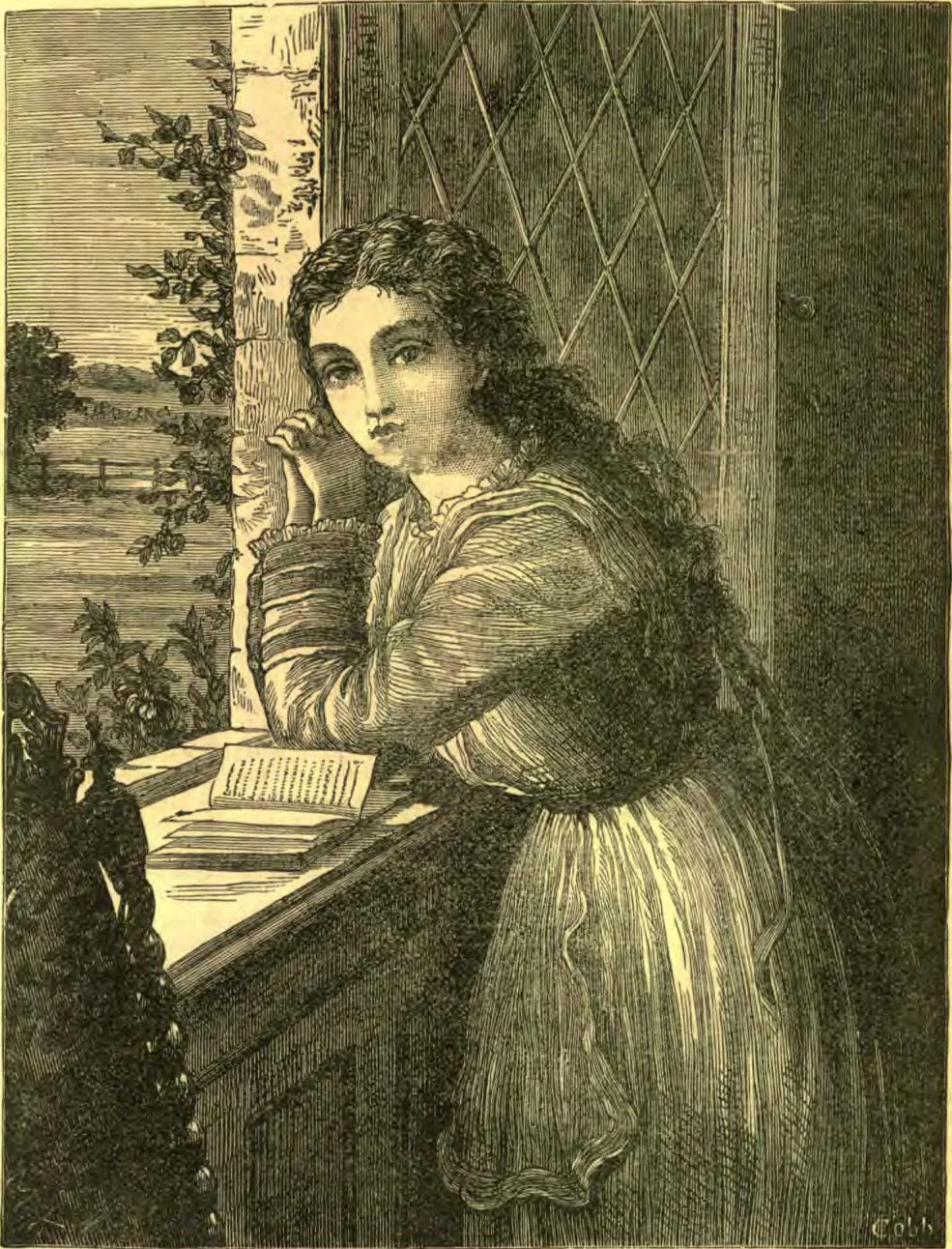
“Duty first, and pleasure afterward,” wrote Amy Leslie in her copy-book one fine morning.
Line after line she penned, making many a mistake, for her thoughts were far away. At last her mother, who was sitting near her, said, “Amy, this is the third time you have spelt ‘pleasure’ without a ‘p,’ and left out the ‘f’ in ‘afterward.’ Put down your pen, and tell me what you are thinking about, for I am sure it is not of your copy.”
“I was only thinking,” replied she, “how glad I should be if my copy said, ‘Pleasure first—duty afterward.’ It is very hard always to have the unpleasant things first. I wish I could have one whole week with no duties at all! How I should enjoy myself!”
Mrs. Leslie remained silent for a moment; then she said, while a quiet smile played round her lips, “Well, Amy, for once you shall have what you want. For a whole week you may amuse yourself; no duties, mind, my child—none at all.”
“There is no chance of my wanting any, I assure you, mamma,” said Amy joyfully; “I shall be so happy, you’ll see!”
“Very well, then,” said Mrs. Leslie, “you may begin to-morrow. To-day I shall expect you to do as usual.”
Amy said no more; she finished her copy, learned her lessons, then went to the nursery to take charge of her little brother, while the nurse was busy with other work. Afterward there were socks to mend, and an errand to run, and buttons to sew on to baby’s shoes, and a letter to write. And so the day passed, and the next morning dawned.
“No duties!” said Amy to herself, as she awoke at seven, which was her usual time for rising; “so I can lie in bed as long as I please.” She turned over, and as she could not sleep, began making plans for the day, and thinking what a delightful time she should have. About half-past nine she came down stairs, to find her breakfast on the table; milk, toast, and eggs, all as cold as possible. “What a wretched breakfast!” grumbled Amy, as she took her seat.
“Well, dear,” replied Mrs. Leslie; “Your breakfast was ready at the usual time, and of course it is cold now.”
Amy said no more. She ate with only half her usual appetite, and finishing in about five minutes, put away her chair, and left the room. As she went up stairs to fetch her hat, baby in the nursery stretched his arms to her to take him; she dashed past, and left the little fellow crying with disappointment. She went down again, a fairy book in one hand, in the other a box of chocolate drops.
The sweets had been a present, but hitherto her mother had only allowed her to have just a few daily; now, however, she might do as she liked, and at present her idea of perfect bliss was the combined charms of chocolate drops and fairy stories.
For about two hours she sat in the garden; then she grew tired, and a little sick from eating too much chocolate, and was returning to the house, when her pet kitten ran out to meet her. For a short time she amused herself by playing with it; but pussy wearied of this, and at last jumped out of her mistress’s arms, leaving a scratch as a keepsake behind her.
Altogether, the morning was hardly a successful one, nor was the afternoon much better. After dinner, one of Amy’s little sisters tore her frock, and was running to Amy to ask her to mend it; but Mrs. Leslie said:—
“Don’t go to your sister, my child; come to me;” and little Jessie, wondering, let her mother darn the rent.
Amy felt very uncomfortable, for she knew that her mother’s eyes were not strong, and were probably aching with the effort of such fine work; but she shrunk from offering her services, and made her escape from the room as soon as she could.
In the evening she was about to draw her chair to the fire and read the newspaper to Mr. Leslie, a duty of which she had always felt rather proud; but her father gravely took the paper out of her hand, saying quickly, “No, Amy, this is a duty; remember, you are to amuse yourself, and do nothing else.”
Amy’s eyes filled with tears, and she ran upstairs to her own room. She had no heart to read the fairy book, or to make clothes for her doll, or to play with the kitten, or to eat the rest of her chocolate drops.
“I shall never be able to bear another day of this,” she said to herself; “I thought it would be delightful to have no duties, but somehow my play does not seem half as good as it was.”
But the next day brought no real pleasure and comfort. Listlessly Amy wandered about, having no zest for any of her former amusements, and feeling thoroughly unhappy. She began to long for the very duties which had seemed so irksome to her; she could hardly keep from crying when she saw the others busy over lessons, or her mother doing work which had formerly been hers.
At last her misery ended in a fit of crying, and she shut herself up in her own room. Sob followed sob so quickly that she never heard her door open, until her mother’s arms were around her. Not a word passed between them for a few minutes; then Amy sobbed out, “O mother! the copy was quite right—‘Duty first and pleasure afterward,’ for without duty there is no pleasure at all.”—Selected.

MAIDENHOOD

MAIDEN! with thy fair brown tresses Shading o'er thy dreamy eye, Floating on thy thoughtful forehead, Cloud wreaths of its sky,
Youthful years and maiden beauty, Joy with them should still abide,— Instinct take the place of duty, Love, not reason, guide.
Ever in the new rejoicing, Kindly beckoning back the old, Turning, with the gift of Midas, All things into gold.
And the passing shades of sadness Wearing even a welcome guise, As, when some bright lake lies open To the sunny skies,
Every wing of bird above it, Every light cloud floating on, Glitters like that flashing mirror In the self-same sun.
But upon thy youthful forehead Something like a shadow lies, And a serious soul is looking From thy earnest eyes.
Early hath life's mighty question Thrilled within thy heart of youth, With a deep and strong beseeching: What and where is truth?
And like some tired child at even, On thy mother Nature's breast, Thou, methinks, art vainly seeking Truth, and peace, and rest.
And to thee an answer cometh From the earth and from the sky, And to thee the hills and waters And the stars reply.
Not to ease and aimless quiet Doth that inward answer tend, But to works of love and duty As our being's end,—
Not to idle dreams and trances, Length of face, and solemn tone, But to faith, in daily striving And performance shown.
Earnest toil and strong endeavor Of a spirit which within Wrestles with familiar evil And besetting sin;
And without, with tireless vigor, Steady heart, and weapon strong, In the power of truth assailing Every form of wrong.
Take the good man's Book, and ponder What its pages say to thee,— Blessed as the hand of healing May its lesson be.
May it ever serve to strengthen Yearnings for a higher good, For the fount of living waters, And diviner food.
—Whittier.

STRANGE FRIENDSHIPS.

A WILD animal, when free, seldom makes friends with any other kind of animal; but the most savage beast, cooped up in a little cage, will often become greatly attached to some weak little creature which it would have scorned to notice when at liberty.
Just how animals make friends with each other, and make the fact known, it is hard to guess. But they do it somehow, and two strange animals will come to enjoy each other's society so much that they cannot bear to be separated. It is often noticed in menageries that elephants will make friends with dogs, and be miserable without them.
Lions, too, are often known to forget their savage nature, and lavish affection on animals as unlike themselves as it is possible to be. There is a noble-looking lion at the Central Park Menagerie, which has only disdain for the men, women, and children who stare at him, but has allowed his affections to be won by a lot of tiny English sparrows.
If you were to put your hand in his cage to stroke his tawny skin, no matter how good your intentions might be, he would tear it in shreds with his terrible paw; and yet he seems to enjoy having the birds hop all over him. Sometimes the fearless little creatures will perch almost on his very nose, as if they wished to show how impudent they could be. But whatever they do, the royal captive only watches them with a sort of sleepy good-nature that seems to say that the birds may do as they please.
In the Zoological Gardens at Paris, they used to have a fierce young lion, whose only friend was a poor little dog that had one day sneaked into the menagerie, and, when pursued, had leaped into the lion's cage, where, to the astonishment of the keepers, he was cordially received. Perhaps the lion saw that the little dog and himself had the same enemies in common. However that may be, the lion adopted the dog for his dear friend, and would not allow him to be taken away.
One morning, before any visitors had come, the gate of the lion's cage was carelessly left unfastened, and the lion contrived to push it open and spring out. It is easy to imagine the confusion and terror that followed. The keepers fled for safety, and the great beast was truly monarch of the place.
The first thought was to shoot him at once, but one of the more shrewd keepers proposed a plan for recapturing him. This man had noticed that the little dog had remained behind in the cage; so he stole up behind the cage, and, catching hold of the poor little fellow, began to whip him. Of course the dog howled piteously.
At the first sound of the dog's voice, the lion, who had been angrily lashing his tail against his sides in front of a tiger's cage, stopped and listened. As the howls continued, the mighty beast bounded savagely toward his cage, and, seeing the keeper beating his friend, leaped in.
The gate was instantly closed and fastened, and the lion found that his friendship had cost him his liberty. The quick-witted keeper was richly rewarded, and to make up for his beating, the little dog was made a pet of, and fed on the choicest bits of meat.
Sometimes the captive animals will have a strong affection for their keepers or trainers; but as a rule, their obedience proceeds from fear, and not from affection. One case of such an affection, however, is worth repeating.
A trainer had a cage of animals, into which he was accustomed to go and perform with four leopards and a lion. The lion was a fine beast, and well trained, but very surly and difficult to control. One day, when the man entered the cage, the lion was very fierce, and refused to perform. The man spoke sternly, but the lion only crouched in one corner of the cage, and growled angrily. The trainer then raised his whip, and struck the beast a smart blow. In another instant the angry creature had sprung upon the daring man, and would have killed him had not the four leopards come to the rescue, and bravely taken the lion's attention until some of the keepers came and rescued the fainting man. One of the leopards died from the wounds inflicted by the lion, and the others could never again be induced to perform with the savage beast.—Selected.

THE JUDAS-TREE.

HAVE you ever heard anything about the Judas-tree? There is such a tree, and there are two reasons given for its singular name. One is that it is supposed to have been this tree that Judas, after he had betrayed our Saviour, went and hanged himself upon. The other is the deceptive character of the tree.
First I must tell you that the common Judas-tree is a native of the south of Europe and of the warmer temperate parts of Asia. There is an American Judas-tree very similar, but with differently shaped leaves. The wood of both species is said to be very beautiful, veined with black, and takes an excellent polish.
The tree bears most beautiful rose-colored flowers, and they appear before the leaves. Says one in describing it, “As I looked from the north window in my room, I saw a tree which, of all the trees I had ever seen, was the most beautiful. Early in May, little buds of a bright pink color covered its branches, and I watched them to the full unfolding of the wealth of bloom. Every twig and branch was a wreath of flowers. Day after day I feasted my eyes upon that charming tree.
“I asked its name; the reply was, ‘It is called the Judas-tree.’ ‘What a name,’ I said, ‘for such a magnificent tree! Why is it that a name which is associated with treachery, dishonesty, and murder should be applied to such an attractive object?’ I learned the secret. It is said that the blossoms are poisonous, and that insects, alighting upon it and imbibing its sweets, are sure to die.
“As I saw the bees and butterflies thronging the Judas-tree, I thought, Ah, poor little innocent things, you don’t know that you are being betrayed, that you are extracting death from the honey-cups!”
And thus you see that, though fair without, this tree is deceptive. And so it was with Judas. He was one of the chosen disciples; went in and out among them, sat at the table with Jesus, and shared with the rest in familiar converse; and yet in an evil hour he betrayed the Saviour, tempted by the offer of a few paltry pieces of money.
You can hardly wonder that the after-shame and disgrace led to another crime,—that of suicide.
And yet it only added to the execration against him. And this event will be handed down with the betrayal to all time. One sin cannot wipe out another. Remember that, like the well-named Judas-tree, many things that seem fair and bright on the exterior may contain poison within. An atmosphere is about them that will, if dallied with, sully the pure in heart.—Child’s Paper.

“REMIND ME OF THE KING.”

LA FONTAINE, chaplain of the Prussian army, once preached a very earnest and eloquent sermon on the sin and folly of yielding to a hasty temper. The next day he was accosted by a major of the regiment with the words,—
“Well, sir! I think you made use of the prerogatives of your office, to give me some very sharp hits, yesterday.”
“I thought of you while preparing the sermon,” was the reply, “but I had no intention of being either personal or sharp.”
“Well, it is of no use,” said the major. “I have a hasty temper, and I cannot control it. It is impossible.”
The next Sabbath, La Fontaine preached upon self-deception, and the vain excuses which men are wont to make.
“Why,” said he, “a man will declare that it is impossible for him to control his temper, when he very well knows that were the provocation to happen in the presence of his sovereign, he not only could but would control himself entirely. And yet he dares to say that the continual presence of the King of kings and Lord of lords imposes upon him neither restraint nor fear.”
Next day his friend, the major, accosted him.
“You were right yesterday, chaplain,” he said, humbly. “Hereafter, whenever you see me in danger of falling, remind me of the King!”—Selected.

YOUR OWN HAND ON THE PLOW.

Mr. B——, a large planter in Alabama, was so successful in his cultivation of cotton as to excite universal attention throughout the South. Certain wealthy gentlemen in Mexico wrote to him several years ago, asking permission to send their sons to his plantations, “to be placed under his tuition and to study his methods.” A few days later, seven or eight young hidalgos arrived, delicate, refined youths, carefully dressed, gloved, and ringed.
“Gentlemen,” said the planter, after welcoming them, “you have come to learn how to raise cotton, so that you will never have a failure in your crops?”
“Yes.”
“It is my theory that no man can intelligently direct his servants to do work which he has never done himself. You never can learn to raise cotton on horse-back. I will teach you my methods. But the first step must be in flannel shirts, and your own hands on the plow. If you are not willing to do this, you had better return to Mexico.”
The young men looked at each other in dismay. But the next morning they presented themselves cheerfully in the field ready for work, and set to plowing with a will. They followed as actual laborers every step in the cultivation of cotton, from its planting until it was ready for the market. They remained with Mr. B. two years, at the end of which time they returned to Mexico, and are now the most successful growers of cotton in that country. They are all firm friends of Mr. B.
“He has the secret of success,” one of them said lately. “No matter what a man’s business may be, he must learn it in detail before he can control it, and the first step is to put his own hand to the plow.”—Youth’s Companion.

Japanese School Builds Life-Size Geography Model

DID you ever think how nice it would be to study geography from a real make-believe world? It seems the Japanese have something like this. At the school of the nobles in Tokio, Japan, in the court behind the school building, is a physical map of that country, three or four hundred feet long. This map, or model, is made of turf and rock, and is bordered with pebbles, which look at a little distance like water. Every inlet, river, and mountain is reproduced in this model with a fidelity to detail which is simply wonderful. Latitude and longitude are indicated by telegraph wires, and tablets show the position of the cities.

WHITE CLOVER.

The distant hills, the long day through, Have fainted in a haze of blue, The sun has been a burning fire, The day has been a warm desire,— But all desire is over; The lights are fading from the west, The night has brought a dreamy rest, And deep in yonder wood is heard The sudden singing of a bird,— While here an evening wind has stirred A slope set thick with clover.
The fields have lost their lingering light, The path is dusky through the night,— The clover is too sweet to lose Her fragrance with the gathering dews,— The skies are warm above her; The cricket pipes his song again, The cows are waiting in the lane, The shadows fall along the hill, And silent is the whippoorwill; But through the summer twilight still You smell the milk-white clover.
The glory of the day hath ceased, The moon has risen in the east, The distant hills, the meadows near, Are bathed in moonlight soft and clear, That veils the landscape over; And born of rare and strange perfume, Pure as the clover's odorous bloom, Dear hopes, that are but half confessed, Dim thoughts and longings, fill the breast, Till lost again in deeper rest Among the blossomed clover.
—Dora Read Goodale.

FOOL'S GOLD.

One day a party of us went up quite a high mountain in Hillsboro County, New Hampshire, called Pack Monadnock. It was a long walk, with a good deal of climbing; but the fine view that spread out before us in every direction for miles, well repaid us for the trouble we had taken. Houses and farms, brooks and ponds, and more than twenty little villages dotted the landscape; while on either hand rose high hills and mountains. How I wished the Instructor family could enjoy this beautiful view.
Great boulders and jagged rocks interrupted our pathway. We stopped to examine some of them. Who knows but that we may find gold or silver? we said. On one hand lay a rock, covered with glittering little specks that looked like gold. Why was it not gold? we said, it was yellow and glittering; we wished it were, there was so much of it around.
But a practical miner from Montana, who was with us, said it was what is called “fool’s gold.” We felt chagrined. Many persons had gathered large quantities of it, thinking it was gold, he said. But it was not gold at all. What is the difference between the two? we inquired. He very soon showed us, as he had some real gold in his pocket, that he compared it with. “Fool’s gold” looks genuine only as you look at it one way. If you hold the stone at the proper angle, it looks yellow and glittering, like gold; but if you look at it from some other direction, the brightness is all gone, and it is only a plain, common stone. Break up the stone, and gather these particles; they crumble like ashes at your touch; they are good for nothing.
True gold, on the contrary, always has the same brightness; turn it whichever way you may, it always has the same appearance. Put it in the fire, and it is gold every time; grind the stone up to powder, and still the gold will be found.
Don’t you think, children, that this aptly illustrates the difference between people’s characters? Some people appear very pleasing when you look at them one way, perhaps when you see them at church; but when you get well acquainted with them, the less you like them. You look at them from another way, and the pleasing qualities are gone. They are cross, or deceitful, or do underhanded things; they are like “fool’s gold,” they do not bear examination. But there are persons like true gold; they are always just the same everywhere you see them. You can rely upon them, knowing that they will be just the same to-day, to-morrow, and always. Pure gold! that is what every child should try to be.
D. M. CANRIGHT.

IMPORTANT BIBLE SUBJECTS.

LESSON 55.—INHERITANCE OF THE SAINTS.
(Continued.)

PROMISE CONCERNING THE KINGDOM OF ISRAEL.

[NOTE TO THE STUDENT.—Do not consider the lesson learned until you can give at least the substance of every text, with the correct reference for each. The references in black letters indicate those texts that should be committed to memory. A little diligent application each day will enable you to do this.]
  1. Why was Saul rejected from being king of Israel?
  2. Who was chosen in his stead?
  3. By whom was David chosen to be ruler?
  4. Where do you find the record of his anointing?
  5. Repeat the promise which the Lord made to David concerning his house and kingdom. 2 Sam. 7:16.
  6. What promise did the Lord at the same time make concerning Israel? 2 Sam. 7:10.
  7. What did he say he would appoint for them? Ib.
  8. Where should they dwell?
  9. From what should they be free?
  10. From this verse, what conclusion must we draw concerning the promise made to Abraham and to the Israelites at Sinai? See note.
  11. In what condition was the kingdom of Israel when the Lord made the promise recorded in 2 Sam. 7:10? 2 Sam. 7:1.
  12. Then what must we conclude concerning that promise of rest and peace? See note.
  13. Who was David’s immediate successor? 1 Kings 1:32–39.
  14. What had the Lord said concerning him? 2 Sam. 7:12, 13.

NOTES.

2 SAM. 7:10: “Moreover, I will appoint a place for my people Israel, and will plant them, that they may dwell in a place of their own, and move no more; neither shall the children of wickedness afflict them any more, as beforetime.” These words were spoken to David, king of Israel, after the Israelites had been settled in the land of Canaan many years. The fact that such a promise was made at this time, shows very clearly that the Israelites were not yet in full possession of the promise made at various times to Abraham, and renewed to them at Sinai. It is evident that for the complete fulfillment of that promise we must look farther ahead.
SINCE, when the Lord promised that he would plant his people in a land of their own, from which they should move no more, and in which they should no more be afflicted (2 Sam. 7:10), the children of Israel were already in the land of promise, and were enjoying rest from all their enemies (2 Sam. 7:1), we must conclude that the promise referred to something far greater than anything they then enjoyed,—to the possession of a territory more extended, an inheritance more sure, and a peace more perfect and lasting. This could all be found in the whole earth, which the saints are to inherit (Matt. 5:5; Dan. 7:27), and which was promised to Abraham and his seed (Rom. 4:13), and in the rest that Christ alone can give—that perfect rest that remains for the people of God.

ALEXANDER SELKIRK.

Alexander Selkirk lived four years and four months alone on the island of Juan Fernandez. It is supposed that the story of his life on that island suggested Defoe’s romance of “Robinson Crusoe,” a book which almost all boys have heard of or read.
Selkirk was a Scottish seaman, who was born about 1676. In 1703 he went from England as sailing master of a vessel, but in 1704, in consequence of a quarrel with the captain, he was, at his own request, put ashore, choosing the fate that should await him alone on this desolate island, rather than sailing under a disagreeable commander.
The following history of Selkirk’s life on the island, we copy from “Alden’s Juvenile Book of Knowledge” for June:—
“Selkirk’s portion, when put ashore, was a sea-chest, his wearing clothes and bedding, a fire-lock, a pound of gunpowder, a large quantity of bullets, a flint and steel, a few pounds of tobacco, a hatchet, a knife, a kettle, a Bible and other books of devotion, together with pieces that concerned navigation, and his mathematical instruments. Resentment against his officer who had ill-used him, made him look forward on this change of life as the more eligible one, till the instant in which he saw the vessel put off, at which moment his heart yearned within him, and melted at the parting with his comrades and all human society at once. He had in provisions for the sustenance of life but the quantity of two meals.
“The island abounding only with wild goats, cats, and rats, he judged it most probable that he should find more easy and immediate relief by finding shell-fish on the shore than by seeking game with his gun. He found great quantities of turtle, of which he ate very plentifully on his first arrival, till it grew disagreeable to his stomach, except in jellies.
“The necessities of hunger and thirst were his greatest diversions from the reflections on his lonely condition. The eager longings for seeing again the face of man, during the intervals of craving bodily appetites, were hardly supportable. He grew dejected, languid, and melancholy, scarce able to refrain from doing himself violence, till by degrees, by the force of reason, and frequent reading the Scriptures, and turning his thoughts upon the study of navigation, he grew thoroughly reconciled to his condition. He now, taking delight in everything, made the hut in which he lay, the most delicious bower, fanned by continual breezes.
“The precaution which he took against want in case of sickness, was to tame kids when very young, so that they might recover their health, but never be capable of speed. These he had in great numbers around his hut; and as he was himself in full vigor, he could take at full speed the swiftest goat running up a promontory, and never failed of catching one unless on a descent.
“His habitation was extremely pestered with rats, which gnawed his clothes and feet when sleeping. To defend himself against them, he fed and tamed numbers of young kittens, who lay about his bed, and preserved him from the enemy. When his clothes were quite worn out, he dried and tacked together the skins of goats, with which he clothed himself. It happened once to him that, running on the summit of a hill, he made a stretch to seize a goat, with which, under him, he fell down a precipice, and lay senseless for the space of three days, the length of which time he measured by the moon’s growth since his last observation.
“This manner of life grew so exquisitely pleasant that he never had a moment heavy upon his hand; his nights were untroubled, and his days joyous from the practice of temperance and exercise. It was his manner to use stated hours and places for exercises of devotion, which he performed aloud, in order to keep up the faculties of speech, and to utter himself with greater energy.
“When the ship which brought him off the island came in, he received the company with the greatest indifference with relation to the prospect of going off with them, but with great satisfaction in an opportunity to help and refresh them. He frequently bewailed his return to the world, which could not, he said, with all its enjoyments, restore him to the tranquillity of his solitude.”

Standing By the Sabbath School for the Children

It don’t make any difference about us old uns, but for the sake of the child’n won’t you please ask our friends to stand by us a little longer?” said an old black man in New Orleans, when told that it might be impossible to rebuild the Straight University for lack of means. The pathetic appeal has an application to those who are “getting tired” of the Sabbath-school work. “For the sake of the children,” stand by a little longer. When the children are all grown up and there are no more to follow, then, and not till then, should any worker think of ceasing from his Sabbath-school labors.

Why Teachers Must Know Their Lessons Thoroughly

A TEACHER not thoroughly familiar with the lesson will be unable to teach with either ease or effectiveness. “A teacher,” says Edward Everett, “ought to know of everything much more than the learner can be expected to acquire. The teacher must know things in a masterly way—curiously, nicely, and in their reasons.” And further, he must see the truth under all its aspects, and present it in just that form and way in which the young mind can apprehend it. And for complete success, he must so present it that the mind cannot misapprehend it.

Teaching Children the Grace of Giving

Most of the children, even in the infant classes, take pride in contributing their money. But how do they usually get it? “Give me a penny for Sabbath-school, papa?” says the little one, as he is ready to start. The penny is, of course, forthcoming; but it represents to the child no equivalent for labor or trouble, and hence the giving of it is not an education in self-denying liberality. Suppose, however, the little one is taught to anticipate the collection beforehand, and to provide for it out of his own pocket-money. Then he receives a lesson in the “grace of giving,” which he may put in practice when he has to bear his share of the burdens in the church.

ST. AUGUSTINE'S LADDER.

ALL common things, each day's events That with the hour begin and end, Our pleasures and our discontents, Are rounds by which we may ascend.

HOW TO MAKE BOYS OF WORTH.

It is recorded that a noted man in Maine a few years ago offered a prize to the boys of York Co., in that State, for the best success in farming; and that he had one hundred and seventy competitors. In his address before the Agricultural Society of that county, he said many good things to the lads. The following paragraphs contain a little of his good advice at that time:—
“Read good books, such as will improve mind and heart; and if you turn at times to lighter reading for rest and amusement, be sure you have the best of that class. Never let a book be found in your room or desk which you would hesitate to let your mothers and sisters open and examine.”
“Every boy of fifteen ought to subscribe for some good newspaper himself, and read it carefully and preserve it in files, marking those articles which interest him most, so he can readily refer to them afterward.”
“If a mechanic, he should take some paper which explains inventions and the working of machinery; if a farmer, some good agricultural paper. The amount of useful information to be obtained from any good paper will surprise you.”

Eskimo Dainties

For the benefit of the little people, we quote the following from Frederick Schwatka’s “Children of the Cold,” in St. Nicholas:—
“It would seem very strange, and perhaps not very pleasant, to my young readers to hear a tallow candle or the shin-bone of a reindeer called candy. And yet these things may really be considered as Eskimo candy, because they would delight the children of the cold in precisely the way that a box of bon-bons would delight you.
“There is a certain kind of water-fowl in arctic countries known as the dovekie. It is about the size of a duck, is quite black, has a prominent white stripe on its wings, and its webbed feet are of a brilliant red. When sitting in rows on the edge of some mossy, dark-green rock, these little red feet are very conspicuous, and, together with the white stripes on the wings, make the dovekie a very pretty bird. Sometimes, when the men have killed a number of dovekies, the Eskimo women cut off the bright red feet, draw out the bones, and, blowing into the skins, distend them as much as possible so as to form pouches. When these pouches are thoroughly dried they are filled with reindeer tallow, and the bright red packages, which I assure you look much nicer than they taste, are little Boreas’s candy. In very cold weather the Eskimo children eat great quantities of fat and blubber; and this fatty food, which seems to us so uninviting, helps to keep them warm and well.
“The only other kind of candy that the Eskimo children have, is the marrow from the long leg or shin-bone of the slaughtered reindeer. Of this, also, they are very fond. Whenever a reindeer is killed, and the meat has been stripped from the bones of the legs, these bones are placed on the floor of the igloo, and cracked with a hatchet until the marrow is exposed. The bones are then forced apart with the hands, and the marrow is dug out of the ends with a long, sharp, and narrow spoon made from a walrus’s tusk. I have eaten this reindeer marrow frozen and cooked; and after one becomes accustomed to eating frozen meat raw, it is really an acceptable tid-bit; when cooked and nicely served, it would be a delicacy anywhere. Sometimes, if Toolooah was unusually lucky, he would have eight or ten reindeers on hand that he had killed during the day, and as each deer has eight leg-bones, from which the marrow can be extracted, quite a meal could be made from this very peculiar candy.”

A Remarkable Ancient Turtle Near Bona, Algeria

Not very far from the city of Bona, in Algeria, there lives the most remarkable turtle known to man. The huge and ancient creature is owned by a leading merchant, who received it as an heir-loom. The turtle is about four feet long, and nearly three wide, and the most aged person around does not remember that it was ever smaller. It is said by some to be about two hundred years old. It is too old to snap at anything, and is totally blind.

LINCOLN'S TENDERNESS.

ABRAHAM LINCOLN was a giant in strength when a young man. He could sink an ax deeper, jump higher and farther, and run faster than any of his fellows, and no one could lay him on his back. But this young giant, six feet and four inches high, scorned to use his strength as a giant. He stopped fights, quelled riots, repelled brutality and protected the weak, for his kindness and good-nature were stronger than his strength.
As Lincoln and a companion were going home one cold night, they stumbled upon an acquaintance lying dead-drunk in the road. Young Abe proposed that they should carry him to the nearest cabin. The churlish companion refused to assist.
“All right!” said Abe. “If you won't, I will,” and suiting the action to the word, he lifted the drunken man on his shoulder, and carried him a long distance to a neighbor's cabin, where he was restored to consciousness. “Abe Lincoln's kindness and strength,” the poor fellow often said, “saved my life.”
When he was President, his tenderness frequently caused generals in the field to complain. “We can't shoot men justly condemned to die,” they would say; “because their mothers or fathers secure Mr. Lincoln's interference by appealing to his compassion for the wayward.”
Mr. Lincoln used to smile, when these complaints were repeated to him, and promise to be more of a commander-in-chief and less of a man. But he wouldn't,—the man, as the next case proved, was more powerful than the President,—and the man had always stretched out a hand to the fallen.
One day, when he was a plain Illinois lawyer, he was riding, with other lawyers, from one court-house to another. The party rode two by two, Lincoln and a friend bringing up the rear. As they stopped to water their horses, the friend came up alone. “Where's Lincoln?” they inquired.
“Oh,” answered the friend, “when I saw him last, he had caught two young birds, which the wind had blown out of their nest, and was hunting for it to put them back.”
In a few minutes, Lincoln came up, and the lawyers began chaffing him.
“I couldn't have slept,” he replied, “if I had not found that nest, and restored the little birds to their mother.”
The kind-hearted giant could show a giant's rage, if men tried to thwart his tenderness. During the Black Hawk War he was a captain, and one day a poor, old, hungry Indian came into camp.
The soldiers, possessed by the pioneer's hatred of Indians, and thinking the old man a spy, were about to kill him. He showed a “safe conduct” from Gen. Cass and also a certificate that he was the white man's friend.
The angry soldiers declared both documents forgeries, and cocked their muskets. In an instant Lincoln was among them, knocking up their guns. Standing in front of the Indian, he ordered them away, saying they should shoot him if they shot the poor man. A dozen muskets were aimed at both, and for several seconds it seemed as if the captain and the Indian would be riddled with bullets. Lincoln stood there angry but resolute, and the angry soldiers lowered their guns, turning away like sullen dogs, robbed of their prey.—Youth's Companion.

THE TALLEST TREES.

CALIFORNIA has the most massive trees; they are beautiful cedars, but the Australian eucalyptus is taller. In the valley of the Watts River, in Victoria, many fallen trees have been measured as they lie on the ground, and found to exceed 350 feet in length. One mighty giant had fallen so as to form a bridge across a ravine. It had broken in falling, but the portion which remained intact measured 435 feet in length, and as its girth at the point of fracture is nine feet, its discoverer estimates that the perfect tree must have measured fully 500 feet. Its circumference five feet above the roots is 54 feet. In the Dandenong district of Victoria, an almond-leaf gum-tree has been carefully measured, and is found to be 430 feet in height. It rises 380 feet before throwing out a branch; its circumference is 60 feet. Tasmania also produces specimens of eucalyptus which are 350 feet in height, and which rise 200 feet before forming a branch.—Selected.
Continue reading: THE SPHINX