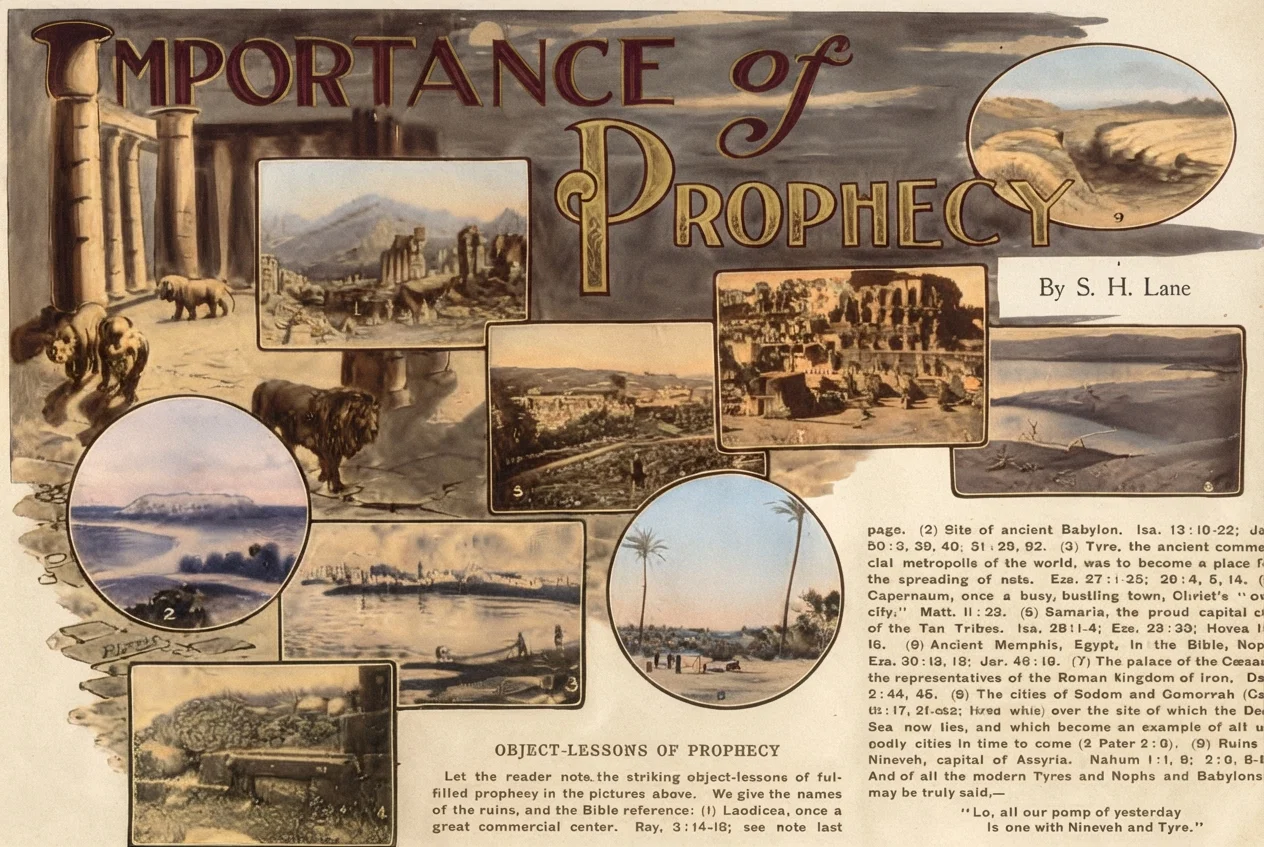
Let the reader note, the striking object-lessons of fulfilled prophecy in the pictures above. We give the names of the ruins, and the Bible reference: (1) Laodicea, once a great commercial center. Rev. 3:14-16; see note last page. (2) Site of ancient Babylon. Isa. 13:19-22; Jer. 50:3, 39, 40; 51:28, 62. (3) Tyre, the ancient commercial metropolis of the world, was to become a place for the spreading of nets. Eze. 27:1-25; 26:4, 5, 14. (4) Capernaum, once a busy, bustling town, Christ's "own city." Matt. 11:23. (5) Samaria, the proud capital city of the Ten Tribes. Isa. 28:1-4; Eze. 23:33; Hosea 13:16. (6) Ancient Memphis, Egypt, in the Bible, Noph. Eze. 30:13, 16; Jer. 46:19. (7) The palace of the Cæsars, the representatives of the Roman kingdom of iron. Dan. 2:44, 45. (8) The cities of Sodom and Gomorrah (Gen. 18:17, 20-32; 19:24, 25) over the site of which the Dead Sea now lies, and which became an example of all ungodly cities in time to come (2 Peter 2:6). (9) Ruins of Nineveh, capital of Assyria. Nahum 1:1, 8; 2:6, 8-13. And of all the modern Tyres and Nophs and Babylons it may be truly said,—
"Lo, all our pomp of yesterday
Is one with Nineveh and Tyre."
Foretelling and Fulfilling
ALL Scripture, being given by inspiration of God, is profitable for doctrine, for reproof, for correction, for instruction in righteousness. 2 Tim. 3:16. It is therefore all important. This being true, one can not justly draw invidious comparison between different parts of the Scriptures.
Some portions are historical, and, as such, deal with the past. Other portions are prophetic, and deal with the future. If one portion of the Scripture is more important than another, it is the prophetic portion, as it deals with the future.
It is not in the wisdom of man to correctly foretell the events of the future. This wisdom abides only with the Father and His associated Son, Christ Jesus, and with those to whom they have revealed it. The all wise Creator declares that He reveals Himself to the children of men. He declared this through Moses. Num. 12:6. He says, "If there be a prophet among you, I the Lord will make Myself known unto him in a vision, and will speak unto him in a dream." He communicates by means of the Holy Spirit. This is clearly set forth in 2 Peter 1:21: "For the prophecy came not in old time by the will of man; but holy men of God spake as they were moved by the Holy Ghost." It is evident by this declaration that the prophecies of the Scriptures did not originate by the will of man, but men were moved upon to predict future events by the Spirit of God.
Christ in Prophecy
The Father and the Son are one in plan and action (John 10:30), and thus Christ is in the foretelling of future events through the prophets. The apostle Peter plainly declares this in his first epistle, first chapter. Speaking of the salvation of the soul, he says: "Of which salvation the prophets have enquired and searched diligently, who prophesied of the grace that should come unto you; searching what or what manner of time the Spirit of Christ which was in them [the prophets] did signify, when it testified beforehand the sufferings of Christ, and the glory that should follow." Verses 10, 11.
Thus the Spirit of Christ not only foretold His own sufferings, sad and heart-rending tho they were to be, but He carries our minds beyond the suffering to the glory that should follow, not only through time, but into the never-ending ages of eternity, where His praises will ever be sung, and His glory will never wane.
Prophecy and History Illustrated
It is evident from these scriptures that prophecy, when given, relates to the events of the future. Thus prophecy is history in advance. To illustrate: Should a seer in holy vision be enabled to behold some of the future political events of our own beloved nation, would we not, as citizens, become deeply interested in his predictions? If, in his foretelling of the future, he stated that in due time we, as a nation, would have war declared upon us by a foreign power; that our territory would be invaded by an alien army; that battle after battle would be fought; fields would be deluged with blood as the result of booming cannon and mortars, bursting shells, the whistling of the Minie ball, and clashing of the saber and bayonet in the hand-to-hand fight of the contesting armies. At times victory would grace our heroic maneuvers, and again defeat, sore and dreadful, would sadden the nation, and dampen our efforts. At last, in a mighty battle, fearful because of its carnage, victory perches upon our national banners, the war is ended; and the dove of peace spreads her wings over the nation, and prosperity greets us on every hand.
If each individual of the nation could be convinced that the predictions were true, with what absorbing interest would he watch every transpiring event, and fully understand that it was merely a blossom which would ripen only to pave the way for more important events, which would ultimately result in the defeat of the alien nation, and the complete victory of our own.
The foretelling of this scene would be prophecy, and the record of its fulfilment would constitute history.
What We May Know
The Word of God foretells the rise and fall of nations from the inception of earthly kingdoms and republics,—from the kingdom of Babylon to the wonderful government in which we live. Every event which is taking place in the world to-day is full of significance, and, to the student of prophecy, is a harbinger of the final consummation, when grace will give place to glory, and prayer to praise.
Just before Christ's passion, He stated to His disciples that some of them would not taste death till they saw the Son of Man coming in His kingdom. Matt. 16:28. A few days subsequently He took three trusted disciples, Peter, James, and John, and led them up into the steeps of a neighboring mountain, and was transfigured before them. In His transfiguration they saw Him as we shall see Him, if we are saved in the kingdom of glory. His face shone as the sun, and His raiment was white as the light. Suddenly there appeared on the scene two men. One was Elijah; he had been translated to heaven without tasting death. The other was Moses, who had led Israel's vast army from Egypt to Canaan.
When the kingdom of God is fully established, its subjects will be the redeemed of earth. That vast, numberless multitude will be made up of two classes. One class will be those who have passed through death, and through the resurrection of the just; they will shout victory over death and the tomb. This class was represented by Moses in the Transfiguration on the mount. The other class will be translated from earth to heaven without tasting death. These are represented in the mountain scene by Elijah.
This mountain view was a real scene. The blessed Master, Moses, Elijah, Peter, James, and John were all personally present. The mountain was a real one, and the bright cloud of glory which enshrouded both the earthly and the heavenly beings was also a real one. Peter was so enraptured that he desired to make three dwelling-places, one for his blessed Master, one for Moses, and one for Elijah, exclaiming, in his ecstasy of soul, "Master, it is good to be here!"
As he viewed the scene, he beheld the glory of God as it will exist in the soon-coming kingdom. He saw the heavenly King, Jesus, and he looked upon the representatives of the heavenly kingdom as they will exist in the final establishment of that kingdom. He felt so sure of this that years afterward, when writing to his beloved brethren, he says, in speaking of that kingdom, "We have not followed cunningly-devised fables, when we made known unto7you the power and coming of our Lord Jesus Christ, but were eye-witnesses of His majesty, . . . when there came such a voice to Him from the excellent glory; . . . and this voice which came from heaven we heard, when we were with Him in the holy mount." 2 Peter 1:16-18.
A More Sure Word
Peter was an eye-witness of that glorious scene. But the eye may mislead. It does not always correctly view the object looked upon. To illustrate: The two rails of a railroad track run parallel the entire length of the line, being the same distance apart all the way; but in appearance, a short distance from the beholder they seem to be approaching each other, and, if one were not aware of the fact that they do not, he would declare to the contrary.
Notwithstanding the fact that Peter had actually seen the glory of the coming kingdom, he declares we have a more sure Word of prophecy. And to emphasize its importance he asserts that we do well to take heed unto it as unto a light that shineth in a dark place; and it is to continue to shine until the arising of the Day-star. When a person is in a dark, dismal cave, enshrouded with darkness which has never been penetrated with the rays of the sun, he guards carefully and cautiously the lamp on whose ray depends his safety. Should that light be extinguished, a false step might plunge him into the abyss below, to be dashed to pieces on the rocks. He is wholly dependent on its beams for his guidance back to the brilliant entrance, where he emerges into the blazing sunlight, freed from the dangers of the dismal dungeon.
As we would guard the light which shines in an earthly dungeon, thus should we conscientiously guard the light of prophecy which, step by step, leads us through the wilderness of sin and wo in this world, and, step by step, points out the way to the better land.
CHRIST WILL COME AGAIN. HOW? WHEN?
By George B. Thompson
He Will Come Again
THERE is no truth of the blessed Gospel which is more clearly taught than that our Redeemer will return the second time. Before this awful event all others pale. It is the sublimest spectacle and most matchless display of transcendent glory connected with the scheme of redemption. When the Lord spoke the eternal principles of His own perfection from the flaming top of Sinai, and traced them in stone with His own finger, the whole earth trembled, and the glory of God was revealed in mighty majesty. But this divine exhibition of heavenly glory will be surpassed when the Redeemer comes to take to Himself the people whom He has saved from the terrible thralldom of sin.
At His first advent He came in weakness. He came as a helpless Babe to show the frailties of our frame. As a Lamb He came to bear the burdens of a weak and degenerate race. But how different the scene when He appears the second time to overturn the proud and stately empires of earth and scatter them like the chaff driven by the wind. We may think of the glorious event, and it is well to let the picture linger in the mind, yet we can never take it in. The human mind can never comprehend in its fulness the hour when, crowned King of all kings, the Saviour comes to reap the harvest of the earth.
How He Will Come
The coming of Christ is a real thing. It is no phantom. It is the advent of a real personal being. Jesus left the earth a real person, bearing in His body the marks of His humiliation. "And while they [the disciples] looked steadfastly toward heaven, as He went up behold, two men stood by them in white apparel; which also said, Ye men of Galilee, why stand ye gazing up into heaven? This same Jesus, which is taken up from you into heaven, shall so come in like manner as ye have seen Him go into heaven." Acts 1:10, 11. "An angelic cloud received Him into glory, and when He appears the second time He is seated upon a "white cloud," "having on His head a golden crown, and in His hand a sharp sickle." Rev. 14:14.
When He comes He will be escorted, like the victorious conqueror which He is, by "all the holy angels." Matt. 25:31. When one angel came to the sealed tomb to call the Redeemer as He lay locked in the fixed embrace of death, the glory which attended the celestial messenger struck to the earth the guard of Roman soldiers who were watching the sepulcher. How much glory, think you, will be revealed when the unnumbered millions of mighty angels come with their Redeemer? They come as reapers to gather the sheaves into the heavenly garner. But this is only a little of the glory which is to be seen. The King comes in the most supernal glory, "the glory of His Father." Matt. 16:27. He will come in "His own glory, and in His Father's, and of the holy angels." Luke 9:26.
In the past, kings, emperors, and potentates of earth have sought to show the glory of their empires. In triumphant splendor and overweening pride they have exhibited all their regal pomp and glory. But they have perished, and their glory is no more. But the consuming majesty and glory which attends the coming of Jesus overshadows theirs as the sun shining in its zenith power eclipses the rays of a candle, and His glory will endure throughout all ages. Its luster will not be dimmed by passing cycles.
When He Is Coming
And now, as in ages in the past, the Lord will warn the world of the event which is approaching. He warned the antediluvians; He warned Sodom; He warned Nineveh; and when His first advent was impending, He sent His forerunner with a special message for the time. And when we reach the closing days of the world's history, we read that there will be "signs in the sun, and in the moon, and in the stars; and upon the earth distress of nations, with perplexity; the sea and the waves roaring; men's hearts failing them for fear, and for looking after those things which are coming on the earth; for the powers of heaven shall be shaken. And then shall they see the Son of Man coming in a cloud with power and great glory." Luke 21:25-27.
Reader, this glorious day draws near; it will soon be ushered in. Prepared or unprepared, its stern realities will soon be upon us. For the righteous it is a day of the greatest joy, when they can look up and rejoice. For sinners it is a day of gloominess, desolation, and destruction. While the Life-giver is still on the mercy-seat, offering pardon to the impenitent, shall we not turn to Him with full repentance, that we may find forgiveness, and be numbered among those who can look up and say, "Lo, this is our God; we have waited for Him, and He will save us!" Isa. 25:9.
Washington, D. C.
THE LORD'S RETURN
1. We ought to be looking for it.
"Seeing that all these things [this earth and its works] shall be dissolved, what manner of persons ought ye to be in all holy conversation and godliness, looking for and hasting unto ["earnestly desiring," A. R. V.] the coming of the day of God." 2 Peter 3:11, 12. "For our conversation is in heaven; from whence also we look for the Saviour, the Lord Jesus Christ." Phil. 3:20.
2. We should love His return.
"Henceforth there is laid up for me a crown of righteousness, which the Lord, the righteous Judge, shall give me at that day; and not to me only, but unto all them also that love His appearing." 2 Tim. 4:8.
3. We should be waiting for it.
"I thank my God always on your behalf, for the grace of God which is given you by Jesus Christ; that in everything ye are enriched by Him, in all utterance, and in all knowledge; even as the testimony of Christ was confirmed in you; so that ye come behind in no gift; waiting for the coming of our Lord Jesus Christ." 1 Cor. 1:4-7. Waiting for an event implies being ready for it.
4. We should be watching for His coming.
"Watch therefore, for ye know neither the day nor the hour wherein the Son of Man cometh." Matt. 25:13. Watching also implies being ready. "Therefore be ye also ready; for in such an hour as ye think not the Son of Man cometh." Matt. 24:44.
5. His return should be a subject of prayer.
"He which testifieth these things saith, Surely I come quickly. Amen. Even so, come, Lord Jesus." Rev. 22:20.
6. We should firmly believe in His coming again.
Because: (a) He promised it just before His death. John 14:1-3. (b) The promise was repeated at His ascension. Acts 1:9-11. (c) He describes it. Matt. 25:31. (d) The apostle Paul further describes it. 1 Thess. 4:15-17.
"In particular it intimates that He will delay His coming so long that wicked people will begin to defy it, and to say, 'Where is the promise of His coming?' They will challenge Him to come; and His delay will harden them in their wickedness. Even His own people will begin to despair of it, and conclude: He will never come, because He has passed their reckoning."
MANY that are looking at me may never die; we are near the end of this dispensation. The coming of the Lord in the clouds to take His church to be with Himself is the Christian's hope. O, to be ready! In the Master's name, I tell you, be ready. I charge you to prepare for His coming.—Henry Varley.
SOME people are greatly frightened when the second coming of Christ is mentioned, or when it is deduced from prophecy that the great event is soon to occur. A Christian should be suspicious of himself if he feels afraid of that glorious day.—Rev. Dr. Robinson.
ADVENT SONG
"Blessed Saviour, Thou art coming!
We shall meet Thee on Thy way,
We shall see Thee, we shall know Thee,
We shall bless Thee, we shall show Thee
All our hearts could never say.
What an anthem that will be,
Ringing out our love to Thee,
Pouring out our rapture sweet
At Thine own all-glorious feet.
"Not a cloud and not a shadow,
Not a mist and not a tear,
Not a sin and not a sorrow,
Not a dim and veiled to-morrow,
For that sunrise grand and clear!
Jesus, Saviour, once with Thee,
Nothing else seems worth a thought!
O, how marvelous will be
All the bliss Thy pain hath bought!
"Thou art coming! We are waiting
With a hope that can not fail;
Asking not the day or hour,
Resting on Thy Word of power
Anchored safe within the veil.
Time appointed seemeth long,
But the vision must be sure;
Certainty shall make us strong,
Joyful patience can endure."
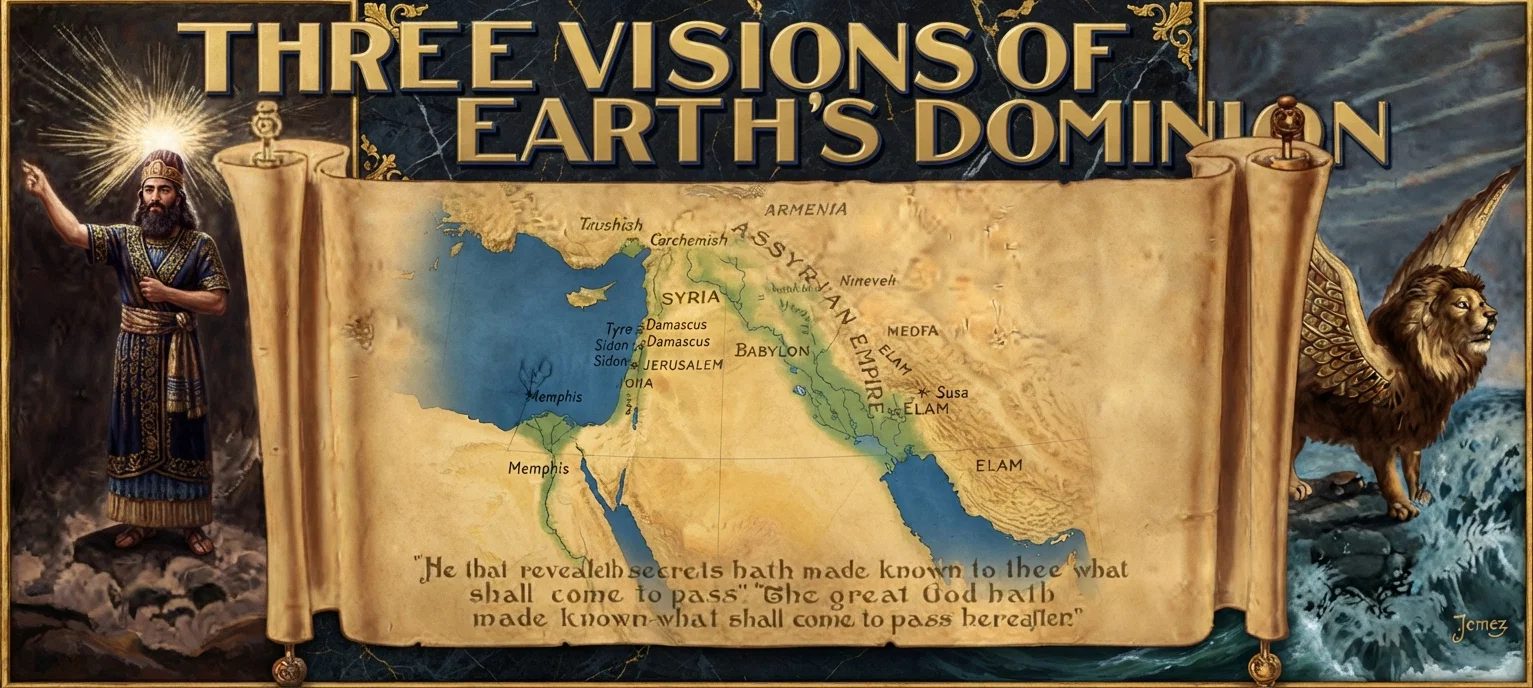
He that revealeth secrets hath made known to thee what shall come to pass. The great God hath made known what shall come to pass hereafter.
THE second chapter of Daniel is preeminently a disclosure to man of God the Revealer.
Babylon was one of the mightiest empires of earth. She was great in extent, great in wealth, great in education, but far greater in her religious influence upon all the nations of earth then and thereafter. She has "made all the earth drunken; the nations have drunk of her wine." Jer. 51:7; Rev. 18:3.
She reached the height of her glory under Nebuchadnezzar, one of earth's greatest rulers, a mighty warrior, a great scholar, a wise statesman, a devout religionist. He took pride in the enlargement and establishment of the later Chaldean empire. He determined it should stand forever, yet questioned as to "what should come to pass hereafter" (read Daniel 2 carefully). God in answer to his longing desire, revealed it to him in a dream, which none of the wise men could tell or interpret. God gave through His servant Daniel,—who gave to God all the glory,—the dream and its true interpretation.
This Is the Dream:
"Thou, O king, sawest, and, behold, a great image. This image, which was mighty, and whose brightness was excellent, stood before thee; and the aspect thereof was terrible. As for this image, its head was of fine gold, its breast and its arms of silver, its belly and its thighs of brass, its legs of iron, its feet part of iron, and part of clay. Thou sawest till that a stone was cut out without hands, which smote the image upon its feet that were of iron and clay, and brake them in pieces. Then was the iron, the clay, the brass, the silver, and the gold, broken in pieces together, and became like the chaff of the summer threshing-floors; and the wind carried them away, so that no place was found for them; and the stone that smote the image became a great mountain, and filled the whole earth." Verses 31-35, A. R. V.
Here Follows the Interpretation:
"Thou, O king, art king of kings, unto whom the God of heaven hath given the kingdom, the power, and the strength, and the glory, and wheresoever the children of men dwell, the beasts of the field and the birds of the heavens hath He given into thy hand, and hath made thee to rule over them all; thou art the head of gold. And after thee shall arise another kingdom inferior to thee; and another third kingdom of brass, which shall bear rule over all the earth. And the fourth kingdom shall be strong as iron, forasmuch as iron breaketh in pieces and subdueth all things; and as iron that crusheth all these, shall it break in pieces and crush. And whereas thou sawest the feet and toes, part of potters' clay, and part of iron, it shall be a divided kingdom; but9
there shall be in it of the strength of the iron, forasmuch as thou sawest the iron mixed with the miry clay. And as the toes of the feet were part of iron, and part of clay, so the kingdom shall be partly strong, and partly broken. And whereas thou sawest the iron mixed with miry clay, they shall mingle themselves with the seed of men; but they shall not cleave one to another, even as iron doth not mingle with clay. And in the days of those kings shall the God of heaven set up a kingdom which shall never be destroyed, nor shall the sovereignty thereof be left to another people: but it shall break in pieces and consume all these kingdoms, and it shall stand forever. Forasmuch as thou sawest that a stone was cut out of the mountain without hand, and that it break in pieces the iron, the brass, the clay, the silver, and the gold; the great God hath made known unto the king what shall come to pass hereafter; and the dream is certain, and the interpretation thereof is sure." Verses 37-45, A. R. V.
It needs but a few words of comment. The head of gold represented Babylon, for which Nebuchadnezzar then stood, the golden kingdom of a golden age, but which closed its career of glory in B.C. 538, when it was succeeded by the Medo-Persian empire, the breast and arms of silver. Dan. 5:28, 30, 31.
The Medo-Persian empire lasted until B.C. 331, and was succeeded by Grecia, the "belly and thighs of brass."
Grecia was, after years of struggle, in her divided state, finally conquered by the imperial iron monarchy of Rome, represented by the legs of iron. The mixing of the clay with the iron, representing the coming in of socialistic and republican principles, symbolized the breaking up of the Roman empire into various divisions.
Weakness of Human Government.
Babylon was a unit. Medo-Persia became one. But Grecia, launched as one under Alexander, became later divided into four. Rome, beginning as one, represented by the strongest of metals, crumbled into numerous divisions, so to remain till the end of all earthly power.
That great image of a man represented the kingdom of man in this world. It tells us in a simple way, just what all history demonstrates, that man has not within himself, however great or wise, the cohesive power, the principle of integrity, to hold together for long any kind of rule or government.
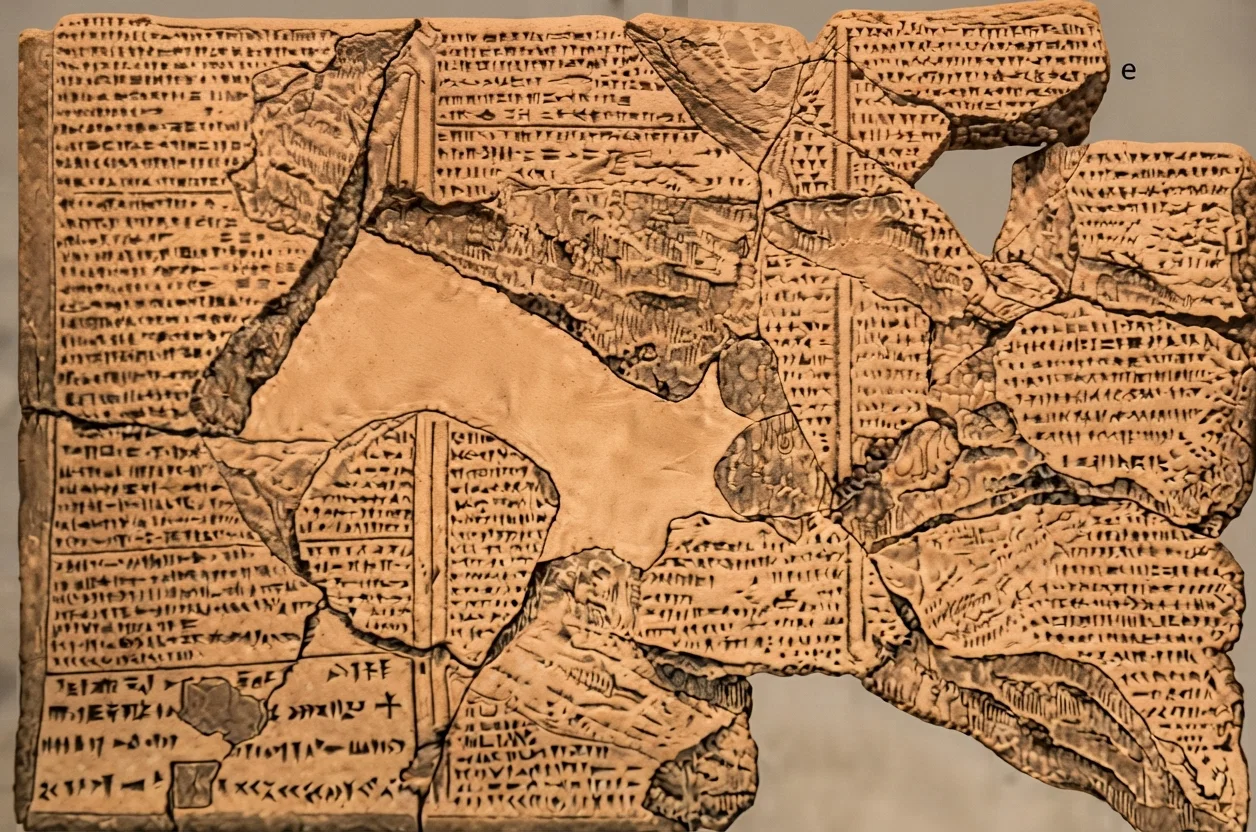
Back of tablet with account of Deluge. (From "Chaldean Genesis" by Smith.)
Charlemagne tried to unite the discordant elements of Western Rome, but he failed. Napoleon tried it, and failed. It has since been tried by intermarriage and diplomacy, but all its union and peace are as fragile as a spider's web. God's prophecy declares that so it will continue till He sets up His everlasting kingdom on the thither side of all the wreck of nations, at the glorious coming of the King of Kings and Lord of Lords.
"And the dream is certain, and the interpretation thereof is sure."
WHEN God revealed to Nebuchadnezzar that the kingdom of Babylon and all that followed it would eventually crumble into dust, the mighty king could not have it so. He saw Babylon the head of gold, but he saw that head covering, controlling, transmuting all the future. It would be all gold; it must be all gold. It was unpatriotic, nay, it was treason, to think that Babylon, Babylon the rich, the great, the beautiful, the seat of learning and religion, would not stand forever.
A Monument to Patriotism
This Babylonian view must be left to posterity. Therefore Nebuchadnezzar made a great image, reaching to the height of one hundred and ten feet, all of gold in appearance, and set it up in the plain of Dura where all could see it, as it reflected the dazzling splendor of the sun. It proclaimed Babylon forever. It was Babylon's fetish of patriotism. Then the king made this proclamation:
"Then the herald cried aloud, To you it is commanded, O peoples, nations, and languages, that at what time ye hear the sound of the cornet, flute, harp, sackbut, psaltery, dulcimer, and all kinds of music, ye fall down and worship the golden image that Nebuchadnezzar the king hath set up; and whoso falleth not down and worshipeth shall the same hour be cast into the midst of a burning fiery furnace." Verses 4-6, A. R. V.
Read the story. There were those in Nebuchadnezzar's dominion who had seen God's view of the nations. They could not fall down to the human or the human idea against God's truth, however beautifully clothed, or howsoever much of earthly power there might be behind it. They must stand as the representatives of the God of truth and right.
And they did stand. The proclamation was kindly repeated for their sakes. Nebuchadnezzar knew somewhat of their worth, but he divorced it from God, the one thing only which made them the men they were. The great assembly again bows in worship; the men of God—Shadrach, Meshach, and Abednego—remain erect.
They are called before the haughty and enraged monarch. They quail not; they have seen a Greater in His love. They are cast into the fiery furnace, and lo, the Greater goes with them and delivers them unharmed, while the minions of the promoter of patriotism against God perish in the fierce flames which would not touch the worshipers of the Most High.
Babylonian Still
But the evil principle still continues. This potently-evil wine the nations have quaffed. This perversion of vision the nations have inherited. As9
As Man Sees God's View
(Continued from page 8, second column.)
Nebuchadnezzar saw only Babylon, so with the earth worshipers, each sees his own kingdom.
The patriots of Medo-Persia felt that that empire was allied with the gods, and would stand forever. So thought the Grecian; so thought the Roman.
The loyal Chinese believes the "Celestial" empire is heaven-born and must stand forever. The devotee of the "Sunrise Island Empire" believes that it is Japan forever. So also the devotee of Europe's great northern empire; he believes that the Russian bear will prowl and growl till all the world shall own his sway.
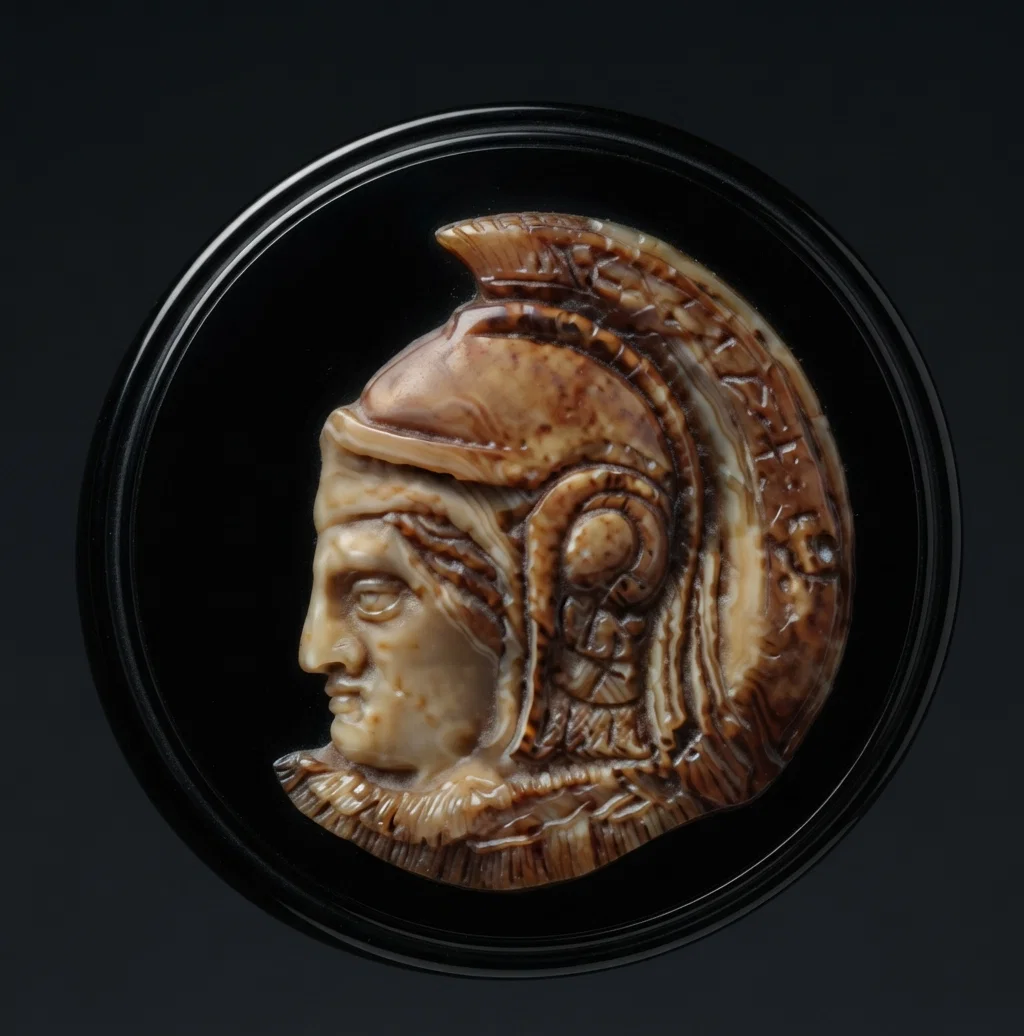
Cameo portrait of Nebuchadnezzar, a votive offering dedicated to Merodach. Engraved on a black stone.
The Briton believes in "Rule Britannia," and that for aye. His idea of ardent patriotism is England always, whatever her moral right. And in England's oldest child, the great, wealthy, strong, virile, Columbia, it is a
popular toast, "Our country; may she always be right; but right or wrong, always our country." The ultra patriots of every nation would heartily drink to the same toast.
But all this is modernized Babylonian worship of the golden image, the exaltation of the human, the losing sight of the divine.
All the governments of earth, founded because of the selfishness of man, are more and more constant developments and crystallizations of that selfishness as the nation ages. That selfishness may be checked by the interfusion of some truly religious movement from without, but only checked. Sooner or later the selfishness which in the beginning restrained men becomes a tyranny, and the end is destruction.
Reader, why not take God's view of earthly powers and build your hope within and upon the everlasting kingdom?