Your ShelfYour Projects

Review and Herald, Vol. 75, No. 11.

MRS. E. G. WHITE

Review and Herald

Mar 15, 1898

Seventh-day Adventist Publishing Association · Battle Creek, Mich. · Mar 15, 1898

MRS. E. G. WHITE

GO, PREACH THE GOSPEL.—NO. 1.

MRS. E. G. WHITE

“For by him were all things created, that are in heaven, and that are in earth, visible and invisible, whether they be thrones, or dominions, or principalities, or powers: all things were created by him, and for him: and he is before all things, and by him all things consist. And he is the head of the body, the church: who is the beginning, the first-born from the dead; that in all things he might have the pre-eminence. For it pleased the Father that in him should all fulness dwell; and, having made peace through the blood of his cross, by him to reconcile all things unto himself; by him, I say, whether they be things in earth, or things in heaven.”
Before leaving his disciples, Christ gave them their commission. Standing but one step from the throne, his last instruction to them was, “Go ye therefore, and teach all nations.” “Jesus came and spake unto them, saying, All power is given unto me in heaven and in earth. Go ye therefore, and teach all nations, baptizing them in the name of the Father, and of the Son, and of the Holy Ghost: teaching them to observe all things whatsoever I have commanded you: and, lo, I am with you alway, even unto the end of the world.”
“Go ye into all the world, and preach the gospel to every creature.” Again and again the words are repeated, that they may not lose their significance. Upon all creatures under heaven, high and low, rich and poor, was the light of heaven to shine in clear, strong rays.
The disciples were to be colaborers with him, their Redeemer, in the work of saving the world. Christ assured them, “All power is given unto me in heaven and in earth.” They were to go forth in his name, and he promised them the ministry of his Spirit. He did not lay before them a plain and easy path. They were to be partakers of his sufferings. But he told them of the legacy they would receive. If they united with one another and with him, his righteousness would shine upon them, and from them to a world constantly increasing in wickedness.
The disciples were to catch the radiance of the light from the Saviour’s presence, and were to let that light shine upon those walking in the shadow of death. They were commissioned to begin their work in Jerusalem. They were to bear witness to Christ in the city which had been the scene of his great humiliation. Here they were to give evidence of their strength and efficiency by lifting Christ up before those who had resisted his mercy and his love. Under the inspiration of Satanic agencies, those whom God had made the depositaries of sacred truth had denied and crucified their Messiah. To them the wondrous power of God was to be revealed. But the work of the disciples was not to begin and end in Jerusalem. They were to carry the truth to all nations.
Christ carried the minds of his disciples to an eminence, and showed them the vast confederacy arrayed against him who came as the light and life of men. He told them that they were to fight not merely against flesh and blood, but against principalities and powers, against the ruler of the darkness of this world, against spiritual wickedness in high places. He reminded them that they were engaged in a warfare on which eternal results depended. In view of the heavenly universe, they were warring against principalities and powers. But they were not left to depend on human wisdom or human facilities. They were to work as seeing him who is invisible.
In his name the warfare of truth against error was to be carried forward, subverting the strongholds of idolatry and sin. People were to be stirred to carry the truth to all tongues and nations, giving the trumpet a certain sound, and rousing the slumbering nations from spiritual apathy and death. The disciples were to be his witnesses. Their every action was to fasten attention on his name, as possessing that vital power by which men may be brought into oneness with him who is the source of all power and efficiency. They were to center their faith in him who is the fountain of mercies, blessings, and power. They were to present their petitions to the Father in his name, and then their prayers would be answered. They were to baptize in the name of the Father, and of the Son, and of the Holy Ghost. Christ’s name was to be their watchword, their badge of distinction, their bond of union, the authority for their course of action, and the source of their success. Nothing was to be recognized in his kingdom that did not bear his name and superscription.
In order that his disciples might engage in this great work, and fulfil their commission, Christ declared that they would have power as God’s peculiar people: “Ye shall receive power, after that the Holy Ghost is come upon you: and ye shall be witnesses unto me both in Jerusalem, and in all Judea, and in Samaria, and unto the uttermost part of the earth.”
Christ read the minds of his disciples, and he saw that they were awake to the peculiar dangers that would assail them. He assured them that if they would go forward in faith to fulfil their commission, they would move under the shield of Omnipotence. He made every provision for the success of their mission. He took the responsibility of the work upon himself.
This was his last instruction to his disciples. He had told them his will concerning their work. He had opened their understanding, that they might comprehend the Scriptures. He had plainly assured them that they were to begin their work in Jerusalem, the very hardest field they could enter, and were to preach the remission of sins to all nations. “Ye are witnesses of these things,”—his trial, his rejection, his crucifixion, his rising from the dead, and being on the earth for forty days. “And, behold, I send the promise of my Father upon you: but tarry ye in the city of Jerusalem, until ye be endued with power from on high.”
“And he led them out as far as to Bethany, and he lifted up his hands, and blessed them. And it came to pass, while he blessed them, he was parted from them, and carried up into heaven.” While the Saviour’s hands were still outstretched in blessing, he was taken from them; and as they stood gazing upward, to catch a last glimpse of their ascending Lord, the sound of the voices of the angels that escorted him was wafted down to them. “While they looked steadfastly toward heaven as he went up, behold, two men stood by them in white apparel; which also said, Ye men of Galilee, why stand ye gazing up into heaven? this same Jesus, which is taken up from you into heaven, shall so come in like manner as ye have seen him go into heaven.” “And they returned to Jerusalem with great joy: and were continually in the temple, praising and blessing God.”
“And when they were come in, they went up into an upper room, where abode both Peter, and James, and John, and Andrew, Philip, and Thomas, Bartholomew, and Matthew, James the son of Alphæus, and Simon Zelotes, and Judas the brother of James. These all continued with one accord in prayer and supplication.”
“And when the day of Pentecost was fully come, they were all with one accord in one place. And suddenly there came a sound from heaven as of a rushing mighty wind, and it filled all the house where they were sitting. And there appeared unto them cloven tongues like as of fire, and it sat upon each of them. And they were all filled with the Holy Ghost, and began to speak with other tongues, as the Spirit gave them utterance.”
By the power of the Holy Spirit the disciples were fitted to act out the impression that had been left upon their minds by Christ’s words,—that they held in trust the most sacred truths ever committed to mortals. The church was fitted for the work of representing Christ. The messengers of God spoke as the Spirit gave them utterance. In accordance with the directions given, they prayed in the name of Jesus. So were the words of Christ fulfilled: “Whatsoever ye shall ask in my name, that will I do, that the Father may be glorified in the Son. . . . The Comforter, which is the Holy Ghost, whom the Father will send in my name, he shall teach you all things, and bring all things to your remembrance, whatsoever I have said unto you. Peace I leave with you, my peace I give unto you: not as the world giveth, give I unto you. Let not your heart be troubled, neither let it be afraid.”
Shortly before his ascension, Christ had prayed, “For their sakes I sanctify myself.” He had given himself wholly to the work of human redemption. Charged with this exalted office, Christ stood as the head of humanity, the visible representative of an invisible God. “He that hath seen me,” he declared, “hath seen the Father;” and again, “I and my Father are one.” And having embodied in himself the love of God, Christ has imparted it to those who believe on his name, that the copies of his character may be multiplied.
“As thou hast sent me into the world, even so have I also sent them into the world.” They are a part of the great firm in the science of salvation, which is to work the works of Christ. “And for their sakes I sanctify myself, that they also might be sanctified through the truth.”
To us as well as to the disciples, Christ has given the work of carrying the truth to the world. But before engaging in this great and aggressive warfare, upon which eternal results depend, Christ invites all to count the cost. He assures them that if they take hold of the work with undivided hearts, giving themselves as light-bearers to the world, if they will take hold of his strength, they will make peace with him, and obtain supernatural assistance that will enable them in their weakness to do the deeds of Omnipotence. If they go forward with faith in God, they will not fail nor become discouraged, but will have the assurance of infallible success.
The hour came for the lifting up of the Son of God on the cross, and the hour has now come for him to be lifted up from the earth. Impelled and stimulated by the love of Christ, as God’s people advance in the work marked out for them, they will conquer through faith. By faith they may behold even more than angels in their ranks; for the abundant aid of the General of armies is ready for them in every emergency. He leads them on from victory to victory, proclaiming at every step, “I have overcome the world.” Your leader goeth forth, conquering and to conquer. Never forget that you are fighting the battle of the Lord of hosts, in full view of the invisible world.

SABBATH MORNING.

Now on this day of rest, O thou Creator blest, To thee we turn! Fountain of pure desire, Our every breath inspire; O, let the holy fire Within us burn!
And as thy people meet Around the mercy-seat, For prayer and praise, Thy blessing, Lord, bestow; O, let salvation flow, Till all the people know And keep thy ways!
So shall thy will be done In earth and heaven as one, Thou God of grace! And all within the fold Shall walk the streets of gold, And evermore behold Thy glorious face.
—J. M. Payne, in Christian Herald.

PRESENT EVENTS IN THE LIGHT OF HISTORY.

M. E. KELLOGG.
(Battle Creek, Mich.)
It is a common practise in these days for those who are determined to maintain the observance of Sunday by law, to charge those who prefer the commandment of God to human tradition with being anarchists.
Not long ago a well-known clergyman, who is devoted to the idea of a mingling of civil government and Christianity, in an article in a paper which he edits, spoke of a newsboy as a “little anarchist” because he sold papers on Sunday. Indeed, this class of devotees of the past, brands every one an anarchist who says a word or does a thing contrary to established custom.
Such a course is not new. It was urged against Stephen that he had said that Jesus of Nazareth should “change the customs which Moses delivered us.” Acts. 6:14. Nearer to our own time, the same objection was raised against the reformer Zwingli. At the great Council of Zurich (April 9, 1522), Bishop Bottli accused Zwingli of “preaching novelties subversive of the public peace;” and declared that “if he was allowed to teach men to transgress the ordinances of the church, a time would soon come when no law would be obeyed, and a universal anarchy would overwhelm all things.”—“History of Protestantism,” Vol. I, page 451.
So we see that when men cry “anarchy” now because their religious dogmas are overturned by the word of God, they are the legitimate spiritual successors of these Romish bishops and priests: they do the same kind of work, and use the same kind of arguments, that those bishops did.
Again: when the claims of the Sabbath of the Lord are presented, and the fact is pointed out that there is no authority for the observance of the first day of the week, we are met with the plea that Sunday has been observed through many ages. “How could an error be retained so long?” we are asked. This is thought to be a good argument, almost as good as Scripture. The same argument was used against the Reformers of the sixteenth century. John Faber, a vicar-general and a strong adherent of the pope, in a public discussion held with Zwingli at Zurich, expressed “his amazement at the past to which things had come, when the ancient usages, which had lasted for twelve centuries, were forsaken, and it was calmly concluded that Christians had been in error fourteen hundred years”! The Reformer quickly replied that error was not less error because the belief of it had lasted fourteen hundred years; and that in the worship of God, antiquity of usage was nothing unless ground, or warrant, for it could be found in the Scriptures.
It is also commonly urged that those to whom God has committed the special truths for these days cannot be right, because they are obscure men, and the Christian world and its theological institutions are against them. This is an old objection. It was used against Luther. Said one archbishop: “I would oblige the laity with the cup, and the priests with wives, and all with a little more liberty as regards meats, nor am I opposed to some reformation of the mass; but that it should be a poor Augustine who presumes to reform us all, is what I cannot get over.”
“Nor I,” responded another bishop, “that a little town should teach all the world; and that the ancient and orthodox waters of Rome should be forsaken for the heretical and paltry stream that Wittenberg sends forth, is not to be thought of.”—Id., page 603.
Was not this but the repetition of the old question, “Can there any good thing come out of Nazareth?”
One more grouping of things past and present to show their similarity: When Seventh-day Adventists appeal to the Scriptures, they are met by appeals to the “Fathers.” The Reformers had the same thing to meet. When Melanchthon presented to the council at Augsburg a statement of the faith of the Reformers, covering the points they were controverting against Rome, the duke of Bavaria, addressing Eck, inquired, “Doctor, can you confute that paper out of the Bible?”
“No,” replied he, “but it may easily be done from the Fathers and the councils.”
“I understand,” rejoined the duke; “the Lutherans are in the Scriptures, and we are outside.”—Id., page 608.
Luther, who was not at Augsburg, wrote thus to his friends there: “You are waiting for your adversaries’ answer; it is already written, and here it is: ‘The Fathers, the Fathers; the church, the church; usage, custom; but of the Scriptures—nothing.’”—Id., page 607.
How closely our experience resembles that of the Reformers may be seen by the preceding quotations from history. Truths which had been obscured for fourteen hundred years were restored by appeals to the Scriptures; and now other truths, not then discovered but now revealed, are being proclaimed to the world.
The experiences of the faithful men who first discovered and uncovered so many papal errors are radiant in the light of present developments. Is not our work one with theirs? We can afford to stand as they stood. They made some mistakes; but with their experience before us, we ought to do better than they. We are closing the work of reform they so nobly began. May we prove worthy of them, and of the Lord whom they honored by their steadfastness in his work.

PERPETUITY OF THE SABBATH.

G. W. MORSE.
(Sanitarium.)
In referring to God’s work during what is termed the “creative week,” as recorded in the first chapter of Genesis, the psalmist says, “He spake, and it was done; he commanded, and it stood fast.” Ps. 33:9. In applying this statement to the work of the Lord for the first six days of that week, we readily discover abundant evidence of its accuracy. One of his commands was, “Let there be light,” and the record says, “There was light.” That command continues in active, powerful operation—it stands fast. We all recognize its undiminished vitality and perpetual force. God continues to say, “Let there be light,” and there is light. In all the various mechanical devices in use by mankind for the production of what is termed “artificial light,” it is God who is speaking. It matters not what the force or combination of forces, the condition or the combination of conditions, that produces the light, the Creator is the author of the results secured. It is he who says, “Let there be light,” and there is light.
And so it is with each and every one of the mandates issued by the Lord during the creative week. Look the list over, then observe what is still going on in the world about us regarding those matters, and it will be seen that those commands continue to operate the same as when first uttered. In fact, the Lord is still proclaiming, still issuing, those identical words of command, and there is the same creative power exercised as in the beginning. It is true that in the matter of the dominion that was given to man, there has occurred a most lamentable change, but that is not the Lord’s fault. So far as he is concerned, that decree is still in force, and it does actually operate, only with diminished results. But it is God’s purpose that even that command shall regain all that has been lost in connection with it.
It is well to remember that the Lord’s commands, as pertaining to the seventh day of the creative week, are of the same perpetual and unvarying force and authority as those issued on the other days, and pertaining to other matters. When that seventh day was reached, the Lord made an entire change in his program. He had fulfilled his purpose in the great work so far carried on, and the record says that he saw that everything “was very good.” Now, what is he going to do on the seventh day? What commands is he going to issue? and will those commands be of the same perpetual force and authority? Let us see.
He first places an eternally abiding seal of approval upon the work of the previous six days, by making of the seventh day a memorial of that work. “He rested, and was refreshed.” Then he blessed the seventh day, and sanctified it. By so doing, he created an institution, and gave command regarding it for the future. He decreed that from that time forward, each recurring seventh day should be the Sabbath. By his power, and his prerogative of being able to call things which be not as if they were, he then and there made a Sabbath of each and every recurring seventh day, for all time and eternity, so far, at least, as this world and its inhabitants should be concerned. See Isa. 66:23.
Thus he forever disposed of the seventh day of each and every week. He created it the Sabbath; and when, in the unrolling of the great scroll of time, that day is reached, it comes to us just what God made it in the beginning—the Sabbath. This is what is signified by the word “sanctified,” as used in Gen. 2:3, when referring to the institution of the Sabbath. The words of the psalmist apply to this act of the Lord as well as to his work on the other days of the week: “He spake, and it was done; he commanded, and it stood fast.” There is no power that can undo, or nullify, that great creative act as pertaining to the seventh day, any more than as pertaining to the work of the Lord upon the other six days of the creative week. The Lord will not do it; for he has said, “My covenant will I not break, nor alter the thing that is gone out of my lips.” Ps. 89:34.
These considerations should forever set at rest the question of the perpetuity and binding obligation of the Sabbath of the fourth commandment. Nothing that men or devils can invent or do, can in the least affect the nature or character of that day. It comes to us clothed in the identical character that God gave it, regardless of whether men so recognize it or not.
It is unaccountably strange that men will behold and acknowledge the perpetual and unchanged authority and operation of the commands given by God upon the first six days of the creative week, and yet deny that his commands pertaining to the seventh day are of the same character.

Christ Expands the Old Gospel, Not Replaces It

It will not do to press too far the words of our Lord to his disciples, that he had many things to say to them which he refrained from saying because they could not bear it at the time. As commonly used by those who have broken away from the fundamental teachings of the church, one would suppose that Jesus reserved the right to reverse all his teachings in the future, and to show that no doctrine was to be held as permanently established. A boy who has mastered the first problem in his geometry has much more to learn, but not one thing which will contradict what he now knows. Jesus had no new gospel to reveal, only the old gospel to expand.—Interior.

E. T. RUSSELL

CAPITAL AND LABOR.—NO. 4.

E. T. RUSSELL
(Oklahoma City, O. T.)
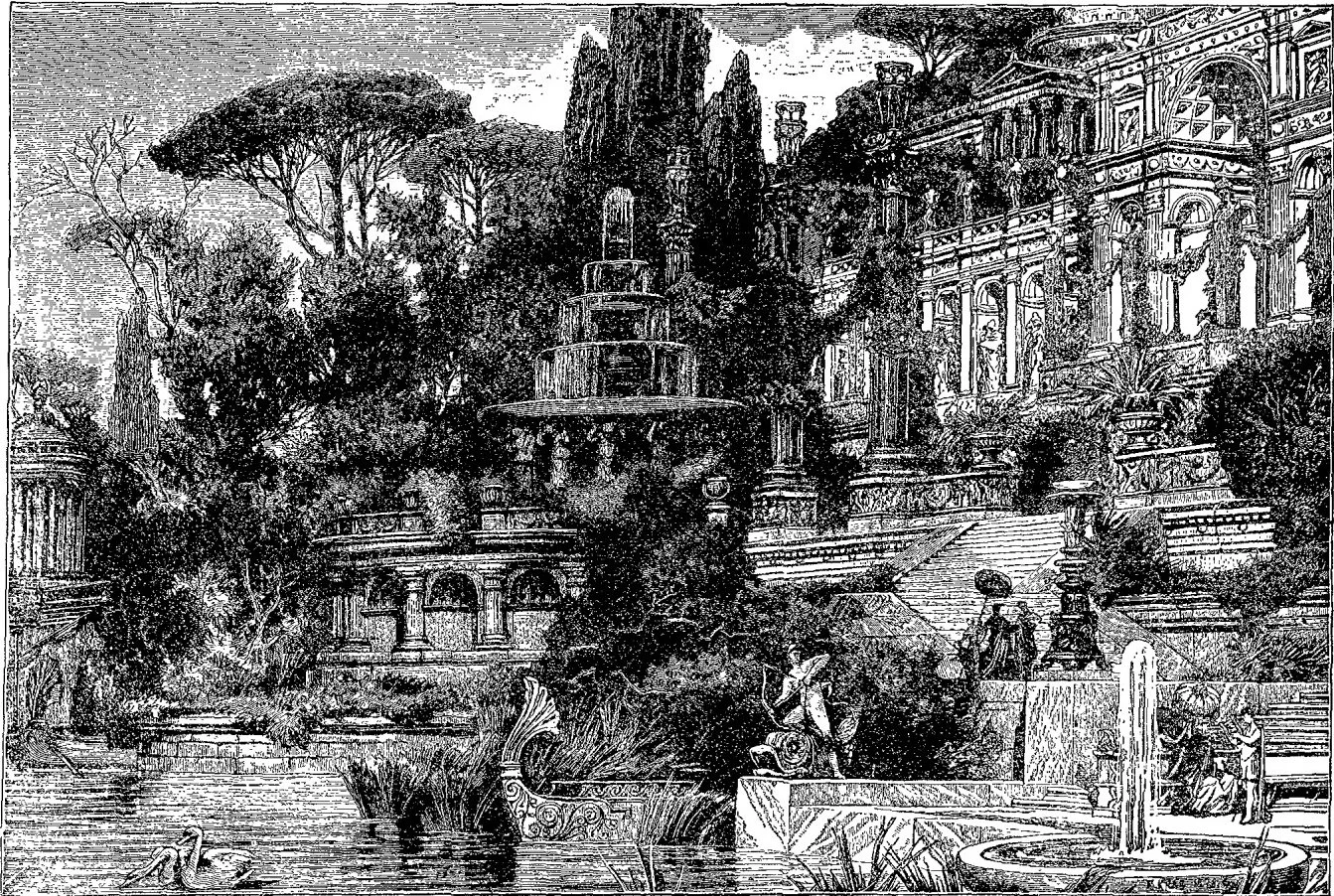
“History repeats itself.” A comparison between the condition of Rome in the last days of the republic with this country to-day, presents remarkable similarities. The author of “Two Republics” thus presents the condition of Rome:—
“Wealth poured in more and more, and luxury grew more unbounded. Palaces sprang up in the city, castles in the country, villas at pleasant places by the sea, parks, and fish-ponds, and game preserves, and gardens, and vast retinues of servants’ everywhere.” The effect of all this absorbing of the land, whether public or private, into great estates, worked by slaves, was to crowd the free laborers off the lands and into the large towns, and into Rome above all. There they found every trade and occupation filled with slaves, whose labor only increased the wealth of the millionaire, and with which it was impossible successfully to compete. The only alternative was to fall into the train of the political agitator, become the stepping-stone to his ambition, sell their votes to the highest bidder, and perhaps have a share in the promised more equable division of the good things which were monopolized by the rich.—“Two Republics,” pages 20, 21.
“PALACES SPRANG UP IN THE CITY, CASTLES IN THE COUNTRY, VILLAS AT PLEASANT PLACES BY THE SEA.”
To-day wealth is pouring into our large cities more and more. Luxury is growing more unbounded. Palaces are springing up in the city, castles in the country, and villas at pleasant places by the sea. Wealth is concentrated in the hands of a few; men are forced by hard times to mortgage their farms, thus placing them in the power of the comparatively small class which owns the wealth of the country. Finding themselves in this plight, the farmers fall into the train of the political agitator, and become the stepping-stone to his ambition.
While visiting this country, Herbert Spencer said:—
You retain the forms of freedom, but so far as I can gather, there has been a considerable loss of the substance. It is true that those who rule you do not do it by means of retainers armed with swords; but they do it through regiments of men armed with voting papers, who obey the word of command as loyally as did the dependents of the old feudal nobles, and who thus enable their leaders to override the general will, and make the community submit to their exactions as effectually as did their prototypes of old. Manifestly, those who framed your Constitution never dreamed that twenty thousand citizens would go to the polls led by a boss.
The servants in Rome were prisoners taken in war. They were bought by the rich; and as many of them were skilled workmen in different branches of industry, it gave the rich a monopoly, and as the native-born Romans could not compete with such labor, they were thrown out of employment. To-day in the United States, the man who is rich enough to control a machine that does the work of fifty or one hundred men has a monopoly; and as men cannot compete with machine labor, they are thrown out of employment.
In the early days of Rome, unions of the different trades and handicrafts were formed for mutual benefit. To-day we have labor organizations that are formed for mutual benefit.
The wealthy Romans controlled the land by controlling the money; and by controlling both money and land, they made the lot of the people most miserable. Speaking of their condition, a historian says:—
The people gave themselves up in despair in the field, as beasts of burden lie down beneath their load, and refuse to rise. The disintegration of society was almost complete. All public spirit, all generous emotions, all noble aspirations, of man shriveled and disappeared as the volume of money shrank, and prices fell. . . . Wealth accumulated in the hands of the few. . . . Whole provinces became the property of one man.
As lands were controlled by the Roman capitalists and worked by cheap labor (slave labor), many were forced to seek the city for employment; and there, finding every avenue of industry filled, they gave themselves over to crime and vice. Women would sell their virtue, and men their manhood, in order to obtain bread. It is with sadness that we have to concede that the condition of our great cities is similar to that of Rome. Truly, history is repeating itself.
In our large cities are organized criminal societies. There we find roughs, gamblers, robbers, thieves, and prostitutes,—the very classes that are ever ready for any desperate undertaking that promises plunder, though the cost may be the sacrifice of property and life. As to the possibility of wholesale destruction in our large cities in the future, Dr. Josiah Strong, the author of “Our Country,” says:—
It must not be forgotten that, side by side with this deep discontent of intelligent and unsatisfied wants, has been developed, in modern times, a tremendous enginery of destruction, which offers itself to every man. Since the French Revolution, nitroglycerin, illuminating-gas, petroleum, dynamite, the revolver, the repeating rifle, and the Gatling gun have all come into use. Science has placed in man’s hand superhuman powers. Society, also, is become more highly organized, much more complex, and is therefore much more susceptible of injury. There never was a time in the history of the world when an enemy of society could work such mighty mischief as to-day. . . . Palaces, factories, railways, Brooklyn bridges, Hoosac tunnels,—all the long inventory of our material wonders,—are destructible by material means. The explosion of a little nitroglycerin under a few water-mains would make a great city uninhabitable. The blowing up of a few railroad bridges and tunnels would bring famine quicker than the wall of circumvallation that Titus drew around Jerusalem; the pumping of atmospheric air into the gas-mains, and the application of a match, would tear up every street and level every house. We are preparing conditions which make possible a reign of terror that would beggar the scenes of the French Revolution.
About forty-five years ago, Tocqueville said, “I look upon the size of certain American cities, and especially upon the nature of their population, as a real danger, which threatens the security of the democratic republics of the New World.”
As the land is full of bloody crimes, and the city is full of violence, can we expect anything else than the scenes described in this scripture: “Wherefore I will bring the worst of the heathen, and they shall possess their houses: I will also make the pomp of the strong to cease; and their holy places shall be defiled”? Eze. 7:24. The Douay Version reads: “I will bring the worst of the nations, and they shall possess their houses.”
Is it not a fact that the United States of America has been largely peopled by immigration from the Old World?—During the past few years there have been brought to the United States, from all parts of the Old World, an average of from two hundred to three hundred thousand immigrants annually. Have we received of what could be termed the best of the European population? It is a fact that we have received many noble people from the Old World, but it is also a fact that we have received the dregs of Europe. It is a fact that seventy-four per cent. of the criminals of Ireland have been landed upon American soil. It is also a fact that England has paid the passage of ex-criminals to the United States, in order to get rid of them. Every detective in New York knows that scarcely a ship comes to the dock carrying immigrants that does not bring English, French, German, or Italian crooks. The Word says, “He will bring the worst of the nations, and they shall possess their houses.”
In the demonstrations of anarchy that we see in the United States, what class-takes the lead? Is it not the “worst of the nations”? In the Homestead riot there was a skirmish between the strikers and the Pinkerton detectives, and twenty men were killed. The militia was called out, and when the soldiers landed on the shores of the Monongahela, and were marched up to be put in safe quarters, many women rushed up and struck them with bricks and clubs, severely injuring some. You do not believe that the best ladies of Homestead were engaged in that performance, do you?
A paper called Truth, published in San Francisco, once said: “When the laboring men understand that the heaven which they are promised hereafter is but a mirage, they will knock at the door of the wealthy robber with a musket in hand, and demand a share of the goods of this life now.” It further adds: “War to the palace, peace to the cottage, death to luxurious idleness. We have no moment to waste. Arm, I say, to the teeth! for the revolution is upon you.”
After explosions in the Houses of Parliament and the Tower of London, anarchists in Chicago uttered the following:—
A little hogs’ grease and nitric acid makes a terrible explosion. Ten cents’ worth would blow a building to atoms. Dynamite can be made out of the dead body of capitalists as well as out of hogs. All Chicago can be set ablaze in a minute by electricity.
The Vorbote, of Chicago, says:—
You might as well suppose the military organizations of Europe were for play and parade as to suppose the labor organizations are for mere insurance and helpfulness. They are organized to protect interests for which, if the time comes, they would fight.
At a labor conference held at St. Louis, Aug. 31, 1897, the following resolution was adopted:—
Resolved, That no nation in which the people are totally disarmed can long remain a free nation; and, therefore, we urge upon all liberty-loving citizens to remember and obey Article 2 of the Constitution of the United States, which reads as follows: “The right of the people to keep and bear arms shall not be infringed.”
What is this but a gentle reminder to the members that were represented in that conference to provide themselves with muskets?
At the same conference, Eugene V. Debs, president of the American Railway Union, gave expression to the following sentiments:—
Whenever the trade unions of this country decide to do battle with our common enemy, they can count upon us to come to the front, and take our places side by side with them, and fight with them. Never in my life have I been more hopeful than now. I am not gifted with great visionary powers, but I can see the beginning of the end. [Cheers.] This meeting is an inspiration. It will lead to great results. This movement has attained tremendous impetus, and will go ahead with a rush. When the people are ready,—and that day is not far off, my friends,—there will be a spontaneous uprising; the Supreme Court will be abolished, Congress dispersed, and the rights of American citizens and American freedmen will be enthroned. [Great applause.] . . . Recourse to the sword! On bearing arms: I hope in this march of common intelligence we shall reach a point where we shall be able to settle these questions without appealing to the sword or the bullet. I cannot tell. Certain it is that there are thousands of our fellow citizens suffering, and certain it is, this cannot last. The time will come to incite the populace. When this time comes, you can depend on me. [Cheers.] I will not stand in the rear and ask you to go ahead. I will be in front, and say to you, “Come on!” [Renewed cheering.]

The Man Who Stoops to Sin

“THE man who will stoop to sin will stand up to defend it.”

Truth Must Guide Life and Build Character

“A TRUTH, however well verified, is useless in a spiritual or religious sense unless it be a truth which the Holy Spirit can employ in guiding life and building character.”

OUR EXAMPLE.

VIOLA E. SMITH.
To each of us sometimes comes the sad experience of having our love met with coldness, our kindness with ingratitude. Some one upon whom we have lavished favors, and for whom we have denied ourselves, refuses to deny himself at all for us, and proves himself to be actuated by selfish motives. How painful it is to be disappointed in a loved one, to lose confidence in one in whom we have trusted! But in such a trouble, as in all others, we may derive comfort from considering the life of Him who “was tempted in all points like as we are.” Christ could not be deceived in people, as we often are, for he knew the hearts of all men; but he was often obliged to quaff the bitter cup of unkindness, even from those who were nearest him. In the time of his greatest need, the twelve, whom he had chosen out of all the world, and to whom he had shown nothing but love and tenderness, forsook him and fled.
O, could he only have felt that, no matter what came, this little band would remain true to him! But it was not so. Peter, the boastful, valued his own safety more highly than he did the Master whom he professed to love, and three times denied that he knew him. How this must have pierced the heart of Jesus!
What a depth of meaning must have been conveyed in that “look” which the Saviour cast upon Peter,—not an indignant rebuke, not a reproachful word, simply a look, full of love and sorrow. It would seem that this act of Peter’s was enough to close the record of human baseness and ingratitude; but still worse treachery was in store for Jesus. Judas, one of the twelve, sold his Lord into the hands of his enemies for thirty pieces of silver.
Then behold the Lord in the garden of Gethsemane! He has taken Peter, James, and John with him; for he feels the need of sympathy, and where in all the world can he look for it if not to these? But in the midst of his distress he goes to them, and finds them sleeping! Indeed, his whole life is one record of love slighted; for “he came unto his own, and his own received him not.” No wonder he delighted to take refuge at times in the humble home at Bethany, where dwelt Mary and Martha and Lazarus, who so honored him. Cannot this unappreciated Saviour sympathize with those who have some small troubles of the same nature? Let us consider how often we ourselves have grieved and slighted him. How often has he stood knocking at the door of our heart, and we have paid no attention. Have we ever been treated as badly as we have treated him?
We may learn a lesson by observing the way in which he treated those who slighted him. Did he resent it, as we are sometimes tempted to do? Did he withdraw his love and sympathy from the offenders, as we often do? Did he at all slacken his efforts in their behalf?—We have no record of any such thing. He was just as loving, just as tender, just as faithful a friend as before. Let us follow in his footsteps, and endure ingratitude in his spirit.

THE BIBLE.

This book reveals the mind of God, the state of man, the way of salvation, the doom of sinners, and the happiness of believers. Its doctrines are holy, its precepts are binding, its histories are true, and its decisions are immutable.
Read it to be wise, believe it to be safe, and practise it to be holy.
It contains light to direct you, food to support you, and comfort to cheer you.
It is the traveler’s map, the pilgrim’s staff, the pilot’s compass, the soldier’s sword, and the Christian’s charter.
Here, heaven is opened, and the gates of hell are disclosed. Christ is its grand subject, our good its design, and the glory of God its end. It should fill the memory, rule the heart, and guide the feet. Read it slowly, frequently, prayerfully. It is a mine of wealth, a paradise of glory, and a river of pleasure. It is given you in life, will be opened at the Judgment, and be remembered forever. It involves the highest responsibility, will reward the greatest labor, and condemn all who trifle with its sacred contents.—Selected.

Live by Faith, Not After the World

“LIVE not after the manner of the world; live by faith. Only the man who leans on the strong arm of God, by the faith of Jesus Christ, may go through life harmless and happy.”

Locke on Studying the Holy Scriptures

“A LITTLE before his death, the great Locke, being asked how a young man could, ‘in the shortest and surest way, attain a knowledge of the Christian religion in the full and just extent of it,’ made this memorable reply: ‘Let him study the Holy Scriptures, especially the New Testament. Therein are contained the words of eternal life. It has God for its author, salvation for its end, and truth, without any mixture of error, for its matter.’”
Continue reading: EXERCISES IN BREATHING