Your ShelfYour Projects

Review and Herald, Vol. 76, No. 4.

THE SIN OF UNBELIEF

Review and Herald

Jan 24, 1899

Seventh-day Adventist Publishing Association · Battle Creek, Mich. · Jan 24, 1899

THE SIN OF UNBELIEF.

MRS. E. G. WHITE.
The Jews as a nation were not atheists nor avowed unbelievers, but the vital truths concerning Jesus Christ were misapprehended by them. They wrested the Scriptures to justify their own course of action; and refused to receive Christ as the Messiah, the Son of God, the Saviour of the world.
John the Baptist had preceded Christ with the message, “Prepare ye the way of the Lord.” He had called upon the Jews to seek first the kingdom of God and his righteousness. Christ came to reveal to men the nature of the kingdom of heaven. He came to show that it is not instituted by men; that it is not controlled by partiality, nor corrupted by hypocrisy. It is not for the few self-centered ones to share largely of the heavenly gift, while the stricken and unfortunate are left desolate and forsaken. The kingdom of heaven is a dispensation of divine mercy, of forgiveness and peace. The darkness of a guilty world was broken by the bright beams of the Sun of righteousness. And “as many as received him, to them gave he power to become the sons of God, even to them that believe on his name.”
When the Pharisees saw the Spirit of Christ working in the hearts of the disobedient; when they beheld sinners coming to the righteousness of the Just; when they saw impartial goodness and mercy, the attributes of the throne of God, extended toward those whom they despised, their hearts were filled with hatred against Christ. The scribes and Pharisees were full of self-conceit and ostentation, and they were disappointed that Christ did not approve of these attributes. They were not deceived in the character of Christ. They saw the contrast between their own impurity and unholiness and the purity and holiness of Christ. In such a kingdom as he would set up, they would find nothing to nourish their pride and ambition. Had Christ fallen in with them, and strengthened their high claims to superiority, they would have looked upon him with favor; but when they saw the publicans and sinners attracted to him, and following him, they were exasperated. They saw these men listening with earnestness to his lessons, and the word went round, “This man receiveth sinners, and eateth with them.”
“For God so loved the world, that he gave his only begotten Son, that whosoever believeth in him should not perish, but have everlasting life.” It was this teaching of Christ that called forth from the Pharisees such bitter hatred. That all were lost; that all were sinners and needed forgiveness; that both Jew and Gentile were included in the work of the Redeemer; that all must conform to the great moral standard,—this was contrary to their self-righteous ideas, and they hated the Great Teacher. They would not tolerate the teaching that did not distinguish them as a holy people, a royal nation.
Was the unbelief of the Jews excusable? Were they guiltless?—Christ’s word to them made them responsible. He addressed them as responsible agents, setting before them their duty. He healed the sick, comforted the sorrowing, and relieved the distressed. The dead obeyed his voice, and came forth to life. But his grand work of mercy and compassion was unheeded. The rulers of Israel closed their hearts against their Messiah. Lessons and appeals fell from his lips with so convincing a power that they were convicted of the truth; but they resisted the impressions of the Holy Spirit, and Christ said to them, “Ye will not come to me, that ye might have life.”
In rejecting Christ, the Jewish nation put from them the blessings which he came to bring them. They bound themselves in everlasting chains of unbelief and resistance. They placed themselves in a position where the calamities predicted must come upon them, because they knew not God, nor Jesus Christ, whom he had sent.
God gives sufficient evidence to every soul. He does not promise to remove every doubt, but he gives a reason for faith. And sufficient evidence was given to the Jews. On the day of Pentecost the message of the apostle Peter was: “Ye men of Israel, hear these words: Jesus of Nazareth, a man approved of God among you by miracles and wonders and signs, which God did by him in the midst of you, as ye yourselves also know: him being delivered by the determinate counsel and foreknowledge of God, ye have taken, and by wicked hands have crucified and slain.” “Ye denied the Holy One and the Just, and desired a murderer to be granted unto you; and killed the Prince of life, whom God hath raised from the dead; whereof we are witnesses.”
“I wot that through ignorance ye did it,” said Peter; but this ignorance did not excuse the action; for they had had great light. Peter says that had they known Jesus to be the Prince of life, they would not have crucified him. But why did they not know?—Because they did not choose to know. They had no interest to search and study, and their ignorance proved their eternal ruin. The ignorance of the Jews was inexcusable, and involved a fearful responsibility. They had had the strongest evidence on which to base their faith, and they were under obligation to God to accept the evidence he had given them. Their unbelief made them guilty of the blood of the only begotten Son of the infinite God.
The followers of Christ will experience the same kind of treatment that their Master received at the hands of men. Men who have had light and evidence will turn as determinedly from Christ as did the Jewish nation. Christ declares: “If the world hate you, ye know that it hated me before it hated you. If ye were of the world, the world would love his own: but because ye are not of the world, but I have chosen you out of the world; therefore the world hateth you. Remember the word that I said unto you, The servant is not greater than his lord. If they have persecuted me, they will also persecute you; if they have kept my saying, they will keep yours also. But all these things will they do unto you for my name’s sake, because they know not him that sent me.”
“It is enough for the disciple,” said Christ, “that he be as his master, and the servant as his lord. If they have called the master of the house Beelzebub, how much more shall they call them of his household? Fear them not therefore: for there is nothing covered, that shall not be revealed; and hid, that shall not be known. What I tell you in darkness, that speak ye in light: and what ye hear in the ear, that preach ye upon the housetops. And fear not them which kill the body, but are not able to kill the soul: but rather fear him which is able to destroy both soul and body in hell.”
There should be no reluctance on the part of man to make known the truth of the word of God, because his neighbors are not pleased with his difference of opinion. This will be a trial of faith, and there will be a temptation to shirk responsibilities because the duties presented are not agreeable. Your neighbors may choose to stand with those who do not love God with the whole heart, who selfishly serve their own interests; but is that sufficient reason why you should do the same? When the invitation is given, “Come; for all things are now ready,” will you say, “I can not come to the gospel feast; I can not heed your invitation: my neighbors will think me foolish, and will ridicule me, and I can not bear ridicule”? Will you say, “I must not displease my neighbors; I must attend to my farm; I must work on the Sabbath: if I keep the commandments of God, I can not be in harmony with my neighbors”? Jesus says that those who slight the gospel invitation,—an invitation purchased at the cost of the life of the Son of God,—shall not taste of his supper.
The Lord is sending an invitation in our day. Who will gladly accept it? Who will venture to refuse?
“For the Lord spake thus to me with a strong hand, and instructed me that I should not walk in the way of this people, saying, Say ye not, A confederacy, to all them to whom this people shall say, A confederacy; neither fear ye their fear, nor be afraid.” What is their fear?—It is that if they obey the commandments of God, they will be despised and ridiculed; if they come out from the world, they will be left to suffer want. Such a fear reveals unbelief in him who provides all our blessings. He sends the showers upon our lands, and permits the sun to shine, that vegetation may flourish. One word from God could withdraw the rain and cut off our supplies of food. With locust and pestilence he could destroy our crops. The Lord has borne long with the perversity of men; but he has their deeds written in the books of heaven, and will repay for their unrighteousness and disregard of his commandments.
Christ made no ostentatious claims to the Messiahship; he did not choose to take a position of royal dignity. But his appearance as a man among men caused the multitude to be easily swayed by the prejudice which leavened the whole nation. From the time when Christ worked the miracle to feed the five thousand, and refused to become their king, his popularity began to wane; and he devoted himself more earnestly to the instruction of his disciples. To inculcate the truth—this was his work, this was his great burden. The twelve were far from being perfect in knowledge, and Christ would not leave them in uncertainty. His enemies sought to prejudice every mind possible. The open hostility of the Pharisees made it necessary for Christ to lay out, in clear, decided lines, the truths concerning himself, and to unmask the hypocrisy of his enemies.
As he neared the time of separation from his disciples, his teaching became more significant and mysterious to their minds. He presented himself before the people as the bread of life. The multitude were impressed with his teaching, large crowds followed him, and precious rays of light were shed upon them; but the disciples no longer held to the hope that the Jews, as a nation, would receive Christ. And now as he clearly defined his spiritual kingdom, and discouraged the idea of a temporal reign, the worldly minded among the people, and even among those who professed to be his disciples, turned from him.
As light is presented before us, we need to watch and pray, lest in the day of our opportunity we follow the example of the Jews; lest we receive the sayings of men rather than the truth, which would disturb our complacency; lest we refuse to live the life of Christ, and thus sacrifice the favor of God. Those who refuse to follow where Christ leads can not have the faith that works by love and purifies the soul. When called to trial, they will yield up their faith in Christ as their personal Saviour, and become open transgressors of the commandments of God. They choose to stand under the banner of the first apostate,—the one who brought sin into the world. They choose to be one with transgressors, rather than be out of joint with their neighbors.
Those who, because they see difficulties in their pathway, and do not want to suffer inconvenience, turn away from the most ample evidence, crucify to themselves the Son of God, and put Christ to open shame. By turning from the truth of God to a lie, they give proof that, had they lived in Christ’s day, they would have treated the Saviour as did the unbelieving Jews. These will not in any sense be found excusable before God, before the angels of heaven, or before men.
Man’s own state of mind does not relieve him of responsibility; for he need not be in that state of mind which will lead him to refuse light. The mind that resists truth will see everything in a perverted light. It will be fastened in the toils of the enemy, and will view things in the light of the enemy. Saul of Tarsus was an example of this. He had no moral right to be an unbeliever. But he had chosen to accept the opinions of men rather than the counsel of God. He had the prophecies pointing to the Messiah, but preferred the sayings of the rabbis, the word of men. In his own wisdom, Saul knew not God, nor Jesus Christ, whom he had sent. Afterward, in repeating his experience, he declared that he thought he ought to do many things contrary to the name of Jesus of Nazareth. Saul was honest in his unbelief. His was no pretension; and Jesus arrested him in his career, and showed him on whose side he was working. The persecutor accepted the words of Christ, and was converted to faith in the Saviour.
Saul did not treat with indifference the unbelief that had led him to follow in Satan’s track, and cost the suffering and death of the most precious of earth,—those of whom the world was not worthy. He did not plead that his error of judgment was excusable. Long after his conversion, he spoke of himself as the chief of sinners. “For I am the least of the apostles,” he said, “that am not meet to be called an apostle, because I persecuted the church of God.” He did not make one excuse for his cruel course in following faithfully the dictates of a conscience that was false.
No human being is excusable for having a conscience that will permit him to cause pain or suffering to any of God’s children. Christ declares: “Whoso shall offend one of these little ones which believe in me, it were better for him that a millstone were hanged about his neck, and that he were drowned in the depth of the sea. Woe unto the world because of offenses! for it must needs be that offenses come; but woe to that man by whom the offense cometh!”
Those who believe in Jesus are very precious to him; and any injury done to them is as if done to Christ himself. He identifies his interest with that of suffering humanity; and those that would interpose between God and the souls who would do him service will be punished in proportion to the light they have had.

GOD'S BUILDING.

Yes, the church of God is rising; It is growing, hour by hour; As the living stones are fashioned By the Sculptor's wondrous power.
O, the constant care and patience, That we each of us require, 'Ere we answer the ideal Of his infinite desire!
Yet his heart is strong and earnest; And by wise and loving skill, Very slowly, but most surely, He, in us, performs his will.
Keen the instruments he uses To transform us to his mind; But the Master's hand is skilful, And his heart is passing kind.
So we will not doubt nor wonder If his ways we can not know; We shall understand them better, As, conformed to him we grow.
— Selected.

THE SACRED RIGHT OF CONSCIENCE.

American Sentinel.
In “Legal Maxims,” compiled and published by Herbert Broom, LL.D., a London barrister, the right of conscience is upheld in the following words:—
Summa ratio est quae pro religione facit,—that rule of conduct is to be deemed binding which religion dictates.
The maxim above cited from the commentaries of Sir E. Coke is, in truth, derived from the Digest, where Papinian, after remarking that certain religious observances were favored by the Roman law, gives, as a reason, Summam esse rationem quae pro religione facit.
It may, however, safely be affirmed that if ever the laws of God and man are at variance, the former are to be obeyed in derogation of the latter; that the law of God is, under all circumstances, superior in obligation to that of man; and that, consequently, if any general custom were opposed to the divine law, or if any statute were passed directly contrary thereto,—as if it were generally enacted that no one should give alms to any object in ever so necessitous a condition,—such a custom, or such an act, would be void.
It may further be observed that upon these two foundations,—the law of nature and the law of revelation,—depend all human laws; that is to say, no human laws can be suffered to contradict these. For instance, in the case of murder: this is expressly forbidden by the divine, and demonstrably by the natural law; and if any human law should allow or enjoin us to commit it, we are bound to transgress that human law, or else we must offend both the natural and the divine. “Neither are positive laws, even in matters seemingly indifferent, any further binding than they are agreeable with the laws of God and nature.”
It can not, however, be doubted that obedience to the laws of our country, provided such laws are not opposed to the law of God, is a moral duty; and, therefore, although disobedience is justifiable in the one case supposed, of a contradiction between divine and human laws, yet this is not so either when the human law affirms the divine in a matter not indifferent in itself; as when it forbids theft, or when the human law commands or prohibits in a matter purely indifferent; and in both these cases it becomes a moral duty on the part of the subject to obey.
These legal maxims constitute what may be called the classics of Anglo-Saxon law,—the foundation principles, which were established centuries ago, affirmed by the most celebrated legal authorities, and which have come down unchallenged to the present time. As such, they are justly to be regarded as unquestionable authority.

Dead While He Liveth

“Dead while he liveth! God pity us all Who thus o'er the living must spread the pall,— Who watch the slow ravage of sin's deep blight, And never can bury our dead out of sight! O pitiful God! who to beauty and bloom Yearly dost waken the earth from its tomb, Strong to deliver, and mighty to save, Quicken that soul in its living grave!”

WHAT TO DO.

MIND your own business. Attend strictly to the mind of the Spirit in you. Keep your hands, and thoughts, and tongue off of other people. Do not try to mold or fashion others; never interfere with them, nor let them interfere with you. Anyway, whatever they do to you, you let them alone. Put away selfishness: it is the tap-root of trouble; it is the source of evil. Selfhood is brutal; there is nothing more brutal than selfishness. Mind your own affairs, but do not mind them selfishly. Be free; but be willing that all others should be free, too: what we claim for ourselves, let us grant to others. Be simple, truthful, meek, and humble. Be His, and do only as he directs. So did Jesus. Make him your pattern, and do as he did.—Selected.

WHAT DOES IT MEAN?

It does not matter what it means, poor heart! The dear Lord knows; to bear it is your part, Nor think some strange thing happens unto you, Which he would not allow so if he knew. He does know. In his all-wise Fatherhood He knows it, and allows it for your good. He is not hard; you do not think he is When in the dark you find your hand in his; When it was light, you tried to walk alone, And thought the strength he gave you all your own.
You did not ask what that last blessing meant; Just smiled and took it, satisfied, content. You did not think it strange. You thought he knew, And planned the sweet surprise that came to you. Tried one, then do you take life's sweet and good, Yet can not trust that tender Fatherhood, But think it makes mistakes whene'er it sends Some hindrance which your eager haste offends? Or when he lets the wicked plot you harm, And stir a whirlwind when you seek a calm; You think it strange, this trial swift and keen, And in your weakness ask, “What does it mean?”
I think the language of God's heart would read: “I love my child, I note his slightest need; I long to prosper him in all his ways, To give him quiet nights and peaceful days: But if I do, he'll loose himself from me, My outstretched hand he will not wait to see; I'll place a hindering wall before his feet; There he will wait, and there we two will meet. I do it not in wrath for broken laws Or wilful disobedience, but because I want him nearer, and I can not wait For him to come; for he might wander late. My child will wonder, will not understand; Still half in doubt, he'll clasp my outstretched hand: But when at last upon my heart he leans, He will have ceased to wonder what it means.” — Delia Rees.

THE HOLINESS OF GOD.

W. W. Prescott.
He is the Holy One (Isa. 57:15), and he desires that we should be holy as he is. The very purpose of the gospel is to restore in each one who will receive it the very holiness of the character of God. The means that God has provided by which this may be restored is all wrapped up in the gift of Jesus Christ. How has he wrought to bring this gift to us so that we may take hold of it?—He has provided a triple channel for the revealing of Jesus Christ and his life,—the holy Sabbath, his living presence in time; the Holy Child, his living presence in the flesh; the Holy Word, his living presence in language.
The Lord has taken common time,—a day which appears just like other days,—and put into it the blessing of his own holy presence, which those who recognize it by faith in what he has done will receive in the day. All those who fail to recognize the difference that God has made, simply cut themselves off from the blessing that God has given in the day,—a blessing that can be received in no other way, because God has given it in this way.
God has taken common, sinful flesh, just like man, and revealed his own holy presence in Jesus of Nazareth. But because he outwardly appeared the same as other men, many are offended in him; and seeing only the peasant of Galilee, do not receive the blessing that God has put in him for them.
So with the word of God. He has taken common language, and by putting his own holiness in it, made it his own Holy Word. Just as he took man, common clay, and breathed into him the breath of life and holiness, so he has breathed into common language the breath of life, and made it the living Word. Yet many say, “These words look just like any others,” and fail to recognize the life and presence of God in them, and so cut themselves off from the blessing of holiness, which he imparts through the Word.
It makes no difference to the holiness of Jesus Christ, of the Sabbath, or the Word, whether we accept them or not; for we can neither make holy nor unholy. But it makes a great difference to us; it is simply a question of salvation,—holiness restored.
Since these three things are in their very nature inseparable,—one triple channel of holiness,—if one is tampered with, the others must be. The Catholic Church did by its own authority, as it itself says, set up another day in the place of the Sabbath, and command the observance of Sunday, for which there is no authority in the Word. Having made a change in the holy Sabbath, they must, in order to authorize it, make a change in the Holy Bible, and put tradition and the authority of the church above the Word. This is a logical necessity from the change of the Sabbath.
But then there is the holy Child Jesus, who made the Sabbath and gave the Word. Of logical necessity, also, his place must be supplanted. So the Virgin Mary is exalted at the expense of Jesus Christ. So long as his teaching and example are given their true place, and the Holy Scriptures are given their true place as the word of God, the Lord’s Sabbath must remain as the only Sabbath. So when the Sabbath is supplanted, the Holy Child and the Holy Word must be supplanted also. Then what is there left, through which man may receive the holiness of God? Thus we see that this is a question of salvation, of life and holiness.

COLORS AND GRACES.

L. A. REED.
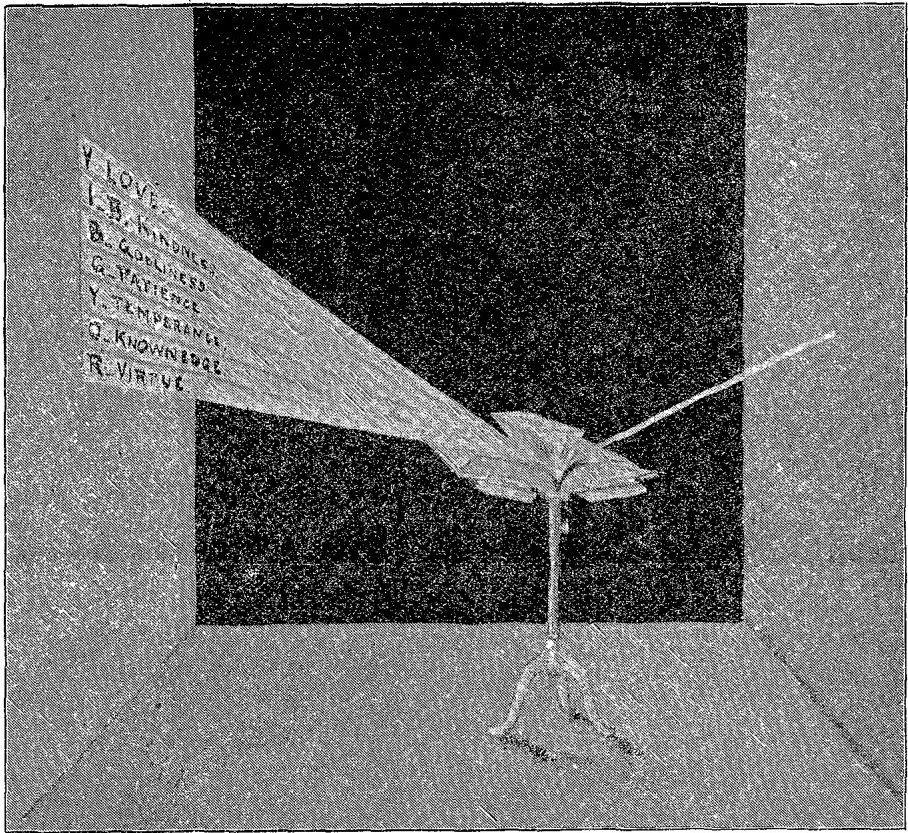
LIGHT is composite; every ray contains within itself seven different colors. Under ordinary circumstances, these colors are not made manifest; but when the ray passes through a glass prism, no two colors take exactly the same path, and we have all seven brought to view.
THE PRISM OF GOD’S WORD.
And so the light which comes from God is one light; and yet every ray has within itself seven different colors, if I may so speak. These are, virtue, or fortitude; knowledge; temperance, or self-control; patience; godliness, or piety; brotherly kindness; and charity, or love.
We found that red is the least bent in passing through the prism; orange, a little more; and so each color following, until violet bends most, and stands outside all the others.
And as we consider these graces, we mark the same quality. Virtue, or fortitude, the very synonym of unyielding determination and fixedness of purpose, is first; it is revealed in one's character, just as the red in the ray of light is revealed,—by its least refrangibility, by its being least bent. It is an excellent quality as a foundation of character; but lacking the reaching-out element of sympathy, could not alone make a perfect character.
Knowledge is next given. Knowledge reaches out a little farther; it knows of something besides its own wants, begins to see the needs of others, and is one of the links of character uniting fortitude and love.
Then comes temperance, or self-control. Our fortitude tended to make us exacting, stern, unyielding, unsympathetic; but knowledge has come into the character, teaching us the value of, and making us ready for, self-control, which, coupled with patience, makes us godlike, or puts us in possession of godliness. But being like God, who is love, we shall now show the last two qualities,—brotherly kindness and love.
Thus observing these graces carefully, one by one, we see their refrangibility increasing with each one. Each character reveals these attributes, just as light reveals the colors,—by a difference of refrangibility (bending quality) in each one,—and in love, the analogue of violet, we have this refrangibility in the highest degree.
But let no one think that by this bending, we mean a bending aside from the path of right. Fortitude, or virtue, is in the character for a purpose; it can not be turned aside from the path of right. And though the red is slightly bent by the prism, in doing so, it follows rigidly the laws of light, which are the laws of God for light. The violet, though having the greatest refrangibility of all, can not be turned this way or that, as we choose; for it follows forever in the path God marked out for it.
By bending-quality, with reference to these graces, we have meant only the reaching-out quality of love and sympathy, or kindness. And this quality enters more and more into each grace enumerated, until we have it in complete perfection in the graces of brotherly kindness and love.
Continue reading: OUR GOD IS A CONSUMING FIRE