[It is not surprising that this Tennessee correspondent should be so astonished at the action of the last Congress in the Sunday closing of the World's Fair as to break out into this rhapsody of amazement. But there are still more amazing things already in progress and yet to come. Let him and every one watch the progress of events, and take at every step a definite stand for the right and against the wrong.]
I CAN imagine how a man could be bribed with a dollar or two to vote for a man he had intended to vote for. Also how by the use of a dozen dollars or so, a man in a tight place might be bribed to vote for a man he had not intended to vote for.
I can imagine how by the use of a few hundred dollars, a mean man might be bribed to burn another man's stacks or barn; or for a few thousand dollars, a mighty mean man might be bribed to murder a fellow-man.
But what tremendous crime requires the enormous bribe of $2,500,000? Is it possible that noble, honorable men would offer such a bribe as that? Is it possible that noble, honorable men could be bribed into a crime commensurate with such a huge appropriation?
Behold the Congress of the United States bribing the management of the Columbian Exposition into an actual union of Church and State!!
Behold the acceptance of the bribe by the management, and its enforcement of the contract!!
Indeed justice has fled from the haunts of men. For shame! For shame!! For shame!!! L. L. GOODWIN.
Mayston, Tenn.
History, Logic, and Truth.
[Rev. A. H. Lewis appeared as the only champion of truth, justice, and the correct principles of legislation, at the hearing concerning the State Sunday law before the Judiciary Committee of the House of Representatives of the State of Pennsylvania, on Feb. 16, 1893. Extracts from the synopsis of Dr. Lewis' remarks published in the Sabbath Recorder are reprinted here.]
I APPEAR in behalf of the Seventh-day Baptists of the State of Pennsylvania, and in behalf of religious liberty for all men. I ask for the total repeal of the Sunday law of 1794.
The origin of the present law is connected directly with the Seventh-day Baptists. Before the Revolutionary War there were many Seventh-day Baptists in Philadelphia and the eastern part of Pennsylvania; they were among the most industrious, upright, and patriotic citizens. At the close of that war there was much general immorality and irreligion, arising from the disorders incident to such times, and from the influence of the moral and religious revolution going on in France in 1793. Philadelphia was the national capital. The yellow fever swept over the city that year, leaving a trail of desolation, sorrow and fear. Accustomed, as the men of that time were, to look upon such epidemics as a direct punishment for sins, the public mind was aroused to learn why such things had come to pass. During the war many laws against vice and immorality had fallen into disuse, or had expired by limitation. The legislature of Pennsylvania convened early in December, 1793, and a committee was appointed to report laws looking toward a better state of things. Religious men of all classes joined in urging this movement, the Seventh-day Baptists, both English and German, being among the foremost. Since the prevailing disorders were most marked on days of leisure, the Sunday question became a prominent factor in the case. When the excitement was at the highest the seventh-day Baptists discovered that the proposed law touching Sunday would press heavily upon them, not in the matter of vice or immorality, but in point of legitimate labor and business. Hence on Thursday, Jan. 2, 1794, they presented the following memorial, saying:
That agreeable to the dictates of their own consciences, they have set apart and kept the seventh day as their Sabbath, and by existing laws are subjected to severe penalties for working on the first day of the week (Sunday), which they conceive to be contrary to the constitution of this85commonwealth, they therefore pray that so much of the “act for the suppression of vice and immorality,” etc., as imposes a penalty on them for working on the first day of the week, may be repealed.
This memorial was based on Section 3, Article 9, of the State constitution, which reads:—
All men have a natural and indefeasible right to worship Almighty God according to the dictates of their own consciences; no man can, of right, be compelled to attend, erect or support any place of worship, or to maintain any ministry against his consent; no human authority can, in any case whatever, control or interfere with the rights of conscience; and no preference shall be given, by law, to any religious establishments or modes of worship.
Religious men of all classes, joined in petitioning the legislature that this exemption be granted to the Seventh-day Baptists. The matter was laid over from Jan. 2 to Feb. 5, 1794; and there is good evidence that the exemption would have been granted but for one circumstance.
The petition for exemption was referred to a committee, of which James McLene, who represented Franklin County, was a member. He was a Scotch-Irish Presbyterian who was fanatically opposed to everything connected with Roman Catholicism. Through a strange ignorance of the facts, McLene had determined that the Seventh-day Baptists were Papists in disguise, to whom no quarter should be granted. His persistent intolerance gained the victory, and the committee reported against the exemption. On the 22nd of April, 1794, under such influences, the present law was enacted. The Seventh-day Baptists and others have suffered persecution under it from time to time for a century, not because of evil, but because personal spite, or petty ambition has enabled intolerant enemies to cause their arrest and punishment for quietly working on their farms. A law which makes such wrongs possible ought not to abide the light of the closing years of this century. Perhaps “exemption” was all that could be hoped for in the shadows of 1794; but is is too late now to ask for less than repeal, for, as I proceed to show, the law violates the fundamental rights of all men and the fundamental doctrines of religious liberty.
THIS LAW IS UNCONSTITUTIONAL RELIGIOUS LEGISLATION, WHICH OUGHT TO BE REPEALED.
Those who seek to evade this fact say: “The law does not compel men to attend church, nor be religious.” This is an evasion. The law forbids “worldly employment or business on the Lord’s day.” “Worldly” has no meaning here except as opposed to “sacred;” this word, as contrasted with the next, “Lord’s day,” has no meaning except it be a day sacred to the Lord, a day specially set apart for his service, and in the interest of religion, and as contrasted with other days not so devoted. The term “Sabbath,”—so commonly used in this discussion, but which legislators dare not use in legal enactment lest the law apply to Saturday and not to Sunday—has no meaning except as a day which men should hold sacred to God. The law of 1794 assumes that it is wrong, is irreligious, sinful, to pursue “worldly” affairs on Sunday; the crucial point in the law is that it forbids certain things on Sunday which may be done on any other day without hindrance, because it is not wrong or irreligious to do them on other days. The things prohibited are not wrong per se, but only wrong at a certain specified time, which the law declares to be the “Lord’s” time. To say that such a law does not enforce a religious duty, is to deny the plainest facts of history and the clearest meaning of words. And more! no Sunday law has been enacted from the pagan law of Constantine in 321 A. D. to the late national provision touching the opening of the Columbian Exposition on Sunday, which did not spring from religious sentiments, and aim at preventing irreligious actions.
When the friends of Sunday wish to evade the claims of Saturday, the Sabbath, according to the Bible, they declare that the law of God, in the fourth commandment of the Decalogue, does not designate a specific day of the week, but only any seventh day of rest after six days of labor. This is the latest and most popular interpretation of God’s Sabbath law. Grant this, not as fact, but for the sake of the argument. By what right then does the law of Pennsylvania go so far beyond the law of God? Who gave the legislature of 1794, under the lead of James McLene, the right to declare that all men in the commonwealth shall cease from all worldly business on a specific day in each week? Was James McLene, with his fierce anti-papistic intolerance, coupled with an ignorance which kept him from knowing the difference between a Seventh-day Baptist and a Roman Catholic, a better religious guide than “Moses, the man of God?” If the Bible does not fix the Sabbath on any specific day, shall the State of Pennsylvania, in the face of its constitution, which declares that “No preference shall be given by law to any religious establishment or modes of worship” assume to determine what these men say the Bible forbids, by declaring that Sunday, a specific day, is the Sabbath? May this commonwealth visit fines and imprisonment on upright citizens because they practice what those who desire to retain this law say the Bible teaches, but what they themselves inconsistently deny when they plead for the law? Tested by popular assertions used to push Saturday out of sight, Pennsylvania has no right to go beyond protecting each man in Sabbatizing on any day he may choose. So far, these advocates of the law of 1794 are right, even though such arguments, invented to ward off the claims of Seventh-day Baptists, logically destroy all Sunday legislation.
BASED ON FALSE CLAIMS.
But a stronger indictment remains. The law of 1794 is based on false claims. It assumes that Sunday is the Sabbath according to the Bible, and that men sin against God who “desecrate it.” Whatever the men of 1794 may have thought, every man who has looked into this matter knows that is not the fact. The Bible designates the “seventh day” as the Sabbath. That this means the seventh day of the week is shown by the fact that the Jews who received the law, so understood it, and have kept it in unbroken succession to this day; and also the fact that Sunday, “the first day of the week,” can be located only by its relation to Saturday, the seventh day of the week. There is not a word or hint in the Bible about the transferring of the Sabbath law to Sunday or the “change” of the Sabbath. The modern theory of such transfer and change did not appear in history until the English Reformation, when it was invented as a compromise between the theory of the English Seventh-day Baptists and that of the Roman Catholics. The “first day of the week” is mentioned but a few times in the New Testament. It is never spoken of as sacred, as the Sabbath, or as being in any way worthy of religious regard. Its observance is never connected with Christ’s resurrection. The term “Lord’s day” occurs but once in the New Testament, and there is no evidence that Sunday was then referred to. There is no definite proof that the term was applied to Sunday until one hundred and seventy years after Christ. In the face of such facts it is difficult to understand how men of this day can continue to assume what we can perhaps, forgive in the men of one hundred years ago.
Similar facts appear in the history of Sunday legislation. The earliest law, that of Constantine, 321 A. D., is wholly pagan in form and fact. It mentions the day only as the “venerable day of the sun.” There is not a trace of Christianity in the law. Sunday legislation did not begin as a part of Christianity. Gradually it combined Christian with pagan elements. The term “Lord’s day” does not appear until 386 A. D., in a law of Gratian, Valentinian, and Theodosius; and the term “Sabbath,” as applied to Sunday, does not appear in civil law or ecclesiastical literature until the Puritan Reformation in England, three hundred years ago. The assumption which underlies the law of 1794 ignores these facts. Historic honesty demands its repeal.
In conclusion, Mr. Chairman, I earnestly and respectfully ask you to consider the repeal of this law of 1794, because,
(a) It contravenes the fundamental principle of religious liberty.
(b) It has always wrought injustice to those who observe the Sabbath—Saturday.
(c) It is unjust toward those who do not believe that they ought to cease from legitimate work on any particular day, for religious reasons.
(d) It rests on the false assumption that Sunday is the Sabbath, and that it is sinful to do on that day that which may be done on Monday without thought of wrong.
(e) It hinders the cause of genuine Sabbath reform by teaching men to rely on the civil law in matters which belong only to the Word of God and the decisions of religious conscience.
(f) It weakens and destroys conscience toward God by putting human authority, resting on false claims, before the divine law.
Permit me also to repeat that, in asking for repeal, I would remove no restriction against the evils which come with Sunday as a day of leisure; evils which Sunday laws help to create by enforcing leisure upon the irreligious. I would inaugurate new and more rigid legislation against saloons, gambling, impurity, rioting, and everything of this kind. I plead for a higher conception of Christianity and of Sabbath-keeping than civil law has given, or can give. I ask for a just and helpful application of Christian principles to all, regardless of creed. This is not a question of majorities, but of God-given rights. It is a question of truth and facts, not creeds and traditions. It is a question of principles, not of the percentage of opinions. That legislation best befits this great commonwealth, bearing the honored name of William Penn, which best attains a broad Christ-like application of the principles of religious freedom to86all classes, and to all questions of religious faith and practice. Before closing, I must come to the defense of “Presbyterian elders,” and Christian people generally who take the Sunday newspapers, ride on Sunday trains, etc. I have heard these people much condemned in the convention just held for the purpose of inducing your honorable body to preserve the law of 1794. These men are not more wicked than men of a century ago. They have learned more of the facts concerning Sunday and have come to believe that it is not a sacred day. They have learned that the Bible does not declare Sunday work to be a sin. They do not fear that God will forge lightning to smite them if they do advertise in Sunday papers. This is the deeper meaning of the growing disregard for Sunday among Christian men. It is neither honest, charitable, nor Christ-like to denounce them as “hypocrites” and “greedy sinners,” for rejecting the false claims of Sunday.
California and a National Sunday Law.
THE Sunday-law effort in the present legislature of California made its appearance in the form of a petition. The following is a copy of the petition:—
To the California House of Representatives of 1893: We, the undersigned, citizens of the State of California, twenty-one years of age and over, most earnestly petition your honorable body to enact a law forbidding all Sunday traffic and work, as well as all coarse and noisy amusements on that day of the week; making suitable exception for works of necessity and mercy, and for private work by those who religiously and regularly observe another day of the week by abstaining from labor and business on the same.
The petition bears the well-known stamp of the American Sabbath Union. It was expected that the union’s agents would make a strong pull at this session. Their three years’ campaign in the State, at the close of which they confidently promised their supporters a Sunday law, has been zealously though quietly prosecuted. They had no doubt of their ability to educate the people up to that point in three years’ time. The boast was that the union never had made a failure, and never would. But it can now record one defeat at least. The Sunday-law measure did not stand half the chance at the session this year that it did two years ago; this time it was not even honored with an introduction. The attempt to call it out by petition heard no favorable response but its own echo. Yet Sunday fares as well in California as in any other State. The bitter pill with the Sunday-law criers is that they have no opportunity to put their opponents in the chain-gang.
The special mark of the Sabbath Union lies in the religious requirement. They have always claimed that they only asked a civil rest day, but their dictum that those who observe another day shall do so “religiously” invariably discovers that the move is a religious one, and its purpose the enforcement of a religious tenet by the power of civil law. They well know that the masses of the people, as well as intelligent and capable lawmakers, are not blind to the fact that the civil government has no legitimate business to interfere with the religious scruples of the people, either to enforce or restrain; therefore they have so far endeavored to dress the Sunday-law movement in a civil garb, with a garniture of solicitude for the physical well-being of the workingman. But the requirement that those who observe another day shall observe it “religiously” and “regularly” so, shows that such is the design for Sunday observance. The logical point is that men should be compelled to be religious at least one day in the week, and that the State is the proper authority to see that such duty is performed.
Should the legislature lend its aid to such a scheme, it becomes the abettor of two gross evils. First, it legalizes a process ostensibly to inculcate morals, but which can only result in making many hypocrites. Secondly, it places in the hands of bigots and fanatics a weapon with which they can persecute those who do not agree with them in the matter of true Sabbath observance, to an almost unlimited extent. And we know from the example of some other States that such men are not lacking when the opportunity is presented.
And, furthermore, when the door is once opened to legislation of a religious character, the demand will not cease with the first success. The tendency already is forcibly to set aside everything that comes in the way of ambitious churchmen and church work. And, surely, if the right exists to say what men shall do religiously on any particular day of the week, there is no reason why other and further demands shall not be enforced at the call of the same influence that should secure the first step.
But some will say there are Sunday laws in nearly all the other States, and only in a few of them have such persecutions arisen, and it is designed here to exempt the class that have been persecuted in those States. But it should be borne in mind that the American Sabbath Union is a New York corporation organized for the very purpose of securing more stringent enforcement of State Sunday laws, and making those laws more stringent in their provisions. And to this end a part of their programme is to secure the enactment of a national Sunday law so that the general Government will not in any of its operations infringe upon the State laws.
And our legislature should bear in mind that a California Sunday law is a prominent factor in the effort for a national law. And this is why the agents of the American Sabbath Union (the California branch) are so zealously working to secure a State law. California stands almost alone among the States as having no such law, and hence is a barrier to the design of presenting before Congress the argument of a unanimity of the States on the Sunday-law question. Therefore the importance to the union of securing something, be it ever so mild at present, that can be called a Sunday law. But when the national law shall have been secured, then, according to the programme, will come a general stiffening up on the part of the States in the matter of enforced Sunday observance. The California legislature should never become a party to any such sinister scheme against the rights and liberties of the people.—Signs of the Times.
Argument Versus Epithet in Public Debate
WHEN argument takes the place of epithet hurling the victory of right principles will dawn, for epithets may be hurled by any one, but sound argument is possible only on the side of the right.— Peabody Reporter.
For the Repeal of a Sunday Law.
JANUARY 10, Hon. John Wacek, of Prague, Minn., member of the Minnesota legislature, introduced in the lower House of that body a bill for the repeal of three sections, Sections 225, 227, and 229, of the Minnesota Sunday law.
The circumstances which led to the introduction of this bill were as follows: Certain petty prosecutions for violations of the Minnesota Sunday law had come up recently before Mr. Wacek, as city justice in the town of Prague, which he dismissed without a hearing. Upon this, a minister of the place came to him and said, “I thought you kept the Lord’s day.” “Indeed I do,” he replied, “but I do not propose you shall enforce your religion upon somebody else, because you believe so and so.” This seemed to cause Mr. Wacek to appreciate the real nature of Sunday laws, and prompted him to introduce the bill referred to. It is not quite a clean sweep of the State Sunday law, but is a movement in the right direction. Its object is evidently in the interests of religious liberty and opposed to bigotry and intolerance.
In view of these facts the following resolutions were passed at the Religious Liberty institute then in progress at Minneapolis:—
Believing that it is the duty of the State to protect liberty of conscience, and that this is the limit of its authority in matters of religion; therefore—
Resolved, That it is the sense of the Minnesota branch of the National Religious Liberty Association, in convention assembled, at Minneapolis, that all religious laws or measures looking toward the enforcement of religious rites or institutions by the State, should be repealed; and further—
Resolved, That we favor the passage of the bill now before the legislature of Minnesota, introduced by Mr. Wacek, known as H. R. 42, being a bill to repeal those sections of the penal code relating to labor, sports, and traffic on Sunday.
This quotation is from the Home Missionary for February. The St. Paul correspondent of the Review and Herald of the date of February 22, says:—
The fight here for freedom of conscience is moving on. Many are becoming interested in the Wacek bill, which proposes to repeal three sections of our Sunday laws. We believe this is a move in the right direction and sent petitions throughout the State. One section asked to be repealed is what is called the Barber’s law. As was expected, this aroused a spirit of opposition from that source. We took occasion to send out a petition favoring the repeal, with some Religious Liberty literature to over three hundred boss barbers in the State, with a letter addressed to each. Yesterday a letter was received from one of these, who said he received signatures from everybody in the village. He said: “I see the same spirit of persecution is here in Minnesota that is in Tennessee. The head of that viper should be crushed. I am glad to stand by you in the fight.” . . . Another bill was introduced, the 9th inst., which makes Sabbath-breaking a misdemeanor punishable by a fine of $100, ninety days imprisonment or both. This increases the fine, ten, and the imprisonment, eight fold over what the law now provides. It seems as though this bill was an aid rather than a hindrance to us in our work.
This is precisely the same thing as occurred in Pennsylvania. The attempt to do away with certain of the Sunday laws of that State, and reduce the fine affixed to the Allegheny County law, was followed immediately by an active effort on the part of the religious legislationists to have the penalties to the State Sunday laws increased. In that case, also, it was thought that this exhibition of enthusiasm for persecution had opened the eyes of some to the true animus of the movement. However this may be, the agitation certainly serves for education, and in this campaign the watchword is, “Educate!” “Educate!”
Abiding Sabbath And Lord's Day.
By Alonzo T. Jones
BY ALONZO T. JONES.
A pointed review of the $500 and $1,000 prize essays in support of the Christian Sabbath, so called. Those desiring some $1,000 reasons for keeping the first day of the week, will find them here. 173 pages, 20 cents. Pacific Press, 43 Bond St., New York City.
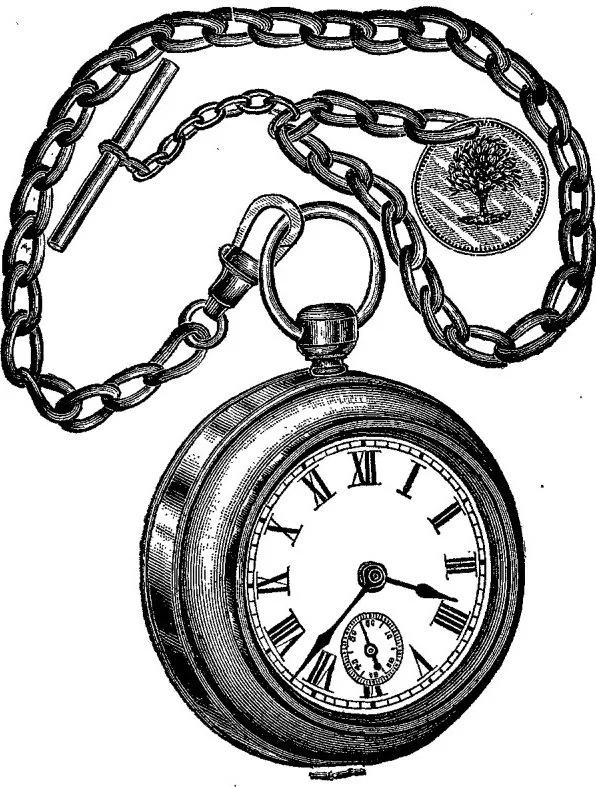
AMERICAN WATCH AND CHAIN.
PRICE, $1.50.
DUST-PROOF GOLD-PLATED CASE.
American Lever Movement, Patent Escapement and Regulator, Patent Winding and Setting Attachment Requiring no Key, 240 Beats to Minute; Hour, Minute, and Second Hands.
THE CHEAPEST GENUINE AMERICAN WATCH EVER SOLD.
Timed, Tested, and Regulated. EVERY WATCH GUARANTEED.
The case is strong and tight, of solid composition metal used the world over as a substitute for gold, with an Elegant Gold-plated Chain and Charm. Packed in a neat box and mailed to any address for $1.50 each; 3 for $4.00 by express; one dozen for $15.00 by express.
FULLY GUARANTEED TO KEEP ACCURATE TIME.
It is fully as durable as the most expensive watch, and with fair usage will keep good time for TEN YEARS. This watch is being manufactured in lots of 100,000 at the rate of 1,000 PER DAY by the largest watch manufacturing concern in the world. This constitutes the sole reason for its low price. It is a practical illustration of what may be done in this country by machinery and skilled operators when an article can be sold in large quantities. Its parts are not made by hand by “Pauper European labor” as are most of the cheap watches now sold, which never run long and can never be repaired. Automatic machinery does everything in this watch, and every part is as true as a die can make it. The movement is the same as in all American watches, and is readily understood and repaired by any jeweler. Every Watch Timed, Tested, and Regulated before leaving our hands, and carefully packed with chain.
A Few Testimonials for You to Read. We Have Them From Every State.
WEBB CITY, Jan. 9, 1893. GENTLEMEN: I am much pleased with the Watch you sent me, and I will say it keeps right up on time. It has not varied any as yet. Most truly yours, DR. ANDERSON.
CATO, Mass., Jan. 6, 1893. GENTLEMEN: I take pleasure in saying the Watch you sent me gave perfect satisfaction. It is a good time-keeper and all you recommend it to be. You will be favored with an order from me soon. Yours truly, W. G. DONNELL.
CALDWELL, Jan. 3, 1893. SIRS: I received your Watch and found it to be as represented in the Twentieth Century advertisement. It would be hard to improve on its time-keeping qualities. Yours truly, MOSES HINCHCLIFFE.
Forte Wayne, Ind. R. H. Ingersoll & Bro., Room 44, 65 Cortlandt St., New York—Kind Sirs: It is a standing rule of mine when I see an admirable trait in any character, or a marked excellence in anything, to express appreciation either in public or in private. Taffy is better than epitaphy. Post-mortem praises do the dead no good. The corpse smells no flowers on its casket. Hence I want to say that I am delighted with your Watch—a little gem. I keep it on my typewriter desk during week-days, right before my eyes, and it keeps splendid time; I then use it on my pulpit Lord’s days. Faithfully yours, REV. STEPHEN A. NORTHRUP.
R. H. INGERSOLL & BRO., Sole Mfrs., Room 44, 65 Cortlandt St., New York.
HEALTH FOODS.
PURE CRACKERS AND BISCUITS,
and Cereal Coffee
MANUFACTURED BY THE BATTLE CREEK BAKERY COMPANY
ESTABLISHED IN 1881.
We manufacture a choice line of these goods, entirely free from lard and all adulterations, at the following prices:—
“A” Fruit Biscuits, white flour, sweetened, per lb. 15c
“B” Fruit Biscuits, whole wheat flour, sweetened, per lb. 15c
Fruit Crackers, not sweetened, 15c
Lemon Cream Biscuits, 12c
Graham Biscuits, 12c
Oat Meal Biscuits, 12c
“A” Graham Crackers, slightly sweetened, 10c
“B” Graham Crackers, not sweetened, 10c
“D” Graham Cracker, (water crackers for dyspeptics), 10c
“A” Oat Meal Crackers, slightly sweetened, 10c
“B” Oat Meal Crackers, not sweetened, 10c
Whole Wheat Crackers, 10c
White Crackers, very palatable, 10c
Carbon Crackers, 15c
Gluten Crackers, 30c
Cereola, a prepared grain food, in bulk, 10c
(The same as formerly advertised under the name “Granola.”)
Pure Gluten, in bulk, per lb. 40c
Wheat, in bulk, per lb. 20c
Cereal Coffee, prepared from grains only, a very choice and healthful drink, in one and a half lb. packages (Once used, never again refused), 25c
Goods to the value of eight dollars, will be sent on the receipt of six dollars, being 25 per cent. discount.
We are now prepared to supply in large quantities the small, round Butter Crackers, purely butter shortened, and dealers wishing to handle such will do well to write us for prices, stating how many barrels they wish to purchase, etc. The price per barrel of about 50 lbs. is seven and one half cents per lb.
Cereola and Gluten are prepared foods, thoroughly cooked and ready for use by the addition of some fluid, as milk and cream, fruit juice or water, as best agrees with the individual. Cereola is a universal Health Food, and is calculated for use both in sickness and health.
In ordering, please remember that the rate of freight on 25 lbs. will be the same as on 100 lbs.
Remit by Bank Draft, Money Order, Express Order, or Postal Note. No private checks accepted.
During the month of November last we have added new and improved machinery to our plant and otherwise increased our manufacturing facilities. Therefore, with these superior advantages, we promise the consumers of Health Foods a nicer and more palatable article in this line than has ever before been produced.
Write us for special rates on large lots.
REFERENCES.
To whom it may concern:
We, the undersigned, residents of Battle Creek, Mich., take pleasure in stating that Mr. Joseph Smith, manager of the Health Food Department of the Battle Creek Bakery Co., has resided in Battle Creek for nearly 20 years, and is a competent and responsible man, and of long experience in his line of business, and one whose goods we can heartily recommend to the public.
URIAH SMITH, Editor Review and Herald.
HON. W. C. GAGE, Ex-Mayor.
J. B. KRUG, of Krug’s Business College.
THOMAS H. BRIGGS, M. D.
HON. GEORGE M. WILLARD, Pub. Journal.
S. S. FRENCH, M. D.
R. T. KINGMAN, Vice-President City Bank.
M. RORABACHER, M. D.
HON. W. H. MASON, postmaster.
HON. J. W. BAILEY, Ex-Mayor.
T. E. SANDS, M. D.
Address, BATTLE CREEK BAKERY CO., Battle Creek, Mich.
FOUND AT LAST!
A Pocket Speller, Dictionary, and Memorandum Book Combined.
It gives the right orthography of all words (over 22,800) in common use, and in nearly every instance their definition. It also gives rules for the use of capitals and punctuation marks, abbreviations of names of States and Territories, letters of introduction and recommendation, definitions of commercial terms, forms of notes, due bills, receipts, letters of credit, orders for money, merchandise and goods stored, principal holidays, marriage anniversaries, combination of shades, and carefully selected laws of etiquette in social and business life, also a silicate slate for memoranda.
This Speller gives the most complete list of words in common use; it is a Speller, Dictionary, Handy Companion, and Memorandum Book combined; it is indexed; it prints all words pronounced alike but spelled differently, so they can be distinguished at a glance; it shows where the letter e at the end of a word is to be dropped when adding ed or ing; it gives a complete list of the most practical business forms; it gives the laws of etiquette in social and business life; these rules alone are worth the price of the Speller.
This Speller is bound in leather, is of convenient size to be carried in vest pocket, and its price brings it within the reach of all. American Russia leather, gilt edge, 50 cents. Sent post-paid to any address on receipt of price. Address Pacific Press Publishing Co., 43 Bond St., New York City.
Brooklyn Eagle on Sunday Closing of World's Fair
THE Brooklyn Eagle, in an editorial item in reference to the Sunday closing of the World's Fair, and the possible action of the management as to the acceptance, or non-acceptance, of the appropriation with the proviso attached, says, “Even if the managers are convinced that the majority is for opening, they may hesitate to offend a powerful minority.” This is a true statement of the legislative history of this whole matter of Sunday closing, hesitation to offend a powerful minority.
Methodist Missionary Imprisoned in Brazil; Persecution at Home
In Brazil, a Methodist missionary has been sentenced to four months' imprisonment for publishing a book derogatory to Roman Catholicism. The Methodist Conference lately in session, appointed a committee to confer with President Cleveland in reference to the matter and seek, if possible, his interference in behalf of the persecuted missionary. There is imprisonment and persecution because of opposition to papal methods within our own boundaries. Why is not that also a proper subject for Executive interference? Have the Methodists considered the advisability of consulting with the President as to the religious persecutions at home?
If the Methodist Conference has not noticed the persecutions in Tennessee and elsewhere, and has failed to take any measures for their suppression, what is the reason? It is because in Tennessee and other States where there have been fines and imprisonment for conscience' sake, the Methodists and other Protestants have not been the persecuted, but have been themselves the persecuting power. What is the consistency in their asking the President to interfere, when what is done to them in Brazil is no different from what they are doing to others at home. Would President Cleveland be justified in quoting to Bishop Newman his own words with which he accepted a place on the committee to call upon the President, and prove their applicability by referring him to an injunction which reads, “Whatsoever ye would that men should do to you, do ye even so to them”?
Roman Catholic Influence, Religion in Public Schools, and Church-State Union
An editorial writer in the Sabbath Recorder, of March 9, speaking of the Roman Catholic influence in this country, for the teaching of religion in the public schools and the union of Church and State, says:
Let us remember, however, that the people who are just now introducing that dangerous principle are not Catholics. Jesuits can well afford to go on a vacation, while Protestants prepare the way for all that they have been desiring and seeking. If the national Government, in obedience to the wishes of an organized minority, is willing to place the stamp of its approval on one religious institution, why not another? Once established the principle and its application is easily extended.
That the application of the principle of Sunday-closing by congressional and governmental authority is very easily extended is shown by the Sunday-closing episode connected with the inauguration of President Cleveland, the official record and correspondence in regard to which is reprinted on another page.
Arena Review Features Women Writers and Social Reform
DURING the past three years the Arena has published almost one hundred papers from the pen of women. This doubtless accounts largely for the fact that the Arena is by far the most popular review among thoughtful women in America. Among other noteworthy features of this issue of the Arena are Dr. Alfred Wallace’s “Social Quagmire and the Way Out of It,” Louis R. Ehrich’s “A Religion for all Time,” Prof. S. P. Wait’s “Life after Death,” B. O. Flower’s “A Pilgrimage and a Vision, or Social Contrasts in Boston,” Dr. F. J. Furnival’s “Defense of Shakespeare,” Dr. Leslie Keeley’s “Defense of the Gold Cure for Drunkenness,” and a well-written paper on the “Money Question,” by John Franklin Clark. The Arena continues to be brave, progressive, and in touch with the advanced thought on social, economic, educational and religious subjects.