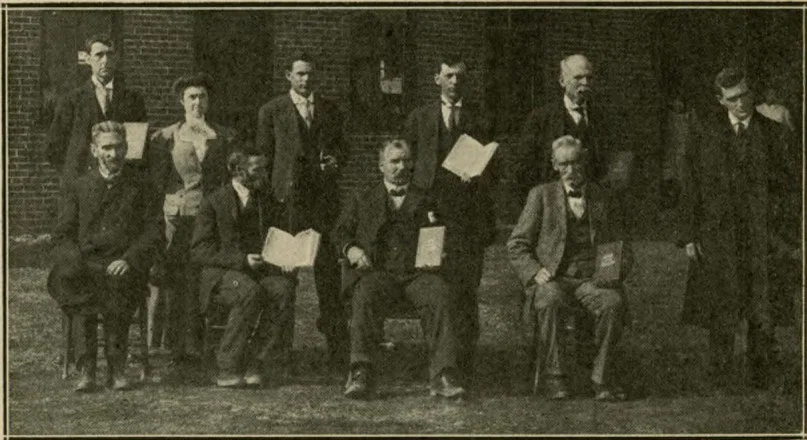
CANVASSERS WHO EARNED THEIR ATTENDANCE AT THE NASHVILLE BOOKMEN'S CONVENTION, HAVING SOLD $1,000 WORTH OF BOOKS OR PUT IN 40 HOURS A WEEK FOR 40 WEEKS
The Southern Bookmen’s Convention
By R. Hook, Jr.
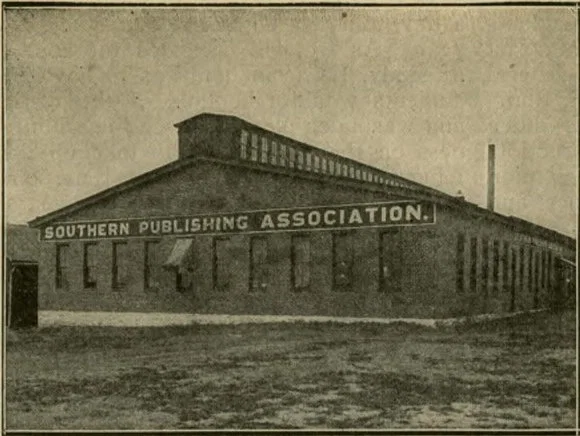
As we look over the past year, and consider what has been accomplished in our work, we see much to cheer and encourage. It is, therefore, with heartfelt gratitude to God that we submit a report of the work of the Southern Publishing Association and of the bookmen’s convention recently held in Nashville.
During the past year, 150,170 volumes of our books were manufactured, and 222,124 pages of the Family Bible Teacher printed. Of the Watchman, 313,000 copies were printed; and of the Gospel Sentinel, 132,500 copies. To accomplish this we have worked an average of fifty-five hours a week. An outlay of over twenty thousand dollars for ink, leather, paper, and other materials has been required. As is well known, our office is engaged entirely in turning out our denominational work, with occasional job-work from the food factory, the sanitariums, and other of our institutions.
As we look over the year, we see many things to be thankful for. Under the blessing of God we were enabled to collect one hundred per cent of our deposit with the defunct City Bank and Trust Company, so that we have come out of this experience without the loss of a cent to the office. Surely there is cause for rejoicing in this, when we remember that the majority of the depositors have received only a ten-per-cent dividend.
Our branch offices have also had a splendid year. In midsummer we shipped two entire car-loads of books to the Fort Worth (Tex.) Branch. These books were speedily disposed of, the canvassers making prompt remittance to the branch office, which, in turn, remitted to the home office, thus greatly assisting in paying off heavy bills for material, which had accumulated as a result of the large volume of business. It is a common thing to receive large-case orders from both Atlanta, Ga., and New Orleans, La.
During the year we have erected a metal warehouse for the storage of signatures, etc. This has released needed room in the bindery. We have also made connections with the city water-supply, which has been a great assistance to us during the year, and has saved considerable expense in hauling water. We are also relieved of the danger of being without water in case of fire.
We are of good courage, and while we have had many perplexities, and decisions have had to be made that called for earnest prayer, the Lord has been with us; and we thank him with all our hearts for the success that has attended not only the work in the office but also the work in the field. The interests of the publisher and canvasser are one. There has been a splendid spirit of co-operation, and to this, in large measure, we attribute the success that has attended the work this year. Above all, we know that the Lord has not only sent his angels to deliver us from pestilence, sickness, and death, but he has also blessed the efforts of the workers. Thus the largest number of books ever sold by this office in a single year has been sold during 1910.
The book sales in our territory by union conferences are as follows: Southern Union Conference, 1909, $30,452.93; 1910, $32,022.60. Southeastern Union Conference, 1909, $29,483.57; 1910, $35,341.85. Southwestern Union Conference, 1909, $62,278.40; 1910, $72,782.34.
Truly there is a great work to be done. The fields are ripe to the harvest, but the laborers are few. There is a demand for more workers, for our literature is to be scattered as the leaves of autumn. There is opportunity for all to have a part in this work, and any tract society secretary or publishing-house officer will be glad to furnish all the information necessary regarding this important branch of the work.
Attending our bookmen’s convention were thirteen canvassers from the Southern Union Conference, who had earned attendance at the convention by selling one thousand dollars’ worth of books or by putting in sixteen hundred hours. We felt so pleased with these faithful workers that we had the picture taken which appears with this article. The total attendance at the convention averaged about seventy. These represented the general agents, field agents, and conference presidents of all the local conferences of the Southeastern, Southwestern,18and Southern union conferences. The three union conference presidents were present, also a number of tract society secretaries. From the General Conference office Brother A. J. S. Bourdeau was present, and gave us much interesting and valuable instruction. Brother J. B. Blosser, of the Lake Union Conference, was also in attendance, and the instruction given by him was much appreciated.
Our workers left the convention feeling that it had been indeed good to be there. After returning home, one of the canvassers wrote: “While I am writing, I must say that all who did not attend the bookmen’s convention in Nashville missed a feast. I am thankful that I had the privilege of attending.” We believe all our workers returned to their fields with new zeal, and that the close of 1911 will prove that the instruction given at this convention was of a practical nature, and that our book and periodical business will show a large increase over that of any previous year. The work is onward, and we are of good courage.
R. Hook, Jr., General Manager.
Our Schools in Other Lands
By H. R. S.
Meiktila (Burma) Industrial School
A SCHOOL calendar just received from Brother Robert T. Thurber announces the opening of this school. Brother Thurber writes:—
“We can boast of only rented quarters as yet, but have conducted the school for about six months, with a total enrolment of sixty boys. We have not taught any industries, and so far have confined our intellectual work to the standards. But we have just hired a Chinese carpenter and contractor, who will teach the boys, and superintend the building of the school. By the time this reaches you, we shall have bought land, and begun. We have succeeded in raising about five hundred dollars in cash, and two thousand dollars in pledges, in the country here, and expect to get much more. But we must have some help from our people, too; and if we get it, this Burma school bids fair to exceed our first expectations.”
Avondale (Australia) School
A letter just received from Prof. B. F. Machlan tells of the continued success attending the educational work in Australia:—
“You will no doubt be interested to know that we started this year with the best attendance in our history. We have our boys’ hall filled, and have had to make a second home at the Avondale Health Retreat, where we have a nice family of boys under an assistant preceptor. We have a few more rooms left in the young ladies’ hall, but the prospects are now that these will soon be taken. Ten per cent of our students are full pay, thirty-five per cent industrial, and fifty-five per cent half pay; that is to say, ten per cent pay their way in full; thirty-five per cent pay nothing, but must have their board, room, tuition, books, and, in many cases, clothing, from the school; fifty-five per cent work five hours a day, and pay eighteen pounds for the year. As we had extended the course of study, I was in doubt as to how the students would take hold of the work, and was much pleased to see the willingness on the part of all to take up the longer courses. Up to this time, our teachers’ course had been only two years, and really meant very little to the one who took nothing but that course. Now it is four years in length, and will fit our students to do good work as teachers. Our commercial courses were also strengthened. Some changes were made in the Bible training-course. These changes, I am glad to say, seem to meet the approval of the brethren, and also of the young people.”
“We have had our regular January rains, and everything looks beautiful and green, and the prospect for crops is good. Of course this means much to us here. Our farm ran at a loss last year. Indeed, I think it hardly ever has paid; but we hope this year to make it pay, and we are straining every nerve to that end.”
British East Africa Mission School
Our brethren have to work slowly and patiently among the native tribes of Africa. Truly with them it is “precept upon precept; line upon line, line upon line; here a little, and there a little.” However, the gospel of Christ is all-powerful; and by the patient efforts of our mission teachers, it finds its way to the hearts of those who have been brought up in the midst of the darkest heathendom.
“We have,” writes Brother A. A. Carscallen, “a nice class of boys coming forward for baptism, but I am not hurrying them. I want to be sure they are going to stay, and that they are in earnest, before we urge them to take that step. We hope to baptize several in a few months. I shall be very glad to report a few members in this dark part of Africa. I have been on this site for over four years now, and have labored hard; and if I can see a few of our boys take their stand for Christ,—and a stand that will last,—I shall feel fully repaid for all I have done. They are now beginning to grasp what it means to be Christians, and are taking a lively interest in the people. I sometimes hear some of them say such things as this: ‘We must think of and love the lives of others,’ and in their prayers they say, ‘We wish to spread thy Word, O God.’ So you see they are thinking of telling others what they have themselves learned.”
How true it is that wherever Christianity goes, the spirit of the Author of Christianity asserts itself in the lives of the believers, and they are not content until they have passed on to others that which they have received. H. R. S.
Dr. DeForest's Report on Swiss Sanitarium Work
From Our Sanitariums
THE following good report comes from Dr. P. A. DeForest, who for a number of years has had charge of the medical work in Switzerland:—
“During the month of January I held health meetings in six different towns and cities. There was a good interest manifested, especially for the first series, the audiences ranging from twenty-five to one hundred twenty. The people seem interested and hungry for these truths, if one may judge by the number of questions asked. I expect to hold another series soon. The sanitarium has paid its way for three years, independently of the food factory or farm, and has on hand a small surplus. We are thankful for these results, especially when we think of the competition which exists on every side. Surely the protecting hand of God is over this work, which was begun and has been carried on in the face of bitter opposition and ridicule. I hope that the time will soon come when the institution will be provided with its own legally qualified physician; but until that time does come, I expect to remain at my post, and do all I can to further the interests of this work.
“Our hearts are made glad to see patients accept the truth from time to time. In 1909 thirteen persons accepted Christ as the result of visiting or working at the sanitarium. Eleven were baptized here, and two started keeping the Sabbath at home, one in Egypt and one in Switzerland. Last winter a lady came to rest and take a course in massage, who was in a sad state of mind, and about to take a fatal step. Something seemed to tell her to come to the sanitarium. After days of struggle, she began to read the Bible, and finally gave herself to the Lord. These things give us fresh courage to go on sowing the good seed, being assured that it will take root and grow in some hearts. Only recently I heard of a young Armenian lady who was here two years ago with her mother, and who on her return home to Cairo, surprised her friends one day by stating that she would attend the school no more on Saturday, because she had decided to keep that day holy. She told inquirers that she had found this truth at a sanitarium in Switzerland, where everybody stopped work and went to church on that day. She now attends our church services in that city, and is studying the way of God more perfectly. As the institution is now equipped, we shall be able to treat from fifty to seventy patients daily.”
WE are pleased to learn of the prosperity of the Loma Linda (Cal.) Sanitarium. Dr. T. J. Evans, in a letter recently received, says:—
“Our institution is now running to its fullest capacity. We have improvised rooms in ends of halls, and used our medical offices for sleeping-rooms, and are holding off people all we can. We19have about twenty applicants waiting for rooms. Of course our dormitory is now about completed, and the girls are moving in, so the congestion will be relieved; but unless we begin to prepare now for the patronage next winter, I fear the same condition will then exist. Our family is growing, and our patronage is increasing each year. We are very busy, but the Lord is blessing us in caring for those who are with us.”
Christian Education
By H. R. Salisbury
Conducted by the Department of Education of the General Conference
H. R. SALISBURY Secretary
Moths, Malaria, and the Idle Soul
“Moths do not destroy the garments that are in use, nor do sins corrupt a busy life. It is when the body is relaxed that malaria seizes upon it; and it is in its hour of need that the soul becomes diseased.”
Planning Each Day for God's Service
“MORTGAGE your day to God before it begins. Form a plan for every instant of it. Live by schedule. It is the stagnant stream that rots. Keep your mind moving.”
Medical Missionary Department
Conducted by the Medical Department of the General Conference
D. H. KRESS, M. D. . . . Secretary
L. A. HANSEN . . . Assistant Secretary
Sanitarium Relief Campaign
By L. A. Hansen
A Union Conference Effort
DEFINITE work is being done, and definite results are being seen, in a special effort that is now on in the Columbia Union Conference. Early in January the president, Elder B. G. Wilkinson, took up correspondence with the various conference presidents, making arrangements for a definite date in each conference for a thorough “Ministry of Healing” campaign.
A period in March was decided upon as the selling time. Before this date, churches were to be visited, instructed concerning the campaign, and their orders taken for the books. Union and local conference officers and workers would join forces. Such help as could be given by General Conference men, by Sabbath visits, was to be rendered. The matter was to be kept in the columns of the union paper in live form. Officers would send out letters, instructions, and suggestions for organization to workers, church elders, and individual church-members. Every church and company of believers was to be reached, and isolated members not to be overlooked, so that every member of every conference would take at least the quota of books for one year.
These thorough plans met with the hearty acceptance of all the presidents, and in the different conferences the work is now being carried forward accordingly. Herewith are given some statements of attitude and experience, as20taken from the columns of the Columbia Union Visitor and other sources.
After presenting the details of this special effort, the president of the union says: “There is a blessing in selling a book like ‘Ministry of Healing.’ The world needs to-day just such a book, with its bright rays of light on soul and body healing. One sister in West Pennsylvania sold a copy to the editor of the leading daily in a certain city, and he was so pleased with it that, unasked, he at once printed an excellent testimonial in its favor.
“Our sanitariums need the financial help which will come from the sale of this book. Brother, sister, in the work of the Lord, do you not wish to help financially these institutions which in 1909 proclaimed to twenty-five thousand patients, people of the better classes, every Friday night the opening hours of the Sabbath? Do you not wish to assist the great medical missionary work which, every year, is doing so many deeds of charity and bringing so many blessings to needy souls?
“Let us all—people, workers, and officers—take hold heartily in this campaign, and do our part. Let none say, ‘This is not my work.’ God will bless the willing worker.”
In New Jersey
The president of the New Jersey Conference, Elder B. F. Kneeland, states his position as follows: “The work of selling ‘Ministry of Healing’ deserves, and must have, our very best effort. We are glad for what has been accomplished, but this is only a small part of what must be done. No one can estimate the good that this book will do when placed in the homes of the people. Now is the time when the whole world is eager for light on the subjects of healthful living and the prevention of disease. Now is our grand opportunity; and I am convinced that if we pass it by indifferently, we shall bitterly regret our mistake. This conference should lay plans for the completion of this campaign at the earliest possible date.”
Many good experiences are reported from this conference. One of our sisters went with fear and trembling to carry a copy of “Ministry of Healing” to the home of a minister. She was not able to give a canvass, but left the book with the minister’s sister, and went home. Within three hours the woman was at her door with the money for the book, saying that her brother wanted such a book very much. “Ministry of Healing” seems to sell itself. An ex-judge picked up a copy of the book in the home of one of our sisters the other evening. Without her saying a word, he said, “If that book is for sale, I want a copy,” and paid her the money for it on the spot.
In West Virginia
The president of this conference writes thus in the union paper: “Eternity only will reveal the good which these books will do in the homes of the people. The Lord is giving us the privilege of doing this work, and either faithfulness or unfaithfulness will be written opposite our names in the ledger of heaven. The Holy Spirit is impressing the people to buy, if we will but carry the books to them, and use our God-given talents to present this work. I trust that we shall all be faithful, and finally receive the overcomers’ reward.”
The matter has been kept before the conference in various ways. Effectual work has been done by both laborers and people, and good results are reported. The membership of the West Virginia Conference is not large, but they mean to do their share, and enjoy their part of the blessing to be found in this work.
In the Virginia Conference
The president of the Virginia Conference says to the believers in that field: “Have you taken a lively interest in the ‘Ministry of Healing’ campaign? We are to sell this book for the relief of our sanitariums. While it is our duty to do this, the doing of it will bring us a blessing, will bless our neighbors, and will relieve our institutions of their burden of debt. If you have taken no books as yet, secure some at once. Read them carefully, and sell them. And you can sell them. It is the slothful man who says, ‘There is a lion in the way.’ The money is needed now, and we must get it and pass it on.”
Encouraging reports come from this conference where the work has been begun. While not strong in numbers, this conference has good material and a fine field, and it will doubtless fulfil its part in this effort, and enjoy its share of blessing.
There are other conferences in the Columbia Union that have united in this special effort, whose reports must be left for another time. Sufficient has been given to show that general co-operation may be secured in this relief movement, and that when it is given the results are telling. What is being done in one part of the field, offers encouragement to others. Shall we not see a greater development of the spirit of willingness to enter upon this good work?
L. A. HANSEN.
Religious Liberty Notes
A SUNDAY bill is pending in the Pennsylvania Legislature, on which a hearing has been promised us on April 4.
NINE years ago there were two hundred ten branches of the Lord’s Day Alliance. Now there are over eight hundred branches, and almost fifty thousand members. This shows the rapidity with which the Sunday movement is growing.
THE Lord’s Day Alliance in Canada is advocating that, as a means to Canadianize foreigners, they should be made to keep Sunday. Such an effort may Canadianize men, but the important question is, Will it Christianize them?
A SUNDAY-CLOSING crusade is threatened in the cities of Hancock and Houghton, Mich. These agitations afford an excellent opportunity to place the true principles of religious liberty before the citizens of the cities and towns where such crusades are carried on.
A SPECIAL religious liberty service was held with the Takoma Park church, Sabbath, March 4. To some extent the meeting assumed the character of a praise service, owing to the fact that the Lord has given his people another respite by hindering the enactment of any Sunday law during the sixty-first session of the United States Congress.
THE Religious Liberty Department has just issued a four-page document, a little larger than the weekly Signs of the Times, that is well illustrated, and is filled with up-to-date, wide-awake matter on the question of religious liberty. It can be used for campaign purposes when Sunday-closing crusades or other similar agitations are on. It is printed from plates, leaving a space at the head where any name may be placed that will make it adaptable to the location where it is to be circulated. This document is printed by the Foreign Mission Seminary, Takoma Park, Washington, D. C., to which all orders and remittances should be sent. The price is $7.90 a thousand, in lots of less than two thousand. On larger lots, a liberal discount will be allowed.
ELDER S. B. HORTON, religious liberty secretary of the Atlantic Union Conference, who has been assisting the Religious Liberty Department in Washington during the Sixty-first Congress, has left for his field of labor in the Atlantic Union Conference.
THE president of the British Columbia Conference, Elder J. G. Walker, is planning a vigorous campaign in his field with the two new religious liberty tracts, entitled “Should Parliament Prescribe Your Religion?” and “A Present Danger.” These tracts should be circulated like the leaves of autumn throughout the Dominion of Canada.
Religious Liberty Work in Oregon
By W. F. Martin
The readers of the REVIEW will perhaps remember that two years ago a strong effort was made to force a Sunday bill through the Oregon Legislature. A large delegation of ministers went from Portland, and joined with the Salem ministers, urging the passage of the bill. They failed to accomplish their purpose, but declared their intention of trying again in 1911. Soon after the convening of the legislature, the writer went to Salem to look after the church work there, and watch developments in the State legislature. Before the legislature convened, I wrote to local members of the senate and house, apprising them of the contemplated move on the part of the churches, and asking them to give some thought to the matter. Many of them wrote me very courteous replies, a number frankly saying they would oppose such a move. The magazine Liberty had been going to the members of the legislature, and it had a great influence in creating a sentiment against religious laws.
No Sunday bill appeared this year till the session was more than half over. The first notice I had of it was an editorial in the Pacific Christian Advocate, upbraiding me for consorting with theater managers, saloon-keepers, and “other reprehensible characters,” in trying to overthrow the work that the churches were trying to build up. My letter to the legislators fell into the hands of the Oregonian, and was published by them. This paper and other large dailies gave considerable space to a discussion of the merits of Sunday legislation, and several times mentioned my opposition to it. This was what called forth the editorial in the Advocate. When the Sunday bill appeared, it was aimed at drug-stores, groceries, and Sunday excursions. Theaters this year were exempted. In order for a merchant to escape the penalties, the bill decreed that he must be a member of a religious society that observed some other day than Sunday as its day of worship. This showed the religious character of the bill.
Again ministers came to lobby for the bill, among them Mr. Tuffts. I went before the committee, and presented my arguments against the measure. It was presented to the house the following day, with a recommendation that it should not pass. The framer of the bill made a plea for it, and the chairman of the committee on revision of laws, to which the bill had been referred, in a fine speech defended the recommendation of the committee. He told the house plainly he considered the bill a step toward a union of church and state; spoke of the division in the Christian world over the Sabbath question; and said to pass such a bill would be legislating on a disputed religious question. A vote was then taken, and the bill was killed, with only two votes in its favor. A strong effort was made to have the bill reconsidered, but the committee as well as the speaker of the house would not hear to it.
Thus another religio-political measure has failed in Oregon. There is talk now of initiating the measure, and having the people of the State vote on it. We shall watch this move with much interest. We thank the Lord for his sustaining hand thus far; the battle is his.
W. F. MARTIN.
Work While the Day Lasts
THE work we do not do in a time of peace and quiet, we shall have to do under the most adverse and trying circumstances. This thought has been impressed upon our minds by some experiences of our magazine workers here in the city of Washington. A few days ago, when one of our agents presented the magazine Liberty to a citizen who is strongly in favor of Sunday laws, he was assured that Seventh-day Adventists, as opposers of Sunday laws, have about reached their limit. Another agent was told by an influential Catholic that the Catholics are forming a society to put down the sale of these magazines in the city of Washington.
Christian Liberty
By K. C. Russell; C. M. Snow
Reports, Notes, and Comments Pertaining to the Current History of the Rights of Conscience
Conducted by the Religious Liberty Bureau
K. C. Russell Secretary
C. M. Snow Corresponding Secretary
News and Miscellany
Notes and clippings from the daily and weekly press
— One of the marvels of the wireless was the picking up of a message at San Francisco, sent from the steamship “Korea,” 4,492 miles away, in the Pacific. The message came faintly, but clearly enough to be made out.
— March 13, Russia sent an ultimatum to China, insisting upon a closer adherence to the treaty of 1881, which has been the subject of negotiations between the two countries for some weeks past. It is claimed that only the immediate execution of the Chinese treaty obligations toward Russia can interrupt an advance of the Russian army, which is prepared to occupy Chinese territory.
— Five powder-mills owned by the Dupont Powder Company were blown up March 9 at Pleasant Prairie, Wis. More than 3,000,000 pounds of powder and dynamite were exploded. The force of the concussion was so great that it was felt in five States; the village of Pleasant Prairie was totally destroyed, many buildings were wrecked in contiguous sections of the country, one man was killed, and a number were injured. It is reputed to be the most destructive powder explosion on record.
— Ninety persons, mostly children, were burned and trampled to death in a fire that destroyed a moving-picture theater at Belogoe, Russia, March 5. Forty persons were injured, many seriously.
— It is proposed to inoculate the army mobilized along the Mexican border with typhoid virus, for protection against the possible spread of that disease among the troops. Practical immunity is claimed as the result of this remedy.
— In his determination to stamp out the rebellion in Mexico, President Diaz has ordered shot all persons detected in the act of highway robbery, raiding, train-wrecking, cutting telegraph or telephone wires, or even throwing stones at passing trains.
— A revolution has been in progress in Paraguay for some time against the government of Col. Alberto Jara, who was recently elected president. Friends of former President Condra are behind the revolt. Martial law has been proclaimed in Paraguay for a period of five months.
— Starting at midnight, March 10, time was annihilated in France for nine minutes and twenty-one seconds. On the stroke of the hour all clocks were stopped for the time indicated, to comply with the law, making the time of the republic the same as in all places within a radius of fifteen degrees, in which the time is regulated from Greenwich, England.
— Stirred by the belief that the revolutionary movement has reached a critical stage, the insurrection in the states of Chihuahua and Sonora, Mexico, are reported to have become very active in tearing up railroads and cutting telegraph wires. According to reports, numerous towns are under siege, and thousands of women and children are cut off from food supplies.
— Hudson Maxim is reported as saying that the United States is now possessed of the greatest war explosive known, one of his own manufacture, and one that is exclusively controlled by this government. The projectile does not explode on contact, but can be sent through the armor of a ship, exploding when reaching the interior, where its work will be much more destructive.
— The mobilization of United States troops along the Mexican border has actively continued during the past week. It is planned to mobilize an army of 20,000, and a number of war-ships have been sent to the Gulf of Mexico. The purpose of the administration in this mobilization has not yet been satisfactorily explained. It is believed that the government has advices and information not generally known, as to danger to life and property in consequence of the insurrection in Mexico, and that in pursuance of the policy of upholding the Monroe doctrine, it proposes to assume responsibility for the protection of foreigners. For lack of definite information, there is much criticism throughout the country regarding what appears to be an unwarranted action. It is believed, however, by many that when full details of the situation are made known, it will be seen that President Taft has acted with discretion.21
— At Virginia, Minn., March 11, twenty-six workmen were crushed to death in an open mine by an avalanche of ore, ice, and earth.
— The erection of a new building in New York hardly seems a matter of great importance, but one just begun is an exception to the rule. It is to be the tallest building ever erected. It will be 750 feet high, fifty feet higher than the Metropolitan tower, and nearly 150 feet higher than the Singer tower. The main building, which will have a whole block frontage on Broadway, opposite the post-office, is to be from twenty-seven to thirty stories in height; with a tower eighty feet square in the middle of it that will have twenty-five additional stories. The land on which it is to be erected cost $5,000,000, and the building is to cost $12,000,000 more. It will contain 13,000,000 cubic feet, and is to be of fire-proof construction throughout. The building is to be used for mercantile purposes.
News and Notes
By A. J. S. B.
THE Internationale Traktatgesellschaft (International Tract Society), our publishing-house in Hamburg, Germany, issues seventeen papers and magazines in the following ten languages: German, Russian, Dutch, Hungarian, Bohemian, Rumanian, Lettonian, Esthonian, Servian, and Polish. Their combined circulation during the year 1910 was 2,545,675 copies.
BROTHER G. C. HOSKIN, formerly secretary of the Iowa Tract Society, recently connected with the Pacific Press periodical department. Speaking of the circulation of the March Signs Monthly, he writes, under date of March 1: “This number is beating them all. Of the regular twenty-five-thousand edition, we now have only five thousand left on the first day of the month, which means that under ordinary circumstances the edition will be gone inside of a week or ten days.”
OUR three missionary periodicals having the largest circulation are the following: Herold der Wahrheit, our eight-page, fortnightly German paper, with an annual circulation of 1,722,550 copies (an average edition of 70,000); Present Truth, our British sixteen-page weekly, with an annual circulation approximating 1,000,000 copies; the Signs of the Times weekly, our well-known sixteen-page pioneer missionary paper, with an annual circulation of 885,875 copies. The combined annual circulation of the three is 3,608,425 copies.
OUR denomination now publishes 126 periodicals and magazines. The latest to be added to the list is El Hogar (The Home), a twelve-page monthly published at Lima, Peru. The pages are of the same size as those of the REVIEW.
THE following incident, related by the father of a thirteen-year-old boy, is of more than ordinary interest: “My youngest boy, Clarence, sold six hundred copies of Life and Health last summer in forty hours. My last order for two hundred copies for him was half sold during the first day of his Christmas vacation.” This boy’s sale of six hundred copies thus averaged him a profit of ninety cents an hour. During his first day’s vacation, he sold one hundred copies, making a profit of six dollars. Many other thirteen-year-old boys could do as well. Write for sample copies, and instructions to agents. Then teach your boy or girl to engage in this helpful, self-supporting profitable missionary work with our magazines. Address your conference tract society secretary. Do so to-day.
BROTHER R. HOOK, JR., manager of the Southern Publishing Association, sends the following interesting item concerning the influence of the Watchman: “We have just received a special-delivery letter from a man in the eastern part of Kentucky, reading as follows: ‘In the February Watchman was an article on “The World’s Unrest,” signed C. P. B. I suppose it was written by your Mr. C. P. Bollman. As I have been studying along this line for some time myself, I should like to talk with him personally. Could I see him if I should come to your city Thursday, or any day after it this week? Telegraph me, upon receipt of this, what day to come.’ Surely the Watchman must have merit when people feel interested enough to make a four-hundred-mile trip in order to study more fully the truths which we believe. Truly the work with our periodicals is missionary work indeed.”
“ONE day last week,” writes an agent for the Signs Monthly, “I sold forty-five copies of the Signs in three hours in the following way: I went into one office about noon, where nearly a hundred clerks were working. In the rear of the office is a dining-room, where they all take lunch. I took my stand before the door of the dining-room and talked to the men as they came out, selling in this way eighteen copies in twenty-five minutes. I then went quickly across the street, into another office, and sold twelve copies in the same way. I ran over to a third place; but it was then one o’clock, and the men had already begun to work. Going to the foreman, I sold him one paper, and asked the privilege of talking to the men. He said, ‘Go on, and sell all you can.’ The first man I talked to was a visitor, watching the men at work. He took one copy, and gave me ten cents. I thanked him and went to the next man, but the first gentleman called me back, and, having paid me ten cents each for every copy I had, said: ‘Now, go through the factory, and give your magazines to the men.’ It took me about ten minutes to do this, after which I went home, rejoicing and praising the Lord for his goodness to me.”