The Youth’s Instructor, Vol. 28, No. 31.

DEPARTURE FOR EUROPE

The Youth’s Instructor

Jul 28, 1880

S. D. A. Publishing Association · Battle Creek, Mich. · Jul 28, 1880

DEPARTURE FOR EUROPE.
THERE is always great interest manifested at the wharves in New York on the departure of steamers for their voyage across the Atlantic. Many persons gather at the pier on such an occasion, some to bid their friends “good-by,” others simply to witness the departure of the ship. Those who, like ourselves, come to the ship early, avoid the crowd and confusion.
As our ship lies only a few rods from where, about ten years ago, I embarked for a journey of over five thousand miles on a Pacific Mail Steamer to California, I recall a circumstance that occurred on that occasion. We had eleven hundred passengers, and there were, at least, as many more persons thronging the wharves. As we neared the time of sailing, the people, though warned not to do so, crowded the “gang-plank” full, till finally, under the great weight, it broke, and about half a dozen persons fell into the water, some of whom were passengers. They were, fortunately, all safely rescued, but suffered the inconvenience of a thorough wetting at an unfavorable time. One of our number, however, lost a $5.00 hat, which he scolded about every day until we reached Panama.
The time for sailing has fully come; the passengers are all safely on board; the whistle gives a loud, grum blast; the gang-plank is drawn; the pilot from his position on the paddle-box gives his order to cast off the ropes, signals to the engineer to put on the steam, and majestically our great boat glides away from the pier into the river. Now comes a second farewell from those on the ship to those still watching on the pier, by an exchange of hat and handkerchief waving. This is continued as long as such objects are discernible to the eye. While engaged in this demonstration, the steamer moves out of the river into the harbor toward the sea, where she gives her “good-by” to America by firing a cannon over the bow of the ship.
Looking at the shores as we pass out of New York Bay, we behold scenes of romantic beauty. We see villas and cottages, shade-trees and smooth grassy lawns, vast fortifications with great cannons peeping out of the casement, and observatories, light-houses, and buoys.
While these land scenes are fast receding from view, our pilot is calling out his directions to the helmsman, who is at the wheel in the stern of the ship, guiding the boat. The pilot calls out “Port!” and an officer of the ship on the deck calls out after him, “Port!” thus passing it on to the helmsman, who says, “Port,” by which it is then known that he has received the word of the pilot. Now the pilot calls out, “Starboard!” next it is, “Steady!” When he says, “Starboard!” he means put the helm to the right; when to the left, he says, “Port!” When he wishes the ship to go straight forward he says, “Steady!” The pilot takes full command of the sailing of the ship until we are fully out at sea; then the captain takes charge.
Here we pass a war-ship, and the ships salute each other in turn by lowering their flags a few feet, and then quickly raising them again. This they call dipping their colors. The pilot-boat is coming for our pilot. Our engines are suddenly stopped. A small row-boat comes up and takes the pilot to his sail-boat. Our captain now takes his position on “the bridge” from one paddle-box to the other, signals to the engineer to put on steam, and with a few words of command, he has the ship put a few points to the north of east with the strong order, “Steady!” We realize now in good earnest that we are going to sea. Soon the land is out of sight, and naught is visible but “the broad blue ocean.”
J. N. L.

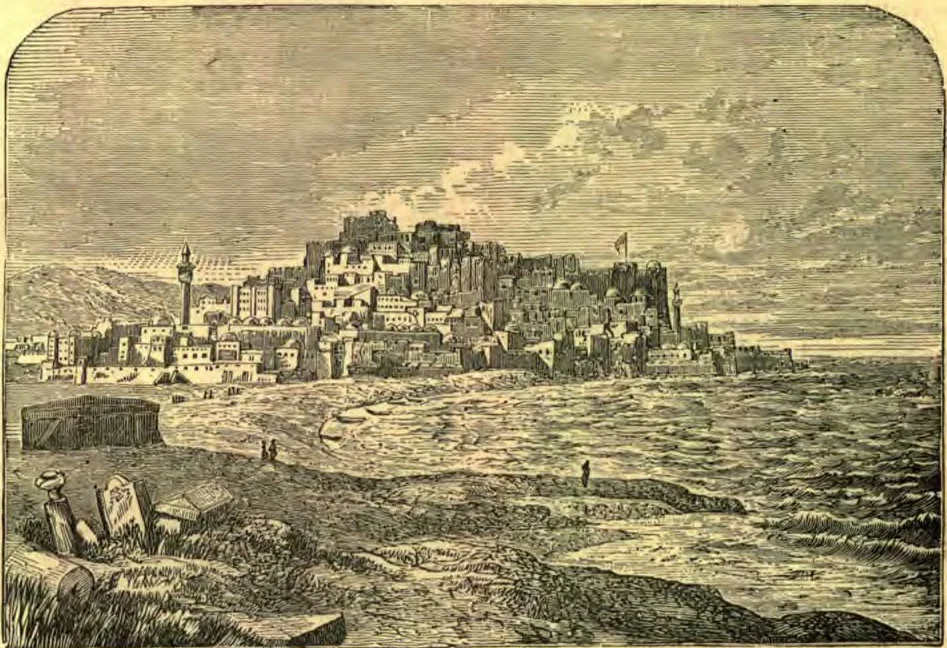
TYRE

In thought I saw the palace domes of Tyre, The gorgeous treasures of her merchandise; All her proud people in their brave attire, Thronging her streets for sport or sacrifice. I saw her precious stones and spiceries, The singing girl with flower-wreathed instrument, And slaves whose beauty asked a monarch’s price. Forth from all lands all nations to her went, And kings to her on embassy were sent. I saw, with gilded prow and silken sail, Her ships that of the sea had government. O gallant ships, ’gainst you what might prevail? She stood upon her rock, and in her pride Of strength and beauty, waste and woe defied.
I looked again. I saw a lonely shore, A rock amid the waters, and a waste Of trackless sand; I heard the bleak sea’s roar, And winds that rose and fell with gusty haste. There was one scathéd tree, by storms defaced, Round which the sea-birds wheeled with screaming cry; Erelong came on a traveler, slowly paced; Now east, now west, he turned with curious eye, Like one perplexed with an uncertainty.
Awhile he looked upon the sea, and then Upon a book, as if it might supply The thing he lacked. He read and gazed again,— Yet as if unbelief so on him wrought He might not deem this shore the shore he sought.
Again I saw him come. ’T was eventide; The sun shone on the rock amid the sea; The winds were hushed;—the quiet billows sighed With a low swell;—the birds winged silently Their evening flight around the scathéd tree; The fisher safely put into the bay, And pushed his boat ashore; then gathered he His nets, and hastening up the rocky way, Spread them to catch the sun’s warm evening ray.
I saw that stranger’s eye gaze on the scene;— “And this was Tyre,” said he; “how has decay Within her palaces a despot been. Ruin and silence in her courts have met, And on the city rock the fisher spreads his net.”

THE FIRST PRAYER.

PRAYER is said to be “the desire of the heart.” It is that and more. It is the earnest calling upon God from the heart. Let me tell you about the first prayer of a little orphan child a good many years ago.
A disease had broken out in the neighborhood of this little girl’s home, which was particularly fatal among the children, in one instance taking away three bright, active children from one family, leaving the parents childless mourners.
These sad circumstances naturally caused much serious thought. The little girl of whom I speak was sometimes left alone all night, the people with whom she lived being called away to care for the sick and the dying. One evening she was sent on an errand to a neighbor’s house, and while there she heard the remark that “not one would escape until the disease had taken every one whose constitution was not strong enough to resist it.”
These words sank like lead into the heart of the little girl. With fleet steps she went back to her home, her heart in an agony of dread, lest she should be stricken down before morning. But her fear was not the fear of death alone, or the natural dread of dying, but the fear of the Judgment. She had been a Sabbath-school scholar, and by its instructions and reading the Bible and other good books, she had learned that she was a sinner by nature, and without the forgiveness of God and his grace in her heart, she must be lost. She knew, also, that to obtain the forgiveness of God she must pray. But she thought, “How can I pray? I do not know how to pray. How can I speak to God? I don’t know what words to use.”
You see she had not been taught to pray, and those that had the care of her had thought their duty done when she was fed and clothed and strictly disciplined in obedience to their commands. But now, at this particular time, she wanted to know what to do to find Jesus. She wanted God’s forgiveness, and knew not how to ask him for it.
While hurrying along home in the fast-gathering twilight, the thought came to her that in her Sabbath-school book there was a child’s prayer in verse. “Now,” thought she, “I know what I can do. I will learn this prayer so as to be able to repeat it, and then I can pray.”
She reached home to spend the night alone. She took her book in her hand, but now a new difficulty presented itself. She was forbidden to have a light, and it was too dark to see the letters. After a little the moon rose and shone clear. She then tried to trace the lines by the light of the moon, but found it insufficient. Then a happy thought occurred to her. There were still a few smouldering embers in the wide, old-fashioned fire-place. She hastily gathered a few chips and light sticks, and soon had a brisk blaze, which afforded light enough, by crouching down close beside it, to see the words.
She now began the willing task of learning the words of the prayer, which consisted of seven or eight couplets, or two-line verses. When she had it learned so as to be able to repeat it, she sought her lonely chamber, and there, in the darkness and solitude, she knelt, and with those words, tried to seek God.
She did not then realize as she does now that this poetic prayer was not at all appropriate; that is, it did not represent the great want, the real prayer of her heart, which was that God would forgive her sins, make her his child, help her to do right, and save her in his kingdom.
That was the real prayer of her heart, and she now believes that God heard it; for his ear is open to the children’s prayer, and he can read the real want of the heart though the child may not know how to frame the prayer with the most appropriate language to express its want. She felt comforted, but not quite at ease. She thought, “I will continue to pray every night, and try to do right; it is all that I can do.”
The second night she knelt, and using the same words, tried to seek God’s mercy; and she distinctly remembers, though more than thirty years have passed, the sweet peace that took possession of her heart as she sought her humble pillow and thought to herself, “I will always pray and be God’s child.”
But for the want of any one to counsel, instruct, and encourage her, she did, after a time, become discouraged and give up the daily prayer. Yet she believes that God did not forsake nor forget her; for she has been spared, and at the age of sixteen she heard and gladly embraced the great truths that this little paper is teaching you.
Let me entreat of you, dear children, to be praying children; and if you really pray from the heart, God will hear and bless you.
C. M. RATHBUN.

Perseverance in Doing What Is Right

WHEN you attempt anything that is right, go through with it. Be not easily discouraged. Form habits of perseverance. Yield not to sloth, and sleep, and fickleness. To resist all these will not be easy, but you will feel that you have done right when your undertaking is finished.

CHRIST

He is a path, if any be misled; He is a robe, if any naked be; If any chance to hunger, he is bread; If any be a bondman, he is free; To dead men, life he is; to sick men, health; To blind men, sight; and to the needy, wealth; A pleasure without loss; a treasure without stealth.

A SERMON OF LOVE.

LAST Sabbath as we sat and listened to the sermon,—a sermon of love,—we felt deeply impressed,—felt the love of God as we had never felt it before. Feeling thus, it gives us pleasure to write out a few of the thoughts as they come to us through memory’s channel.
The text was taken from 1 John 2:1, 2: “My little children, these things write I unto you that ye sin not. And if any man sin, we have an advocate with the Father, Jesus Christ the righteous; and he is the propitiation for our sins, and not for ours only, but also for the sins of the whole world.” History tells us that it was the custom of the beloved disciple, in his old age, to sit in his chair, and, in sweet tones, teach the people, commencing, “Little children.”
“If any man sin;” sin is the transgression of the law, and the transgressor must perish; for “the soul that sinneth, it shall die.” But just here the love of God is shown; “for God so loved the world that he gave his only begotten Son, that whosoever believeth in him should not perish, but have everlasting life.”
We must not get a wrong idea of God the Father because it was necessary for Christ to die in order to maintain the majesty of the law. Christ did not die to appease the wrath of an angry Father. “God so loved the world that he gave.” The Father loved us just as much before Christ died as after. God’s love is infinite, but he must be just; and Christ died that God might be just, and yet pardon the sinner. And as the love of God to us was dwelt upon, and the beauty of his character presented to us, our heart seemed to warm and expand under the influence of such love.
But if God’s law is so great that its transgression caused the death of the Son of God, should not poor, fallen man fear to disobey its commands? And in view of God’s love, should not the words of the psalmist David be the language of each heart?—“I will keep thy law continually forever and ever.”
Dear young friends, read the whole of the second chapter of 1st John, and you will get something of an idea, more, perhaps, than our pen can give you, of this “sermon of love.” You may thus catch something of the spirit which went with it, and which touched our heart so sensibly that we felt compelled to place a short pen-picture before the readers of the INSTRUCTOR.
V. A. M.

LESSONS FOR CHILDREN.

LESSON LXXXIII.—JERUSALEM DESTROYED.

We will now go back a little, and notice how Josiah lost his life. Pharaoh Necho, king of Egypt, went out with an army to fight against the king of Assyria, and as he was passing through Palestine, the country of the Jews, Josiah went out with an army to stop him, and was killed in battle at Megiddo. Josiah had promised to be a friend to the king of Assyria, and so he thought it was his duty to hinder the king of Egypt.
After Josiah was slain, the people took him to Jerusalem, and buried him there. Then they made his son Jehoahaz king in his stead.
Pharaoh went on his way; but when he came back from his warlike expedition, he stopped at Jerusalem, and took away Jehoahaz from being king, when he had reigned only three months. He then made Eliakim, a brother of Jehoahaz, king in his room. He changed Eliakim’s name to Jehoiakim, and took Jehoahaz to Egypt.
Pharaoh made the Jews promise to pay a tax of many thousand dollars; but before Jehoiakim had reigned three years, Nebuchadnezzar, king of Babylon, came up against Jerusalem and took it. He put Jehoiakim in fetters, with the intention of taking him to Babylon; but finally set him free, and allowed him still to be king in Jerusalem, with the promise that he would pay tribute, and that he would be a true friend to the king of Babylon, both in peace and in war.
Nebuchadnezzar carried away some of the children of Israel, and of the king’s seed, and of the princes, to Babylon. He also carried away to Babylon part of the vessels of the house of God, and put them in the temple of his god. Among the captives taken at this time was Daniel, the one who was afterward cast into a den of lions.
Jehoiakim was a wicked king, and when he had reigned eleven years, he met a disgraceful death, and his son Jehoiachin reigned in his stead. But when Jehoiachin had been king three months and ten days, the king of Babylon came again to Jerusalem, and took him away to Babylon. Nebuchadnezzar also took away all the princes, all the mighty men of valor, and many thousand of the people, leaving only the poorer sort in the land.
Nebuchadnezzar then made Zedekiah king in place of his brother Jehoiachin. Zedekiah was a very wicked king, and the officers who helped him in ruling the nation were worse than he. They killed the prophet Urijah because he reproved them, and tried to kill Jeremiah, but the Lord protected him. “Moreover, all the chief of the priests, and the people, transgressed very much after all the abominations of the heathen; and polluted the house of the Lord which he had hallowed in Jerusalem.”
The Lord pitied the people, even in their wickedness, and continued to warn them; but they mocked and misused his prophets, until the Lord saw that it was of no use to bear with them any longer. So he allowed the king of Babylon to come against them with an army, and kill very many of the people with the sword.
The Babylonians also robbed the temple, burned it and all the palaces with fire, broke down the walls of the city, and carried away all the people that had not been killed.

QUESTIONS.

  1. What will we now go back to notice?
  2. Who went out to fight the king of Assyria?
2 Chron. 35: 20. 3. Through what country did he have to pass?
  1. What did Josiah try to do?
  2. What was the sad result?
  3. Why did Josiah think it was his duty to try to hinder Pharaoh from going to fight against the king of Assyria?
  4. What did the people do with Josiah after he was slain? 2 Chron. 35: 24.
  5. Whom did they make king in his stead?
  6. What did Pharaoh do after the battle with Josiah?
  7. What did he do with Jehoahaz, when he returned?
  8. How long had Jehoahaz reigned?
  9. Whom did Pharaoh make king in his room?
  10. What change did he make in his name?
  11. What did he do with Jehoahaz?
  12. What did he make the Jews promise to do?
  13. How did the Jews change masters before Jehoiakim had reigned three years?
  14. What did Nebuchadnezzar do with Jehoiakim?
  15. What did he finally allow him to do?
  16. What did Jehoiakim have to promise?
  17. What persons did Nebuchadnezzar take to Babylon at this time?
  18. What else did he take away?
  19. Who was among the captives?
  20. What kind of king was Jehoiakim?
  21. How long did he reign?
  22. After his death who reigned in his stead?
  23. How long did Jehoiachin reign?
  24. How did he lose his place as king?
  25. Who besides Jehoiachin were taken to Babylon at this time?
  26. Who were left in the land?
  27. Whom did Nebuchadnezzar make king in place of Jehoiachin?
  28. How did Zedekiah rule?
  29. What was the character of his officers?
  30. How did these men act toward the prophets whom the Lord sent to reprove them?
  31. What did the chief of the priests and the people do? 2 Chron. 36: 14.
  32. How did they treat the messengers of God? Verses 15, 16.
  33. When the Lord saw that the people despised his words, what evil did he let come upon them?
  34. What did the Babylonians do to the temple and the palaces at Jerusalem?
  35. What did they do to the city?
  36. What did they do with the people that had not been killed?

BIBLE LESSONS FOR YOUTH.

LESSON CIX.—HEROD THE GREAT.

HEROD the Great was the one who put to death the infants at Bethlehem, in the vain attempt to destroy Christ. His previous life had been such as to fit him for such deeds of cruelty.
Julius Cæsar was assassinated in the senate at Rome, B. C. 44, after which the empire was divided among the new triumvirs, Octavius, Antony, and Lepidus. In this new division, Syria and the East fell to Antony, who was generally favorable to Herod, and aided him in his ambitious projects.
Phasael, Herod’s elder brother, committed suicide. Herod, about this time, allied himself to one branch of the Maccabee family by marrying Mariamne, granddaughter of Hyrcanus. Mariamne was remarkably beautiful, and it is said that Herod was very fond of her; yet nothing could save her from becoming the victim of his suspicious temper, as we shall see.
The other branch of the Asmonean family, however, made Herod much trouble. Antigonus, a son of Aristobulus, having gained some successes, caused the ears of Hyrcanus to be cut off, that, being mutilated, he might no longer be eligible to the office of high priest. He then compelled Herod to retreat to a fortress on the Dead Sea, called Massada. Herod then went to Rome, and having persuaded Antony and the senate that he was the only one who could restore order in Palestine, secured for himself the power and title of king. Returning to Judea, he put Antigonus to death, and the rule of the Asmonean princes came to an end.
A quarrel having broken out between Antony and Octavius, Antony was defeated in battle, and about a year afterward, both he and his beautiful, yet unprincipled, paramour, Cleopatra, committed suicide in Egypt. Cleopatra was the last sovereign of Egypt, and the ancient kingdom of the Pharaohs and the Ptolemies now sunk into a Roman province. Octavius soon became emperor of Rome, and was called Cæsar Augustus. This is the same Cæsar Augustus from whom it is said in Luke 2 : 1 that there went out a decree that all the world should be taxed, thus showing the unlimited extent of his dominion.
Herod made Aristobulus, his wife’s brother, high priest; but the young man was so pleasing in his manners that he became a great favorite among the people. This aroused the jealousy of Herod, who was in constant fear lest some member of the Asmonean family should aspire to the throne. Accordingly, he invited Aristobulus to visit him at Jericho, where it was arranged that, while the young man was bathing in a fish-pond, some of the king’s officers, under pretense of sport, should hold his head under water till he was drowned.
Having thus rid himself of one whom he feared might become his rival, he next arraigned Hyrcanus, who was now eighty years old; and, under false pretext, had him put to death. Mariamne, appalled and alienated by these barbarous murders of her near relatives, was accused of plotting against her husband, and put to death by his orders. But the monster was not content with the murder of his wife. His two sons, Alexander and Aristobulus, who were promising young men, and seemed to inherit through their mother something of the noble spirit of the Maccabees, fell under suspicion, and were strangled by order of their father. Great numbers of innocent persons were thus put to death; and these revolting acts of cruelty were continued till the time of our Saviour.

QUESTIONS.

  1. By what act of cruelty was Herod the Great especially distinguished?
  2. What had been the character of his previous life?
  3. What was the fate of Julius Cæsar?
  4. How was the Roman empire divided after his death?
  5. Under whose dominion did Syria fall?
  6. Describe Antony’s course toward Herod.
  7. How did Phasael, Herod’s brother, terminate his life?
  8. How did Herod form an alliance with one branch of the Maccabee family?
  9. What member of the other branch of this family arose to give Herod trouble?
  10. What terrible act of cruelty did Antigonus perform?
  11. Into what strait did he drive Herod?
  12. How did Herod seek relief?
  13. What did he make Antony and the Roman senate believe?
  14. What did he secure for himself?
  15. On his return to Judea, how did he bring the rule of the Asmonean princes to an end?
  16. What misfortune did Antony meet?
  17. How did he close his life?
  18. Who was the last sovereign of Egypt?
  19. For what was she noted?
  20. How did she end her career?
  21. To what condition was Egypt then reduced?
  22. What eminence did Octavius soon reach?
  23. What was he called?
  24. How is he mentioned in Luke 2 : 1?
  25. What does this incidentally show?
  26. Whom did Herod make high priest?
  27. What aroused the jealousy of Herod toward Aristobulus?
  28. Why was his jealousy so easily aroused?
  29. How did he rid himself of Aristobulus?
  30. Describe his course toward Hyrcanus.
  31. How was Mariamne affected by these barbarous murders of her near relatives?
  32. What was her fate?
  33. Name and describe the two sons of Herod by Mariamne.
  34. How were their flattering prospects at once cut short?
  35. How long did these revolting acts of cruelty continue?
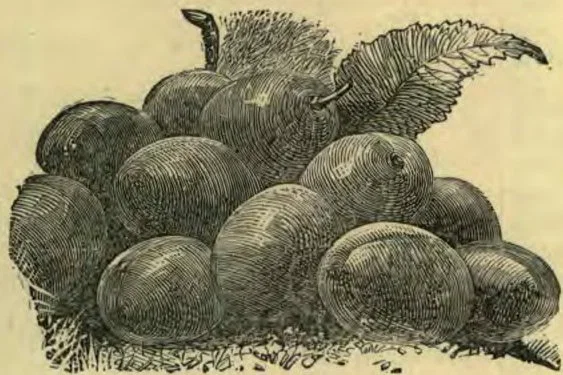
PLUMS
How we are going to tell you something about plums that we want you to be sure to remember.
The plum is a hardy fruit; by this we mean that it will grow in almost any kind of climate. There are a great many kinds of plums; the latest catalogues say that there are about two hundred and seventy-four.
Damascus was formerly celebrated for this fruit, and the many kinds known as damson, probably originally came from there.
A large number of choice sorts, which are of great size and beauty, have originated in the United States. The chief uses of the plum are for dessert, for drying, and for preserving in sirups.
When a person wants a plum orchard, he sows the nuts or stones of any free-growing kinds, and when they are two years old buds them with choicer sorts.
The wood of the plum, especially of the wild species, is hard and bears a polish; but it is apt to crack, and for this reason it is chiefly used for handles to tools, and for walking-sticks.

LETTER BUDGET.

WEST VALLEY, N. Y.
Dear Editors: I am a little boy six years old. I cannot write, so I am telling my mother what to write for me. I have two sisters; one is with my pa who is laboring with the tent, and the other is at home. She and I learn our Sabbath-school lessons every Sabbath. My lesson last week was about Isaac. I love to hear the letters in the INSTRUCTOR read, and I would like to see all the little boys and girls who write them. I want to be a good boy so that I can have a home in the new earth.
Hershie Peabody.
BIRMINGHAM, MICH.
Dear Editors: I go to school every day, and study reading, arithmetic, geography, and spelling. My teacher’s name is Miss Brown, and I like her very much. I like to go to school. I am eight years old. I have been taking the INSTRUCTOR about two years and like it very much. I like to read all my papers, but think the “Budget” the best of anything in it. I am trying to be a good boy so that I may be ready when our Saviour comes.
Yours truly,
Ezra Mathewson.
HADLEY, ENG.
Dear Instructor: I feel to thank the editors many, many times for the YOUTH’S INSTRUCTOR. I hail each one with great joy, for in it I find so much that is interesting. I am twelve years old. I keep the Sabbath with my mother, two sisters, and a little nephew. We wish very much to be baptized, but have never yet seen a Sabbath-keeping minister. Pa calls on me some to work on the Lord’s day, and if he was not such a kind pa it would be easier to refuse him, I think. But I hope and believe that he will yet be a commandment-keeper. Dear editors, pray that he may, and then I know that God will hear, and help to open his eyes to the great danger of not keeping all God’s law. Eld. Andrews was within five miles of us last Tuesday, and we felt like putting crape on our door to think that we could not see him and be baptized.
Good-by.
Benere Bower.

ENIGMA

[This letter from Europe contains fourteen hidden presidents of the United States.]
Dear Jane: Our sojourn in Europe is almost at an end, and we shall soon turn our faces homeward.
We are now at a place called Hochwanbure, not far from the Black Forest. A damsel of eighteen is the only maid-servant. We have to send all our washing to Neuendorf. There is plenty of fishing and shooting; trout, salmon, roebuck, hares, etc., are always to be found. I have finished a white dress for Grace, in satin and polka stitch.
George reads medical books, and is pleased with one by Dr. Gottlieb Jeffers, on “The Brain,” and “Das Hanbuch an Anatomie.” We go next week to Dormad. You remember Dormad is on the Neckar. Then we go to Cologne, to the Hotel de Nord, the best hotel in Cöln, as the Germans call it.
My travels will fill more sheets than you will care to read. I have no end of presents for all, among others a novelty Lerwick cheese, which your father will like. I am glad the sun has pierced through his mental darkness and he is all right.
In haste, your friend, HARRIETT AYLORME.
P. S. I send “The Emigrant’s Farewell.”
— Youth’s Companion.

EUROPEAN CATHEDRALS.

CATHEDRAL OF COLOGNE.

The Cathedral of Cologne is chiefly known as being still unfinished, though founded in 1248. It is one of the most magnificent specimens of the Gothic style, and is in the form of a cross, four hundred and forty-four feet long, two hundred and one feet wide (two hundred and eighty-two feet in the transept), and two hundred and one feet high. The central tower over the transept is three hundred and fifty-seven feet in height. The two main towers, when completed, will reach the great height of five hundred and eleven feet.
The lofty interior, the rich, stained-glass windows (some ancient and some modern), and the fine proportions of the whole structure, impress one deeply. The exterior is, however, on account of its richness, as well as its vastness, more impressive than the interior. The main portal is no less than ninety-three feet high. The choir, which is separated from the nave by an iron screen, was completed in 1322. It is flanked by seven chapels, in which are a few paintings and several interesting monuments.
The original designs of the Cologne Cathedral are lost, and the real architect, as will be seen in its completion, was Zwirner, a master of Gothic art, celebrated throughout Europe, who died in 1861. The work is under the fostering care of the Emperor of Germany, who has already expended upon it nearly three millions of dollars, the greater part of which was from his private exchequer.—Arthur’s Home Magazine.

HUMAN NATURE.—A TRUE INCIDENT.

Two little children five years old, Marie the gentle, Charlie the bold; Sweet and bright and quaintly wise, Angels both, in their mother’s eyes.
But you, if you follow my verse, shall see That they were as human as human could be, And had not yet learned the maturer art Of hiding the “self” of the finite heart.
One day they found in their romp and play Two little rabbits soft and gray,— Soft and gray, and just of a size, As like each other as your two eyes.
All day long the children made love To the dear little pets,—their treasure trove: They kissed and hugged them until the night Brought to the conies a glad respite.
Too much fondling does n’t agree With the rabbit nature, as we shall see, For ere the light of another day Had chased the shadows of night away,
One little pet had gone to the shades, Or, let us hope, to perennial glades, Brighter and softer than any below,— A heaven where good little rabbits go.
The living and dead lay side by side, And still alike as before one died; And it chanced that the children came singly to view The pets they had dreamed of all the night through.
First came Charlie, and, with sad surprise, Beheld the dead with streaming eyes; However, consolingly, he said, “Poor little Marie,—her rabbit is dead!”
Later came Marie, and stood aghast; She kissed and caressed it, but at last Found voice to say, while her young heart bled, “I’m so sorry for Charlie,—his rabbit’s dead!”—Sel.

You have reached the end of this edition.

The Youth’s Instructor · Jul 28, 1880