The Youth’s Instructor, Vol. 31, No. 21.

THE LITTLE WELSH GIRL

The Youth’s Instructor

May 23, 1883

S. D. A. Publishing Association · Battle Creek, Mich. · May 23, 1883

THE LITTLE WELSH GIRL.
Among the Sabbath-schools established in Wales toward the close of the last century, was one in the picturesque village of Llanfihangel. One of the scholars, Mary Jones, was the daughter of poor but pious parents. Her mother, by employing her to carry the lantern when the nights were dark, made Mary an exception to the general rule, which did not allow children to attend church-meetings, or the “societies” peculiar to Wales.
In those days Bibles were scarce, and sold at a very high price. Few of the cottagers were able to purchase them, and the only Bible to which Mary had access was in a farm-house two miles distant from her home. So great was this young girl’s love for the Bible that for six years she continued to avail herself of the permission given her to read and study her lessons in this Bible, treasuring up whole chapters in her memory.
It soon became the one desire of her heart to own a copy of this precious Book, and to this end she treasured up every penny in the hope that she might one day be able to purchase one. At last the necessary amount was made up; but she was told that no copy of the Bible could be had nearer than Bala, more than twenty-five miles distant, and that it was doubtful whether one could be found there. But the young girl was not to be discouraged, and one bright morning in the spring of 1800 she rose with the lark and started off toward Bala.
Barefooted, she walked all the way, carrying a pair of shoes to put on at the end of her journey, in a wallet, which she had borrowed to bring back the long-coveted Bible. It was a lovely day, and the little girl beguiled the weariness of the journey with happy thoughts of the treasure she hoped soon to call her own.
Night came on before she had reached Bala, and David Edwards, the friend with whom she lodged, advised her to go to bed and rest until morning. “Thou shalt sleep here to-night,” said the good man, “and we will go to Mr. Charles as soon as I see a light in his window to-morrow morning, so that thou mayst reach home before night.”
At the earliest dawn Mr. Edwards aroused his young friend, and they proceeded to the abode of Mr. Charles. The good pastor was deeply moved at the recital of her story; how for six long years she had every week trudged two miles on foot in order to study her lesson in a borrowed Bible, saving up her pence and half-pence through all those long years that she might be able to have one of her own. “It truly grieves me,” he said, “to know that this little girl has come all this distance to buy a Bible, and I have none to give her. The last supply of Welsh Bibles has been sold out for months, except a few that I have kept for friends whom I must not disappoint. What I shall do for Welsh Bibles for my country again, I know not.”
The poor girl burst into tears, and Mr. Charles found himself altogether unable to resist her appeal. “My dear child,” he said, “you must have a Bible, difficult as it is for me to spare you one. It is impossible for me to refuse you. David Edwards,” he continued, “is not such a sight enough to melt the hardest heart?—a girl so young, so poor, compelled to walk all the distance from Llanfihangel to Bala and back again, about fifty miles, to get a Bible? From this day I can never rest until I find out some means of supplying the crying wants of my country for the word of God.”
This visit made a lasting impression upon Mr. Charles; and by relating this young girl’s history in his appeals before wealthy friends in England, great sympathy was awakened in behalf of Wales. In the midst of the enthusiasm produced by the recital of the story, at a meeting held in London, December, 1802, for the formation of a society to meet the want of Bibles in Wales, the venerable Joseph Hughes, of Battersea, threw in the suggestion, “Mr. Charles, if a society for Wales, why not a society for England, and for the whole world?” In these words we see that the visit of this little Welsh girl to Rev. Thomas Charles was closely linked with one of the greatest events in the history of Christianity,—the establishment of the British and Foreign Bible Society.
In all her after-life Mary Jones continued to value the Bible as her chief treasure. She read a portion of it every day, and committed to memory, many of those books richest in Divine truth; such as the book of Job, Psalms and Proverbs, Isaiah, the Gospels, and many of the Epistles. Her interest in Sabbath-schools never flagged; and at all the public catechisings held by the great Welsh apostle, Mr. Charles, he was sure to find his young disciple from Llanfihangel. During such catechisings his eye would naturally turn to her for the most correct Scriptural replies; and the entire assembly was often thrilled by the intelligent and heartfelt appreciation of Bible truths evinced by this devoted young Christian.
In after years she became famous for the multitude of her bees and the quantity and quality of her bees-wax. Her receipts from the honey were used for the maintenance of her family; but the receipts for bees-wax, which in fortunate seasons amounted to a considerable sum, were devoted to the Bible Missionary Societies. Never was any bee-keeper on such friendly terms with the busy little workers, who repaid her care by the most delicious honey in all the country round. Incredible as it may appear, she would catch and hold them on the palm of her hand as readily as if they were common flies. She was wont to say that it was owing to their missionary zeal that she was never stung by them. “They all knew that she gave a share of the fruits of their labor to the service of their Creator, and on that account considered her service a privilege and a delight.”
When a collection was made in 1854 toward a million Testaments, a half-sovereign was found in one of the boxes. It was the only one, and it was feared that it had been put in by mistake. But it proved to be the gift of Mary Jones.
On the 28th of December, 1866, this good woman entered into her rest. She died in her eighty-sixth year, after a long life passed in poverty and obscurity. But who can estimate the blessed results of that humble life!—Selected.

THE MONTH OF MAY.

A MAY SONG.

By H. G. Adams.
I love the flowery May, With its sunshine bright and gay, Its ringing laughter in the woods, and shouting in the vale; I love the hawthorn bloom, With its delicate perfume, That whitens all the hedges round, and sweetens every gale.
I love the merry May, And I long to be away In copse and dingle, where the flowers like stars are shining out, To hear the sweet birds sing, And the gurgle of the spring, That gushes from its ferny bed, and freshens all about.
Oh, yes, I love the May, 'Tis Nature's holiday, And children hail its coming with an ever new delight; There are blossoms on the bough, There are mirth and gladness now; The youngsters have a pleasant time from morning until night.

SOWING GOOD SEED.

We cannot raise a good crop unless we plant good seed. There is no soil that will produce corn, or beans, or pease, or potatoes, unless seed is first put into the ground. You may plough, and plant, and dig, and hoe, as long as you live, but you will never get anything good out of the land unless something good is first put in. It is so with our hearts; if anything good is to come out of them, something good must first be put in; and there is nothing better to sow in the heart than the living Word of God.
Sometimes we plant in the soil a little, insignificant bulb; and it is wonderful to see how from that little bulb will come forth beautiful leaves and rich and fragrant flowers. So a rusty-looking seed will often bring forth buds, and blossoms, and fruits to support and strengthen mankind.
We see nothing in the seed which promises such results. If we had not seen it done, we could hardly believe that from a little apple-seed, planted in the ground, there would spring a great tree which would live for many years, and bear thousands and thousands of apples, feeding and refreshing the people; and that each apple would contain ten or twenty other seeds, each of which might produce another tree, all the trees bearing apples differing in size, form, and taste from the first one, and each kind producing other seeds and other trees to the end of the world!
Yet all this is done; and so one apple-seed is worth more than the costliest diamond that ever blazed on a monarch’s crown, or the brightest gem that ever graced a queenly form.
A diamond planted in the earth would stay there; a seed would spring up and grow. A pearl would lie in the ground forgotten; a pea would burst, and spring up, and blossom, and bear fruit.
Why is this difference? It is because the diamond is a mere lifeless crystal, while the little seed has, wrapped up in it, life, the very life of God, from whom comes the life of every living thing; and it is that divine life which works these wonders in the little seeds. And as seeds seem insignificant and worthless, and men cannot understand how they can become so strangely fruitful, so men cannot see how the word of God, planted in the heart, can produce such glorious effects.
And yet we know that almost all there is of beauty and blessing in this world, springs up like fruit from this living and abiding word,—this precious seed, that is sown with so many tears. And so, children who desire to live beautiful lives should search the Scriptures, and plant the word of God within their hearts. Many young persons who have neglected this, have grown up in ways of sin and wickedness, until their whole lives have been desolate, barren of good, and filled with the thorns and briars of sin and sorrow, simply because the good seed of God was not sown in their hearts.
The time for sowing seed is in the spring, before the weeds and thistles cover the soil and choke the seed. And the time to sow the word of God in the heart is in the early spring-time of life, before our hearts are overrun with the weeds and thistles of sin, and before the thorns choke the word, and cause it to become unfruitful.
“So now may grace, with heavenly shower, Our stony hearts for truth prepare; Sow in our souls the seed of power, Then come and reap thy harvest there.”

DISCIPLINING AN EMPEROR'S SON.

Czar Nicholas was a stern disciplinarian, and not infrequently gave his only son, the late Czar, a severe lesson. When the late Czar Alexander was a lad of fourteen, he was made sub-lieutenant of the Imperial Guards. His new epaulets soon got him into trouble.
One day when in uniform, he happened to cross one of the halls of the palace where the highest dignitaries of the realm were assembled. As he entered, they arose and bowed. This mark of respect from the oldest soldiers of the empire flattered the boy's vanity.
In his glee he repeatedly passed through the room, expecting the same recognition from the courtiers. The latter took no further notice.
Vexed at what he considered a breach of etiquette, the young Grand Duke complained to his father of the treatment he had received. Nicholas took him by the hand, and led him to the hall.
“These men whom you want to honor you,” he said, “are the men you should honor. You should regard any mark of respect they pay you as an excess of kindness. What you have done shows that you are too young to wear the epaulets of an officer. I deprive you of them.”
All entreaties were in vain. Alexander was degraded in the presence of the assembly; to be made, however, colonel in the Grenadiers of the Guard, at the age of sixteen.
Before honor is humility; and the greater Son of a mightier Ruler than Nicholas of Russia, ‘took upon him the form of a servant,’ and ‘learned obedience by the things he suffered;’ and gave his life a ransom for his foes. “Wherefore God also hath highly exalted him, and given him a name which is above every name.”
Are we willing to walk in the path of humility till God shall crown us with eternal honor? or do we prefer that pride which “goeth before destruction,” and the haughty spirit that prepares us for a fall.—Selected.

Good Deeds Shine Like Stars

GOOD deeds will shine as the stars of heaven.

THINGS MONEY CANNOT DO.

SOME boys and girls have an idea that money can do almost anything, but this is a mistake. Money, it is true, can do a great deal, but it cannot do everything. I could name you a thousand things it cannot buy. It was meant for good, and it is a good thing to have, but all this depends on how it is used. If used wrongly, it is an injury rather than a benefit. Beyond all doubt, however, there are many things better than it is, and which it cannot purchase, no matter how much we may have of it.
If a man has not a good education, all his money will never buy it for him. He can scarcely ever make up for his early waste of opportunities.
-Neither will wealth itself give a man or a woman good manners. Nothing, next to good morals and good health, is of more importance than easy, graceful, self-possessed manners. But they cannot be had for mere money.
Money cannot purchase a good conscience. If a poor man or a boy or a girl, any one, has a clear conscience that gives off a tone like a sound-bell when touched by the hammer, then be sure he or she is vastly richer than the millionaire who does not possess such a conscience. Good principles are better than gold.—S. S. Visitor.

AN HONEST BOY.

In a country school a large class were standing to spell. In the lesson there was a very hard word. I put the word to the scholar at the head, and he missed it; I passed it to the next, and so on through the whole class, till it came to the last scholar,—the smallest of the class,—and he spelled it correctly; at least, I understood him so, and he went to the head, above seventeen boys and girls, all older than himself. I then turned around and wrote the word on the blackboard, so that they might all see how it was spelled, and learn it better. But no sooner had I written it, than the little boy at the head cried out, “Oh, I didn’t say it so, Miss W——; I said e instead of i;” and he went back to the foot, of his own accord, quicker than he had gone to the head. Was not he an honest boy? I should always have thought he spelled it right if he had not told me; but he was too honest to take any credit that did not belong to him.

Lamps in Jerusalem.

Dr. H. Bonar says: “As there are no street lamps in Jerusalem, one must have his lantern when needing to be on the street after sunset—both because he would be laid hold of by the guard as a suspected person if found without a light, and because the rough, narrow streets really require it. Our Jerusalem waiter, Gabriel, considered it as regular a part of his duty to come for us with his lantern as to wait at table. On he marched before us, up one narrow street and down another, always holding the light as near the ground as possible, to indicate the ruts and stones, for it was our feet alone that seemed to need the light. We thus found new meaning in the passages, ‘Thy word is a lamp unto my feet, and a light unto my path.’ ‘The commandment is a lamp; and the law is light.’ ‘The sure word of prophecy’ is as ‘a light that shineth in a dark place, until the day dawn, and the day star arise.’”

Choosing Books Wisely: Quality Over Quantity in Reading

It is better to read one good book carefully than ten in a slovenly way. Be slow to begin a book if it is likely you will not have time to finish it. Be careful how you spend your time in reading books which are not worth reading. You would better throw away money than time, for time is worth more than money.

NEW-TESTAMENT HISTORY.

LESSON 136.—PHILIP PREACHES IN SAMARIA.

When Stephen was arraigned and tried before the Sanhedrim, the witnesses who testified against him were obliged by law to take the lead in putting him to death. In order to be the better prepared for their cruel work, they took off their outer garments, and left them in the care of a young man whose name was Saul. In thus keeping the clothing of the executioners, Saul consented to their deed, and really took part in the martyrdom of this holy man.
After Stephen’s death, devout men carried him away and buried him, making great lamentation over him. The violent murder of Stephen, sanctioned as it was by the Sanhedrim, the highest tribunal among the Jews, was but the signal to such a persecution of the church at Jerusalem as scattered the disciples abroad throughout the provinces of Judea and Samaria. Wherever they went, “they preached the word,” and thus they spread in every direction the gospel of salvation through Christ. Among the persecutors of God’s true people, Saul seems, at this time, to have been chief; for he went from house to house, and seizing both men and women, hurried them away to prison.
As the Samaritans were more willing than the Jews to hear the preaching of Jesus, so they were more ready to listen to his disciples; for Philip, on going down to the city of Samaria, found its inhabitants eager to hear his words, glad to behold the miracles which he wrought, and willing, with one accord, to heed his teaching. Perceiving that these people were sincere in their professions of faith in Christ, and that they were ready, not only to believe, but to obey, the gospel, he baptized them, both men and women.
Among the converts was one Simon, who had been a sorcerer, and had bewitched the people, making them believe that he had the power of God. After he was baptized, this man remained with Philip, wondering at the great miracles which were performed in the name of Jesus.
When the apostles at Jerusalem knew that Samaria had received the word of God, they sent them Peter and John, who, when they had come down, prayed for the converts, and laid their hands on them, that they might receive the Holy Ghost. Now when Simon saw that the gift of the Holy Ghost was bestowed upon those on whom the apostles laid their hands, he became very anxious to have power to do as they did, and offered them money, saying, “Give me also this power, that on whomsoever I lay hands, he may receive the Holy Ghost.” But Peter, moved with indignation, said, “Thy money perish with thee, because thou hast thought that the gift of God may be purchased with money. Thou hast neither part nor lot in this matter; for thy heart is not right in the sight of God. Repent therefore of this thy wickedness, and pray God, if perhaps the thought of thy heart may be forgiven thee. For I perceive that thou art in the gall of bitterness, and in the bond of iniquity.” Then said Simon, “Pray ye to the Lord for me, that none of these things which ye have spoken come upon me.”
When Peter and John had finished their work in the city of Samaria, they returned to Jerusalem, but either on their way, or soon after their return, they preached the gospel in many villages of the Samaritans. Perhaps they preached to some of the very people on whom they once wanted to call down fire; but what a different spirit they now possessed! Philip probably remained in the city of Samaria till an angel called him, and told him to go away southward to a certain road leading from Jerusalem to Gaza. On reaching the place, Philip saw an Ethiopian eunuch riding along in his chariot. This Ethiopian was a man of high rank under queen Candace, having charge of all her treasures. He had now been to Jerusalem, and was returning home, reading, as he rode along, from the book of Isaiah.
And the Spirit of God said to Philip, “Go near, and join thyself to this chariot.” Philip obeyed; and as he heard the eunuch reading, he said to him, “Understandest thou what thou readest?” And the eunuch said, “How can I, except some man should guide me?” Then he invited Philip to come up and sit with him in the chariot. The eunuch had just been reading these words from the fifty-third chapter of Isaiah:—
“He was led as a sheep to the slaughter; And as a lamb before his shearers is dumb, So he opened not his mouth: In his humiliation his judgment was taken away: His generation who shall declare? For his life is taken from the earth.”
When Philip had taken a seat by him, the eunuch said, “Of whom speaketh the prophet this? of himself, or of some other man?” Then Philip told him the meaning of the passage, and preached to him salvation through Christ. Philip’s words so affected his hearer that, as they came to a body of water, the eunuch exclaimed, “See, here is water; what doth hinder me to be baptized?” And Philip said, “If thou believest with all thy heart, thou mayest.” The eunuch replied, “I believe that Jesus Christ is the Son of God.” Then the chariot was stopped, and Philip and the eunuch both went down into the water, and Philip baptized him.
When they came up out of the water, the Spirit of God caught away Philip, and the eunuch saw him no more; yet he was so happy in the truth he had just received, and in the satisfaction of obeying it, that he went on his way rejoicing. But Philip was next seen at Azotus; and passing on from that place, he preached in all the cities till he came to Cæsarea.

QUESTIONS.

1. What did the Jewish law require of witnesses in a criminal case?
2. How did the witnesses who testified against Stephen prepare themselves for their cruel work?
3. Who took care of their garments while they stoned Stephen? Acts 7: 58.
4. How did he thus bring guilt upon himself?
5. What respect was paid to Stephen’s remains? Acts 8: 2.
6. By whom was the murder of this man sanctioned?
7. What rank did this council hold among the Jews?
8. What followed this first act of martyrdom?
9. What was the effect of this persecution?
10. What resulted from this scattering of the disciples? Verse 4.
11. Who was chief among the persecutors of the church at this time?
12. What did he do?
13. Who went down to the city of Samaria, and preached the gospel there? Verse 5.
14. How did the people of that city receive him?
15. What spirit did they manifest with reference to his teaching?
16. How were his labors blessed? Verse 12.
17. What noted person was among the converts?
18. What had he made the people believe?
19. After being baptized, what did he do?
20. What was done by the apostles at Jerusalem, when they learned that Samaria had received the gospel?
21. What did Peter and John do when they had come down to Samaria?
22. When Simon the sorcerer saw this done, what desires did it awaken in him?
23. What did he offer the disciples?
24. What request did he make?
25. What did Peter say about taking the money?
26. What did he say about Simon’s experience in spiritual things?
27. What did he advise Simon to do?
28. What reply did Simon make?
29. What work did Peter and John do, either on their way back to Jerusalem, or soon after their return to that place?
30. What message did Philip receive? Verse 26.
31. On reaching the place, whom did he see?
32. Who was this Ethiopian?
33. Where had he been?
34. Where was he now going?
35. How did he busy himself, as he was riding along?
36. What was Philip now told to do?
37. What question did Philip ask the eunuch?
38. What did the man say?
39. What had he just been reading?
40. What did Philip do, on being invited to take a seat in the chariot?
41. What was the effect of his words?
42. Describe the baptismal scene and what followed.

NOTES.

CHAP. 8., Ver. 5. The city of Samaria. This does not mean a city whose name was Samaria, for no such city at that time existed. Samaria was a region of country between Judea and Galilee. Matt. 2: 22. The ancient city Samaria, the capital of that province, had been destroyed by Hyrcanus, so completely as to leave no vestige of it remaining; and he “took away,” says Josephus, “the very marks that there had ever been such a city there.” Herod the Great afterward built a city on this site, and called it Sebaste, i. e., Augusta, in honor of the emperor Augustus. Perhaps this city is intended, as being the principal city of Samaria; or possibly Sychar, another city where the gospel had been before preached by the Saviour himself. John 4.—Barnes.
Ver. 23. In the gall. This word denotes properly bile, or that bitter, yellowish-green fluid that is secreted in the liver. Hence it means anything very bitter, and also any bad passion of the mind, as anger, malice, etc.—Ibid.
Ver. 27. A man of Ethiopia. In its largest sense the term Ethiopia was applied to all the African lands south of Egypt; more definitely, it included the modern Nubia, Senaar, Kordofan, and part of Abyssinia. Its inhabitants were black in color and large in stature. Their land appears to have been one of wealth, and to have maintained some commercial relations with Palestine. The Hebrew equivalent for Ethiopia is Cush, and by this name it is designated in Genesis.—Abbott. This man was not, as some have suggested, a Jew who lived in Ethiopia, but most probably was a heathen convert to Judaism, and now was returning home from a pilgrimage to the chief shrine of his adopted religion. We know that at this time there were many Jews in Ethiopia.—Schaff. Under Candace. Candace is said to have been the common name of the queens of Ethiopia, as Pharaoh of the Egyptian rulers, and Cæsar of the Romans.
Ver. 40. Azotus. This is the Greek name of the city which by the Hebrews was called Ashdod. It was one of the cities which were not taken by Joshua, and which remained in the possession of the Philistines. It was to this place that the ark of God was sent when it was taken by the Philistines from the Israelites; and here Dagon was cast down before it. 1 Sam. 5: 2, 3. Uzziah, king of Judah, broke down its wall, and built cities or watch-towers around it. 2 Chron. 26: 6. It was a place of great strength and consequence. It was distant about thirty miles from Gaza. It was situated on the coast of the Mediterranean, and was a seaport. It is at present inhabited by Arabs chiefly, and is by them called Mezdel. The surrounding country is represented as remarkably verdant and beautiful. In the neighborhood there stands an abundance of fine old olive-trees, and the region around it is fertile. He preached in all the cities. Joppa, Lydda, Askalon, Arimathea, etc., lying along the coast of the Mediterranean.—Barnes. Cæsarea was distant about 70 miles from Jerusalem, on the shores of the Mediterranean sea. Before the days of Herod the Great, it was merely a station for vessels. Herod, however, designed to make it the commercial capital of Palestine; he adorned it with marble palaces, provided it with a magnificent harbor, larger than the Piraeus at Athens, and with a vast quay. In the midst of the new city rose, on an eminence, the temple of Cæsar, with statues of the Emperor and of Rome. With slavish adulation, King Herod named the city after his powerful patron Augustus, Cæsarea, under whose mighty protection for the present and the far future he placed the new capital of the old Land of Promise. After Herod’s death, Cæsarea became the residence of the Roman governors of the country. Here the well-known procurators Pontius Pilate, Felix, and Festus held their “courts.” At the commencement of the Jewish war, we read of twenty thousand Jews resident at Cæsarea, being massacred. It has been for several centuries a mere heap of ruins. A few fishers’ huts now occupy the site of this once proud capital.—Schaff.

THE KINKAJOU.

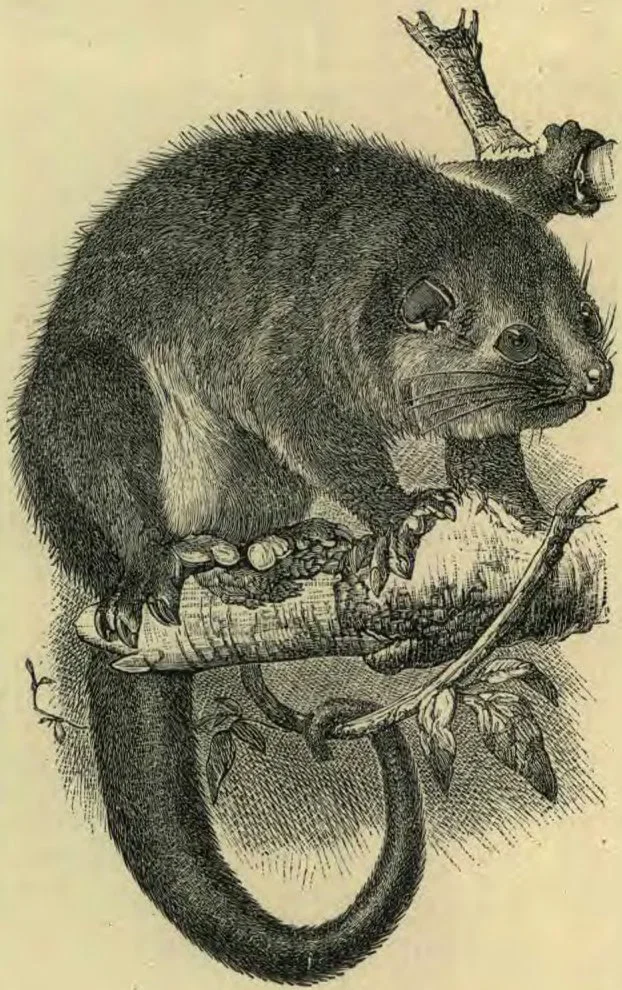
SHOULD we be traveling in South America, we might come across an animal that looks very much like the one in the picture. But we need not be afraid to come near a kinkajou; for the animal sleeps all day, and is very hard to wake up. Bright light hurts its eyes, and disturbs it more than it does the owl. If it should be waked up in the day-time, it would be quite uneasy until the bright light was gone.
But when night comes, the kinkajou is very lively, running up and down the branches of trees, and every little while coming down to the ground to get a drink. It makes a low, bleating sound. The kinkajou comes down the tree head first, and keeps from falling by hitching the claws of his hind feet in the bark.
Like the monkey, it can curl its tail around the branches, and help hold itself on. This curious tail helps the animal to climb. It can also hang for some time by its tail and its two hind feet with its head downward.
Its fur is of a dull brown color striped with darker brown, with a dark band around the neck; but these marks are faint, and cannot be seen unless the light is just right.
The kinkajou has a very long and limber tongue, which it can thrust into the smallest cracks after the insects that are sheltered there. It is fond of honey, and uses its tongue in getting the honey out of the bees’ wax store-house. If it cannot reach with its mouth the food it wants, it darts out its tongue, or uses its tail to bring these things nearer. It will eat fruit, insects, honey, birds, eggs, and such things.
This curious animal is no larger than a cat, but it is a great deal stronger. In its wild state it is quite fierce, and will even beat off a man if he is not armed. It is, however, easily tamed, and likes to play with its friends just as little puppies and kittens do. It is fond of petting and caresses.
W. E. L.

THE WORKING TOOLS OF INSECTS.

I WONDER if you know that the smallest insects you see about you have tools given them to do their work with. There is a little fly called a saw-fly, because it has a saw to work with. It is really a very much nicer saw than you could make, if you were ever so old.
The fly uses it to make places where the eggs will be safe. What is more strange, it has a sort of home-made glue which fastens them where they are laid.
Some insects have cutting instruments that work just as your scissors do. The poppy-bee is one of them, whose work is wonderful. This bee has a boring tool, too. Its nest is usually made in old wood. This borer cleans out the nest ready for use. When all is ready, the insect cuts out pieces of leaves to line the nest and to make the cells. These linings are cut in the shape of the cells. You would be surprised to see the care taken to have every piece of just the right size, so that it will fit. When they are fitted, the pieces are nicely fastened together and put into the nest.—Our Little Ones.

Letter Budget.

May Smith writes from St. Paul, Minnesota: “This is the first time I have written for the INSTRUCTOR. I hope to go to Sabbath-school and day-school pretty soon. We keep the Sabbath. Pray for me that I may be a good girl.”
Florence L. Larmneneth writes from Long Valley, Cal.: “I am thirteen years old. I am going to get subscribers for the INSTRUCTOR. I go to Sabbath-school every Sabbath. There are fourteen Sabbath-keepers in this valley. I am trying to do right.”
Florence N. King sends a letter from South Lancaster, Mass. She says: “I have never written for the INSTRUCTOR before, so I hope this will be printed. I am eleven years old. It is nearly a year since I began to keep the Sabbath. I am trying to do right so I can be saved when Jesus comes.”
Guy Head writes from Warren Co., Pa.: “We take the INSTRUCTOR and like it very much. We have a family Sabbath-school. There are four of us keeping the Sabbath. I am thirteen years old. I have one brother eight years old. We are trying to be good boys so that we can live on the new earth.”
Amy Armstrong, of Chicago, Huron Co., Ohio, says: “I am ten years old. I have two sisters and a mother; my father died when I was two years old. I like to read the INSTRUCTOR, especially the Budget. I go to school every day. I send my love to the INSTRUCTOR family.”
Nellie E. Clark sends us a very neatly written letter from Los Angeles, Cal. She says: “I am nine years old. I have taken the INSTRUCTOR nearly three years, and think it is the best little paper in the world. I go to day-school, and to Sabbath-school, and I learn my Sabbath-school lessons in Book No. 3. I am trying to be a good girl.”

BRIGHT LITTLE DANDELION.

Bright little dandelion Glitters in the sun, The wind combs out his yellow hair Like gold that is spun: Let the winter work its will With its frost and snow, When he hears the robin's trill, He begins to grow.
What is he about there, Underneath the mold? Has he not an hour to spare, Digging hard for gold? Has he work enough to do To cut his jacket green, To slash it and shape it too, Fit for king or queen?
How does he hear, think, When brooks begin to flow? Does he never sleep a wink The long night through? Like a ghost he fades, alas, Ere the summer's fled, In among the meadow grass, A halo round his head!
—Mary N. Prescott.
Written for the INSTRUCTOR.

Kindness Returns: The Reward of Good Deeds

PERFORM a good deed, speak a kind word, bestow a pleasant smile, and you will receive the same in return.

SABBATH-SCHOOL MAPS.

Twelve-sheet Map, illustrating the travels of St. Paul, 81x170 inches. $18.50
Eight-sheet Map of Palestine, 81x116 inches, 12.50
Eight-sheet Map, illustrating the Travels of St. Paul, 81x116 inches, 12.50
Peninsula of Mt. Sinai, 52x72 inches, 5.00
Old-Testament Map of Palestine, 41x58 inches, 3.00
Old-Testament Map of Palestine, 28x41 inches, 1.50
New-Testament Map of Palestine, 41x58 inches, 3.00
New-Testament Map of Palestine, 28x41 inches, 1.50
Map illustrating the Travels of St. Paul, 1.50
(The above are on cloth without rollers.)
Map illustrating the Travels of St. Paul, (boards) 13½x18½ inches. .50
Travels of St. Paul, (card) 5¼x3¼ inches, .04
Same on paper, .03
A Bird's-eye view of the Holy Land, in colors, varnished and mounted. 50x78 inches. With an index to all the principal places, rivers, and mountains of Palestine. 8.00
“Bird's-Eye View of the Holy Land can be sent only by express. Twenty-five per cent discount to Sabbath-schools. The others will be sent by mail on receipt of price.
Continue reading: HELPS TO BIBLE STUDY,