At the institute to be held at Lincoln, March 17-31, the Sabbath-school work will receive its share of attention. We expect to have some papers read and instruction given on important questions relating to this line of work, and we hope to see a good representation of officers and teachers of our schools, in attendance. Bro. M. H. Brown, the district superintendent of Sabbath-schools, will be present, and doubtless will take charge of the instructions, and give us much needed help in this work. This will be the best opportunity of the kind that we have ever had in Nebraska. Let all come who can.
W. N. HYATT.
To Texas Canvassers.
By T. T. Stevenson
Dear Brethren and Sisters: The time for our spring workers’ meeting is rapidly approaching, and we trust that every canvasser, also those who expect to canvass in the future, will begin now to plan to attend this meeting. We feel that it will be one of great importance to the cause in Texas, especially to the canvassing work. Bro. W. R. Smith, of Iowa, the canvassing agent for Dist. No. 5, will be present to give valuable instruction, and we hope none of the canvassers will slight this privilege of learning more about this important branch of the work. We believe the time has fully come for us to make advance moves in Texas. What we need most is men and women who are connected with God to enter the field already white for the harvest. The Lord will bless our efforts and give us success when we work for the good of souls.
We wish to organize at this meeting, for systematic work during the coming year. We hope to start several companies, and would like to hear at once from those who wish to work in this way. Please let us know just how much you can furnish toward fitting out a company, in the way of horses, vehicles, etc. We would like to have all come prepared to go from the meeting to the field, without returning to their homes.
T. T. Stevenson, State Ag’t.
CAMP-MEETINGS FOR 1890.
By O. A. Olsen
THE time is close at hand when another camp-meeting season will open, and it is very important that the time for each meeting be decided upon as soon as possible, so that our brethren can shape their affairs accordingly. We also suggest that changes of time be avoided, if possible, after appointments are once made, as this is liable to bring confusion. It will be quite impossible to give every State its first choice. We shall be very glad to do so where we can.
The number of these meetings increases every year, also their importance. At the late General Conference the country was divided into six General Conference districts, and a member of the General Conference Committee was placed as superintendent over each district. Each district is composed of several States and Conferences. It is no longer possible to arrange our camp-meetings so that they will come in range, and one set of laborers attend the most of them. Last year, and also before, we found it necessary to hold two, and sometimes more, camp-meetings at the same time. This requires more laborers. This year we shall find it necessary to hold several camp-meetings on the same date. We have therefore thought it to be the better way that the member of the General Conference Committee who stands at the head of the work in each district, in connection with the presidents of the State Conferences in his district, make the arrangements for the camp-meetings in that district. The member of the General Conference Committee will attend all the camp-meetings in his district, with such help as may be arranged for by the interchange of laborers between the several Conferences.
We also suggest that every State camp-meeting be preceded by a workers’ meeting. Experience has taught us that we cannot overestimate the value of the workers’ meeting. This makes the time of the camp-meeting virtually two weeks. The expense and labor attending a camp-meeting are too great for only one week’s meeting. With only these few days, you hardly get started before it is time to break camp, and the effort is nearly lost. We also urge that the workers’ meetings be furnished with good help. We hope by the arrangement herein suggested, in distributing the General Conference Committee as much as we do, that at least one member of that Committee can attend the workers’ meetings. In appointing the camp-meetings in the several districts, the time should be so arranged as to give good help at the workers’ meetings preparatory to the camp-meetings proper. Will the district superintendents and the State Conference presidents make the arrangements for the camp-meetings in the several districts as soon as possible? O. A. OLSEN, Pres. Gen’l Conf.
News of the Week.
FOR WEEK ENDING FEBRUARY 22.
DOMESTIC.
—The green postage stamp is to be superseded by one of deep carmine.
—The senate at Olympia, Wash., passed an Australian ballot bill Tuesday.
—Thirty million population schedules are being printed for the forthcoming census.
—Jay Gould is reported to have acquired nearly all the coal fields in the Southwest.
—A peculiar and fatal cattle disease is reported raging in the vicinity of Columbus, Ind.
—Flames in the Touro Block in New Orleans, on Wednesday, caused a loss of $150,000.
—Another heavy snow-storm in the Sierras has interfered with trains on the Central Pacific Road.
—Mrs. Burritt, of Racine, Wis., on Wednesday finished a fast of twenty-one days as a cure for dyspepsia.
—By a vote of twenty-one to eight, the North Dakota Senate adopted, on Wednesday, the Australian election system.
—In an accident near Suisun City, Cal., on Friday, a large number of railroad employees are reported to have been killed.
—It is reported that Texas stockmen will lose hundreds of thousands of dollars by the President’s proclamation ousting them from the Cherokee strip.
—Warren Bloom and Warren Adkins, boys of twelve, quarreled over a game of cards at Hope, Ind., Wednesday, when Bloom drew a revolver, and fatally shot his young companion.
—Seventeen prominent citizens of Sharon, Ga., and vicinity, were arrested, Monday, on charges of conspiring against, and intimidation of, S. L. Duckworth, the newly appointed postmaster there.
—Secretary Windom has served notice on the Commissioners of Emigration at Castle Garden that the Government will not need their services after April 18. Immigrants will be landed on Bedlow’s Island.
—The deadlock in the Iowa House was broken on Wednesday, by arrangement of the parties. Mr. Hamilton, Democrat, was elected Speaker, while the Republicans secured the Speaker pro tem, the chief clerk, his first assistant, and important committee chairmanships.
—The New England Land company of Egypt is the paradoxical name of a syndicate organized in Boston to purchase town lots in Port Said and Alexandria, and to build a 200-mile modern trunk line from Port Said through to Damascus, in Arabia Petrea. Among the members are Gen. Butler, Frank Jones, Gov. Goodell of New Hampshire, Senator Frye of Maine, and Joseph G. Palmer of New Jersey.127
—The electrical execution machines at Sing Sing prison have been tested by a committee for the State, composed of Dr. Carlos F. Mac Donald, Dr. A. D. Rockwell, Dr. P. H. Laudy, and electrical assistants. The tests clearly showed that the dynamos were even more deadly than had been represented. When run at less than their ordinary revolutions per minute, the electrical pressure was found to exceed 1,600 volts, instead of being only 1,000. This proves that about 300 times a second the pressure runs about 2,000 volts.
FOREIGN.
—Great hordes of Chinese are said to be flocking into Siberia.
—Four children of John Leston met death by suffocation in a fire at Kingston, Ont., late Wednesday night.
—The Socialist party of Germany numbers now nearly 1,000,000 adherents, not quite one-fiftieth of the empire’s population.
—An order has been issued from Berlin prohibiting the circulation in Germany of the Volksanwalt, a paper published in Cincinnati, O.
—Leprosy is spreading in New Caledonia. Three thousand aborigines and many convicts have been attacked. Louise Michel talks of going to their succor.
—Count Julius Andrassy, the well-known Hungarian statesman, who has been ill for some time at Volosca, near Fiume, died Feb. 18. He was sixty-seven years old.
—A telephone has been established between Yokohama and Striznoka, a distance of 100 miles, in Japan, by order of the mikado. It is the first in the country, and works finely.
—The French Government proposes to celebrate the twentieth anniversary of the establishment of the republic on Sept. 4, in an extraordinary style at Paris, Bordeaux, Lyons, and Marseilles.
—Cardinal Manning pronounces the summons of Emperor William to a conference of nations on the labor question to be the wisest and worthiest act proceeding from any sovereign of our times.
—A Paris dispatch gives news of an explosion in a colliery near Decize, Department of Nièvre, Feb. 18. It is not known how many lives were lost, but already thirty-four bodies have been recovered.
—The Russian Government has ordered the planned great railway line across Siberia to be begun in May. When the line is completed, it is estimated that the tour of the world in fifty days will be feasible.
—Artesian wells sunk in the desert of Sahara, reach water at a depth of 230 feet, at which a steady pour of 5,000 gallons per minute has been obtained. The water is brackish, but answers for irrigation purposes.
—The German elections for seats in the Reichstag have just been held, and the result is a sensation, owing to the sweeping victories gained by the socialists. It is doubtful if the government party will be able to maintain its majority. Bismarck meets a decided rebuke in his measures relative to the working-man.
—The Paris correspondent of the London News says Dom Pedro’s nervous disease increases, and partly unhinges his mind. He lives in daily expectation of being recalled to rule Brazil, and does not realize the precarious state of his own finances. He refuses to reduce his imperial suite, and maintains his expenses on a grand scale.
—Major Wissmann, the explorer, is planning a campaign in Central Africa. At the head of a strong force, he will march into the interior at the end of April. He will have 400 natives, fully equipped and armed with magazine rifles, eighteen mountain guns, two torpedo boats and four river boats, and two large guns to defend stations to be built on the caravan road.
—The Pacific mail steamer “China” arrived Feb. 21, from Hong Kong and Yokohama, Japan. It is reported that the storm which swept along the Boshu coast Jan. 24 was very disastrous. About 1,000 fishing boats, with between 2,500 and 3,000 fishermen, drifted out to sea. Nine hundred of these boats, with all the men on board, were lost. Most of the bodies drifted upon the beach, and were taken care of by sorrowing relatives.
—A very useful invention, tending to lessen the possibility of accidents in factories, is now being extensively adopted in England. The breaking of a glass which is adjusted against every wall of every room in the mill, will at once stop the engine, an electric current being established between the room and the throttle-valve of the engine, shutting off steam in an instant. By this means the engine was stopped at one of the mills recently in a few seconds, and a young girl whose clothes had become entangled in an upright shaft was released uninjured.
RELIGIOUS.
—The Philadelphia Presbytery voted against revision.
—The Church of England has nearly 360,000 members in India.
—The Bible has been translated into sixty-six of the languages and dialects of Africa.
—Scores of converts are reported to have been secured in a series of revival meetings held in Decatur, Ill., and vicinity.
—The Woman’s Foreign Missionary Society of the Methodist Episcopal Church has more than 130,000 members.
—The first convert in the Upper Congo Valley was recently baptized at Equator Station. The valley contains 30,000 people.
—Dr. Talmage is arranging to turn 100,000 subscriptions of $1.50 each to The Christian Herald, into the fund for rebuilding his tabernacle.
—Five years ago there were five girls’ schools in Yokohama and Tokio. To-day there are more than thirty, and all well patronized.
—The last census in New Zealand reveals the interesting fact of a profession of religion on the part of no less than ninety-five per cent of the whole population.
—During the Wednesday session of the Illinois conference of the Swedish-American Church, a resolution thanking God for the general prosperity of the last year was defeated by the farmer lay delegates, on the ground that they had experienced no great amount of prosperity.
—Leo XIII. has directed that his monumental tomb shall consist of only his figure recumbent in white marble upon a sepulchral urn of porphyry, on the sides of which are to be the statues of Religion and Justice. Many of the popes have prescribed their monuments, though Pius IX. did not leave any directions in regard to his.
—The new creed of the Presbyterian Church of England contains the following clause: “We assuredly believe that on a day known only to God, the Lord Jesus Christ will suddenly come again from heaven with power and great glory; and we look for this second appearing of our Saviour as the blessed hope of his Church, for which we ought always to wait in sober watchfulness and diligence, that we may be found ready at his coming.”
The Sabbath-School.
“The entrance of thy words giveth light.”—Ps. 119:130.
5.Why could not Christ act as priest in the earthly sanctuary? Chap. 8:4.
6.If the earthly was the pattern of the heavenly, must there not be two holy places in the heavenly? Chap. 9:23, 24.
7.What does the word “true” mean in verse 24? Ans.—The true holy places—holy places, understood.
8.Where are the true holy places? Verse 24.
9.How often did the high-priest enter the most holy on earth? Verse 25.
10.How often does Christ enter the heavenly sanctuary for us? Id. (See verse 12.)
11.What is meant by the end of the world, verse 26? Ans.—The last dispensation.
12.For what hath Christ appeared? Id.
13.Whose sins did he come to put away? (Compare chap. 7:25.)
14.Whose sins does he put away? Ans.—Only those who cease to sin. They who continue to transgress the law of God never have their sins put away; they retain them. Matt. 7:21.
18.What is implied by introducing the judgment as following death? Ans.—That the judgment is consequent upon this life, and for one probation only.
19.What analogy is shown between our probation and the death of Christ? Verse 28. Ans.—As we die once, living but one life, having but one probation, so Christ once died to bear sins.
20.For how many did he die? Id. (Compare chap. 2:9.)
21.What is meant by the words, “Once . . . hath he appeared,” Heb. 9:26? Ans.—He has made one advent to this world.
22.Will he appear again? Verse 28.
23.How will he appear? Id. (See note.)
24.For what purpose will he appear? Id.
25.To whom will he appear unto salvation? Id. (See 2 Tim. 4:1, 8.)
26.How will he appear to those who do not look for him, nor love his appearing?2 Thess. 1:6–8; Rev. 6:15–17.
NOTE.
It is to be regretted that commentators have so generally overlooked the true intent of Heb. 9:28, and construed it to mean “without a sin-offering.” The original word occurs seventy-three times in the New Testament, and is rendered “sinful,” once; “offense,” once; “sin,” seventy-one times. It is never claimed that it can bear the sense of sin-offering in the New Testament, except in 2 Cor. 5:21, and Heb. 9:28. And we are very confident that it does not in either of these texts. In 2 Cor. 5:21 the contrast and the force are measurably lost by so rendering it. “He hath made him to be sin for us, who [himself] knew no sin.” Our iniquity was laid upon him; he was bruised for our sakes—in our stead. He bore our sin, and suffered as if he had actually been the sinner. The Scripture doctrine of substitution is entirely too strong and clear to admit of this text being changed into sin-offering.
In Hebrews 9 there is presented a series of events, mostly in contrast with the things of the earthly service, each of which occurs without being repeated. He offered one sacrifice; he offered it but once; he entered once into the heavenly sanctuary. Man dies once (therefore there is but one probationary life); and after this one death, the judgment. So Christ was once offered to bear sin; and he will once more (a second time) come, without sin. He was once offered to bear sin; he bore it on the cross; he bears our judgment—the iniquity of his priesthood— before the throne. As a priest, he has continually taken sins, except from those who choose to retain them. But when he comes again, he will be separated from sin; he will bear sin no more. As it reads, it signifies that at his second coming his priesthood, his act of sin-bearing, is forever ended.
The difference is evident and material. He might come without a sin-offering, he might not renew his sacrifice, and yet not make an end of his priestly service. He has made but one offering in more than 1,850 years, and his priesthood has continued all these centuries by virtue of that one offering. And it might continue indefinitely, in the same manner, by that one and the same offering. All these centuries he has been receiving the sins of penitents. But he comes without sin, separate or apart from sin, as it really means. This indicates that he will bear sin no more; that he has put it from him. Then he that is unjust must so remain. Rev. 22:10–12.
The following remarks from Dr. Barnes on this text, concerning the coming again of our blessed Saviour, are interesting:—
There is a propriety that he should thus return. He came once to be humbled, despised, and put to death; and there is a fitness that he should come to be honored in his own world.
Every person on earth is interested in the fact, that he will return, for “every eye shall see him.” Rev. 1:7. All who are now in their graves, all who now live, and all who will hereafter live, will behold the Redeemer in his glory.
It will not be merely to gaze upon him, and to admire his magnificence, that they will see him. It will be for greater and more momentous purposes—with reference to an eternal doom.
The great mass of men are not prepared to meet him. They do not believe that he will return; they do not desire that he should appear; they are not ready for the solemn interview which they will have with him. His appearing now would overwhelm them with surprise and horror. There is nothing in the future which they less expect and desire than the second coming of the Son of God, and in the present state of the world his appearance would produce almost universal consternation and despair. It would be like the coming of the flood of waters on the old world; like the sheets of flame on Sodom and Gomorrah.
“GOOD HEALTH.”
By E. J. Van Horn
I PRESUME there never was a time since mankind became diseased, but that the words “good health” have been significant. It is quite evident, from the increase of patent medicines and the large number of “cure-all” discoveries which are noticed in almost every paper now printed, that every person who desires to experiment in the nostrum business begins at once to “scientifically” prepare a panacea for the ailments to which flesh is heir. He knows that almost every person is a sufferer, so the quack does not have to go far to find some poor soul who desires health more than wealth. Now is the chance to have the “new discovery” tested. In order that this “wonderful” discovery may be brought before the public, the “professor” begins to aver that this “cure-all” will remove the pale and sickly appearance, and produce new life and vitality. This the great sufferer most earnestly desires, and, to secure it, invests in the nostrum with a strong hope that he will soon be in perfect health.
But I imagine that some who read this will think that no Seventh-day Adventists will be humbugged in this way, because they are health reformers. Are they? Seventh-day Adventists are mortal, and many of them are liable to be imposed upon by quacks, unless they are posted. The question may be asked, How can we become posted? I answer, By taking the Good Health. Those of our brethren and sisters who do not have this good journal, are suffering loss. If you desire good health, become a subscriber for the journal by that name. Are you a firm believer in the third angel’s message? If you are, you ought to be a health reformer; and in order to be one, you need just such a journal as Good Health, that you may keep posted. The editor has been trying for several years to make it a practical instructor, and he has now begun a series of articles which are calculated to place quackery and charlatanism before the public in their true light. I hope all our people will take the Good Health. It is larger than it was formerly, and is filled with timely warnings and useful information. The editorials on medical frauds in the January and February numbers, are worth the subscription price for the whole year.
E. J. VAN HORN.
BUSINESS NOTICES
Appointments.
“And he said unto them, Go ye into all the world, and preach the gospel to every creature.”—Mark 16:15.
I EXPECT to meet with the church in Leslie, Mich., Sabbath and Sunday, March 1, 2. Hope all the members will make an effort to be present. I. D. VAN HORN.
THERE will be a workers’ institute held at Milton Junction, for instruction in all branches of the work, beginning March 26 and continuing two weeks. It is expected that all workers in the State will attend. Particulars next week. A. J. BREED.
PROVIDENCE permitting, I will meet with the Jefferson, Mich., church March 1, 2; Allegan, March 7-9. First meeting at each place Friday, at 7 P. M. Dr. O. G. Place has kindly consented to attend the former meeting, and Dr. K. Lindsay the latter, to deliver addresses on health and temperance topics. Come prepared to remain until the close of the meetings. A. O. BURRELL.
BUSINESS NOTICES.
[Under this head, short business notices will be inserted at one dollar for each notice of four lines or less. Over four lines, twenty-five cents a line. Persons unknown to the managers of the REVIEW must give good references as to their standing and responsibility. Ten words constitute a line.]
WANTED.—A young man desires a place on a farm with S. D. Adventists. For further information address Erick Anderson, Box 44, Clyde, Kan.
Obituary Notices.
“Blessed are the dead which die in the Lord from henceforth.”—Rev. 14:13.
LOWREY.—Died at Lorraine, Jefferson Co., N. Y., Jan. 29, 1890, Bro. Lorenzo Lowrey, aged 74 years, 7 months, and 2 days. Bro. Lowrey lived all his life on the farm of his birth and death, with the exception of a short time when he lived four miles distant to care more fully for the interests of the church of which he was a member. In 1842 he made a public profession of religion and united with the Baptist Church. In 1844 he became very much interested in, and fully embraced, the doctrine of the soon coming of our Saviour. He firmly believed that the preaching of Christ’s soon coming was a fulfillment of the first angel’s message of Rev. 14:6, 7. In 1848 he began to observe the seventh-day Sabbath, and from that time till the day of his death he fully believed that the proclamation of the Sabbath and its kindred truths is in fulfillment of the third message of Rev. 14:9–12. When the Mannsville church was organized in 1860, he became a charter member of it, and at the time of his death he was its deacon. When the brethren and sisters erected their meeting-house, he contributed largely for it. He was a quiet, earnest man, and conscientious, so much so that he was noted for his fair and honorable dealing. He died in the full assurance of faith that he would soon have a part in the resurrection to immortality. He leaves a wife, three daughters, and a large circle of relatives and friends to mourn their loss. The funeral was largely attended. Discourse by the writer, from Job 14:14. S. H. LANE.
WEEKS.—Died of la grippe, at Phillipsburg, Kan., Jan. 27, 1890, Johnny Weeks, infant son of George and Esther Weeks, aged 1 year and 8 months. Johnny is laid away to await the coming of the Lifegiver. Thus these parents have another tie to bind them still closer to the One that is mighty to save, and who will call forth the sleeping saints. We mourn, but not as those who have no hope. Words of comfort were spoken by the writer, from Matt. 19:14. O. S. FERREN.
TOZIER.—Died in Fairfield, Maine, Jan. 22, 1890, sister Lydia Tozier, aged 77 years and 6 months. Sister Tozier embraced the third angel’s message and its kindred truths some twenty-four years ago, while living in Canaan, Maine, and remained faithful to her convictions of duty to the last. We trust she rests in hope of receiving the crown of life when the Saviour comes to make up his jewels. Remarks by the writer from 1 Cor. 15:26, to a large gathering of friends. P. B. OSBORNE.
DAVIDSON.—Died at Stowe Prairie, Todd Co., Minn., Dec. 5, 1889, Mrs. Charity Davidson, aged fifty-three years. For about four years she was afflicted with cancer, which was the cause of her death. Sister Davidson was converted in early life, and joined the Methodist Church. She embraced the truths of the third angel’s message about twenty-five years ago, and continued in that faith till her death. She was an earnest, conscientious, devoted woman. Her severe sufferings were borne with Christian fortitude, and she died with a good hope of life eternal when the Master comes. The funeral was held, and she was laid to rest, at Grove Lake, Minn. She left a husband, one son, one daughter, and other relatives to mourn her loss. The services were conducted by the writer, assisted by Eld. Barklo (Methodist). E. A. CURTIS.
Travelers’ Guide.
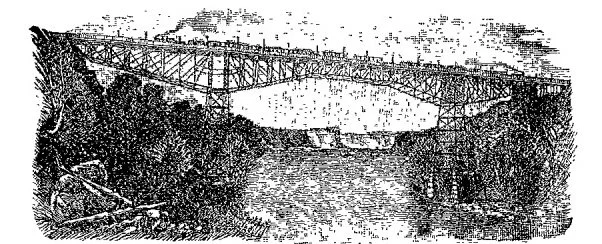
MICHIGAN CENTRAL NEW CANTILEVER BRIDGE, NIAGARA FALLS.
O. W. Ruggles, General Pass. & Ticket Agent, Chicago. Geo. J. Sadler, Ticket Age., Battle Creek.
Chicago & Grand Trunk R. R.
Time Table, in Effect Jan. 19, 1890.
GOING WEST
STATIONS
GOING EAST
Boston
8.30
7.30
7.30
7.30
New York
11.10
7.40
10.10
10.10
Buffalo
9.50
5.40
7.30
8.00
Niagara Falls
8.15
3.17
5.30
7.10
Boston
a m
p m
p m
Montreal
8.00
7.45
7.45
Toronto
8.40
7.57
7.25
Detroit
9.45
7.45
11.50
Going west
Chi. Pass.
B. C. Pass.
Limited Exp.
Pacific Exp.
Pacific Exp.
Mail Exp.
Stations
Mail
Limited Exp.
Atlantic Exp.
Night Exp.
Port Huron Pass.
am 5.55
pm 5.10
12.45
5.55
7.45
7.15
Dep. Port Huron Arr.
pm 10.20
am 1.05
7.35
10.30
10.50
7.20
5.40
1.50
10.20
9.08
9.31
Lapeer
8.40
11.48
6.17
8.51
9.17
8.05
6.20
2.25
10.50
9.45
9.05
Flint
7.55
11.17
5.40
7.45
8.35
8.48
7.15
2.53
11.28
10.30
9.58
Durand
7.15
10.48
5.05
7.15
8.00
10.00
8.25
3.45
12.37
11.35
10.50
Lansing
5.35
9.57
4.00
6.05
6.35
10.70
9.00
4.13
1.09
12.08
11.00
Charlotte
4.57
9.27
3.25
5.26
6.02
1.00
10.00
5.00
2.00
1.00
12.05
Battle Creek
4.05
8.45
2.35
4.55
5.15
1.49
pm
2.50
1.48
12.48
Vicksburg
3.19
8.01
1.48
am
2.00
1.58
1.50
Schoolcraft
2.05
1.35
2.52
6.19
3.43
2.45
1.42
Cassopolis
2.15
7.16
12.45
3.25
3.40
6.50
4.25
3.35
2.25
South Bend
1.25
6.40
12.00
2.50
5.00
4.52
Haskell’s
12.05
5.20
8.10
6.55
5.10
4.00
Valparaiso
11.50
5.20
10.30
1.30
pm
10.10
8.10
7.30
6.25
Chicago
9.05
3.15
8.15
11.25
pm
am
pm
Arr.
Dep.
am
pm
pm
pm
Where no time is given, train does not stop.
Trains run by Central Standard Time.
Valparaiso Accommodation, Battle Creek Passenger, Port Huron Passenger, and Mail trains, daily except Sunday.
Pacific, Limited, Day, and Atlantic Expresses, daily.
Sunday Passenger, Sunday only.
W. E. Davis, Gen. Pass. and Ticket Agt., Chicago. A. S. Parker, Ticket Agt., Battle Creek.
Political Means and the Gospel of Evolution
Prof. J. B. Thomas, D. D., in The Watchman of Jan. 23, 1890, has a forcible article on the course of those who, losing the spirit of the gospel from their hearts, are not willing to let it progress from its own moral power, but desire to carry on the work of conversion by wholesale through human enactments, as Clovis made hordes of his followers to become papists at the point of the sword. In the course of his article, he alludes as follows to the attempt now being made in this country, to advance what men are pleased to call the cause of Christ, through political means:—
Closely akin is the notion that a wise seizure of political and social forces in the name of Christianity, may greatly hasten the establishment of the “kingdom of heaven.” Satan may thus be beaten at his own game, and ousted from his kingdom with his own artillery. It is the environment that primarily needs to be changed rather than the man, according to this teaching. But the teaching itself may readily be recognized, not as that of the New Testament, but of “another gospel which is yet not another,” viz., the gospel of evolution. In vain now as of old do men hope to gather “grapes of thorns, or figs of thistles.”
THE SEVENTH-DAY ADVENTIST YEAR BOOK OF 1890.
By O. A. Olsen
This book has just been placed in my hands. The appearance is very neat and tasty, and it contains most valuable information for every Seventh-day Adventist and every other person interested in the work, history, and progress of this cause. The arrangement is better than that of any previous Year Book we have issued.
First, we have the Workers’ Directory, giving the name and post-office address, and indicating the line of work of each laborer. This alone is of the greatest interest and value, and is itself worth many times the price of the whole book. Then follow the general organizations, etc., giving the officers, ministers, and other laborers, not only of the General Conference, but of every State Conference, every tract society organization and Sabbath-school association, and the International Health and Temperance Association; also the laborers and officers in our various home and foreign missions, including publishing houses and educational and health institutions. This is a department that gives us just such information as we all want. Next we find the proceedings of the General Conference, International Tract and Missionary Society, International Sabbath-school Association, International Health and Temperance Association, Central Seventh-day Adventist Publishing Association, and Pacific Press Publishing Company. This is a large and important department, and bears careful study. In these proceedings are found concise and intelligent reports from every part of the field, which of themselves are of exceeding interest; and every one interested in this work and its progress should not fail to give this part of the book close study, that he may be intelligent in reference to the plans and workings of every branch of the cause in every part of the field.
Next follows a department containing the constitutions and by-laws of the various organizations,—General Conference, State Conferences, International Tract Society and State tract societies, International Sabbath-school Association and State Sabbath-school associations, International Health and Temperance and State health and temperance associations. This is put in convenient form, and is easy of access for study and reference.
Then a postal guide is inserted, giving necessary and important information in regard to postal regulations. These few hints will save you much trouble in looking up many points that you might wish to know on this subject.
Lastly, we have some of the annual addresses presented at the late General Conference,—the “Opening Address,” presenting a brief outline of the work and its needs; the address of the Educational Secretary, which should not only be read, but carefully studied, since the education of laborers bears a very important relation to our work, and should receive most careful attention; last of all, the “History and Future Work of Seventh-day Adventists,” by Eld. U. Smith. This will bear reading and rereading, with careful study. It will not only make one intelligent concerning the rise and progress of the work, but will fill his soul with devout gratitude to God, and awaken an earnest desire for a deeper consecration, and strengthen faith and confidence in the work.
Each department and each part of the book is worth alone many times the price of the entire book. No one can afford to be without it; and when we take into consideration the exceeding small price,—only ten cents, with the addition of postage when sent by mail,—the amount is so trivial as to place it within the reach of every one. It should be in the family of every Seventh-day Adventist. An effort should be made by ministers and elders of churches to see that our brethren everywhere obtain the book. It is not published as a matter of speculation; the price cannot cover the real cost of the book. But our brethren everywhere need it that they may be intelligent in reference to every branch of our work.
The book is now ready. Let the orders come in. You want it just as soon as possible, and we hope that none of our friends will deprive themselves of the intelligence and instruction to be obtained by its study. It is also a fit book to be put into the hands of those who may wish to learn in reference to our work and people. Let the Year Book for 1890 have the widest circulation possible.
O. A. OLSEN, Pres. Gen’l Conf.
Pegg Reviews the Blair Sunday Bill in Denver
IN the Rocky Mountain News (Denver, Col.) of Feb. 9, 1890, Bro. J. D. Pegg gives a full-column article reviewing the Blair Sunday-rest bill now before Congress, showing up its true nature before the readers of that paper, and its inevitable results, if it should succeed. In the same paper appears an editorial calling attention to Eld. Pegg's article, and indorsing his positions. The editor closes his article with these words: “The Blair Sunday bill should be killed, because the good points it embraces would not justify the risk of such a precedent in legislation, even were its defects removed, being confessedly a religious movement, and to serve religious purposes.”
Russian Bible Readings Issued from the Basel Office
Bro. H. P. Holser sends us the following notice of reading-matter just issued from the office in Basel for the Russian people. The most effectual way of introducing the truth into that country is through reading-matter. We hope, therefore, to see this method amply sustained and pushed to every reasonable extent.
By this mail we send you eight Russian Bible-readings, of four pages each, just from the press. They are printed on light and regular tract paper. The light are to be sent in sealed letters, as this is the only means of getting them into Russia. On the heavier paper, four readings are bound together, making sixteen-page tracts. All are numbered, and are as follows: No. 1, “Importance of the Prophecies;” No. 2, “Daniel 2;” No. 3, “Daniel 7;” No. 4, “Daniel 8;” No. 5, “Daniel 9;” No. 6, “Second Advent;” No. 7, “The Sanctuary;” No. 12, “Saints’ Inheritance.” Price, eight pp. one cent. Regular discount to tract societies.