The Youth’s Instructor, Vol. 28, No. 44.

SOME THINGS ABOUT SPIDERS AND THEIR WAYS

The Youth’s Instructor

Oct 27, 1880

S. D. A. Publishing Association · Battle Creek, Mich. · Oct 27, 1880

SOME THINGS ABOUT SPIDERS AND THEIR WAYS.

SPIDERS rank among the most interesting animals in the insect world; but it is not needful that more than a general description be given of a creature so well known. It may be observed, however, that the body is composed of two pieces, and the legs are generally eight in number. Each limb has seven joints, and the foot usually terminates in two claws; but some spiders have only one, while others have three or four. At the base of each jaw is a feeler, or palp, with little claws at its tip. The spider has six or eight eyes, and its skin is rather leathery and horny, sprinkled over with hairs and little spines.
The name in natural history for this insect is arachne, which term also includes scorpions and mites. There are some ten special varieties of spiders, and they are found in all parts of the world, but are largest in warm countries. Being carnivorous in their habits, they devour their prey alive. Spiders are very fond of fighting, the victorious party commonly devouring the other. They are very cleanly in their habits, and spend much time in cleaning themselves from dust with the toothed combs and brushes which nature has attached to their limbs.
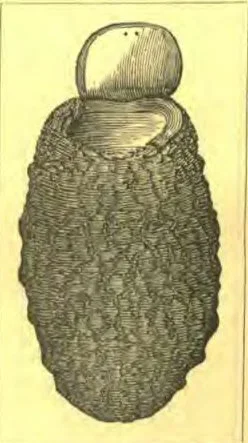
Tarantulas, also, belong to the spider species. This variety makes no web, but wanders about for its prey, which it runs down with great swiftness. Its den is made in crevices and holes which it neatly lines with silk of its own manufacture. See the illustration below.
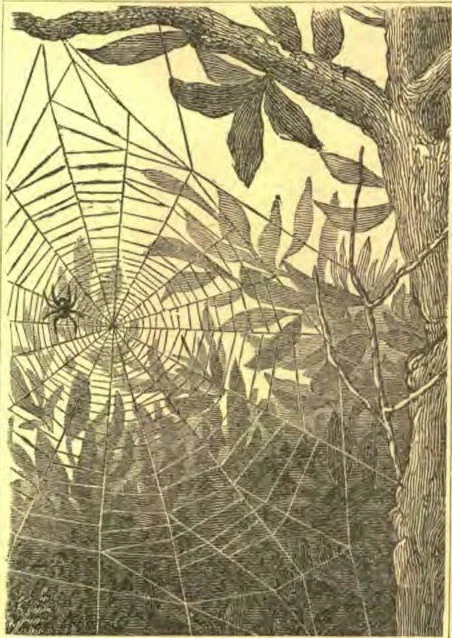
WEB OF THE COMMON GARDEN SPIDER.
Spiders generally hatch but one brood in a year. The eggs are carefully protected in little silken bags, or cocoons. The female spider lays nearly a thousand eggs in a season. The mother is quite affectionate to her young family, and in return for this maternal care her little ones frequently devour her alive. The males and females live separately. The latter are the ones most frequently seen, and are much the larger.
Spiders can endure long fasts, and in this climate they remain torpid during winter. Some of them live several years. Though objects of general aversion from their cruel habits and dismal haunts, yet they display an instinct which amounts almost to reason.
The most remarkable office of spiders is that of weaving their webs by means of a silken thread drawn from fleshy warts on the under side of the abdomen. These spinning glands, called spinnerets, are from four to six in number, and contain thousands of delicate openings, from each of which descends a thread so thin as to be invisible to the naked eye until all are united in one. One set of these warts, or spinnerets, produces threads which are glutinous, while another set furnishes those which are smooth.
THE TARANTULA. (Called also the Wolf Spider.)
In spinning their webs, spiders show much perseverance, and great ingenuity. Recently a spider managed to fasten a silken cable across a river more than a mile in width! They perform such feats in the following manner: When they wish to go from tree to tree, or cross a stream, they let go a thread from their spinnerets in the direction of the wind, and when their delicate sense of touch tells them it has reached an object, they pass over it. In this way they travel long distances without descending to the ground, a multitude of tiny cables being seen on dewy mornings of spring and autumn. Some small gossamer spiders even speed through the air buoyed up by their fragile threads. Mr. Darwin, in the journal of the voyage of “The Beagle,” says that when anchored in the river La Plata, sixty miles from the shore, he has seen the rigging covered with cobwebs, and the air full of pieces of web floating about. The spiders, however, when they struck the ship, were always hanging from single threads.
The beautiful ray-like webs which we commonly see, so like a figure in geometry, as shown in the cut, are made by a variety of spiders called Epeiridæ, from the Greek word peirō, “to affix.” This species includes the common Garden Spider. How nicely they affix their webs to a limb, or the angle of a window!
Savage and unsocial as spiders are, they are capable of a certain amount of domestication. Pelisson, a prisoner in the old French Bastile, had a pet spider which came regularly at the sound of a musical instrument to get its meal of flies; and a spider-raiser in France is said to have tamed eight hundred, which he kept in a single apartment for the silk made from their gossamer threads. Spiders readily learn to take food from the hand or a pair of forceps, or water from a brush, and will come to the mouth of their bottle and reach after it on tip-toe.
The spider’s supply of silk seems to be limited to sufficient to make six or seven webs in a season. The thread is very strong and fine, and one of its uses is for the division of the micrometer in astronomy. According to Louenhoek, the great naturalist, it takes four millions of the extremely delicate threads to make a thread as large as a human hair. And each thread of the spider as used in the web is made up of thousands of smaller ones.
G. W. AMADON.
(To be Continued.)
TARANTULA'S NEST.
TARANTULA'S NEST.

SPIDER'S WORK.

By study, by art, and by rule, The wheel of the workman is made; But the spider he needs no tool, And he never learned his trade. No human model he takes Of iron, of wood, or of steel; No plane, no measures, he makes; Yet how perfect his filmy wheel! His lines, his circles, his curves, So regular, yet so involved!— A method that never swerves, And a knowledge that none have solved.
Long practiced and early taught, Until habit and skill combine, The lace-maker's work is wrought After pattern and fair design; But the spider copies none, As in bush and shrub he traces, All silver white in the sun, His wonderful gossamer laces.
No pillow, no loom needs he For the delicate web he weaves, Spread out on the breezy tree Like a veil on the trembling leaves.
A long effort science requires Ere its cleverest sons are able To perfect electric wires, Or to lay a telegraph cable; But the spider wins his goal With an instinct swift and fine, As from garden pole to pole He stretches his plastic line.
Can the human artist cope With the marvelous little elf That skillfully spins his rope, And then walks along it himself?
Man, working by second causes, Looks only on natural laws: 'Tis well when he sometimes pauses To remember the Great First Cause. The wisdom that man attains, For which mortals must pore and plod, The insect untutored gains; But alike 't is the gift of God.
—London Prize.

Fish That Store Water to Survive Drought

It is said that there are fish which are provided with places in their bodies in which they lay up sufficient water to moisten their gills when the rivers or the ponds, on which they depend, are dried up, as is often the case in tropical regions.

HOW SHALL WE PRAY?

Much has been said and written upon prayer, and it is not with the thought of adding anything to what has already been said that we pen these lines, but to call the attention of our readers to it by way of remembrance.
Young friends, do you pray? Do you pray often? Our Saviour when upon earth spent whole nights in prayer, and shall we pray any less than did he? Then, too, let us not be content to simply say our prayers, to go through a form of words, but let us try to feel our need, and then ask for just the things we want. A little deaf and dumb girl, upon being asked, “What is prayer?” wrote in answer, “It is the wishes of the heart.” Yes, this is true; and unless our petition comes from the heart, it will not be genuine prayer.
Christ says, “If ye ask anything in my name, I will do it.” “If ye abide in me, and my words abide in you, ye shall ask what ye will, and it shall be done unto you.” These are plain, positive, and unlimited promises, save in the condition, “If ye abide in me, and my words abide in you.” This “abide in me” is, however, an important thing in prayer. It signifies that to expect an answer to our petitions, we must have the indwelling of the Holy Spirit in our hearts,—must have a close connection with God. Then, and only then, may we expect an answer to our prayers.
Sometimes our wants and our woes grieve us more than our sins, and we make these first, and thus fail to receive the expected help; for the Lord will not hear us if we regard iniquity in our hearts. We must be willing to confess our sins.
“Mary,” said a mother to her little six-year-old daughter, “you are growing old enough to really pray, instead of just saying your prayers. You ought to ask the Lord for the things you really want, and tell him when you have done wrong, and ask his forgiveness. Then you would be really praying.”
“Yes, mamma,” said Mary, “but then sometimes I don’t want to tell the Lord when I have done wrong.”
Mary’s answer shows very clearly the real nature of these hearts of ours; we are not willing to confess our sins; but there is no true repentance unless there is confession of sin. Peter says in Acts 3:19, “Repent ye, therefore, . . . that your sins may be blotted out, when the times of refreshing shall come from the presence of the Lord.” Repentance, therefore, is necessary for the forgiveness of sins.
Jesus understands all our feelings, he knows all our wants; yet he desires to have us come to him and ask. We should consider it a privilege to pray. Jesus will hear and answer, and he is able to help us out of all the difficulties we get into, and save us from the hands of Satan, who is much stronger than we.
May we, dear readers, be of the happy number who love to pray, and who will finally enter the City of God. V. A. M.

Oriole's Nest Wired With Scraps From Tinsmith's Shop

In Birmingham, New York, last summer, a pair of orioles built their hanging nest in a tree opposite a tinsmith's. The limb to which the nest was suspended recently blew down, and the nest is now preserved as an evidence of the remarkable skill and instinct of these birds, for the nest was found securely wired to the branch with pieces of wire which had been picked out of the sweepings of the shop.

MINE AND THINE.

Children like to have some things that they can call their own. This is right; but never for a moment should they wish to possess, even in name, that which belongs to another. A borrowed article should be carefully used and then returned, while all the time we should bear in mind that another’s property is confided to our care. If this principle is impressed in childhood, it will follow one through life. And oh, how many terrible failures it would prevent! How many would by this means become persons of honor and of trust, who otherwise become defaulters, bankrupts, and often criminals.
While handling the property of your mates, be careful to do so with their full consent, without even a wish to call it yours. It may be only a top, or a ball, or a pair of skates, yet if it is not yours, you should be very careful of it, and not wish to own it, unless you can purchase it by fair and honorable dealing. But do not try to be an adept in trade; i. e., to buy cheap and sell dear, for that is low and dishonorable.
To borrow a book, or an umbrella, or such articles as may be proper to borrow, and return them in due time, is honorable; but if they are not returned, it is swindling. How many libraries are lost by lending! The borrower forgets or neglects to return a book until years have elapsed; then the owner forgets his loss, and the borrower thinks that he has a book of his own; but God has that book catalogued on high. Be careful of mine and thine.
Joseph Clarke.

GOOD MORNING.

Don’t forget to say, “Good morning!” Say it to your parents, your brothers and sisters, your schoolmates, your teachers, and say it cheerfully and with a smile; it will do your friends good. There’s a kind of inspiration in every “good morning,” heartily and smilingly spoken, that helps to make hope fresher, and work lighter. It really seems to make the morning good, and to be a prophecy of a good day to come after it. Such greetings cheer the discouraged, rest the tired one, and somehow make the wheels of life run more smoothly.

PRAYER

When our hearts have grown weary and grieve, Or when we have wandered away, It is sweet in the gathering eve, To creep to His footstool and pray.
Ah! He knows of the burdens we bear, And the desolate ways we must tread; He has gathered each tremulous prayer; He has marked if a spirit has bled.
And He loves us, and pities our pain; To His patient, compassionate breast Never turneth the stricken in vain; “Oh, ye weary ones, come and find rest!”

ATTENTION

A very large proportion of Sabbath-school scholars come to the class with their minds preoccupied with matter foreign to the lesson. But the work of the Sabbath-school teacher is, like that of the pastor, to arrest the attention of his hearers before any impressions can be made.
It has been said that not one in a thousand has sufficient mental discipline to give undivided attention, until it is arrested by a power stronger than that which already absorbs the mind. Attention is hard to get, and it is equally hard to give. The mind is engaged, and will keep so until possessed and overwhelmed with that which is proposed to be imparted.
It is a matter of discipline, a matter of the will, it is true; but it is useless to expect attention until something sufficiently interesting is given to absorb it. It is useless for the teacher to scold on account of inattention. It is his business to secure it. Knowledge is not repulsive to the scholar’s mind. Naturally it seeks and loves knowledge as its physical nature craves food.
It is for the sake of the truth that attention is sought,—not for the sake of the mere words of Scripture; they are but the husks. The ideas contained in the Sabbath-school lesson are what the teacher strives to implant in the attentive mind of the scholar. His own personal attractions and ability, his illustrations, his reasoning and arguments, are only instrumentalities to the great end, which is to make favorable impressions.
It is by the truth, as “the power of God unto salvation,” that this great work is to be accomplished. Its own inherent power, accompanied with the Spirit, must effect results. Whatever natural gifts the teacher may possess, and whatever helps he may call into requisition, let him be assured that the word of God must be the chief means by which the attention of his scholars is to be secured.
There are certain conditions, however, upon which his success will depend. Let us suggest a few things which the teacher must keep in mind:
1. CLEARNESS.—The lesson, if it is to be successfully fixed in the mind of the pupil, must be perfectly transparent to the teacher. He cannot teach that which he does not himself fully understand. Every point, argument, and illustration must be familiar to him. He must have a distinct view of them, and their bearings on each other. The end must be seen from the beginning.
Besides this, he should be acquainted with the minds he is to deal with, that he may know how to apply the truth. The physician knows that the success of his remedies depends upon their application. So the teacher will measure his success, not only by the clearness with which he perceives and presents divine truth, but also by the understanding of the case in hand. A self-possessed teacher, having his thoughts fully at command, and his lesson completely impressed upon his own mind, so that his soul will be affected by it, cannot fail to influence the attention of his class.
2. LIFE.—Animation must characterize the teacher’s person. Vivacity must take the place of anything that would appear like deadness. The eye and the tongue must be electrified. The whole face, in particular, must sparkle with a fascinating power. All the scholars must be seen at once, and such an influence extended over them that they will be attracted to give attention.
Then the words and ideas imparted should not only be sharp and lively, but should be fresh,—not dead abstractions, not mere bones, but living truths, put so that they will live in the mind of the pupil.
3. EARNESTNESS.—A soul all on fire for God cannot but impress others, if its zeal is well directed. The enthusiasm of an impassioned soul, all aglow with truth, is certainly attractive, and must command attention, all things being equal. That holy enthusiasm which the knowledge and love of divine truth imparts, and which the thought of the joys of Heaven, and the precious worth of souls must inspire, is certainly an enviable enjoyment, to say nothing of its power to make impressions for God. The secret of any business is to put soul into it.
4. READINESS.—The teacher’s knowledge must be at command. Hesitation, stopping to think, or waiting to look into his book to find just what he wants to say, is sure to distract attention.
Teaching children successfully admits of no dullness. The greatest readiness of utterance must be cultivated by the teacher, and if he lacks here, his first business is to train himself up to the point of real efficiency in this particular. It will require hard work; but a resolute spirit may overcome the difficulty.—E. D. JONES, A. M., in Aids to Sunday-school Workers.

LESSONS FOR CHILDREN.

LESSON XCVI.—REVIEW OF LESSONS XCIII.—XCV.

  1. WHAT was Daniel’s native country?
  2. How did he come to be in Babylon?
  3. At what different times were others of Daniel’s countrymen brought to Babylon?
  4. What king was reigning in Babylon when the Jews were taken to that country?
  5. What did he finally do to the city of Jerusalem?
  6. How did Darius come to be reigning over Babylon?
  7. How did he arrange the affairs of his government?
  8. What made the presidents and princes angry with Daniel?
  9. How did they try to destroy him?
  10. What did they finally bring about?
  11. How did the king show himself friendly to Daniel?
  12. How did he show his confidence in Daniel’s God?
  13. Who first appeared at the den the next morning after Daniel was cast in among the lions?
  14. How was Daniel preserved in the lions’ den?
  15. How was he delivered from it?
  16. What became of the men who had tried to destroy Daniel?
  17. How would this bring a knowledge of the true God to every nation in the king’s vast empire?
  18. What decree did Darius issue?
  19. Describe Daniel’s first vision.
  20. What did each of these beasts represent?
  21. What was presented to Daniel after he had seen the beasts?
  22. How does he describe this Judgment scene?
  23. Who was seen to come before the Ancient of Days, after the Judgment was finished?
  24. What was given him?
  25. Describe Daniel’s second vision.
  26. How are the great kingdoms represented in this vision?
  27. In what chapter of the Bible is this vision recorded?
  28. How was Alexander the Great represented in this vision?
  29. How was the division of the Grecian kingdom shown?
  30. What part of this vision did Daniel fail to understand?
  31. Why could he not understand it?
  32. Did Gabriel ever explain it to him?
  33. How long after?
  34. In what chapter is this explanation found?
  35. What was Daniel doing when the angel appeared to him?
  36. For what was he praying?
  37. How did he know that the time had nearly come for his people to be delivered?
  38. What made him fear that they would not be delivered at that time?
  39. What did Gabriel say to him before beginning to explain the vision?
  40. While explaining the vision, what did he tell Daniel about the Saviour?
  41. Who gave the Jews permission to return to Jerusalem?
  42. How many of them returned to their country at this time?
  43. How were they hindered in rebuilding the temple?
  44. Who carried this matter to the Lord in prayer?
  45. Did Daniel ever return to Jerusalem?

Bible Words of Comfort in Sorrow

EVERYBODY needs words of comfort at one time or another. The youngest child is old enough to cry. The oldest person finds it hard to keep the tears back always. There are no words like Bible words. If you want to help any one in sorrow, you can best do so by finding words in the Bible that suit his case.

LESSONS ON NEW-TESTAMENT HISTORY.

It has been the general desire of a large part of our Sabbath-school membership that we might have a series of lessons on New-Testament history; but it was thought that such lessons would be much better understood, and would be more profitable, after the Old-Testament history had been studied by the youth, and the series of Lessons on Prophecy had been completed by the Bible classes. For this reason the New-Testament lessons have been delayed till the present time.
With Lesson Sheet for October, the Lessons on Prophecy are brought to a close, and the fourth division is ready to enter upon the study of the new series. Many of the members of this division are familiar with Old-Testament history and the prophecies, and are now prepared for the study of the life and teachings of Christ and his apostles.
The youth's, or third division, has lately completed the study of the Old-Testament history, and that of the intervening period down to the time of Christ, and has already begun the study of the new series.
Thus two large divisions, including more than one-half of our Sabbath-school workers, are now prepared to unite upon the study of the New-Testament lessons, which, beginning with November, will be published in the INSTRUCTOR Supplement.
With these facts before us, we recommend that the third and fourth divisions in all our schools unite in one division, and study the New-Testament lessons.
Among the advantages of this plan are the following:—
  1. Both youth and adults will be furnished with the most interesting and profitable lessons that could possibly be found.
  2. Uniting the two in one large division will add to the interest of review exercises.
  3. Having one less division to look after, the superintendent can give more attention to each.
  4. Uniting more teachers on one lesson will increase the interest of the teachers' meeting.
As these lessons which have been so often called for are now furnished, and our schools are under such favorable conditions to adopt them, we hope to see the interest of all who have been looking for them increased in the Sabbath-school work.
W. C. WHITE, Pres. S. D. A. Gen. S. S. A.
NOTE—The children in the second division will keep right on with their lessons in the INSTRUCTOR, and the children studying Bible Lessons Nos. 1 and 2 will continue as before, the only change recommended being the union of the 3d and 4th divisions.
Those of the 3d division who are up to date, will, in taking up the new series, have to go over a few of the same lessons that they have studied before, but the strength gained by a union of the divisions will more than compensate for this apparent loss. COMMITTEE.

A CRY FROM AFRICA.

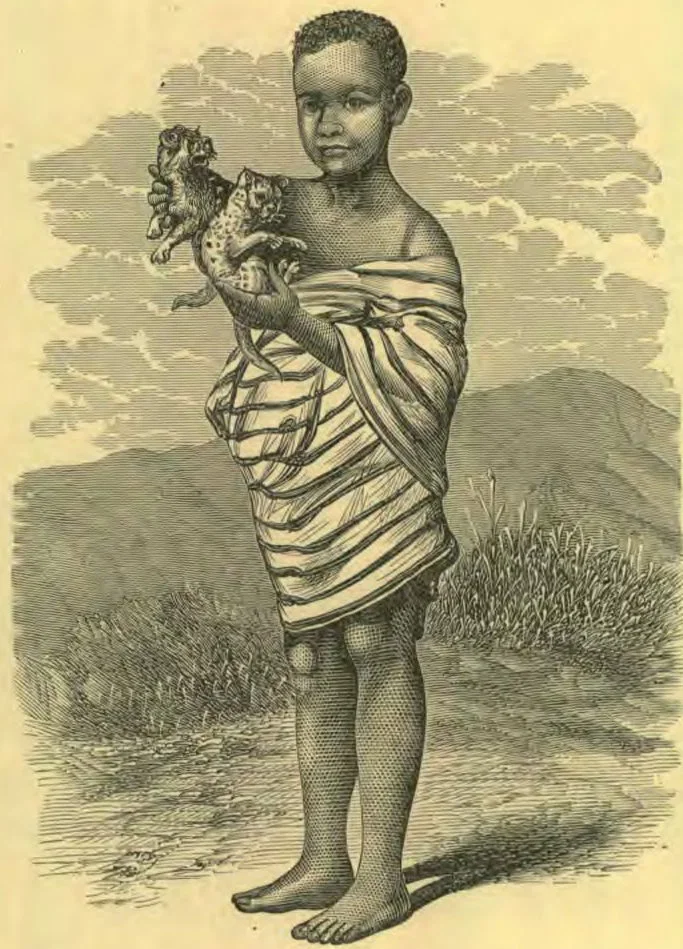
LEOPARDS IN PAY FOR LEARNING.

There is a gentleman in Philadelphia, Mr. Edward S. Morris, who is greatly interested in the children of Africa, and is doing all he can to provide schools for them. Any assistance will be thankfully received.
He has kindly furnished the picture in this paper, representing an African boy with two baby leopards in his arms, with which he tried to buy his passage to America. He tells the touching story of this boy’s desire for knowledge as follows:—
“It was at sunset one beautiful Sabbath day, as I stood for the last time on the beach at Monrovia, waiting for my boat to take me out to the anchored vessel at sea. A little native boy came to me, bowing low, but with his eyes firmly fixed upon me. I told him to stand up and never bow to man. Understanding my actions more than the words, he stood up. I then said, ‘What do you want?’ In broken, disjointed English—the best the little fellow could utter—and pointing out to the ship, he said, ‘You God-man take me big America, big ship.’ ‘What for?’ I asked. He answered, ‘Me learn big English you.’
“In consequence of my then enervated condition from over-work, I was forced to say ‘No’ to the little fellow. I did not say it harshly, but in mild and gentle accents; whereupon he immediately drew forth from the fold of a cloth around him, two little leopards, alive, with unopened eyes, and presenting them said, ‘Me give him; you take me big America, big ship, learn big English.’ Think of it, readers; the mother leopard must to his knowledge have been near when he captured her kittens; still, that hungry, thirsting child, risked his life to earn a passage to America, solely to gain an education.
“This little boy could have obtained as his passage money—without any such risk of life—a parrot or a beautiful gazelle, the tusk of an elephant, or large ear-rings of pure African gold; but no, he wanted to convince me at the beginning, not only of his bravery, but of his burning desire for education,—for ‘big English,’ as he called it. I have no words to tell you of my feelings so suddenly and unexpectedly brought into action. I only know that there and then I resolved myself into a life-long committee of one, with power to act, promising to leave nothing undone to practically answer the cry of that little boy.”
And there are hundreds of thousands more in that country burning for an education; and they should be taught not only “big English,” but about God and the way to Heaven. V. A. M.

LETTER BUDGET.

Z. U. Trotman, of Battle Creek, Michigan, writes: “I have taken the INSTRUCTOR for six years and like it very much. My father, mother, and I keep the Sabbath. I want to be a good boy and keep all God’s commandments so that when Jesus comes I may have a home with him in his kingdom.”
Howard W. Hubbell, of Otto, New York, says that he has never written for the INSTRUCTOR before. He is ten years old. He does not go to Sabbath-school, but recites his lessons to his mother or father. He wants to meet all the INSTRUCTOR family in Heaven.
Nelia Comer, of Cosmos, Minnesota, writes us of her brothers and sisters, how they are all trying to be Christians. Their family are all the Sabbath-keepers in Cosmos except one brother, a Norwegian. She desires the prayers of the INSTRUCTOR family.

PRESIDENTIAL ELECTORS.

The Tuesday next after the first Monday in November, every fourth year, is a day of great interest to the American people. In the evening of that day, eager throngs gather about the newspaper bulletins and the telegraph offices all over this country to catch the latest news of the presidential election.
But the ballots, which the people will cast on the second day of November next, will have printed on them, not the names of the men whom the voters desire to see President and Vice-President, but the names of certain other men, called presidential electors. And these presidential electors meet in their respective States on the first Wednesday in December following the election, and vote by ballot for President and Vice-President.
It is something of a study to find out the number of presidential electors, as the number is different in the different States. The number of electors in a State is equal to the whole number of senators and representatives to which the State may be entitled in Congress. As you know, every State is entitled to two United States senators, it making no difference whether the State is as small as Rhode Island or as large as Texas. As there are now thirty-eight States, there are seventy-six senators, and so, of course, seventy-six electors. To these seventy-six electors we must add as many as there are representatives in Congress from all the States.
Every State is entitled to at least one representative. When its population exceeds 131,425, the State is entitled to one representative for every 131,425 of its population. This is plain, when one thoroughly understands it. For instance, the population of Illinois in 1870 was 2,539,891. Divide this sum by 131,425 and we have nineteen and a remainder. The remainder is always thrown aside, as it would be rather difficult to send a fraction of a man to Congress, wouldn't it? So Illinois sends nineteen representatives. Going through one State after another in this way, we shall find the number of representatives each sends to Washington. But when we come to the population of Nevada, we find it put down in the census of 1870 at only 42,491. Certainly 131,425 will not go into 42,491. According to the rule which we have been following, Nevada is not entitled to any representative at all. But there is an exception to this rule, which says that no matter how small its population, every State shall be entitled to at least one representative.
Now, as the evenings are growing longer, it would be real nice if you could take your slates, and with a table of the population in 1880 of the different States before you, find out just how many representatives each State is entitled to.—Sel.

Saving the Pieces of the Day

DR. FRANKLIN says that “every little fragment of the day should be saved. The moment the day breaks, set yourself at once to save the pieces.”

You have reached the end of this edition.

The Youth’s Instructor · Oct 27, 1880