Your ShelfYour Projects

Review and Herald, Vol. 67, No. 3.

THE NEED OF COMPLETE CONSECRATION
Earlier text: THE GOLD COAST COLONY

News of the Week.

FOR WEEK ENDING JANUARY 18.

DOMESTIC.

—Five boys went swimming in the East River at Brooklyn, N. Y., Tuesday.
—Nancy Vaughn, said to have been 120 years old, died at Eagan, Ill., on Tuesday.
—Columbia, S. C., was disturbed by an earthquake at 6:40 o’clock Wednesday evening.
—The Utah Legislature convened Monday, and Mormons captured all the officials’ and employees’ positions.
—A crate of strawberries recently grown in the open air at Charleston, S. C., were shipped Tuesday to New York.
—By the explosion of the boiler of a steam shovel at New Brighton, Pa., Wednesday, one man was killed and nearly a score were injured.
—The legislature of Wyoming, which went into session Tuesday at Cheyenne, opened in the new capitol building, which was finished a few days ago at a cost of $300,000.
—Three hundred people of Carmi, Ill., have been compelled to leave their homes by a sudden rise in the Little Wabash River. From seventy-five to 100 houses were submerged.
—After forming a lake covering forty acres, the great artesian well at Woonsocket, S. D., has been brought under subjection. Experts say that it is the most powerful artesian well in the world.
—The annual report of the corresponding secretary of the National W. C. T. U., Mrs. C. B. Buell, shows a total membership for 1889 of 142,348, a gain of 3,821 over the total paid membership of 1888.
—At Maysville, S. D., Tuesday, a band of women armed with hatchets and other weapons, wrecked several illicit drinking places, known as “blind pigs,” and totally destroyed the fixtures and furniture.
—The school-house at Tunbridge, Vt., was wrecked Saturday by a heavy log sliding down hill and crashing through the structure. One little girl was seriously injured, and several of the pupils had narrow escapes.
—The first bill passed by the legislature of South Dakota—to provide for refunding the indebtedness of the State—was signed by the governor Wednesday afternoon, both houses adjourning for five minutes to celebrate the event.
—Monday evening at Baltimore Northern Central Railway Elevator No. 3 and the British steamer “Sacro-basco” were destroyed by fire. Three sailors are supposed to have been cremated, and four or five others were severely burned. The financial loss is about $700,000.
—Six men who committed murders in the Indian Territory were hanged Thursday at Fort Smith, Ark.
—The Straits of Mackinaw were closed by ice Friday morning—about ten days later than the closing of 1889.
—Nearly 20,000 coal miners are reported idle in the anthracite basin of Pennsylvania, owing to the mild weather.
—Four men were killed and several badly hurt by the premature explosion of a blast at a camp near Johnson City, Tenn., Thursday.
—Miss Carrie Burnham Kilgore, of Philadelphia, has been admitted to practice before the United States Supreme Court. This is the fourth of her sex.
—It is reported that thousands of negroes are migrating from South Carolina to Oklahoma, and that by spring there will be 50,000 colored people in that district.
—Twenty-nine people in the German settlement of Waltham, Mich., are suffering from trichinosis, the result of eating pork at a Christmas dinner. One has died.
—Near Hampton, Utah, Wednesday forenoon, three cars of a Union Pacific train left the track and rolled down an embankment. A dozen persons were more or less hurt, and the rolling stock was wrecked.
—At College Hill Junction, near Cincinnati, Friday evening, the Chicago vestibulated train ran into the rear coach of the Glendale accommodation, killing five persons, injuring others, and demolishing several coaches.
—Coughlin, O’Sullivan, and Burke, the three murderers of Dr. Cronin, have been at last immured in their life quarters in the Illinois State penitentiary at Joliet, their motion for a new trial having been overruled. Kunze, who was sentenced for three years, will be given a new hearing.
—The prize of $1,000 for the largest yield of shelled corn grown in 1889 on one acre, has been awarded to Z. J. Drake, of Marlboro County, South Carolina, whose crop was within a fraction of 255 bushels, green weight, shrunk to 239 bushels, kiln-dried, and diminished to 217 bushels when chemically dried.
—The City of Clinton, Ky., was visited by a tornado Sunday night, which demolished fifty-five houses, killing eleven persons and injuring fifty-three others. St. Louis, Mo., also suffered from a like visitation Sunday afternoon, which unroofed and blew down buildings, killing four persons and injuring as many more. One hundred and fifty buildings were more or less damaged. Damage from the high winds was also reported at Brooklyn, N. Y., Memphis, Tenn., and other places.
—On the supposition, doubtless, that they had everything in their own hands, the great coal barons of the country have for years been keeping up the price of that necessity, regardless of the visible supply, the cost of production, the claims of justice and humanity, or of anything else except the promptings of their insatiable avarice. But they could not look into the future, and did not take into their calculations the effect of two consecutive open winters, and it now transpires that the weather has done what all the combinations of workingmen in the country could not do; it has completely floored them, leaving them to dispose of their hoarded anthracite at $5.75 a ton—less than the midsummer price.

FOREIGN.

—Emin Pasha has had a relapse, and is now in a critical condition.
—A great flight of locusts, thought to have covered 2,000 square miles, is reported to have passed across the Red Sea from Africa to Arabia.
—Five persons are thought to have perished in last Thursday’s storm near Rosebud, N. W. T. They started in a sleigh to drive to Gleichen, and have not since been heard of.
—Advices from Cairo announce the arrival of Henry M. Stanley and party, where they were received by the khedive. The explorer says that the terms upon which the Soudan was abandoned amount to a political crime.
—The trouble between England and Portugal continues, Lord Salisbury’s harshness, it is said, having been the principal obstacle in the way of an adjustment. Portugal has the sympathy of France and Spain, and has appealed to Bismarck. A British fleet is said to have entered the Tagus.
—Advices from Brazil report a disquieting state of affairs. It is said that the brother of the present Minister of Agriculture, four ex-ministers, three senators, and several deputies have been arrested as implicated in the attempted revolution of Dec. 18. The provisional government has ordered that the use of the calendar with saints’ names for each day be discontinued, and that Comte’s Positivist calendar be substituted therefor. This calendar substitutes the name of some eminent man for a saint’s name for each day, divides the year into thirteen months, and dedicates the months to Moses, Homer, Shakespeare, Dante, etc., substituting these for the names now in use.

RELIGIOUS.

—A general conference of Chinese missionaries is to be held at Shanghai, beginning May 7 and continuing ten days.
—In twenty years the number of Baptist church members in Sweden has increased from 7,900 to 32,308. The baptisms in 1888 were 2,390.
—The Secretary of State on Monday issued a license of incorporation to the German Synod of the New Church, at Chicago, their purpose being to perpetuate religious customs.
—The first Universalist church in America, erected in 1780, was burned Wednesday. It was located on the old Pierce farm at Gloucester, Mass., and had for years been used as a barn.
—The Rt. Rev. M. Marty, bishop of the new diocese of Sioux Falls, S. D., has translated the Catholic creed and prayer-book into the Indian language for distribution among the members of the Catholic Church on the Sioux Reservation.
—A Hindu gentleman has called a congress of Brahman priests and learned men for the purpose of incorporating the Bible among the sacred books of India, and officially recognizing Christ as the last and spiritual Avatar, or incarnation of Brahma, the supreme deity.
—The pope has issued a new encyclical which sets forth the principles which shall guide Catholics in their relations toward the state, which, the encyclical says, they must obey when such a course does not entail disobedience to the divine laws. In countries where the state opposes Catholicism, Catholics must combat the enemy, but must not tie the church to any political party.

LETTER TO THE HEBREWS.

LESSON 18.—HEBREWS 8:6-13.

(Sabbath, Feb. 1.)
1. In what does the difference between the old covenant and the new consist? Heb. 8:6.
2. What were the promises of the old covenant?
3. What are those of the new?
4. Was there any promise of pardon in the old covenant? (See Ex. 19:3-8; 24:3-8.) These scriptures contain the complete record of the making of the old covenant, but they contain no hint of pardon, or of any help through Christ.
5. Then how did people under the old covenant find salvation? Heb. 9:14, 15.
6. Was there actual forgiveness for the people at the very time they sinned? or was forgiveness deferred until the death of Christ? Ps. 32:5; 78:38. Enoch and Elijah were taken to heaven, which shows that they had received the same fullness of blessing that those will receive who live until the Lord comes.
7. Since there was present and complete salvation for men who lived under the old covenant, and forgiveness of the transgressions that were under the first covenant came only through the second, what must we conclude? Ans.—That the second covenant really existed at the same time as, and even before, the first covenant.
8. Tell again what is included in the blessings of the second covenant?
9. What will be received by those whose transgressions are forgiven through the new covenant? Heb. 9:15, last clause.
10. Whose children are all they who are heirs of the eternal inheritance? Gal. 3:29.
11. Of how many is Abraham the father? Rom. 4:11, 12.
12. Did Abraham have righteousness? Gen. 26:5.
13. How did he obtain this righteousness? Rom. 4:3; Gal. 3:6.
14. Through whom did Abraham receive this righteousness? Gal. 3:14, first part.
15. Then could the covenant with Abraham have lacked anything? Ans.—No; having Christ, it had all that can be desired—“all things that pertain to life and godliness.”
16. Since all the blessings which people receive through the new covenant, they receive as children of Abraham, can there be any difference between the second covenant and the covenant with Abraham?
17. How long before the old covenant was the covenant with Abraham made? Gal. 3:17.
18. Then why was that “first” covenant made? (See notes.)

NOTES.

The question has often been asked, How could any be saved under the old covenant, if there was no pardon in that covenant? That there was no pardon in that covenant is readily seen: 1. There is no hint of pardon in the covenant itself, as recorded in Ex. 19:5-8, or in the reiteration and ratification of it in chap. 24:3-8. 2. In the sanctuary service there was no blood offered that could take away sin. Heb. 10:4. There was, therefore, no chance for pardon in that covenant. But to say they were under that covenant settles nothing as to what was in the covenant. All were under that covenant who lived while it endured. But that was not all. They were “beloved for the fathers’ sake.” As children of Abraham, they were also under the Abrahamic covenant, of which their circumcision was the token. John 7:22; Gen. 17:9-14. This was a covenant of faith already confirmed by the word and oath of the Lord, in Christ, the Seed, and it was not disannulled by any future arrangement. Gal. 3:15-17. All who were of faith were blessed with faithful Abraham. Verses 6-9. Overlooking this plain fact, which indeed lies at the very foundation of gospel faith in the new covenant, which is but the development of the Abrahamic, some have ascribed salvation to the covenant at Horeb. But, according to both Scripture and reason, if salvation had been possible in that covenant, there was no need of the second. Heb. 7:11; 10:1, etc.
Though much dissatisfaction is expressed by commentators with the received rendering of Heb. 9:1, their suggestions do not make it very greatly different. The first covenant is said to have had ordinances of divine service and a sanctuary of this world. But these were superadditions, not at all necessary to the covenant, but quite necessary as types of the sacrifice and priesthood of the new covenant. They all recognized the existence of sin; but no sin was taken away by them. Heb. 10:3, 4. As a sanctuary of this world, and offerings that could not take away sin, were connected to that covenant, these things themselves were but recognitions of the fact that there was no pardon in that covenant. By those things the people expressed faith in the mediation of the new covenant. If any pardon had been contained in that covenant, we must conclude that some means would have been devised to make that fact manifest. But there was not.
The word “sanctuary” means a holy place, or the dwelling-place of God. Indeed, the same word is often used in the Hebrew for sanctuary and holiness. All can see that it is derived from a verb which signifies to sanctify or make holy. The sanctuary being a holy dwelling, and being divided into two rooms, each of course was a holy place. And each is called the holy. (See Lev. 16:2.) Here the word “holy” is used, and we learn only by the description—within the vail before the mercy-seat, which is upon the ark—that the inner holy is meant. Inasmuch as in the second was placed the ark, containing the tables of stone on which were the commandments,—the most sacred things committed to them,—it was called the most holy, or, properly according to the Hebrew, the holy of the holies.
What was in the ark? Few subjects have occasioned more perplexity than this description of what was in the ark. The apostle specifies as being in the holy place, only the candlestick and the table upon which was the bread; whereas it is certain that the golden altar of incense was also therein. Moses had direction to put the two tables of testimony in the ark. Ex. 25:16, 21. This order he obeyed. Ex. 40:20; Deut. 10:5. But we do not read of his putting anything else in the ark, or of his being ordered to do so. In 1 Kings 8:9 it is distinctly said that “there was nothing in the ark save the two tables of stone, which Moses put there at Horeb, when the Lord made a covenant with the children of Israel.” This was spoken of the time when the vessels of the sanctuary were brought into their appropriate places in the temple built by Solomon. Dr. Clarke says:—
As Calmet remarks, in the temple which was afterward built, there were many things added which were not in the tabernacle, and several things left out. The ark of the covenant and the two tables of the law were never found after the return from the Babylonish captivity. We have no proof that, even in the time of Solomon, the golden pot of manna, or the rod of Aaron, was either in or near the ark. . . . We need not trouble ourselves to reconcile the various scriptures which mention these subjects, some of which refer to the tabernacle, others to Solomon’s temple, and others to the temple built by Zorobabel, which places were very different from each other.
That changes took place is evident. If Paul wrote of the tabernacle in the days of Moses, then the rod of Aaron and the pot of manna had been removed from the ark before the time of Solomon, which some suggest might have occurred while the ark was in the hands of the Philistines. Or, otherwise, Paul was speaking of things as they existed some time after Solomon, of which we have no account in the Scriptures. Which is the case, is not at all material.
None should allow themselves to be confused by the terms first covenant and second covenant. While the covenant made at Sinai was called “the first covenant,” it is by no means the first covenant that God ever made with man. Long before that he made a covenant with Abraham, and he also made a covenant with Noah, and with Adam. Neither must it be supposed that the first or old covenant existed for a period of time as the only covenant with the people before the promise of the second or new covenant could be shared. If that had been the case, then during that time there would have been no pardon for the people. What is called the “second covenant” virtually existed before the covenant was made at Sinai; for the covenant with Abraham was confirmed in Christ (Gal. 3:17); and it is only through Christ that there is any value to what is known as the second covenant. There is no blessing that can be gained by virtue of the second covenant that was not promised to Abraham. And we, with whom the second covenant is made, can share the inheritance which it promises only by being children of Abraham. To be Christ’s is the same as to be children of Abraham (Gal. 3:29); all who are of faith are the children of Abraham, and share in his blessing (verses 7-9); and since no one can have anything except as children of Abraham, it follows that there is nothing in what is called the second covenant that was not in the covenant made with Abraham. The second covenant existed in every feature long before the first, even from the days of Adam. It is called “second” because both its ratification by blood and its more minute statement were after that of the covenant made at Sinai. More than this, it was the second covenant made with the Jewish people. The one from Sinai was the first made with that nation.
When it is demonstrated that the first covenant—the Sinaitic covenant—contained no provisions for pardon of sins, some will at once say, “But they did have pardon under that covenant.” The trouble arises from a confusion of terms. It is not denied that under the old covenant; i. e., during the time when it was specially in force, there was pardon of sins, but that pardon was not offered in the old covenant, and could not be secured by virtue of it. The pardon was secured by virtue of something else, as shown by Heb. 9:15. Not only was there the opportunity of finding free pardon of sins, and grace to help in time of need, during the time of the old covenant, but the same opportunity existed before that covenant was made, by virtue of God’s covenant with Abraham, which differs in no respect from that made with Adam and Eve, except that we have the particulars given more in detail. We see, then, that there was no necessity for provisions to be made in the Sinaitic covenant for forgiveness of sins. The plan of salvation was developed long before the gospel was preached to Abraham (Gal. 3:8), and was amply sufficient to save to the uttermost all who would accept it. The covenant at Sinai was made for the purpose of making the people see the necessity of accepting the gospel.

Sacred Chronology.

A new and revised edition of a little work published by S. Bliss about forty years ago, giving the chronology from creation till the death of the apostle John. Also, “The Peopling of the Earth; or Historical Notes on the Tenth Chapter of Genesis.” By Alonzo T. Jones. A valuable reference book. 298 pages, cloth, $1.00.
Address, REVIEW & HERALD,
Battle Creek, Mich.; 26 and 28 College Place, Chicago, Ill.; or Toronto, Ontario.

Parable of the Ten Virgins.

A NEW TRACT, BY URIAH SMITH,
Designed to give a better understanding of this parable, showing its past and present application, and defining the “shut door.” 24 pp. Price, 3 cents.
Address, REVIEW & HERALD,
Battle Creek, Mich.; 26 and 28 College Place, Chicago, Ill.; or Toronto, Ontario.

History of the Doctrine of the Soul

Among all races and peoples, ancient and modern, including theologians, philosophers, scientists, and untutored aborigines, carefully brought down to the present time. 186 pages, 75 cents.
Address, REVIEW & HERALD,
Battle Creek, Mich.; 26 and 28 College Place, Chicago, Ill.; or Toronto, Ontario.

BUSINESS NOTICES

Appointments.

“And he said unto them, Go ye into all the world, and preach the gospel to every creature.”—Mark 16:15.
THE district meeting for Dist. No. 2, Ohio, will be held at Belleville, Jan. 31 to Feb. 3, inclusive. The presidents of the Conference and Tract Society will both be present. Matters of importance in the T. and M. and Religious Liberty work will be considered. Let every church in the district be represented.
H. M. MITCHELL, Director.
SCHUYLER, Neb., — Feb. 1 Grand Island, " — " 7–9 Silver Creek, " — " 14–16 Cedar Rapids, " — " 21–23 Raeville, " — " 28–March 1
We hope there will be an attendance of our scattered brethren and sisters.
THOS. H. GIBBS. W. N. HYATT.

BUSINESS NOTICES.

[Under this head, short business notices will be inserted at one dollar for each notice of four lines or less. Over four lines, twenty-five cents a line. Persons unknown to the managers of the Review must give good references as to their standing and responsibility. Ten words constitute a line.]
WANTED.—Good homes in S. D. A. families for five small children. Address Mrs. Gertrude Fisher, Westerlo, Albany Co., N. Y.

LABOR BUREAU.

A MAN and his wife desire employment among Sabbath-keepers. Address J. W. Fleming, Saranac, Mich.
Two girls wish employment among Sabbath-keepers. Address Mrs. H. C. Pine, Templeton, Ind.

ADDRESS.

THE address of Eld. R. F. Cottrell until April 1 will be Sanitarium, Battle Creek, Mich.

Obituary Notices.

“Blessed are the dead which die in the Lord from henceforth.”—Rev. 14:13.

HOPE.

BY MAUD SAFFORD.
(Wellsville, Wis.)
When life's storms be overpast, We shall see the Righteous Sun, Gilding every cloud at last, Woe all gone and bliss begun!
Weep not, you whose eyes run o'er With tears wrung from hearts that ache; Think of when you'll weep no more! Christ will bid your dead awake!
Night is here in all its power? Be not hopeless or forlorn; Surely there will come an hour When will dawn an endless morn!
They shall hear, within the graves, His low voice, so thrilling, sweet; They that slumber 'neath the waves, Shall come forth their Lord to meet.
O, weep not! the time will come When we'll see our holy God. Where thy victory, O tomb, When Christ opes for us the sod?
Holy One who died for us, Sinners of a mortal breath,— Next we'll see thee, glorious, Blessed Vanquisher of death!
LINNELL.—Bro. Samuel Linnell died of congestion of the lungs, in Kilbourn City, Wis., Nov. 15, 1889, aged 83 years and 5 months. He embraced present truth about eighteen years ago, under the labors of Eld. R. F. Andrews, at Dell Prairie, Wis., and he tried to live a Christian until death. The funeral services were conducted by Eld. L. H. Brown (Free Baptist). Text, John 11:12, last clause. We trust he sleeps in Jesus. MRS. C. S. LINNELL.
MAYFIELD.—Sister Katharine Mayfield died Nov. 15, 1889, after a short, but painful illness, in Gardner, Kan. She had formerly belonged to the Christian Church, but embraced the third angel's message under the labors of Eld. R. S. Donnell while at Excelsior Springs, Mo., one year ago last August. She was an efficient worker in the tract and missionary work until her death. We mourn her loss, but hope to meet her in the earth made new. MARY LITZENBERG.
CORNELL.—Died near Perrysburg, Ind., Dec. 29, 1889, Estrella, daughter of Mr. and Mrs. Frank Cornell, aged 2 years, 1 month, and 29 days. She had always been in poor health. She was very near and dear to the family, but the Lord saw fit to take her from them; and we know that he doeth all things well. “Asleep in Jesus” was sung, after which a short discourse was delivered by Eld. V. Thompson, showing from God's word the hope that the little one would come forth and live again at the resurrection of the just. J. H. CHARLES.
WATSON.—Died at Grenola, Kan., June 27, 1889, in the fifty-fifth year of her age, sister Matilda Watson; also, on Sept. 28, 1889, her son, Edward Watson, in the twenty-sixth year of his age. Fifteen years ago, when the truth was introduced in this place, sister Watson was one of the first to accept the message. She united with the church at its organization, and has lived a devoted Christian life. It was her delight to talk about the truths of the third angel's message. For several years she was a great sufferer. The circumstances were such that the funeral services of both mother and son were not held until Dec. 15. A large congregation of friends and neighbors were in attendance. There are still three sons and one daughter living, who may have the privilege of meeting their loved ones in the first resurrection. OSCAR AND RUTH HILL.
BABCOCK.—Enos Babcock died at Gold Hill, Ore., of cancer of the stomach. Bro. Babcock began the observance of God's Sabbath last summer, and from that time until his death he loved present truth with all his heart. Finding that the health of himself and wife was failing, he went from Webster, Dak., to Oregon, thinking that a change of climate would improve their health. On returning for his family, he found his wife quite low, and Oct. 17 they laid her away to rest. He then returned to Oregon, only to reach his new home in time to die. Dec. 27, just two months and ten days after the death of sister B., he peacefully fell asleep, with a bright hope of immortality at the second advent of the dear Saviour. Thus bereft of both father and mother, their dear children must wait for the Life-giver. May God help them to be faithful. C. M. CHAFFEE.
NOURSE.—Died at Rome, N. Y., Dec. 30, 1889, of typhoid fever, Flora H., daughter of Lucien and Ellen Nourse, in the twentieth year of her age. Her parents embraced the present truth about sixteen years ago at Chittenango Falls, N. Y.; hence Flora's first impressions were in the way of the truth. Five years ago the family moved to Rome, at which time sister Flora was baptized and joined the Rome church. She had a very pleasant disposition, was a faithful daughter, and was loved by all who knew her. About two months ago her mother was taken with the same disease, and during the weeks that followed, Flora ministered faithfully at her bedside; but when the crisis passed and the mother began to rally, the daughter was stricken down no more to rise till the Healer of all diseases shall appear. She suffered much for four weeks, but no murmur escaped her lips. The day before she died she looked up to her nurse and asked if she would die. The nurse said that they would do all that they could to save her, but said, “Are you afraid to die?” She raised her eyes toward heaven, and slowly shook her head as she replied, “O no, no!” It was with deep sorrow that we laid this beautiful young sister away, yet the sorrow is mingled with rays of resurrection hope. Funeral from the house Jan. 1, 1890. Remarks by the writer, from 1 Pet. 1: 24, 25. A. K. PLACE.
PETTIS.—Our dear mother, Sarah A. Pettis, died at the home of her son, Henry Pettis, in the township of Kasota, Minn., Oct. 13, 1889. She was born in Litchfield, Conn., May 16, 1811, and moved to Ohio, with her parents, in her youth. She was married there to Charles Pettis, in 1833. From Ohio they went to Illinois in 1834. In May, 1854, she, with her husband and family, settled in Minnesota. Her husband sickened and died of typhoid fever in 1856, leaving her with four small children to care for. She toiled bravely on, and although they were days of hardship, in speaking of them she would always say the Lord helped her. She was a member of the United Brethren Church until she heard the Sabbath truth, when she joined the S. D. Adventist Church, of which she was a faithful member until her death. She rests in hope of immortality beyond the grave. May her children follow her example, and be ready to meet her in the glad morning of the resurrection. SARAH H. PETTIS.
BROWNELL.—Died in Battle Creek, Mich., Nov. 5, 1889, of consumption, Adelia C., wife of Willard H. Brownell, and daughter of Mrs. Amanda Vasbinder, aged thirty-seven years. At the age of eighteen, she became a member of the Christian church at Pine Run. Fifteen years ago she was deeply interested in a series of meetings held at that place by Elds. J. O. Corliss and E. B. Lane, during which time she rendered valuable service as organist, furnishing her own instrument. She cherished dearly the hymns treating upon the advent faith. While struggling with the grim monster Death, her aunt sang, “Asleep in Jesus, blessed sleep!” etc., to which she responded with strong assurance, rejoicing that very soon that sleep would be broken by the voice of the Son of God. She leaves a mother, husband, son, and many relatives and friends to miss her genial influence and mourn their great loss. We trust that they may so walk in the light of divine truth that their fondest hopes will be realized in a reunion with their loved one when the Lord shall come to claim his own. Funeral discourse by Eld. Corliss, from Isa. 9: 2. MRS. E. B. LANE.
AUSTIN.—H. N. Austin died in Berkshire, Vt., Nov. 27, 1889. Bro. Austin had nearly completed the seventy-first year of his age. He had lived with his companion, sister C. R. Austin, a little less than fifty years. He was born in the town of Berkshire, and always lived there. He was the son of a Free Will Baptist preacher. A joyous childhood and an active youth developed a strong man with a warm heart and genial nature, for whom life had many attractions, among which was music. Sacred song was his joy and delight, and when the powers of muscle and nerve failed, nothing moved the emotions of his soul and brought the deep sob and falling tears quicker than the voice of some loved one singing a familiar hymn. In middle life he gave his attention to the study and consideration of the revelation of divine truth. From the prophecies he plainly saw that the coming of the Lord must be near. As a preparation for this event, he recognized the fact that God requires consecration of heart, and obedience to his law. With his companion, he commenced the observance of the Bible Sabbath in 1854, from which time his house was a home for those who preach the gospel of “peace, and bring glad tidings of good things.” Six years since he was stricken down with apoplexy. Two years ago he lost his speech. At one o'clock on the day of his death, he took dinner with his family and a visitor friend. One hour later the last shock came, life's record was closed, and the silence of death was in the family circle. Dec. 1, funeral services were held in the meeting-house which for more than a quarter of a century echoed the melody of his heart and voice as a sweet singer. Remarks were made from Heb. 4: 9, 11. The widow, four daughters, an only son, and a large number of friends were in attendance. A. S. HUTCHINS.

Travelers' Guide.

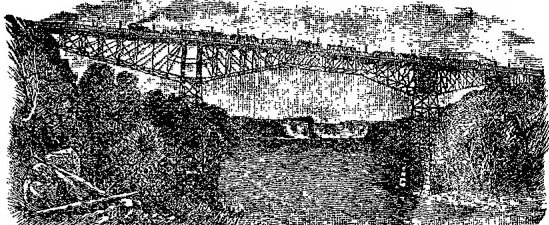
MICHIGAN CENTRAL NEW CANTILEVER BRIDGE, NIAGARA FALLS.

MICHIGAN CENTRAL

“The Niagara Falls Route.”
EAST.
STATIONS. 2 Mail. 2 Day Express. 1 N. Y. Express. 1 Atlantic Express. 2 Night Express. 2 Kal. Accom’n 2 Local Pass’gr.
Chicago am 7.55 am 10.35 pm 3.10 pm 10.10 pm 9.25 pm 4.50
Michigan City 10.05 12.28 4.52 12.23 11.33 6.58
Niles 11.25 pm 1.30 5.45 1.50 am 12.55 8.45
Kalamazoo pm 12.55 2.45 5.58 3.35 2.27 am 7.10 5.29
Battle Creek 1.40 3.23 7.33 4.25 3.15 7.55 6.14
Jackson 3.30 4.47 8.52 6.15 4.45 9.35 7.55
Ann Arbor 4.52 5.45 9.41 7.50 6.00 10.43
Detroit 6.35 6.50 10.45 9.20 7.30 11.50
Buffalo 3.30 am 4.25 7.15 5.55 9.05 pm 8.50
Rochester 6.00 9.20 8.00 11.20
Syracuse 8.10 11.35 10.20 am 1.30
New York pm 4.30 8.50 7.20 9.42
Boston 8.30 10.57 9.35 pm 2.50
WEST.
STATIONS. 2 Mail. 2 Day Express. 1 Chicago Express. 1 Pacific Express. 2 Evening Express. 2 Kal. Accom’n 2 Local Pass’gr.
Boston am 8.30 3.00 pm 7.00
New York 11.50 6.00 10.00
Syracuse pm 8.30 am 2.10 am 8.00
Rochester 10.40 4.20 10.45
Buffalo 8.30 pm 12.40 6.55 pm 1.20
Detroit am 9.10 8.00 pm 1.20 10.15 pm 8.00 pm 8.50
Ann Arbor 10.25 8.59 2.20 11.35 9.15 5.17
Jackson pm 12.05 10.05 3.20 am 12.54 10.55 7.10 am 6.25
Battle Creek 1.45 11.36 4.30 2.15 am 12.27 8.52 7.55
Kalamazoo 2.50 pm 12.13 5.07 3.07 1.20 pm 9.45 8.40
Niles 4.20 1.30 6.22 4.52 3.66 6.97 10.15
Michigan City 5.42 2.37 7.20 5.43 4.32 9.00
Chicago 7.55 4.35 9.00 7.45 7.00 11.20
O. W. RUGGLES, GEO. J. SADLER, General Pass. & Ticket Agent, Chicago.  Ticket Agent, Battle Creek.

HISTORY OF THE WALDENSES.

BY J. A. WYLIE.
A plain and well-written narrative concerning this remarkable people, from their earliest history to the present time. The faith, persecutions, martyrdom, and wholesale massacres of the Waldenses; their schools, missions, and itinerant work; their mountain fastnesses; the fierce wars waged against them; their exile, and re-establishment in the valley,—are all set forth with historical accuracy. A book which should have a wide circulation. Muslin, 90 cents. 212 pages, on tinted paper, illustrated.
Address, REVIEW & HERALD,
Battle Creek, Mich.; 26 and 28 College Place, Chicago, Ill.; or Toronto, Ontario.

THE YOUTH'S INSTRUCTOR.

AN ILLUSTRATED WEEKLY PAPER FOR CHILDREN AND YOUTH,
Devoted to moral and mental culture, and especially designed as a companion to Bible study. It is the best paper in the world for youthful readers, being free from modern fables and sentimentalism.
The publishers design that the Instructor shall contain the choicest illustrations and reading matter that can be secured, suitable for young minds; and while the size of the paper is unchanged, the price for single copies has been reduced from 75 cents to—
ONLY SIXTY CENTS PER YEAR.
TEN or more copies to one address, 50 CENTS EACH.
Address, YOUTH'S INSTRUCTOR, Battle Creek, Mich.
Continue reading: VIEWS OF NATIONAL REFORM