Your ShelfYour Projects

Review and Herald, Vol. 91, No. 12.

THE WORK
Earlier text: Western Canadian Union Conference

God's Call to Our Youth

"The advent message to all the world in this generation," is the aim of this people. Many times I wonder how this work will be accomplished. Time and again the REVIEW comes to us with the sad news that another warrior has fallen on the field of battle. Who will catch up the blood-stained banner of Prince Immanuel, that is about to fall from the old warriors whose hands have been weakened from many years of labor in the Master's cause, and bear it in the thickest of the fray to a glorious victory? Whom shall we call to enlist in this most glorious warfare? We cannot call those upon whose heads Father Time has been weaving his white silken threads. While they would gladly go, time has made such inroads upon their strength that they are no longer able to endure hardships, and are thus unwillingly forced to stay at home.
As I go from city to city, I find attractive notices like this, "Young men wanted for the army and the navy." In many places an army officer is stationed by the poster encouraging young men to enter the service of Uncle Sam. I have thought of the greater call the Lord of hosts is making for our young people to enlist in the glorious work of giving to dying nations a message of life, joy, comfort, hope, and peace. Instead of becoming expert in the handling of devices for the destruction of our fellow men, we are to become efficient in the handling of the sword of the Spirit, to the salvation of men. There are no laurels distributed here for being valiant in battle for Prince Immanuel, nor may any tombstone of honor rest upon our graves, yet a much greater reward awaits us than nations can give, the crown of immortality.
I am writing to you, dear young people, to consider the call of the high and lofty One. The Lord has need of your services. Will you not begin to plan ways and means by which you may do efficient work in the Master's cause? Our recruits must come from the ranks of our young people. It is to them that we must look to fill up the gaps made by the death of our faithful laborers, and to enter new fields that are constantly crying, "Come over . . . and help us." How long, dear young people, shall we listen to this earnest, agonizing plea for help without making any effort to save them? God will hold us responsible if we fail to do our part.
While visiting the navy yard in Boston, I saw a drill master with about eight raw recruits, drilling them in the ways of a good soldier. He had them go through various maneuvers; and thus, by constant drilling, they became proficient. Our schools are the places where young men and women are being trained and drilled for the work that God has commissioned us to do. Will you not consecrate yourself to the work God has for you to do?
I am glad that many are heeding the call; but there are many more that ought to fit themselves for the work of saving souls. Heed the Master's call, and great will be your joy in service here and your reward in heaven at last.
CHAS. F. ULRICH.

Sumatra

WE are thankful for the spirit of liberality we find manifested here, and are hoping to have some go forward in baptism when Elders R. C. Porter and F. A. Detamore visit us about the end of the year. Our greatest success, so far, has been among the Chinese- and Malay-speaking people generally. But how to reach the thirty millions of the native population is still a problem.
I have recently engaged a Javanese Christian as my teacher, and he has assisted me in translating studies, which he told me the other night he appreciated. He is a young man who has an independent mind; he does not blindly follow the teachings of others, but thinks for himself. He is editor of one of the Malay newspapers here. I know you will join us in praying that our association with him may help him to see the truth for this time.
Mrs. Wood has a number of readers, several Chinese women among them. One humble Dutch family who are walking in the light as far as they know it, pay tithe and attend Sabbath meetings. A Chinese family that I have been laboring with have recently taken hold earnestly. For some weeks I felt anxious about them, but two Sabbaths ago this man and his wife, accompanied by his brother, came first to our prayer meeting and then to our Sabbath services. He has had an unexpected trial by having done little business for some days. One day he took in but four cents American money, instead of four dollars as he was accustomed to doing. But they are all of good courage, and we help them to draw words of comfort and encouragement from God's Word. G. WOOD.

College Place Meetings Widely Advertised Through Newspapers

ONE of the most widely advertised union conference meetings held this winter was that of the North Pacific Union. This meeting was held at College Place, Wash., February 25 to March 7. From the opening day until the close, daily reports of the meetings were furnished the two newspapers in Walla Walla, which gave us considerable space. Prominent space was also given by the large dailies in Portland, Oregon, and Spokane and Tacoma, Wash. It was encouraging to learn that the Associated Press was also sending out reports, thus giving the meetings publicity in several States.
One night during the ministerial institute, which took up the first six days of the conference session, the manager of the Associated Press in San Francisco wired in to the correspondent at Walla Walla to send him an account of the Adventist meetings at College Place. It seems that the Associated Press correspondent heard about midnight that some unusual statements were being made by our ministers, which he thought would be of interest to readers of newspapers in the western part of the country, and telegraphed his correspondent to hurry the article to the central office. This was done, and the article was then distributed to newspapers in all parts of the territory included in the San Francisco office.
After the meeting had been in session about one week, a letter was received by one of the delegates from a brother in South Dakota inclosing a clipping from a newspaper published in his home town, telling of the meeting in College Place and also giving some remarks by one of our leading brethren. The many unusual statements our ministers make in connection with the exalted message they are giving to the world arouse the interest of newspaper men, who then seek after our news. This was fully demonstrated at the College Place meeting by the fact that the newspaper editors in Walla Walla expressed their anxiety for the news, and by the liberal amount of space they gave reports.
It was encouraging to talk to a number of the workers concerning the press work, and to learn of their progress in having reports on various subjects published in their home papers. Some told of strangers attending their tent and hall meetings who would not have heard of the effort they were holding had it not been for the notices in the newspapers. Others said that even though their audiences were small, they felt that a good work had been done by having extracts of their sermons published in the newspapers, thus reaching hundreds and thousands of people through this medium.
The residents of Walla Walla and the surrounding country where the Walla Walla papers circulate, were considerably awakened to the importance of our meetings in College Place through the reports in the papers. One of the union conference brethren made a very interesting statement, in which he said that a bank president of Walla Walla had been reading the reports with interest and told him that he was going to attend the meetings. This brother brought out the thought that the newspaper can be used to arouse the interest of influential men in the work our denomination is doing.
Another brother told of a woman in Montana who, though she lives forty miles from a railroad, has read of our work through a newspaper. This woman did not know that there were any Adventists in Montana, but she later heard of the camp meeting in that State, and rode two hundred miles on the railroad to attend it. She afterward accepted the truth, and now rejoices with us in the third angel's message.
We can never tell how far the influence of our efforts through the newspapers will be felt, nor how many souls will be numbered among the redeemed as a result of using this medium for the advancement of the glorious doctrines we hold. Our brethren should never let an opportunity slip by to use the newspaper in connection with their work.
W. L. BURGAN.

Trust in God

MRS. ALTA M. LACKEY
BROTHER, are you tired and weary? Do you tread the way alone? Human friends and loved ones failed you? Naught to cheer the journey on?
Courage, brother, Christ has suffered Loss of friends and human aid. Do as Jesus in your struggle, Go and to the Father pray.
Often when his heart was bleeding From a lack of human love, All alone he sought the Father, Finding sympathy above.
Learn the lesson God has hidden In the lonely life you live; Christ alone is all-sufficient. Peace with God flesh cannot give.
Loveland, Colo.

Michigan

Mt. Pleasant.—During the week of prayer we held meetings for the children in a room adjoining where the older people held their meetings. At the first meeting there were nine children present. As we began talking about the nearness of Christ's coming, the Spirit of the Lord came down upon us in large measure. One began to weep, and in a few moments all were weeping aloud.
We asked how many would give themselves wholly to Jesus, and every hand went up. The text was repeated, “If we confess our sins, he is faithful and just to forgive us our sins, and to cleanse us from all unrighteousness.” When we knelt in prayer, all confessed their sins in childlike simplicity. After prayer, we asked if they believed God had forgiven their sins. Then opportunity was given for confessions to be made to one another. We wish those who read this might have seen those dear children go to one, then another, and whisper their confessions. O, that older people were as simple and as willing to confess their wrongs! The Lord wants us to be as little children in these things. “Verily I say unto you, Except ye be converted, and become as little children, ye shall not enter into the kingdom of heaven.”
Next, we had a testimony meeting, after which we quietly went into the room where the older ones were, and every child gave a testimony there. It brought a blessing into their good meeting, and caused great rejoicing to the parents, as the children made heartfelt confessions to them.
The following evening several other children were present. Those who had been there the evening before, bore their testimony at the beginning of the meeting, telling the others how God had visited us in such a marked manner. We asked the others if they desired to give themselves to Jesus also, and every hand was raised. We then knelt, and each confessed his sins.
These were very precious meetings. We believe we received drops of the latter rain, and it makes us long for more. Let us do faithful work for the precious lambs of the flock.
Mrs. Cleora Green-Webster.

New Jersey

NEWARK.—“And the Lord said unto the servant, Go out into the highways and hedges, and compel them to come in, that my house may be filled.” Luke 14:23.
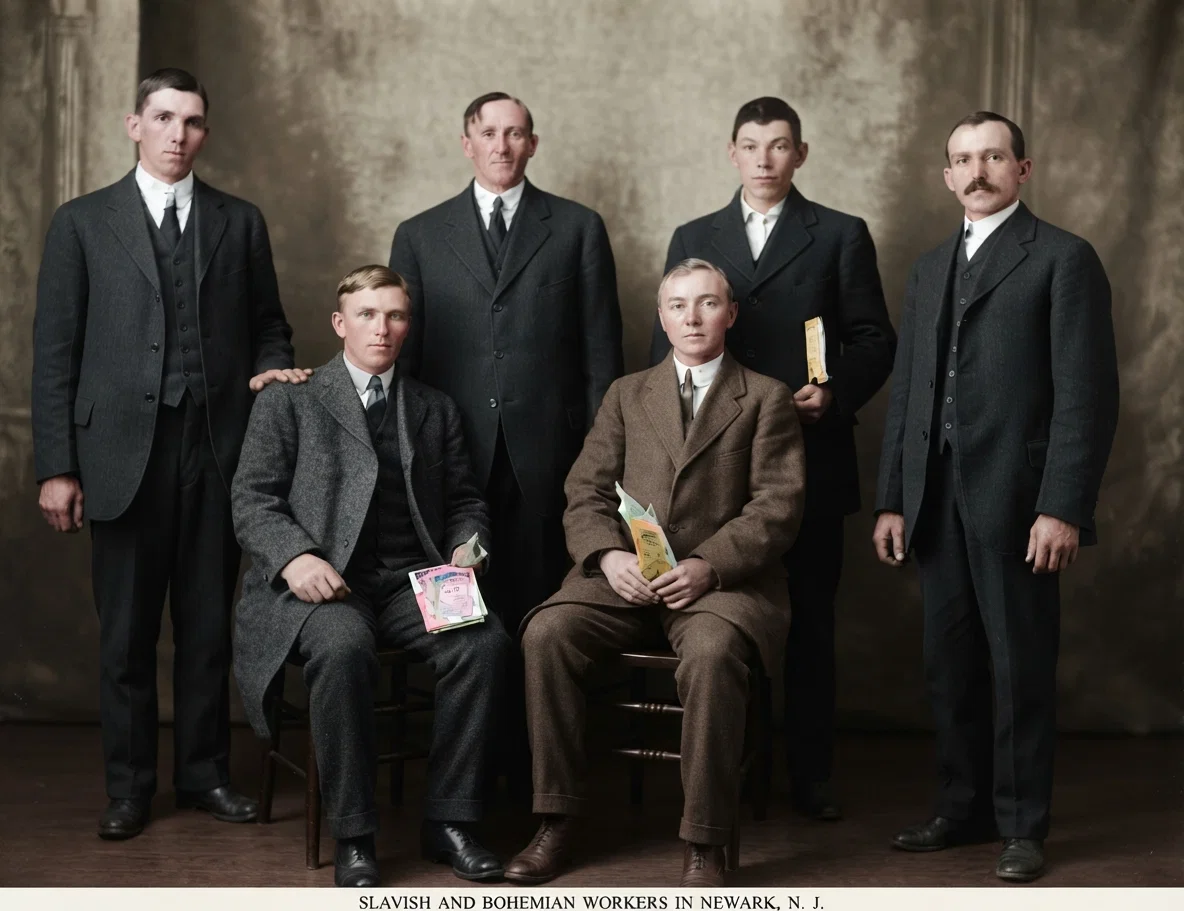
In these closing days of the Lord's work on the earth, we need more than human wisdom to know how to deal with human minds. Our work for over four years in the city of Newark has been confined to searching out a few of the jewels from among the Slavish and Bohemian people. We realize that the Lord has blessed in a marked degree, when we consider the mixed population in these congested Eastern cities. At present we have a membership of thirty-three, and five others awaiting baptism.
This organized church represents the result of my public efforts, and the personal work done by our church members and our faithful Bible worker, Miss Valenta, in house-to-house work.
Our method is to go to Passaic, a suburb of Newark, every Sunday morning with tracts and small books. We visit the people in their homes and sell the truth-filled literature. You will notice in the accompanying cut our company of six starting on their mission. On the last three Sundays their sales have amounted to forty dollars cash. For three months we tried to conduct meetings in a rented hall, but met such violent opposition that our audiences were almost nothing, and we were obliged to close the hall and adopt the latter method.
SLAVISH AND BOHEMIAN WORKERS IN NEWARK, N. J.
We are of good courage, and mean to press the battle to the finish, and thus receive the crown in waiting.
PAUL MATULA.

Missouri

Marceline.—Reports which appear in our good church paper from time to time, telling of the success various workers are having, inspire me to tell you how the Lord is blessing my efforts. I am an old soldier and unable to do manual work. Recently I decided to secure a supply of books, adding to the store from time to time as I could spare the money from my little pension, and lend them to persons willing to read. I now have about forty dollars' worth. I have made a nice little case in which to carry them. In going from house to house I search for lovers of good books who are anxious to read, and then I lend them a book for two or three weeks. Making a second trip, I gather up the books that have been read, and leave others where they are desired. I find the people hungry for this class of literature, and could use five times as many books as I have. Twenty families are now reading. In these families are about sixteen children. With these I hold a reading class. I believe that the loving Father is leading in this work. I ask an interest in your prayers, and shall appreciate all the good literature that you can send me. D. A. Easton.

Greater New York Conference

The Greater New York Conference has been passing through one of the most searching revivals in its history.
The annual session was called to order Tuesday, February 17, and was scheduled to close the following Sunday, but the interest was so great that services were continued till the following Wednesday evening. It is doubtful if there has ever been a greater manifestation of divine power in the history of our message than was witnessed during these meetings. At times the Lord took full possession of the meeting and swept everything before him, but no semblance of fanaticism was manifest. Singers were silent, ministers were weeping between the porch and the altar, and the people were intent on seeking God. This followed day after day,

Cuba

think that for about twenty-five hundred dollars they could get a lot and build a little chapel which would serve their purpose very nicely. They also think that they could raise a thousand dollars of this amount on the island, but would need help from the outside for the remainder.
The work in Porto Rico has been signally blessed financially. The tithe from the island last year amounted to over one thousand dollars, and their total income to over seventeen hundred dollars. The work during 1913 was entirely self-supporting, and when the year closed they had several hundred dollars on hand with which to start the new year. With the new workers who are now going to the island we may look for some good reports from that field.
GROUP OF WORKERS AND ASSISTANTS IN CUBA

Cuba

February 3 I sailed from Ponce, Porto Rico, for Santiago, Cuba, arriving in Santiago the morning of the sixth. Elder A. J. Haysmer had arrived the same morning from Jamaica, and he and Elder Allen met me at the boat. As it was Friday, we spent the Sabbath with the company in Santiago.
A native Cuban took great interest in going over the ground with us and describing the charge of Colonel Roosevelt and his rough riders when they took the fort on San Juan hill. We visited also the large ceiba tree under the shade of which a treaty of peace was signed.
We were interested in those historic places, but we were more interested in the plans for carrying the gospel of peace to Santiago by our colporteurs and Bible workers.
There are about half a dozen in Santiago keeping the Sabbath. We were kindly entertained at the home of one of our native brethren. Sunday morning we took the train for Las Tunas, where Brother and Sister J. E. Anderson have been conducting a day school during the past four years. The Lord has blessed them in this work, and they have had a good influence among the people in the town. However, as conducting a day school in Latin countries seems to be a very slow process in winning people to the truth, Mrs. Anderson will probably close her school for good at the end of this term, and will unite with Brother Anderson in evangelical work in the city of Havana.
From Las Tunas we went to Las Minas. Four or five years ago Brother Guy Holmes located in this place with the plan in mind of opening a school. He was later joined by Brother Charles Franz. Although these brethren have not been able to do very much in direct school work, they have had a good influence in the American colony where they are located, and also in the village of Minas. Mrs. Ida Fischer-Carnahan and her daughter are at present conducting a day school in the town. Mrs. A. F. Burgos has also been engaged in Bible work in Minas for some time, and a nice little company has been brought into the truth. The brethren have erected in the town a little chapel that will seat about fifty people. It is free from debt. I had the privilege of speaking to the native brethren in this chapel the night we were there, while Brother Haysmer spoke in English in the church in the American colony.
From Las Minas we went to Santa Clara, the headquarters of the Cuban Mission, where Brother Allen had made arrangements for the workers' institute. He had secured a large, old-fashioned, Spanish house located on a hill just outside of Santa Clara, from where we had a fine view of the city. About thirty workers and brethren and sisters gathered for this meeting, which began February 12 and continued for one week.
We were glad to see that in Cuba as well as in Porto Rico native young men are being developed to do successful colporteur work. Four of these who had been doing good work during the past year were present at the Cuban meeting. The Lord came very near to us in our institute work, and the brethren expressed their determination to push the work during the coming year more vigorously than ever before. During 1913 the colporteurs sold over $9,000 worth of literature in Cuba. They have set their stakes at $15,000 for 1914. The tithe and offerings in Cuba during 1913 amounted to $1,877.54, a gain of more than $300 over the previous year.
As the members of the Cuban Mission Committee were present at this meeting, plans for future work were considered. Brother H. A. Robinson, who has been in the office during the past several months, will again go to the field to take charge of the colporteur work. Mrs. Burgos will locate in the city of Santiago to engage in the Bible work. Brother J. E. Anderson will engage in the evangelical work in the city of Havana. Pedro Cruz, a native licentiate, has an interest in Las Cruces, in the interior. Earnest evangelical effort is Cuba's greatest need.
The brethren in Cuba are very desirous to have a mission training school started on that island. This matter was carefully considered during the meeting, but as they have not the money in hand for such an enterprise, it was advised that they first make an effort to see what funds can be secured before undertaking anything definite, in harmony with the policy of the General Conference not to incur debts in our missionary operations.
February 17 I sailed from Havana, reaching New York the evening of the twentieth. Let us not forget to pray for the work and workers in these Spanish Catholic fields. N. Z. T.

Educational Department

J. L. SHAW | General Secretary W. E. HOWELL | N. Am. Div. Asst. Secretary

Our First Educational Sabbath

THERE has been no time to receive reports from the field, but this day was observed according to appointment by the Takoma Park and Memorial churches in Washington, D. C. The secretaries of this department assisted in the services at these two churches. Though they themselves had prepared the readings, their souls were refreshed, and their sense of responsibility deepened by the rapt attention given by the people to the presentation of the readings on the care and education of our children and youth.

Aims of the Day

1. To bring to the attention of all the people and impress the encouraging facts that in the United States and Canada we now have (in round numbers) 450 church schools, 525 church-school teachers, and 8,500 church school pupils; that we have invested in facilities for these schools about $150,000, and that to maintain them we are spending an average of more than $10,000 a month the year round.
2. To lead us all to think more seriously over the fact that there are still not far from 8,000 Seventh-day Adventist children of church school age in this country who are not provided with the privileges of Christian education in schools of our own. 3. To bring before our minds afresh the special instruction that has been given us on the education of our children and youth, especially those of tender years, and embodying ideas like these:—
"The church does not realize the situation. She is sleeping on guard."
"Fathers and mothers must arouse and work as for life, or many of the youth will be forever lost."
"No amount of labor in this line [foreign fields] can excuse us for neglecting the education of our children and youth."
"The Lord would have the children gathered out from those schools where worldly influences prevail, and placed in our own schools, where the Word of God is made the foundation of education."
"In the closing scenes of this earth's history many of these children and youth will astonish people by their witness to the truth, . . . a work in proclaiming the truth to the world that at that time cannot well be done by the older members of the church."
"Our church schools are ordained by God to prepare the children for this great work."
"In selecting teachers, we should use every precaution, knowing that this is as solemn a matter as the selecting of persons for the ministry."
4. To enlighten our people on what our church schools are doing, and what is being done to build them up in strength; but especially what more needs to be done than we are doing; such as the following:—
Every church member, whether a parent or not, needs to conceive a new and practical interest in educating the children, the natural increase of the Lord's heritage; therefore let every church call a special meeting to study its own relation to this matter. If it has a school already, what can be done to increase its facilities and efficiency? If it has no school but has children, shall we start a school next autumn? If it has no school and no children, what can we do to help carry the school burden in other churches?
5. To present the very pressing need of two funds to strengthen the church school work: one to aid in the preparation of textbooks and manuals, worked out on principles of Christian education and adapted to denominational needs; the other to provide scholarships of fifty dollars each for the education and training of more and better teachers for our church schools. We want many young men and women to make church school teaching their life work. To all who will do this, we want to give the best chances possible to make thorough preparation, and to provide them the very best tools we can to work with.

What Shall We Do?

Now, brethren and sisters in the churches, what shall we do? We believe that these aims of our first Educational Sabbath are laudable and timely. This day was not appointed, nor the readings prepared, merely to fill in the time. We want results. We want to see a stir all along the line, prompted by the deep movings of the Spirit, to arouse and do our whole duty by our children. Jesus said, "Suffer little children to come unto me, and forbid them not." Shall we suffer them? or shall we forbid them?
W. E. H.

News and Miscellany

Notes and clippings from the daily and weekly press
— A recent count of the automobiles of Berlin discloses the fact that the German kaiser owns twenty-six cars, all reserved for his exclusive and private use. Twenty are kept in Berlin or Potsdam and six at Corfu. In addition, one fitted as a kitchen accompanies him in the army maneuvers.
— England is offering $25,000 for the aviator who makes the best time around that island's rim of 1,540 miles, driving an English make of engine; also $50,000 for the first to cross to the United States. Between England and France alone the total amount to be won this year in cash prizes and business awards for aviation is not far short of $500,000.
— A campaign, nation-wide in its scope, was launched recently in New York by Mrs. William K. Vanderbilt against the use of cocaine, morphine, heroin, and other drugs. It was stated in this connection by Dr. Jackson R. Campbell, who for twenty-seven years has been a physician in the New York Department of Correction, that there are fully 15,000 cocaine and morphine victims in the city of New York alone. One third of the crimes committed can be traced to the state of mind and body produced by the use of cocaine and morphine.
— Andrew Carnegie, on February 10, gave $2,000,000, to be used through the churches, for the promotion of international peace. The income of the fund, about $100,000 a year, will be expended by a board of twenty-nine trustees, representing all the leading religious denominations in the United States. This gift is, in addition to the $10,000,000 foundation established by Mr. Carnegie on Dec. 14, 1910, "to hasten the abolition of international war." The announcement was made at the close of a luncheon at Mr. Carnegie's home, attended by the trustees of the new foundation. The trustees organized The Church Peace Union, which will be incorporated under the laws of New York State.
— The Swedish cabinet resigned February 10, and King Gustave summoned Baron Gerard Luis de Geer to form a new cabinet. Baron de Geer is governor of Kristianstad, and is a senator belonging to the moderate liberal party. The resignation of the cabinet was the result of acute differences of opinion between its members and the king as to the sovereign's right to give free expression publicly to his opinion in political matters without previously consulting the ministers. The cabinet held that as a constitutional monarch the king should not make political speeches without ascertaining beforehand if the cabinet approved the substance of them, and the king refused to submit to such restraint.
— Persian landowners, mostly partisans of the deposed shah, have been bribed by the czar's agents to cede their land to Russian colonists. Large land transactions have taken place on the northeastern frontier, near Mero, where a colony of retired Russian soldiers is being rapidly established. Russian immigrants are streaming in, and land is being bought for seventy-five cents an acre with funds mainly supplied by the government in St. Petersburg. Russia has responded to the world's protest against Muscovite aggression in Persia by withdrawing a part of the army of occupation, but she has adopted a more subtle and fundamental method of colonization for the establishment of Russian ascendancy in Persia.
— Heroin, a drug with effects as baleful as cocaine or morphine, has come under the ban of the federal postal authorities, who are endeavoring to stop the sale by mail of habit-forming preparations.
— The Brazilian government authorities, on March 5, proclaimed a state of siege in the cities of Rio de Janeiro, Nictheroy, and Petropolis. This is to remain in force until March 31. The government's action is taken as a preventive measure against any possible troubles. Disturbances were feared from certain elements of the population as a result of the recent insurrection in the province of Ceara. A strict censorship was immediately established by the government on telegraphic communications, and all the troops were confined to barracks, in readiness for any eventualities.
— Hailed as the greatest living engineer, Col. George Washington Goethals, U. S. A., builder of the Panama Canal, was accorded an honor on March 4, at the ninth annual banquet of the National Geographic Society, that has been achieved by few men — the honor of receiving at the hands of the President of the United States a gold medal in recognition of his services to his country and the world. Gathered at the tables in the banquet hall of the New Willard hotel was one of the most distinguished assemblages ever seen in Washington, D. C. Colonel Goethals, as the guest of honor, was surrounded by the President and his Cabinet, members of the diplomatic corps, statesmen of Congress, army and navy officials, jurists, scientists, and many other notables of the national capital. Secretary of State Bryan was toastmaster.
— Printed books weighing in excess of eight ounces will be acceptable by parcel post after March 16. The term "book" is construed by the postal department as covering printed books of all kinds, including catalogues, check books, receipt books, and music books. Zone weights will apply as well as zone rates. The present third-class rate of one cent each two ounces or any fraction thereof applies to books weighing less than eight ounces. Much interest has been manifested in the application of the parcel post to mailing books. After the announcement that books would be acceptable it was discovered that a "book" is printed matter that is bound, while a pamphlet is not bound. That ruling would have kept from parcel post large catalogues, etc., while admitting small booklets, for catalogues, being unbound, would have to be classified as pamphlets. But the Post Office Department comes to the rescue with the explanation that when a pamphlet weighs eight ounces or more, it is a book; and, conversely, if a book weighs less than eight ounces it is not a book, but is third-class matter.
— What is expected to be one of the most momentous sessions ever held by the parliament of Great Britain began on February 10. There are not only the Home Rule and Welsh Disestablishment Bills, which come up for third passage and then become law despite anything the lords may do, but there is a great mass of other business which will compel the government to fight continuously to hold the confidence of the House of Commons. Threats of civil war were made openly on the floor of the House of Commons, which convened immediately after the king had read his "speech from the throne." In his address His Majesty emphasized the grave seriousness of the situation in Ulster growing out of the fight for the Home Rule Bill, and expressed his regret that the efforts to solve the Irish problem so far had proved unsuccessful. The Liberal Government, supported by a coalition of Liberal Labor members and Irish Nationalists, stands pledged to carry through this bill, which twice has been passed by the House of Commons only to be rejected by the House of Lords. The government possesses a sufficient majority to secure its passage a third time. Then when it is signed by the king it automatically becomes a law without the consent of the House of Lords. Until three years ago every attempt to carry through this measure was frustrated by the House of Lords, whose hereditary members are the mainstay of the conservative Unionist or Tory party. Lloyd-George's famous budget of 1909, which was bitterly fought by the upper house, marked the great turning point in modern English politics, and the parliament act forever broke the power of the reactionary lords by abolishing their absolute veto and thus opening the way to real democratic reforms.
— The acute Mexican situation created by General Villa's failure to account for the death of Benton, a British subject, in a manner satisfactory to this government, and his supercilious attitude toward our State Department's efforts to investigate the case, has been relieved by the Mexican general's more recent concession to Secretary Bryan's demands. Moreover, representations have been made to the Huerta government demanding reparation for the death of Vergara, an American citizen whose ranch was sacked and who himself was hanged by the federal troops. This demand being apparently ignored, on March 8 a troop of Texas rangers crossed the border, and recovered the body of the ranchman. This action may participate a crisis, but our government is seeking to make both factions feel that their security does not lie in its attitude toward either the federals or the constitutionalists. What the future may bring forth we do not know, but it must be conceded that thus far the President's idealistic policy of noninterference has been the only course that could have saved us from war and bloodshed. If persisted in, it may even yet win out against the sinister forces that have long sought intervention and would now welcome war. It is to be earnestly hoped that the peace policy thus begun can be carried to a successful conclusion, notwithstanding the general feeling that Mexico deserves to be rather severely chastised.

Education Day in Washington

THE following reports have been handed in by persons who were present at the services.

At the Takoma Park Church

Education Day was observed at the Takoma Park church with appropriate services. Brother E. R. Palmer, manager of the Review and Herald Publishing Association, presided, and offered fervent prayer for the blessing of heaven to rest upon our children and young people, and upon our educational work. The first readings were presented by Prof. J. L. Shaw, General Conference Educational Secretary. Prof. C. C. Lewis, principal of the Fireside Correspondence School, followed with the remaining readings. These readings made a strong presentation of what our church schools are doing, what is being done for them, and what remains to be done. Marked attention was given to the readings, and a deep impression was made.

At the Memorial Church

At the Sabbath morning service in Memorial Church, the program outlined in the magazine Christian Education was carried out. The readings were listened to with close attention as the cause of our children's education was earnestly pleaded by the readers. The church elder, Prof. M. E. Olsen, gave a stirring talk on what it means to conduct a successful church school, and urged the holding of parents' meetings once a month, and the frequent visiting of our church school in Takoma Park, where a number of children from Memorial Church attend. It is hoped that by another year this church may have a school of its own.

College Notes

THE latest information we have shows the enrollment (above the eighth grade) in our colleges to be as follows:—
Union College . . . . . . . . . . . . . . . . 307 Walla Walla College . . . . . . . . . . . . 292 Emmanuel Missionary College. . . 232 Pacific Union College . . . . . . . . . . . .200 Mount Vernon College . . . . . . . . . . 180
This makes a total enrollment of 1,211.
Pacific Union College reports twenty-five young men preparing for the ministry, and Emmanuel Missionary College, twenty-five.
The calendar of Washington Missionary College for 1914-15 is now ready for distribution. It may be had by addressing the president, J. L. Shaw.
Pres. I. H. Evans, of the North American Division Conference, recently wrote: "I think we must urge and insist that our students persevere in school until they finish sixteen grades of work. It will do them good, and make them stronger men and women in every way."
Our second Educational Sabbath for 1914 will be observed in the interests of our colleges and academies. The date is August 8. W. E. H.
TAKE the self-denial gayly and cheerfully, and let the sunshine of thy gladness fall on dark things and bright alike, like the sunshine of the Almighty,— James Freeman Clarke.

Study at Home

MANY young people are prevented from attending school by circumstances over which they have no control, but they need not despair; they should avail themselves of "the opportunity afforded by the Fireside Correspondence School to keep up their studies until circumstances permit them to attend a resident school. One lady writes as follows: "I am enjoying my study (Bible doctrines) very much indeed, and I find that the message as outlined in the study is clearer to me than at any time during the ten years I have been an Adventist. I thank you for urging me to start in when I did."
The Fireside Correspondence School has some thirty courses prepared, including history, Bible, English, Greek, Latin, commercial, and mothers' normal subjects. For further particulars address the principal, C. C. Lewis, Takoma Park, D. C.
Continue reading: NOTICES AND APPOINTMENTS