The Youth’s Instructor, Vol. 43, No. 45.

JAPANESE HOMES

The Youth’s Instructor

Nov 7, 1895

S. D. A. Publishing Association · Battle Creek, Mich. · Nov 7, 1895

JAPANESE HOMES.
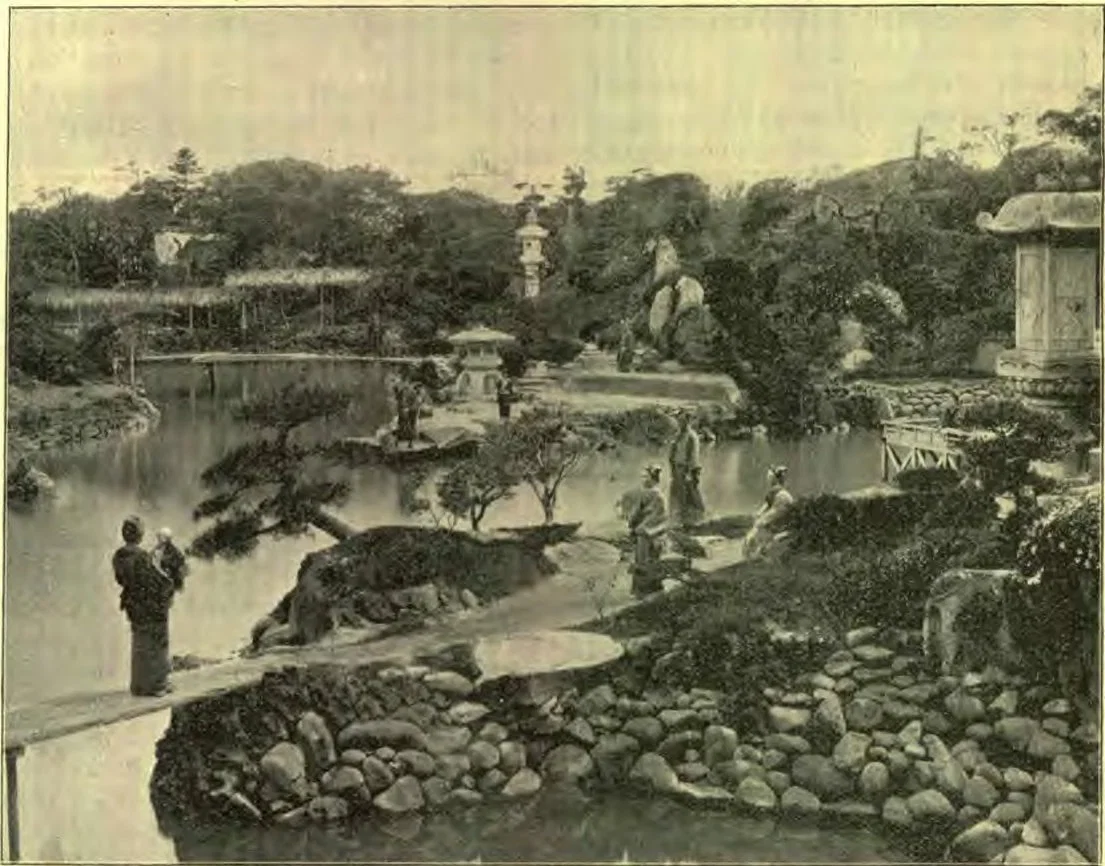
I have been telling you something of the history and religion of Japan; I will now endeavor to give you a glimpse of the people in their homes. Their houses are quite unlike ours, but are well suited to the needs of the inmates.
The ordinary Japanese house is a light frame-work structure. There are no stationary walls all around, such as we have; but the outside is protected by sliding doors, called “amado,” which are all slid into a box in the daytime. If the weather is warm, the house remains open to outside air all day long; but in winter semitransparent paper screens, called “shoji,” replace the sliding wooden doors. Rooms are separated from each other by paper slides called “fusuma,” which run in grooves at the top and bottom. By taking out these screens, several rooms can be thrown into one. The best apartments in a Japanese house are usually at the back, so that the occupants may look out upon the flower garden, which is also in the rear.
But really the Japanese can scarcely be said to have flower gardens,—at least not such as we see in this country. A flower garden conveys to our minds the idea of a little parterre, laid out in stiff, rectangular beds, in which bloom various kinds of annuals in summer, but which are bare in winter, except for the shrubbery. Now a Japanese garden is a little park in miniature. If there are flowers, they are removed as soon as their season of bloom is over, and others put in their places, as long as the warm weather continues. There are trees, rocks, hillocks, lakelets, and tiny streams spanned by bridges. You can easily imagine, when looking out upon one of these gardens, that you are gazing upon the picture of a beautiful landscape. The Japanese are great lovers of nature, and endeavor to reproduce some of her beauties in the tiny little spaces of ground allotted them at their back doors. Only the wealthy people can afford to have such large, beautiful landscape gardens as the one represented in the picture.
The floors of a Japanese house are covered by thick straw mats, upon which the people sit in the daytime and sleep at night. They have no such furniture as tables, chairs, bedsteads, etc., in their houses. Thick quilts are laid upon the floor at night for beds, and in the daytime they are folded up and put away. The Japanese eat from little trays, one of which is placed before each member of the family. These trays contain several tiny bowls filled with rice, fish, etc.
A JAPANESE GARDEN.
A JAPANESE GARDEN.
There are no grates or fireplaces in Japanese rooms, but, instead, the “hibachi.” The hibachi is a large bronze or metal bowl, or an ordinary wooden box lined with tin. It is filled to about three inches of the brim with ashes, upon which glow a few live charcoals. A tripod upon which sings a tiny kettle of water, is thrust down over the coals. Around the hibachi the family sit or squat upon their feet, which keeps their lower extremities warm, while they toast their fingers over the coals. They constantly smoke from tiny pipes. When thirsty, they pour some of the hot water upon the tea leaves kept in readiness in the little pot which is always at hand, and drink the rather bitter beverage. If a friend or acquaintance comes in, it is considered quite rude not to offer him a cup of tea and a slice of cake, or other refreshments.
The population of Japan is very much crowded. The country is not quite as large as California, and only an eighth of that can be cultivated, on account of the mountains and hills. There are forty-one million people. This allows less than a third of an acre of arable land for each person.
The young folks in Japan who get married are usually too poor to set up housekeeping for themselves, and even if they were financially able, they would probably remain with the husband's parents, because that is the custom of the country. There is generally a large family in each household—father, mother, grandfather, grandmother, and the sons and their wives and children, besides others. In America young men toil to amass wealth for old age; not so in Japan. At about fifty years of age the father gives up his business and property, if he has any, to his sons, who are expected to support the old people as long as they live. The children usually regard the care as a sacred trust, treating their parents with the utmost respect and consideration. They never seem to weary of ministering to the wants of the old, and when times are hard and food is scarce, as is often the case in Japan, they cheerfully deny themselves and their children to keep their parents in comfort. Here is a lesson to young America. With all our boasted superiority and civilization, we can certainly learn something from them in regard to gratitude to our parents and respect to the aged.
Japanese children are early instructed in rules of politeness. They are taught to be kind and considerate to all. “The grandfather and grandmother must come first of all in everything; no one at meals must be helped before them in any case; father and mother come next, and after them the children, according to their ages. A younger sister must always wait for the elder, and pay her due respect, even in the matter of walking into the room before her.” We might well emulate the politeness of the Japanese in some respects. Their soft, gentle manners are often in striking contrast with the rude, rough conduct of American boys and girls.
While we can find much to admire in the Japanese social system, we can also find many things to condemn, especially their worship of idols. Now, dear children, will you not pray that the true God, who is so loving and kind, will send teachers to them, to show them how vain and foolish it is to be bowing down to stocks and stones, which can neither see nor hear, and to teach them about their kind heavenly Father, who is constantly bestowing rich blessings upon them, though they know him not? MRS. J. A. BRUNSON.

RELIGION MEANS SERVICE.

“We are laborers together with God.” Christ is the head of the church on earth, and he requires that every one who believes in him as the Redeemer, shall surrender himself to obey his word, to love God supremely, and to love as Christ loved those who are perishing in sin. In every church there should be men who will set in operation missionary efforts, and teach the workers how to exercise tact, and how to carry out the best missionary methods. There should be many workers in every city, and laborers sent to every possible field. We have the promise of the Creator of all worlds, the promise of him who has all power at his command in heaven and earth, that he will be with us, and will work with the living, working church on earth. He appoints angels to coöperate with human agencies in advancing his work for the saving of perishing souls. All heaven is employed in ministering to the heirs of salvation, imparting the renewing power of the Holy Spirit to those who shall work for the salvation of souls.
No church is to be passive; no individual member of the church is to be irresponsible and unemployed. The Lord soon cometh out of his place to punish the inhabitants of the world for their iniquity; the earth shall disclose her blood, and no more cover her slain. The message of warning must be carried to sinners; it must be proclaimed to those who have not had the light of truth. The church must be educated to the idea that they are not to use their time and their money upon themselves, but must devote themselves to the diffusing of light to those who are in darkness. The whole law is fulfilled by him who loves God with all his heart, and his neighbor as himself. Upon these two principles of love hang all the law and the prophets. The Lord Jesus loves those for whom he died, and he requires all who believe on his name to coöperate with him in self-denial and self-sacrifice. Those who believe in Christ as their personal Saviour will put forth earnest efforts to make him known. He is the way, the truth, and the life, and by presenting the truth as it is in Jesus, souls that are perishing will be saved.
We need to look to God continually, and fortify our souls by earnest prayer and watching thereunto. Religion means service, earnest, faithful service to God. All who have been chosen of God are to be co-partners with him. They cannot combine self and selfishness with true, faithful service. All who enter the portals of bliss will be found faithful. They will have rendered such service that their Redeemer can say to them, “Well done, thou good and faithful servant: thou hast been faithful over a few things, I will make thee ruler over many things: enter thou into the joy of thy Lord.” The Lord has laid out in distinct lines the conditions that must be met if we would be his followers in deed and in truth. He says, “If any man will come after me, let him deny himself, and take up his cross, and follow me.”
I would impress upon our young men and young women the necessity of making their calling and election sure. I would beseech you to do no haphazard or uncertain work where your eternal interests are involved. By so doing you lose happiness, peace, comfort, and hope in this life, and you lose also your immortal inheritance. My young friends, you are judgment-bound, and through the grace of Christ you may render obedience to the commands of God, and daily gain fortitude and strength of character, so that you need not fail or be discouraged. Divine grace has been abundantly provided for every soul, so that each one may engage in the conflict and come off victorious. Do not become sluggish; do not flatter yourselves that you may be saved in walking in accordance with the natural traits of your character—that you may drift with the current of the world, and indulge and please self, and yet be able to withstand the forces of evil in a time of crisis, and come off victorious when the battle waxes hot. You must learn daily how to use the weapons of your warfare, and to wield the sword of the Spirit, which is the word of God. You must learn how to resist the devil, that he may flee from you. You must learn every day to obey the orders of the Captain of the Lord’s host.
My young friends, do you pray? Are you educating yourselves to offer petitions for pure thoughts, for holy aspirations, for a pure heart and clean hands? Are you educating your lips to sing the praises of God, and are you seeking to do the will of God? This is the kind of education that will be of the greatest value to you; for it will aid you in the formation of Christ-like character. You are thus learning how to obtain the robe of Christ’s righteousness, by appropriating to yourself the ample promises of his word.
Many feel stirred with an ambition to minister to others. Let them learn to walk humbly with God, to be doers of his word, where they are. Let them learn to be obedient, to serve in whatever capacity they may. Let them learn to do the humblest work, and to realize that they are serving Christ in whatever circumstances they may be placed. In doing humble physical work, you may reveal the fact that God is with you, and that you are trading upon the talents he has intrusted to you. Right where you are, opportunities and privileges will present themselves to you, and if you are seeking to serve Christ, you will see and improve them. In the humblest situations you will find occasions for the exercise of firm integrity and fidelity; and if faithful in serving God in the lowest place, you will be intrusted with higher responsibilities. If you are faithful in a few things, your faithfulness will testify that you are a student in the school of Christ, and that you are cultivating your ability to serve him in larger fields. Jesus says, “He that is faithful in that which is least is faithful also in much.”
MRS. E. G. WHITE.

THE PARABLE OF THE CLOCKS.

I HAVE a clock that has the peculiarity of striking correctly, but pointing incorrectly. The hands, for instance, will indicate four o’clock while the strike will be one, and this upon comparison with the regulator will be found correct. When this clock is examined, the source of its idiosyncrasy is found to be external. It is discovered that the hour-hand has become loose upon the shaft, and, consequently, when it gets around to one on the dial plate, it drops of its own weight to four. Please remember that this clock is a good and correct striker, and that its trouble is external and easily remedied.
Of strange clocks I have had my share. I can, therefore, relate that I once had a clock that pointed correctly but struck incorrectly. The hands, for example, would point to one while the strike would proclaim four, or six, or eleven perhaps. The pointing was all right; it was the striking that was wrong. And the source of this false striking was found to be deep. It was within—it was internal. And it took a clockmaker to describe the trouble and remedy it.

The lessons — what are they?

1. In the church are two classes of men. Some men strike correctly, but point incorrectly. Their daily lives and transactions do not, seemingly at least, point in the right direction. They seem careless of morals, indifferent to religion, and tolerant of the worst evils. The pointing is wrong. But wait. At the critical moment, when lines are sharply drawn, when the enemy is discharging his most destructive fire, when loyal subjects are fearlessly falling into line,—at such a critical moment these men boldly and resolutely stand among the foremost. They strike right. They redeem themselves in our thoughts. Yet a regret lingers that the pointing was not always as clear and uncompromising as the striking.
There are others,—some who point always correctly, but who never in a whole revolution strike correctly. They have pounds of theory, but never an ounce of practise. The form of godliness have they, but know nothing of the power. You see these men week after week, and they are seemingly pure, chaste, honest, severely moral, and intensely religious. But the critical moment comes, the moment that tries men’s souls, and these men take position with the enemy. The striking is wrong. We are disappointed, and more than ever convinced that all that glitters is not gold.
2. In the church is another class of men. Throughout the entire circuit of their lives they both point and strike correctly. They do this year in and year out, and the equation of variation is not greater than belongs to imperfect material. They are the trees planted by the rivers of water, the lights of the world, the salt of the earth, the heroes of faith, the Abrahams, the Joshuas, the Jeremiahs, the Daniels, the Pauls. Their pointing and striking never cease to be seen and heard in the world. They are Secker’s “singular Christians.” Would that the church had more of them!
3. Briefly, if a preference must be expressed between the churchman that strikes correctly but points incorrectly, and the one that points correctly but strikes incorrectly, the choice must fall to him who strikes correctly. Correct striking indicates that the internal adjustments are correct. In the churchman it shows a right heart. Given a right heart, and the head will not go far wrong, nor stay wrong long. On the other hand, correct pointing depends upon outward arrangement. The consummate fiend may so skilfully adjust his outward relations as to appear a saint.
The churchman who strikes correctly is to be preferred to the one who points correctly. But better than either, is he who is correct both in his striking and pointing.
“Covet earnestly the best gifts.”—Selected.

The Preponderating Value of Friendship

No other possession of life holds such preponderating value as one's friends. All beside these are a part of the scenery of the external and temporal world; but friendships are of the eternal and divine.—Lilian Whiting.

AN EASTERN WAR CLOUD.

EVER since the close of the war between Japan and China, it has appeared very probable that there would be a war between Japan and Russia. The latter country has been working for many years to extend her power eastward, and has succeeded in getting a line of railroad from Russia in Europe through Siberia to Vladivostok, on the Japan Sea. This port is closed by ice the major portion of the year, and Russia greatly desires a warmer port or ports to the South. All the warm ports on the east coast of Asia are held by China or Corea, and it has been the object of Russian diplomats to secure some concession from these countries, that would give them what they desire.
The late war, which put Port Arthur and the whole country of Corea into the hands of Japan, was very annoying, to say the least, to Russia, as it seemed directly to thwart her long-cherished hopes. The sudden prominence of Japan and her springing into being as a first-class power also greatly irritated Russia, especially as she seemed to come up just at the time to prevent Russian expansion. Russia therefore interfered in the war, or at least in the settlement of the difficulties, and demanded that the Japanese should retire from Port Arthur and the Liau-Tong peninsula. Japan agreed to do this, but Russia is evidently in a hurry, and has lately repeated her demand with a good deal of emphasis. Again Japan consented, with the proviso that Russia should not take possession of the territory thus vacated. Still Russia is not satisfied; and she now demands that Japan withdraw her army from Corea. This is more than the island empire of the East can bear with honor, and the mikado politely but very firmly refuses to accede to this demand. Whereupon the Russian fleet of nineteen war vessels has set sail from Vladivostok for Corea, and it is reported on good authority that China has given Russia the privilege to use the harbor of Port Arthur, and to build railways in the Liau-Tong peninsula. Upon this the Japanese fleet is recalled from Formosa, and another terrible duel of the steel leviathans of the sea may soon occur.
All this is portentous; but a deeper tinge is placed upon the war-cloud by the attitude of Great Britain. The success of Russia in gaining the control of China in the great loan and in other ways, has awakened in England a well-founded fear that she will get possession of all the great seaports of China and Corea, and thus control the eastern trade so long held by English merchants. The result of this new move of Russia has therefore stirred England as she has not been moved before for years. The British press are unanimous in expressing the opinion that England cannot afford to allow the balance of power to be disturbed as it would be by such a preponderance of Russia in the East. In harmony with this general feeling of the English people, British ships have been ordered to Chinese waters to strengthen the fleet already there; and so urgent is the case believed to be, that some of the English papers express the fear that the Japanese fleet will be defeated before the British fleet can get to their support. It is needless to say that there is great activity in military and naval circles in Great Britain. Meanwhile negotiations will be carried on, and perhaps the war will be averted; but it may be that the little cloud, now only the size of a man's hand, will yet fill the whole European horizon.
While we have no desire to take sides in this possible conflict, and we deprecate war as barbarous and unchristian, there are reasons why we cannot desire the success of Russia should war actually occur. The defeat of England and Japan by Russia would result in the full control of China by Russia. This would mean the utter stagnation of China and a relapse into barbarism again, just as there seems to be a prospect for her to take a forward step toward civilization and progress. Russia, with its autocratic power and ignorant people, stands for despotism and intolerance. She is a despotic power in which the rights, wishes, and welfare of the people are little regarded. It would be a most disastrous thing for China to be controlled by such a power. On the other hand, England stands for constitutional government, the liberty of the people, and progress. Russia enslaves the peoples she conquers; England elevates and educates all with whom she comes in contact, as far as it lies in her power. So should England and Russia fight over China, the future of that great and populous country for weal or for woe will be decided.

CRIMES AND CRIMES.

The papers report a reign of terror in Chicago, and the police are bestirring themselves for the arrest of the violators of law. The chief of police has addressed a letter to the force, giving special attention to two kinds of criminals which do exceedingly trouble the city. The first-mentioned criminals are the Sunday barbers. There is an alarming frequency of this kind of criminals in the city. Some hundreds of shops were open, and one man reported that eleven hundred men were shaved in his shop in one day. It must be understood that the shaving is literal, and that cheating is not referred to.
Eleven hundred men made happy with a clean face, for ten cents apiece! Think of it! Eleven hundred criminals made in one shop in one day! This is a specimen of one class of crimes that Chicago is bound to suppress. It is very remarkable that it is not considered a crime to shave a man any other day than Sunday! It is also very unfortunate, to say the least, that there is no other day when a man is so tempted, and almost forced, to commit this particular crime as on Sunday! He is busy all the week, and a stubbly face is expected on work days; but when Sunday with its enforced idleness comes, one naturally wants to look pretty well, especially if one is going to church. But the law is inexorable; be shaved you must not. There is danger that the sharp razor will cut the very props of morality from underneath the city!
There are other crimes in Chicago which demand a little attention, and which Chief-of-police Badenoch mentioned after having mentioned the Sunday barbers, who appear to be the chief barbarians. Men are murdered and robbed. Burglars are systematically working the city. Street-cars are stopped, and all the people in them made to hand over their watches and money. The law makes these actions crimes every day in the week. In these cases it is the deed, and not the day, which makes the act a crime.
Now to be consistent, Chicago might do one of two things: make shaving a man a crime on every day of the week alike, or allow thieves and robbers to carry on their work six days in the week, but prohibit it on Sunday! If shaving is a crime, it deserves no toleration whatever; if it is not a crime, it is an undue act of authority to prevent it on one day. The very fact that an act is not prohibited on six days in the week is sufficient evidence that it is not a crime against the state on the other day. Such laws have a tendency to make the people feel that law is but an arbitrary fiat, devoid of reason, and depending solely upon the will or caprice of the law-makers.

TREMBLING TURKEY.

PROBABLY never before has the Ottoman empire been in so precarious a condition as now. The Armenian riot in Constantinople has had the effect of bringing the great powers of Europe to a sense of the true situation of Turkish affairs, and they united in a manifesto to the Porte, urging, even demanding, immediate attention to the amelioration of the condition of the Armenians, under threat of the total dismemberment of Turkey. To enforce this demand, an English fleet of fourteen ships-of-war lies off the island of Lemnos, waiting for orders. The jolly tars of Britain would like nothing better than to direct the fire of their big guns upon Constantinople, the capital city of the most rotten government on the face of the earth.
But although the whole Ottoman empire was trembling and tottering, the sultan refused to accede to the demands of the powers, and justified the destruction of the Armenians on the ground that they were rebellious. He evidently thought that the governments of Europe could not yet agree upon the manner of the division of his estate. Thus the sultan, descendant of some of the most powerful monarchs of past ages, holds his position as a sovereign by the slender tenure of the jealousies of those who are anxious to destroy his kingdom, and who are only waiting for a favorable opportunity to do so.
During all the time the negotiations have been going forward, the tension in Constantinople and in other cities of the empire was great. The Armenians in Constantinople did not dare to leave the churches, where they had taken refuge, and in Erzeroum and Trebizond the Moslems rose on the Armenians, and killed many of them. It is estimated that seven hundred Armenians have been killed in this outbreak.
Not only is there danger of the fall of the empire from its open enemies, but there is danger of at least a change of rulers by the Turks themselves. The divinity which is supposed to hedge a king is not always proof against poison or the dagger, and this is as true in Turkey as in any other country. The sultan is a victim to the greatest fear of secret assassination, and has lately secluded himself much more than usual, and doubled his guards. His brother, the previous sultan, is a prisoner, and is said to be insane, but his sons are reported to be ready for revolt.
At last accounts the sultan had yielded to the powers, and agreed again to carry out the reforms for Armenia which were agreed upon by the treaty of San Stefano. But a Turk’s promise is worthless rubbish, at the best, and it is quite possible that, even should the sultan do the best he can, he will be unable to carry out the promised reforms. Probably the Armenians will continue to cause trouble until the Turkish empire is no more. May the day be hastened. M. E. K.

HUNGERING AND THIRSTING.

“BLESSED are they which do hunger and thirst after righteousness: for they shall be filled.” Matt. 5:6. When once the soul has entered upon the path of holiness, away from self and sin and toward God; when it has recognized its poverty, mourned over its sins, and in true meekness has repented of them, then there is begotten in that soul an intense longing for the character seen in the Infinite. There will be a hungering and thirsting for righteousness, and the promise is that this desire shall be satisfied.
Here two of the most natural desires of all men are used to illustrate spiritual truth; but these terms are not used in the ordinary sense of one’s going to his meals when the proper time comes, but rather in the sense that one has a most intense desire for food and drink. As a wanderer on the desert, perishing from hunger and thirst, longs for food and water lest he die, so should we desire the righteousness of God, for without it we shall perish. Hunger and thirst, then, express more than simply a faint desire for righteousness; an intense longing is meant.
What is righteousness, for which we should have such an intense desire?—It is the character of God, and it has been represented to us in two ways,—in the law of God and in Jesus Christ. In the first it is expressed in words as a rule of life; in the second it is seen in life itself,—the life lived by Jesus here upon earth. Every person who reads the law of God must admit that all its precepts are founded in equity; they express the right. But while all see that these precepts are right, all do not desire to observe them; and those who do desire to keep them, find themselves so weak that they are unable to obey this perfect law. Again and again they find themselves yielding to the seductions of sin, and doing what the law, which they admit in their own minds to be good, has forbidden. Sinful man is in actual bondage to himself; but there is a Liberator, who will befriend and succor all those who have this intense, earnest desire for righteousness.
Jesus has righteousness to bestow upon those who hunger and thirst for it; but how often it is the case that those who profess the name and religion of Jesus Christ desire to be saved,—to have eternal life,—much more than they desire the character, the righteousness, of God! Such persons overlook the best and the most precious part of the Christian’s experience. They long for life, but not for righteousness. They would enter heaven if they could, just as they are; but this cannot be; righteousness must first be obtained.
The righteousness of God, which is right-doing, obedience to his law, can come to us only through Christ, who kept that law. The law demanded obedience, and Christ rendered it, so that he is the channel through which the righteousness of the law is given to us. To the penitent, hungering soul righteousness is given freely, covering all past transgressions. The whole past debt to the law is discharged at one time,—a glorious gift of righteousness. Then the Lord takes the sinner into a partnership with himself. The sinner furnishes the will to do good, and the Lord supplies the power to live righteously. So by a gift bestowed upon us, and a life wrought within us, all done by Christ, we may be filled with the righteousness we need. The life, both past and present, may be filled with righteousness. The promise is certain to those who comply with the conditions. “Blessed are they which do hunger and thirst after righteousness: for they shall be filled.” Let us seek for it with all the heart. One of olden time said: “As the hart panteth after the water brooks, so panteth my soul after thee, O God. My soul thirsteth for God, for the living God.” Should we not be in earnest to receive this gift of righteousness, that when our work is done the Lord may see in us those precious qualities which are worthy to be immortalized and taken into the heavenly kingdom? M. E. K.

“TO DO GOOD.”

The writer of the letter to the Hebrews offers this practical advice: “But to do good and to communicate forget not: for with such sacrifices God is well pleased.” Heb. 13:16. The whole tenor of the book of Hebrews is to show that the sacrifices ordained by God had ceased by limitation because of the offering of the true sacrifice, Jesus Christ. So we read in the preceding verse: “By him [Christ] therefore let us offer the sacrifice of praise to God continually, that is, the fruit of our lips, giving thanks to his name.” So now the sacrifices we are to offer to God should be continual praise to his name. This is the fruit of our lips, which God loves to receive.
The same idea is brought out in Rev. 8:3. Here a scene in heaven is revealed to our comprehension. The worship of God in heaven and upon earth is mingled together. “And another angel came and stood at the altar, having a golden censer; and there was given unto him much incense, that he should offer it with the prayers of all saints upon the golden altar which was before the throne.” This text shows how the sacrifices of our lips are presented before God,—not imperfect as they ascend from us, but mixed with the holy incense from the angel’s censer. Then “the smoke of the incense, which came with the prayers of the saints, ascended up before God out of the angel’s hand.” How precious the thought that the poorest prayers, if offered in true penitence, are purified by holy incense before being placed upon the golden altar to be presented to God!
This idea is evidently referred to by Paul in Rom. 8:26: “Likewise the Spirit also helpeth our infirmities: for we know not what we should pray for as we ought: but the Spirit itself maketh intercession for us with groanings which cannot be uttered.” These scriptures should encourage us to offer sacrifices of praise to God.
But while we do this, we should not think that that is all we have to do to be Christians. A Christian is like Christ, and he “went about doing good”; and the good he did was to poor, suffering humanity. So the writer of the letter to the Hebrews, after having shown what sacrifices are now acceptable to God, shows that there are also sacrifices to be made for our fellow men which are very pleasing to God. So he adds: “But to do good and to communicate forget not: for with such sacrifices God is well pleased.” There are sacrifices to be made for others,—a giving up of our own to do others good. “To communicate” has no reference to words, but to deeds. The Lord does not require us now to bring a firstling of the flock to sacrifice to him; he asks for the praise of our hearts and lips. But while we yield to him these sacrifices, let us remember the other sacrifices which are so pleasing in his sight. The hungry can be fed, the sick visited and helped, destitute children looked after, clothed, and otherwise provided for. We should not “forget” to do these things.
It is very probable that the great majority of professed Christians do not forget to perform the outward devotions prescribed by the church with which they are identified. They will go to church, attend to family prayers, read the church papers, contribute to the support of the gospel at home and abroad, and believe very sincerely all that the church believes. All these they ought to do; but if in their devotion to these things they should neglect to do something for others, forget the very test of faith,—“to do good” to the suffering,—they will not heed the words of inspiration we have quoted. An inspired apostle has said: “Pure religion and undefiled before God and the Father is this, To visit the fatherless and widows in their affliction, and to keep himself unspotted from the world.”
A cold winter is approaching. Thousands of poorly-clad and insufficiently-fed people are looking forward to the coming winter with hearts filled with anxiety. Many a mother will deny herself needed clothing that her children may be clothed. There will be great opportunities for those who have something to spare to “communicate” to those who are needy. Let us then in the coming days remember these two kinds of sacrifices, being especially careful “to do good”; and God will be pleased with the efforts we will make.
M. E. K.

APPEARANCE OF EVIL.

“ABSTAIN from all appearance of evil.” There is a version that reads, “Reject all that appears base.” Evil is anything that is opposite to good, anything that is contrary to God’s will. “Ye that love the Lord, hate evil.” The prophet in speaking of the Lord says, “Thou art of purer eyes than to behold evil, and canst not look on iniquity.”
Thus we see that it should be our effort to keep as far away from evil as possible. The farther we are from evil the nearer we are to the Lord. In Rom. 12:9, the apostle says: “Abhor that which is evil.” To abhor is to “dislike bitterly.”
We cannot abhor evil while we love those things that have the appearance of evil. A man who has turned away from drink is not safe as long as he seeks the company of those who indulge in drinking. Likewise, young people cannot be free from the evils of the present day as long as they follow the fashions of the world. If we do not dress as the people of the world do, but seek to be as near like them as possible without doing just as they do, we have the appearance of evil.
We may break off from dancing parties, theaters, and other entertainments of like nature; but as long as we love the pleasure parties, lawn socials, and all these entertainments that are so nearly of the same character as those we have separated ourselves from, we are in danger.
To forsake all is the only way to be safe. While on the enchanted ground, we are liable to fall. Let us seek the Lord for clear eyesight to see the very appearance of evil; and then let us turn from it. J. H. D.

LESSON 8.—RESULTS OF A UNION OF CHURCH AND STATE.

An Adulterous Alliance.
(November 23, 1895.)
1. What did Christ say of his kingdom? John 18:36.
2. What are the kingdoms over which men rule called? Rev. 11:15.
3. What relation does the Lord sustain to his church? Isa. 54:5; Eph. 5:25–27.
4. What is said of the Lord, the husband of the church? Heb. 7:25.
5. What, therefore, must be the nature of a union of the church with the state?—An adulterous union.

A DENIAL OF THE POWER OF GOD.

6. Since Christ is the husband of the church, need the church fear? Isa. 43:1, 2; 41:10.
7. What power is pledged to her protection? Isa. 40:26; Matt. 28:18.
8. What is the gospel of Christ? Rom. 1:16.
9. From whom does this power come? Luke 24:49; Acts 1:8.
10. Could greater power be asked for the accomplishment of any work?
11. What do men deny when they ask the aid of civil power in gospel work?—The power of God.
12. When would professed Christians especially deny the power of God? 2 Tim. 3:1–5.

HYPOCRISY AND RELIGIOUS PERSECUTION.

13. What is hypocrisy? (See note .)
14. Is it sin for a man to perform a religious act in which he has no faith? Rom. 14:23.
15. What does law in civil government imply?—Force. (See Dan. 3:15.)
16. What is the inevitable result of using force in religion?—Religious persecution. (See note .)

RUINOUS TO BOTH CHURCH AND STATE.

17. Whom did the Jewish church accept as king instead of Christ? John 19:14, 15.
18. What was the result? Matt. 23:37, 38; Luke 19:41–44.
19. What will be the final result? Luke 19:27.
20. When civil governments take sides in religious controversies, and become the instruments of persecution, what must invariably be the result? (See note .)
Continue reading: BOOKS OF THE BIBLE