The Youth’s Instructor, Vol. 33, No. 21.

ROSA BONHEUR

The Youth’s Instructor

Jun 10, 1885

S. D. A. Publishing Association · Battle Creek, Mich. · Jun 10, 1885

ROSA BONHEUR

Her full name is Maria Rosa Bonheur. However, this remarkable woman is always spoken of by her second name, and we seldom see the first, even in print; she lives in a quaint old chateau, on the edge of the forest of Fontainebleau. This chateau was built in the time of Louis XV. When was that? You will have to brush up your French history and find out. The old pile looks to be a rambling sort of an affair. It has a tower, and queer gables, massive chimneys, and dormer windows. It looks like a pleasant place, and as if it might be a luxurious home. Rosa Bonheur was not born to luxury. Her father was a portrait and landscape painter, and had a large family to support. The daughter says of him that he might have become famous as a painter, had he not been obliged to spend his life in giving lessons, and so failed to paint great pictures which would give to the world evidence of his genius.
Maria Rosa was born at Bordeaux in 1802. She had several brothers and sisters who were artists. They were all instructed by their father. Rosa early developed a fondness for animals, and began to paint excellent pictures of her domestic favorites. Her mother died when she was eighteen; and it was in the same year that this heavy loss fell upon her, that she placed her first painting in the exhibition. It was a picture of two rabbits. It was painted in a very different place from the large and handsome studio which she occupies at present in the old chateau at Fontainebleau. Her studio in those early days was in an old attic. But though the Bonheur family were poor, they did not lack for the necessities nor even for the comforts of life. Her father married a second time. The step-mother was a woman whom all the children loved, and who made up to them, as far as possible, the loss they sustained in the death of their own mother. Some time after the rabbit picture, Rosa began to paint horses. You know that to paint a horse well is not easy. She worked long and hard, painting horses in different attitudes, and finally she produced her great picture. Perhaps she is better known by her “Horse-fair” than by any other picture she has painted. I think it was thirteen years after her first picture of the rabbits was placed upon exhibition that the “Horse-fair” was given to the world. This wonderful painting is now in the Stewart Gallery in New York. Mr. Stewart paid forty thousand dollars for it. Another remarkable production of her brush is “The Nivernais Ploughing,” or in the French, “Le Labourage Nivernais.” Another picture represents a drove of cows crossing a lake. Some have already reached the shore and clambered up the rocks, others are just emerging from the water, while far out on the lake are others, with their heads just above the water, as they swim toward the shore, which the foremost have reached. The naturalness of the different positions is wonderful, as is the case in the “Horse-fair.”
Now the question comes up, How does she do it? Do you suppose the power came to her all at once? Do you think she does it without an effort? God gave to Rosa Bonheur a wonderful talent; but suppose she had never made any effort to cultivate it, do you think she would ever have painted the “Horse-fair”? Remember, between the painting of the rabbit picture, and the painting of the great work of her life, that there was an interval of a dozen years or more, and I suppose that these were years of patient study and toil; I suppose that the young girl grew weary oftentimes, and perhaps she was sometimes discouraged, though I can scarcely believe that she ever thought of failure. Though the way to the success she sought might be long and arduous, she must persevere unto the end.
We may not be able to do what Rosa Bonheur has done; but what are we doing with our talent?—The Pansy.

OUTGROWN

ONCE a birdie built a nest; As she built, she sang the while Her sweet labor to beguile; Warbling merrily, Working cheerily, Singing when she paused to rest, Singing all the while she sought What would make her nest most fair; Singing while her nest she wrought With a patient, pleasant care; Wrought it neat and fair to see, Wrought it firm and strong to be; Or the winds that blew by day, Else might bear her nest away; Or the winds abroad at night Would destroy it in their might.
Lo! the birdlings in the nest, Wide bright eyes and downy bre'st, Feeble wings, with glad unrest Fluttering, fluttering eagerly. Ah, ’t is very plain to see That, though tiny birds they be, Long they their small wings to try, They would fain know how to fly To the heights afar that lie, To the vast, receding sky, Through its clear blue distances, Often and again it is They must try, and fail, and try, Ere they learn them how to fly.
All too small this tiny nest is For a brood so brave and restless. “Give us wider room,” they cry, “Or we ne’er shall learn to fly.” Ah, the feeble, fluttering wings! Ah, the bright-eyed little things! “Space—a wider space!” they cry, “Or we ne’er will learn to fly.” So the nest wrought with such care Is too small—away they fare.
—Selected.

WALKS ABOUT BOSTON.—6.

OLD SOUTH CHURCH.

(One of the most famous meeting-houses in Boston is the Old South Church on the corner of Washington and Milk Streets. Some of the most memorable events in American history cluster around this old house. The church itself is a plain brick building, with a tall spire. The body of the house is eighty-eight by sixty-one feet in dimensions, and has two galleries, one above another; quite a large church, you see. The society which built this church was first organized in 1669, 216 years ago. In 1729 the first meeting house was pulled down, and the present structure was built on the same spot. Benjamin Franklin was baptized and attended worship here, and Whitefield has preached here. Can you tell who these famous men were? Don't read this over without finding out.
Here the patriots of the Revolutionary times assembled to awaken the spirit of liberty, to contend against the oppression of the British. One of the most memorable speeches of those times was made by Mr. Warren in the old church. The Boston “tea party” was organized within these walls. In 1775 the British troops turned this church into a riding school. They took out all the pews, burned them up, and covered the floor a foot deep with earth, so they could train their horses here. That was a mean thing for them to do. Time and again during the Revolution, this old church was crowded to its utmost capacity with people who came to listen to such men as James Otis, Samuel Adams, Warren, Quincy, and Hancock. Very stirring indeed were these meetings, and so wide-spread was their fame, that in England, this church was called the hot-bed of rebellion.
After the evacuation of Boston by the British, Gen. Washington went to view the Old South Church. There, standing in the eastern gallery, and looking down upon the scene below, he said, “It is strange that the British, who venerate their own churches, should so desecrate ours.” This old building is now used as a historical museum, where are kept interesting relics of the Revolution. Here is marked the very place where Washington stood, and the very window through which Warren came to deliver his oration.
Here are swords, rifles, saddles, and the very drinking cups, which the soldiers in those times used.
You can well spend several hours here, looking over the relics of those old times. You seem to stand in the presence of those old heroes, and drink in the spirit which animated them. It greatly impresses one with the shortness and vanity of life. Here are the very shoes, hats, coats, and scores of little things which those men used; but where are the men themselves?—Dead,—every one dead. Only their deeds and their memory remain, and so it will be with us shortly. We should be anxious, then, to perform deeds worthy to be remembered.
D. M. CANRIGHT.

NOT TRUSTWORTHY.

One afternoon a gentleman was shown into Mr. Lamar's library.
“Mr. Lamar,” said the visitor, “do you know a lad by the name of Gregory Bassett?”
“I should think so,” replied Mr. Lamar, with a smile. “That is the young man,” he added, nodding toward Gregory.
The latter was a boy aged about fourteen. He was drawing a map at the wide table near the window.
“A bright boy, I should judge,” commented the visitor, looking over the top of his glasses. “He applied for a clerkship in my mill, and referred me to you. His letter of application shows that he is a good penman. How is he at figures?”
“Rapid and correct,” was the reply.
“That's good! Honest is he?”
“Oh, yes,” answered Mr. Lamar.
“The work is not hard, and he will be rapidly promoted, should he deserve it. Oh, one question more, Mr. Lamar! Is the boy trustworthy?”
“I regret to answer, No,” was the grave reply.
“Eh!” cried the visitor. “Then I don't want him.”
That ended the interview.
“Oh, Uncle!” cried Gregory, in tears.
He had set his heart on obtaining the situation, and was much disappointed at the result.
“Gregory, I could not deceive the gentleman,” Mr. Lamar said in a low tone, more regretful than stern.
“You are not trustworthy, and it is a serious fault. Three incidents occurred within as many weeks, which sorely tried my patience, and cost me much loss of time and money.”
Mr. Lamar's tone changed to one of reproach, and his face was dark with displeasure.
“I gave you some money to deposit in the bank,” he resumed. “You loitered until the bank was closed, and my note went to protest. One evening I told you to close the gate at the barn. You neglected to do so. The colt got out during the night, fell into the quarry and broke its leg. I had to shoot the pretty little thing to put an end to its sufferings.”
Gregory lifted his hand in a humiliated way.
“Next I gave you a letter to post. You loitered to watch a man with a tame bear. ‘The nine o'clock mail will do,’ you thought. But it didn't. On the following day I went fifty miles to keep the appointment I had made. The gentleman was not there to meet me, because he had not received my letter. I lost my time, and missed all the benefit of what would have been to me a very profitable transaction. It is not too late for you to alter your present course of life; and unless you do reform, your life will prove a failure.”
The lesson was not lost upon Gregory. He succeeded in getting rid of his heedless ways, and became prompt, precise, and trustworthy.—Exchange.
Written for the INSTRUCTOR.

AN ANCIENT SHIP.

Written for the Instructor.
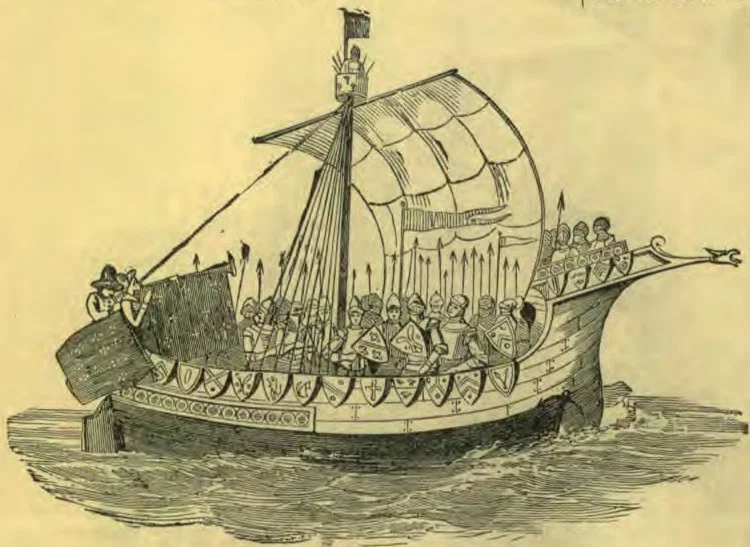
WHITHER is this ship sailing? to what far country? and with what intent? Surely no peaceful design has called forth these grim knights, clad in helmet and corselet of steel, with burnished shields and glittering spears. No doubt they are faithful followers of their king, and going at his command to war against his enemies. At the stern stands the trumpeter, merrily sounding the spirited notes of the war song. Up at the topmast head is stationed a skilled warrior, with good, true weapons wherewith to trouble the foe.
Or it may be they are red cross knights, bound by some vow, on a pilgrimage across the Great Sea to the Holy Land; and in this way they vainly hope to atone for the bloodshed they have caused, and the sins they have committed. Such pilgrimages were frequently made in those early days.
Their frail barque rides high out of the water. It does not look as if it could hold very many passengers, or withstand a very tempestuous sea. It must be very much smaller than the vessel the great apostle took shipping in when he sailed to Rome; and it does not seem to be any better made, although built nearly fourteen hundred years after Paul sailed over the blue waters of the Mediterranean, in that wild autumn storm.
No doubt these sailors have on board strong ropes, hundreds of feet long, that they can bind about the vessel in a storm, just as the sailors did on Paul's ship, when it quivered from stem to stern with the violence of the waves. Then, you remember, they undergirded the ship with those strong ropes, to keep it from falling to pieces.
It seems wonderful that they could make such long voyages in these little ships that we would not consider fit for a fishing boat. Just think of trying to sail from Spain to the Holy Land in a boat that in a hard storm had to be bound about with ropes, to keep her from falling asunder! Columbus must have had some better ships than this one, when he crossed the Atlantic nearly a hundred years later, and no doubt they were a little larger too. Such ships were thought to be wonderful contrivances then.
But what would these old-time mariners say if they could see the wonderful steam-ships of modern times, that can cross the Atlantic in a week? What would they think of the great cable that unites the two continents, so that people can talk together, though three thousand miles of water stretch between them; and of the miles of railroads, telegraphs, and telephones stretching over the country? They would surely believe the prophet was right when he said, so many, many hundreds of years ago, that near the time of the end “many shall run to and fro, and knowledge shall be increased.” W. E. L.

AN EMBLEM OF HOSPITALITY.

Among the wandering tribes of Arabia, salt is an emblem of hospitality. If a thief, groping in the darkness, happens to lay his hand on a vessel of salt, and he tastes of it, he abandons his hostile purpose and withdraws. An Arab protects his deadliest foe, if he has ever tasted salt with him. Layard, the famous traveler, in going to Assyria, had to pass through the territories of a hostile kalhni, who had slain several Englishmen, and who was now trying to get the traveler. Layard knew of his hostile intentions, so one day, drawing near his enemies, he waited till the dinner hour, when they were all in their tents. He rushed into their midst, and seizing a bowl of salt, he put some of it to his lips, exclaiming, “Now I am safe.” “You are safe,” was the reply; and every possible kindness was afterward shown to Layard.—Pansy.

A RIDE THROUGH MISSION VALLEY.

On the first day of February we went for a ride into the country surrounding San Diego, Cal. The weather was delightful. We drove briskly along the shore of the beautiful land-locked bay upon which San Diego is situated. Soon we reached old San Diego, or “Old Town,” as it is called. Here a high point of land, perhaps twelve miles long and three miles wide, runs out into the ocean, forming the northern boundary of San Diego Bay. Near the end of this point, called Point Loma, stands a light-house that I have been told is the second highest in the world.
Old San Diego is a ruined and dilapidated old town. Many of the buildings are built of adobe, a kind of unburnt brick made of yellow clay. Unfinished and unroofed buildings are numerous; and others, that have been deserted, are rapidly moldering back to earth; altogether they present a sad picture of desolation. The few scattered inhabitants seem devoid of enterprise, and gaze upon the stranger as if travelers’ visits were short and far between.
Leaving this old town, we drove east, up Mission Valley, following the course of the San Diego River. Mission Valley has but few inhabitants. It is almost naked of fences or trees. But little of the soil is cultivated, the land being used for pasturage, which is quite good during the winter and spring.
Very many years ago, this valley was quite thickly settled. Unmistakable traces of these settlements may still be clearly seen in the adobe buildings frequently met with, once happy homes, but long ago abandoned to decay. Standing in proximity to some of these moldering ruins are the shade trees of the old-time occupants,—the date palm, the only living witnesses of departed life. Some of these trees are at least forty feet in height, with rough, gray, limbless trunks. At the top, spreading out like an immense umbrella, are the long, sword-like green leaves; while beneath the green ones, hang the long, gray, dead leaves of other years, giving the trees a striking appearance of venerable age, well suited to the long vigils they are keeping.
The next point of interest in this valley is the ruinous Old Mission, founded in August, 1774. In 1775, out of forty-six souls living at the Mission, all but five were murdered by the Indians; and the buildings were burned. The rebuilding began the next year, and continued without further disturbance. This immense adobe structure, long ago deserted, its roof and walls crumbling and falling in, gives evidence of once having great strength. The walls are four feet in thickness. What a storied silence lingers around them!
Just below the ruins, on the flat, or river bottom, is the oldest olive orchard in the State; still green and fruitful, but sadly on the decline.
On the Old Mission premises there are large patches of the tame, flat cactus. I noticed some fully twenty feet in height, with trunks twelve inches or more in diameter. I went under and among them. It was so strange,—a forest of cactus! They are sometimes known as the prickly pear. We tasted of a prickly pear, which we picked from a cactus tree, and found the sweet, rich, yellow, spicy fruit not unpalatable. We could but think of the great difficulty that “Peter Prangle” must have experienced in picking three pecks of prickly prangly pears from the touch-me-not branches of three prickly prangly pear trees.
From the Old Mission we made a hasty journey of perhaps twelve miles up the mountain-side, and over the mesa, or table-land, to San Diego. H. A. ST. JOHN.

CAMP-MEETING SABBATH-SCHOOL LESSON FOR DIVISION B.

LOVE TO GOD AND MAN.

1. Whom has God commanded us to love? Luke 10:27.
2. How much are we to love God?
3. Who has given us our mind, and all our strength?
4. How much are we to love our neighbor?
5. If we love our neighbor as ourselves, how will we be likely to feel toward our kinsfolk and brethren?
6. What is the greatest love we can have for any one? John 15:13.
7. How much are we to love our brethren? 1 John 3:16.
8. What did our Lord himself say about this? John 15:12.
9. How much did Jesus love his disciples?—He gave his life for them. Eph. 5:2.
10. How should we feel toward our enemies? Matt. 5:44.
11. What example of this did our Saviour set? Rom. 5:8; Luke 23:34.
12. What thought will help us to love even our enemies? 1 John 4:11.
13. How has God shown his love to us? John 3:16.
14. How ought we to show our love to one another? 1 John 3:18.
15. What does God especially command? Verse 23.
16. How important does our Lord regard this commandment? Matt. 22:35–40.
17. If we have this unselfish love in our hearts, will we be likely to do harm to any one? Rom. 13:10.
18. If we thus keep the commandments of God, and do the things that are pleasing in his sight, what shall we receive? 1 John 3:22.
19. Who are said to be born of God? 1 John 4:7.
20. Can we be the children of God without loving our enemies?—No; for Jesus commands us to love our enemies that we may be the children of God. Matt. 5:45.
21. How may we know that we dwell in God, and he in us? 1 John 4:13.
22. If we keep the love of God in our hearts, how shall we feel at the coming of our Lord? 1 John 2:28.
23. What promise is made us? Verse 25.

CAMP-MEETING SABBATH-SCHOOL LESSON FOR DIVISION C.

UNSELFISH LOVE.

Long, long ago, our Lord Jesus Christ came to this earth to tell men the way to heaven. One day a man who thought himself very wise, asked Jesus a question. He said, “Master, which is the great commandment?” Jesus said, “Love the Lord thy God with all thy heart, . . . and thy neighbor as thyself.”
The man of learning said this was a true answer, but he did not seem quite satisfied; for he said, “Who is my neighbor?” Then Jesus told of a man who was robbed, while on his way from Jerusalem to Jericho.
These cities are away across the ocean, in a country called the Holy Land. Jerusalem lies among the hills and mountains, while Jericho was on the edge of a plain, not far from the River Jordan. The road from Jerusalem to Jericho is crooked and very dangerous. In some places great rocks hang over the path; while close by, on the other side, you can look away down, down, into the ragged ravine below. The turns of the road around the sharp rocks are so short that robbers may be close by, and not be seen.
Now while the man that Jesus told about was going along this lonely path, a band of thieves fell upon him. These cruel men were not satisfied with robbing the poor traveler, but stripped him of his clothes, wounded him, and nearly killed him. Then they ran off, and left him to perish.
There the man lay, naked, and bruised, and bleeding. He did not know what would become of him, but after a time a priest from Jerusalem happened to come along.
How glad the man must have felt to see help so near! But the proud priest, when he saw his helpless brother in such a plight, passed by, and went on his way. Next there came a Levite. Now, thought the man, I shall surely be cared for. But no; the Levite did as the priest had done, who so coldly passed him by. What was to become of the poor traveler? The priests and Levites served in the temple, and were supposed to be the best of men. If they would not help him, what could he expect from any one else?
By and by, however, there came along a Samaritan. Now the Jews and the Samaritans had once had a quarrel, and hated one another so badly that the Jews called the Samaritans dogs, and would not even eat with them. So, of course, the traveler, who was a Jew, did not expect any help from the Samaritan. What must have been his surprise, then, to see the Samaritan stop, get off from his beast, and come to him. He was an entire stranger to the Jew, and was far from home, on a journey; yet he pitied a man in distress, and was glad to help him. After tenderly dressing the man's wounds, he put him on his own beast, took him to an inn, and paid for having him taken care of until he should get well. When Jesus had finished telling his story, he asked, “Who was neighbor to him that fell among thieves?” The wise man answered, “He that showed mercy on him.” Then Jesus said, “Go thou, and do likewise.”

QUESTIONS.

  1. When did the Lord Jesus come to this earth?
  2. What did he tell men?
  3. What question was asked him by a man who thought himself very wise?
  4. What did Jesus say?
  5. Did the man think this a good answer?
  6. Did it satisfy him?
  7. What other question did he ask?
  8. How did Jesus answer this question?
  9. In what country were the cities of Jerusalem and Jericho?
  10. Where is the Holy Land?
  11. Did you ever see any one who had been there?
  12. Would you like to visit it?
  13. In what kind of place does Jerusalem lie?
  14. Where was Jericho?
  15. What about the road between these two cities?
  16. What hung over the path in some places?
  17. What might you often see on the other side?
  18. What about the turns in the road?
  19. How could that keep the robbers from being seen?
  20. As the man that Jesus told about was going along this lonely path, what happened to him?
  21. Were these men satisfied with robbing the traveler?
  22. What else did they do?
  23. In what condition did they leave the man?
  24. Who happened along after a time?
  25. How do you think the man must have felt when he saw a good priest coming?
  26. Did the priest see him?
  27. Did he go to him and help him?
  28. What did he do?
  29. Who next came along?
  30. How did he act?
  31. Why did the people expect the priests and Levites to be the best of men?
  32. Could the traveler expect to get any help from others, when such good men took no notice of him?
  33. What stranger happened to be passing through that lonely place that day?
  34. How did the Jews feel toward the Samaritans?
  35. What did they call them?
  36. In what other way did they show their hatred for them?
  37. Could the poor, wounded Jew expect any help from this Samaritan, whom he hated so badly that he would not eat at the same table with him?
  38. What did the Samaritan stranger do when he saw his enemy in such a plight?
  39. How did he take the man to a place of safety?
  40. What else did he do for him?
  41. Which showed the most unselfish spirit—the priest and the Levite, or the Samaritan?
  42. Which had the truest love for him?
  43. Which pleased God most?
  44. Has God told us to love our enemies?
  45. Can you find it in your Bible?
  46. When Jesus had finished his story, what question did he ask the wise man?
  47. What did the man say?
  48. What did Jesus tell him to do?

IMPORTANT BIBLE SUBJECTS.

LESSON 48.—INHERITANCE OF THE SAINTS.

(Continued.)

CHRIST THE PROMISED SEED.

[NOTE TO THE STUDENT.— Do not consider the lesson learned until you can give at least the substance of every text, with the correct reference for each. The references in black letters indicate those texts that should be committed to memory. A little diligent application each day will enable you to do this.]
1. To whom besides Abraham himself was the promise made? Gen. 17:7.
2. When the promise was made to his seed, to whom did the Lord specially refer? Gal. 3:16.
3. Quote the texts given with Gen. 3:15 to show that Christ is the one who is to win back the earth.
4. What will he then have for his possession? Ps. 2: 7, 8.
5. What persons are also called sons of God? Rom. 8:14-16.
6. What follows from the fact that we are children of God? Rom. 8:17.
7. Then to be children of Abraham, and heirs of the promise made to him, to whom must we belong? Gal. 3:29.
8. How is it that we belong to Christ? 1 Peter 1:18, 19; Rev. 5:9.
9. What act marks us as his? Gal. 3:27.
10. What have we before seen to be the characteristics of the children of Abraham? John 8:39.
11. And what were the works of Abraham? Gen. 26:5.
12. What verse in the New Testament, then, gives a complete description of his children? Rev. 14:12.

CAMP-MEETING LESSONS.

In accordance with the action of the General Sabbath-school Association at its session last December, a series of lessons has been prepared for the use of the children at the camp-meetings for this season. Division A, using the lessons in the INSTRUCTOR, will recite the regular lesson for the date at which the meeting occurs; but as the lessons for the children are not alike in all the churches, it is necessary to unite on something that will make the work on the camp-ground as simple as possible. To accomplish this, there will be only two divisions among the children. Those children who are using Books Nos. 1 and 2 will study the lesson for the C Division. Those using Books Nos. 3 to 6 will study the lesson for Division B.
Preserve this paper, for it contains the lessons that will be recited by the children at your camp-meeting. We ask that the parents take special pains to assist their children to learn these lessons before they go to the meeting, as the time is usually so taken up on the ground that it is difficult to do much studying there. A full supply of the Sabbath-School Worker “Extra,” containing all the lessons, will be sent to each meeting, and yet it is not best to wait till you get there, but prepare the lessons before going.
It will be seen that both the lessons for the children are prepared on the same subject of “Love.” This will give the chance to review both the divisions together, by the exercise of a little ingenuity on the part of the questioner. A “Review Exercise” is given in the “Extra” referred to above, which will assist in accomplishing this.
S. S. PUB. COM.

SHELLS OF THE OCEAN.

A TRAVELER in Palestine, writing for the press in America, gives a description of the shell banks on the shores of the Mediterranean Sea out from Jaffa, which one cannot read without being impressed with God’s immensity in his work of creation. The writer says:—
“The shore of the sea was strewn with eighty distinct varieties of shells, all molded and colored according to the most exquisite pattern. Involuntarily we drew up our horses, feeling that it would be sacrilege to tread such gems under foot; but my escort said the shells extended for miles, and he set the example of ruthlessly urging his horse over the most beautiful. After awhile, we dismounted and began to gather treasures for preservation.”
“The shell banks were many feet deep in some places, and I had no idea Nature could construct such delicate handiwork. The pinks, blues, and golds were indeed tantalizing. I am not sure that any one at home will believe they are unpolished and unpainted. I cannot conceive how any display could be more elegant; but my attendant says what we saw was tawdry compared with that which may be witnessed after a storm.”
“Tons and tons of these shells have been shipped to America and elsewhere, but the beach is not impoverished. The mighty factories of old Mediterranean are engaged in replenishing the supply faster than man can deplete it.”

CURRENCY OF THE CANNIBAL ISLANDS.

We have in the following paragraphs a description of the money seen by a traveler on the New Hebrides and the Solomon Islands:—
“On one of the islands he noticed a neatly kept house, which he was told was the money-house. Entering it, he found a number of mats hanging from the roof, beneath which a fire was constantly kept up, under the effects of which they became covered with a black, glistening coating, and adorned with festoons of soot. It was a man's business to keep the fires always burning, and so low as not to scorch the mats. A well-colored mat is very valuable. It is the strangest of all kinds of money, for it must never be taken from the money-house, even when the title in it is transferred from one owner to another.
“The inhabitants of Santa Cruz Island use for money rope-ends, about an inch thick, and ornamented with scarlet feathers, which are worn about the waist. The traveler could not obtain new coins of this kind, but found them current everywhere. The specimens he bought were already old, and the feathers grown dingy.
“The money of the Solomon Islands consists of neatly worked pieces of shell about the size of shirt buttons. These were strung on strings about four yards long, and are distinguished under the names of red and white money. They usually wear them around the neck. This gentleman saw a necklace of this kind which was valued at about a hundred dollars. Marble rings are also worn on the breast for ornaments, and as valuable money.”

TREE-HOUSES

It is true that the tree-house in the story of the “Swiss Family Robinson” is a fiction, but if we can credit the following, as given in the Youth’s Companion, such houses are sometimes built:—
“A recent traveler among the islands of the South Pacific says that the tree-house is common among the natives. Trees grow there to the height of a hundred feet without a branch, and are then full of large boughs and dense leaves. The natives build houses large enough to accommodate ten or twelve inmates, and stock them with provisions, and with stones and other weapons of defense.”
“To reach the lower branches from the ground, they make long ladders of creeping vines, which are fastened securely at the top, and may be drawn up quickly at notice of coming danger. They do not usually live in the tree-houses, but in huts upon the ground. When invaders come from the neighboring islands, they retreat to their lofty homes, where they are secure from danger.”

A Quaker's Maxim on Kindness and Opportunity

A QUAKER once wrote: “I expect to pass through this world but once. If, therefore, there be any kindness I can show, or any good thing I can do to any fellow being, let me do it now. Let me not defer or neglect it, for I will not pass this way again.”

QUEER UMBRELLAS.

The first umbrella was built in the night. When and where, nobody knows; but it was years and years ago. Possibly you think it was of little use, if only a “toad’s umbrella.” Do not be sure of that. If the steam-engine was suggested by the lifting of the lid of a boiling tea-kettle, why should not our umbrellas be suggested by the natural ones?
Umbrellas were in fashion among birds, animals, fishes, and plants long before men used them. Even to-day, one of the prettiest is that worn by the “umbrella bird” of South America. The plume-like parasol of the gray squirrel, as he sits eating his noonday meal, shading himself with his bushy tail, is of ancient date.
Although fish are not afraid of the rain, some of them carry umbrellas; just why, we do not know, but the “umbrella shells” have been carrying their little pearl parasols for thousands of years.
As for plants, the palm, toad-stool, and “umbrella tree” are but a few of the many that follow the fashion.
Nature’s umbrellas are made better than man’s. They are strong, pretty, and last during the owner’s life-time. They never are lost or stolen; and though a strong wind may break them down, it rarely turns them inside out.
The umbrella birds, trees, and fishes are never caught in a shower without protection; and if one of them possesses a damaged umbrella, he never leaves it in his neighbor’s hall, and goes away with a better one. Instead, he polishes it up as nicely as possible, and is as proud as if it were the best made.
In all the books we have read, we have found no case of an absent-minded umbrella bird, tree, or fish. This is very strange, but it is true.
The first knowledge we have of umbrella men reaches back a number of thousands of years, to the time when the great pyramids and carved monuments of Egypt and Assyria were young and first made. From pictures left on the pillars and walls in Egypt, we know that the ancient kings and nobles used umbrellas.
Then among the Asiatic peoples, the Chinese, Japanese, and Burmese, came the stiff-looking parasols of paper and feathers, ornamented with pictures of strange birds and beasts.
In Burmah a man of rank is known by the number of umbrellas he may carry. The king is the “lord of twenty-four umbrellas;” and in the pictures which represent him sitting in state, there are held over his head twenty-four umbrellas, all on one central handle; from which it may be seen how fond the Orientals are of making a spread.
Although the people of many countries greatly valued the umbrella, it is only a little over a hundred years since the English people thought it a very silly thing for a man to carry one, no matter how hard it rained. Of all the wise men who lived in great London, none had courage enough to carry an umbrella. Ladies carried them, but for a man to do so every one thought would be as ridiculous as if he wore a lady’s dress or a bonnet. They therefore turned up their coat collars, put their hands in their pockets, and tramped along through the drenching rain, spoiling their hats and their tempers, and leaving comfort for the ladies.
One man, however, whose name was Jonas Hanway, did not like to get wet, and cared little what people said, so one day he appeared in the street holding an umbrella over his head. And what a tumult it caused! Boys ran, shouted, and jeered; men laughed; women and girls giggled. But what cared Jonas? He was dry. They were wet. Let them laugh. Before long, other men began to carry umbrellas. Then people laughed at them. But more and more it became the custom, till now for a gentleman not to own an umbrella is as strange as it was then for Jonas Hanway to carry one.
Not long ago a man invented an umbrella or parasol to be attached to the neck and shoulders, leaving both hands free. Few people, however, cared to be turned into “umbrella birds,” so they never have become popular.
If all the umbrellas that are made in a single year in the United States were placed in a row, allowing three feet of space for each, they would make a procession three thousand miles long; for it is estimated that their number exceeds seven million.
Philadelphia is the great umbrella city of America, as there are more factories for them there than anywhere else.
It is quite a job to make an umbrella. How long do you suppose it takes? Just fifteen minutes. Although a single umbrella is put together in so short a time, there are a great many hands employed in doing it. The steel workers, the brass and nickle finishers, the carvers, the cutters, the stitchers, the ironers, and the finishers are but a few of the army of helpers. First the stick, nicely polished, carved, and slotted, is mounted; then it is fitted with ribs and stretchers; next the lower end of the stretcher is strung on the wire runner. When the two runners are secured, the V-shaped pieces of gingham or silk for the cover are sewed together, and, with a few skillful stitches, are put on the frame. A little finishing, examining, and wrapping, and it is ready to lend a helping handle to its purchaser in some of his many battles with the storms of life.—Little Christian.
Continue reading: DECIDED LITTLE ROBBIE