Your ShelfYour Projects

Review and Herald, Vol. 75, No. 17.

CHRIST'S COMMISSION

Review and Herald

Apr 26, 1898

Seventh-day Adventist Publishing Association · Battle Creek, Mich. · Apr 26, 1898

CHRIST'S COMMISSION.

MRS. E. G. WHITE.
The Lord has given his church a special work of personal service to do. God could have sent angels to work for the reformation of man, but he did not do this. Humanity must touch humanity. The church is the Lord's instrumentality. He works through those that are willing to be worked. If the church had cherished a sense of her accountability, fervent, earnest messengers would have carried the truth to countries far and near. God's living word would have been preached in every corner of the earth.
What was Christ's last commission to his disciples before he left them?—Lifting up his hands, he blessed them, and said, “Go ye into all the world, and preach the gospel to every creature.” This command has not been fully obeyed by the professed followers of Christ. Our salvation depends on our obedience. It is left with each one to say whether he will qualify himself to do the work God has appointed him to do, or whether he will bury his talent in the earth.
Christ's commission is to be received and acted upon. We are to go forth in faith, with earnest prayer for the promise of One who has said, “Lo, I am with you alway, even unto the end of the world.” With the promise of such companionship, we are guilty of great unbelief and disobedience if we refuse to take up the cross of self-denial and self-sacrifice.
The words, “Go ye into all the world, and preach the gospel to every creature,” are spoken to every individual. We may be adapted for different branches of the work; but while we do our part unselfishly, we are obeying the command. Do we search the precious word of God interestedly, that we may say, “The entrance of thy words giveth light; it giveth understanding unto the simple,” not to men and women of weak intellect, but to those who cherish simplicity of heart and mind, who are willing to be taught by the Holy Spirit, that they may know how to open the word of life to others? As we communicate the light that has found entrance to our souls, the Holy Spirit gives increased light, and our hearts are filled with the precious joy of the Lord.
Christ did not go to heaven directly after his death. It is claimed by some that when he died, although his body was laid in the grave, his spirit went to heaven. But after his resurrection he said to Mary, “Touch me not; for I am not yet ascended to my Father: but go to my brethren, and say unto them, I ascend unto my Father, and your Father; and to my God, and your God.” If, after he bowed his head and died, he went directly to heaven, certainly he did ascend to his Father.
Christ remained in the grave the allotted period of time, and then he took up his life again. In the hearing of the people he had said, “Destroy this temple, and in three days I will raise it up,” referring to his body. He came forth from the grave a conqueror, proclaiming, over the rent sepulcher of Joseph, “I am the resurrection, and the life.”
We have a crucified, risen Saviour to present to the people. All who have come to Jesus for pardon have found him ever ready to take their sins, and to impute his righteousness to them. He who has come to Christ, and has been truly converted, will have a longing to save the souls that are out of Christ. He who loves God supremely and his neighbor as himself cannot rest content with doing nothing. He goes forth proclaiming, “Behold the Lamb of God, which taketh away the sin of the world.” As he comes to Christ himself, his whole soul breathes out for Christ. He receives the light and knowledge that the Lord gives to every true seeker to impart to others. After the Holy Spirit has molded the heart of the true believer, the light that enters heart and mind cannot be shut in; it must shine forth to others.
God will use humble men as his instruments. Even though they have but one talent, if they trade upon it, it will increase. The great fault in the church is that the work of saving souls is so limited that the advancement of the kingdom of God is slow. A backslidden church is the sure result of a selfish church,—a church that does not use her talents in co-operating with Jesus to restore the image of God in men. We are to minister to every creature. A responsibility is laid upon us to work for all,—our friends, our acquaintances, those who are bound up with the world and alienated from God. The apparently amiable and agreeable are to come into the sphere of our labors. The truth is for them as much as for us, and we must say, “Come.”
God has entrusted the knowledge of the truth of redemption to every converted soul, and this knowledge is to be given to others. With a tender, sympathetic heart, tell them of the great truth of redemption. If we are in earnest, we can and will so speak that all will see that we have the love of the truth in our hearts. The frivolity and love of amusement that we encounter may chill our soul, but it will not silence the message we bear as Christ's witnesses. And each soul saved will save other souls; for those who are truly converted will realize that they are the depositaries of sacred trusts. What rich blessings will follow pure, consecrated effort, the worker depending on God to give the increase!
It is a most fatal mistake to suppose that the work of saving souls depends alone on ordained ministers. All who are ordained unto the life of Christ are ordained to work for the salvation of the souls of their fellow men. “The Spirit and the bride say, Come. And let him that heareth say, Come. And let him that is athirst come. And whosoever will, let him take the water of life freely.” It is by the Spirit's power that souls that are dead in trespasses and sins are quickened to hear the words of life.
There are heathen at our doors; there is infidelity in the church that palsies the working element with unbelief. The command to work unselfishly and earnestly, wearing Christ's yoke and bearing his burdens, rests upon every soul. Wherever his work, whatever his business, his first interest is to seek the kingdom of God and his righteousness; and by precept and example, in word, spirit, and action, to show his earnest zeal for Christ.

THE SECRET OF HIS PRESENCE.

In the secret of His presence, how my soul delights to hide! O, how precious are the lessons which I learn at Jesus' side! Earthly cares can never vex me, neither trials lay me low; For when Satan comes to tempt me, to the “secret place” I go.
When my soul is faint and thirsty, ’neath the shadow of His wing There is cool and pleasant shelter, and a fresh and crystal spring; And my Saviour rests beside me as we hold communion sweet; If I tried, I could not utter what he says when thus we meet.
Only this I know: I tell him all my doubts and griefs and fears; O, how patiently he listens, and my drooping soul he cheers! Do you think he ne’er reproves me? What a false friend he would be If he never told me of the sins which he must surely see!
Do you think that I could love him half so well, or as I ought, If he did not tell me plainly of each sinful word and thought? No! he is so very faithful, and that makes me trust him more; For I know that he does love me, though he wounds me very sore.
Would you like to know the sweetness of the secret of the Lord? (Go and hide beneath his shadow; this shall then be your reward: And whene’er you leave the silence of that happy meeting-place, You must mind and bear the image of your Master in your face.
You will surely lose the blessing and the fulness of your joy If you let dark clouds distress you and your inward peace destroy; You may always be abiding, if you will, at Jesus’ side; In the secret of his presence you may every moment hide.
— Ellen L. Gorch.

Laboring Earnestly to Bring Souls to Christ

“As Christians, we are to labor most earnestly to bring souls to Christ. There must be no cheap chapters of experience woven into our Christian life.”

THE SECRET OF WINSOMENESS.

WHAT is it in Jesus that so draws men, that wins their allegiance away from every other master, that makes them ready to leave all for his sake, and to follow him through peril and sacrifice even to death? Is it his wonderful teaching?—“Never man spake like this man.” Is it his power, as revealed in his miracles? Is it his sinlessness?—The most malignant scrutiny could find no fault in him. Is it the perfect beauty of his character?—None of these things will account for the wonderful attraction of Jesus. Love is the secret. He came into the world to reveal the love of God; he was the love of God in human flesh. His life was all love. In most wonderful ways during all his life did he reveal love. Men saw it in his face, and felt it in his touch, and heard it in his voice. This was the great fact which his disciples felt in his life. His friendship was unlike any friendship they had ever seen before, or dreamed of. It was this that drew them to him, and made them love him so deeply, so tenderly. Nothing but love will kindle love. Power will not do it, holiness will not do it, gifts will not do it,—men will take your gifts, and then repay you with hatred. But love begets love, heart responds to heart. Jesus loved.—Dolan.

THE TEACHING OF LIGHT.

L. A. REED.
(Jacksonville, Ill.)
JOHN was called the disciple whom Jesus loved. He was closely associated with our Lord during his earthly ministry, and was favored with marvelous revelations of God through Jesus Christ. And this message which God committed to him, he seems, in his first epistle, to have summed up in few words; for he says, “This then is the message which we have heard of him, and declare unto you, that God is light, and in him is no darkness at all.” 1 John 1:5.
Because the Word says that God is light, it does not necessarily follow that light is God. The converse of a proposition is not necessarily true. But God is light, and all out of him is darkness; therefore, light is of God. We find reasoning like this in 1 John 4:7, 8. In verse 8 we have the statement that God is love; and in verse 7 we have another statement, not that love is God, but that love is of God. And from this it follows that love is a manifestation, or revelation, of God. 1 John 4:10; John 3:16; Rom. 5:8.
By a parity of reasoning, since light is of God, light is a manifestation, or revelation, of God. Indeed, this is the definition of light. “Whatsoever doth make manifest is light.” Eph. 5:13. Then, anything that makes manifest is light. But what is it that light makes manifest?—We have already said that it makes God manifest. But are we not told that the works of the flesh are manifest, and that the reproved things are by the light made manifest?—Certainly. But the revelation of sin is always the revelation of righteousness. Sin is the lack of righteousness, and the revelation of sin is the revelation that righteousness is lacking,—that righteousness ought to be where as yet it is not. But this revelation of righteousness is the revelation of God; for there is none good but God (Mark 10:18), and there is none but him righteous, no, not one. Rom. 3:10. Then, the revelation of righteousness is the revelation of God’s righteousness, it is a revelation of God’s character, it is God made manifest. And this agrees with the truth that Jesus Christ, who is the Light of the world, was God made manifest in the flesh.
Now this reasoning does not pertain to spiritual light alone. All that we have here said is true of natural light also. The light from the sun is as truly a revelation of God as is anything he has given. It may not be as full a revelation, though this I am disinclined to admit, and it may not be as plain a revelation. But Paul says that the invisible things of God, even his eternal power and Godhead, are clearly seen, being understood by the things that are made. And though it is not given to me to say how clearly, or plainly, sunlight reveals the character of God, it is given to us all, in the verse referred to, to say that since sunlight is one of the things made, it is one of the things which clearly show the eternal power and divinity of God. The invisible things of God are clearly seen, being understood by the things that are made.
Many books are given to a study of light for light’s sake; but I do not know of one that is given to a study of light with the purpose of finding in light the revelation of God. But the REVIEW is ever ready to proclaim the principles of Christian education; and through the kindness of its editors, I hope to show you, in the sunbeam, some of the marvelous revelations of God’s wondrous character.

“HAVE YE RECEIVED THE HOLY GHOST SINCE YE BELIEVED?”

R. A. UNDERWOOD.
(Mesopotamia, Ohio.)
If not, why not? God’s word is a living, present truth to every one who believes. That there are aggressive and progressive steps in the Christian life, no one with the open Bible before him can deny, even if his own experience has not verified this truth. How often we have heard the statement, “I desire a deeper work of grace in my soul.” Thousands have longed for more power, to be kept from sin, and to rescue men and women from death. It is good that we have such a desire; but will God create the desire and not supply the demand?—To do so is not like our Father, who, the promise is, “shall supply all your need according to his riches in glory by Christ Jesus.”
We hear much at the present time about the baptism of the Holy Spirit. That we have reached the time when the “latter rain,” “the refreshing,” “the outpouring of the Spirit,” “the baptism of the Holy Ghost,” should be experienced by the people of God, is a plainly revealed truth of the Bible.
In all ages when God has had a specific work to be done in the earth, a counterfeit has been introduced, by which many have been deceived. Now that God is about to bestow upon his waiting, trusting people the greatest of all spiritual blessings, we are in danger of being led to accept the spurious. In view of this, every child of God should, with humility of soul, study the Word with earnest prayer for light upon this subject.
We must understand and accept the conditions upon which God has promised the baptism of the Spirit. If we do not, we may be led to accept the false. Before entering upon the study of this most important subject, I will quote the following from the pen of Mrs. E. G. White, on pages 126 and 127 of “Gospel Workers:” —
The Lord often works where we least expect him; he surprises us by revealing his power through instruments of his own choice, while he passes by the men to whom we have looked as those through whom light should come. God desires us to receive the truth upon its own merits,—because it is truth.
No one should claim that he has all the light there is for God’s people. The Lord will not tolerate this. He has said, “I have set before thee an open door, and no man can shut it.” Even if all our leading men should refuse light and truth, that door will still remain open. The Lord will raise up men who will give the people the message for this time . . .
The spirit in which you come to the investigation of the Scriptures will determine the character of the assistant at your side. Angels from the world of light will be with those who, in humility of heart, seek for divine guidance. But if the Bible is opened with irreverence, with a feeling of self-sufficiency, if the heart is filled with prejudice, Satan is beside you, and he will set the plain statements of God’s word in a perverted light.
These extracts need no comment. Reader, pause and lift your heart to God in earnest prayer to be kept by his power from those things that invite Satan to stand by your side, and that you may receive only truth and light.

Trust in the Lord, Day by Day

“Trust in the Lord to hide thee, Wait on the Lord to guide thee, So shall no ill betide thee, Day by day.
“Rise with his fear before thee, Tell of the love he bore thee, Sleep with his shadow o’er thee, Day by day.”

CONCENTRATION

The King's Messenger.
Do one thing, and do it well. “This one thing I do,” and keep doing. A constant dropping wears away the stone. Don’t scatter. Concentrate, and consecrate to concentrate. Put your heart and hand, your mind and will, to everything you do. Don’t be diffuse or superficial.
These are Holy Ghost days; press them, fill them, use them. We are loose in our business and in our religion, in our home and in our society. Let us gather up, pull ourselves together, concentrate, and mind our business; never wobble, but put ourselves and himself in everything we do, doing our work as unto the Lord.
Keep straight at the thing in hand. Put your mind on it, make your mental activities be subservient to it. Think it out. Some one has brightly said, “We seldom think of anything because we are always thinking of something else.” Don’t think yourself; let Him think,—let him be made unto you wisdom. Your thoughts are vain thoughts. Concentrate on him. He will bring to your remembrance, and will see that the pigeonholes in your mind are stocked with well-assorted facts, and will arrange and bring them forth at the proper time and in the right manner and best place. Let him do this.
Jesus is power, and he understands the economy and use of power; he will not allow it to run to waste or be vitiated; but will sustain it, and make it accomplish his purpose in the right direction and proper manner every time.
He is the Condenser and Concentrator: our strength will be increased; for our weakness will be merged into his power. Physical and spiritual forces will be held and used by him. We shall not weary, we shall not faint. Our leaf shall not wither, and whatever we do shall prosper.
Concentrate on him and in him. Receive ye the Holy Ghost. Be of one mind; only such a mind counts. Have but one idea, and that idea him.
Witness unto him. Let him make Jesus known, let him make the truth known, let him open the Scriptures to your understanding. Let him; it is his office work. He can do it; we cannot. Tell of him, and tell what he has done, and is doing, in, for, by, and through you; and that he will do exceeding abundantly above all we can ask or think for every one, or any one, who will receive him.
Confine yourself to him, fix your heart on him. Give him a chance to commune: communion is better than service or work. Talk with God, and God will tell. He will make himself known. Let him.

THE TREMBLING MOUNTAINS AND MOVING HILLS.
A. O. TAIT.
(Oakland, Cal.)
The prophecies of both the Old and the New Testament are filled with descriptions of the great storms and general upheavals of the earth that will mark the closing years of time. These descriptions are given in the most vivid and forcible language. In vision, God placed the prophets in the very midst of these last-day tremblings and tossings of earth. With the most intense reality the upheavals of the ground, the trembling of the mountains, and the moving of the hills were viewed by the holy seers. Their vision was so real and so divinely complete that for the time they dwelt right amid the great events of our time. The things actually seen by us in these times were just as really seen in vision by the prophets of old; so in writing of our times, they are truly reporting what they actually saw.
The accuracy of their vision we can verify if we will look about us.
Perhaps there is no more graphic description of the commotions to take place in the earth at the close of time than may be found in the fourth chapter of Jeremiah. Says the prophet: “My people is foolish, they have not known me; they are sottish children, and they have none understanding: they are wise to do evil, but to do good they have no knowledge. I beheld the earth, and, lo, it was without form, and void; and the heavens, and they had no light. I beheld the mountains, and, lo, they trembled, and all the hills moved lightly. I beheld, and, lo, there was no man, and all the birds of the heavens were fled. I beheld, and, lo, the fruitful place was a wilderness, and all the cities thereof were broken down at the presence of the Lord, and by his fierce anger. For thus hath the Lord said, The whole land shall be desolate; yet will I not make a full end. For this shall the earth mourn, and the heavens above be black: because I have spoken it, I have purposed it, and will not repent, neither will I turn back from it.” Verses 22–28.
Verse 26 is sufficient of itself to show when this prophecy applies. It is at that time when the “presence of the Lord” and “his fierce anger” are manifested. These utterances of the Word at once direct the mind to the “last days.” As you read these words of Scripture, the Spirit of God applies them, and the conviction is irresistible that the closing scenes of earth are here presented. And the language is divinely sublime. God has given his Spirit to be the interpreter of his own word; and when the Spirit urges home upon the heart any truth plainly stated in the Word, we have the strongest evidence that can be given of the great realities of the book of God. “If any man will do his will, he shall know of the doctrine, whether it be of God, or whether I speak of myself.” John 7:17. “For the Spirit searcheth all things, yea, the deep things of God.” 1 Cor. 2:10. We should heed the voice of God speaking to us in his word, as he reveals to us the unmistakable tokens of the coming of his Son.
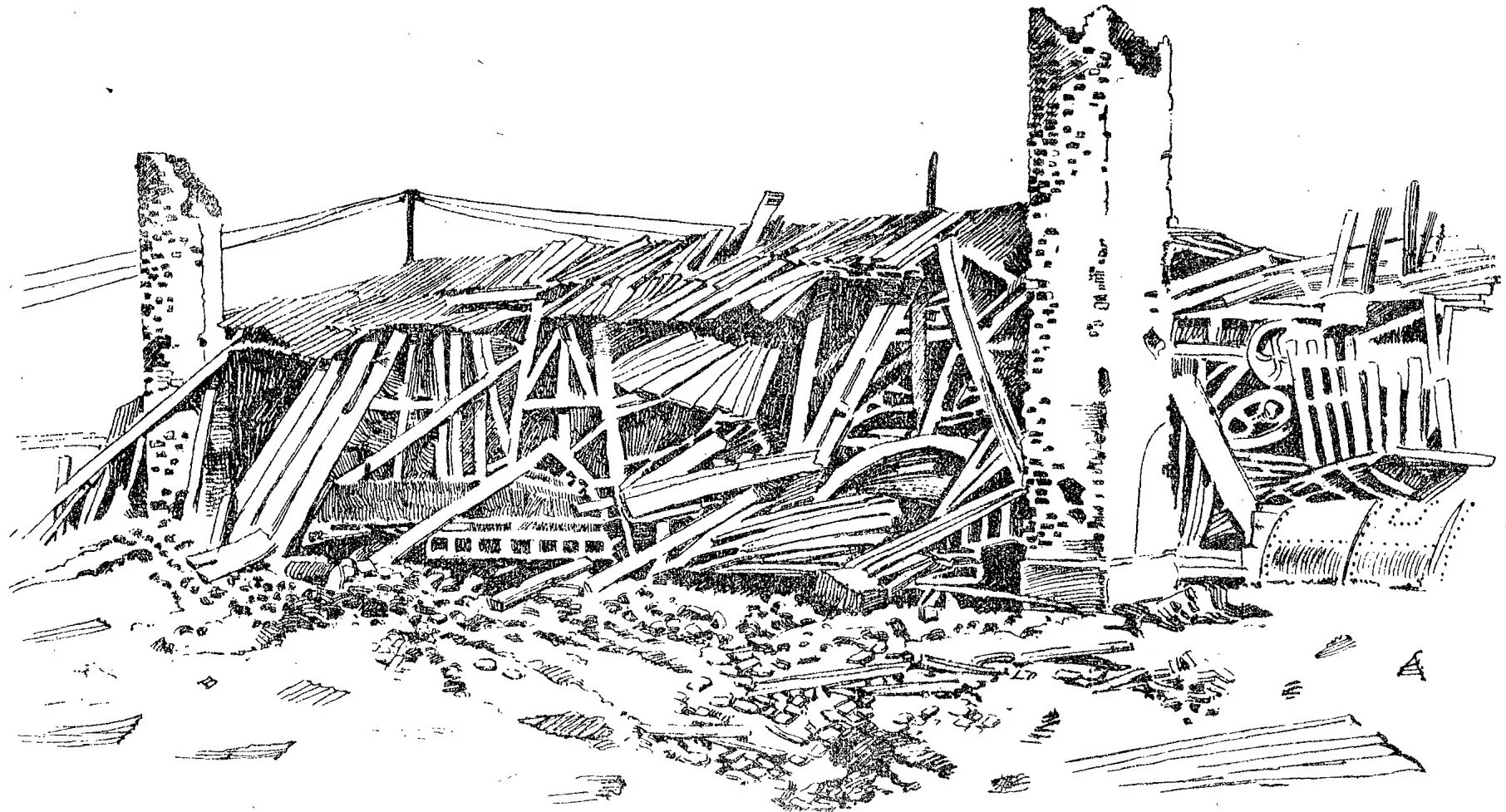
The Sawmill at Mare Island Navy Yard, San Francisco Bay, after the earthquake Wednesday night, March 30, 1898.
Verse 23 of this prophecy says: “I beheld the earth, and, lo, it was without form, and void; and the heavens, and they had no light.” “In the beginning,” when “God created the heaven and the earth,” he said that “the earth was without form, and void; and darkness was upon the face of the deep.” Gen. 1:1, 2. So, then, when Jeremiah viewed the destructive scenes of the last days, he saw the earth so completely “broken down” that it was reduced to its original chaos. It will become again “without form and void,” preparatory to the Lord’s work of creating out of it “new heavens and a new earth, wherein dwelleth righteousness.”
Note how expressive is the prophetic language that describes the work of thus reducing the earth again to chaos. Says the prophet: “I beheld the mountains, and, lo, they trembled, and all the hills moved lightly.” Verse 24. What a wonderful commotion that will be, when the “mountains” tremble, and “all the hills” move lightly! Could language be more sublime? Could expressions be devised that would suggest scenes of more awful grandeur? Only one thought could be more truly sublime, and that is that we are now living in the very time viewed by the prophet. We have seen some of the beginnings of these “tremblings” of the mountains. Their heaving and shaking will become all the more intense as the days go by. And what must be the scene just ahead of us when the time is reached when the “hills” begin to “move lightly”?
It was my privilege to be shaken by the startling earthquake on the Pacific Coast, March 30 of this year. It is said to have been the hardest shock felt in this section since 1868. The trembling continued forty seconds. No particular damage was done except at the Mare Island Navy Yard, in San Francisco Bay; but there the damage was very heavy. The illustration shows the navy yard sawmill after the shock. Many other buildings on the island were damaged, but this one most of all. This forcibly illustrates the fact that when the batteries of heaven open up, the works of men appear very weak and insignificant.
There is something about the shock of an earthquake that is most awfully sublime and majestically grand. The sensation of the shaking and trembling of the earth under your feet cannot be described in human language; it must be experienced in order that one may know what it is. The thought that the solid earth, like the sea, is actually being rocked and tossed by the agencies which God has prepared to shake and crumble things into their original chaos, fills one with reverence. How small does man seem under such circumstances, and how small and insecure appears the earth itself; but how great, how powerful, is our God! If other evidences were lacking, it would hardly seem possible that we could doubt his ability to protect us, after feeling the force of his infinite power in shaking the ground upon which we stand.
It is true that there have been earthquakes in the past; but these, of themselves alone, would not constitute a sign of the end of time. In fact, occasional earthquakes could never be regarded as an evidence of the last days; for something more than an occasional upheaval and shaking is predicted. As presented in previous articles, and as every devoted student of the Word knows, “fearful sights and great signs shall there be from heaven.” Luke 21:11. And “the earth shall reel to and fro like a drunkard, and shall be removed like a cottage.” Isa. 24:20. And in addition to this, attention may be called again to Jeremiah’s words, “I beheld the mountains, and, lo, they trembled, and all the hills moved lightly.”
Picture to yourself, if you can, these mighty commotions of nature, as nature’s God permits the earth itself to “reel to and fro” and tremble with disapproval of the sin that has so long held sway upon it. Imagine all the hills moving lightly, as a tossing bark upon the surging ocean! The Lord is coming, and even the hills are to skip with joy at the approach of the rightful King.
But all are not prepared for this event. Many look with dreadful fear upon these disturbances of the earth. They are trembling before the thought of what they see coming. It is sin, and sin alone, that causes any one to fear because of the manifestation of the power of God. We have entered upon times that will try men’s souls; and only those who have been freed from sin will be able to stand.
Hasten, Christian worker, to give the message of warning, pointing all to the “Lamb of God, which taketh away the sin of the world.”

BEING SANCTIFIED THROUGH TRUTH.

G. W. MORSE.
(Battle Creek, Mich.)
“Sanctify them through thy truth: thy word is truth.” John 17 : 17. Such was the prayer of Christ to his Father for his followers. To sanctify is to set apart, or prepare, for a holy, or religious, service; and truth is the only means whereby a person may become so sanctified. In John 8 : 32 the Saviour says, “Ye shall know the truth, and the truth shall make you free.” Truth is the opposite of error. Error is darkness, ignorance, folly, and sin,—that which will ultimately result in death. Truth is light, wisdom, righteousness,—that which will lead to eternal life. To know the truth in its completeness is to be free from all that is implied by error. To whatever extent one does know truth, just so far is he freed from error and its consequences. What is it to “know the truth”?—Evidently, to understand it, accept it as truth, and conform to it so far as its requirements extend.
All truth is of God. It is not necessary to speak of it as “God’s truth;” for there is no other truth. Then, when we learn a truth, we learn of God. Truth is God’s word, and that is why it sanctifies those who accept it as such. “The word of God is quick, and powerful, and sharper than any two-edged sword, piercing even to the dividing asunder of soul and spirit, and of the joints and marrow, and is a discerner of the thoughts and intents of the heart.” Heb. 4 : 12. It is no wonder that truth has a sanctifying effect upon us; it could not be otherwise.
But in order for truth to have a sanctifying effect upon us, we must recognize it as God’s word. And this is the basis of all true education. “In all thy ways acknowledge him [the Lord], and he shall direct thy paths.” Prov. 3 : 6. To acknowledge the Lord is to recognize him, fully realizing his presence and authority. All education should be from the standpoint of truth, which is God’s word. True education is simply a preparation for holy, or religious, service, and that is just what God purposes that truth shall accomplish for us; for to sanctify is to prepare one for that kind of service. All study of truth, recognizing it as God’s word, is educational in its effect, and brings us more and more into harmony with God. This is the great purpose that should be kept constantly in view,—to come into harmony with God; that is repentance, conversion, salvation.
Since truth is God’s word, and God is love, it follows that truth is but an expression of his love and goodness. What is the purpose of God’s goodness? In Rom. 2 : 4 we are informed that it is to lead us to repentance, and that is just what has been remarked; for to come to repentance is to come into harmony with God. Repentance is simply the act, or process, of exchanging error for truth; it is abandoning error, and accepting truth in its place. Thus it is that the truth will make us free,—free from error, and all that is signified by it.
In Ps. 33 : 5 we are told that “the earth is full of the goodness of the Lord.” That is certainly a vast amount of goodness, and it would seem as if it was sufficient to bring all to repentance. And such would be the case if all would recognize that goodness, and discover in it the wisdom and power of God. This earth is simply one vast globe of God’s goodness, and he wants us to recognize that goodness,—discover it, and comprehend its purpose. The heavens also declare God’s goodness; yea, the whole universe is but one vast, illimitable proclamation of his goodness.
God “hath made his wonderful works to be remembered” (Ps. 111 : 4); but we cannot remember anything that we have never heard of or known about. Hence we readily discover the necessity, yea, the obligation, that rests upon us to study the works of God. In the second verse of the psalm last quoted are these words: “The works of the Lord are great, sought out of all them that have pleasure therein.” The Lord would have us take pleasure in seeking out and studying his works—his goodness. To study God’s works without recognizing God, is of little benefit to one. Just so the study of truth without recognizing its Author, is of very small benefit as compared with what would be realized if it were properly studied.
God’s works do not consist alone of material things, such as planets, land, water, trees, animals, etc. All principles of truth, in every department of science, are also God’s works. Every principle of mathematics has God for its author. The true system of education, teaching, or preaching, is one that will recognize this fact, and proceed in harmony with it at all times. The true system of education is not only founded upon truth, but it is a system always and forever pertaining to truth. Every advance step in education, from the cradle to the grave, should be by some precept of truth; and the golden link that connects that truth with its divine Author should always be pointed out and recognized. All study of truth should be carried forward with a realizing sense that it is God’s word,—an expression of his goodness, love, and power. Truth studied in this manner, and with a just recognition and companionship of the Holy Spirit, will have the sanctifying effect designed by God.
There is another beautiful thought in connection with the text quoted above: “He hath made his wonderful works to be remembered.” Right here is where the Sabbath comes in. God not only made his works to be remembered, but he instituted a special memorial of those works, and sanctified it to that very purpose. God wants his works to be remembered all the time, and himself recognized at the same time as the Creator of those works. And so his memorial is of universal application and perpetual obligation. By perpetual obligation I mean constant, unvarying, continual, all the time,—seven days of the week, fifty-two weeks of the year, and all the years that his works continue.
In Ex. 31 : 13 the Lord says, “Verily my Sabbaths ye shall keep; for it is a sign between me and you throughout your generations; that [in order that, or that thereby] ye may know that I am the Lord that doth sanctify you.” Thus the observance of the Sabbath is to be to us a sign of our sanctification; sanctification comes to us through the truth; and the truth is God’s word,—that same word that spoke the worlds into existence.
Now see the beauty and harmony of God’s plan: the works of God are all good, and expressions of his love. It is God’s purpose that his goodness, as seen in his works, should lead men into harmony with himself. As man proceeds in his study of God’s works and the truths exemplified by them, recognizing, meanwhile, that the works and truths so studied are from and of God, he thereby becomes sanctified; i. e., educated, prepared for, the service that the Lord has for him. Then the Sabbath comes to him as the sign, or seal, of his sanctification; and the Sabbath is the memorial of those identical works and truths that were studied for the purpose of attaining sanctification.

A FORTUNE FROM REFUSE.

Christian Herald.
A MINING company, whose offices are in New York, received a report recently from their agent in California, which caused them some chagrin. Among the properties owned by the company is a mine about ten miles from the Colorado River, which, after being worked for many years, was believed to be worked out, and was abandoned. The San Diego Sun says that the last lessee was confident that the mine would still be productive if money was expended upon it. He did his utmost to get the necessary capital to develop it, but failed. He left everything standing, and went away in disgust.
A few months ago a prospector who visited the mine noticed, at the back of the mill, a large heap of débris, technically called “tailings,” which he thought might be worth working. He offered the company ten cents a ton for it, and estimated that the pile contained a hundred thousand tons. They had not expected to make anything more out of the mine, so they willingly accepted the offer. The speculator bought a cyanid plant, hired a few Mexican laborers, and set to work on the mound. After working it for three months, an agent of the company called upon him to receive the money. He asked how the speculation was turning out, and learned, to his amazement, that it had already netted the speculator fifty thousand dollars, and he expected that when he had finished the mound, which would be in about three years, he would have made two hundred thousand dollars more. The chagrin of the company, on hearing of this fact, may be imagined. They cannot be said to have lost anything, and, as a matter of fact, they gained ten thousand dollars more than they ever expected to make out of the old mine; but it is not a pleasant reflection for them that they had the opportunity of making a quarter of a million dollars, and missed it.
A similar discovery will be made at the last by many Christians who now make no effort to win souls for Christ from the human refuse that is going to waste on all sides of us. They will not lose their own souls, but they will miss the crown that Christ will give to those who toil for him. “They that be wise shall shine as the brightness of the firmament; and they that turn many to righteousness as the stars forever and ever.” Dan. 12:3.

Remaking the Man Before the World

ONE may remake the world a thousand times, but he will never introduce the soul of man to the kingdom of heaven until he remakes the man. The secret of happiness is not affluence, but content. The gate to heaven’s kingdom is not the golden gate of worldly riches, but the narrow gate of poverty of spirit. It is not the great army, but the little flock, to whom God gives the kingdom.—Interior.
Continue reading: CHRISTIAN MANLINESS