The Youth’s Instructor, Vol. 38, No. 20.

THE RHINE

The Youth’s Instructor

May 14, 1890

S. D. A. Publishing Association · Battle Creek, Mich. · May 14, 1890

THE RHINE.
Rising in the eastern part of Switzerland, the Rhine flows north to Lake Constance, thence west between Switzerland and Germany, and then northwest through Germany and Holland to the North Sea. It is about nine hundred miles long; and from Basel to the sea, which is some six hundred and thirty miles, allows uninterrupted navigation.
Its banks present every variety of scenery,—rugged rocks, dense forests, fertile valleys, fruitful vineyards, sometimes perched among lofty crags where industry has won a domain amid the fastnesses of nature, romantic roads, beautiful springs of mineral water, populous cities, flourishing towns, ancient castles, and romantic ruins, with which a thousand legends are connected.
From remote antiquity the Rhine has been associated with momentous events in the history of the nations that dwell along its shores. It has witnessed scenes of Roman conquest and defeat, of chivalric exploit in feudal times, and of wars and negotiations in modern times.
“Under the Romans, various important points on the west bank of the Rhine were fortified, in order to guard the stream and prevent the incursions of the German tribes. But the latter still occasionally came across in boats, and slaughtered the Roman settlers. Hence Julius Cæsar at length found it necessary to terrify the heroic intruders.” He crossed the Rhine with a powerful army, and took possession of the country. The time of occupancy by the Romans was an era of great splendor, but it was succeeded by ages of barbarian turbulence. The craggy peaks on both banks became the sites of castles of feudal chiefs, who waged constant war among themselves, and laid the passing stranger under heavy black-mail.
At length a time came when such perversion of power could no longer be tolerated, and a confederacy of traders and merchants was formed, which proclaimed war against the robbers, destroyed their strongholds, and abolished the system of tolls and taxation.
But during this barbarian ascendency, several ecclesiastical cities had grown up, which enjoyed independence and security under their prince-bishops. Mayence, Cologne, Trèves, and Aix-la-Chapelle were the principal cities thus distinguished. These, also, in course of time, “lost their ancient privileges; the wars of the French Revolution changed their fortune, and consigned them to one or another of the modern European sovereignties.”
Following the course of the river from its source, we traverse a lovely Swiss valley for about fifty miles, and finally emerge into an expanse of the river, which forms a lake forty-four miles long and nine miles wide at its broadest part. The Romans called this lake “Lacus Brigantinus;” the modern Germans call it the Boden-Sea; the French and English know it as Lake Constance.
Leaving the lake at the picturesque old town of Stein, we soon reach Schaffhausen, a place of about twelve thousand inhabitants. It still retains many of the mediæval features of a Swabian village of the empire. The principal building is the cathedral, a basilica after the early Roman style. The town is commanded by the castle of Munoth, which consists of a round tower of several stories, containing a winding incline plane instead of a staircase, with walls sixteen feet thick and bomb-proof vaults. The view from the top is very fine.
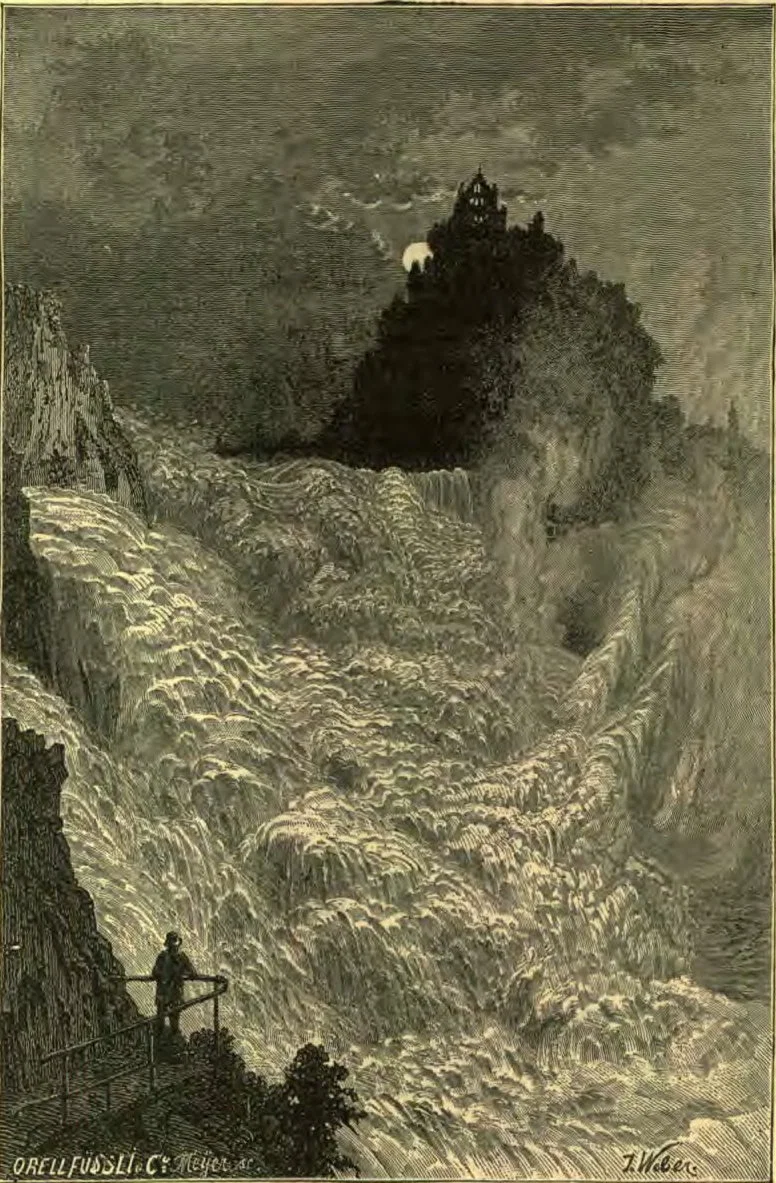
Near Schaffhausen are the Falls of the Rhine, shown in our picture. In point of volume, they are the most imposing falls in Europe. “The river is precipitated in three leaps over a rocky ledge of irregular form, which, with the whirlpools and the rapids, form a cataract of about one hundred feet. Before eight in the morning and after three in the afternoon, innumerable rainbows are formed by the sunshine in the clouds of silvery spray. One of the best surveys of the falls is obtained from Schloss Laufen, which is picturesquely situated on a wooded rock immediately above the falls. Foot-paths lead through the grounds to the most important points of view, from one of which (an iron platform projecting over the foaming abyss and close to the stupendous scene) the vast volume of emerald-green water is seen descending with a roar like thunder, apparently threatening to overwhelm the spectator, and constantly bedewing him with spray. The finest view is obtained from Schlösschen Wörth, situated on an island opposite the falls.”
There are a great many places of interest along the Rhine, but only a few of them can be noted here. Among the principal towns below the falls just described, is Basel, where our office of publication is situated.
Strasburg is a quaint old town, with its cathedral, one of the most imposing edifices in Europe, in which is the wonderful clock made by Schwilgue. “This clock attracts spectators at all times, especially at noon. On the first gallery an angel strikes the quarters on a bell in his hand, while a genius at his side reverses his sand-glass every hour. Higher up, around a skeleton which strikes the hours, are grouped figures representing boyhood, youth, manhood, and old age (the four quarters of the hour). Under the first gallery the symbolic deity of each day steps out of a niche, Apollo on Sunday, Diana on Monday, and so on. In the highest niche, at noon, the twelve apostles move round a figure of the Saviour. On the highest pinnacle of the side tower, which contains the weights, is perched a cock, which flaps its wings, stretches its neck, and crows, awakening the echoes of the remotest nooks of the cathedral. The mechanism also sets in motion a complete planetarium, behind which is a perpetual calendar. The most wonderful feature of this piece of mechanism is that it is calculated to regulate itself, and adapt its motions to the revolution of the seasons for an almost unlimited number of years.”
Worms is a place of peculiar interest to all Protestants, as the scene of Luther’s great triumph over Catholic power. A grand statue has been erected here to his memory. The artist has caught the spirit of the man in his marble representation. With a scroll in his hand and his face upturned to heaven, he seems to be invoking the divine aid, and one can almost hear his fervent appeal: “Here I stand; I can do no other; may God help me. Amen.” Around his statue are grouped the most prominent of his fellow-laborers, and the generous supporters of the Reformation.
The most interesting portion of Rhine scenery begins near Mayence, at its confluence with the river Main, and extends to the Drachenfels, near Bonn, a distance of over one hundred miles, following the windings of the river. At Mayence there is a statue of Gutenberg, the inventor of movable types.
St. Goar is one of the finest of the Rhenish towns, and derives a look of importance from the extensive ruins of Rheinfels, which rise high above the town. Immediately above St. Goar rises the imposing rocks of the “Lorelei.” “The well-known legend of the nymph who had her dwelling on the rock, and, like the sirens of old, enticed sailors and fishermen to their destruction in the rapids at the foot of the precipice, has long been a favorite theme with poet and painter. Heine’s beautiful ballad is still deservedly popular.”
Bonn is the birthplace of Beethoven, one of the world’s greatest musical composers. And who has not read the pathetic poem, “Bingen on the Rhine?” Bingen is a beautiful, quiet spot. No wonder the heart of the brave soldier turned back to so sweet a home and the many loved ones there, as he lay “dying in Algiers.”
“The towns and villages of the Rhine are remarkably uniform in their general aspect and character. Each consists of a row, or parallel rows, of houses exceedingly ancient in appearance, surrounded by walls of defense, those being very low, and in most cases in a state of rugged decay. Each town has its church, whose spire is a chief object rising from the cluster of encircling human dwellings. These communities are the miserable remains of burghs which flourished hundreds of years ago, under the auspices or despotism of the feudal chief whose castles crown the neighboring heights. What now remain are only the residences of the humble farmers of the district, and of the cultivators of the vines of the Rhine, that grow on the adjacent hills. The precipices, which sometimes rise to the height of seven hundred feet, are formed into terraces like steps of stairs, one terrace above another. The vines to be cultivated on these terraces are planted in baskets of mold forced into the clefts of the rocks, or supported by the walls which form the divisions between the terraces. Unless great care were taken in thus preserving the baskets of mold, the whole would be washed away by the winter torrents, and the poor families who own them would be ruined in an hour.”
Some one, in traveling along the Rhine, has left us this prosy description: “Two long rows of peaked hills, all alike, dwindling in perspective, a river between them, and every one with its ruined castle perched upon the top.” A more poetical remembrance is in the following lines from Byron:—
“Chiefless castles breathing stern farewells From grey but leafy walls, where Ruin greenly dwells. And there they stand, as stands a lofty mind, Worn, but unstooping to the baser crowd; All tenantless, save to the crannying wind, Or holding dark communion with the cloud. There was a day when they were young and proud: Banners on high, and battles passed below; But they who fought are in a bloody shroud, And those which waved are shredless dust ere now, And the bleak battlements shall bear no future blow.”
MARY STEWARD.

WEAK THINGS OF GOD.

'Twas but a little wayside flower That pleased the hurrying traveler's eye; It bloomed to cheer one lonely hour, And in his weary hand to die.
'Twas but a little wayside rill, Among the stones and sands that sprang; A bird dropped down and took its fill, Then with fresh wing upsoared and sang.
'Twas but a little gift of bread, Forgotten as a transient care; A hungry child it comforted, And answered a believer's prayer.
'Twas but a little, passing word A stranger's lips were moved to speak; A burdened spirit overheard, And straight was stirred the truth to seek.
'Twas but a little, simple song A bard unknown had leave to sing; Not oversweet and none too strong, But still it touched a tender string.
On wings of hope and faith it flew, And the quick echoes caught the ear Of toilers listening in the dew, And captives at their bars anear.
Flower, rill, and word, and song, and gift— What were they but weak things of God? And yet they bore his message swift Where life strove on with soul or sod.
Weak things; but who shall name the small? And who declare what great must be? Since, in God's uses, each and all Reach out to his infinity.
—Selected.

GRANDMA'S SCHOOLMISTRESS.

“No, grandma,” said Jennie, decidedly, “you are quite wrong. ‘Uncle Tom’s Cabin’ was not published first in book form; it appeared as a serial.”
“Well, well,” said grandma, with a sigh, “perhaps you are right. I make a good many blunders nowadays.”
In half an hour, however, she had recovered her spirits, and began to tell a visitor how she saw General Washington in Portsmouth after the Revolutionary war.
“Why, grandma,” interrupted Jennie, “it wasn’t Washington. It was LaFayette. You always told us so.”
“Perhaps it was,” said grandma, “perhaps it was. My memory is going fast. I begin to notice it as I never did before.”
Then mamma, who had all the time been making Jennie telegraphic signals with eyes and brows, asked her to go to her room for a moment. There she followed her, and gave her, as Jennie afterwards said, “such a talking to” as she had never received in her life, not even when she painted a monogram on the baby’s arm.
“You seem to have taken upon yourself the office of grandma’s schoolmistress,” she concluded. “You have been both impertinent and cruel.”
“Perhaps I ought to have said, ‘I beg your pardon,’ when I corrected her,” said Jennie, between her sobs, “but I was in a hurry to speak.”
“You should not have spoken at all. You are very kind to grandma. You pick up her stitches, thread her needle, and do her errands patiently, but still it is through you that she is every day reminded of her age and weakness. You correct her when she makes a mistake, you express your surprise when she forgets.”
“But I can’t bear to have her make mistakes before people!” cried poor Jennie.
“The record of a long and honorable life is not to be injured by a few lapses of memory at its close,” said her mother. “Little daughter, learn to be humble as well as kindly in your treatment of the old.”
Jennie dearly loved her grandmother, and she was broken-hearted at the thought of having failed in tenderness toward her. The lesson did not need to be repeated, and one day grandma said to her, lovingly:—
“My little girl, you grow pleasanter to live with every day. You are like the little girls I used to know when I was a child, loving, yet respectful and childlike.”—Youth’s Companion.

ROUND THE WORLD.—12.

A TRIP TO THE MISSION STATION.

SOUTH AFRICA is not as yet blessed with many railroads, and many places have still to be reached by the primitive method of staging, familiar to our forefathers and the pioneers of the Western States of America.
It was by this means that our trip to Lovedale, where is located the largest missionary institution in the colony, was performed. At 6 A. M. the coach was advertised to start from the depot with passengers and mails, but it was more than an hour after that time when it put in an appearance, and all voyageurs were requested to “hurry up and take seats.” We did hurry up, but to take seats was altogether another matter. The coach, or rather cart, for the more elaborate title could hardly be given it, was a two-wheeled concern, with sitting space for six, arranged three abreast, on two seats, one behind the other. But these were hardly visible for the multitude of mail sacks that covered everything. They were piled on before and behind, under the seats and over them, and out on to the pole in front of the dashboard. One of the party crawled in behind, and after making his leg perform a sort of corkscrew movement, managed to seat himself; the writer found a corner at his side, a young colonist perched himself beside the jarvey, and a gold-digger took up his position on a heap of the staple cargo in front. This completed the list.
With the usual amount of shouting and yelling from the postboys and grooms, the start was effected, and soon the vehicle was under way, and whirling down the main street of the sleeping city. Six Cape horses pulled us merrily along, the whole team being so poor that they scarcely made one good shadow. Our driver was a native of Kaffraria, and armed with the typical bugle and two whips, he performed his duty with great adroitness. One of these scourges, for they are little less, consisted of a light bamboo pole, about twenty feet in length, and with a rawhide lash some ten feet longer. This was applied to the leaders and mid-team; the other was hardly quarter the length, with a short, thick thong, for the benefit of the wheel horses.
The night had been rainy, and we soon became painfully aware of the fact; for the road was a case of alternate truck-holes and camel’s humps, over which the chariot bumped in a merciless manner. The kneading and percussing and vibration received was sufficient to digest the heaviest dinner that mortal ever ate, but was to hygienists something totally unnecessary. With brakes set, at full speed the descent is made down one hill, across the railroad track, and then in a gallop the steeds make straight up another. The cart reels and sways, and tips heavily backward, and the Jehu with a most complacent smile informs the passengers that “another one of them, sir, and she’ll tip over; so if you value your lives, sit forward.” But we can’t; for there’s no room for our feet, and our knees are curled up in close proximity to our noses, so the risk must be run, and all relapse into silence, and devote all their energies to holding on.
A mountain range now appears in the offing, with a deep canon running through it. Into this we enter, the road winding along on the side of the precipice. The scene is one of wild and almost gigantic grandeur,—above, on one side, tower rocks and crags for many hundred feet, some of them looking as if a touch would send them crashing down on to the road, from thence to be precipitated into the gorge beneath. This is filled with a jungle of euphorbias and cactuses, and many tropical trees, covered with beautiful jasmine and a creeper known as monkey rope. The speed is breakneck, and when the bottom of Pluto’s Vale is reached, all breathe more freely.
At Fish River a halt is made for a change of horses, as these which have pulled thus far have commenced to show signs of weariness, which has called forth the most unearthly cries of exhortation from the Jehu, in a lingo incomprehensible to us. Many ostriches are feeding by the way-side, but in appearance they are far different from the pictures in the old school readers. White feathers are much more profuse in the portrait than on the bird itself, and the ostrich that ran away from the hunter, and buried its head in the sand, thinking that, because not seeing, it could not be seen, never breathed on the plains of South Africa, its native home. They are very powerful, and have a special antipathy for colored people. One blow of their foot is sufficient to break the back of a horse.
The road now lay over a rough bush country, peopled for the most part by natives, their little round huts looking like bee-hives dotted all over it. At Breakfast Vlei a stop was made for dinner, and we endeavored to do justice to the corpse of a chicken tough enough to try the temper of the best Sheffield steel. All the afternoon we journeyed, and at set of sun, on reaching the top of a small hill, beheld the village of Alice lying beneath, and just beyond the Chumie River stood the massive gray stone buildings of the Lovedale Mission station. We were soon comfortably ensconced within its walls.
P. T. M.

A BRIGHT BIRD.

He was an English starling, and was owned by a barber. A starling can be taught to speak, and to speak very well, too. This one had been taught to answer certain questions, so that a dialogue like this could be carried on:—
“Who are you?”
“I’m Joe.”
“Where are you from?”
“From Pimlico.”
“Who is your master?”
“The barber.”
“What brought you here?”
“Bad company.”
Now it came to pass one day that the starling escaped from the cage, and flew away to enjoy his liberty. The barber was in despair. Joe was the life of the shop; many a customer came, attracted by the fame of the bird, and the barber saw his receipts falling off. Then, too, he loved the bird, which had proved so apt a pupil.
But all efforts to find the stray bird were in vain.
Meantime, Joe had been enjoying life on his own account. A few days passed on very pleasantly, and then, alas! he fell into the snare of the fowler, literally.
A man lived a few miles from the barber’s home who made the snaring of birds his business. Some of these birds he stuffed and sold. Others, again, were sold to the hotels near by, to be served in delicate tidbits to fastidious guests.
Much to his surprise, Joe found himself one day in the fowler’s net, in company with a large number of birds as frightened as himself. The fowler began drawing out the birds, one after another, and wringing their necks. Joe saw that his turn was coming, and something must be done. It was clear that the fowler would not ask questions, so Joe piped out:—
“I’m Joe!”
“Hey! what’s that?” cried the fowler.
“I’m Joe,” repeated the bird.
“Are you?” said the astonished fowler. “What brings you here?”
“Bad company,” said Joe, promptly.
It is needless to say Joe’s neck was not wrung, and that he was soon restored to his rejoicing master.—Sunday-School Advocate.

THE GOLDEN RULE EXEMPLIFIED.

In the Heathen Woman’s Friend we find the following story told by an English missionary lady about a class of small children she was teaching in China:—
“The youngest of them had by hard study contrived to keep his place at the head so long that he seemed to claim it by right of possession. Growing self-confident, he missed the word, which was immediately spelled by the boy standing next him, whose face expressed the triumph he felt, yet he made no move toward taking the place, and when urged to do so, firmly refused, saying, ‘No, me not go; me not make Ah Fun’s heart solly.’ That little act meant much self-denial, yet was done so thoughtfully and kindly that spontaneously from several lips came the quick remark, ‘He do all the same as Jesus’ golden rule.’”

THREE LITTLE CHICKS.

THREE little chicks Got into a fix; Would you like to know what about? Well, listen a minute. There's something in it, It is well for you all to find out.
Hear the old hen say, In an old hen's way, That each little chick understood, “O dear! O dear! I dreadfully fear You are all very naughty and rude!”
But they stretched up their necks, And continued their pecks, As they wickedly fought with each other, And the hen saw beside her A hairy, fat spider, And then she knew what was the bother.
It hung by a thread From the rafter o'erhead, And Whitey and Speckle and Gray Each wanted the bite, And you see how the fight Began in the usual way.
Whitey crowded off Speck, And gave Gray a peck, And said, “Go away; it is mine!” But Speckle and Gray Said emphatically, “Nay! I am bound on that spider to dine!”
And now would you see Just which of the three Secured the prize he was after? While they were fighting And scratching and biting, The spider went home to the rafter
And each little sinner Had lost a good dinner, And the spider might chuckle, and say, “Ha, ha, my fine chicks, That is one of my tricks, And I gain, and you lose in that way!”
The old mother hen Turned soberly then, And said to her children three, “You may see, if you choose, How you always will lose By acting so selfishly.”
“You go hungry to bed, With each a sore head, While the spider sits up on the rafter, To enjoy your defeat In taking his meat, And is shaking all over with laughter.”
From this little fable I am sure you are able To learn what you all ought to know,— That selfish contention, As I hardly need mention, Will never a good thing bestow.
—Methodist Recorder.

HIVING THE BEES.

“THE bees have swarmed,” said Hal, as he rushed into the kitchen, where his mother was at work.
“What shall we do? Your father will not be at home for several hours,” said the mother.
“Do! Why, I can hive them,” said Hal. “I watched papa hive the other swarm.”
“Do!” said the house-maid, before Hal had finished,—“I’ll tell you what to do! Drum on pans and pails. Make all the noise you can, so they will alight. That’s the way Carrie Barnes did when her bees swarmed. Her mother and all the rest drummed on tin pans.”
Hal went to the barn for a new hive, and the children got pans and pails, and went to drumming with sticks. The house-maid got an old stove-pipe, and laid it across a broken cart-wheel, and she drummed, making more noise than all the rest.
“Oh, what a racket!” said Hal, as he dusted the hive, and wet the inside with sweetened water.
What the bees thought of the noise I do not know, but they soon began to settle upon a raspberry bush. I really think they went there because their queen led them; but the house-maid thought it was because of the noise they made.
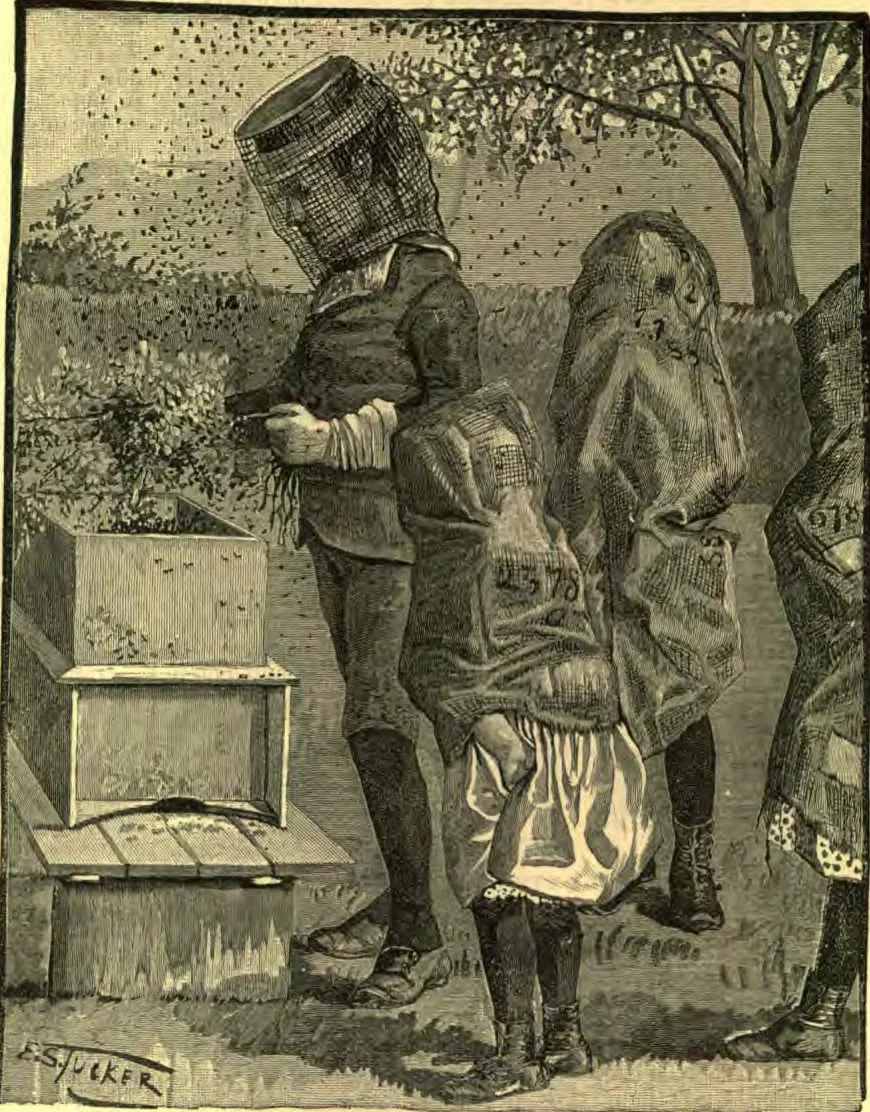
When the children saw that the dark bunch grew larger and larger on the raspberry bush, Hal put his father's bee-veil over his hat, buttoned his coat to the chin over it, and drew on long gauntlet gloves.
“Now I’m ready for the bees,” said Hal.
“I wish I had a veil,” said Ruby.
“I’m going to crawl into this gunny-sack,” said little Ned, “and look through the holes.”
Then all the little children pulled gunny-sacks over their heads, arms, and hands, and ran up close to the bees while Hal was hiving them.
Hal worked very gently. He pried up the bush. Taking hold of the top of it with one hand, he put the other hand under the roots, and lifted the whole mass of bees over the hive. He gave it a quick shake, which dropped the most of them into the hive.
With great care and delicate touches he brushed the bees away from the edge of the hive, and replaced the cover.
“I don’t believe I have killed three bees,” said Hal, delighted with his success.
“I believe we should have lost that swarm if it had not been for you, Hal,” added his mother.
“You mean if we hadn’t drummed on the pans,” cried the house-maid.
When Hal’s father came, his boy tried to look sober as he said, “Papa, the bees swarmed two hours ago!”
His father looked at him a moment, adding, “And you have hived them?”
“Yes, sir,” said Hal, with sparkling eyes.
“You have done a good thing,” replied his father, proudly.
His father gave him that hive of bees, from which he has raised many others.—Our Little Ones.

THE LESSON BESSIE TAUGHT.

Bessie must have awakened in the morning with a plan in her busy little head for teaching certain members of the Newton family a lesson. The first thing she did was to go into the library, and finding on a chair a new magazine that Harry had left there, she pulled off a cover. “There!” thought she, “I’ll teach Harry not to leave such a valuable thing as a book where it doesn’t belong.”
Then she went into the boys’ room, and finding a borrowed book out of place, she remarked to herself, “This will never do. A borrowed book should always be carefully put away; and besides I do not believe in borrowing, especially when a boy has so many books of his own as Willie has. I’ll just destroy this one to teach Master Willie a lesson. So she soon defaced its pretty, bright cover badly.”
Next, she visited Majory’s room, and finding more dust on the floor than should have been there, she evidently thought of the saying, “Dirt is displaced matter,” and gave Majory a gentle hint by tipping the contents of the scrap-basket out upon the floor.
Then she went to the sitting-room, and finding Alice’s hat on a little work-stand, she thought, “Another thing out of place—another lesson to be taught.” So she pulled out the feathers, leaving hat and trimmings on the floor.
When all was done, she cuddled up on the lounge, well satisfied with her morning’s work. At the dinner table four members of the family looked as though each wished some one else would speak first. Finally mamma said:—
“I see Bessie has been trying to teach us again.”
Four voices answered faintly, “Yes.”
“She certainly has taught us once more that there should be a place for everything, and everything should be in its place,” said papa.
“Including Bessie herself,” added mamma.
And Bessie? Well, Bessie was a six-month’s-old puppy, with innocent, soft brown eyes.—Lucy Southworth Hunt.

DON’T WANT TO.

“Tom,” said mamma, looking up from her sewing, “run into the other room and bring me my thimble. It’s on the window-sill.”
Four-year-old Tom was sitting on the floor, tying the cat into a harness of gray tape, which matched her fur beautifully.
“Don’t want to,” he replied, cheerfully attempting to pull poor kitty’s ears through an impossible loop.
Mamma said no more, and Tom stole one or two curious glances at her from under his curly, brown lashes. Was it possible that he was going to have his own way? Usually mamma said something more, and it ended by Tom’s doing—oh, so slowly and unwillingly!—what he was told to.
But something was the matter with that beautiful gray harness; it wasn’t so pretty, after all, and it didn’t fit in the least.
So Tom abandoned it, and hunted up his long lines that grandma made, and fastened them to the rocking-chair. Those lines acted very queerly. Tom couldn’t understand it.
“Oh, de’ me!” he said at last, despairingly. “Mamma, my lines is snangled; please to unsnangle ’em for me—won’t you?”
Mamma’s brow drew into a little frown, and she said, in a whining voice,—
“No, I don’t want to.”
Tom looked at her very hard, and decided that she hadn’t understood him, so he repeated his remark:—
“I said vey must be fixed, mamma; please to fix ’em.”
“Don’t want to,” she said, this time with more of a whine than ever.
“But you’re the mother,” Tom objected.
“Don’t want to,” was all the answer he received; so, very much puzzled, he carried them to Bridget.
By and by papa came home, and met his small son in the hall.
“See here, little fellow,” he called cheerily, “take this paper to mamma. I’m in a hurry.”
Then Tom’s pretty lips pouted, and “Don’t want to” was what they said. A gleam of remembrance lighted papa’s face, and he took the paper in himself. That was such a little thing that Tom forgot it, but papa didn’t.
After dinner the little boy was in his father’s lap before the fire, and mamma heard him beg, as usual:—
“Please tell Tom a ’tory, papa,—a big one, ’bout a bear.”
Papa’s eyes twinkled, but he drew down the corners of his mouth, and said,—
“I don’t want to.”
“Why for not?” queried Tom.
“I don’t want to.”
Tom slid down to the floor, and sat there in silence for a whole long minute; then he said:—
“And when my lines was all snangled up, she said she didn’t want to, and I fink fings is funny.”
Papa and mamma looked at each other and smiled.
After a little, just when Tom and the gray kitten were having such a good time on the rug, mamma remembered, as Tom was afraid she would, and remarked:—
“I know a little boy who is very sleepy, and I know a lovely white bed to put him in. Come, Tom.”
“Oh no!” said Tom, briskly, “I don’t—”
Then something occurred to him, and he got up without another word, took the gray kitten in his arms, and he and mamma went upstairs. But the gray kitten objected, and dragged her sharp claws crossly down Tom’s little round arm. Usually he cried when he was worsted in a contest with the gray kitten. This time he looked up at mamma, and said, slowly,—
“D’you see her a-sayin’ she di’n’t want to? Tom don’t say it vat way.”
“I am not so sure, little boy,” replied mamma, as she took him in her arms; “because, you know, when you pout and frown and say you don’t want to, when mamma asks you to do something for her, then it hurts mamma just as if you made long, dreadful scratches right on her heart.”
“Oh de’ me,” said Tom in dismay. “Tom won’t do vat any more to yo’ poor heart,—he don’t want to!”—Sunday-School Times.
Continue reading: Small Duties