SPEAKING of the condition of the Papacy at the close of the fifteenth century, a writer of that period says: 'Certainly the wars fought to maintain the temporal power of the popes have cost more lives than all the present inhabitants of Italy. And the wars will not cease as long as the pontiffs hold the temporal dominion. And if any one maintains that the pontiffs are compelled to make war to defend themselves, we would say that they certainly ought to make war if there is no other way out of the difficulty. But very few have been the wars waged on the pontiffs; for almost all the wars fought in times past have been waged or instigated by the pontiffs with or without reason.'
Times of Alexander VI.
If, then, we open a page of history of the sixteenth century, we find corruption continued. For, as the historian says: 'With a renewal of studies and the awakening of new forces of civilization, the times began to change for the better; but the popes remained always more or less immoral, covering themselves with the vices of the times, which are almost always inseparable from men of power. And as their rule accorded them an exceptional power, either because they had a double office, or because they were princes elected, they contaminated themselves with exceptional vices which were possible only to themselves.' 'Nephewism' expresses the desire on their part to raise their relatives to the dignity of princes and sovereigns, and to enrich them in a fabulous way. This was always a source of scandalous dissipation of the public money of the church, and a fountain of corruption and rascality which has rendered abominable the names of Borgia, Farnese, Medici, Borghese, Pamphili, Barberini, and other papal families.'
Of this epoch it is but necessary to recall the names of Alexander VI. and his wicked and nefarious son and daughter, Cæsar and Lucrezia Borgia (for this pope had five recognized children), to form an idea of the depravity of this period. The corpse of Alexander VI., who died from the effects of taking a dose of poison that he had prepared for one of his cardinals, was taken out of St. Peter's and buried in another church, as he was considered unworthy to be associated with the other popes in his death. Speaking of the event, a great writer has well said: 'All Rome ran with indescribable gladness to visit the corpse. Men could not satiate their eyes with feeding on the carcass of the serpent, who, by his unbounded ambition and pestiferous perfidy, by every demonstration of horrible cruelty, monstrous lust, and unheard-of avarice, selling without distinction things sacred and profane, had filled the world with venom.'
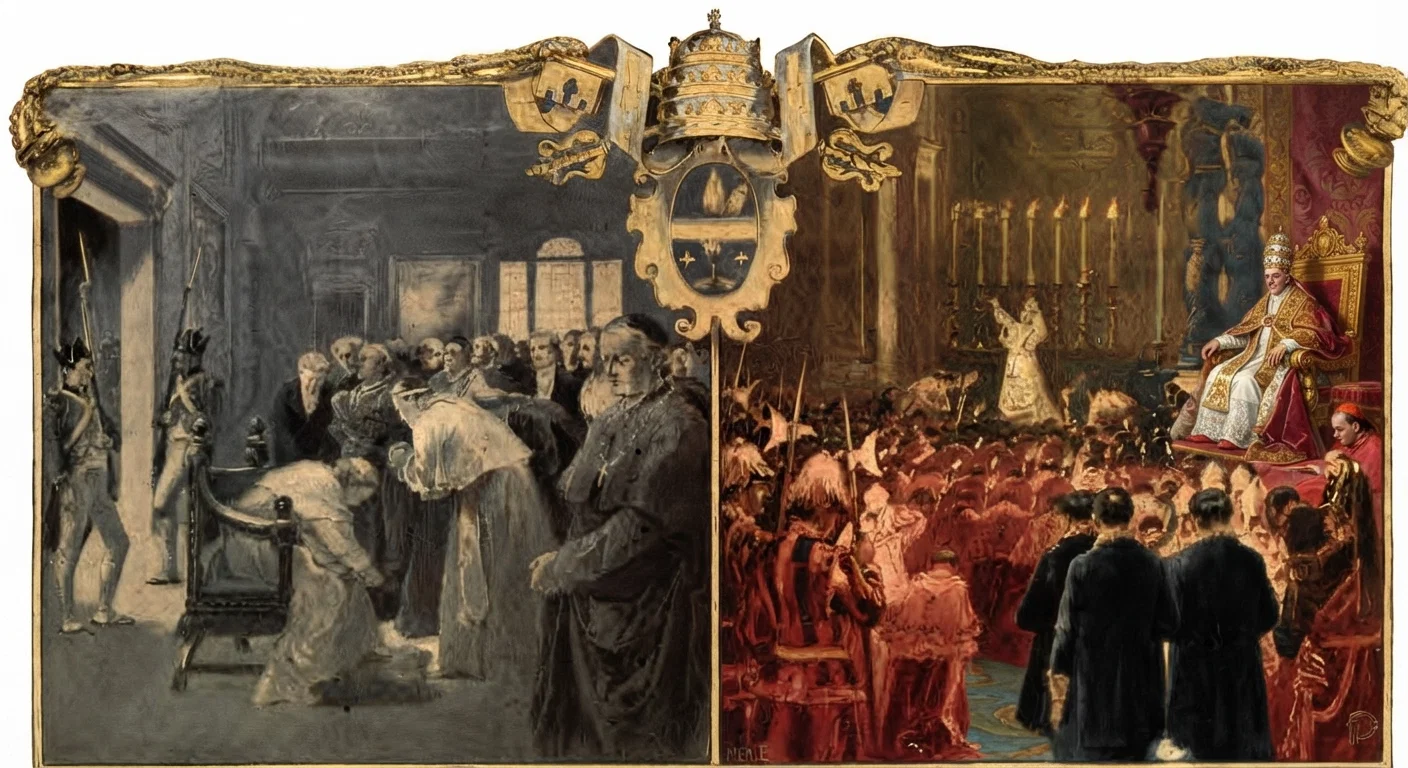
Our twofold picture is a fair representation of the Papacy at two different phases of its history; the one at the left, 1798, when the pope was taken captive, and died in captivity. Little honor was then paid the Papacy by the powers of Europe. The picture at the right represents the Papacy as it is at the present time with the world bowing before it. Soon we shall see fulfilled Rev. 18:7: "I sit a queen, and am no widow, and shall see no sorrow."
Coronation of Clement XIV.
Of the pomp and luxury of the papal court of the last part of the eighteenth century, we have a good description given by a prelate of the church who lived at that time. We shall take but a few extracts of his splendid description of the coronation of Clement XIV.:
The sounding of trumpets, the beating of drums, the ringing of bells, the booming of cannon, triumphal arches, flaming banners waving from hundreds of towers, flags floating from the forts, the houses richly draped with elegant tapestries, golden powder strewed along the streets, the people gathered in great crowds, and a confusion of plausible voices that announced that something extraordinary was to take place in the Eternal City. It was the coronation of an obscure monk who, under the name of Clement XIV., ascended the papal throne. From the palace of the Quirinal to the Lateran church the pope was to ride on horseback. The procession was headed by horsemen with long lances from which floated silk banners of red and blue, while the silvery plumes of their helmets sparkled in the sun. They were dressed in red costumes adorned with crimson, fringed with gold. After them followed four horsemen clad in brilliant armor trimmed in gold; then came the relatives of the cardinals richly dressed, and the artisans of their palaces and their secretaries clothed in velvet and gold. After these came the nobility of Rome, surrounded by a large group of attendants in grand livery. Next followed the private attendants of the pope, carrying the pontifical miters, in crimson velvet, closely followed by a part of the Swiss guard, clad in armor and with shields and lances. Then came the prelates mounted on black mules, richly equipped. Following them came attendants of the pope wrapped in their sumptuous robes and riding upon mules with purple equipage. Then came the ambassador and senator, dressed in black, with togue of velvet, and surrounding them were their courts.
Prince Don Lorenzo Colonna, of the kingdom of Naples, followed mounted upon his noble Spanish steed, and he fairly sparkled on account of his highly-burnished arms and the many jewels that adorned his person. His proud horse stepped lightly upon the golden sand strewn along the line of march. After him came the masters of ceremony mounted upon mules, with pontifical equipage and a prelate carrying the papal cross, at the sight of which the people became greatly agitated. For in the midst of a group of footmen dressed in red, and the Swiss guard clad in shining armour, came the pope mounted upon a white pacer, covered with a caparison of crimson velvet embroidered in gold. He was dressed in a white robe with surplice and mantle of red velvet adorned with emerald, over which was a stole of gold garnished with large pearls, and on his head he wore the miter. The pope was followed by twenty-four pages, who wore10red silk stockings, while the white plumes of their caps touched the shoulders of the youth who belonged to the best families of Rome. On each side of the pope rode his private secretaries, while the Gestatorial throne followed, borne by nobles. Then came the cardinals, two by two mounted upon mules equipped in red, ornamented in gold, with two footmen before and following, carrying their stems and ensigns. Then followed the officers of state,—the patriarchs, archbishops, and bishops with their attendants. After the pontifical cortege came the elegant carriage of the pope, covered with red velvet and adorned with gold figures, and lined within with brocade silk, drawn by six large Phrygian horses, covered with red velvet trimmed with tinsel and fringe of gold and embroidered within and without. After another group of princes in medieval costumes of great pomp, came forty-eight carriages containing other nobility clad in the richest vestures. And the procession closed with the papal infantry and the Swiss guard clad in shining armor.
For lack of space I have abbreviated very much the above description, but enough has been said to show something of the luxury and pomp of the papal court of that period. And yet this epoch will not compare with some of the preceding for extravagant pomp and display.
Just Previous to the Fall of the Temporal Power.
Let us now take a look at the last part of the papal history just before the fall of the temporal power. Of the papal government of that time, Cardinal Pacca says that the pope allowed himself to be dominated by his favorites. The French writer De Montalembert says: 'The abuse of the Papacy is the very existence of the Papacy itself. The antagonism of the people is not artificial, but is true and just. The government is intolerable. The people are discontented, oppressed, agitated, and it is not longer possible for the papal government to maintain itself except with the arms of foreign powers, because the Papacy is without power, moral or material.'
Monsignor Liverini, a Roman prelate, writing in 1861 of the feeling of the people ruled by the Papacy, says: 'If the army of France were withdrawn without putting in its place a strong force that assured the life of the clergy, in one week all the priests and monks would be exterminated, so fierce and savage is the public indignation against the papal government in these years.' And again he says: 'If the papal states should need to be administered as they were for fifteen years under Cardinal Antonelli (secretary of state under Pius IX.), it would be much better for the people subject to the Holy See, and the pope himself, if he had lost these states in the revolution of 1849. Or rather it would be better that he had never possessed them. For this reason from one end of Italy to the other they cry, 'Death to the priest.''
The historian Macchiavelli, says: 'The ecclesiastical states were acquired either by virtue or fortune, but without either they are maintained; for the cardinals are the only princes that have states and do not defend them; have subjects, and do not govern them.'
The Marchus of Pimodan, who fought for the papal cause, says: 'I am glad to place my all for the aid of the cause of the Holy See; only once in a while a doubt torments my mind, that we have come here to confirm abuses that we would not tolerate in our own home,' that is, in France.
And of the morality of Rome at that time we are told that the city was full of harlots that paid a regular revenue into the papal treasury in order to receive permission to carry on their life of sin. Drunkenness was very common both in priest and people; and, in short, we might say that the papal government was rotten and corrupt to the core; the people themselves were sick of papal rule, and hailed with great acclamations of joy the entrance of the Italian troops into 'the Eternal City' in 1870 to relieve them from a government that under the cloak of religion maintained a rule of abuses and corruption.
HE GAVE TO HIS DISCIPLES.
By Augusta W. Heald
IN the Gospel account of the feeding of the five thousand with five loaves and two fishes, we read that Christ gave the food to His disciples, and they gave to the multitude. They received the bounty from the Saviour's hands; their hands passed it to others. This is the true Gospel way. Christ imparts to His humble followers all the fulness of blessing, that they may become avenues of blessing.
We are in constant need of heavenly grace, both in our own soul experience and in all our intercourse with others. How blessed to receive in such rich measure that others may share the bounty with us! And truly it is our privilege thus to receive. God's munificence is limited only by our want of faith. He waits to impart unto us rich gifts. We may have special strength for every time of need. We may have also a word of encouragement for the faltering one by our side who has not yet learned to trust in the Giver of all good.
O, for that nearness to Christ, that we may "know how to speak a word in season to him that is weary"! We may at least repeat to such an one the dear Master's words, "Come unto Me, all ye that labor and are heavy-laden, and I will give you rest."
Shall we not, as faithful followers of our dear Lord, seek Him in earnest faith and prayer, that we may receive the gift and be permitted to impart to others?
AUGUSTA W. HEALD.
OUR GREAT ENEMY.
By John C. Kastner
IT is just as easy to ask for the salvation of every created soul, as for our own. The “We” and “Us” are in great evidence in the Lord’s Prayer, while the “I” is nowhere. It couldn’t be in it and feel at home.
But the “I” manages to get in most everywhere else, and, as a rule, gets in to stay, to make things warm for everybody all around, and finally attain unto supreme rule, or go under.
That “I” is antichristian, ungovernable, unendurable. To it we trace all our tribulation and failures to get where it can not enter. It is too big to get in.
Notwithstanding all this, most folks worship little else. Others try to identify it with His name, and some crucify Christ daily to glorify this same “I.” Christ came not in His own name. “I” ever does. Christ suffered for our sin. “I” makes everybody suffer for his.
Jesus fed the poor. “I” wants the earth, tho everybody else starve.
The strangest part is that the great, great majority of professed Christians worship “I.” This is because “I” expounds their true inwardness, their desires, their aspirations.
“If another shall come in his own name, him ye will believe.” And “I,” of course, is in evidence. Now, it matters little who is the most exalted “I,” the most successful “I,” the most infallible “I.” All the other “I’s” will do homage to the great “I,” will idolize, and deify. “I” loves a lie, and all his followers kiss it. “I” is wise—in his generation. Has he not twisted every Gospel text into support of his divine call? Has he not proved his infallibility by giving the constant lie to the spirit and example of our Saviour? Has “I” not succeeded in doing the very opposite of what Christ did, and obtained every blessing (?) Jesus declined when tempted of Satan in the wilderness? Why wonder that “I” is so popular? “I” governs every kingdom of this world, and is called a benefactor, a priest, a prophet, and a king; aye, a god! Yea, many contribute millions to educate the ignorant in the ways of “I.”
Who can war against “I,” or escape his mask? Cain couldn’t. Judas couldn’t. No “I” ever could. Every follower of our Lord can. The most exalted “I” will get left.
“I” has no soul worth saving. It (we drop the “he” for the best of reasons) is made up of pocket interests, vanity, conceits, and self-glorifications, that can not possibly inherit the kingdom of God. It has more11rights, titles, privileges, and prerogatives than there be words in the unabridged dictionary, and also a most miserable existence—even in this life. It never can love—but “I,” and always has a lie in its right hand. “He feedeth on ashes.” JOHN C. KASTNER.
LOVE'S FRAGRANCE.
By Frances E. Bolton
"We are unto God a sweet savor of Christ."
"Pity thyself," said Peter to his Lord.
"Spare, save Thyself," said he who once denied,
"Be it far from Thee," was the selfish word,
"Thou needest not to be thus crucified."
"Get thee behind Me," said the Master then,
"Thou savorest not of God whose name is Love.
Offense to Me, thou savorest of men,
Not of the fragrance of the courts above."
"Pity Thyself, and spare Thyself," again
We hear the words of Peter's yet untried.
That savor of the selfishness of men,
Denying now that self be crucified.
But following Christ, we see Gethsemane,
And feel its shadows creep upon our way,
And just beyond the cross of Calvary,
And shall we for the work of Peter stay?
The sword of temporal power, the blow of force,
The self-strength sought the demons to defy,
And boasting so to follow Christ's meek course,
Failed in the crisis, and will still deny.
O seeker for the fulness of the breath
Of Heaven's Holy Ghost, reject the plea.
Spare not thyself, but loving unto death,
Go with Thy Master to thy Calvary.
Sink into nothingness. Die on thy cross,
Deny thyself and not the power above,
And lo, from out thy death and utter loss,
Shall rise up, Phœnix-like, the life of Love.
And lo, the savor of thy garments then,
Will be of Christ, the Lily of the Vale,
And thou shalt be as fragrance among men,
Shedding the Christ-love in the mart and dale.
The Holy Ghost shall raise thee from the tomb,
The resurrection power shall in thee move,
And as a rose thy life shall breathe perfume,
The very perfume of the life of love.
Sweet to the Father as an altar flame,
Thy prayer shall rise as incense to the skies,
Savor of Christ, the breathing of His name,
Nor self-stench mingle with love's sacrifice.
Thy garments then will smell of aloes sweet,
Of frankincense and myrrh and priceless nard,—
Love's offering poured out at thy Saviour's feet
Will yet return (so ordered by thy Lord)
Upon thy head, and fill the house with bloom
(Tho some will murmur at the waste again),
Thy God shall welcome up thy sweet perfume,
And spread Love's sweetness through the hearts of men.
FRANCES E. BOLTON.
PREVAILING PRAYER.
By Nora Evelyn Harvey
It is the privilege of every Christian to prevail in prayer. It is the privilege of the Christian to know what the Lord wants him to do. It is his privilege to know what is right. Through prayer the way is made plain to us.
To obtain the assurance of the pleasure and will of God, we must pray intelligently; in other words, we must understand the attributes of God, and we must know where to address our prayers. In our minds, and by faith, we must see Him in the most holy place of the heavenly sanctuary. We should pray submissively, being willing for God's will to be done, even tho it might cause us suffering. Under these conditions how sweet is communion with the Lord. O, the blessedness of prayer! What a privilege to talk with our God!
When we have asked the Lord to lead us, then let us believe and remember that He is leading us. We often keep the Lord from working by unbelief, after we have asked Him to lead us. Commit everything to Him, and trust Him to work out all the complications of life.
The Urim and Thummim were oracles by which the Lord spoke to His people in ancient times. When a halo of light was seen about the Urim it was an evidence that the Lord was pleased with the request, and the right way was thus made plain. The Lord's displeasure was shown by the cloud at the Thummim. It is the Christian's privilege when praying, to know if the light encircles the Urim, or if the cloud is at the Thummim. O, what a joy to be living in this experience! We may have it. Let us obtain it. There ought to be a Urim and Thummim in the experience of each one.
When the Lord grants our requests, even while we ask, what light and joy comes into our souls, and what wonderful and blessed peace follows. If to answer according to His will, it brings a cloud over our own life's experience, then we are to know that He does what is right, and good and best for us.
"Acquaint now thyself with Him, and be at peace; thereby good shall come unto thee." Job 22:21. Nora Evelyn Harvey.
SEARCH THE SCRIPTURES
EPHESIANS.
By F. D. Starr
AMONG the most noted places where Paul and others preached the Gospel was Ephesus, a city in Asia Minor, near the coast of the Ægean Sea. It was at this place that John made his home in the latter part of his life, and from which, it seems, he was banished to the isle of Patmos, and to which place he returned after his exile.
At Ephesus, as is quite generally understood, John wrote the Gospel bearing his name, and also the book of the Revelation. This being his home, it is interesting to note that the first message of warning in the seven messages sent to the “seven churches,” as recorded in Revelation 2 and 3, is addressed to “the church of Ephesus.” While these messages are prophetic and symbolic, yet they no doubt had some application to the local churches named in the messages. The meaning of the name Ephesus is “desirable.”
Ephesus is the only church of the seven to which epistles now extant were sent by both Paul and John. We see from Col. 4:16, however, that Paul wrote an epistle to the church at Laodicea, the last named in the list of seven churches, but that epistle has not been handed down to us.
An interesting fact concerning the Gospel work at Ephesus, is that the first missionary effort made there was by Paul, as recorded in Acts 18:19. Not long after this, that eloquent Gospel orator, Apollos, came to Ephesus, and met with marked success in his work. This work was defective in a very vital point, however, the experience by the converts of the power of the Holy Spirit; and the apostle Paul had to supplement the labors of Apollos, instructing the believers more fully and then rebaptizing them.
It was at Ephesus that the vagabond Jews were defeated in their effort to cast out evil spirits, using the names of Jesus and of Paul. Here it was that many who used curious arts brought their books, to the value of several thousand dollars, and burned them. At this place also arose the great uproar about the silver shrines for Diana, and the cry of the populace, “Great is Diana of the Ephesians.” The mob spirit was finally quelled by the wholesome advice of the town clerk, “We ought to do nothing rashly,” advice that every Christian should diligently follow, tho it came from the mouth of a Gentile.
It was the elders of the church at Ephesus who were called to Miletus by Paul, to whom he gave the solemn warning concerning the apostasy that should originate with the bishops, or elders, of the church—a startling admonition indeed, “Of your own selves shall men arise, speaking perverse things, to draw away disciples after them.” How strikingly was this fulfilled in the subsequent history of an apostatizing church!
Significant was the position occupied by the Ephesus church, and equally significant is the apostolic epistle addressed to that church. As in all his epistles, so in this, we find the plain distinction between ceremonialism and spirituality. The middle wall of partition between Jew and Gentile is broken down by the same act that caused the veil of the temple to be rent in twain from top to bottom. “Ye who were far off are made nigh by the blood of Christ.”
The forlorn condition of Gentiles in the flesh is vividly described in chapter two. Think of it—“without Christ,” “aliens from the commonwealth of Israel,” “strangers from the covenants of promise, having no hope, and without God in the world.” The covenants were all made with Israel, as we find by referring to Rom. 9:4, 5. To enter into covenant relation with God, we must become members of the true house of Israel, being grafted into the true olive tree.
There are three words used in English that came from the Greek word translated “Gentile.” These are the terms, “Gentile,” “heathen,” “nations,” all coming from the Greek word ethne, from which comes our word “ethnology,” the science of nationality, or of nations. So these three terms—heathen, nations, Gentiles—are really the same in the original sense. They are used in contrast with the terms “Jew” and “Israelite,” which are applied to God’s chosen people. To obtain favor with God, and the benefits of covenant relation with Him, one must be changed from a heathen, or Gentile, to a true Jew. Rom. 2:29.
The superlative degree of Christian experience is found in Eph. 3:17-19. The apostle there states that we may be able to comprehend with all saints what is the breadth, and length, and depth, and height; and to know the love of Christ, which passeth knowledge, that we might be filled with all the fulness of God. To know the unknowable is a point of excellence that is beyond the comprehension of the human mind. The study of this book and the practise of its teachings will bring us to that higher plane of Christian life. F. D. STARR.
LACK OF POWER IN THE CHURCH.
By Arthur Tappan Pierson
BUT the pew may largely paralyze the pulpit. There are conditions in the hearer as well as in the preacher which help or hinder the Spirit. Often a fundamental mistake is made in the call. An untried, unproved, and therefore unknown, man is invested with the pastoral title and staff, who may be chosen simply because of some rich endowments of gifts, with little reference to graces; and this is most hazardous. “Like people like priest.” The hearer largely determines the preacher and shapes his ministry. A man in the pulpit must be a very uncommon man if he is not affected by the atmosphere of his church. If his congregation be wealthy and worldly, it is very hard for his spirituality not to be stifled. F. W. Robertson confessed that his preferences were “with the aristocrat, but his principles with the mob;” but with too many, preferences practically become principles. Wealth and numbers foster pride and forfeit power. Innocent IV. boasted to Thomas Aquinas, “You see the church can no longer say, like Peter, ‘Silver and gold have I none.’” “Nor,” replied Aquinas, “can she any more say, ‘Rise up and walk.’”—A. T. Pierson.
PREPARE FOR THE WORK.
By Chas. H. Graham
TIME is fast closing,
The Lord will soon come,
And take to the mansions above
Those who have toiled
Through the heat of the noon,
And given Christ's message of love.
The world is now waiting
In darkness and sin
For the message that you should proclaim,
O, who will go forth
And bring the lost souls
To Christ who has died to redeem?
Be faithful, my brother,
The way may seem dark,
But look upward, have courage, press on,
For the Lord will soon come
And you shall then wear
The crown that through grace you have won.
CHAS. H. GRAHAM.
The Homeless Among Plenty
By Herbert D. Ward
ONLY God knows the number of homeless in the midst of warmth and furniture and plenty—homeless because their hearts are atrophied.—Herbert D. Ward.
"ALL THINGS TO ALL MEN."
By Bertha L. Selmon
THE Gospel missionaries in the frozen regions of the North may find it advisable in some degree to adopt the costume found suitable in this icy atmosphere; but in almost every land the question of apparel is one which little concerns the success of the messenger. Nowhere else in all the world does one meet the same or similar conditions as those found in the great heart of the Chinese Empire. In each of the great port cities, and even in Hankow, the metropolis of the interior, foreign settlements have been built up. The French, English, and German, in their several concessions, have come to be a matter of fact in the Chinese economy.
These people have even become infatuated with the ingenuity and vices of the strange intruder, learning only too rapidly to ape the cigaret-smoking and other ways of the iniquitous class, who, for selfish interests, have found their way to these centers of trade and traffic. In these places, where even these commercial classes regard the missionary with infidel contempt, no matter in what garb he may appear, it would often place him at a disadvantage in the eyes of both natives and foreigners to appear in the dress of the people.
But this is not real China—the ancient, unawakened Middle Kingdom. Far in the interior, among the thousands of market places and villages, live the farming class, many of whom have never seen one of another race. Here the missionary meets altogether another problem. Often for months and even years, he may be alone amid the hundreds of millions; alone but for a sprinkling of others here and there, whom he may or may not occasionally meet. Little by little, through hardship, toil, and self-denial, has been won the privilege of going up and down with the Gospel tidings among the masses of a people who have dwelt long behind the bulwarks of idol and devil worship, prejudiced by superstition and conceit, superstition which, tho to-day has given way in greater or less degree to tolerance of the stranger and his message, still manifests itself in the path of Gospel progress.
The missionary is frequently termed foreign devil, and many children yet believe him capable of digging out their eyes, and various other atrocities. The foreign doctrine, as they call it, is supposed to possess some bewitching influence; the young convert is believed to have in some way eaten the foreigner's doctrine, often his relatives regard him as one insane. Thus it is that the Gospel worker finds even the children afraid of him. They must be kindly won, as one would tame the birds of the forest. But once they find he has a loving heart, and is a human being like themselves, they at once become our neighbors and friends.
Flower Pagoda in Canton.
Then there is the conceit. In the language of the Chinese, China is termed the Great Pure Kingdom, and while they are willing to admit there is much that is not pure in the hearts of the present generation, much of the downward trend is not unjustly blamed upon the foreigner's opium. The foreigner is, they believe, willing to do anything for money, while their noble ancestors were devoted only to the improvement of themselves and the good of their race.
Let us for a moment cast aside our own prejudice, and weigh thoughtfully the observations of an ambassador of the "son of heaven" in a foreign court.
The English are a hard-working race, and they have millions of devices for getting money. . . . . In their view our holy doctrine (Confucianism) is mere useless and empty talk. . . . . But this true knowledge of theirs consists of various feats of deft manipulation, knowledge that can turn out a machine; nothing more. . . . . The doctrine handed down to us from holy men of old may be summed up in two words, humanity and justice. . . . . A man who follows the precepts of humanity and justice is beautiful in his speech and admirable in his actions. . . . . But do we see these results in western lands? No, indeed; the whole energy is centered in the manufacture of different kinds of machines; steam vessels and locomotives to bring rapid returns of profit, and guns and rifles to slay their fellow men. They rival one another in greed and cunning methods of acquiring wealth.
A maxim from the Chinese classics is, "What Confucius teaches is true, what is contrary to his teaching is false; what he does not teach is unnecessary." And such is the attitude of a civilization and education which has dwelt within itself for centuries, that in its light the foreigner is a barbarian who is dressed in strange-looking garments, and does not know how to feed himself with chop-sticks!
The pioneer missionaries in this field were close followers in the footsteps of Him who laid off in the courts above the robes of heaven; He was willing for our sakes to be on earth,—the Son of Man,—to wear the garb disgraced by a race of rebels, that He might win back some from the land of the enemy. Surely the followers of Jesus could only regard it a little thing to thus become one among these sons of the East, "that by all means they might save some."
Buried under the superstition and conceit of these people, are hearts not unlike our own, hearts filled with longings, burdened with grief, longing for love and sympathy which is truly found only in the blessed message of salvation. How can we reach them, one by one? How can we win them? Often through the little ones we reach the parents. How can we get so near to these that our hearts beat with theirs, and they are not afraid to climb in our laps and put their little arms around us?
Yes, we must become one of them. We may wear the blue cotton garments, and whisper to them the words of their mother tongue. Some even of our own race regard us as of no nationality; but Jesus said, He that would be great, let him be servant of all. And when we have given ourselves to win these, whom we have learned to love as our neighbors, friends, and brothers and sisters in the Gospel, the dress only seems a part of it all. We have no caste to lose; we look for a "city which13hath foundations," and when the sheaves are gathered, we hope and live and pray that some of these may dwell with us in that home above, where there is neither barbarian, Scythian, bond nor free, but Christ is all in all.
BERTHA L. SELMON.
Siang Cheng, Honan, China.
"HE LEADETH ME."
By William E. Sheffield
He leadeth me—
And shall I fear to go
Where such a loving Hand
Doth guide me every step
Unto that better land?
O, no! Be this my boast,
My supreme comfort be,
No matter what betide,
He leadeth me.
He leadeth me
When through the waters dark
I pass from here to there;
No fears will burden me;
He hath me in His care.
O, then with grateful tongue,
This theme my song shall be;
Through sunshine and through storm,
He leadeth me!
He leadeth me
Yet not but me alone,
Great dangers passing through;
The hand that guides me on,
In love is stretched to you.
Then show to all the world
The love that made you free,
And let this be your theme—
He leadeth me.
—William E. Sheffield.
Bank of Mountain View
In the long cold winter evenings of the East while sitting round the fire to keep warm, wouldn't you like to know about a place in California where the sun shines 300 days of the year and where the flowers always bloom? Mountain View is that place and the
Bank of Mountain View
the old reliable Bank, would like to tell you all about it. Write to us for information. Address