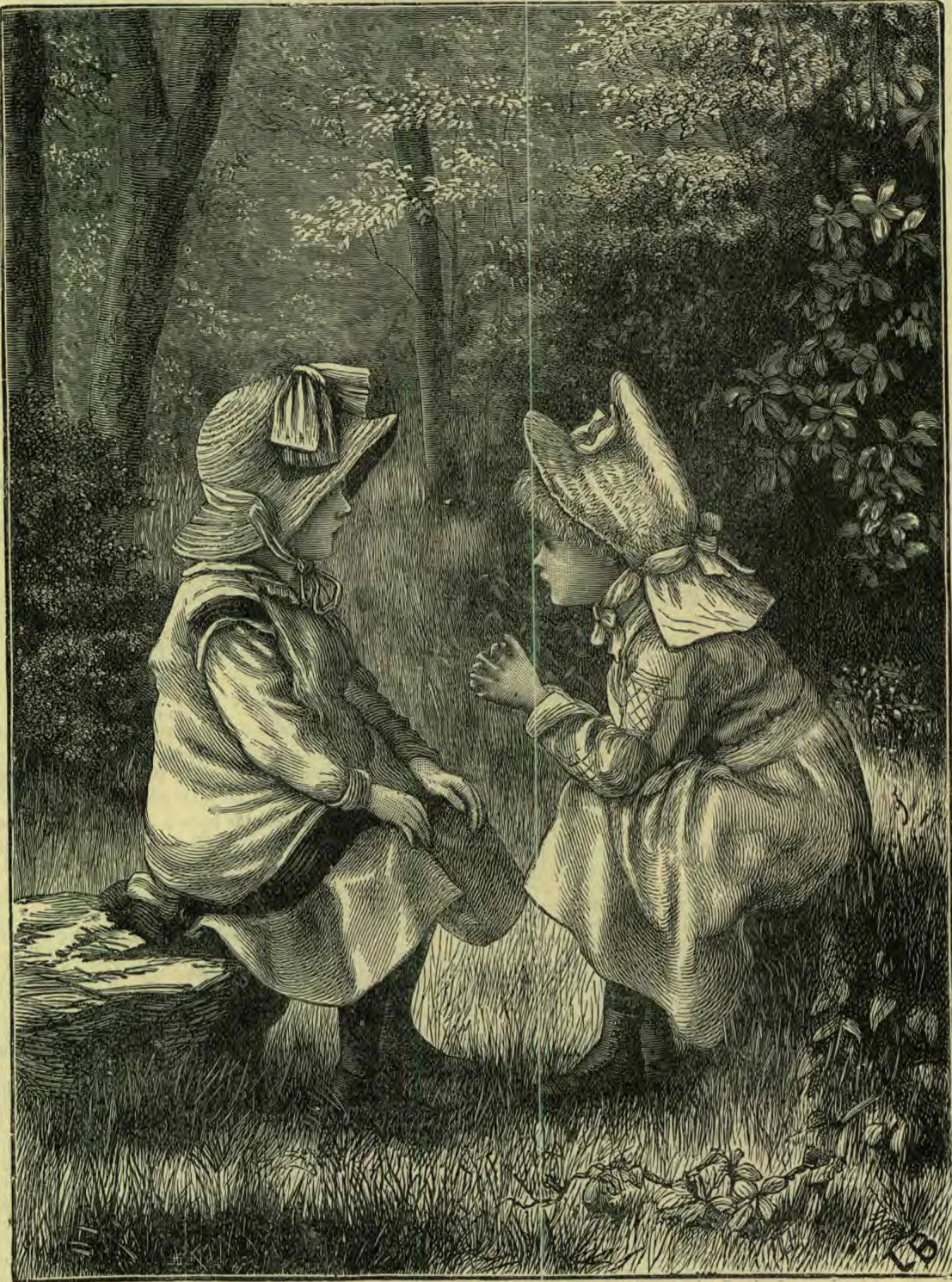
Such a pleasant walk as Lottie and Eva had, going to the little red school-house on the hill! The path ran down the road past a rambling old white farm-house, then across a meadow lot and through a strip of woods. They liked best the place where the meadow lot and the woods met, for on either side of the path lay a large old stone that made a fine seat; and here they stopped to rest one beautiful day in late October. Eva threw her little dog-eared spelling book down in the grass, and leaning her elbows on her knees, said in an earnest tone, “I shouldn't think, Lottie Brown, you'd go with Lucy Miner any more. If you knew all about her that I know”—and Eva paused to see what effect her words were having.
“Why, Eva Stone,” said Lottie in surprise, “Lucy is just exactly as good a girl as you are, and my mamma lets me play with her, too.”
“Well,” returned Eva, with a toss of her head, “I don't care if she does. I wouldn't play with a thief.”
“With a thief!” echoed Lottie, every ribbon on her straw sun hat quivering with horror, at the idea.
“Yes; with a thief,” said Eva boldly. “She stole the teacher's beautiful pearl penknife. Now what do you think of that for anybody that makes believe she's so good?”
“I just don't believe it, at all,” said Lottie; “and I'd like to know how you knew it.”
“Well, I was behind the entry door; and I heard Miss Gray ask Jennie Hallern if she had seen any thing of her knife; and Jennie said, ‘No’; and Miss Gray said she was very sorry to lose it, for it was a birthday present; and the last time she used it was at her desk when Lucy came to sharpen her pencil. And so of course she took it,” concluded Eva.
“I don't think that proves any thing,” said Lottie; “nobody saw her take it.”
“Well,” said Eva, stooping over to pick up her spelling book, before going on her way to school, “you needn't believe it if you don't want to. But I am not going to play with a thief or any body that goes with one,” and she walked on alone toward the school-house.
Now Lottie was much distressed at the thought of having Eva angry at her, for Eva was a favorite at school, and Lottie was anxious to have her for a friend. So, like some older folks, she forsook Lucy, and ran to overtake Eva and make up.
At recess she went off to play with some of the other girls, and would not notice Lucy at all. There was a great deal of whispering, with sly nods toward Lucy, who could not for a moment imagine what had happened. Things went on this way for nearly a week, and she was left out of all the games and merry-making.
The teacher noticed that something was wrong, though she could not find out what it was. But one day she happened to overhear Lottie and Eva talking under the window. “Ah!” said Miss Gray, with a sigh of relief, “this explains matters.” So when school was done, and the books put away for the night, she said she would tell them a story. There was a little rustle of satisfaction, for Miss Gray's stories were delightful. But this one didn't begin as they usually did. She only told them of two old women she knew, who lived in the same door yard for ten years, and never spoke a pleasant word together in all that time, because one of them had said some hard things about the other one; and how this old woman who had such an unruly tongue had made so much trouble between this neighbor and a very dear friend that it had ended in a lawsuit. And then Miss Gray dismissed them without saying any more.
As Eva passed her teacher to say “good night,” she saw that she had her pretty penknife in her hand. Then she guessed why Miss Gray had told them about the two old women. Miss Gray noticed Eva's flushed face, and asked her to stay after the rest went home. Then she talked to her kindly, and Eva told her all about the matter.
“I am very sorry,” said Miss Gray, when Eva had ceased sobbing, “that you have been so hasty in judging Lucy; and if I were you, I would own my wrong to the others and ask Lucy's forgiveness.”
Eva promised she would do it the next morning; and Miss Gray said, as she rose to go, “There is one verse in the Bible it would do us all good to remember; ‘A whisperer separateth chief friends.’” W. E. L.
Letter Budget.
LENA MAY ROBBINS and MAMIE C. ANDERSON, two little girls, each ten years old, write letters from Lake Co., Cal. Mamie says: “I go to Sabbath-school every Sabbath. Our Sabbath-school is small, but it is real good. I am doing what missionary work I can with the children around here. I keep the Sabbath with my mother, who is a widow. Will you remember us?”
Lena attends the same Sabbath-school, studies in Book No. 2, and likes her teacher, superintendent, and also the INSTRUCTOR. She has three sisters and two brothers. Her papa does not yet see the truth. She wants us all to remember them.
Mamie’s way, of helping those right around her, is the right one. Our time to work is now, and we must do the work at hand. Will you remember Lena’s and Mamie’s request?
The next letter reads: “We are two little girls claiming a place in the circle. We are ADA and JENNIE MARVIN, aged ten and eight years. We have two little brothers, five and three years old, and we had a baby sister, but it died of whooping cough when it was only four weeks old. We loved it dearly, and want to live so we may enjoy its company in the earth made new. Mamma is our teacher in Sabbath-school. We study Book No. 2, and she has a small blackboard on which she makes the lessons plainer and easier. Papa is a carpenter. He knows the seventh day is the Sabbath, although he does not keep it. We hope he will yet stand on the Lord’s side. Mamma’s health has been very poor, and we have to help her do the work. We are keeping our little aunt, six years old, at our house, because her mamma is dead. She is a sweet little girl. Mamma says if we are kind and good to her it will be the same as being kind to the Saviour. We love the INSTRUCTOR, with its interesting contents every week, and we would like to see our letter in print, if mamma did write it for us. We want to be good little girls, and have eternal life when Jesus comes.”
You, little girls, have a mission right at home, with the sweet little girl that has come to live with you. What she shall be when she is older will depend very much upon how you live before her; so you must never let her see any but good, pleasant actions, nor hear any but sweet words.