Pacific Press Publishing Company · New York · Jul 18, 1895
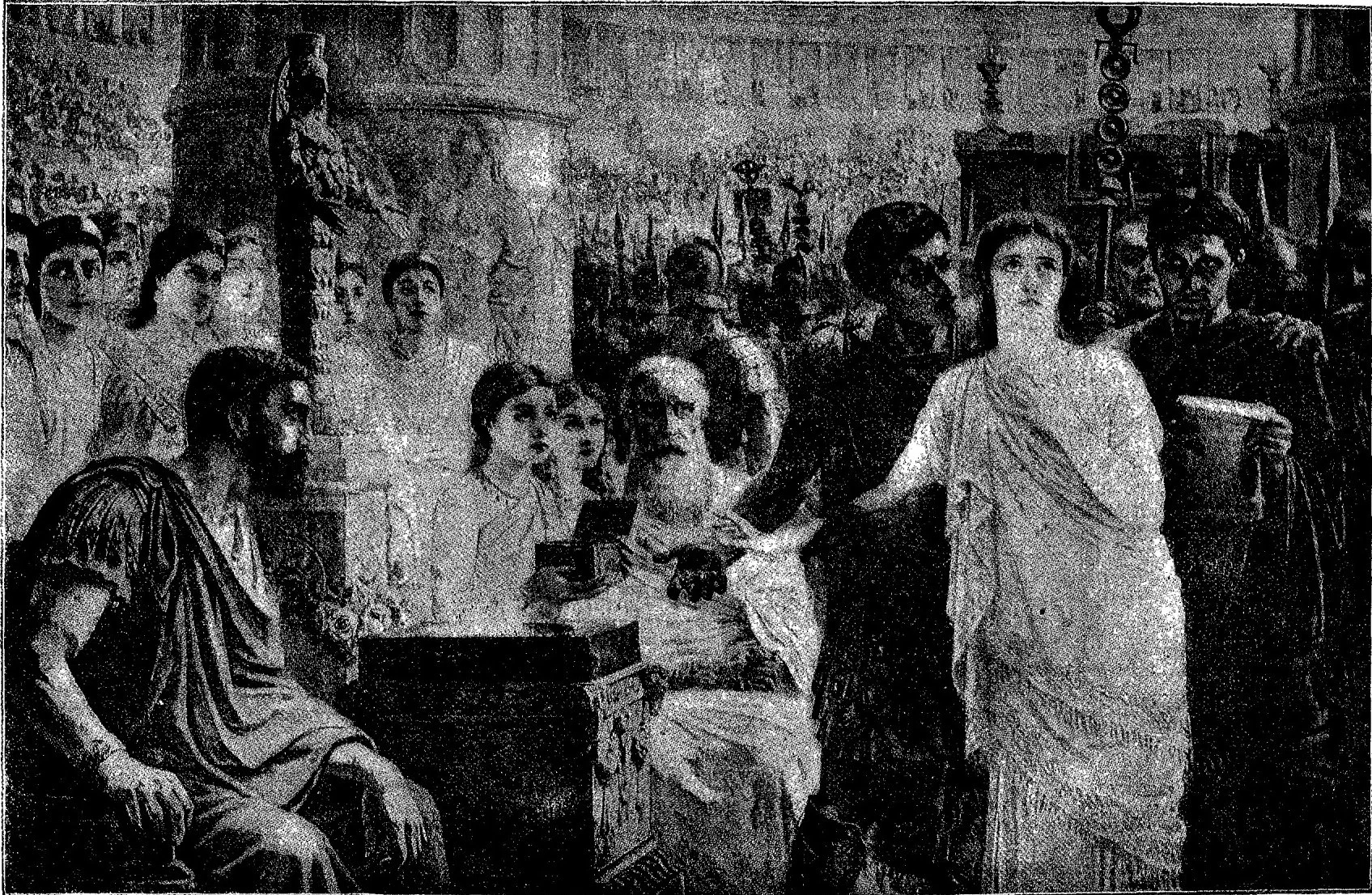
“CHRIST OR DIANA.”
“STEADFAST she looks to heaven, and breathes the Sacred Name, unmoved by lover’s plea, or sword, or rack, or flame. O holy hope in God! O fearless faith divine! undimmed by death, or time, or tears; immortal and sublime!”
“Edwin Long has not only won for himself merited fame as an artist, but more, he has in this picture given to the world a double object lesson on the cruelty of religious persecution and the triumphs of Christian fortitude, without an equal.
“‘Christ or Diana’ is a masterly representation of the conflict between Christianity and paganism. Studying the inspired face of the martyr and the countenance of her anxious lover,—who, realizing the cruel death that awaits a refusal, urges her to be ‘subject to the powers that be,’—one forgets the present, and absorbed in the scene, involuntarily asks, ‘Will she compromise?’ To cast upon the flame a few grains of the incense would be to recognize the worship of the goddess Diana and reject Christ. What a contest! It is the Roman world against conscience. A religion hoary with age and resplendent with earthly glory, is determined to crush the new and simple faith of the despised Nazarene.
“Silence seals the assembly. Again the gray-haired priest repeats the conditions: ‘Let her cast the incense; one grain and she226is free’—as if loth to sacrifice so sweet a life. The musicians wait with more than usual interest. Every face is solemn. But as the needle seeks the pole, so the eyes of the maiden turn heavenward, and she is steadfast. Her doom is sealed; Christianity triumphs; Rome is baffled. The emperor proclaims liberty of conscience, and the battle is won; but won for that age only, for history has many times repeated the scene. When men cease to suffer for principle, either sin or righteousness will have perished from the earth.”
The painter and the sculptor vie with each other in the effort to do honor to that faithfulness to principle so beautifully portrayed by our illustration. But reader, this faithful martyr was not a martyr in the eyes of the ruling Church and State of her time. She was but the despised follower of the despised Nazarene. Her steadfastness was termed stubbornness, and she died not as a martyr, but as a malefactor, a destroyer of religion and social order, an enemy to the peace and dignity of the State.
Thus it has always been. Faithfulness to conscience has been denounced as stubbornness by the contemporary historian. Decade after decade has passed before the “hated heretic” is viewed in the true light of a martyr to conscience.
Tennessee Against Conscience.
Eight men are now in jail at Dayton, Tenn., for refusing to cast the single grain of incense on the altar of what they believe to be a false worship. Sunday, by many good people, is held to be the sabbath. They have a right so to think, and to conform their lives accordingly. But many who hold this belief demand more than this. They demand that their neighbors shall be made to at least act as if they too believed that Sunday is the sabbath. To this end they appeal to the government to enact statutes which shall force their dissenting neighbors to recognize that Sunday is the sabbath.
Some of these dissenters, like the eight men now in jail, not only believe that Saturday, the seventh day, is the only Sabbath of the Bible, but they believe that the Sunday-sabbath is an institution of the papacy, the “mark of the beast,” the observance of which by one who is cognizant of this fact is to invite upon him the “unmingled wrath of God.” With them life and death are at stake. That they are terribly in earnest no one can doubt. The kind-hearted judge, in passing sentence upon them, declared: “It must be patent, even to the most casual observer, that they are good citizens, who are thoroughly conscientious in the course they have taken.”
And so now, instead of having pagan Rome against conscience, as presented in our illustration, we have the “Christian” commonwealth of Tennessee against conscience.
The Possibilities Involved.
If both Tennessee and the persecuted men continue firm, what is to prevent the infliction of the death penalty as a final punishment? The logic of the case demands it. In similar cases last March the judge fined the same offenders one dollar and costs, but immediately remitted the fine and expressed a regret that he could not remit the costs. But at this the second offense, he increased the fine more than seven-fold as a punishment for continuing in a course which he admitted was dictated by “thoroughly conscientious” motives,—a course, too, which injured no other human being. Being “thoroughly conscientious” in the course they have taken they would meet the contempt of the judge and all men if they should now violate their consciences for fear of fines and imprisonment. If they continue to be “thoroughly conscientious,” they will certainly soon come before the judge for a third offense, and, following the course pursued in the second case he will multiply the penalty in accordance with the gravity of continued violation, and so on from one degree of punishment to another until life imprisonment or capital punishment is reached. All this is involved in the first attempt of the State to coerce the conscience, and two steps toward this final and fatal result have been taken in Rhea County, Tenn. The great historian, Gibbon, thus forcibly states the principle which is being so vividly exemplified in that State:—
It is incumbent on the authors of persecution previously to reflect whether they are determined to support it in the last extreme. They excite the flame which they strive to extinguish; and it soon becomes necessary to chastize the contumacy, as well as the crime of the offender. The fine, which he is unable or unwilling to discharge, exposes his person to the severity of the law; and his contempt for lighter penalties suggests the use and propriety of capital punishment.
Loyalty to Principle, Secular and Sacred.
Faithfulness to principle in secular matters is applauded by men of the world. The men of the Revolution who refused to pay the “three pence a pound” tax on tea are accounted heroes to-day. And when Ambassador Pinckney resolutely answered a foreign power, “Millions for defense, but not one cent for tribute,” our nation applauded the patriotic utterance and prepared to sacrifice a million human lives to defend the principle at stake. How much more important is it that Christian men should remain true to a principle which involves loyalty to their Creator and Redeemer, and upon which turns their weal or woe for both time and eternity! Ought not their watchword to be, Thousands of loyal hearts for the defense of truth and right, but not one cowardly compromise with error and oppression?
MORE RELIGIOUS PERSECUTION.
By Editor
[From the New Orleans Times-Democrat, July 5.]
THE Times-Democrat has had occasion several times recently to comment on religious persecution in several States of the South, especially Tennessee, Mississippi and Georgia. It has generally been the supposition that civilized countries had given over fining and jailing people for their religious belief and for action corresponding to that belief. But the supposition, in the light of the cases which we have already mentioned and the one which we are now about to cite, will have to be modified, or we shall be driven to make the painful admission that we are not so far advanced in civilization as we have taken ourselves, and as we often vaunt ourselves, to be.
Everybody knows that a religious sect known as the “Seventh-day Adventists,” who keep the seventh day of the week as the day of rest and religious observance, and who having worshiped on the seventh day perform their usual vocations on Sunday, is scattered pretty widely over the Union, having little colonies interspersed in many of the States. It is also well enough known that the “Seventh-day Adventists” are upright, industrious, law-abiding and God-fearing people, the genuineness and strictness of whose religious observances and the general rectitude of whose lives compare very favorably with those of any other sect in this broad land. These men prefer to obey what they honestly believe to be the voice of God than to obey human injunction to the contrary. The Almighty in days of old gave this commandment to his chosen people: “Remember the Sabbath day to keep it holy. Six days shalt thou labor, and do all thy work; but the seventh day is the Sabbath of the Lord thy God: in it thou shalt not do any work.” And this commandment was included in what was known as the “Decalogue” or “Moral Law”—a body of divine commands which is still inculcated by the various Christian sects. The Christian sects obey the whole moral law, just as it was received by Moses from Jehovah on Mount Sinai, with the one exception of the command in question. After the resurrection of Christ on the first day of the week, they changed the Christian Sabbath from the seventh day on which Jehovah fixed it, to the first day of the week, to be commemorative of Christ’s resurrection. But the change was made, as far as we have heard, without divine authority; and those, therefore, Jews or Christians, who are strict constructionists of the law and are from strong religious convictions punctilious about such matters, and who keep the Sabbath on the seventh day as it was originally ordained, have at least as ample justification for their seventh-day observance as the great body of Christians have for their first-day observance.
On the one side is the express command of Jehovah to keep the seventh day holy; and opposed to it is the injunction of secular legislators to keep the first day holy. That is the difficulty in which the Seventh-day Adventists find themselves, and as we said they obey the voice of God rather than the voice of man.
And in this age of boasted civilization, they are punished for acting up to their religious convictions! They are fined and imprisoned for conforming to a command of Jehovah, which a State law seeks to nullify.
Tennessee should revive the thumb-screw and the boot, the stake and the fagot as well, and revert altogether to the inquisitional methods of medieval times. Failing that, she should lose no time in repealing monstrous laws which the very judges of her courts blush for the shame of having to enforce.
CHRIST AND SABBATH LAWS.
WHEN Christ came to earth more than eighteen hundred years ago, there were statutes enforcing false sabbath keeping, and he deliberately violated them. Healing the sick on the Sabbath day was regarded by the Pharisees as “work” and therefore a breach of the sabbath (Luke 13:10-16, and John 5:5-18); and many of the people were afraid of these false-sabbath statutes and would suffer their racking pains until the going down of the sun, after which they would crowd about the Lord of the Sabbath for his healing touch. Mark 1:21, 32, 33.
But Jesus was not afraid to violate these wicked statutes even though he knew that an effort would be made to kill him if he did. Mark 3:1-6. He violated statutes which enforced false sabbath keeping in order to teach the people to hallow the true Sabbath which had been hidden by these traditional enactments. Jesus Christ is the great model Sabbath keeper. His followers are to-day commanded to “follow his steps.” This is what Seventh-day Adventists are doing. They violate statutes which enforce a false sabbath. They do it in order to teach the world that Sunday is not the Sabbath and that the seventh day is. The Seventh-day Adventists now in jail at Dayton, Tenn., are there for doing that which their Lord did. “The servant is not greater than his lord. If they have persecuted me, they will also persecute you.” John 15:20.
ROGER WILLIAMS BANISHED BECAUSE HE OPPOSED SUNDAY LAWS.
The following paragraphs from the “Schaff-Herzog Encyclopedia of Religious Knowledge,” article “Roger Williams,” show that seventh-day observers are in good company in suffering because of their opposition to compulsory Sunday observance:—
He [Williams] went to Salem, where, in April [1631] the church asked him to become their teacher. But, as we learn from Winthrop, “at a court held at Boston (upon information to the governor that they of Salem had called Mr. Williams to the office of teacher), a letter was written from the court to Mr. Endicott to this effect; that whereas Mr. Williams had refused to join with the congregation at Boston, because they would not make a public declaration of their repentance for having communion with the churches of England while they lived there; and besides had declared his opinion that the magistrate might not punish a breach of the sabbath nor any other offense, as it was [which was] a breach of the first table [first four commandments of the Decalogue]: therefore they marveled they would choose him without advising with the councils and withal desiring that they would forbear to proceed till they had conferred about it.” The issue of these interferences was, that, in the summer or early autumn, Williams withdrew to Plymouth.
Williams returned to Salem in the latter half of the year 1633, some of the Plymouth people having become so attached to him that they removed thither also. He became assistant to the pastor, and on the death of the latter, in 1634, was himself made pastor of the church. During his whole ministry there, he held the very highest place in the love and honor of the people of Salem.
But certain of his opinions brought upon him the displeasure of the authorities of the colony. He was repeatedly cited to appear before the General Court; and in October, 1635, it was “ordered that the said Mr. Williams shall depart out of this jurisdiction within six weeks now next ensuing.” Permission was afterwards given him to remain at Salem until spring, but as it was soon reported, that, at gatherings in his own house, he had continued to utter the objectionable teachings, an officer was sent to Salem in January, 1636, to apprehend him, in order to put him on board ship, and send him back to England. On the officer’s arrival at Salem, it was found that Williams had departed three days before, whither could not be learned.
The most noted of the proscribed opinions of Williams was the doctrine that the civil magistrate should not inflict punishment for purely religious error. It has been urged that it was not simply for his doctrine of religious liberty, but for other opinions also, that Williams was banished. This, however, will not exculpate the General Court; for we find them enacting a law, that “If any person or persons within the jurisdiction . . . shall deny . . . their [the magistrates’] lawful right or authority . . . to punish the outward breaches of the first table . . . every such person or persons shall be sentenced to banishment.” In other words, though it be admitted that Williams was banished for other utterances, together with the proclamation of the doctrine of religious freedom, the court deemed it proper to decree banishment for that teaching alone. Certain others of Williams’ opinions were condemned, e. g., those regarding the royal patent, the administration of certain oaths, etc.; and it is declared by some that these doctrines threatened the civil peace and thus rendered him justly liable to exile. But in Rhode Island, where the teachings of Williams and of all others were freely permitted, life and property and civil order were as secure as in Massachusetts. In other words, the Rhode Island experiment showed that Williams’ teachings were not dangerous to civil order, and that therefore his banishment from Massachusetts was unnecessary, and consequently unjust.
There is a striking parallel between the banishment of Roger Williams and the imprisonment of Seventh-day Adventists to-day. Williams denied the right of the civil magistrate to punish men for breaking a sabbath; so do Seventh-day Adventists. The persecutors of Williams declared that his opposition to Sunday statutes would destroy civil order; the persecutors of Seventh-day Adventists assert the same. Williams continued his opposition to Sunday statutes in the face of an enactment forbidding it; so do Seventh-day Adventists. For his opposition Williams was banished; for their opposition Seventh-day Adventists are now in jail at Dayton, Tenn. Our secular histories are full of praise for Roger Williams, because of his opposition to Church and State union of his day, and Baptist historians and Baptists generally are proud, and justly so, of his noble stand against religious legislation. But if he was right in opposing Sunday statutes then, and in suffering banishment rather than cease his opposition to them, why ought not all Baptists and all admirers of Williams to rally to the defense of Seventh-day Adventists who are to-day, and in America, suffering imprisonment for the same offense? Why is it that certain Baptist papers praise the conduct of Roger Williams and denounce his persecutors, while denouncing the same conduct in Seventh-day Adventists, and indorsing their arrest and imprisonment? Consistency, thou are a jewel!
The Indiana Baptist states the situation forcibly when it says:—
Roger Williams should be on earth again to teach some Baptists that “the civil magistrate has no authority to punish breaches of the first table of the Decalogue.” We are yet far from the recognition of the right of every man to perfect religious liberty.
Yes, a second Roger Williams is sorely needed; and we have hopes that we are to have such a man in the person of H. L. Wayland, of the Examiner National Baptist and Christian Inquirer, who is now doing noble, courageous work in that direction.
In the words of the Examiner and National Baptist: “We wonder that the very stones do not cry out against such travesties of justice, that Christian men do not lift their voices in protest against such wicked perversion of religion, this insult to the name of Christ. And, in particular, why do not Baptists, whose fathers stood against the world for soul-liberty, make themselves heard when these relics of mediæval bigotry and persecuting intolerance are found in our free country?”
We appeal to all Baptists and all lovers of justice and right, Look upon the scene of Roger Williams bidding good-by to home and loved ones before fleeing into the wilderness from the hand of persecution! Look at that scene and remember that it has been repeated scores of times in the last few years in the States of Tennessee, Maryland, and Georgia! The eight imprisoned men at Dayton, Tenn.,—imprisoned for their faithfulness to the same principle for which Roger Williams was banished—are men with human hearts, men who love their homes and families and are in turn loved by wife and children; and likely there were moistened eyes when the parting came, and the little ones clung to father’s side. Oh, when will men cease to martyr the true heroes of their day while engaged in building the monuments of those martyred by their fathers! Thank God, there are men to-day who with a weeping wife pressing their hand and the little ones clinging to their garments, will, with resolute face, look heavenward and pledge freedom and fortune, honor and life, to the maintenance of truth and religious liberty! Thank God that faithfulness to truth and conscience has not perished from the earth!
BAPTISTS AND SUNDAY STATUTES.
The following from a standard publication of the Baptist Church states clearly the position which that church has held from the days of Roger Williams, against a union of Church and State in general, and compulsory Sunday observance in particular:—
The duty of the civil magistrate in regard to the observance of the Lord’s day.
Christ said (John 18:36): “My kingdom is not of this world: if my kingdom were of this world, then would my servants fight, that I should not be delivered to the Jews: but now is my kingdom not from hence.” Here Christ refuses to employ physical force. His kingdom is not of this world; and civil laws and228the force of the magistrate are not the means to promote its advancement. It is a kingdom of truth and love, because each man is a free moral agent under the government of God, he is accountable to God. This personal accountability to God carries with it the right of every man to decide for himself his religious belief and his worship. With these the State has no right to interfere. These rights of conscience are inalienable. For the protection of these, with other inalienable rights, States are organized, civil laws enforced, and magistrates elected. So far as religion is concerned, the sphere of the State is described in one word—PROTECTION. . .
However much we may deprecate the demoralizing tendencies of Sunday theaters and concerts, games and excursions, and the sale of candies and fruits and newspapers on the Lord’s day, still we ask for legal restraint upon such things only in so far as they may directly interfere with public religious worship. As Christians, we ask of the State only protection in the exercise of our rights of conscience; and we will depend alone upon the truth of God and the Spirit of God to secure the triumph of Christianity. With an open field and a fair fight, Christianity is more than a match for the world, because “the foolishness of God is wiser than men.” 1 Cor. 1:25. The almightiness of the Eternal God is in the cross. Hence Christ said: “And I, if I be lifted up from the earth, will draw all men unto me.”—“The Lord’s Day,” pp. 29–31, by D. Read, LL. D.; American Baptist Publication Society, 1420 Chestnut St., Philadelphia.
If the Baptist papers of the South would join with the Baptist Examiner, of New York and Philadelphia, in maintaining these principles, and in instructing their constituency therein, the persecutions of seventh-day observers in the South would be greatly diminished.
ALEXANDER CAMPBELL AGAINST SUNDAY STATUTES.
Since the days of Roger Williams, there has not arisen in the popular denominations of America any other man who has so consistently and faithfully opposed the legal enforcement of Sunday observance upon the people, as did Alexander Campbell, the founder of the Christian or Disciple Church. As early as 1820 there arose in Western Pennsylvania what were called “Moral Societies,” whose principal object was the enforcement of Sunday observance by means of legal pains and penalties. Mr. Campbell condemned the work of the societies, and a newspaper discussion followed, which continued in the Washington (Pa.) Reporter, from April 17, 1820, until February 22, 1822. The following is a sample of the irresistible logic of Mr. Campbell’s arguments:—
There is no precept or command in the New Testament to compel by civil law, any man who is not a Christian to pay any regard to the Lord’s day, any more than any other day.
Therefore, to compel a man who is not a Christian to pay any regard to the Lord’s day, more than any other day, is without authority of the Christian religion.
The gospel commands no duty which can be performed without faith in the Son of God. “Whatsoever is not of faith is sin.”
But to compel men destitute of faith to observe any Christian institution, such as the Lord’s day, is commanding duty to be performed without faith in God.
Therefore, to command unbelievers, or natural men, to observe in any sense the Lord’s day, is anti-evangelical or contrary to the gospel.
Speaking of his motive in opposing these compulsory Sunday observance societies, he said:—
“I wrote from principle; I had no object in view but one; viz., the suppression of an anti-rational, anti-scriptural, and anti-constitutional confederation, that I conscientiously believe to be dangerous to the community and inimical to civil and religious liberty. And while I am able to wield a pen, I will oppose everything of the kind, from the same principles, that comes within the immediate sphere of my observation.”
PRESBYTERIANS, ATTENTION!
Dr. Barnes On Enforced Sunday Idleness.
THE celebrated Presbyterian theologian, Dr. Albert Barnes, speaks thus of compulsory Sunday idleness. Let Presbyterians and all other thinking men read and ponder:—
If we can have a sabbath, sacred in its stillness and its associations; maintained by a healthful, popular sentiment, rather than by human laws; revered as a day of holy rest, and as a type of heaven; a day when men shall delight to come together to worship God, and not a day of pastime, Christianity is safe in this land, and our country is safe. If not, the sabbath, and religion, and liberty will die together. If the sabbath is not regarded as holy time, it will be regarded as pastime; if not a day sacred to devotion, it will be a day of recreation, of pleasure, of licentiousness.
Since this is to be so, the question is, what is to be the effect if the day ceases to be a day of religious observance? What will be the effect of releasing a population of several millions one-seventh part of the time from any settled business of life? What will be the result if they are brought under no religious instruction? What will be the effect on morals; on religion; on sober habits of industry; on virtue, happiness, and patriotism? Can we safely close our places of business and annihilate all the restraints that bind us during the six days? Can we turn out a vast population of the young with nothing to do, and abide the consequences of such a universal exposure to vice? Can we safely dismiss our young men, all over the land, with sentiments unsettled and with habits of virtue unformed, and throw them one day in seven upon the world with nothing to do? Can we safely release our sons and our apprentices and our clerks from our employ, and send them forth under the influence of unchecked, youthful passion? Can we safely open, as we do, fountains of poison at every corner of the street, and in every village and hamlet, and invite the young to drink there with impunity? Can there be a season of universal relaxation, occurring fifty-two times in a year, when all restraints are withdrawn, and when the power of temptation shall be piled with all that art and skill can do to lead the hosts in the way to ruin, and to drag them down to hell?
One would suppose that the experiment which has already been made in cities of our land, would be sufficient to remove all doubt from every reasonable mind on this subject. We are making the experiment on a large scale every sabbath. Extensively in our large cities and their vicinities, this is a day of dissipation, of riot, of licentiousness, and of blasphemy. It is probable that more is done to unsettle the habits of virtue, and soberness, and industry; to propagate infidelity, and to lay the foundation for future repentance or ignominy; to retard the progress of the temperance reformation, and to prepare candidates for the penitentiary and the gallows on this day than on all the other days of the week. So it always is where institutions designed for good are abused. They become as powerful in evil as they were intended to be for good. The sabbath is an institution of tremendous power for good or evil. If for good, as it is designed, and as it easily may be, it is laid at the foundation of all our peace, our intelligence, our morals, our religion. If for evil, it strikes at all these; nor is there any possible power in laws or in education that can, during the six days, counteract the evils of a sabbath given to licentiousness and sin.
It may be answered that a great many voluntarily choose thus to spend Sunday. This is true, but it is also true that the Church and the State, if they have not united to compel idleness on that day, are not responsible for the dissipation occasioned by that idleness, but, on the other hand, if the Church and the State have compelled them to be idle when they preferred to engage in honest toil, they become responsible for the crime that idleness produces.
The Sabbath of the Lord is a spiritual rest, not merely a day of cessation from work. When God enjoins rest from labor, it is that the time may be employed in spiritual worship. God requires man to cease from his labor on the Sabbath, but he gives to man a spiritual nature, by means of which the cessation from labor is profitably employed. On the other hand the State compels idleness, but does not and cannot give to the idler that spiritual nature which enables him to properly employ the enforced idleness; and therefore, as Satan finds some mischief for idle hands to do, the State, in enforcing idleness on Sunday instead of promoting morality, is in reality fostering immorality as Dr. Barnes here teaches.
SPURGEON ON SUNDAY LAWS.
I AM ashamed of some Christians because they have so much dependence on Parliament and the law of the land. Much good may Parliament ever do to true religion, except by mistake. As to getting the law of the land to touch our religion, we earnestly cry, “Hands off! leave us alone.” Your Sunday bills and all other forms of Act-of-Parliament religion seem to me to be all wrong. Give us a fair field and no favor, and our faith has no cause to fear. Christ wants no help from Cæsar. Let our members of Parliament repent of the bribery and corruption so rife in their own midst before they set up to be protectors of the religion of our Lord Jesus. I should be afraid to borrow help from government; it would look to me as if I rested on an arm of flesh, instead of depending on the living God. Let the Lord’s day be respected by all means, and may the day soon come when every shop shall be closed on the Sabbath, but let it be by the force of conviction, and not by force of the policeman; let true religion triumph by the power of God in men’s hearts, and not by the power of fines and punishments.—Extract from one of Spurgeon’s Sermons, quoted in Australian Sentinel for March.
METHODISTS OPPOSE PERSECUTION.
By Editor
A SAD feature of the imprisonment of Seventh-day Adventists for inoffensive Sunday labor is that their prosecutors in many cases are members of the Methodist Church, whose founders themselves suffered much from members of State-enforced creeds.
To show that the persecution of seventh-day observers by Methodists is contrary to the published, standard theology of that church, we quote from that celebrated Methodist work, “Binney’s Theological Compend,” a work officially recommended as a part of every Methodist minister’s course of reading. The quotation is as follows:—
It is the duty of the civil power to protect Christians against disturbance in their Sabbath worship. But the power is intruding into the divine prerogative when it assumes the right to compel the subject to worship God, or to refrain from those pursuits that do not disturb others. The keeping of the Sabbath is eminently a moral duty, and hence it must be a voluntary service rendered under the pressure of moral suasion only.
This is the position which the SENTINEL has always maintained, and it is the position taken by Seventh-day Adventists in their opposition to Sunday laws; and had it been followed by Methodists, much of this modern persecution for conscience’ sake would never have occurred.