HOW AN African king made a prohibition law and enforced it in his dominions, is described by Dr. A. T. Pierson in the Missionary Review.
It appears that Sekhome, the chief of the Bamangwato, the father of Khama, had no faith in Christianity, and when Khama became a Christian, Sekhome tried to prevent his succeeding him. After some trouble, however, Khama did succeed, and set about governing according to his Christian principles.
He began to fight rum systematically. He called the white men together and told them his mind. They pleaded to be allowed to bring in small cases of brandy as medicine. He gave consent, but he must see no drunkenness. Of course the drunkenness came. Then there was a new summons for the white men, and this time they were forbidden even to bring in drink for their private table use. “Bring none! I will allow none! There’s an end of it!” He had to resort to fines, threats, and even to banishment from the country; but he stood firm. When, after many provocations, the crisis came, and notwithstanding oft-repeated warnings, there was drunken violence and uproar, the good Khama wore a stern face, which always meant fixed purpose. He went and saw with his own eyes how his laws were trampled on, and then he said:—
“You despise my laws because I am a black man. Well, if I am black, I am chief of my own country, and I rule here and shall maintain my laws. Go back to your own country. Take all that is yours, and go. If there is any other white man who does not like my laws, let him go, too. I am trying to lead my people to act according to the Word of God, which we have received from you white people, and you, white people, show them an example of wickedness such as we never knew. You know that some of my own brothers have learned to like the drink, and that I do not want them even to see it, that they may forget the habit; and yet you not only bring it and offer it to them, but try to tempt me with it. I make an end of it to-day. Go, leave my town, and never come back.
The effect of such talk from an African chief was like a thunderclap; everybody was stunned. One man at last ventured to plead for exemption from the stern law of banishment on the ground that he had grown up in the country, and he and Khama were old friends. “Surely, for old friendship’s sake you will pity me!”
“Friendship!” said the indignant Khama, “you call yourself my friend, do you? You are the ringleader among those who insult and despise my laws.” Then, with withering words of rebuke, he answered his plea for pity, by reminding him that there was a plea for “pity” which he owed to his own people. His answer was worthy of Chief Justice Hale, who used similar words of the “mercy” due to his own country, which he would endanger if he was unduly merciful to criminals. Khama flamed with righteous anger, but he cleaned his town that day of the white man’s drink-curse, and then he also forbade the use and sale and manufacture of native beer. At one time death seemed to threaten him if he carried on his holy crusade; but he only answered, “You may kill, but you can not conquer me.”—Family Herald and Montreal Weekly Star.
MISSION WORK OF THE AMERICAN BOARD.
At the recent annual meeting of this oldest of American missionary societies, it was reported that the income for the year just closed was $697,371. Its representatives are found in twenty missions at strategic centers, amid a population exceeding six million souls and using twenty-seven different languages; 514 missionaries, assisted by 3,483 native laborers, are engaged in preaching the Gospel, directing schools, translating the Bible, creating a Christian literature, and healing the sick. In these missions are 505 churches, having 50,892 members, 4,551 having been received on confession of faith this year; 929 Sunday-schools, with 66,601 pupils, and giving $147,879 annually to the support of the Christian work around them; 13 colleges, with 2,132 students; 17 theological seminaries, with 228 students in direct training for the ministry; 103 boarding and high schools for girls and boys, with 10,226 students, besides 1,135 day-schools, with 49,375 pupils.—Missionary Review.
Do Thy Little: God Has Made
Do THY little; God has made
Million leaves for forest shade;
Smallest stars their glory bring,
God employeth everything.
INFLUENCE
By A. E. Hamilton
This learned I from the shadow of a tree
That to and fro did sway upon a wall,
Our shadow-selves, our influence, may fall
Where we can never be,
—Miss A. E. Hamilton.
PERIODICALS WANTED.
SIGNS, Review, Sentinel, and Life Boat, for use in connection with meetings. Address, postpaid, E. Max Trummer, Kingston, Ill.
Late clean copies of any of our denominational publications, for missionary work. Address, postpaid, E. J. Harvey, San Diego, Cal.
SIGNS, Sentinel, Review, and tracts for distribution in Thomasville, Monticello, and Tallahassee. Can use thousands. Address, postpaid, Mrs. Lulu Wightman, 222 Monroe Street, Thomasville, Ga.
Wonders OF THE 19TH CENTURY
Is a 32-page tract. Its object is to recount and describe some of the principal inventions of this closing century, and to show their significance. It contains fifteen illustrations. Is an easy seller.
Price, 5c each or $2.00 per 100.
PACIFIC PRESS PUBLISHING CO., Oakland, Cal.
New York City. Kansas City, Mo.
The Winning of Margaret
How Margaret and her skeptical friend Ralph were converted. A well-told story.
1 “The former treatise I made, O Theophilus, concerning all that Jesus began both to do and to teach, 2 until the day in which He was received up, after that He had given commandment through the Holy Ghost unto the apostles whom He had chosen; 3 to whom He also showed Himself alive after His passion by many proofs, appearing unto them by the space of forty days, and speaking the things concerning the kingdom of God; 4 and, being assembled together with them, He charged them not to depart from Jerusalem, but to wait for the promise of the Father, which, said He, ye heard from Me; 5 for John indeed baptized with water; but ye shall be baptized with the Holy Ghost not many days hence. 6 “They therefore, when they were come together, asked Him, saying, Lord, dost Thou at this time restore the kingdom to Israel? And He said unto them, It is not for you to know times or seasons, which the Father hath set within His own authority. 8 But ye shall receive power, when the Holy Ghost is come upon you; and ye shall be My witnesses both in Jerusalem, and in all Judea and Samaria, and unto the uttermost part of the earth. 9 And when He had said these things, as they were looking, He was taken up; and a cloud received Him out of their sight. 10 And while they were looking steadfastly into heaven as He went, behold, two men stood by them in white apparel; 11 which also said, Ye men of Galilee, why stand ye looking into heaven? this Jesus, which was received up from you into heaven, shall so come in like manner as ye beheld Him going into heaven.”
Golden Text.—“While He blessed them, He was parted from them, and carried up into heaven.” Luke 24:51.
SUGGESTIVE QUESTIONS.
(1) To what other work does the author of this book refer? Who then was the author of The Acts? Verse 1. Note 1. (2) How far does the history in the “former treatise” reach? To whom had Christ given commandment? Through what means? Verse 2. (3) To whom had He shown Himself? How long? Of what had He spoken? Verse 3. Note 2. (4) What commandment had He given them? Verse 4. Note 3. (5) What did He say of John the Baptist? Of what other baptism did He speak? Verse 5. (6) At a subsequent meeting, what question did the disciples ask? Verse 6. Note 4. (7) What answer did He give? Verse 7. (8) Then what promise did He make? For what purpose was this endowment? Verse 8. Note 5. (9) After He had spoken these words, what occurred? As He ascended, how was He hidden from their sight? Verse 9. Note 6. (10) As the disciples stood gazing upward, who suddenly appeared to them? Verse 10. (11) What did these “men” (or angels) say to the disciples? Verse 11. Note 7.
NOTES.
1. The book of Acts was written by Luke; the “former treatise” here mentioned is the Gospel according to Luke, as is shown by ch. 1:3, 4 of that book. Theophilus was a person of distinction, as is indicated by the title “most excellent,” which is applied in the former book. Professor Knowling says the title “was appropriated to Romans holding high office.” It is applied to Felix (Acts 23:26), and is equivalent to that of “most noble,” applied to Festus (ch. 26:25).
2. Infallible Proofs.—That which was infallible proof to the disciples of that time was their own eyesight and hearing together with Christ’s opening their minds to an understanding of Scriptures. Luke 24:45. That which is infallible proof to us of His resurrection, is the testimony of the Spirit through them that saw and heard Him. That the Lord deems this sufficient evidence is shown by His upbraiding the disciples for not believing the word of the women who had seen Him (Mark 16:14), and His reproof of Thomas because he did not believe the word of the other disciples who had seen Him. “Blessed are they that have not seen, and yet have believed.” John 20:29.
3. Waiting for “the promise of the Father” is equivalent to tarrying “until ye be endued with power from on high.” Luke 24:49. This is an emphatic reminder of what Jesus had told His disciples before His death,—“without Me ye can do nothing.” See John 15:4, 5.
4. Restoring the Kingdom.—It had already been explained to the disciples that Christ would go away, and come again to receive them to Himself (John 14:1-3), and that when He should “come in His glory, and all the holy angels with Him,” then He would establish His kingdom (Matt. 25:31-34). This they understood more fully after the day of Pentecost.
5. Witnesses.—Every true disciple of Christ is a witness unto Him, and the whole earth is a field of witnessing. Such a work needs power; not mere human or natural force, but the power of God. But this power is for those only who will use it in the way He directs through His Word. Jesus Christ is the Faithful and True Witness (Rev. 1:5; 3:14), and every true follower is a fellow-laborer in the same great work.
6. The cloud was the company of angels that came to escort their Commander in His victorious return to the heavenly courts. They were also joined by the trophies which He took with Him in the persons of those who came out of their graves after His resurrection. See Matt. 27:50-53; Ps. 68:18; Eph. 4:8, margin.
7. The manner of Christ’s coming is here definitely given, and is a positive refutation of all claims that He comes when individuals die, or that His second coming is in the past. He is present by His Holy Spirit all the time (Matt. 28:20; John 14:15-23; 16:4-16); and when He comes again in person, it will be “with clouds, and every eye shall see Him.” Rev. 1:7; see also Jude 14, 15.
LESSON 2.—JANUARY 11.—THE PARABLE OF THE GREAT SUPPER
NOTE.—In the preparation of these lessons all Scripture references, and the pages of “Christ’s Object Lessons,” should be thoroughly studied first, then the questions. The questions are not the lessons. They are only for the purpose of finding out what we have observed while studying. More of the preciousness of these lessons will be obtained if the lesson is studied each day throughout the week. In the parables of Jesus there is salvation from sin for every type of sinner—from the Pharisee to the publican. The notes are wholly selected from such portions of “Christ’s Object Lessons” as apply to each lesson.
LESSON 2.—JANUARY 11.—THE PARABLE OF THE GREAT SUPPER.
12 “And He said to him also that had bidden Him, When thou makest a dinner or a supper, call not thy friends, nor thy brethren, nor thy kinsmen, nor rich neighbors; lest haply they also bid thee again, and a recompense be made thee. 13 But when thou makest a feast, bid the poor, the maimed, the lame, the blind: 14 and thou shalt be blessed; because they have not wherewith to recompense thee: for thou shalt be recompensed in the resurrection of the just. 15 And when one of them that sat at meat with Him heard these things, he said unto him, Blessed is he that shall eat bread in the kingdom of God. 16 But He said unto him, A certain man made a great supper; and he bade many; 17 and sent forth his servant at supper time to say to them that were bidden, Come; for all things are now ready. 18 And they all with one consent began to make excuse. The first said unto him, I have bought a field, and I must needs go out and see it: I pray thee have me excused. 19 And another said, I have bought five yoke of oxen, and I go to prove them: I pray thee have me excused. 20 And another said, I have married a wife, 21 and therefore I can not come.”
SUGGESTIVE QUESTIONS.
1. What classes of persons did Jesus say need not constitute the invited guests for “a dinner or a supper”?
2. What reason did He give for this instruction?
3. Who should be invited?
4. What would be the result to the giver of the feast?
5. What would make this result possible?
6. When would the reward be received?
7. What response did one of the guests make to this instruction?
8. With what statement did Jesus then continue His instruction?
9. How general were the invitations to this supper?
10. How were the invited guests reminded of their engagement?
11. What was the message sent to them?
12. How did they treat this urgent call?
13. What did the first one regard as of more importance than the privilege of being present at the feast?
14. How did the second one show that he held his oxen in higher esteem than his host?
15. Whose influence held the third one back from responding to the final call?
NOTES.
1. It is evident that this parable deals with the final call to the Gospel feast of those who had previously been invited, and of the way in which they treated this call. The suggested future happiness of those who should “eat bread in the kingdom of God” led to this instruction and furnishes a simple basis for understanding its meaning. The Lord rained “bread from heaven” for His people (Ex. 16:4), that they might learn that feeding upon His Word was the real means of sustaining life. Deut. 8:3. On this basis the Gospel invitation had been sounded through the prophet Isaiah (Isa. 55:1–3), with the promise of “the sure mercies of David.” This was the promise of eternal life through faith in Christ (Ps. 89:28, 29), who was “born of the seed of David, according to the flesh.”
2. When the Word “became flesh, and dwelt among us,” He said: “The bread of God is He which cometh down from heaven, and giveth life unto the world. . . . I am the living bread which came down from heaven; if any man eat of this bread, he shall live forever.” John 6:33, 51. Thus it is evident that when “they did all eat the same spiritual food,” they were feeding upon Christ, just as “they drank of that spiritual Rock that went with them; and that Rock was Christ.” 1 Cor. 10:4. And so the provision for the Gospel feast is Christ Himself, who has been given for us and to us. The eating of this “bread of life” is not to be deferred until the setting up of the kingdom of God, but the call to the feast must be heeded here, or that future happiness will never be realized. This is the emphatic teaching of this parable.
3. Those who were bidden to the feast were so much occupied with various temporal matters that they treated as of trifling importance the final call of the host. What a true picture of the present danger! Luke 21:34. No earthly possession or earthly tie should be allowed to keep us away from Christ (Luke 14:33, Matt. 19:29), and the most diligent attention to worldly interests will not be a valid excuse for neglecting the Gospel call. Read Luke 10:38-42.
LESSONS BY MAIL ON MEDICAL ELECTRICITY OR HOW TO USE THE BATTERY
By G. L. Abell
By Prof. G. L. Abell, Member of the Board of Directors of the Electro-Medical Society of San Francisco
Learn how to use the battery and treat yourself. Many diseases are quickly cured by the proper application of electricity. The course embraces the treatment of every organ and part of the body. The lessons are written in plain language and are illustrated. Course, five dollars. Send for circular. Address,
PROF. G. L. ABELL
School of Chemistry and Electro-Therapeutics
36 Geary St., San Francisco, Cal.
Picturesque Route to Pan-American, Buffalo
GRAND TRUNK RAILWAY SYSTEM
If you are going to Buffalo, to New York, or to any Eastern point beyond Chicago, bear in mind that the Grand Trunk Railway System runs
SOLID VESTIBULE TRAINS
With sleeping cars, dining and cafe cars, through to principal Eastern points, without change.
QUICK TIME & LUXURIOUS SERVICE
Fine Scenery & Courteous Attendants
All trains for Buffalo and New York run via Niagara Falls, crossing the famous Steel Arch Bridge. Passengers allowed a stop-over at the great cataract.
The Grand Trunk is also the favorite route to Toronto, Montreal, Quebec, New England, and the Atlantic Coast via the White Mountains. It has won the title of the Great International Tourist Route, and offers its patrons an endless variety of summer tours.
Inquire of Agents, or address
GEO. W. VAUX, A. G. P. & T. A., Grand Trunk Railway System, Chicago, Ill.
PURE FOOD MAKES PURE BLOOD
PURE FOOD MILL
A mill that enables your cook to do the work of three mills on one combination mill, is up-to-date and economical. It grinds grains, makes nut butter, cuts up meats, eggs, dates, pulverizes coffee, drugs, salt, etc.
Price $4.00
For circulars, terms, etc., address WILL T. DAWSON, Battle Creek, Mich. 117 Manchester Street
When you go East, take
“The Overland Limited”
Via UNION PACIFIC RAILROAD
Less Than Three Days to Chicago
Four Days to New York
Leaves Oakland Daily at 10:36 A. M.
“The Fast Mail”
Three and One-half Days to Chicago
Both Pullman and Tourist Sleepers through to Denver, Kansas City, Omaha and Chicago Daily without Change. Leaves Oakland at 6:44 P. M.
EVERY DAY IN THE YEAR
PERSONALLY-CONDUCTED TOURIST EXCURSIONS TO THE EAST EVERY WEDNESDAY AND FRIDAY EVENINGS
Steamship Tickets to and from all points in Europe by all trans-Atlantic steamship lines
H. V. BLASDEL, Passenger Agent
1160 Broadway, Oakland, Cal.
THE HOUSE WE LIVE IN
In this book the children are told all about the wonderful little instrument and how it enables them to speak in loud or low tones
This is a sample of the comparative method of teaching used in this excellent book
218 pages, fully illustrated, price, 75 cents
PACIFIC PRESS PUBLISHING CO. OAKLAND, CAL.
11 W. Twentieth Street New York City
18 W. Fifth Street Kansas City, Missouri
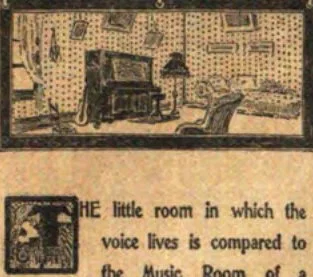
THE MUSIC ROOM
THE little room in which the voice lives is compared to the Music Room of a
Chicago in LESS than 3 Days
From San Francisco at 10 a. m.
CHICAGO, UNION PACIFIC & NORTHWESTERN LINE
DOUBLE Drawing-room Sleeping Cars, Buffet, Smoking, and Library Cars, with barber. Dining Cars meals a la carte. Daily Tourist Car Service and Personally Conducted Excursions every week from San Francisco at 6 p. m. The best of everything.
R. R. RITCHIE
617 MARKET ST. PALACE HOTEL
GEN. AGENT PACIFIC COAST SAN FRANCISCO
OR S. P. COMPANY'S AGENT
WANTED, A RUSTLER
A man to take one-half interest in water distilling plant, good business already established, can be developed to several hundred dollars per month. It has cost over $1,000 to equip and develop the plant, and will take $300 for one-half interest, including good horse, harnesses, buggy, wagon, bottles, crates, still, etc. Do not want to sell plant. Object, have too much other work to give it personal attention. Must be S. D. A. in good standing. Address, Garden City Sanitarium, San Jose, Cal.
The Winning of Margaret
A story, showing in a beautiful way that the second coming of Christ is very near
A. G. L. No. 53 · 1c each · 68c per hundred
PACIFIC PRESS PUBLISHING CO.
Oakland, California
11 W. 20th St., N. Y. 18 W. 5th St., Kansas City, Mo.
DAY OF THE SABBATH
IS IT ANY DAY, OR IS IT A PARTICULAR DAY? AND IF A PARTICULAR DAY, WHAT DAY IS IT?
A. G. L. NO. 50 1C EACH 68C PER HUNDRED
PACIFIC PRESS PUBLISHING COMPANY
OAKLAND, CALIFORNIA
11 W. 20TH ST., NEW YORK. 16 W. 5TH ST., KANSAS CITY, MO.
NEW CLUB RATE for 1902
THE SIGNS OF THE TIMES HAS ONE CLUB RATE FOR 1902, AND THAT IS SEVENTY CENTS PER YEAR PER COPY FOR FIVE OR MORE COPIES.
THIS GIVES THE INDIVIDUAL, OR SMALL CHURCH THE SAME OPPORTUNITY TO DO MISSIONARY WORK WITH THE PAPER AS THE LARGEST CHURCH OR SOCIETY.
THE FOLLOWING TABLE SHOWS JUST HOW MUCH ANY CLUB WILL COST FOR ANY LENGTH OF TIME. LARGER CLUBS AT SAME RATE.