Your ShelfYour Projects

Review and Herald, Vol. 75, No. 18.

GOD’S STANDARD OF CHARACTER

Review and Herald

May 3, 1898

Seventh-day Adventist Publishing Association · Battle Creek, Mich. · May 3, 1898

GOD’S STANDARD OF CHARACTER.

MRS. E. G. WHITE:
The law of God is binding on all human intelligences. “Think not,” said Christ, “that I am come to destroy the law, or the prophets: I am not come to destroy, but to fulfil. For verily I say unto you, Till heaven and earth pass, one jot or one tittle shall in no wise pass from the law, till all be fulfilled. Whosoever therefore shall break one of these least commandments, and shall teach men so, he shall be called the least in the kingdom of heaven: but whosoever shall do and teach them, the same shall be called great in the kingdom of heaven.”
God requires obedience to his law. But Satan, ever since his fall, has been working against this law. He created disaffection in heaven by his ambition to be higher than Christ, the Commander of the heavenly host; and then he attacked the law of Jehovah. He held a position next to Christ, and in his rebellion he carried the angels with him. With their leader, these were expelled from heaven; and when Christ came to this earth to live the law that Satan had declared could not be kept, Satan followed him from the manger to the cross, doing all in his power to render his work a failure.
Many mistakes were made by the Jewish teachers in regard to the true character and far-reaching principles of the law. Its relation to sin was misconceived and misapplied. The outward action was dealt with, but inward sins were not touched. Those who did not allow the defilement of the soul to develop into outward defilement, were looked upon as righteous, while in their hearts they cherished thoughts of the most sinful character,—thoughts that were earthly and sensual.
In his sermon on the mount, Christ made known the comprehensive and far-reaching character of the law of God. He applied its great principles to the thoughts and the desires. He taught that all wrong thoughts and feelings, though unknown to any human being, are a transgression of the law of God, and that those who cherish them must suffer the penalty. Thus the law was shown to reach the inner life.
Christ presented the truth as a sharp sword, which cut to the soul. He flashed the divine requirements upon the secrets of the perverted heart. “Ye have heard that it was said by them of old time, Thou shalt not commit adultery: but I say unto you, That whosoever looketh on a woman to lust after her hath committed adultery with her already in his heart.” “Ye have heard that it was said by them of old time, Thou shalt not kill; and whosoever shall kill shall be in danger of the judgment: but I say unto you, That whosoever is angry with his brother without a cause shall be in danger of the judgment: and whosoever shall say to his brother, Raca, shall be in danger of the council: but whosoever shall say, Thou fool, shall be in danger of hell fire.”
In the Old Testament and the New the law is shown to be God’s standard of character. A lawyer came to Christ with the question, “What shall I do to inherit eternal life?” “What is written in the law? how readest thou?” the Saviour asked. The lawyer had been urged by Christ’s enemies to ask him this question, that they might find something wherewith to accuse and condemn him. In his wisdom, Christ referred the question back to the questioner. This was so unexpected that the lawyer did not study how to evade the matter, but answered him honestly, in accordance with the light that he had. He was acquainted with the principles of the law, and he replied, “Thou shalt love the Lord thy God with all thy heart, and with all thy soul, and with all thy strength, and with all thy mind; and thy neighbor as thyself.” “Thou hast answered right,” said Christ; “this do, and thou shalt live.” To love God with all the heart is the first great law of the universe. When the love of God fills the heart, love to our fellow men will flow forth in words and deeds as the fruit of that love.
From the pillar of cloud the Lord gave the same lesson to Moses, to be given to the people. “The Lord spake unto Moses, saying, . . . Ye shall do my judgments, and keep mine ordinances, to walk therein: I am the Lord your God. Ye shall therefore keep my statutes, and my judgments: which if a man do, he shall live in them. I am the Lord.”
“Thou shalt love the Lord thy God with all thine heart, and with all thy soul, and with all thy might. And these words, which I command thee this day, shall be in thine heart: and thou shalt teach them diligently unto thy children, and shalt talk of them when thou sittest in thine house, and when thou walkest by the way, and when thou liest down, and when thou risest up. And thou shalt bind them for a sign upon thine hand, and they shall be as frontlets between thine eyes. And thou shalt write them upon the posts of thy house, and on thy gates.”
To-day Satan’s influence is great, and it is his special work to make void the law of God. Those who place themselves under his control he leads to do this also. The work he began in heaven he has zealously carried out on the earth. The war between the two great armies is waged upon the commandments of God and the faith of Jesus. Satanic agencies are united with human agencies in an effort to make void the law of God, and to teach for doctrines the commandments of men. Two contending forces are striving for the mastery. Shall we allow our influence to swell the tide of iniquity and transgression? Every soul that believes the word of God should arise and shine because his light has come, and the glory of the Lord has risen upon him. Shall we not study the word of God critically, refusing to trust to our own intelligence, which may be under the control of a masterly tempter?
It means everything to us on which side we place our influence. It makes all possible difference what we believe. The falsehood maintained by Satan, that the law of God is abrogated, will be accepted in all honesty by those who have not walked in the light as it has shone upon their path. They have turned aside to falsehood, and they wrest the Scriptures to maintain their false theories. The more sincerely a man believes falsehood, the more fatal it is to his own soul. He earnestly advocates this falsehood, and those who have not been sanctified through the truth accept it. The more he advocates error, the more certain he becomes that it is truth, and that truth is error, and must be exposed and denounced. He is imbued with a zeal that is in accordance with the zeal of his leader.
A striking contrast is seen between those who practise the truth and those who have joined the ranks of the apostate. Meek and lowly will those be who follow the Lamb of God. Boastful, denunciatory, and lawless in word and deed will those be who war against the commandments of God. They are thus because they have the spirit and attributes of the dragon, who was wroth with the woman, and went to make war with the remnant of her seed, who keep the commandments of God, and have the testimony of Jesus.
God’s law is immutable and eternal; for it is the transcript of his character, and by it God designs to bring the family on earth into harmony with the family in heaven. God has made it possible for men to obey his requirements, by making it possible for them to be partakers of the divine nature. Thus our characters may be molded in accordance with the law of God. And by willing obedience to this law our characters are conformed to the character of God.
Obedience to the law of ten commandments is the condition of salvation. This is God’s positive requirement. The Bible declares that no one can truly love God and yet refuse to obey his law, after receiving light in regard to its immutability. Many attempt to justify their disobedience by distinguishing between God’s commandments and Christ’s commandments. This they do, that they may bear the name of Christian and yet live in violation of God’s law. But those who plead thus place their faith in a falsehood devised by the father of lies.
God’s commandments are indeed the commandments of Jesus. “If a man love me,” Christ declared, “he will keep my words: and my Father will love him, and we will come unto him, and make our abode with him.” “He that hath my commandments, and keepeth them, he it is that loveth me: and he that loveth me shall be loved of my Father, and I will love him, and will manifest myself to him. . . . He that loveth me not keepeth not my sayings: and the word which ye hear is not mine, but the Father’s which sent me.”
“He that saith, I know him,” John wrote, “and keepeth not his commandments, is a liar, and the truth is not in him. But whoso keepeth his word, in him verily is the love of God perfected: hereby know we that we are in him. He that saith he abideth in him ought himself also so to walk, even as he walked. Brethren, I write no new commandment unto you, but an old commandment which ye had from the beginning. The old commandment is the word which ye have heard from the beginning.”
Through Jesus there is divine sympathy between God and the human beings who, through obedience, are accepted in the Beloved. Thus humanity conforms to the will of divinity, fulfilling the words, “If ye love me, keep my commandments.” The commandment-keeping people of God are to walk in the sunlight of Christ’s righteousness, their countenances expressing cheerfulness and thanksgiving, joyful in the assurance, “Blessed are they that do his commandments, that they may have right to the tree of life, and may enter in through the gates into the city.”

CALVARY

YEA, all the paths of earth lead up to thee, O Calvary! The sad, the pleasant, The bond and free, The prince and peasant, As equals meet around thy tree. The past and present, Merged into one, are found Upon thy holy ground. Darkness and light Are on Christ’s left and on his right, But we ourselves must place In judgment or in grace: We may in darkness stand, Or kneel in light at his right hand. Unheeding of his wistful cry, We cannot pass Christ by; We must “Hosanna” sing, or “Crucify,”— Confess him, or deny.
—Selected.

THE BAPTISM OF THE HOLY SPIRIT.

R. A. UNDERWOOD.
(Mesopotamia, Ohio.)
The conditions upon which God has promised to baptize his people with the Holy Spirit and with power are overlooked by many who expect this wonderful blessing. They wait, and wonder why it does not come, in some cases accepting the counterfeit. We are asked to receive the Holy Spirit, but the way is not clear to many how this blessing is to come. Before we can receive the Holy Ghost, we must know that he is. We cannot receive him for what he is, unless we know something about who he is, and what he is. We must also feel the need of him, and make the necessary preparation on our part, in order to receive him.
Many overlook the work that must first be done for us before the Lord can trust us with the power that comes with the baptism of the Holy Spirit. “Ye shall receive power, after that the Holy Ghost is come upon you.” Acts 1:8. The disciples were commanded to wait for the promise, and to tarry in the city of Jerusalem, until they should be “endued with power from on high.”
Those days of waiting and tarrying were not days of idle expectancy. No, no! they were days of earnest work, self-examination, consecration, and a coming into the unity of the Spirit, so that when the day of Pentecost had come, the disciples were all of “one accord.” This is one of the conditions of receiving the Spirit. See 2 Chron. 5:13, 14.

PROGRESSIVE WORK.

The divine order of the progressive work for the child of God is: (1) Justification, or the new birth; (2) consecration; (3) sanctification. There is much confusion in the minds of many concerning these terms and their meaning. By some they are supposed to mean about the same thing. In this they are mistaken. I can only briefly notice each point, but hope to make clear the distinctive work of grace embraced in each step.
The first step, the new birth, is the beginning of the new life. “As many as received him, to them gave he power to become the sons of God, even to them that believe on his name.” “Verily, verily, I say unto thee, Except a man be born again, he cannot see the kingdom of God.” This is received by confession and faith. “If we confess our sins, he is faithful and just to forgive us our sins, and to cleanse us from all unrighteousness.” “Therefore being justified by faith, we have peace with God through our Lord Jesus Christ.” “Being born again, not of corruptible seed, but of incorruptible, by the word of God, which liveth and abideth forever.”
This, then, is the first step in the onward march of the child of God, but we must not stop simply with being born. “As newborn babes, desire the sincere milk of the word, that ye may grow thereby.”
No one can advance far in the “new and living way, which he [Christ] hath consecrated for us” (Heb. 10:20), unless he takes the second step, which is to consecrate himself fully to God. This is essential; yea, it is the point upon which all progress in the spiritual life and power turns. Without consecration, the new-born child dies, and is a Christian only in name.
Consecration is our part of the work, and means much more than many suppose. “For
Moses had said, Consecrate yourselves to-day to the Lord, even every man upon his son, and upon his brother; that he may bestow upon you a blessing this day.” Ex. 32:29.
This means that we are to devote, set apart, dedicate, all our powers to the service of God. That leaves no room for a person to have “his own way,” or to choose his own work, or where he shall go. The consecrated person has turned that over to God, and God has already “consecrated the way” for him. The will is on the altar of consecration. This is the secret that opens joy, peace, and the fruits of the Spirit to the child of God. Through consecration we are enabled to be so surrendered to God and to one another that the unity and oneness born of heaven are ours.
“And the glory which thou gavest me I have given them; that they may be one, even as we are one: I in them, and thou in me, that they may be made perfect in one; and that the world may know that thou hast sent me, and hast loved them, as thou hast loved me.” John 17:22, 23. Those who have not done this, or who are unwilling to do it, need not expect the baptism of the Holy Spirit. The consecrated man has given up his will, his life, his honor, his glory, his time, his all, to seek
the glory of God only. Such a one can believe for the baptism of the Holy Spirit. Says Christ, “How can ye believe, which receive honor one of another, and seek not the honor that cometh from God only?” “He that speaketh of himself seeketh his own glory: but he that seeketh his glory that sent him, the same is true, and no unrighteousness is in him.”
Some are praying for the baptism of the Holy Spirit who know nothing of what it means to be consecrated, or to be sanctified by the truth. Those who simply have been justified, and know nothing of consecration, cannot exercise intelligent faith in praying for the baptism of the Spirit. Let us begin at the right place, and we shall not be deceived nor disappointed.

SANCTIFICATION.

It is our part to do the consecrating, and it is God’s part to do the sanctifying. God cannot sanctify a person who is not consecrated. Should the Lord baptize an unconsecrated person with the Holy Spirit and with power, it would be simply confirming that soul in sin and death.
In every successive step of sanctification, which is a life-work of cleansing us from all sin, known and unknown by us, the Lord will bring us to a test of our consecration. When Christ brings his word to us by whom he will, revealing some unknown sin, the consecrated soul will say, I have given up my way to walk in your living, consecrated way, and I accept the light. And thus he will walk out into new revelations of truth. “If we walk in the light [that means to accept every ray of light God sends], as he is in the light, we have fellowship one with another, and the blood of Jesus Christ his Son cleanseth us from all sin.” 1 John 1:7.
Thus the work of sanctification is carried on by God for every one who will consecrate himself to God. “Who then is willing to consecrate his service this day unto the Lord?” 1 Chron. 29:5.

HEARKEN

The King's Messenger.
“HAVING ears, hear ye not?” said Christ to his disciples in the face of an awful blunder in their understanding of some things he had said and done. And again, years afterward, when talking with John alone on the Isle of Patmos, he repeatedly uttered the cry, “He that hath an ear, let him hear what the Spirit saith.” Then it is possible to have ears and not hear, not because he is not speaking, but because our ears are given to other sounds, to other voices. Pathetically does he plead, “Hearken diligently unto me.”
It is his business to speak; it is ours to listen, in the stillness of all flesh, and the clear understanding will follow. Listening involves absolute silence on our part. We may never hope to have all the din about us cease, nor all clamoring voices hushed; but if silence reigns in our hearts, we shall hear; for he speaks within, and the clashing of wildest elements outside will not confuse us. It is not outward silence he is asking for, but inward quietness. It is the inward tumult that drowns his voice. You may be perfectly serene outwardly, and your lips smile, while there is the wildest noise in your spirit.
If you would hear him, be silent in yourself. Let every self-centering desire subside into passiveness. Let your reasoning cease. Let your judgment keep silence. Let there be no rising up to do or to be. Let there be no resistance in your heart. Let your very desires lie down quietly. Let all your hopes of happiness stay calmly at his side. For if any of these are active, their noise in the spirit dulls the sensibility of your ear, and you miss his voice.
Self always produces discordant sounds, which lead us out of harmony with Christ’s will. And out of harmony with him, our lives become an unpleasant discord, that wears on us, exhausting our strength, and spoiling our very powers of service. Be still, beloved, and you shall know God.
Hearken, hearken diligently, and you shall hear his voice, and your following will be easy and complete; for he has said, “My sheep hear my voice, and I know them, and they follow me,” and they will not follow a stranger, for they know not the voice of strangers. Cease to know so many voices. Cease to know the voice of your own self-life. Hearken, be still, and you shall know his voice.

LIGHT FROM THE WORD.

L. A. REED.
(Jacksonville, Ill.)
In the preceding article it was shown that sunlight is a revelation of the character of God; it is a manifestation of his divinity and eternal power; it is a revelation of God. In this article let us take up another line of reasoning, which will lead to the same thought.
In Ps. 119:130, R. V., we are told that the opening of God’s word gives light. And in verse 105 of this same psalm we are told that the “word is . . . a light.” In the beginning, the earth was without form, and void, and darkness was upon the face of the deep. But God said (this was the opening, and the letting free, of his word), “Let there be light: and there was light.” —God commanded the light to shine out of darkness; and, obedient to his word of command, it shone.
It is an axiomatic truth that like begets like. Something cannot come from nothing; and a thing which does not possess a given quality cannot impart that quality to something else. The foundation of the gospel rests on this truth. Adam lost his righteousness, and hence he could not impart righteousness to his children. “As is the earthy, such are they also that are earthy.” But Jesus Christ had a righteous character, and to his children he imparts this righteous character; and as he had no sin, it is manifestly true that he cannot impart sin to his children. “As is the heavenly, such are they also that are heavenly.”
Now, the word of God gives light. All light is given through the word of God. I care not whether the light be that of a candle, or of the hearth, or of the lamp, or of the electric battery, or of the electric dynamo, or of the firefly, or of phosphorescence, or whatever else, still its origin and activity are due directly to the word of God. And I believe that every one of my readers is sufficiently well informed in Bible truth to trace back to that origin any one of the sorts of light named.
And now, since it is true that like begets like, this light which is begotten by the word of God must partake in some measure of the qualities and character of that word. The word gives to light that which the word has to give. Light receives from the word that which the word has to give. And to the extent that the word gives to light its properties,—to the extent that light receives from the word,—just to that extent will light be like the word; and just to this extent will light be a revelation and a manifestation of the word. And as we have shown that to some extent, light must receive from the word, it follows that to some extent, light must show forth the character of the word.
Then a study of light in its true sense must be and is a study of the word of God. A study of the nature of light is a study of the nature of the word; a study of the character of light is a study of the character of the word. And he who studies light only for light’s sake, is not studying it for all that it is worth. He who has seen no farther than this has not seen, by any means, so far as he ought. He has failed as yet to see the real object of his study of this particular manifestation of the word. It is well to study light,—to study it carefully, scientifically, to learn all we can about it. Sometimes we can hardly see wherein it reveals the character of God and his word. But even then we should study it, knowing that in time we shall see farther,—that sooner or later, behind every peculiar property of light, we shall be able to see the love and goodness of God.

SUNRISE

VIOLA E. SMITH.
A KING comes in state from the Orient; “Hear you his foot's royal tread? He throws out before him his banner Of purple and crimson and red.
Far up the sky toward the zenith He lifts his bright scepter of gold. With warm arms of light he embraces The earth, erst so somber and cold.
The wondering world waiteth to welcome This glorious prince from afar, And light from his countenance streaming Has quenched every heralding star;
All nature is waking to greet him, And dark shades of night flee away, As forth from the lands of the Orient Comes rolling the beautiful day.
Thou Sun of my soul, blessed Saviour, Rise thou on my spirit's dark night, And with the bright light of thy presence, Put sorrow and doubting to flight!
O, scatter the mists of the lowlands, That hide from my vision the sky, And strengthen, with life-giving glances, The things that are ready to die!
Then shall life blossom out in its beauty, And every dark cloud flee away, As into my heart's dim recesses Comes sweeping thy beautiful day.

“THERE SHALL BE SIGNS UPON THE EARTH.”
A. O. TAIT.
(Oakland, Cal.)
The intense war spirit among the nations of the earth is only one of the many signs given by which we may plainly know when the Master's coming is near. For in this, the last generation before the coming of our Lord, he fills the world with evidence of his advent. And the evidence is so conspicuous and clear that every one must see it, even with his physical eyes.
God will have every one know what he is about to do for this sin-cursed earth, because his great love leads him to seek to save every person who can be won by his grace. Hence he places signs in the earth all about us, so that we must see them. And as we see these signs, the impression comes irresistibly upon us that they betoken the end, and admonish us to get ready.
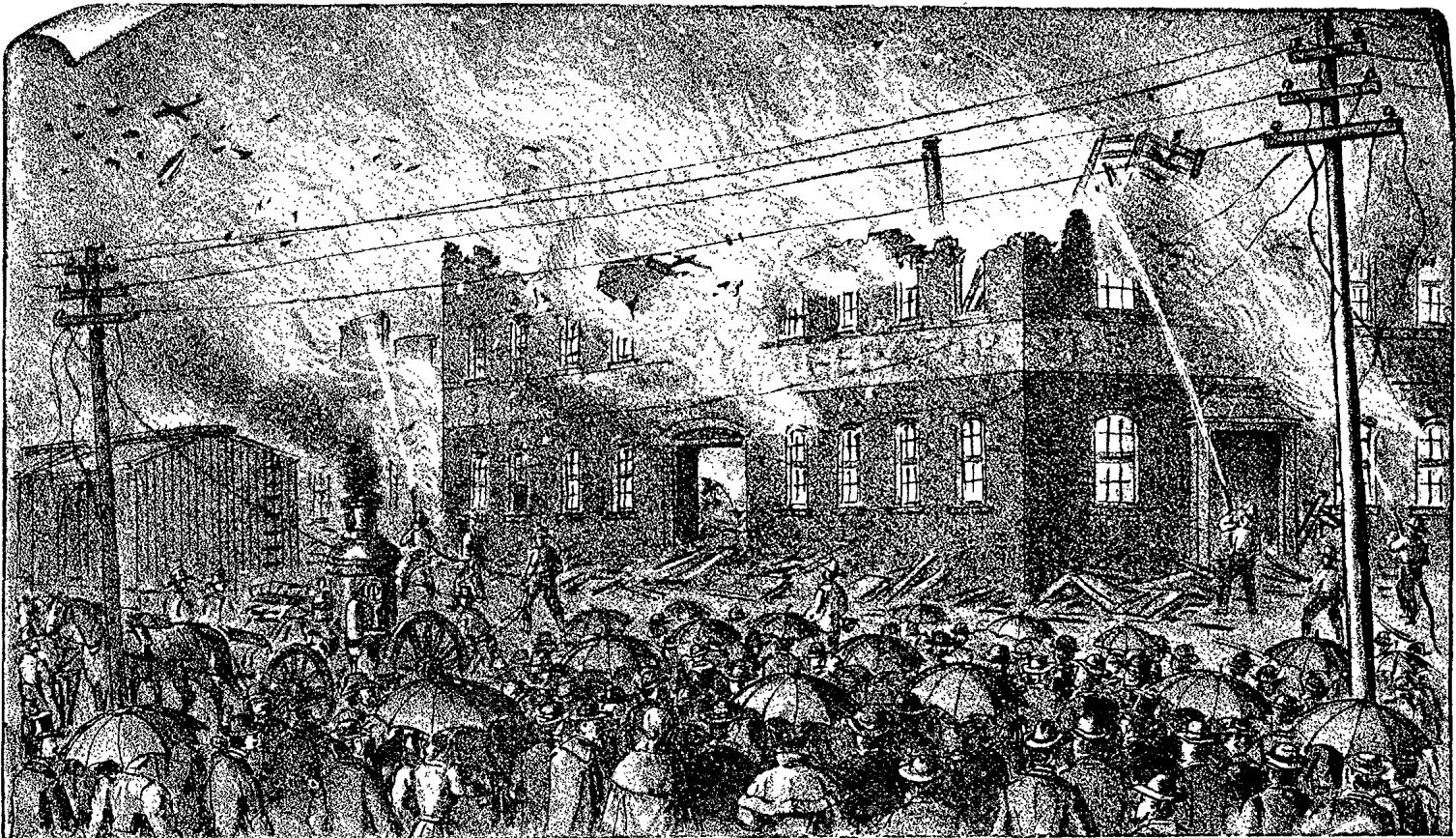
The St. Louis cyclone, May 27, 1896. Ruin and burning of the refrigerator building.
Perhaps there is no sign of his coming that more forcibly impresses itself upon the mind than the rapidly increasing storms, cyclones, pestilences, etc., that are devastating so many parts of our earth. The Lord gives these things as a sign of the approaching end of time, and the Spirit of God invariably impresses the mind with just what they mean.
If people only realized how fully the evidence of the second coming of Christ has been given in the last half-century; if our eyes were only open to the fact that millions of Bibles are being circulated every year, and that in many different ways our God has caused the light of his word to enter the minds of men; if we could only know how many millions have already had the scriptures that give the evidence of his coming impressed on their minds and hearts, we would not be surprised when men, terror-stricken and filled with awful forebodings of danger in the presence of an approaching storm, are heard crying out, “The end of the world is come! the end of the world is come!”
The Lord has said: “Fear, and the pit, and the snare, are upon thee, O inhabitant of the earth. And it shall come to pass, that he who fleeth from the noise of the fear shall fall into the pit; and he that cometh up out of the midst of the pit shall be taken in the snare: for the windows from on high are open, and the foundations of the earth do shake. The earth is utterly broken down, the earth is clean dissolved, the earth is moved exceedingly. The earth shall reel to and fro like a drunkard, and shall be removed like a cottage; and the transgression thereof shall be heavy upon it; and it shall fall, and not rise again.” Isa. 24:17–20.
How forcible is this language of inspiration! “The earth is utterly broken down.” And again, “The earth is clean dissolved;” and further, “The earth is moved exceedingly.” Any one of the expressions from this scripture is most impressive in its statement of the breaking up of this sin-cursed earth; but the prophet adds one forcible statement to another as he brings before our minds what this earth is to pass through as it nears its end. And not only is it to be “broken down,” “clean dissolved,” and “moved exceedingly,” but “the earth shall reel to and fro like a drunkard, and shall be removed like a cottage.”
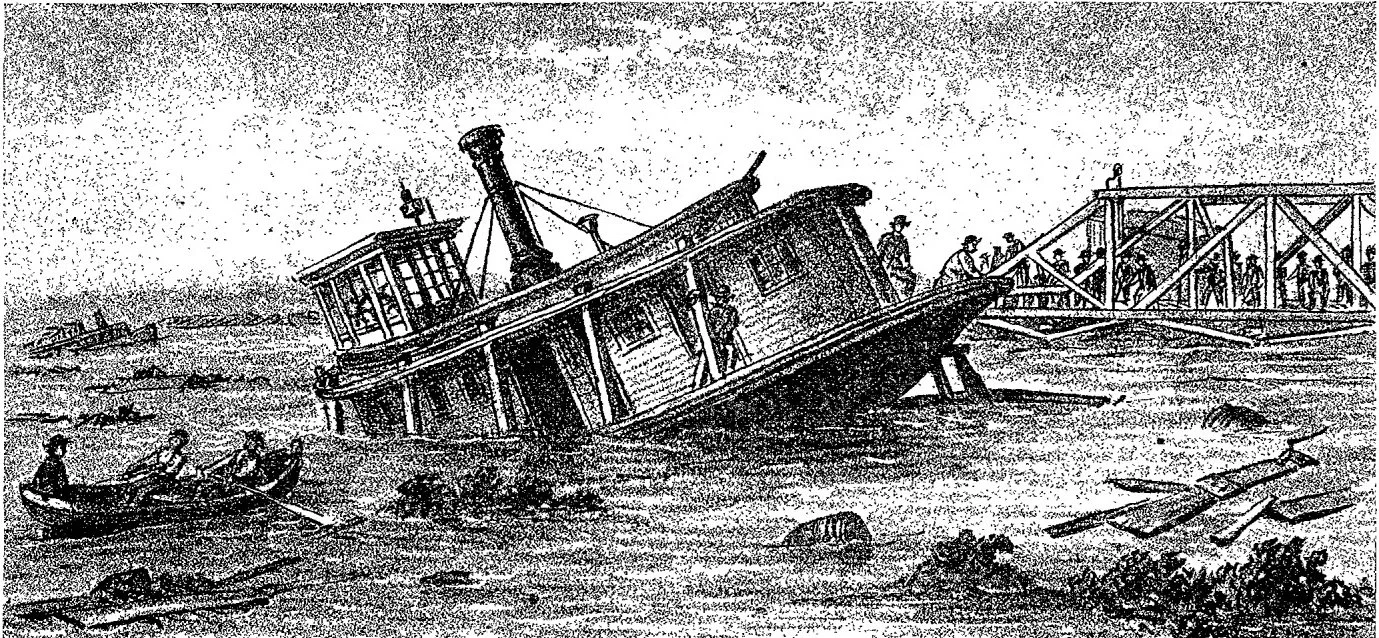
Tugboat and other wreckage after the St. Louis storm.
As we read the foregoing picture that our Lord gives of what the earth itself is to pass through; how truly can we say that the Master will leave no one without the clearest evidence that the end of all things is at hand. And do you and I, as Seventh-day Adventists who profess to believe these things, realize that we are even now in the very midst of these fulfilling prophecies? Our literal eyes are now looking at the veritable signs of Jesus’ coming, that the prophets saw only by vision. O that we, as we see these things, may be filled with the thought of their great and solemn reality! May we, morning, noon, and night,—yes, continually, every moment,—pray that our Heavenly Father will baptize us anew, and with power, for his service.
Certainly we can say that “prophecies are being fulfilled, and stormy times are” around us. Let us not make the mistake of allowing our hearts to become hardened against this overwhelming evidence, and so be lost despite all the Lord’s efforts to save us. The Lord’s coming is imminent. Get ready; and as you get ready, devote yourself also to telling others, that they may be ready.

Spring Showers and the Latter Rain

If seeds planted in spring need showers to make them germinate and grow through summer, much more when the time comes for the grain to mature. The day of Pentecost represents the spring-time of the Christian age. The present is the time for rains to mature the grain for the harvest. M. M. Jackson.

“TIMES OF REFRESHING.”

“The times of refreshing shall come from the presence of the Lord.” The set time to favor Zion, the promised time for the outpouring of the Spirit in the last days, the sound of his coming in the tops of the mulberry-trees, is here. He has come, and has entered upon his work; marvelous results are to take place, nations are to be born in a day. Yes, he is here! he has come,—come into my heart and into thousands of others, quietly, gently, unostentatiously,—come to stay, to enlarge, to multiply, to increase. Witnesses are abounding,—clear, cheery, loving, sweet baby witnesses. How they are drawn to one another, and how they are bringing his coming nearer! What fortunes are gathering for his work, what precious lives are laid for his disposal, what hearts and hands and brains are emptied for his infilling! Halleluiah! He is here. Jesus is coming! We are in the appointed days, we are nearing the end; it is surely coming, it cannot delay.
'Tis coming up the steep of time, And this old world is growing brighter; We may not live to see the dawn sublime, But high hopes make our hearts throb brighter. We may be sleeping in the ground When it awakes the world with wonder; But we have felt it gathering round, And heard its voice of heavy thunder,— 'Tis coming! Yes, 'tis coming! — Selected.

SCIENCE AND INFIDELITY.

O. C. GODSMARK.
(Los Angeles, Cal.)
The scientist who views the works of nature, and does not take into account the intervention of divine power, must have many difficult problems presented to his mind. Scarcely can we look in any direction without seeing things accomplished that are in direct opposition to all known laws of so-called science.
True science, or a proper understanding of the manifestation of God’s power, is beautifully harmonious, and is intended to draw the mind of man into sympathetic action with the laws of his Creator. The science of astronomy is said to be the most exact of all branches of classified knowledge; yet in this field of observation we find the most perplexing complications arising, by which, were it not for the overruling power and care of a living God, the whole universe would be brought into complete ruin.
When he who says that “there is no God” has explained, to his own satisfaction, the origin of matter in its different manifestations, he further calmly declares, confining his observations to our solar system, that these worlds and satellites are so evenly poised in their relation to one another and their great center—the sun—that they move on in their yearly courses, held in position by the great law of gravitation. Now, gravitation is that force by which all particles of matter in the universe tend toward, or attract, one another; and in this case it is said to be so strongly exerted by the sun over each mighty world as to hold it firmly in its own orbit, and to keep it from being carried, by its own momentum, into the fathomless depths of space unknown. All this might do were it not for a further application of the same law,—that each planet powerfully attracts, and is attracted by, each of the other members of our system. This tremendous force exerted by the different worlds over one another, which can scarcely be computed in millions of tons, increases as they draw near one another and decreases as they separate in their courses, according to the squares of their distances. And right here the whole theory of the solar system’s being so evenly balanced in the scales of gravitation comes to naught.
Take, for instance, the condition of our solar system at the beginning of the present year, when all the planets in our system, with the single exception of Neptune, were practically huddled together on one side of the sun. Each of these worlds was tugging away, with a force inconceivably strong, to draw all the other worlds to itself, and the whole number were being more powerfully influenced by the sun to draw them all to itself. Neptune, on the opposite side of the sun, was adding his force to that of the sun, to draw these all into one general mass of ruin. Now, according to all the known laws of science, what kept these worlds from entering upon a general solar stampede? Why was not Uranus, the one farthest from the center, while undergoing the combined strain of all the other worlds, with that of the sun’s, drawn from his path? And why did he not, in obedience to the law of gravitation, attract to himself the other worlds in a mad flight of destruction to the sun, thus causing the eternal ruin of this portion of God’s universe?
The solution of this problem is not found within the pale of science. To say that centrifugal force preserved our solar equilibrium, in no sense answers the question. This force in no way affects the present proposition. Here the man who believes not in the existence of a God must stop in his reasoning. Here the one who, while admitting the existence of a Creator, tries to believe that all things go according to given laws established in the beginning, and are not now under the continual watch-care and guidance of our Heavenly Father, must lay aside his infidelity, or stand without any foundation for his belief.
The power of God, and that alone, controls and guides these mighty worlds in their unvarying course around the sun. The words, “Upholding all things by the word of his power,” and, “By him all things consist,” contain deep truths, that the mind of man has not yet fathomed. The same kind Father who hears the cry of the orphan and widow, and who watches the sparrow in its flight, guides, with unerring care, the worlds his hands have formed.

Living Branches Bear Fruit Through the Spirit

“SILVER and gold may canker, and garments become moth-eaten; but the indwelling of the Spirit produces living branches, which must and will bring forth fruit. John 15: 2-5.”

What Could You Expect for a Cent

“A LITTLE fellow at church with his mother observed that she put a penny in the collection-basket. On the way home she was expressing dissatisfaction with the sermon. The child met her complaint by saying, ‘Well, mother, what could you expect for a cent?’”

Linking the Fireside, Pulpit, School, and Shop

The fireside, the pulpit, the school, and the shop must be linked and leagued together.—John H. Vincent.
Continue reading: CHRISTIAN MANLINESS