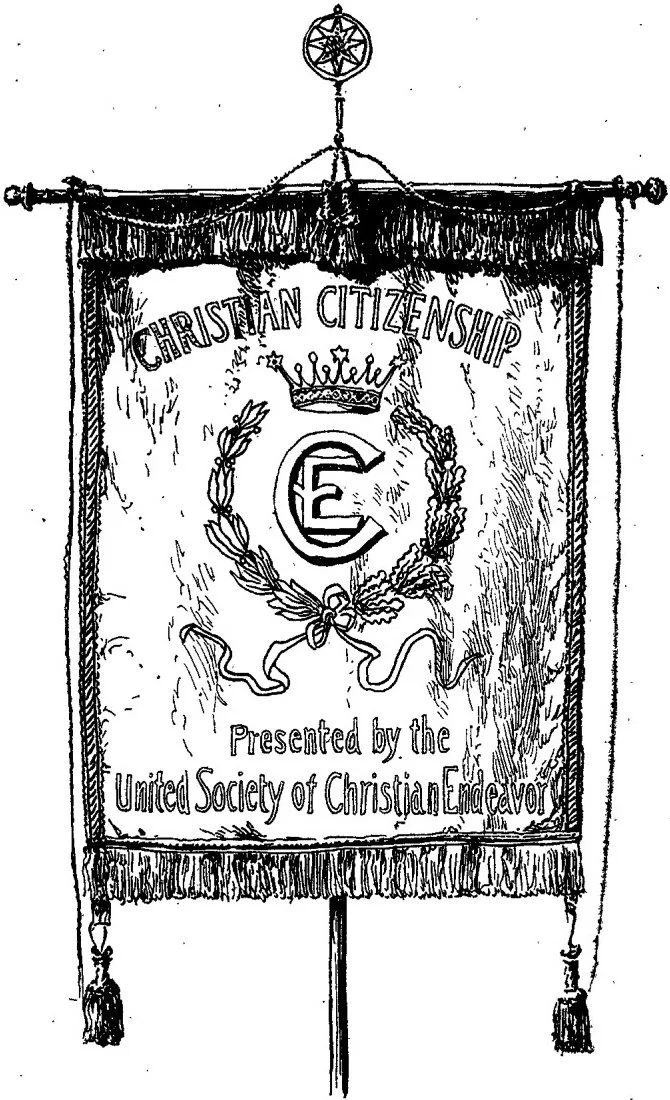
Is the “Christian Citizenship” movement a Christian undertaking in truth, or is it such only in name? We ask this question with particular reference to some statements made by the president, Mr. Edwin D. Wheelock, in the Golden Rule, of December 10. That individual says:—
“It has taken three years to educate, even a comparatively few people up to a clear understanding of the full and true meaning of the Christian Citizenship movement. . . .
“Christian citizenship is more than reform; it is regeneration.
“It is more than the ethics of politics; it is the science of righteousness.
“It maintains that the State is as truly sacred as the Church, should be governed by as high principles, and should recognize God as the source of all authority.
. . . . . .
“It believes that but two ways lie before our country; one leading to anarchy, the other to the application of gospel principles to public affairs.
“It is the voice of one crying in the wilderness of public sins, ‘Prepare ye the way of the Lord;’ measure all things by the rule of absolute righteousness rather than that of ‘policy’; cast out whatever is not in harmony with the teaching of Christ.”
The first of these statements distinctly and emphatically affirms that “Christian citizenship” is regeneration. This is a scriptural term, and refers the mind to that deep and vital mystery of the gospel of God—the new birth. “Except a man be born again, he cannot see the kingdom of God” is a cardinal doctrine of the Christian religion. This new birth is “of water and of the spirit.” John 3:5. In Titus 3:5 it is spoken of as “the washing of regeneration and renewing of the Holy Ghost.”
But “Christian Citizenship” is confessedly not “of water and of the Spirit.” It does not seek to attain the end it has in view by any such means. Its means are, the ballot and legislation. Through these it seeks “the application of gospel principles to public affairs.” As therefore its means are earthly and not spiritual; as regeneration8is wholly a spiritual process, wrought only by spiritual agencies; and as “Christian Citizenship” claims to be regeneration and not mere reform; it follows that it is a fraud, and therefore not Christian at all. But not only is it a fraud in not being what it claims to be; it is a substitute for that which has been instituted by God for human salvation. It is a man-made system of regeneration—a substitute for the real generation which is of God by the Holy Spirit. In claiming to be regeneration, it stamps itself as not only a fraudulent, but an anti-Christian, thing.
The acceptation of Christian Citizenship as the means of regeneration, means its acceptance as the Christian religion. The Christian Citizenship worker will engage in politics—for “the application of gospel principles to public affairs” by means of the ballot and legislation can be nothing more than a form of politics—believing that he is thereby showing forth “the science of righteousness.” It is the same old error which has done such evil work all through the ages—the confounding of politics with Christianity. And this latest phase of it is no better than any of the others, and no less fraught with evil to mankind.
Christian Citizenship and the Coming of the Lord.
By A. F. B.
IF elected by the majority will He serve? If the Lord Jesus Christ, “the Lord of Glory,” should be elected by the majority of the people of the United States as ruler of the nation, will He accept the office?
There is a confederation of ecclesiastical forces engaged in a religio-political campaign with a view to electing the Saviour as Supreme Ruler of this nation. When this shall be accomplished it is proposed to carry the campaign to other nations until He shall be made undisputed Ruler of the world.
At this point some will deny that there is any such campaign in progress. Others will pass the matter by with the remark that if true it is the work of a few irresponsible fanatics. Others still, who favor the campaign, will readily admit the existence and strength of the movement, and will be ready for a discussion of the main question. These last ones are asked to wait until the existence and magnitude of the campaign are shown to those readers who are disposed to doubt or deny it.
The largest campaign procession yet organized to impress the public with the magnitude of the movement was the one which marched from the steps of the national capitol down Pennsylvania Avenue to the treasury building. This procession numbered fifty-thousand, and was composed of representatives of twenty-five Protestant churches federated under the name of the United Societies of Christian Endeavor, an organization numbering three millions. This magnificent parade was headed by a body of clergymen, one of whom carried a banner, an illustration of which is here reproduced from a photograph. This great demonstration was made in the interests of what is called Christian Citizenship. “Christian Endeavor Stands for Christian Citizenship,” were the words used by the President of the United Societies of Christian Endeavor, Mr. Clark, when publicly presenting the banner to the clergyman who carried it at the head of the mammoth procession. The official report of this demonstration says of its ultimate aim:—
“That grand exhibition of young manhood and womanhood is the clearest omen yet seen of the coming time when Christ, whose right it is to reign, shall be supreme on Capitol Hill.”—Official Report, Fifteenth International Christian Endeavor Convention, Washington, D. C., July 8–13, 1896.
A later and if possible more striking statement of the ultimate object of the Christian Citizen crusade is the following:—
“Not until the kingship of Jesus is established over our land and the world, and his teachings made the rule in all public affairs will the Christian Citizenship League have achieved its purpose to prepare the way of the Lord. And then it shall be found that not only has the way for his coming been prepared, but that He has indeed and in truth come.”—The Christian Citizen (December, 1896), the official organ of the Christian Citizenship League.9
Having shown that the object of the Christian Citizenship campaign is to make Christ the Ruler of the United States and then of the world, the next question that suggests itself is, What are the methods by which this is to be accomplished?
As its name signifies, this is not an organization of Christians designed to advance the kingdom of God (which is “righteousness and peace and joy in the Holy Ghost”) in the hearts of men by the only methods known to that kingdom (by the Spirit and “the sword of the Spirit which is the word of God”); but is an organization of professed Christians formed to establish the kingdom of God by the exercise of the functions of earthly citizenship—political methods—through political parties, primaries, political conventions, platforms, candidates, campaigns, ballots, voters, challenges, contested elections, caucuses, fillibustering, laws, detectives, sheriffs, hangmen, etc. These are the methods by which the Christian Citizenship crusade purposes to make Christ the Ruler of the United States!
If thus nominated and elected will the Lord qualify? Will he accept the office, and reward the political Jameses and Johns, his most enthusiastic campaign workers, with the best offices on the right hand and the left in his newly established kingdom? Will he? “What think ye of Christ?”
Before this question is answered, the reader is asked to consider another phase of the subject. It is proposed by this movement to make “His teachings” “the rule in all public affairs.” It is asserted that when this is accomplished Christ will come. By this it is seen that the doctrines of the Christian religion will become political issues, to be argued on the street corner and in the bar-room, and to be voted on by the believer and the unbeliever, the Catholic and the Protestant, the high and the low; and passed upon by judges and juries of varying creeds and characters.
Thus the kingdom of God which is declared to be a kingdom of righteousness and truth, and its law a spiritual law, and its sphere the hearts of men; is to be dragged into the sphere of politics, made subject to majorities, and handled with unconsecrated hands. Are these methods of advancing the kingdom of God in the hearts of men, Christian methods? Are they the methods Christ used? Would he accept the rulership in such a kingdom established by such methods? To ask the question is to answer it. But there is divine precedent and precept with which to answer the question.
About A. D. 32 there appeared in Judea the first Christian Citizenship League. Its object was the same as that of the modern league, to enthrone Christ. Of the Lord’s attitude toward that league it is written, “When Jesus therefore perceived that they would take him by force to make him King, he departed again into a mountain himself alone.” He fled from that “Christian citizenship” crowd, “a great multitude” too, preferring rather to be alone than be with those who so utterly misinterpreted the nature of his kingdom, and misread his character. And just as certain as Christ left those who would make him King of carnal men by carnal methods in A. D. 32, just so sure will he leave those in 1897 who seek thus to make him King. And just in proportion as these Christian Citizenship methods have been adopted, in that proportion has Christ already left the churches of to-day.
On a later occasion, when an apprehensive politician who had been informed by the Jewish Citizenship League that Christ wanted the politician’s place, asked the Lord if the charge was true, He replied: “My kingdom is not of this world, if my kingdom were of this world then would my servants fight that I should not be delivered to the Jews.”
No, Christ’s kingdom among men to-day is a spiritual kingdom, and its subjects are spiritual subjects who serve him in spirit and in truth. He seeketh such to serve him. But now in A. D. 1897, he will not, as in A. D. 33 he would not, be forced to take the position, secured by political methods, as King over carnal men.
Nevertheless, he will be this world’s King. He will come in all His glory and establish His kingdom among men. For to this end was He born. But this will not be accomplished by any Christian Citizenship League, nor by any other political movement. When His kingdom of righteousness and truth has been established by the Holy Spirit in the hearts of all who will receive it, then He will come and destroy out of His kingdom all things that offend and them which do iniquity, purify the earth with fervent heat, “make all things new,” and “reign for ever and ever.”
A. F. B.
Christmas Feast Days and the Kingdom of God
“By general agreement of scholars the beginning of our Christian era has been set four years wrong. By general agreement the Christmas day, December 25th, has also been set wrong. . . . So little have feast days and celebrations to do with religion that it never occurred to one of the four evangelists to tell us the day and the month. . . . All this teaches us the old lesson, that the kingdom of God is not meat and drink, nor birthdays or birthyears, but righteousness and peace and joy in the Holy Spirit.”
Such is a very truthful observation made by the New York Independent, of December 17; and another equally truthful which it suggests is that no surer evidence of the decadence of Christianity in the life of the people could exist than the general and ever-increasing deference paid to such celebrations by the Christian churches. The Independent will bear correction on one point: “feast days and celebrations” do have a great deal to do with religion; but nothing to do with Christianity. They simply put the stamp of paganism upon the religion of which they are made a part.
It was on this very point that the Apostle Paul wrote with the deepest concern to the church he had established in Galatia. “How turn ye again,” said he, “to the weak and beggarly elements, whereunto ye desire to be in bondage? Ye observe days, and months, and times, and10years. I am afraid of you, lest I have bestowed upon you labor in vain.” Gal. 4:9–11. What would the apostle say to-day were he to write to the churches, in view of their ostentatious observance of Christmas, Easter, and other festivals which God never instituted, while totally disregarding the one day which he has solemnly ordained as his everlasting memorial—the seventh day of the week?
The Source of National Atheism.
THE one leading characteristic of the French Revolution was atheism. Not the atheism of men as individuals, but the atheism of men in organized, representative, governmental, capacity. It was strictly national atheism: being the action of the national assembly in its official character as such.
This national atheism was not a sudden wild break of men, in an effort to present to the world a novel spectacle: it was the direct, logical, result of a system that had formerly dominated the country.
There had been fastened upon France, through the governmental authority, a religion professedly Christian. It was not Christian; yet it was adopted and ever held by the national authority, as Christian. All national favors were for this religion; the national authority forced it upon all; the national power rigidly excluded all other forms of worship.
When the Reformation of the sixteenth century came, and therein Christianity was offered to the people of France, it was tabooed, denounced, warred upon, and at last, by the revocation of the Edict of Nantes, was excluded. Then the nation was left under the crushing weight of the old false religion; and it was not very long before the people of France found themselves under the necessity of relieving themselves of the incubus that was upon them.
This religion had been adopted and maintained for the supposed good of the State. It was proposed always to the State by “the Church” under the pretense that it was essential to the welfare of the State. It was found at last to be the greatest evil that afflicted the State. Instead of being for the good of the State, it was found to be only a continued and increasing curse. And in order for the State to find relief, it was essential to repudiate this national religion.
Now note: this religion, though not Christianity, was held by the people of France to be Christianity. The nation had been trained for ages in the opinion that it only was Christianity. They knew nothing else as Christianity. And to them, in repudiating it they were repudiating Christianity. In repudiating it, they did not pretend to be doing anything else than repudiating Christianity; for it was all that they knew as Christianity, and it must be repudiated. And when men intentionally repudiate Christianity, even though it be in something that is mistaken for Christianity, they commit themselves only to atheism. Thus it was that France attained to national atheism.
This, too, was nothing else than carrying to their legitimately logical conclusion the proposition and arguments, by which the country had been held under the power of that national religion. In arriving at national atheism, every step that was taken in the National Assembly was logically derived from propositions that had been laid down by the Church. Every argument offered was but the legitimate extension of the arguments already in print on behalf of the national religion.
For instance, it had always been argued, and was then argued, by the Church, that the exclusive establishment and maintenance of that particular religion as the only Christianity, was essential to the welfare of the State: and that it was the province of the State, of its own motion by an official act, to establish this religion for its own good. The Church has long declared in behalf of the exclusive establishment of that religion, that “it cannot be doubted that it belongs to the prince to require of full right that which is necessary to the State.”
Upon this it was argued in the Revolution that, As this religion had been established and maintained for the good of the State, and the event had demonstrated that it was the greatest evil of the State; as it undoubtedly belonged to the State itself to require of full right that which is necessary to the State; as it was now undoubtedly necessary to the State that it be relieved of this great evil; it followed conclusively that the State had full right to repudiate the whole religious establishment. The full right to establish religion, or to do any other thing, for the welfare of the State, remains the full right to repudiate that religion, or to undo whatever may have been done, when it is found to be working evil instead of good to the State. There was no escape from this conclusion.
Holding what had been taught to them by the Church, that “The Church is in the State, the State is not in the Church,” they declared, “We are a National Convention: we have assuredly the right to change religion”—meaning the religion of the State. “The State used its right to suppress a corporation which had no longer a place in the new society.”
Bear in mind that this national religion was held by all there to be Christianity, and when this was repudiated, it was intended to be the repudiation of Christianity; and when that was repudiated there was nothing left to them but national atheism. The only religion they had then to guide them was the religion of reason; the only god the god of reason.11
Thus, “The boldest measures of the French Revolution in regard to the Church, were justified beforehand from the point of view of the purest monarchical tradition.” It “was only a rigorous application of the maxims of the ancient monarchy. It was simply Gallicanism to the utmost.”
“It is well to remind the detractors of the French Revolution, that the National Assembly in this radical measure only imbibed the principles of the ancient French Monarchy.” (De Pressensé, “The Church and the French Revolution.”) And these principles of the ancient French Monarchy were derived altogether from the national religion. “The representatives of the ancient society . . . imagined that the very foundations had been removed, whereas the maxims of their fathers were being turned against them.”
Reprint of Leading Article Due to Demand
By Editor
AS orders have been received for several thousand copies of our issue of November 26, which cannot be supplied—though sixty-five thousand were printed; and as this present number will go to many thousands of new names, we reprint, with necessary revision in this number, the leading article of that number.
Two Nations, Two Lessons: 1789 and Religious Liberty
The French Revolution and the United States Government began in the same year.
In the year 1789, and because of genuine respect to Christianity, the United States rejected all semblance of national religion, holding that no national religion is Christianity. Thus in the Constitution of the United States was embodied the very principle announced by Jesus Christ for earthly government, when he said, “My kingdom is not of this world;” “Render unto Cæsar the things that are Cæsar’s, and unto God the things that are God’s;” “If any man hear my words, and believe not, I judge him not.”
In the year 1789, began the French Revolution—the inevitable logic of an exclusive national religion—an attempt of the French nation to relieve itself of the unbearable curse which had been put upon it in the exclusive establishment of a national religion. This religion was held to be Christianity, and because of its abominable practices and unbearable oppression, was hated and repudiated, and the nation was plunged into national atheism as the only escape.
Thus in these two nations in the same year God set before the world those two all-important lessons as to the right way and the wrong way. These lessons have been before the nations ever since for their instruction. By the example of the United States the other nations were led gradually but constantly in the right way. But now, against Scripture, against the Constitution and every fundamental principle of the United States, against blessed experience, and in the very face of the terrible warning of the French Revolution, the allied religious forces of the United States are determined to accomplish here the establishment of an exclusive national religion.
Is it possible that the American people will allow themselves and the national power thus to be carried captive to error that cannot possibly mean anything but ruin!
Saul of Tarsus, Not Paul the Apostle.
By O. F. Campbell
BY O. F. CAMPBELL.
“AND Saul, yet breathing out threatenings and slaughter against the disciples of the Lord, went unto the high priest, and desired of him letters to Damascus to the synagogues, that if he found any of this way, whether they were men or women, he might bring them bound unto Jerusalem.” Acts 9:1–2.
This is Saul of Tarsus.
But Paul the Apostle had another spirit. As he himself was persecuted and stood before King Agrippa for his faith, we hear him give expression, through the Spirit of God, to these words: “I verily thought with myself, that I ought to do many things contrary to the name of Jesus of Nazareth. Which thing I also did in Jerusalem: and many of the saints did I shut up in prison, having received authority from the chief priests; and when they12were put to death, I gave my voice against them. And I punished them oft in every synagogue, and compelled them to blaspheme; and being exceedingly mad against them, I persecuted them even unto strange cities.” Acts 26:9–11.
What a wonderful confession is here made! that in doing all this evil work he was exceedingly mad. And all his efforts were seconded by the recognized heads of religion—the ministry. But after Jesus the Man of Calvary, spoke to him and he inquired, “Who art thou, Lord?” he is made acquainted with One he has never known before, although making high profession of religion. Now he is ready to repudiate the whole business and say it was “contrary to the name of Jesus of Nazareth.”
The great lesson we can learn from this record is that those who engage in this kind of business, though they live in 1897, do not know Jesus, and therefore need to form his acquaintance at once that they may cease “being exceedingly mad.” They need to get rid of that spirit, have their names changed, and have the Spirit of Jesus—the spirit of love. O that every professed follower of Jesus Christ would learn this important lesson and not count an unhallowed zeal as evidence of true Christianity.
The Problem Entered Upon in 1789
“To this day the problem entered upon in 1789 is still before us.”—De Pressensé.
National Religion Threatens the United States
And now, just now, there are national combinations of religionists, determined to fasten upon the United States their religion as the national religion. As we have shown, they have already made much progress. It is proposed by them that the State needs this, and must do it by national acts for its own good. With what they have already gained, they are certain to succeed in their designs. And as certainly as this shall come to pass, so certainly it will soon be found that instead of being for the good of the nation, it is the greatest evil that ever befell the nation, and inevitably threatens only the ruin of the nation. Then a demand will be made that for the good of the nation this religion shall be officially repudiated by the nation as such.
Bear in mind also that this religion is now proposed to the nation for adoption as Christianity. It is not Christianity, but it is proposed as essentially and only Christianity. It has been adopted, and it will be further favored, as Christianity; and when found necessary to be repudiated it will be treated still as Christianity. And intentionally to repudiate Christianity, even though this be brought about through apostate and false Christianity, is to land in atheism. And for the national authority to do this, is to land in national atheism. This is as certain now as it was before. And thus this nation, by encouraging this proposed national religion, will throw itself, as did France, into the terrible strait between the curse of a religious despotism working only certain ruin, and the curse of a national atheism which can work nothing less. Will the people, will Congress, will the nation, take warning in time? And by keeping themselves clear of all semblance of recognition of a national religion, will they do all in their power to enable this nation to escape the ruin which is but the logical result of the establishment of an exclusive national religion?
Sunday Rally in Jersey City.
By A. R. Bell
BY A. R. BELL.
A RALLY under the auspices of the American Sabbath Union was held Tuesday evening, December 15, at the Summit Avenue Baptist Church, Jersey City, N. J. The subject discussed was “The American Sabbath; its relation to good citizenship and Christian progress;” ten minute addresses being delivered by the several speakers representing the Christian Endeavor Society, the Epworth League, the Baptist Young People’s Union, and the Society of Andrew and Philip.
The meeting was presided over by Rev. Dr. Brett, of the Dutch Reformed Church, and in his opening remarks he referred to Isa. 58:13, 14:—“If thou turn away thy foot from the Sabbath, from doing thy pleasure on my holy day; and call the Sabbath a delight, the holy of the Lord, honorable; and shalt honor him, not doing thine own ways, nor finding thine own pleasure, nor speaking thine own words: then shalt thou delight thyself in the Lord;” as being just what the Lord wanted of man in regard to the American sabbath.
The first speaker said he believed in the Sabbath. He believed that the ten commandments stood to-day as when God gave them on Sinai, not one having been abrogated.
He believed in the enforcement of sabbath (Sunday) laws, yet said he would fight against any law enforcing religious principles. The sabbath laws, said he, were not enforced to make men religious, but for society’s good.
The pastor of the church spoke in behalf of the Baptist Young People’s Union.
Among other things, he said, “We are determined to stand without swerving for the proper observance of the sabbath. We are scriptural in all things, and we are scriptural in this.”
The next speaker in his remarks said: “We are here to stand for the fourth commandment. . . . Sabbath breaking is a mark of a backslidden church. It is time,” said he, “we were getting back to the law of God.”
The representative of the Christian Endeavor Society laid all the blame for sabbath (Sunday) desecration on the church, excusing the world “because they did not know the seventh day to keep it holy.” Another speaker hoped that the time would soon come when all business except works of necessity and charity would cease on the sabbath, or at least, said he, if stores had to be opened, that it would be only for a little while sabbath morning.
What a ridiculous position to take! Claiming to stand for truth against error; claiming the Bible as their only guide; claiming the Sabbath as a sign between God and his people these men confederate together, their object being the preservation of a day which God in all the Bible never once calls the sabbath!
At the close of the meeting, the writer, who was formerly a member of this church under another pastorate, had a short interview with the pastor. He was asked the question, “Do not the Baptists claim to be strictly biblical in all their doctrine, claiming no other guide than the Bible?” Replying in the affirmative, he was asked, “Where in all the Bible can be found warrant for such a meeting as has just been held?” Pleading ignorance of the meaning of this question, he was asked, “Where in all the Bible can it be found that the first day of the week, Sunday, is called the Sabbath?” His answer was: “Oh, that’s a question for every man to settle in his own mind.” On being asked the question, “What saith the scripture?” his reply was, “There are a thousand and one other things of vastly more importance than the Sabbath on my mind and I have no time to bother with such a subject.”
Consistency! here is a man who thinks the Sunday is of such vast importance that he invites the American Sabbath Union to hold a rally in his church for the support of it, who himself spoke for ten minutes, showing his hearty sympathy with the cause, yet says that a thousand and one other things of vastly more importance than the Sabbath of God occupy his mind. A peculiar state of things truly.
The writer also had the pleasure of introducing himself to Dr. J. H. Knowles, general secretary of the Union. The following dialogue ensued:—
Writer—Dr. Knowles, what is the principal object of your society?
Dr. Knowles—The proper observance of the Sabbath.
Writer—The first thing then to know is which day is the Sabbath, is it not?13
Dr. Knowles—Certainly.
Writer—One of the speakers tonight quoted Isa. 58:13, 14 as the day to be kept holy. Is this the day to keep?
Dr. Knowles—Yes.
Writer—Does not God say the seventh day is the Sabbath? Why then do you quote this scripture and apply it to the first day?
Dr. Knowles—Oh, I know you—who you are. You follow us up wherever we go. You are well meaning and earnest, but you look only on one side of the question.
Writer—There is only one side to this question. We are to keep holy the Sabbath day, and God says the seventh day is the Sabbath.
Dr. Knowles—You only look on one side of the question.
Writer—How many sides are there to this question?
Dr. Knowles—What church do you belong to?
Writer—The Seventh-day Adventist.
Dr. Knowles—I knew it. Everywhere we go you follow us, we find your papers and other reading matter.
Writer—Dr. Knowles, I will ask you a plain question and I trust you will give me a plain answer. God in his word says the seventh day is the Sabbath; you say the first day of the week is the Sabbath, now who is right, who speaks the truth, you or God?
Dr. Knowles—You only look on one side of the question.
This is all that could be gotten from the doctor, so leaving a SENTINEL in his hand (the Christian Endeavor special) I bade him good-night.
I would say also that every person who attended the meeting, including speakers, save one who refused it, received a copy of that number of the SENTINEL.
Well may Rome say:—
“Thus sidle to the goal with awkward pace,
Halting on crutches of unequal size,
One leg by truth supported, one by lies,
Secure of nothing but to lose the race.”
How Thanksgiving Day Became a Sacred Institution
THE position now held by Thanksgiving Day is a perfect illustration of how Sunday became a holy day. At first it was celebrated by individuals upon their own motion. Next it received governmental recognition only in a general way, becoming gradually more special as time went on; then at last finding recognition by government as distinctly a Christian thing. When it reached this point it became too “holy” a thing to bear without serious “desecration” such worldly exercises as common labor or games of ball, etc. The next step that may be looked for is the demand for a law forbidding the interruption and desecration of the “holy” associations and character of the “sacred” day.
When it was first recognized by the Government in a general way, this was considered a worthy tribute to the value of religion in general, to the Government. When it was recognized by the Government in a distinctly Christian sense, this was counted as a more worthy tribute to the value of “Christianity and its institutions,” to the Government. And now if only a law can be secured “to protect the day from desecration,” this will be a most worthy tribute to the value of “Christianity and its institutions,” to all the people. And whether a person believes in Christianity and its institutions or not, he must be compelled to obey the law and observe the institution “for civil and sanitary reasons;” and because “religion or rights of conscience does not enter into the matter at all, it is simply a matter of law.”
As the Christian Statesman has declared, and what is most likely the truth, that “President Cleveland’s proclamation will be a precedent for generations to come;” “and not only will Thanksgiving proclamations continue to be issued, but they will have more generally a distinctively Christian character”—we may expect to see such a course pursued with reference to its observance, as we have described. Then Thanksgiving Day will be just as sacred and just as holy as Sunday is now. For then it will have just the sanctions that Sunday has, and will rest upon just such authority as Sunday does.
“Christian Citizenship” In Milwaukee.
By Geo. M. Brown
BY GEO. M. BROWN.
DECEMBER 17th Mr. A. M. Haswell, Secretary of the National Christian Citizenship League, delivered an address in Milwaukee on the subject of the relation between the working men and Sunday laws.
After stating that he should confine his remarks to the civil aspect of Sunday laws and their desecration, he expressed the idea that an implied contract exists between every citizen and the Government, by which the citizen agrees to keep the laws upon the statute books, and as the Sunday law is one of these laws, every one is in duty bound to keep it.
He indulged in quite an extended eulogy of the Puritans and their laws and said, “They met in the cabin of the Mayflower—God’s modern ark of the covenant—and there framed the first Sunday law. Similar laws were made by the other colonies and have been adopted by the States.”
“No one,” said he, “favors the repeal of these righteous laws but blatant infidels, howling anarchists, and blind, greedy, grasping monopolies.” He defined personal liberty as “the right to do as I please, so long as I trample on no one’s rights, and no righteous law on the statute book.”
After referring to the agitation of the Personal Liberty League for the repeal of the Sunday law now on the statute books of this State, he said: “Any one who under the sacred name of personal liberty seeks to have the Sunday law repealed is more worthy of the rope or the bullet than were Jefferson Davis and Benedict Arnold.” This statement was applauded by the audience.
He declared that the only hope the workingman had14of a day of rest was in having a law, enforcing a rest-day, and said: “Shall we repeal the Sunday law at the beck and cry of howlers who hate the sabbath and the sabbath’s God? Never”!! In his estimation those who work for the repeal of the law are enemies of law and order.
Among the methods which he suggested for combating the opposers of Sunday laws, and especially those who were working for the repeal of the laws now in force, he mentioned the circulation of petitions by “the prettiest young ladies” who should secure the signatures of all the voters possible.
He also advised the members of the League to consolidate with every society, Protestant or Catholic, that is favorable to Sunday laws and that will work for them. The audience frequently applauded the speaker, and though the number present was not large, there was considerable enthusiasm manifested. A portion of Nehemiah 13 was read as a Scripture lesson at the beginning of the service, and it was manifest that many would like to “lay hands on” all who do not observe Sunday, even as Nehemiah threatened to lay hands upon the merchants and sellers of fish who desecrated the Sabbath of the Lord in his day.