The Youth’s Instructor, Vol. 33, No. 18.

NIGHT

The Youth’s Instructor

May 20, 1885

S. D. A. Publishing Association · Battle Creek, Mich. · May 20, 1885

NIGHT

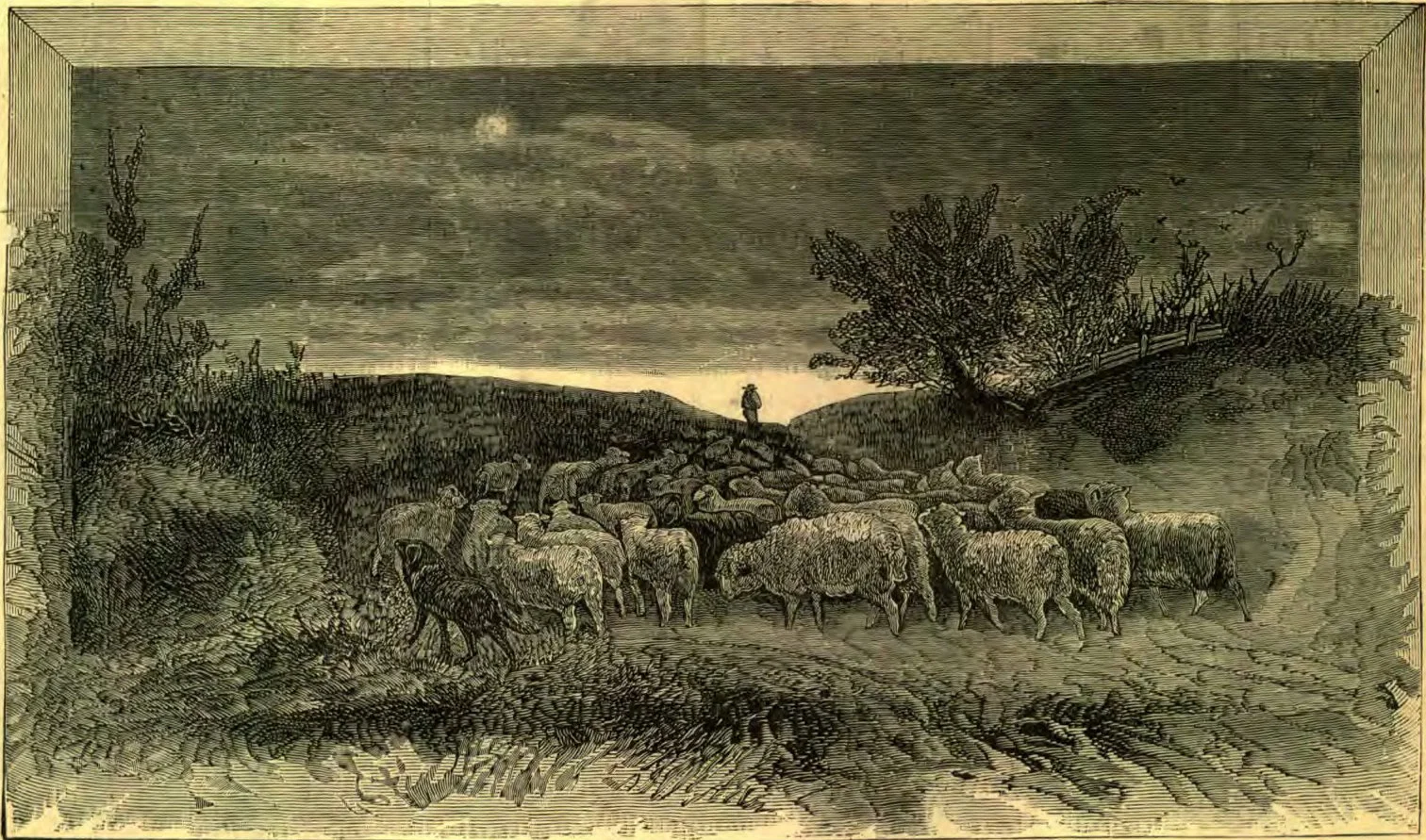
THE sun sinks down behind the hills, And dusky shadows fall; The birds all homeward wing their way To leafy tree-tops tall. But hark! When all things else are still, Borne on the dying wings of day, I hear a clear voice calling shrill, “Ca-dà, ca-dà, ca-dà;” And saucy echoes, far away, Softly mock, “Ca-dà, ca-dà.”
It floats o’er meadow, vale, and rock, Down to the pasture-land, White-dotted with the waiting flock That all impatient stand To hear the voice that bids them seek The fold when skies grow gray, With joyous bleat, they hear it speak, “Ca-dà, ca-dà, ca-dà;” While echoes think to lead astray, And softly call, “Ca-dà, ca-dà.”
They follow in the beaten path That winds by hill and dell; And echoes mock each pattering hoof, Re-ring each tinkling bell. The sky hangs all its lanterns out To light them in the fold. While croaking frogs in distant ponds Pipe out a chorus bold, And crickets chirp, content they lie, Safe-sheltered from the cold.
S. ISADORE MINER.

TWO RAINY EVENINGS.

RAIN, rain, rain! Annie Watts stood between the heavy curtains of the parlor windows, looking out. It was not a hard rain, but a steady one—a rain which seemed to have come to stay. It began about five o’clock that afternoon, and now, at half-past seven, was still coming quietly down. She was not sorry, however. It was Friday evening, which was the night for prayer-meeting, and the one evening when she did not have to study to-morrow’s lessons, but might amuse herself as she wished, and to-night she chose an interesting story. “It rains too hard for me to go out to-night,” she said to her Aunt Emma, as she came away from the window.
“Of course it does,” responded Aunt Emma decisively. “I hope Lizzie won’t think of going.”
“Oh, she won’t,” Annie asserted, sitting down in an easy-chair by the table, where a large lamp was burning. She found her place in her story-book, and began to read.
Annie Watts and her twin sister Lizzie were motherless girls, whose father left them in charge of his maiden sister. And this aunt was not a Christian. She never, on Sabbath or week-day, entered the Lord’s house, and was rather pleased when one of the girls remained away.
“Aren’t you ready, Annie?” Lizzie asked in some surprise, stepping into the parlor ready to go. “It’s time.”
“You surely are not going!” cried Annie.
“Lizzie, you cannot go out to-night in the rain,” commanded Aunt Emma.
“I don’t want to go without your permission, dear auntie,” she said, “but you know I go to school always when it rains, and it never hurts me. My dress is too short to get draggled, and my waterproof and rubbers are so stout and my umbrella so large no rain can get to me. Do you think it can hurt me?”
“I suppose not,” the aunt reluctantly admitted. “Go on if you want to.”
“Well, I’m not going to risk my life by going,” Annie announced shortly, without looking up from her book.
Lizzie went on her way joyfully, and the aunt and niece, left behind, read the whole time, hardly speaking a word while she was gone.
“Not a bit wet; see!” she cried, as she came in, taking off waterproof and rubbers.
“I see,” returned the aunt, but not graciously. “You were about the only one there, weren’t you?”
“There were only twelve there,” she said sadly, “that was all. Just think of it! But I never did enjoy a meeting so much. I wish you both could have gone.” There was a look of peace and real happiness on her face. Annie saw it, and maybe Aunt Emma did too.
“O Annie!” Lizzie exclaimed the next moment, “Aunt Ellen was there. She says that Cousin Jennie comes home to-morrow, and she wants us to come up and spend to- morrow evening with them. Jennie has been learning to sing at school, and we may expect some very good music. Of course you are invited, auntie.”
“How nice!” cried Annie. “You’ll go, won’t you, auntie?”
“Certainly. I want to see Jennie.”
They went to bed soon afterward. Annie’s thoughts were so filled with the story she had been reading and the cousin she was going to see, who was almost a sister to her, and who had been from home for nearly a year, that her prayers were careless that night; but Lizzie, her heart still glowing with the blessedness of the meeting, prayed fervently.
It was still raining the next morning.
“It will clear off before evening,” Annie declared. We very often make our predictions according to our wishes, do we not?
“I don’t think it will,” rejoined Aunt Emma. “It’s very probable we will have to postpone going to Sister Ellen’s till Monday evening.”
“Oh, no we won’t,” Annie replied. She was too eager to see her cousin Jennie to tolerate the idea of a postponement.
Evening proved, when it came, that Aunt Emma, and not Annie, had been right. It still rained, and much harder than it did the evening before. Miss Watts repaired to the parlor after supper with no idea of going out. She was reading when the girls came in dressed to go.
“Oh, auntie, aren’t you going?” cried Lizzie.
“Going out in this rain? I think not. I don’t want to risk catching another such cold as I had last month. You’re not going, Annie, surely!”
“Why—why,” she stammered, “Jennie will be there expecting us, or I wouldn’t go.”
“I never made any profession to be a Christian, and maybe I’m not the one to say it, but I rather think the Lord was at the church last evening, expecting you, and a less rain than this kept you at home.”
“I—” Annie began, but rushed out of the room without finishing.
She was hurriedly trying to unfasten the outer door, when she heard her aunt say,— “It’s just that thing, Lizzie, that’s kept me where I am. I’ve watched professed Christians all my life, and have seen them doing so many more things for their own pleasure than for the Lord, that I sometimes think there is no true Christianity.”
“Dear auntie, don’t watch Christians any more,” she heard Lizzie say gently, “you will see so many failures in them; but look at the great Example of all, our Saviour. You will see no failures there.”
Annie had the front door open at last, and ran out, calling to Lizzie to hurry.
She did not enjoy herself that evening, glad as she was to see Jennie. She could not forget her aunt’s words. Was it possible her own lukewarmness was keeping another from Christ? Did she do for her own pleasure what she would not for her Lord? Looking back over her short life—Annie was but fourteen—she saw with startling clearness that she lived for herself only, and not for the Lord. She remembered that though the rain had never kept her home from school, or from anywhere she wanted to go, it had always kept her from God’s house. Christian principles had not governed her when it became hard to obey them.
On her knees that night Annie confessed these sins. Her repentance was sincere. She confessed to her aunt, too, for she feared she had been a stumbling-block in her way. In the Lord’s strength, after that, she fought to overcome self, which always stands in the way of true religion.
Next year, when Aunt Emma became a Christian, and stood before the world fighting on the Lord’s side, she told her sister Ellen that it was Annie’s as well as Lizzie’s consistent life, which taught her what true religion was, and finally led her to Jesus.—Irene Widdemer Hart.

WALKS ABOUT BOSTON.—4.

When I began these articles for the INSTRUCTOR, I expected to furnish one every week; but I was called home by the death of our little boy. Now that I am back again, we will turn our thoughts toward Boston once more. Let us see what we can find of interest.
Going along down near the old State House, of which I have told you, we come to a large market called Quincy Market. This is a very long, large building, devoted wholly to the market trade. It is five hundred and thirty-five feet long. Let us see how long that would be. Sometimes we read about long distances, but do not stop to consider how long they are. Almost any boy knows how long a rod is,—sixteen and one-half feet, or about five good long steps for a man. In one hundred feet there would be about six of these rods. Here, then, is a building about thirty-two rods long. Now you compare that with some building that you know,—your own house, the school-house, or church. Many churches are not over three or four rods long; this market is as long as ten churches, placed one right along after another. We enter one end of the building, and we see a long passage, perhaps twelve or fifteen feet wide, running through the whole length of the market.
On each side of this passage there are a large number of stalls, as they are called, or places where men sell their stuff. One of these is generally from six to ten feet wide, and perhaps ten or fifteen deep. So you see that there would be perhaps fifty of them each side. Now let us see what they have to sell. In the first one we come to, they have mutton in all shapes. Here is a whole dressed sheep, a lamb, mutton chops; anything you can name in the line of mutton, the market-man has ready for you. You will also notice that everything about his stall is just as neat and clean as it can be made. No dirt or filth of any kind is allowed to gather there. In the next stall, perhaps, we find geese, ducks, chickens, pigeons, and wild fowl of every description. Some of these are dressed, but many of them are not. He also keeps his stall clean, but it does not look so inviting as the other. In the next they have pork in every shape you can think of. First, there hangs a great, whole hog, dressed, of course; it may be he will weigh three or four hundred pounds; from this down to the little pig small enough to roast in the oven.
Then we have hams, sausage, pigs’ feet, and souse. Johnny, what is souse? This stall is clean enough, but I remember what filthy things these hogs are at home, so I don’t want any of them on my plate. In the next stall they have veal. I suppose you all know what veal is. Look here, what is that? Tripe, they call it. Now, I don’t believe many of our little folks can tell what tripe is, yet many persons think it is very nice to eat. They think that it is good for the stomach. You will have to go to the dictionary to find out what it is. Then we have strings of Bologna sausage, and the like. In the next stall is venison,—that is, deer meat,—squirrels, rabbits, and wild game of all kinds. Ah! how nice and clean the next stall looks! Here they keep cheese, butter, and eggs. How nice the butter looks, and there are such lots of it, too; some in round balls, some in tubs, and some in rolls, round and square. Here are cheeses, big and little; white cheeses, red cheeses, and yellow cheeses, some round and some flat. As to eggs, there is no end of them.
Passing on, we come to the vegetables. There are so many that we could not even name them. In fact, you could scarcely think of any kind of vegetable that you would not find here. In the next stall they have strawberries, oranges, and apples. This is the stall I think I should patronize the most. A little farther down we come to the fish market. Now I don’t like fish at all, especially salt fish, or big fish; but we will look them over, for all that. They have fish here of all sizes, from some not larger than your finger, to a monstrous great one as large as a hog. Some of them are so large that a slice out of one looks like a great piece of pork. See here, what is that? Snakes? I declare, they look like them a great deal—long, slim, and slippery, and see how they wriggle around; but some people eat them, and call them good. They are half snake, half fish: they call them eels.
What have we here? Turtles? Yes; little ones and big ones. There is a monster, nearly as large as a bushel basket. The dirty looking thing! I don’t believe I should like him, yet many people think they are excellent eating. But how cruel they are with them! There are two or three bushels of little turtles in that box, all turned in together, just as you would shovel in potatoes,—some right side up, and some bottom side up. They leave them there alive for several months, and never feed them. In the next stall we have a great black bear brought in just as he was killed. And so we go on, stall after stall crowded full of all kinds of meats.
We walk out on the street, and all along the way we see large quantities of provisions, load after load. The first thought is, What can they do with all this? how can they ever sell so much? Tramp, tramp, tramp; men, women, and children, by the hundreds and by the thousands. Now we begin to think, Where in the world can so many people get anything to eat? Then we remember the market, and we now understand how it is that they have so much to sell. And yet this is only one market out of many in the city of Boston.
D. M. CANRIGHT.

FRANS JOSEPH HAYDN.

FRANS JOSEPH HAYDN was born on the first of April, 1732, in the town of Rohrau, on the frontier between Austria and Hungary. He is often spoken of as being the father of instrumental music. He was the son of a poor wagon-maker, who had no idea of giving his boy a costly education. But the father had a passion for music, and was wont, in the evening, after the work was done, to play some solo on an old violin, while the mother accompanied the instrument with a voice of unusual sweetness. The little Joseph did his best to be with them at such times, and early betrayed his extraordinary musical talent.
When he was six years old, one of his uncles, Sir Frank, of Hamburg, readily perceiving the boy's musical gift, took him home with him for the purpose of instructing him in music. His uncle, though very strict, was an able teacher, and the lad made rapid progress under his supervision.
Shortly after Joseph's coming to Hamburg, the kettle-drummer of the chapel died, and as Easter day was at hand, the people inquired with no little anxiety as to who should take his place. Upon this, Sir Frank conceived the bold idea that Joseph, with a little practice, might possibly fill the vacancy.
Therefore he immediately put him to taking lessons. The first lesson, however, made the boy very eager to practice by himself.
But how could he do this without an instrument? In his zeal he ransacked the whole house, and finally, to his great joy, he found a moldy willow basket, which had been used to contain flour, but which was at the time empty. Over this he stretched a cloth as tightly as he could, and placed his improvised instrument upon the nicest chair in the house. The consequence of this was that the flour came off the basket onto the fine wooden covering of the chair, and in the end completely ruined it. For this the little musician received a severe whipping from his guardian. A few days after, however, to the great satisfaction of his rigid uncle, he accomplished the task which was assigned to him.
In the summer of 1740 the director of St. Stephen's church, at Vienna, came to Hamburg, and when he heard of the musical child, he wished to see the boy.
So the lad was sent for, and when the director had heard him sing a few simple songs, he exclaimed: “I will take the boy with me to Vienna, and present him to the empress. We have not a boy in all our school with such a voice, and I am sure that he will bring me honor.”
Now a message was sent to Rohrau, asking the permission of his parents for the removal of their son. They at once came to bid him a tender farewell; and although it was hard for them to part thus from their first-born, they dared not resist such a proposal for his future welfare.
When, a few days afterward, Joseph arrived at Vienna, and for the first time heard the glorious music in St. Stephen's Cathedral, he felt, according to his own words, “as if all that his mother had said to him about heaven, was at once made a reality, and as if he stood in the presence of the holy angels.”
The young Haydn had to pass through many strange vicissitudes, which are altogether too numerous to record here.
After a time he became a member of the choir in the above-named cathedral. While occupying this office, he received instruction in playing the harpsichord and the violin, besides some schooling. Suddenly and unexpectedly he was discharged from his place, because of his wholly losing his voice while it was changing. By giving private lessons, he was able, with great sacrifice, to rent a miserable room in a garret, and a nearly useless harpsichord. Upon this instrument, notwithstanding its worthlessness, he made rapid progress.
Besides beginning to compose, he was obliged to perform the most humble duties of a servant, in order to earn his daily bread. After incredible difficulties he obtained, in 1759, the office of music leader, and shortly after, that of chapel master, in Eisenach. His compositions were soon known even in Austria, and were eagerly bought in Leipzig, Paris, Amsterdam, and London.
In the last named city, Haydn visited several years, and was there overwhelmed with honors of all kinds. The people wished that he might always remain in England. But he went back to his mother country, and settled in Vienna, where he wrote, at sixty-five years, his most renowned compositions,—“The Creation” and “The Seasons.” He had during his life become a rich man, but he had used his riches for the good of his fellow men; for he was unusually liberal to the poor. His death took place in Vienna, on the thirty-first of May, 1809.
Translated from Swedish, by D. OMAR BELL.

SHARING

I SAID it in the mountain path, I say it on the mountain stairs: The best things any mortal hath Are those which every mortal shares.
The grass is softer to my tread For rest it yields unnumbered feet; Sweeter to me the wild rose red, Because it makes the whole world sweet.

A BOY'S HYMN.

“JUST as I am,” Thine own to be, Friend of the young, who lovest me; To consecrate myself to Thee, O Jesus Christ, I come.
In the glad morning of my day, My life to give, my vows to pay, With no reserve and no delay, With all my heart I come.
I would live ever in the light, I would work ever for the right, I would serve Thee with all my might, Therefore to Thee I come.
“Just as I am,” young, strong, and free, To be the best that I can be; For truth, and righteousness, and Thee, Lord of my life, I come.
With many dreams of fame and gold, Success and joy to make me bold; But dearer still my faith to hold, For my whole life, I come.
And for Thy sake to win renown, And then to take the victor’s crown, And at Thy feet to cast it down, O Master, Lord, I come.
—Marianne Farringham.

THE DANGER OF A LITTLE LEARNING.

“A LITTLE learning is a dangerous thing.” So says Pope. Is it? When a little child, a mere beginner, you started to school, you could master only a little learning. Perhaps during one day you mastered only one letter. But was there any danger in that? You knew that one letter—perhaps it was i or a—thoroughly, and you have never forgotten it. The wisest man could not know the name or shape of that letter more surely than you did.
There is no danger in a little learning, if you possess that little with exquisite accuracy. This one letter, correctly known, formed for you a firm beginning. Suppose, on the contrary, you had learned eight or ten of the letters, but were not certain of any, calling a character at one time by one name, at another time by another; this would have been but a feeble smattering—the kind of “little learning” that is dangerous, for it leads one to think himself more learned than he really is.
A native African, living near the sea-coast, prided himself on his ability to speak English, an ability shown mainly by his parrot-like power to repeat English words picked up from the sailors whom he frequently met. Of a few of these words he had learned the meanings, and yet, not being thorough in them, he frequently confused his phrases and used the wrong ones.
“Good morning,” said he to a group of sailors whom he one day met.
Surprised at being accosted in their own language, and glad to meet with one who could probably tell them the way they had lost, they eagerly made inquiries of him. With a smile and a bow, he repeated words of great profanity, the sounds of which he had learned, but the meaning of which he did not know.
That is an illustration of the kind of “little learning” that is dangerous—not the firm foundation, about which, no matter how little it is, you are sure; but the smattering which you merely suppose you know. What you only half know, or mis-know, can never be a help to you. On the contrary, it will always be a “dangerous thing,” a hindrance.—S. S. Classmate.

SILENCED

In a place of public resort, a skeptic was haranguing a crowd of young men, and was denouncing the Scriptures. A plain-looking old man who was standing by, seizing an opportunity to reply, said:—
“See here, boys, here is a man reviling the book which contains the ten commandments, the Lord’s prayer, and the parable of the prodigal son.”
The infidel was staggered by the simple statement, and the crowd dispersed.

SOME FACTS ABOUT NEWSPAPERS.

The editor of the Classmate has gathered some curious facts about newspapers, which may be of interest to our readers. He says:—
“The authenticated history of newspapers begins in Germany, says the latest volume of the Encyclopædia Britannica. The earliest plainly periodical collection of the news of the day, as distinguished from the isolated newspapers (of which there is at least one example as early as 1498, and in Germany alone about eight hundred examples all dating before 1610, still to be found in existing libraries), is the Frankfurter Journal, a weekly publication started by Egenolph Emmel in 1615. Antwerp follows, with its Nieuwe Tijdinghen, of 1616. Six years later came the establishment in London, by Nathaniel Butter and his partners, of a like paper, under the title of the Weekly News. All these were the enterprise of ‘stationers,’ undertaken in the ordinary way of their trade, and hawked about the streets by ordinary ‘mercuries.’”
“The oldest English newspaper still existing is the London Gazette; but there are others, still held by private persons, which date as far back as the seventeenth century. Thus the Worcester Journal was established in 1690, and the Edinburgh Gazette nine years later. The oldest London daily paper still existing is the Morning Post, founded in 1772. The Times, under its present name, dates from 1788. The first daily journal attempted in the metropolis was the Postboy, 1695; but the first successful venture under this head was the Courant of 1702; and a fac-simile reproduction of the first number is given by Mr. Ashton in his book on ‘Social Life in the Reign of Queen Anne.’ The originator of this humble precursor of our great newspapers was E. Mallet, who resided ‘next door to the King’s Arms Tavern at Fleet Bridge.’ The size is small folio, printed on one side only; and the editor concludes his first number by an ‘advertisement’ in which he says that his paper is ‘designed to give all the material news as soon as every post arrives, and is confined to half the compass to save the public at least half of the impertinences of ordinary newspapers.’ He also drolly states that he will not ‘take upon him to give any comments or conjectures of his own, but will relate only matter of fact; supposing other people to have sense enough to make reflections for themselves.’”
“The date of this paper is Wednesday, March 11, 1702. It contains news from Naples, February 17 and 22; Rome, February 18 and 25; Vienna, March 4; Frankfort, March 12; Paris, March 13 and 18; Liege, March 14.”
“There was no railroad or telegraph in those days, and hence the news from Rome and Naples and Vienna took longer time to get to London than now. But we have nothing in these times to equal the enterprise which gave the intelligence of occurrences from one day to a week before they happened. Yet this is what this paper does. Here are items of news dated March 12, 13, 14, and 18, while the date of the paper itself is March 11. We do not pretend to explain it, but only take the facts from a facsimile copy of the paper now on our editorial table. The editor of that day either had a remarkable foresight, or made remarkable typographical errors.”
“Five newspapers established before the year 1700 in Great Britain are still alive: The London Gazette, 1697; Course of the Exchange, 1697; Barrow’s Worcester Journal, 1690; Stamford Mercury, 1695; and the Edinburgh Gazette, 1699. None of these were dailies. London possessed no daily evening paper until 1788; nor did any evening paper attain an important position until the period of the war with Napoleon, when the Courier, established in 1792, became the newspaper of the day.”
“In our own country, the first newspaper was the Boston News Letter, established in 1704; the second was the Boston Gazette, 1719; and the third, the American Weekly Mercury, started only one day after the Gazette.”

IMPORTANT BIBLE SUBJECTS.

LESSON 45.—REVIEW.

[NOTE TO THE STUDENT.—Do not consider the lesson learned until you can give at least the substance of every text, with the correct reference for each. The references in black letters indicate those texts that should be committed to memory. A little diligent application each day will enable you to do this.
1. When God had finished the creation of the world, what did he say in regard to it? Gen. 1:31.
2. For what purpose did he create it? Isa. 45:18.
3. To whom did he give the earth and the dominion of it? Ps. 115:16; Gen. 1:26.
4. How long did man retain this dominion?—Until the first sin.
5. What effect did the sin of our first parents have on the race?—They became servants of Satan. Rom. 6:16.
6. If the race became the servants of Satan, what became of their possessions? Luke 4:6.
7. Then in whose dominion and under whose power are we living?
8. What promise was made to Abraham? Gen. 13:14, 15.
9. How extensive does Paul say this dominion was to be? Rom. 4:13.
10. Then when Abraham was told to look northward and southward and eastward and westward, how much territory did this direction include?—The whole world.
11. How did God assure Abraham that he would do as he said? Heb. 6:13; Gen. 26:3.
12. Who were to share the possession of the earth with Abraham? Gen. 13:15.
13. How numerous were they to be? Gen. 13:16.
14. Did Abraham immediately enter into possession of the land? Acts 7:5; Heb. 11:9.
15. Did his posterity? Gen. 15:13.
16. Where did Abraham look for the fulfillment of the promise? Heb. 11:10.
17. Did any of the patriarchs receive the promise? Heb. 11:39, 40.
18. Who will finally inherit the earth? Ps. 37:11; Matt. 5:5.
19. Is the final inheritance confined to the literal family of Abraham? Gal. 3:29.
20. Can we look for the fulfillment of this promise so long as Satan has control of the earth?
[Note.—As the mail failed to bring the lesson from the regular lesson writer, the publishers have taken the liberty to provide a review, in order that the Sabbath-schools may not be obliged to go without a lesson for this Sabbath.]

ACCORDING TO YOUR FAITH.

Are you sometimes discouraged because you do not meet with greater success? Let me tell you a little story: “When Williams, the missionary, was in Edinburgh, on one occasion he gave a glowing account of the success of the gospel in the South Seas, and excited the audience to perfect enthusiasm. There rose after him a missionary from India, and the tears stood in his eyes as he began to speak. He said, ‘I have listened with the greatest admiration and delight to the words of Mr. Williams, but I have no such stories to tell. All I can say is, I have lived, and labored, and preached the gospel in India for twenty years, and I know not if with any success; but there is one thing that cheers me: my Master will not say in the day of Judgment, “Well done, good and successful servant,” but, “Well done, good and faithful servant.”’”
But you do not work among heathen, and in India. Even if you did, might not a stronger faith bring richer blessings? Let me give you the testimony of a very successful teacher: “If I have any secret of success, it is that I expect to succeed. I used to teach with the expectation that, at some future day, my class might become Christians, and that there might be some result. I supposed that it would be some concurrence of events, some extraordinary providence, some special wind from heaven, that would blow upon that seed, and cause it to germinate. As long as I so taught, I had no success, and I became discouraged.
Since I have taught with the expectation that my teaching would result in present salvation, I have had nothing but success.” Teacher, thy reward will be, even here, much as is thy faith.
Then onward! Work while it is day! Wait for thy rest until God calls thee home.—Teacher’s Cabinet.

POSSESSION

The golden pomp of stars; the dusk of night; The balm of blooming flowers; the dews that shine At silver dawn, each drop a crystalline; The streams that furl themselves to sleep in light; The sky, blue gate of day's high temple bright; The sun, God's brow half seen; the hills divine With lavish blossoming; the sea's green shrine, Grand with eternal hymns; birds, cloudless white,— All these are mine! Man cannot sell and buy The works of God, and hide them in the clay! Wealth cannot buy the glory of the day! I treasure more that bit of sunset sky Than all yon mountain's wealth of hidden ore; The gold I prize paves all fair heaven's floor.

THE CALENDAR.

To know the inconveniences other people have sometimes endured, helps one better to appreciate improvements. The advantage of the present method of calculating and recording the changes of the moon in advance, as contrasted with the old way of proclaiming them from the house-tops, is shown in the following extract:—
“The word ‘calendar’ is derived from calendarium, denoting the commencements of months, which, in the language of ancient Rome, were called dies calendae, or simply calendae; i. e., days on which ‘calling out’ should occur, from calo, I call. This ‘calling out’ took place upon the reappearance of the small crescent after new moon, and at the present day remains the custom among those people, as for instance the Turks, who reckon time wholly from the phases of the moon. This was loudly proclaimed from the roofs of public buildings by appointed priests, or seers, who were required to seek for the moon’s crescent in the evening sky either two days after new moon, or four or five days after the last appearance of its light in the morning sky; this was established as the beginning of the month. This method of reckoning time has been long practiced in those countries in which the constant clearness of the heavens enables people to determine with considerable accuracy the first appearance of moonlight. In countries, however, where continued clearness of the sky was not afforded, the seers desired that they be permitted to calculate the recurrence of the phases of the moon for a certain time in advance, and therewith the regular succession of the months, and to publicly record the number and the method of counting the days of the single months. Thus, in place of the public proclamation from the house-tops of the observed appearances, the calendar came into use, containing calculations of the ‘calling days.’”

ABOUT NAMES.

In naming objects now-a-days, but little if any regard is paid to the meaning of the names given. It was not always so. The Little Christian says:—
“Names often have a meaning and a history. Many of the ancient names are what we might call ‘nicknames;’ that is, names describing some peculiarity of the person who bore them; hence they were originally very significant, though most persons have no idea of their origin and former meaning.
“Scripture names were usually very expressive: Abraham signified ‘father of a multitude;’ Israel, a ‘prince with God;’ and nearly all the Bible names were expressive of some important idea or fact.
“Names are among the most enduring things in history. A recent writer endeavors to trace the history of the Anglo-Saxon race from India, showing that the names now common in Great Britain and elsewhere can be traced back, stage by stage, until they are found in those distant regions.
“Some of the most common names about us have interesting histories. Merchants often do not know the meanings of the names of the goods they sell, which in many cases are derived from the places whence the articles were first brought. Some writer has searched out the origin of the following names:—
“Damask is from the city of Damascus; calico, from Calicut, a town in India formerly celebrated for its cotton cloth, and where calico was printed. Muslin is from Mosul, on the Euphrates; alpaca, from an animal of Peru, a species of the llama, from whose wool the fabric is woven. Buckram takes its name from Bokhara. Fustian comes from Fostat, a city of the Middle Ages, from which the modern Cairo is descended; cambric, from Cambrai; baize, from Bajac; dimity, from Damietta. Drugget is derived from a city in Ireland—Drogheda. Duck comes from Tournay, in Normandy. Blanket is called after Thomas Blanket, a famous clothier connected with the introduction of woolens into England about 1340. Serge derives its name from serges, a Spanish name for a peculiar woolen blanket. Velvet is from the Italian velluto, woolly—Latin vellutus, a “hide” or “pelt.” Shawl is the Sanskrit salta, “floor;” for shawls were first used as carpets and tapestry. Bandanna is from an Indian word meaning to “bind” or “tie,” because bandannas are tied in knots before they are dyed.”

AN OLD HISTORIAN.

As the young hear older persons talking about great men, they will some time hear, if they have not already, the name of Flavius Josephus. The following from Treasure Trove will tell who he was. His writings make the Bible so plain that Bible scholars will be interested in reading his "Antiquities of the Jews" in connection with Old-Testament history.
“Flavius Josephus, one of the oldest Jewish historians, was born in Jerusalem, A. D. 37. In those days, it was considered a great distinction to belong to the family of a priest, and as Josephus's father was one, he was considered of illustrious birth. He was very quick at his studies, and was given a good education. At sixteen he was so proficient that the chief priests often submitted to him difficult questions. He retired into the desert, and lived with a hermit for three years; then he returned to Jerusalem and became a Pharisee.
“He visited Rome in the year 63, and procured the liberation of some Jewish prisoners who had been sent there by the governor Felix. When the Jews revolted against Rome, Josephus was appointed governor of Galilee. In his history of ‘The Jewish War,’ the story of his brave defense, capture, and escape from death are told. At the destruction of Jerusalem, his influence with the emperor procured the freedom of his brother and fifty friends. His name until that time had been Josephus only; then, out of gratitude for the emperor's kindness, he adopted Flavius, the name of the emperor. At the request of the emperor, he wrote the history of ‘The Jewish War,’ which gave a faithful chronicle of the stirring events he had witnessed.
“Josephus's other work of importance, ‘The Antiquities of the Jews,’ was finished in the year 95. It was written to acquaint the Romans with the early history of the Jews as it is told in the Scriptures. He wrote two other books, besides a memoir of himself. His death is thought to have occurred in 95 A. D., but is not definitely known.”

GIRLS IN AUSTRIA.

It is not alone in America that girls are trained to habits of industry; for frequently it is stated of different nationalities that “the girls are taught to do all kinds of work.” The following is what the American Register says of the Austrian girls:—
“Up to fifteen years of age, Austrian girls are kept at their studies, but not deprived of society. They dress very simply, rarely wearing a silk gown until the day they leave the school-room. After they leave school, they go through a year's or even two years' teaching in the pantry and in the kitchen, under some member of the family, or even, in some cases, in another family, under trained cooks. They may never be obliged to cook a dinner, but they are thus rendered independent of cooks and servants, as they learn how to do everything themselves, long before they begin housekeeping on their own account.
“Germans and also Austrians are celebrated for their stocks of linen. Here, as soon as a girl is born, the weaving of her linen is begun, and every year a piece, or a certain number of yards, is set aside for her trousseau, ready for her marriage. Grandmothers, on their side, are not idle. They pass their time knitting for their grandchildren, supplying not only their wants, but also laying aside for the future, a dozen dozen of stockings of every kind being the usual number of any bride's trousseau; and some of these knitted stockings are as fine as the finest woven ones. An Austrian girl or lady is never seen without some kind of work in her hand.”

Living So That No One Believes Slander

WHEN a friend once told Plato what scandalous stories his enemies had circulated concerning him, the philosopher replied, “I will live so that nobody shall believe them.”

Rewards of Sabbath-School Teaching

The intellectual activity promoted by Bible study, compensates the teacher for his labor and self-sacrifice. This study neutralizes the materializing effects of business and worldly care. Sabbath-school teaching pays in the intellectual habits it induces.
The teacher is also rewarded in the gratitude of the parents whose children he instructs. The success of the scholar, too, will bring many hours of satisfaction to the teacher in his declining years.

The Soul Needs the Water of Life

A dry pump yields no water, no matter how hard we work the handle. The soul needs the water of life put into it by the Lord before it can gush forth in streams of holy deeds and words.
Continue reading: LUCY'S FIRST DAY IN VACATION