The Youth’s Instructor, Vol. 30, No. 48.

THE APOSTLE JOHN

The Youth’s Instructor

Nov 29, 1882

S. D. A. Publishing Association · Battle Creek, Mich. · Nov 29, 1882

THE APOSTLE JOHN.
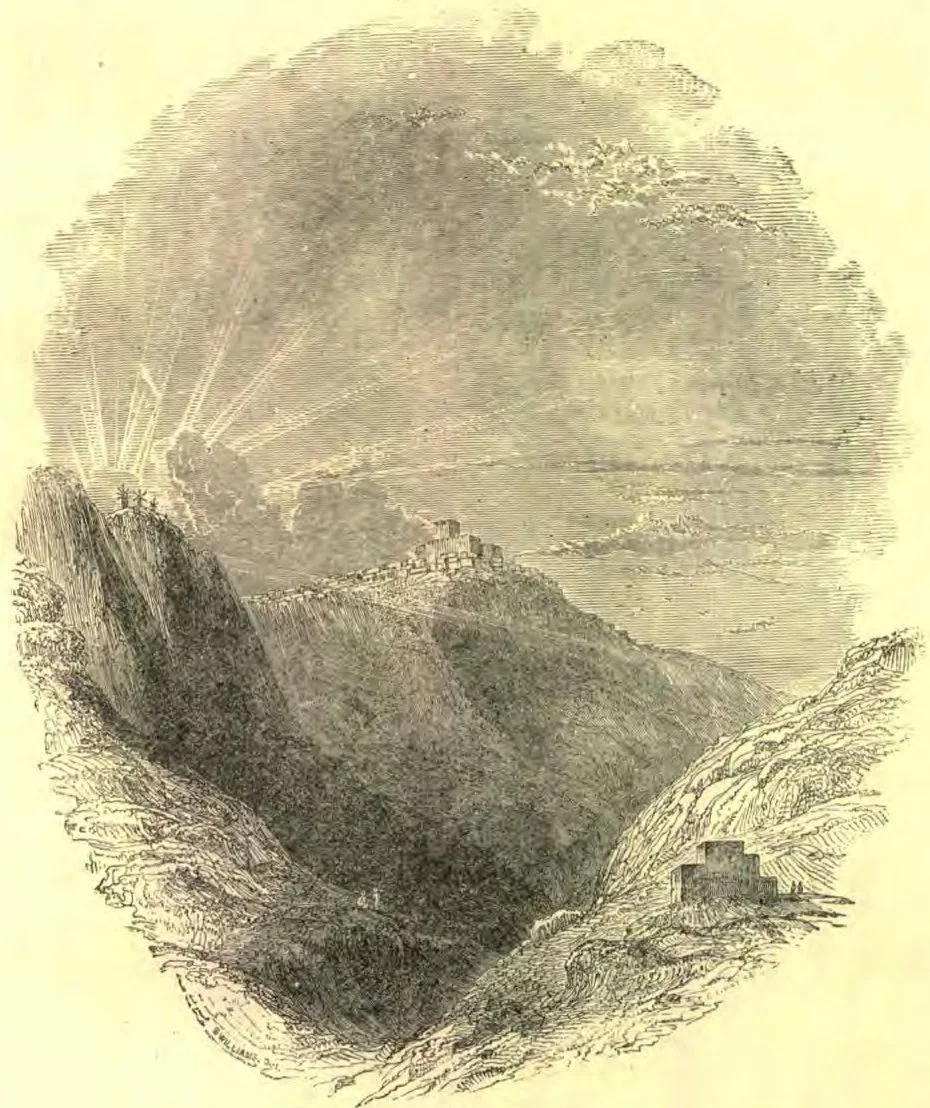
AMONG the most favored of our Lord’s disciples were James and John, sons of Zebedee and Salome. Their father was a fisherman, living at Bethsaida on the shore of the Sea of Galilee, and his sons followed his occupation until our Lord, at the beginning of his ministry called them to follow him, and become “fishers of men.” They then left their nets in the boat with their father and his hired servants, and, together with their partners, Simon Peter and Andrew his brother, accompanied Jesus on his travels. In the Bible record of the choosing of the twelve apostles, the names of Peter, James, and John are mentioned first, and these three seem to have enjoyed special honors and privileges. They alone witnessed the transfiguration of Christ, and they alone saw his agony in the garden. James and John were especially zealous for their Master, and it was probably on this account that “he surnamed them Boanerges, which is, The sons of thunder.”
healing the sick, and carrying the news of salvation through Christ to those outside of Jerusalem. Twice they were imprisoned together, and once “the angel of the Lord by night opened the prison doors and brought them forth.” In the midst of these persecutions, the life of John was saddened by the martyrdom of his brother James, who was the first of the twelve to suffer death in the service of his Master.
ISLE OF PATMOS.
ISLE OF PATMOS.
John remained in Jerusalem for many years, a pillar of the church there. He at length removed to Ephesus, though at just what time is uncertain. Here he spent many years in laboring among the churches of Asia Minor. Under the cruel persecution of Christians by the Emperor Domitian, the life of John was sought in many ways. It is said that at one time he was cast into a caldron of boiling oil, but was miraculously preserved from injury. He was afterwards banished to the Isle of Patmos, where he was put to hard labor in the mines. Patmos is a rocky, desolate island rising out of the Archipelago, or Ægean Sea. It is about twenty-eight miles in circumference, with bold, deeply indented shores, and was used by the Romans as a place of banishment for criminals. The principal town is situated on a high and steep hill, now crowned by a fortress-like building called the Monastery of St. John. Half-way down this hill is a natural grotto overlooking the sea, where tradition tells us John saw the wonderful vision recorded in the book of Revelation.
John afterwards returned to Ephesus, where he lived to a very great age, so that he could scarcely go to the assembly of the church without being carried there by his disciples. Being now unable to make long discourses, his custom was to say in all meetings, “Little children, love one another.” And when they wondered at the frequent repetition of these words, he was wont to answer: “This is what the Lord commands you; and this, if you do it, is sufficient.” There is some dispute about the exact date of his death, but it was probably about 100 A. D. He was no doubt buried just outside the city of Ephesus, as several ancient historians speak of his tomb as being there in their day. C. H. G.

ONLY

It was only a blossom, Just the merest bit of bloom, But it brought a glimpse of summer To the little darkened room.
It was only a glad “good morning,” As she passed along the way; But it spread the morning’s glory Over all the livelong day.
Only a song; but the music, Though simple, pure, and sweet, Brought back to better pathways The reckless, roving feet.
“Only?” In our blind wisdom How dare we say at all? Since the ages alone can tell us Which is the great or small. —Selected.

LITTLE PREACHERS.

“Grandpa, I do not think I would like to be a minister.”
Grandpa looked at Harry over his spectacles. He was not quite sure that he had heard the words aright.
“What is it you do not want to be?” inquired grandpa.
“A minister. I do not think I shall ever want to be one.”
“What made you think of that, boy?—you are not old enough yet to know what you want to be.”
“Yes, sir; I know I am not old enough yet, but Mr. Draver said, yesterday, in Sabbath-school, that he wanted to see us all little preachers.”
“What else did he say?”
“I did not hear much more than that, because, you know, grandpa, aunty sent me down the street just before Sabbath-school time, to ask Dr. Brewster to call in the afternoon, and so I was a little late.”
“So Mr. Draver wants to see you all little preachers?” said grandpa, thoughtfully. “Well, I like Mr. Draver’s words, only they are not strong enough.”
“Not strong enough? What do you mean, grandpa?” inquired Harry, perplexed.
“If I had been saying the words, I would have said to the boys: You are all little preachers.”
“That would have been very funny, grandpa; that would have been too funny for anything, and, grandpa, how could it be true? We are not ministers, any of us, and may-be never will be.”
“Mr. Draver did not mean to say anything about your being clergymen, or preaching to people in pulpits in church, did he?”
“No, sir; I did not hear him say just that.”
“He did not mean that; he wanted to see you all little preachers of good.”
“You do puzzle me so, grandpa,” said Harry; “it seems to all mean the same thing.”
“Oh, no, not at all; for all boys and girls, and men and women living, are preachers; but of all these only a few are called clergymen, and preach in pulpits.”
Harry began thinking that there was little use in trying to understand this, that it was something very new and very odd.
“But, grandpa,” he said, “there are a great many boys, and girls too, who are not good, for sure they are not preachers.”
“Now, you do make a mistake indeed! Preachers? Certainly they are, only they preach for the wrong side.”
Harry looked up at grandpa, and gave him a funny little smile.
“For the wrong side!” Harry repeated the words, and stood with his head a little tossed back, thinking.
“You know that there is a right way and a wrong way of doing everything. Every single action of our lives is either right or wrong, there is no between about it. If an action is not right, it is wrong; if it is not wrong, it is right.”
“Yes, grandpa, I know.”
“There is a right way and a wrong way of thinking, as well as of acting. It is impossible to think or act at all without thinking or acting on the right side or the wrong side.”
“But, grandpa, what has that to do with being preachers?”
“We will get to that part in a minute. There are always two powers which draw us to the right or the wrong,—the powers of good and of evil. The most simple thing we do inclines to the one or the other.”
“Just play—like playing marbles—is not inclining to good or to evil, is it, grandpa?”
“Certainly. Play, if it is honest and fair, is good; if it is unjust, or done in bad temper, ill-timed, or dishonestly, it becomes evil. Everything we do, from the time we begin to live, all during our lives, either inclines to good or to evil—is for God, or against him.”
“But, grandpa, when papa goes to business every day, it is not doing anything for God, or against him, is it?”
“Certainly it is. It is right that your papa should go to his office and attend to his business when he gets there; if your papa is honest, and truthful, and earnest in his business, he is doing right. If it were possible for your dear papa to be dishonest, and untruthful, and careless in his business, then he would be doing wrong. Everything we do, my boy, is either right or wrong.”
“But grandpa—”
“About the preachers? Well, Harry, every act of our lives is a little chapter for God or against him. Every time you go out to play, you preach for God or against him. You do not mention his name. You do not get up on a high place and preach, by getting the boys around you, and telling them to be good. If you are good yourself, are honest, good-tempered, truthful in your play, you preach on God’s side; if you are dishonest, ill-tempered, untruthful, you preach on the wrong side—the side of evil.”
“How very strange! it is more strange than Mr. Draver’s wish.”
“But it is true, boy; nothing could be truer. We all preach. We cannot help it. It is impossible to help it. The two boys who sat in Mr. Howard’s pew yesterday morning—I am sure you will remember them—were preaching the whole of sermon-time.”
“Grandpa, that is the very oddest thing of all,” said Harry, laughing outright. “They sat right in front of us, and neither of them spoke the whole morning.”
“Yet they both preached the whole morning. One boy sat still and listened to every word of the sermon, and found the places of the hymns, and evidently remembered that he had come to church to worship God: he preached on the right side—on God’s side. The other boy was turning over the leaves of the books; looking around the church—up at the windows, and about in the pews—and twisting about without listening to the sermon, or attending to the worship. He preached on the wrong side. Sometimes the very best preaching is done by sitting perfectly still.”
“Grandpa, I never would have begun to think of such a thing, and do you really think that Mr. Draver meant this kind of preaching?”
“Yes, my boy, and now you see how we are all preachers. Our actions are like powerful words. We preach by our lives. Nobody lives without preaching. Everybody preaches a little on the wrong side sometimes; everybody preaches a little on the right side sometimes; but when God comes to judge his preachers, he will look at the heart, and remember those who tried always to be on the good side. From a good, sincere heart, good thoughts and actions must come; from a bad heart, bad thoughts and actions must come; but, Harry, boy, always remember, that no matter what you want to be, you are a preacher.” —Geo. Klingle.

A BIT OF U. S. HISTORY.

How many of you have read Longfellow’s poem, “Paul Revere’s Ride?” It is the story in verse of an incident at the very beginning of the Revolutionary War. You who have studied history know that when the British troops were stationed at Boston in the year 1775, and the colonists had a quantity of fire-arms and ammunition stored at Concord, it was suspected that the British were to march from Boston to Concord for the purpose of destroying the stores. And Paul Revere having arranged with a friend that signal lights should be hung in the tower of the Old North Church, as soon as he saw the signals and knew by the number of lights which way the British were going, started upon his memorable ride. His intention was to ride to Concord, and give notice of the approach of the enemy, also to alarm the people along the route. And it is the story of this ride that Longfellow tells us in the poem. I hope that you will get the book and read it right away. I am sure you will like it. I always read it to my history class when we reach this point in the history of the United States. John Hancock and Samuel Adams were two very prominent men among the colonists, and they were spending the night at Mr. Clark’s house in Lexington, and as one good result of Paul Revere’s ride these two were able to escape. There was a sharp fight at Lexington, and the first blood of the Revolutionary War was shed there on April 19, 1775. A monument has been erected at Lexington to honor and perpetuate the memory of the brave men who were the first to lay down their lives for American liberty. The British marched on to Concord after completing their work of death at Lexington, and succeeded in doing what they had been sent to do. But by the time they were ready to return, the whole country had been aroused, and men from every direction were gathering. From behind hillocks, trees, and buildings these men fired upon the British as they were marching back to Boston after their day’s work. And the result was that but a small part of the one thousand men who marched out of Boston at midnight ever returned. And this was the beginning of that long struggle for the liberty which we enjoy. It is a wonderful story, this of the Revolutionary War, full of thrilling and romantic incidents. I hear boys and girls saying that history is dull. But begin with Paul Revere’s ride, and I am sure you will want to know more.—The Pansy.

God's Flowers Preparing for the Next Summer

LAST summer’s flowers are all gone. You cannot find one in the fields or gardens. Yet we know that next summer the earth will be covered again with floral beauty. God has other flowers preparing, just as fragrant and beautiful as those which the frost has killed. So the joys that have faded from our homes and bosoms are not the only joys. God has others for us in store, as sweet and rich as those we have lost, which he will give us in due time.

AN AUTUMN IDYL.

The presence of autumn is here; The daisies are drooping and dying, The blood of the arbute is chill, The leaves of the maple are sere, And through them the breezes are sighing,— The presence of autumn is here.
The sadness of autumn is here; The brightness of summer is over, The grass on the hill-side is wan, The sky is portentous and drear, The bees have forsaken the clover,— The sadness of autumn is here,
The muteness of autumn is here; The swallows have hastened away, The winter birds sing on the bough A song that lacks music and cheer; All nature seems wrapt in decay,— The muteness of autumn is here.
The lessons of autumn are here, As told in the storm-king’s harsh breath, Which warns men how fleeting is life; But at the lone grave of the year The flowers are lovely in death,— The lessons of autumn are here.
— Youth’s Companion.

SCENES IN THE LIFE OF CHRIST.

LESSON 97.—THE COMING OF OUR LORD.

AFTER speaking of the darkening of the sun and moon, and the falling of the stars, our Lord continued in the following words: “And then shall appear the sign of the Son of man in heaven; and then shall all the tribes of the earth mourn; and they shall see the Son of man coming in the clouds of heaven with power and great glory. And he shall send his angels with a great sound of a trumpet, and they shall gather together his elect from the four winds, from one end of heaven to the other.”
The sign of the Son of man in heaven, is probably the cloud on which he will appear.
After thus talking with his disciples about the signs that should betoken his second appearing, he says to them, “And when these things begin to come to pass, then look up, and lift up your heads; for your redemption draweth nigh.” In order to show them how certainly they might look for his immediate coming, when they should see these signs, he drew an impressive lesson from nature, saying, “Behold the fig-tree, and all the trees; when they now shoot forth, ye see and know of your own selves that summer is now nigh at hand; so likewise ye, when ye see these things come to pass, know ye that the kingdom of God is nigh at hand;” or as Mark records it, “Know that it is nigh, even at the doors.” Having thus shown how all may know when his second coming is at hand, he cautions the generation that shall then be living upon the earth, saying, “Take heed to yourselves lest at any time your hearts be overcharged with surfeiting, and drunkenness, and cares of this life, and so that day come upon you unawares.” “What I say unto you, I say unto all, Watch.”
He then gave them the beautiful parable of the Ten Virgins, as found in the first thirteen verses of the twenty-fifth chapter of Matthew.
After this, he gave a parable representing the Judgment, in which he taught that whatever we do for the poor, the sick, or the afflicted, will be accepted as done for Christ himself; and that if we forget to help the needy, it will be set down against us the same as if we neglected our Lord under similar circumstances.
“And it came to pass, when Jesus had finished all these sayings, he said unto his disciples, Ye know that after two days is the feast of the Passover, and the Son of man is betrayed to be crucified. Then assembled together the chief priests, and the scribes, and the elders of the people, unto the palace of the high priest, who was called Caiaphas, and consulted that they might take Jesus by subtilty, and kill him. But they said, Not on the feast day, lest there be an uproar among the people.”
“Then entered Satan into Judas surnamed Iscariot, being of the number of the twelve. And he went his way, and communed with the chief priests and captains, how he might betray him unto them. And they were glad, and covenanted to give him money. And he promised, and sought opportunity to betray him unto them in the absence of the multitude.”

QUESTIONS.

1. After speaking of the darkening of the sun and moon, and the falling of the stars, as signs of his second coming, what did Jesus predict as the next grand event to take place? Matt. 24:30.
2. What is it thought that this sign will be?
3. How will the nations of the earth be affected when they shall see it?
4. What sight will soon burst upon their view?
5. What will be heard?
6. On what errand will Jesus send his angels?
7. What admonition did our Lord give for those who should behold the signs of his second appearing? Luke 21:28.
8. From what did he then draw an impressive lesson?
9. For what purpose did he give this parable?
10. Relate the parable.
11. How does Mark record the last part of it?
12. Having thus shown how all may know when his second coming is at hand, what caution does he give to the generation that shall then be living upon the earth? Luke 21:34.
13. What did he especially urge upon them?
14. What did he then give them?
15. Describe these virgins.
16. How did five of them show their lack of wisdom?
17. What cry was heard at midnight?
18. How were the foolish virgins then troubled?
19. How did they seek relief?
20. What happened while they were gone to buy oil?
21. What answer did they receive when they sought admittance?
22. What application does our Lord make of this parable?
23. What parable did Jesus give after this?
24. In this parable, what does he teach with reference to helping the needy?
25. What does he teach about our neglecting those who need help?
26. What welcome is the king represented as giving to the righteous?
27. What reason does he give for welcoming them thus?
28. How are the righteous represented as expressing their surprise?
29. How does the king answer them?
30. What doom does he pronounce upon the wicked?
31. After Jesus had finished all these sayings, what predictions did he make with reference to his approaching death? Matt. 26:1, 2.
32. For what purpose did the chief priests and the elders hold a council at this time?
33. Where was the council held?
34. Why did they fear to lay hands on Jesus on the day of the feast?
35. Tell how Judas agreed to betray his Lord. Luke 22:4, 5.
36. Tell how he was prompted to such a wicked action.
37. What opportunity did he seek for fulfilling his purpose?

NEW-TESTAMENT HISTORY.

LESSON 111.—THE RESURRECTION.

“And when the Sabbath was past, Mary Magdalene, and Mary the mother of James, and Salome, had bought sweet spices, that they might come and anoint him.” “And behold, there was a great earthquake; for the angel of the Lord descended from heaven, and came and rolled back the stone from the door and sat upon it. His countenance was like lightning, and his raiment white as snow; and for fear of him the keepers did shake, and became as dead men.”
“Now upon the first day of the week, very early in the morning, they came unto the sepulchre, bringing the spices which they had prepared.” “And they said among themselves, Who shall roll us away the stone from the door of the sepulchre? And when they looked, they saw that the stone was rolled away; for it was very great.”
Among the first who came to the sepulchre was Mary Magdalene, who, looking in and seeing that Jesus was not there, ran to Peter and John, saying, “They have taken away the Lord out of the sepulchre, and we know not where they have laid him.”
Some of the women went into the sepulchre, but could not find the body of Jesus there. “And it came to pass, as they were much perplexed thereabout, behold two men stood by them in shining garments; and as they were afraid, and bowed down their faces to the earth, they said unto them, Why seek ye the living among the dead? He is not here, but is risen; remember how he spake unto you when he was yet in Galilee, saying, The Son of man must be delivered into the hands of sinful men, and be crucified, and the third day rise again.” “But go your way, tell his disciples and Peter that he goeth before you into Galilee; there shall ye see him, as he said unto you.” “And they departed quickly from the sepulchre with fear and great joy, and did run to bring his disciples word.” St. Mark says that they “fled from the sepulchre”; that they “trembled and were amazed”; and that they said nothing to any man, probably meaning that they spoke to no one on the way. With mingled feelings of joy and fear, they hastened to the disciples with all speed.
It seems that Peter and John had been previously informed by Mary; “so they ran both together: and the other disciple did outrun Peter, and came first to the sepulchre. And he, stooping down, and looking in, saw the linen clothes lying, yet went he not in. Then cometh Simon Peter, following him, and went into the sepulchre, and seeth the linen clothes lie, and the napkin that was about his head, not lying with the linen clothes, but wrapped together in a place by itself. Then went in also that other disciple, which came first to the sepulchre, and he saw and believed. For as yet they knew not the Scripture, that he must rise again from the dead. Then the disciples went away again unto their own home.”
“But Mary stood without at the sepulchre weeping: and as she wept, she stooped down, and looked into the sepulchre, and seeth two angels in white, sitting, the one at the head, and the other at the feet where the body of Jesus had lain. And they say unto her, Woman, why weepest thou? She saith unto them, Because they have taken away my Lord, and I know not where they have laid him. And when she had thus said, she turned herself back, and saw Jesus standing, and knew not that it was Jesus. Jesus saith unto her, Woman, why weepest thou? whom seekest thou? She, supposing him to be the gardener, saith unto him, Sir, if thou have borne him hence, tell me where thou hast laid him, and I will take him away. Jesus saith unto her, Mary. She turned herself, and saith unto him, Rabboni; which is to say, Master. Jesus saith unto her, Touch me not; for I am not yet ascended to my Father: but go to my brethren and say unto them, I ascend unto my Father, and your Father, and to my God and your God. Mary Magdalene came and told the disciples that she had seen the Lord, and that he had spoken these things unto her.” “And they, when they had heard that he was alive, and had been seen of her, believed not.”
Meanwhile the other women were on their way to the disciples, “And as they went to tell his disciples, behold! Jesus met them, saying, All hail. And they came and held him by the feet, and worshiped him. Then said Jesus unto them, Be not afraid: go tell my brethren that they go into Galilee, and there shall they see me.” They came and told these things unto the disciples, “and their words seemed to them as idle tales, and they believed them not.”

QUESTIONS.

  1. When the Sabbath was passed, what was done by Mary Magdalene, and Mary the mother of James, and Salome? Mark 16:1.
  2. Describe the descent of the angel? Matt. 28:2.
  3. How did the angel appear?
  4. How were the soldiers affected by his appearance?
  5. Who came to the sepulchre at the dawn of the first day of the week? Matt. 28:1; Luke 24:1.
  6. What did they bring with them?
  7. What did they say among themselves? Mark 16:3.
  8. What surprised them as they came to the sepulchre?
  9. What did Mary Magdalene discover as she looked into the sepulchre?
  10. What did she immediately do? John 20:2.
  11. What did she say to them?
  12. How were some of the women perplexed, when they had gone into the sepulchre? Luke 24:3, 4.
  13. Who appeared to them?
  14. How were the women affected?
  15. What question did the angel ask them?
  16. What did he say about Jesus?
  17. What did he ask them to remember?
  18. What did he tell them to do? Mark 16:7.
  19. How did they proceed to obey his instructions? Matt. 28:8.
  20. What does Mark say of them?
  21. What does he probably mean in saying that they said nothing to any man?
  22. When Mary had spoken to Peter and John, what did they do? John 20:3, 4.
  23. Describe their visit to the sepulchre.
  24. Where did they then go?
  25. Who still lingered at the sepulchre?
  26. What did she see as she stooped down and looked in?
  27. What question did they ask her?
  28. How did she answer?
  29. As she turned back, whom did she see standing near to her?
  30. What question did he ask her?
  31. Whom did she suppose him to be?
  32. What reply did she make?
  33. How was she enabled to recognize him?
  34. Why would he not allow her to touch him?
  35. What did he tell her to do?
  36. How did the disciples receive the intelligence she brought them? Mark 16:11.
  37. What did Jesus say to the other women as they were on their way to tell the disciples what had happened? Matt. 28:9, 10.
  38. How did the disciples receive their report? Luke 24:11.

KINDNESS TO ANIMALS.
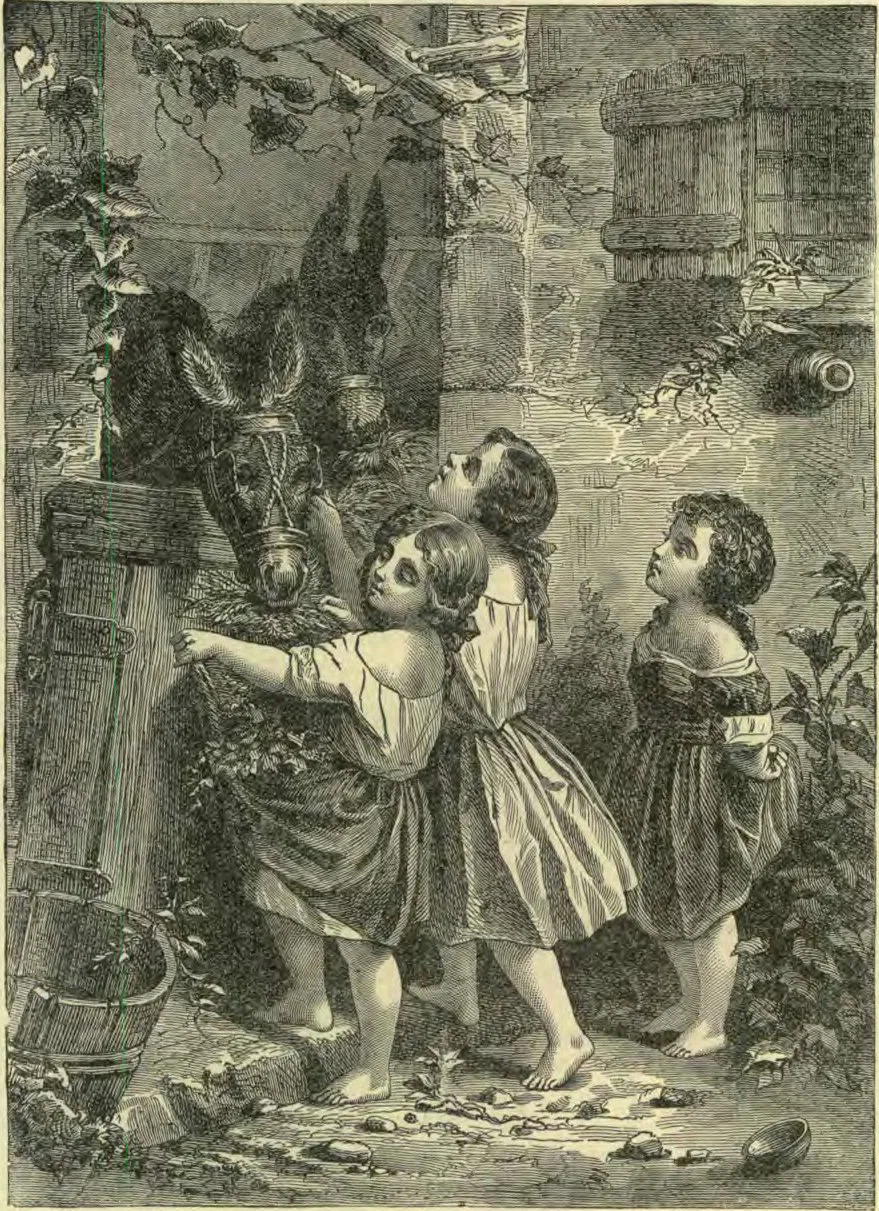
THESE children seem to be very anxious to feed the dumb animals that thrust their heads over the door to receive what is offered to them. No doubt the pasture where they roam gives them plenty of good grass, and such food as they like, but they love to be noticed, and they will eat the grass out of the children’s hands, even if they are not very hungry. And it is sport for the children to see them feed out of their hands. So they eagerly pull up the grass to give them.
How much better it is to treat the dumb creatures thus, than to whip and abuse them as some people do! Animals should be treated with kindness, and when they are thus treated, they will act kindly in return, unless they are very ugly. The horse and cow are of great use to us, and they deserve kind treatment. It is very wrong to torment them or to keep food away from them. God has given them to us, to help make our homes pleasant, our work easy, and to supply many wants of our lives. And in return for these things, he wants us to treat them kindly, and to take good care of them.
The disposition of many a boy is seen in the way he treats dumb animals. If he abuses them, and treats them unkindly, you may be pretty sure that he is a hard-hearted boy, and one not fit to be in good company. Any one who takes delight in abusing animals is indeed without kind feelings, and his company should be shunned, unless he changes his ways.
There is a society organized in this country, that has for its object the prevention of cruelty to animals, and it is a very good thing in some cities and towns, where animals are so often abused. I do not know as it is necessary to belong to such a society in order to have a care for these creatures, for it is something we can all attend to if we will.
Some animals know pretty well when they are abused. A short time since, a friend told me of a horse that he knew, which did not like to work if she was whipped. One day a man was driving her before a wagon, when he struck her with the whip for no cause. She at once stopped, and would not go on. The driver then went up to her head, and rubbed her nose, and told her that he was very sorry that he had struck her, and asked her to forgive him, and he promised he would not strike her again. Then he seated himself in the wagon, and took up the lines, and the horse trotted off as nicely as could be. If all children were taught to feed and pet the dumb animals as these children in the picture are doing, they would grow up with kinder hearts, and there would not be so many rough, cruel men in the world.—Selected.

WHAT THE ROBINS TAUGHT.

“Look, Laura, just look out of the window,” said Mrs. Brown one morning as the family were seated at breakfast.
All hurried to the window where a bright, red-breasted robin was tugging with all his might at a long string fastened to one of the cherry-trees. He tried several times to loosen it, but was not able to do so. Finally taking the end of the string in his mouth, he flew, but the little fellow was brought to a sudden stop when at the length of the string. Again he tried, only again to fail. Then he flew away.
Soon he returned, but this time not alone. “See, Laura, the robin has brought his mate to help him get the string.” They then both took the string in their bills and started to fly, but could not break the string. “You go and untie the string, daughter, and see what they will do,” said Mrs. Brown. Laura returned to the window just in time to see both robins catch the string in their mouths, and fly away in triumph with the well-earned trophy. They wanted it no doubt to finish the lining to their cozy nest.
Did you say the problem was too hard or the question too deep, my boy? Be taught by the little bird; try again and again, and then if you don’t succeed, no doubt some one who loves to help those who try to help themselves will show you your way through. C. E. H.

WEAVING SUNSHINE.

“You can’t guess, mamma, what Grandma Davis said to me this morning, when I carried her the flowers and the basket of apples!” exclaimed little Mary Price, as she came running into the house, her cheeks red as twin roses.
“I am quite sure, darling,” said mamma, “that I cannot; but I hope it was something pleasant.”
“Indeed it was, mamma,” said Mary. “She said, ‘Good morning, dear; you are weaving sunshine.’ I hardly knew what she meant at first, but I think I do now; and I am going to try to weave sunshine every day.” “Mother,” concluded Mary, “don’t you remember that beautiful poetry, ‘Four Little Sunbeams,’ you read to me one day? If those sunbeams could do so much good, I think we all ought to try to be little sunbeams!”
After a few moments’ pause, a new thought seemed to pop into Mary’s little head, and she said, “O mamma, I have just thought. When Lizzie Patton was here, she told me that her Sabbath-school class was named ‘Little Gleaners,’ and I know another class called ‘Busy Bees.’ Now, next Sabbath I mean to ask our teacher to call our class ‘Sunshine Weavers,’ and then we will all go to weaving sunshine.”
It is a good plan. Sunshine-weavers will be kindly remembered long after cross, hateful people have been forgotten.—The Sunnyside.

LETTER BUDGET.

BERTIE WOODMAN, of Fowler, Indiana, says: “We go four miles to Sabbath-school. I think the INSTRUCTOR is the best paper I ever saw. I am seven years old, and I have a sister five and a brother three years old. We have two pet pigeons. One will fight when it is in the box.”
ADDIE E. CLEMENT writes from Hollis, N. H. She says: “I see that other little girls write for the ‘Budget’ and I thought I would like to see my name there too. I shall be twelve years old the 21st of February. I have three sisters and one brother. We read in the Bible for prayers every morning by turns, one reading one verse and another the next. I am trying to love the Lord with all my heart and to do as he wants me to.”

LITTLE HELPS.

A LITTLE star, away up high, Shining in a cloudy sky, Doesn't want to stay alone When all the other stars are gone.
Then he thinks, Oh, yes, he should, Doing all the good he could; So he sends a little ray To light a traveler on his way.
The traveler lifts his grateful eye To bless the little star on high, And, pressing on with courage new, Soon finds his weary journey's through.
So little folks can do some good, If they try just as they should, Giving smiles and words of cheer, Spreading comfort everywhere, —S. E. E.

You have reached the end of this edition.

The Youth’s Instructor · Nov 29, 1882