The Youth’s Instructor, Vol. 64, No. 52.

Wartime Food Shortages and Meatless Days in Europe

The Youth’s Instructor

Dec 26, 1916

Review and Herald Publishing Assn. · Takoma Park Station, Washington, D. C. · Dec 26, 1916

Wartime Food Shortages and Meatless Days in Europe

According to a German maxim, “A woman strong in flounces is weak in the head.”
In order to conserve the food supply the French cabinet recently ordered two meatless days a week.
The German food dictator is attempting to relieve the present meat shortage by the use of seal flesh.
There are 25,287,000 suffering people in extreme destitution and helplessness as a result of the European war.
The amount of money expended for direct war purposes alone since Aug. 1, 1914, would build one hundred and forty-six Panama canals.
The United States Steel Corporation in announcing a 10-per-cent increase in wages to its employees, added nearly $20,000,000 to its annual pay roll.
Near Springfield, Illinois, a man recently committed suicide, being unable to free himself from the thirst for liquor acquired through cider drinking.
Jack London, author, playwright, and adventurer, died recently, and his body was cremated without funeral ceremonies, as Mr. London did not believe in any future life.
A constitutional amendment authorizing the State legislature to grant pensions to the blind was adopted by the Missouri voters at the recent election by a plurality of 12,719.
Hon. William Jennings Bryan says prohibition is right for any unit from county to nation. He means to secure a declaration from the Democratic party for national prohibition in 1920.
Russell Sage, as errand boy in a grocery store in Troy, New York, got his board and four dollars a month. When he died, he left one hundred million dollars’ worth of railroad securities.
A French sergeant was buried alive when his trench was blown up by a German mine. Old Dog Tray scented him out, and dug till he saw his master’s face. Then, exhausted, he sat down and howled until soldiers came to the rescue.
On November 21, the British hospital ship “Britannic” was sunk in the Kea Channel of the Ægean Sea by a mine or torpedo. The admiralty announced that of those aboard about 50 were lost, 28 were injured, and 1,100 saved. The Kea Channel, where the great ship was lost, lies between the mainland of Greece and the island of Kea.
It is estimated that this year’s cotton crop in the South, including the seed, will be worth a billion and a quarter dollars to the growers. Add 300,000 bales left over from previous crops, which will probably be disposed of this year, and the result will be that there will be brought into the South above $1,500,000,000 for the cotton and seed marketed this year. A billion and a half dollars for one year’s cotton crop seems incredible. It is an amount several hundreds of millions of dollars above the largest ever received for cotton in the history of the nation.
The 1915 Nobel prize for the greatest work of idealistic literature has just been awarded to Romain Rolland, and the 1916 to Verner von Heidenstam, the former a French novelist and the latter a Swedish poet. Romain Rolland’s idealism has brought upon him the censure of his own country, since it is thought that he has made too strenuous an effort to preserve a fair and unprejudiced attitude. He has sent to the belligerent nations this word in behalf of humane and generous treatment of prisoners of war:—
“Do not break down all the bridges, since it will ever be necessary to cross the river. Do not destroy the future. A good, open, clear wound will heal; but do not poison it. Let us be on our guard against hatred. If we prepare for war in peace according to the wisdom of nations, we should also prepare for peace in war.”
On November 22, Francis Joseph, aged emperor of Austria-Hungary, died, having reigned for sixty-eight years. Charles Francis Joseph, grandnephew of the deceased emperor, takes the throne. He is twenty-nine years of age.

Frozen Food

THE markets of Irkutsk, in Siberia, are an interesting sight, for the products offered for sale are, in most cases, frozen solid.
Fish are piled up in stacks like so much cord wood, and meat likewise. All kinds of fowl are similarly frozen and piled up. Some animals brought into the market are propped up on their legs, and have the appearance of being actually alive, so that as one goes through the markets one seems to be surrounded by living pigs, sheep, oxen, and fowls standing up.
But, stranger yet, even the liquids are frozen solid and sold in blocks. Milk is frozen into a block in this way, with a string or stick frozen into and projecting from it. This, it is said, is for the convenience of the purchaser, who is thus enabled to carry his milk by the string or stick handle.— Every Week.

Nashville Young People's Society Sells Mistletoe for Missions

Notice

THE Nashville young people's society is seeking to swell the Harvest Ingathering returns by the sale of mistletoe for the holiday season. One to three pounds are offered at the rate of seventy-five cents; more than three pounds at fifty cents. The entire proceeds go to missions. Address Lynn H. Wood, 2014 Twenty-third Avenue N., Nashville, Tenn.

The Fires of Friendship

“THE fires of friendship burn brightly only when fed from both sides.”

If Sinners Entice Thee, Consent Thou Not

If sinners entice thee, consent thou not.— Proverbs.

The Snowstorm

ANNOUNCED by all the trumpets of the sky, Arrives the snow, and driving o’er the fields, Seems nowhere to alight: the whited air Hides hills and woods, the river, and the heaven, And veils the farmhouse at the garden’s end. The sled and traveler stopped, the courier’s feet Delayed, all friends shut out, the housemates sit Around the radiant fireplace, inclosed In a tumultuous privacy of storm. Come, see the north wind’s masonry. Out of an unseen quarry evermore Furnished with tile, the fierce artificer Curves his white bastions with projected roof Round every windward stake, or tree, or door. Speeding, the myriad-handed, his wild world So fanciful, so savage, naught cares he For number or proportion. Mockingly On coop or kennel he hangs Parian wreaths; A swanlike form invests the hidden thorn; Fills up the farmer’s lane from wall to wall, Mauger the farmer’s sighs, and at the gate A tapering turret overtops the work. And when his hours are numbered, and the world Is all his own, retiring, as he were not, Leaves, when the sun appears, astonished art To mimic in slow structures, stone by stone, Built in an age, the mad wind’s night work, The frolic architecture of the snow. — Ralph Waldo Emerson.

Make It a Good Year!

MATILDA ERICKSON
He had a long list of resolutions, for he was determined to make the new year a good one. He wanted it to be the best he had ever lived. He had resolved to be kinder at home, more diligent in his work, more thoughtful of others, to get his lessons well at school, and to fill his spare moments with good reading. They were remarkably good resolutions for a boy of his years.
Commending him for his good list, his older friend asked: “Now shall I show you my New Year’s resolution?” “Oh, yes, do,” was the ready response. She then opened her Bible, and on the flyleaf he read:—
“Resolved: To Take Time to be Holy”
It is well to start the new year with good resolutions; but to make it possible for good resolutions to grow into noble deeds, one must plant them in good soil and cultivate them. A farmer might have the best kind of seed corn, but he would hardly expect to reap a harvest in the fall unless it be planted, cultivated, and given other care that it needed.
You wish to make 1917 a good year. Then shun the empty life that lives without a purpose. Do not indulge in harmful reading nor questionable amusements. Put away faultfinding; put away pretense; and put away self-pity. Be true to your convictions, and stand for right though you stand alone; but at the same time be charitable in your judgment of others. Have your life so securely poised that the annoyance — usual or unusual — shall not disturb your equilibrium.
But remember that while you may resolve to do these things, you cannot carry out your resolutions in your own strength. To act strongly, life must be rooted deeply in prayer, in quiet communion with God and his Word. Back of the strong outward life must be the strong inner life of prayer. The strong life that never loses its courage, its enthusiasm, its sweetness, its serenity, is not found on the bargain counter. It always costs just so much.
Then you who wish to make 1917 a good year, will you not resolve to take time to live the victorious life? Each day let God establish your heart. Let him fortify it and make it a calm, peaceful place beyond the reach of the storms that rage without. Then you and your Master will have a quiet place in which to commune. There he will give you strength for your work, wisdom for your decisions, peace from all threatening storms. And then you shall be able to say with the poet:—
“In the secret of his presence I am kept from strife of tongues; His pavilion is around me, And within are ceaseless songs! Stormy winds, his word fulfilling, Beat without, but cannot harm; For the Master’s voice is stilling Storm and tempest into calm.
“In the secret of his presence All the darkness disappears; For a sun that knows no setting Throws a rainbow on my tears. So the day grows ever lighter, Broadening to the perfect noon; So the way grows ever brighter, Heaven is coming near and soon.
“In the secret of his presence Nevermore can foes alarm; In the shadow of the Highest I can meet them with a psalm; For the strong pavilion hides me, Turns the fiery darts aside, And I know whate’er betide me, I shall live because he died.
“In the secret of his presence In a deep, unbroken rest; Pleasures, joys, in glorious fulness, Making earth like Eden blest; So my peace grows deep and deeper, Widening as it nears the sea, For my Saviour is my keeper, Keeping mine and keeping me!”
And to you who have decided to live the strong, victorious life during 1917, the Master gives these simple directions: “When thou prayest, enter into thy closet, and when thou hast shut thy door, pray to thy Father which is in secret; and thy Father which seeth in secret shall reward thee openly.” These directions contain at least five things for you to consider: time for prayer, place for prayer, alone in prayer, the Father’s presence, and the blessing you may claim.
First of all, you must take time to pray. Your appointment with God must be given the precedence of every other duty on your daily program. Gordon says that one must plan for this appointment with a bit of red iron in the will, for Satan will try desperately hard to crowd it out. He knows that the weakest child of God who really takes time to pray is too strong for him to overcome. Egerton Young, a missionary to the North American Indians, tells of a frail little Indian girl who was a great spiritual power. She had been the means of leading to Christ some almost hopeless savages. When asked about her work, she attributed her success to the two hours she spent every day alone with God, never allowing any other duty to crowd out this interview.
Second, comes the command to “enter into thy closet.” To that quiet place where you may be alone with God you are to retreat for prayer. Third, “Shut thy door.” God not only wants you to come, but when you enter your place of secret communion, he wants you to shut out all duties that seem to forbid your taking time to pray. You are to shut out of your heart and mind all disturbing influences. If you cannot do this, ask him to do it for you. Then when you tell him about your needs, let him talk to you through his Word.
When you have complied with these commands, you may claim the promises that follow. The Father will meet you in the chamber of secret prayer; and will reward you openly. When you come to him with your sorrows, your longings, your fears, your trials, and your failures, he will sympathize. With him you may leave all that oppresses your heart, and carry away his joy. With him you may leave your want, and carry away his supply for “all your need according to his riches in glory.” This is so wonderful; and the most wonderful thing about it is that it is all true.
One day a stranger visited the old cathedral in Freiburg. His interest was centered in the organ, which the old sexton took great pride in exhibiting. He asked for permission to play it, but was denied the privilege. He pleaded, but the sexton said that the instrument was so delicate that he could not let him play it. Finally, however, because of his importunity, the stranger was permitted to seat himself at the organ. The old sexton was awe-stricken as he listened. Never before had such music rolled out from his favorite organ. “Who are you?” he asked, as the stranger was leaving. “Felix Mendelssohn-Bartholdy,” the stranger replied. After that, when the sexton exhibited the organ, he would say: “Ah, could you have heard it when Mendelssohn played! And think, I nearly forbade him to play upon it!”
My dear young friend, a greater than Mendelssohn wants permission to use your life during 1917, that he may draw out of it rare possibilities of which you have not even dreamed; that he may lift your life up to his own ideal for it, which is “higher than any human thought can reach.” Then will you not let him have your life, that he may make 1917 a good year for you?

Preparing for War

Signs of Christ’s Coming — No. 2

Preparing for War

No one needs to be told that the nations have been preparing for war. Even before the great struggle began which is now convulsing Europe, the leading powers were investing millions of dollars in building dreadnaughts and other weapons of slaughter, and creating great standing armies. More than twenty-five hundred years ago this condition was portrayed by a prophet of God.
The desire for peace among the nations is a worthy one. Who does not abhor the thought of bloodshed, the terrible scenes of slaughter, followed by want and sorrow beyond computation? But what men and women may long for and what is really to take place are two different things.
Under the inspiration of God, the prophet Joel cried out: “Prepare war, wake up the mighty men, let all the men of war draw near.” Joel 3:9. These three statements of fifteen words give a remarkable delineation of conditions in army and navy circles, a striking picture of modern militarism.

“Prepare War”

Figures that give the cost of war preparations are staggering. The human mind can scarcely grasp them. The total annual military expenditures of the world, before the war, approximated $2,500,000,000. The money spent by as peaceful a nation as the United States in the one hundred and forty years of its political life, $16,802,743,000, exceeds by several billion dollars the gold production of the world since the discovery of America in 1492.
Further preparations that are now being entered upon by our nation will totally eclipse anything of the past. A tentative program presented to Congress with the indorsement of President Wilson provides for an army of more than one million trained men in six years, and a navy of ten dreadnaughts and six battle cruisers within five years.
“Prepare war,” says the prophet, and today it is echoed on every side. G. V. L. Meyer, former Secretary of the Navy, in his annual report for 1912, said: “What the navy is striving for is to get the highest possible efficiency and preparedness for war.” —Page 5.
Former Secretary of War Henry L. Stimson, in his annual report for 1912, speaks in the same strain: “It is therefore our most important military problem to devise means for preparing great armies of citizen soldiers to meet the emergency of modern war.” —Page 73.
“The greatest conference of governors in the history of the United States came to a close in Boston with a formal discussion of the nation’s most pressing problem — military preparedness.”
Mrs. Mary S. Lockwood, founder of the Daughters of the American Revolution, says that “if our legislators will put their ears to the ground just now, they will hear a mighty shout swelling over this country from East to West, from North to South, and what it says is, ‘Prepare! Prepare!’”
Can any one doubt that the world is entering upon the time foreseen and predicted by the prophet?

“Stir Up the Mighty Men”

This prophecy points out a new movement in military and naval enterprise. There is to be a stirring up of the great, powerful, leading men. It has remained for the developments of the past year or two to show the real significance of these five words.
In a statement issued July 18, 1915, Secretary of the Navy Daniels tells of his purpose to create a board of inventor advisers. The most famous inventor in this country, Thomas A. Edison, has been asked to act as chairman. The secretary says of this board:—
“No one realizes any more than I do that this is but a beginning. Merely inventing things will not strengthen our navy. We must have for the work that lies before us the loyal and intelligent coöperation not only of Congress, but of the whole nation. To convert dreams into realities, much more must be done than merely to show how these dreams can be made into practical and useful things.
“The navy itself, and particularly the chiefs of our own bureaus, are doing wonderful work in this respect. I seek to strengthen their hands by the greatest genius that our country can afford, and at the same time, by having men in whose judgment and whose ability the entire nation places implicit confidence actually associated with our own officers, to secure that interest from the public which is absolutely essential to the work ahead. I have great hope that the beginning we have made is really a beginning — the first step in an onward march — and not a temporary spurt, launched with momentary enthusiasm, only to halt as soon as the first wave of interest dies out. No one can tell what will be the result of what we are now inaugurating, but in any event if it is to achieve the purpose for which it is intended, it will be through the support of the people of this country and Congress, and by hours and years of hard, unremitting and unspectacular labor by those who have the actual work in hand.” —Washington Herald.
Two days later Mr. Daniels announced:—
“After consultation with eminent men in the navy and civilian life, I have decided to ask eight societies having large memberships, each to select two members who will make up the advisory committee. In this way I feel sure we will have the hearty coöperation of the thousands of trained experts who make up their membership. The members of these societies will naturally see to it that their most eminent representatives are chosen. We will therefore obtain for the navy the direct advice of those selected to serve on the committee, and also the interest of all the members of the societies who make the selection.” —Washington Star.
These scientific bodies are as follows: American Chemical Society, American Institute of Electrical Engineering, American Institute of Mining Engineers, American Mathematical Society, American Society of Civil Engineers, American Society of Mechanical Engineers, American Aëronautical Society, Inventors’ Guild.
This is surely a remarkable program. Is it not a stirring up of the “mighty men”? All the talent and wealth of the nation will soon be brought into play to devise and manufacture the most deadly weapons for human destruction.
This stirring up of the mighty men is not limited alone to this country. Under date of August 15, the Washington Post reported from London that “Minister of Munitions Lloyd-George has announced the personnel of his inventions board, which is to consider projects and inventions relating to munitions for land warfare,” and Lord Fisher of the navy “has assembled around him a brilliant corps of scientists” for the benefit of the navy.

“Let All the Men of War Draw Near”

True to the program outlined by the prophet, every available man and woman will soon be called upon to train for prospective war. The present administration’s plan provides for “raising a citizen army of 800,000 men in six years, which, with a regular army of 140,000 men and 300,000 reserves, would give a trained force, exclusive of State militia, of about 1,200,000 in the event of war.”
“Employers throughout the United States — corporations, manufacturers, professional men, tradesmen, and business men of all classes — are to be asked to contribute as their share in the national defense, permission for their employees to engage, without serious financial loss, in two months’ military training during each of three years.”
“We could have 5,000,000 young men trained in arms and military tactics, who could always be a potential force to be called upon in time of need,” said Senator Owen. “Let all the men of war draw near,” said the prophet, and the nations are fulfilling the words.
“Let no man deceive you.” The tremendous preparations for war that are being made, will end in the last great catastrophe of the world. This cataclysm will shortly precede the second coming of Christ and the end of the world. “Seek ye the Lord while he may be found, call ye upon him while he is near.”
CLAUDE E. HOLMES.

Pure English

Slang

SHE was an unusually interesting girl,—earnest and energetic, with a sweet, unassuming manner. We spoke of it as we walked home from the women’s prayer meeting where we had met her for the first time. This young woman was chosen to lead the next meeting, and we doubted not that it would be an especially interesting one. Such the meeting proved to be, and we were enthusiastically discussing the evils of harmful gossip, when our young leader, making reference to a time when people had made remarks concerning her which were untrue, grew very much in earnest and said with some vehemence, “O Gee! when folks say mean things about you, it just makes you want to be mean.”
Some way the delightfully pleasing manner was forgotten, and in our hearts we felt only disgust for the one who would resort to such language in conducting a prayer meeting. But was our attitude wholly a fair one? She was the youngest of us all. She did not really want to use an expression like that at a religious gathering, but had simply been so accustomed to using slang when with her young associates that it accompanied her even to the prayer meeting among this assembly of sedate, elderly women, where she had been honored as leader.
This incident would have passed out of my mind had it not been for the fact that a few weeks later a newspaper announced the departure of our interesting young woman to a neighboring State where her services were engaged in a high school to teach two foreign languages. Will her slang, I wonder, follow her even into the schoolroom?

Pure English

I have in mind another young woman about whose personality there is nothing striking. She would be considered by most people as having only ordinary accomplishments, but one has only to converse with her to know that she is a true gentlewoman. I have listened to that young woman, and fairly longed to be able to talk as she talked. Not that she speaks fluently on every subject; neither is her vocabulary unlimited, but about her pure, unaffected English, there is an indescribable charm. Really, if I should hear my friend, even in our most private conversations, make use of the expression to which our young leader of the prayer meeting resorted, I should feel decidedly alarmed, and doubt her sanity.
You may think this young woman has had special opportunities, been reared among college people perhaps, and never listened to anything but the most perfect language. Not so, she has had no advantages that you and I cannot have. She has simply made the best of her opportunities, has read good books, and has chosen to use the best language she could at all times.
We cannot all speak fluently. Some of us may go through life with hesitating, stammering words; and it is a comfort to know that even these, when consecrated to God’s service, may influence for good where unconsecrated fluency may have no effect. But it behooves us all to use the very best words we know how to use, and there is decidedly no place in the language of the Christian for coarseness and slang. Is it not worth while to make a determined effort to avoid all such, that at all times and in all places our conversation may be in every way such as “becometh the gospel of Christ”? VIDA V. YOUNG.

Police Preparedness in New York

THE police department of America’s greatest city is prepared to the best of its ability to meet almost any conditions brought about by fire, flood, cyclone, tidal wave, earthquake, or even a foreign invasion. The force of eleven thousand men is trained for all the various kinds of work involved in dealing with a sudden catastrophe. The plans are ready, and need only to be drawn forth from their pigeonhole in order to set the whole machinery in motion. In case of riot or other necessity, eight thousand men can be concentrated almost immediately at any given point in the entire city.
In any great disaster, the first problem is to provide food and shelter for the homeless. Such unfortunate people immediately become a great, suffering, distracted horde, difficult to handle effectively without organization. These “refugees” have been carefully planned for. Sites for camps have been selected, boats and vehicles listed for transportation purposes, and arrangements made for canvas shelter. The whole camp will be conducted according to the highest standards of camp hygiene and sanitation as laid down by modern military regulations. This work will all be done by policemen. They not only know how to lay out the camp site, but can pitch the tents, and put into operation all the sanitary measures applying to large groups of people housed in one camp. They have had the best of training, both theoretical and practical, under regular army officers. Many of them have been through the course at the Plattsburg camps for this very purpose.
Then there is the commissary branch of the work. The people must be fed, and that without the delay and waste of the well-intentioned but hastily and ill-organized volunteer efforts. This commissary work has been studied to the last detail. The police department not only knows exactly where to lay its hands immediately on the needed food supplies, but will furnish out of its own ranks the cooks to prepare the meals. Even bills of fare have been planned and an outfit of eating utensils provided. Provision has also been made against the possible cutting off of the city’s outside food supply by the destruction of railroad terminals and other transportation facilities.
In times of disaster, telegraph and telephone wires are often destroyed. It would be difficult in such a case to communicate in the ordinary way with the various police units scattered throughout the great city. The department, therefore, has its own wireless stations and operators, and its signal corps trained in wigwag, heliograph, and other systems of communication, so that even with the telephone and telegraph lines disconnected, orders can be sent out and the men mobilized for their different duties.
The possibility of foreign invasion also brings along its problems for the police. A threatening enemy may have agents within the city, ready to destroy the water supply and transportation depots with a few well-placed explosives. All the important points of the city’s public services have therefore been carefully noted and will be heavily guarded at the first sign of trouble. Important public buildings will likewise have strong police lines thrown around them.
All this emergency work would naturally divert a large part of the force from its ordinary duties. Disorderly elements are prone to take advantage of just such conditions, and looting and other forms of lawlessness take place. This is where another organization, recently formed, will step in as a second line of police defense. It is called the Home Defense League. This organization is simply the banding together in every police precinct of a group of citizens for training as a police reserve. There are already about two hundred of these precinct organizations, with a total membership of about twenty-one thousand men. The members of this Home Defense League meet weekly in school buildings, halls, or vacant lots, for lectures and practical instruction in police duties, calisthenics, and military drill. The police captain of the precinct supervises the work, but the men elect their own officers, and will in due time be provided with their own distinctive uniforms and badges.
The scheme as a whole is frankly experimental, but the enthusiasm so far exhibited by the different branches of this Home Defense League speaks well for its success. The league’s first participation in practical work came last month, when the members assisted the police in enforcing sanitary regulations to prevent the spread of infantile paralysis. When it is considered that in the event of a serious war a regiment or two may very possibly be recruited entirely from the ranks of the police department, the importance of having a trained reserve to step into the vacant places will easily be seen. A city must not be without sufficient police protection even under ordinary conditions. But one can imagine the serious plight of a large community called on to face a sudden outbreak of domestic disorder at a time, for instance, like the present—when a large part of its State militia is serving on the Mexican border, more than a thousand miles away.
The job of the policeman in a big city is far from being simply a matter of pounding the pavement. His work is many-sided. He must be something of a lawyer, partly street cleaner and health officer, naturally a peace officer, and also a good deal of a military man. While other branches of the policeman’s training have always received considerable attention, the military side has only recently been developed. It forms a distinct and important part of the preparedness program of the New York police. Any one who saw the members of the New York’s “Finest” on the occasion of their recent annual parade will appreciate the military proficiency that has been gained by the men. While it is not designed to make a military man out of the policeman, it is essential for him to know how to give proper commands in a clear, intelligent manner, and how to move large bodies of men from one point to another with order and precision. These results are produced by military drill, which also helps greatly to develop discipline and a spirit of coöperation which are essential to the morale of the city’s organized police force. The handling of weapons is, of course, a necessary feature of the policeman’s training. The men are instructed in revolver practice, and are also taught to shoot with the regular army rifle, and to operate machine and rapid-fire guns.
To supply as much practical experience as possible, a “Police Plattsburg” has been established at Fort Wadsworth, on Staten Island. Here, throughout the summer, the policemen will come in companies of three hundred and fifty at a time for a stay of two weeks. The course is voluntary; the men pay their own expenses, and do all the work of maintaining the camp in its food and sanitary arrangements. Instruction is under the auspices of regular army officers and police officers, and is adapted to the special needs of a policeman’s work. There is a twelve-hour day of field work, with lectures and demonstrations at night. Besides military training, the instruction includes calisthenics, boxing, wrestling, jujutsu, the operation of motor launches, automobiles, and motorcycles, the care and feeding of horses, wigwag and other methods of signaling, the laying out and maintenance of the sanitary military camp, and the providing, issuing, preparation, and serving of food.
This whole program of preparedness on which the New York Police Department has been engaged now for over a year must undoubtedly be one to increase the confidence of the citizens in their police protectors. — American Review of Reviews, August, 1916.

Christmas Night at Sea

On the Boundless Deep — No. 12

Christmas Night at Sea
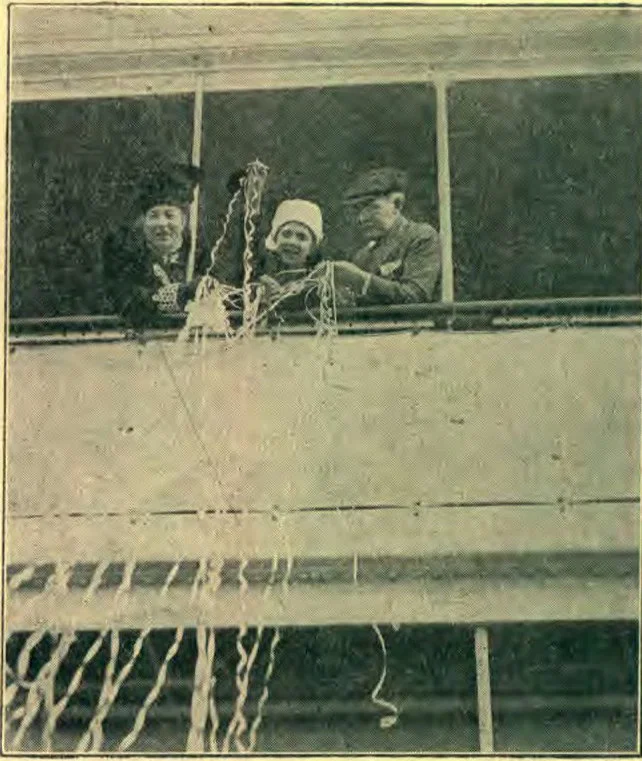
We heard no sound of reindeer or bells; we saw no traces of sleigh—or snow or land on which tracks might have been made. But all the juveniles and younger ladies found well-filled stockings on the morning of December 25. There was none of the accustomed sparkle of frost and snow; it was a warm, brilliant summer day. To us it was a sweetly solemn Sabbath day. The very newness and uncertainty of our own future seemed to draw us into closer touch with Him the beginning of whose earthly pilgrimage this day is meant to commemorate.
The usual words of good cheer and Christmas greetings, and the circulation among the passengers of the latest mail from home,—boxes marked to be opened on this day,—furnished an opportunity for interesting little visits with newly made friends, and to talk with them about the old, old story and what the birth and death of the Saviour really mean to us personally. It is surprising how “that wonderful redemption” draws hearts together.
A subdued excitement stirred the atmosphere. Sounds of hammer and saw were audible. Preparations were on foot for an elaborate entertainment in the evening. When, later, we saw the large stage draped with the big and beautiful Stars and Stripes, and otherwise attractively decorated, it was a pretty sight. Most of the program was what would naturally be expected from a theatrical troupe. We could scarcely identify the participants as our table mates and the ship’s crew. Doubtless they acted their parts well. It was said to be a great show. The music was wonderful. We remained up for only this and one other number, and did not go out to the minstrel show, though we did see the rotund galleyman, painted blacker than black, and with the silliest grin imaginable, his eyes glinting comically from the depths of a chuckle.
Mr. Snow was asked to furnish something for the occasion. Somehow, it did not seem the proper thing to celebrate Christmas with a minstrel show. It seemed that at such a time some one should speak for the Master and for the soberer significance of the day they were turning into a frolic. So, with the captain’s kind permission, he climbed to the highest point accessible to court the muse. Though of course his poem was not in harmony with the spirit of the rest of the entertainment, yet it was well received. The captain and the master of ceremonies thanked him for it, and they and ever so many others told us how much they enjoyed it.
The sea was rough that night, and the ship plunged and plunged, but Charles took as firm a stand as the boy is reputed to have done on the burning deck. These words from “The Lady of the Lake” comically flitted through my mind:—
“He mann’d himself with dauntless air, And firmly placed his foot before: ‘Come one, come all! this rock shall fly From its firm base as soon as I.’”
Above the hoarse roar of old Neptune, we could distinctly hear the following words:—

“Our Christmas Day

“Mayhap ’tis in God’s providence Our privilege should be To celebrate this Christmas day Out on the heaving sea. Some leaving friends and native land. Some faring homeward are. Each has his bitterness or joy, And each his guiding star.
“Far from the dread of war’s alarms, Or crack of hostile guns, Or scenes of desolation dire, Our day in smoothness runs. Here reigneth joy and hope and peace. Below, around, above, And arching over every head, The rainbow of God’s love.”
“Two thousand years have come and gone Since that glad natal day When in the humble manger crib The Prince of Glory lay. The wondering wise men knelt around, And humble shepherd folk To whom in glad angelic song The God of heaven spoke.
“How many millions of earth’s sons Have sunk beneath the sod Since angels first acclaimed His birth Who was the Son of God! And here tonight we meet upon This newest Christmas day, In memory of the Christ child there Who in that manger lay.
“Peace, peace on earth, good will to men. Was in that angel song, And in this life who toiled for men, And, toiling, did no wrong. He taught us how to live and serve, And nobler, truer be, E’en though the way he trod should lead To blood-stained Calvary.”
“All that he had he freely gave, All that he was, laid down, That man might rise from his defeat, And gain a victor’s crown. He fought that battle over sin For God, for you, for me; And won for us the right to live Through all eternity.
“They mocked and scourged that spotless Lamb, They nailed him to the tree; They shed his blood that bitter day On grim old Calvary. ‘Forgive them, Father,’ was his prayer; ‘They know not what they do;’ And so today in heaven above He pleads for me and you.
“’Twas not one spear alone that thrust His loving bosom through; That spear is in my hand today In every wrong I do. His heart is wounded by our sins, And he is crucified When I through wanton sinfulness My Saviour have denied.
“I see him toiling through the throngs That sore upon him press For healing and for comfort in Their sorrow and distress. He suffers in their suffering; Their misery he shares. No sorrow of the human race Can take him unawares.
“So now in every land and clime Men love that blessed name, And tell the beauties of that life And its undying fame. It tames the savage heart of man, It molds our lives anew, Puts love for hate, and joy for woe, Our whole life journey through.
“This Christmas day, this day of cheer, This birthday of the Christ, Men celebrate from year to year, A sacred, holy tryst. And yet in sore distress he bows,— So many have forgot The purpose of his sacrifice On that blood-sprinkled spot.
“’Twas not to fill the world with mirth And vanity and dross That he went up that cruel mount And perished on the cross. Through every fiber of his life God’s one great purpose ran,— To reconcile the race to God, And win the heart of man.
“This does our Christmas signify; And as the years go by We see the signs of his return, In earth, and sea, and sky. So let us keep this hallowed day, And yield to his control; Then share with him the bliss of heaven While endless ages roll.”
Mrs. C. M. Snow.
Continue reading: The 1917 Goal